Tag Archives: Adam Pagnucco

Meet the New Liquor Monopoly

By Adam Pagnucco.  

Meet the New Liquor Monopoly.  It’s the same as the Old Liquor Monopoly, except with less accountability.

OK, now that the applause is dying down, let’s look at the details.  The New Liquor Monopoly proposed by County Executive Ike Leggett would be a quasi-governmental authority rather than a county department.  It would have the same warehouse, the same equipment, the same trucks, the same ordering and billing systems, the same employees, the same front-line and middle management, the same union and – of course! – the same state-sanctioned monopoly status.  This is “change” that only a monopoly would love!

But wait.  There is one significant difference.  Under the current system, the Executive Director of the Department of Liquor Control (DLC) is a department director who serves at the pleasure of the County Executive.  Should the Executive become displeased with his or her performance, that person could be dismissed.  The County Council has a role (at least hypothetically) in holding DLC accountable through its power to approve DLC’s operating and capital budgets as well as any debt secured by liquor profits.

Those sources of accountability disappear in the New Monopoly.  The proposed authority would be governed by a Board, which would be nominated by the Executive and approved by the County Council, and that Board would hire a CEO.  The CEO would not report to the Executive.  The council would no longer have approval authority over the New Monopoly’s operating or capital budgets.  The New Monopoly would also have unfettered authority to issue debt.  Here’s a question, folks – what do you think will happen to liquor prices if the New Monopoly screws up and takes on too much debt?  Pish posh – it’s not like the existing Monopoly has ever screwed up, yeah?

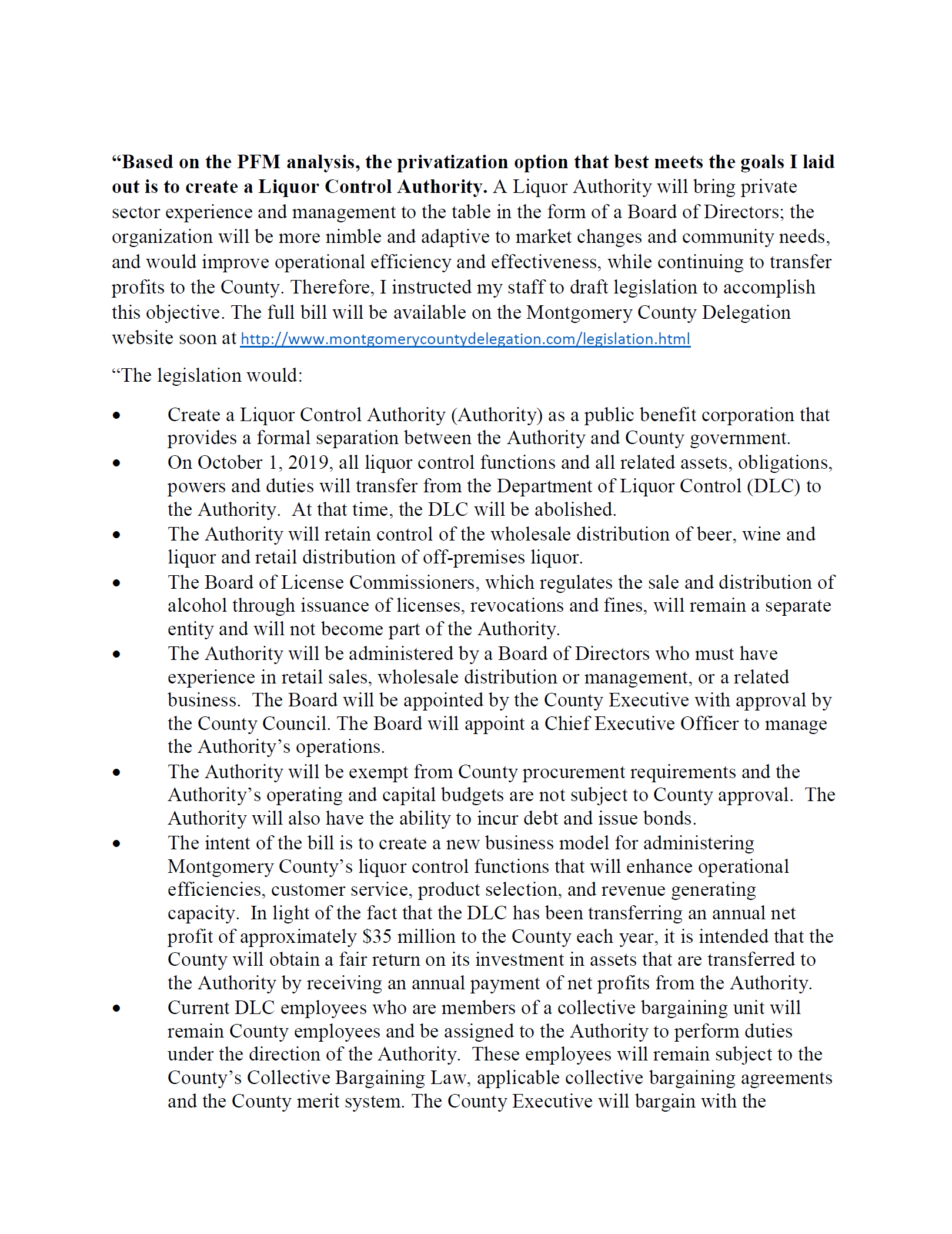
We know you can barely contain your excitement.  Here is the County Executive’s statement so you can absorb all the dirty details!

exec-statement-1

exec-statement-2exec-statement-3At first glance, the New Monopoly is little different from the Old Monopoly.  From top to bottom, it is the same entity in terms of capital, labor and processes.  But this new beast could be much more dangerous than the old one.  It is neither accountable to its customers nor to elected officials.  In fact, it is accountable to no one at all.

Folks, it’s time for brutal honesty: our county government has failed us.  The liquor monopoly’s problems have been apparent since the first year of the current County Executive’s first term.  For nine long years, the county did nothing as the monopoly continued to get worse, culminating in the epic 2015 New Year’s Eve disaster.  Thousands of consumers and licensees signed a petition to End the Monopoly and residents even voted for term limits in part due to fury over DLC.  And what do we get?  A proposal for Endless, Unaccountable Monopoly.

We, the residents and business owners of this county, have not been heard.  Our demands for freedom have been subjugated to the crushing burden of alcohol totalitarianism.  There is only one thing left to do.

Vote for candidates who will End the Monopoly in the next election.

Share

MoCo Revolts

By Adam Pagnucco.

In a thundering rebuke to Montgomery County’s governing establishment, voters have passed term limits by a 38 point margin with early votes and election day votes counted.  Folks, let’s call this what it is.

A Revolt.

This year will see one of the largest electorates in Montgomery County history.  While the absolute number of voters may be declining in our mid-term elections, it has been steadily rising in presidential general elections.  County residents voted overwhelmingly for Hillary Clinton over Donald Trump (by 54 points as of this writing).  But they also voted for term limits despite the fact that most county voters are Democrats and all county elected officials are Democrats.  This year was reminiscent of the 2008 general election, during which MoCo voted for Barack Obama by 45 points but also approved Robin Ficker’s charter amendment restricting property tax hikes by just 5,060 votes.  This demonstrates the capacity of county voters to keep national issues and local issues separate when they so desire.  The big difference between 2008 and now is that the margin of term limits’ passage was so titanic that it’s possible that half of all Democrats voted for it.

The scale of this upheaval is virtually unprecedented.  Sure, County Council incumbents have been defeated here and there and a sitting County Executive was beaten in 1990.  But the voters voted against all the incumbents this year, or at least put an expiration date on their services.  To find something comparable, you would have to go back to 1962, when five of seven Council Members were ejected, and 1966, when six Council Members were defeated.

Former County Council Member Steve Silverman astutely characterized term limits supporters as “a convergence of strange bed-fellows.”  County employees upset about reduced raises, business people unhappy about what they see as an unfriendly business climate, residents opposed to new master plans with more density, Republicans and unaffiliated voters angry about being marginalized, opponents of the county’s liquor monopoly, people upset about the recent Giant Tax Hike and nanny state laws, and those who genuinely regard term limits as facilitating good government came together as they never have before.  As David Lublin wrote, these groups may have had incompatible visions of what county government should be, but all of them believed the way to get there was to get rid of the incumbents.

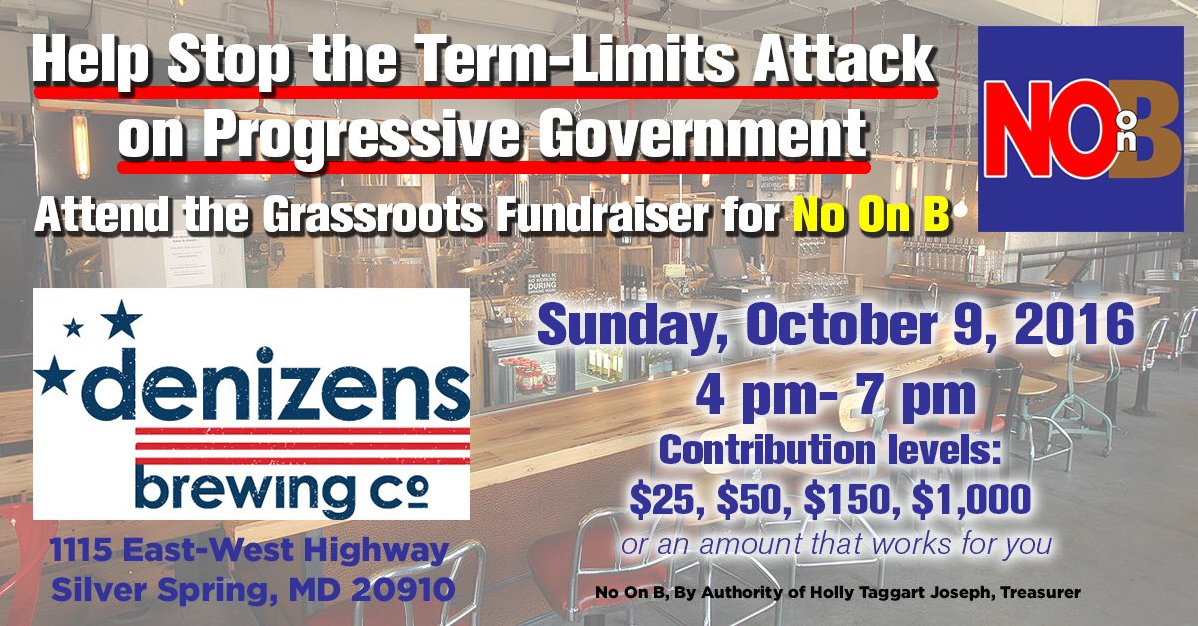
Term limits opponents made two primary arguments.  First, they described term limits as “an attack on progressive government.”  This had the effect of making the term limits question a referendum on current county elected officials, a perspective actually shared by many supporters.

term-limits-opposition-fundraiser

And second, they tried to make term limits toxic by emphasizing their support by figures like Donald Trump, Robin Ficker and Help Save Maryland.

term-limits-trump-ficker

That strategy didn’t work for two reasons: the opponents were vastly under-funded as they were going uphill and the message itself was not calibrated for a general electorate that is less liberal than Democratic primary voters.  Social media proved to be the weapon of choice for both sides, and in terms of Facebook likes, supporters outgunned opponents by a ratio of 13-1.  Opponents were counting on the Democratic sample ballot and the Apple Ballot, both opposing term limits, to win.  But whereas the sample ballot is often mailed to all county Democrats, this time around it was mailed only to those who had newly registered.  And the teachers union did not supplement its Apple Ballot poll coverage with multiple mass mailings as they do in mid-term years.  Accordingly, the impact of both ballots was blunted.  Opposition organizer Tom Moore made a valiant effort, but this was an unwinnable campaign from the start.

To be fully understood, this year’s vote must be put into the context of recent history.  Since 2008, county voters have decided four major ballot questions and each time they took what was arguably the less progressive position.  Put those four votes together and here is the message from the voters:

We don’t want more property taxes.  We don’t want more government fees.  We don’t want a labor union running the police department.  And even though most of us are Democrats, we are telling the Democrats who run the county government that twelve years in office is long enough.

This is pretty much the opposite of the long-standing posture of the county’s political establishment.  And it’s not just coming from flakes, fanatics and fringe types like Robin Ficker and Help Save Maryland – it’s coming from a majority of county voters.  If there was ever a moment for the governing class to do some soul searching, this is it.

Opponents of term limits may be right about one thing – they may change the names of elected officials, but not the type of them.  Democrats, often very liberal ones, will continue to be elected because of our closed primary system.  But the combined message of the last four ballot questions imposes a hard choice on the elected officials of today and tomorrow.  They can try to balance the interests of various constituencies across the political spectrum at the possible cost of losing the progressive support that influences Democratic primaries.  Or they can stay the course and watch more moderate general election voters pass even more restrictive ballot questions, including perhaps the ultimate bane of progressivism – a hard tax cap.

Share

MoCo Solicits for Liquor Monopoly Propaganda Video

By Adam Pagnucco.

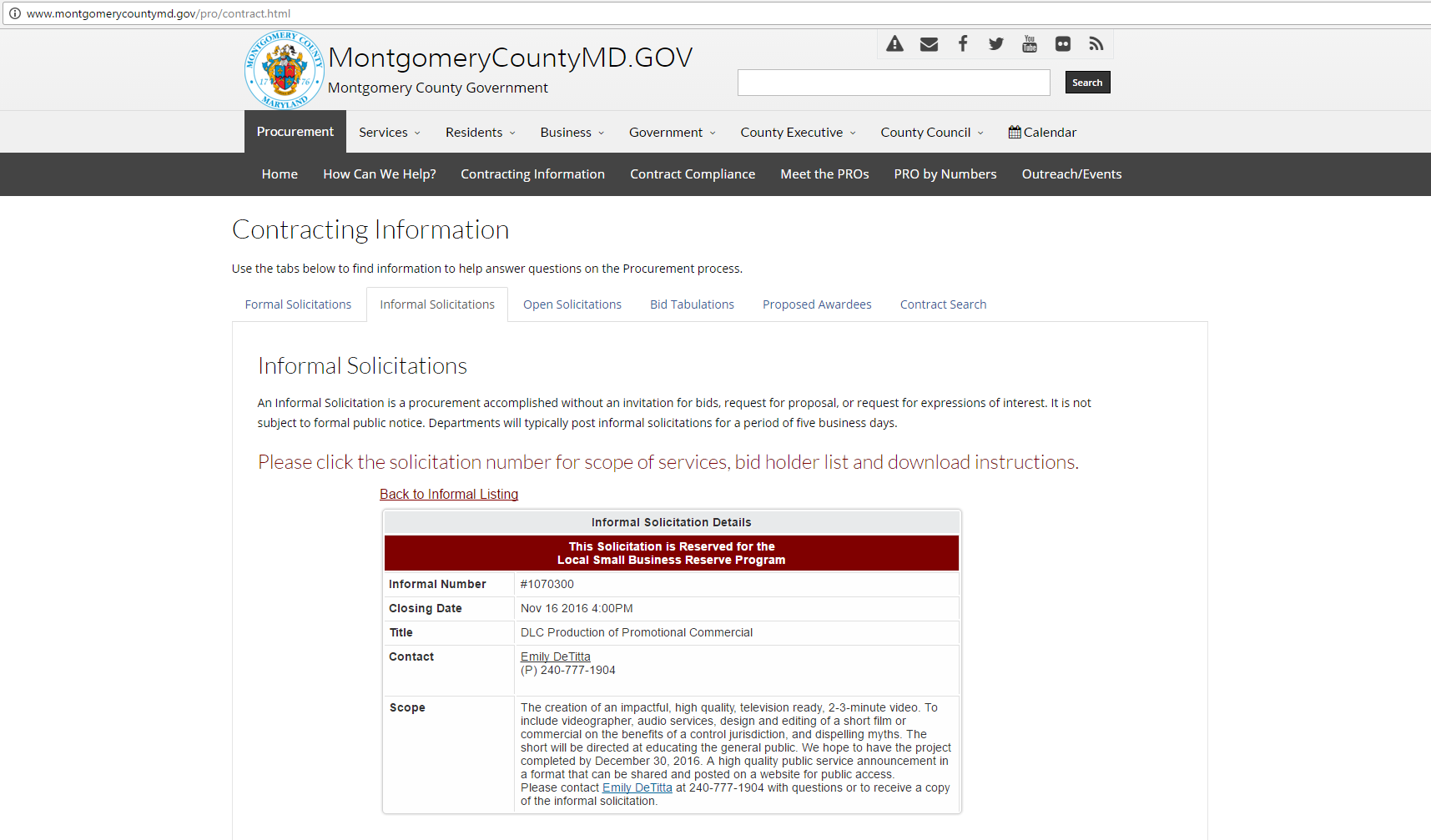
The Montgomery County Government has issued a solicitation seeking bids on a propaganda video defending the county’s liquor monopoly.  The solicitation comes after the County Executive’s task force on the issue concluded its meetings with (so far) no apparent resolution.

The informal solicitation, captured in a screenshot from the county’s website below, invites companies in the county’s Local Small Business Reserve Program to bid on an opportunity to create a video about the Department of Liquor Control (DLC).  The solicitation describes the project scope as, “The creation of an impactful, high quality, television ready, 2-3-minute video. To include videographer, audio services, design and editing of a short film or commercial on the benefits of a control jurisdiction, and dispelling myths. The short will be directed at educating the general public. We hope to have the project completed by December 30, 2016. A high quality public service announcement in a format that can be shared and posted on a website for public access.”

video-solicitation

This is not the first time the county has used public resources to spread political propaganda supporting the liquor monopoly.  Last January, the county distributed flyers defending DLC at county liquor stores while the county’s state legislators were debating its fate.  The flyer distribution ended shortly after it was exposed by Fox 5.

The cost of the video will not be known until a bid is accepted, although the solicitation’s fine print states that it cannot exceed $25,000.  The cost of distribution could be much more, especially if the county runs the video as an ad on private television channels.

All of this comes after the county’s state legislators, who have purview over DLC since it is established in state law, asked the County Executive last year to consider various models of liberalizing the liquor monopoly.  The Executive agreed and convened a task force to study various options, but the task force’s three meetings ended without a visible result.

With this solicitation, the county appears to be digging in to defend the monopoly despite its massive failures and the protests of thousands of residents against it.  The liquor monopoly is one of several reasons why MoCo residents voted for term limits and yet the county is staying the course.

Will they ever learn?

Share

MoCo’s Two Electorates, Part Three

By Adam Pagnucco.

Part Two presented a host of demographic data comparing Democrats who voted in all three of the 2006, 2010 and 2014 primaries (“Super Dems”) to voters from all parties who voted in both of the 2008 and 2012 general elections (“Super Generals.”)  Let’s compare the two groups more concisely below.

In summary, when compared to Super Dems, Super Generals are more likely to:

  1. Be age 29 or younger.
  2. Be ages 30-39.
  3. Live in Clarksburg.
  4. Live in Damascus.
  5. Live in Germantown.
  6. Live in Council District 2.
  7. Live in Legislative District 39.
  8. Live in precincts that are 25% or more Asian.
  9. Live in Legislative District 15.
  10. Live in Montgomery Village.

When compared to Super Dems, Super Generals are less likely to:

  1. Be ages 70-79.
  2. Be age 80 or older.
  3. Live in Takoma Park.
  4. Live in Chevy Chase.
  5. Be ages 60-69.
  6. Live in Legislative District 20.
  7. Live in Bethesda.
  8. Live in Kensington.
  9. Live in Legislative District 18.
  10. Live in Council District 5.

The above items are ranked in order of likelihood.  So for example, the biggest difference between the two electorates is in age, but that is far from the only difference.

Super Dems are mostly from Downcounty, tend to be seniors or close to it, have a lot of voting history and may be majority liberal.  They elect MoCo’s county officials and state lawmakers, who tend to be responsive to them.  Super Generals are geographically diverse, younger in age, have less voting history and are much more diverse ideologically.  Liberals probably do not account for a majority of Super Generals.  It is the Super Generals, not the Super Dems, who decide charter amendments and ballot questions, including this year’s amendment on term limits.

Two more facts are relevant to Super Generals.

First, on the last three major county ballot questions, the general electorate voted in favor of stricter limits on property tax hikes, against the ambulance fee and against broad collective bargaining rights for the police union.  These were arguably the less progressive positions on all three questions.  If these questions were submitted only to Democratic primary voters, they may all have had different outcomes.

Second, a Washington Post poll in September found that MoCo voters from all parties together gave Governor Larry Hogan a 66% job approval rating.  This was not significantly different from the Governor’s statewide approval rating of 71%.  It’s hard to imagine a majority progressive electorate approving of an anti-tax GOP Governor to that extent, but this is further evidence that liberals may not in fact be a majority of MoCo voters.

Term limits is the issue of the day and will be decided soon enough.  But a broader question looms.  Given the differences between MoCo’s Two Electorates, what happens when elected officials cater to one of them at the heavy expense of the other?  The recent large property tax hike, which was spread all across county government, was aimed at the priorities of liberal Democratic voters.  It also became the core of the push for term limits which is aimed at the general electorate.  This suggests a need for balance and restraint by those running the government.  Because if one of the two electorates feels unheeded, either one has the tools to strike back – either by unseating incumbents or by shackling them with more ballot questions and charter amendments.

Share

MoCo’s Two Electorates, Part Two

By Adam Pagnucco.

In Part One, we began contrasting MoCo’s Two Electorates: namely, the Democratic primary voters who pick our elected officials, and the general election voters who decide charter amendments and ballot questions.  Today we present new data on the two electorates from the voter file.

We have integrated the January 2015 voter file available from the county’s Board of Elections with a variety of U.S. Census demographic data to analyze two groups of MoCo voters.  The first group, whom we call “Super Dems,” are those Democrats who voted in all three of the county’s 2006, 2010 and 2014 primaries.  The second group, whom we call “Super Generals,” are those voters from all parties who voted in both the 2008 and 2012 presidential general elections.  We would have also included 2004 voters if we could have, but the voter file doesn’t go back that far.  Presidential general election voters are relevant to this year, which is also a presidential year in which term limits are on the ballot.

Let’s look at a few demographics for Super Dems and Super Generals.

Party Affiliation

party-affiliation-two-groups

Super Dems are, of course, 100% Democrats.  Super Generals are 60% Democratic, 21% Republican and 18% others (most unaffiliated voters).  This matches the distribution of general election votes referenced in Part One.

Gender

gender

Both groups are majority female, with women being a slightly higher share of Super Dems.

Age

age

Super Dems skew towards seniors, with an average age of 64.  Super Generals are much more diverse on this measure, with an average age of 55.  While 19% of Super Generals are below age 40, only 3% of Super Dems are.  And while 63% of Super Dems are age 60 or older, only 39% of Super Generals are.  This means that while young voters are a meaningful voting bloc in general elections, they generally are not in MoCo Democratic primaries.  The difference in average date of voter registration in the county further emphasizes the deeper roots Super Dems have in MoCo than Super Generals.

Average Household Income

average-household-income

This is not a significant differentiator between the two groups, although this data masks real differences in residence geography.

Residence Type

residence-type

This is also not a significant differentiator.  Both groups overwhelmingly live in single family homes and a big majority of them are probably home owners.

Location of Residence

location-of-residence

Super Dems are more likely to live in Downcounty locations like Takoma Park, Chevy Chase, Bethesda, Kensington and Silver Spring while Super Generals are more spread out, including in Upcounty communities like Clarksburg, Damascus, Germantown and Montgomery Village.  This has ideological implications.  In this year’s Congressional District 8 primary, the very progressive Jamie Raskin ran up his biggest margins inside and near the Beltway, while the more moderate David Trone did best in northern areas.

District of Residence

district-of-residence

Once again, the geographic split between the two groups is obvious.  Fifty-four percent of Super Dems can be found in the two liberal strongholds of Council Districts 1 and 5, while Super Generals are more geographically balanced.  This may help explain why three of four At-Large Council Members come from Takoma Park.

Precinct Demographics

precinct-demographics

Race and ethnicity are not available from voter registration data, but we can examine those factors for the precincts in which voters live.  By this measure, Super Generals appear to be slightly more diverse than Super Dems.  This suggests a need for more outreach to people of color by the Democratic Party, which should be their natural home.

We will conclude in Part Three.

Share

MoCo’s Two Electorates, Part One

By Adam Pagnucco.

Montgomery County voters are some of the most progressive people in the nation.  They elect only Democrats, and almost all very liberal ones.  They celebrate diversity and respect civil rights.  They support a large, active government that passes liberal laws, provides excellent schools and generous social services and has extensive environmental programs.  Perhaps most importantly, they are willing to pay the taxes that support all of this.

Is the above a true statement?  Yes.  And maybe no.  It all depends on which electorate you’re talking about.  Montgomery County has two of them.

The first electorate is comprised of those Democrats who vote in the closed primaries for County Executive, County Council and members of the General Assembly.  Many of these are liberals who vote for candidates with similar views.  Indeed, there is an old aphorism that it’s nearly impossible to run too far to the left in MoCo elections.  Most elected officials here regard these voters as their political base and tend to be highly responsive to them.

But there is a second electorate: those residents who vote in general elections.  These voters come from all political parties and have significant ideological diversity.  For the most part, they tend not to reject the nominees of the Democratic Party for local and state office.  (The last Republican elected officials here were defeated ten years ago.)  But they can and do weigh in on charter amendments and ballot questions, and they do not always behave in accordance with the county’s progressive reputation.

This blog series examines the differences between these two electorates on the eve of the general election, when a landmark ballot question on term limits will be decided.  Of the two electorates, only one – the general election voters – will decide whether term limits will pass.

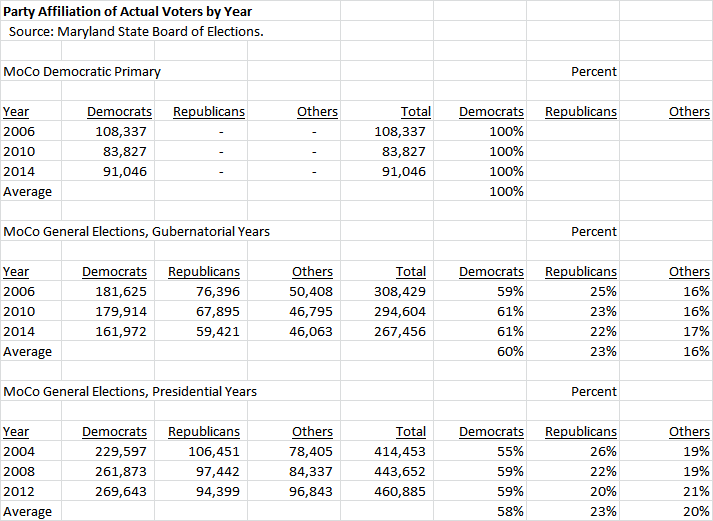
First, we examine the party composition of the two electorates.  The Democratic primary voters are of course 100% Democrats since Maryland uses closed primaries.  The general election voters are roughly 60% Democratic, slightly more than 20% Republican and slightly less than 20% unaffiliated or members of other parties.

party-affiliation

Are liberals a majority of the general electorate?  That’s hard to say, but a little math can help.  If just a fifth of the Democrats, who comprise 60% of general election voters, are not liberals, then a majority of the general electorate would probably not be liberal.  (There are a handful of Green Party members in MoCo, but not enough to change the basic math here.)  So while a majority of Democratic primary voters may be liberal, it’s difficult to apply that characterization to the entire electorate.

Another factor that can be easily seen from the data above is the relative size of the electorates.  There are about three times as many voters in gubernatorial general elections as there are in gubernatorial Democratic primaries.  Presidential general election voters outnumber gubernatorial primary Democrats by five to one.  So while Democratic primary voters pick our elected officials, the presidential general voters are a much closer gauge of the political sentiments of the entire community.

We will begin contrasting MoCo’s two electorates in Part Two.

Share

A Critical Error in Early Voting

By Adam Pagnucco.

On Saturday, I was given a ballot by election officials at the Wheaton early voting site that would have allowed me to vote for John Sarbanes for Congress.  The problem is that I live in Jamie Raskin’s district.  And after I posted the story on Facebook, three friends of mine said that similar things happened to them.  This incident points to a significant flaw in the early voting system that needs to be addressed.

To understand what happened, let’s review how the early voting system works.  A key difference between early voting and election day voting is that voters are allowed to use any early voting site in their county regardless of where they live.  So unlike election day voting at a precinct location, election officials at early voting sites are responsible for making sure that voters get ballots reflecting the districts in which they live.

The first step in early voting is a check-in, during which a staffer verifies a voter’s identity and gives the voter a registration slip indicating his or her precinct and district information.  Next, the voter proceeds to a table at which another staffer checks the registration slip and gives the voter an appropriate ballot.  The voter then fills out the ballot in a booth and proceeds to a scanning device, where the registration slip is collected and the ballot is inserted, scanned and retained.  Lastly, the much-desired “I Voted” stickers are disbursed.

In my case, I checked in, got a registration slip reflecting my information accurately and was given a ballot.  When I started marking the ballot, I noticed that one of my choices for Congress was John Sarbanes.  That was a problem since I don’t live in his district – I live in Congressional District 8, home of Jamie Raskin.  I returned to the ballot table and told them I had the wrong ballot.  Upon checking, the election staffer said, “Good catch,” gave me a new ballot and told me to take my old ballot to a different area.  Acting on instructions, I marked the old ballot as spoiled, folded it in half and put it in an envelope containing other spoiled ballots.  I asked the election staff what would have happened had I indeed voted for Sarbanes.  They said they didn’t know.

Once I told the story on Facebook, two of my friends told me that they were initially given the wrong ballots by staffers at early voting, but the mistakes were caught before they could bring the ballots to the voting booth.  A third friend said she was given a wrong ballot and, like me, she returned it to the staff to get a correct ballot.  This latter incident happened during the primary.

These were honest mistakes, and whenever human beings are involved in a process like this, mistakes happen.  The problem from a systemic perspective is that there is insufficient redundancy built in to prevent and correct these mistakes.  Once the ballot staffer gives a voter a ballot, there is no person other than the voter who can make sure that the ballot is the correct one.  By the time the voter approaches the scanner, there is no way to be sure that the ballot accurately reflects that voter’s districts.  And when the ballot is scanned, it’s too late to tell because there is nothing on the ballot itself identifying the precinct of the voter who cast it.  For all anyone knows, that ballot is accurately counted.  A paper recount would not find otherwise.  Worst of all, there is no way to track these mistakes.  Unless people like me report their experiences, it would be hard to know that this problem is occurring at all.

The result of all this is that an unknown number of ballots are being cast for candidates by voters who do not live in their districts.  The scale of that problem is mitigated somewhat because this is a presidential year, and the only variability in this county’s ballots occurs between the three Congressional Districts.  But in a mid-term year, there will be elections in five County Council districts and eight state legislative districts in addition to the three Congressional Districts.  There will be many ballot permutations reflecting voters who live in different configurations of these districts.  So the potential for mistakes is much higher.  Relying on individual voters to prevent these mistakes is not an adequate solution.

It’s too late to correct these errors for the ballots already cast, and unless election officials act immediately, it may be too late to clean up the process for this election.  But there is time to build safeguards into the system for the 2018 elections, during which the issue will be even more critical.  The State Board of Elections and their overseers in the General Assembly need to make sure that this problem gets fixed.

Share

Leventhal Blasts the Dumbest Lobbying Campaign of All Time

By Adam Pagnucco.

On the evening of October 20, a representative of Clark Enterprises (Bob Eisenberg) appeared before the Montgomery County Council to testify on the Downtown Bethesda Master Plan.  Clark has been involved in a dispute with its next-door neighbor, fellow developer Brookfield Properties, over Brookfield’s plan to erect a new building on top of the Bethesda Metro Station.  Clark hired PR firm KOFA Public Affairs to wage a campaign to block the new building that accused Council Members of being tools of developers and criticized their salaries.  Accordingly, we labeled it “The Dumbest Lobbying Campaign of All Time” since even dimwitted lobbyists understand that elected officials don’t respond well to attacks on their integrity.

Above is the reaction of Council Member George Leventhal to KOFA’s insult-laden campaign.  Hide the children, folks!


Share

Term Limits Opposition in Shambles

By Adam Pagnucco.

With the challenge to Robin Ficker’s petition signatures having failed in court, the opposition to term limits has hit a new low.  Opponents have less than three weeks left and over 400,000 prospective general election voters to reach.  Tick tock says the clock.

How do you win on term limits?  Here’s a theory: voters will vote in accordance with their perceived self-interest.  Whoever wishes to sway them must address their self-interest and take account of how they see it.  Failure to do so means losing the argument.

So far, the opponents’ arguments against term limits seem to be that they are unfair to elected officials, that Robin Ficker is a baaaaad man (he is), that county Republicans favor them, that nativist extremists were involved in gathering petition signatures (they were), that Nancy Navarro would be denied three full terms under Ficker’s language, that Donald Trump favors term limits and that term limits supporters are like Brexit supporters.

Well, OK.  But what do any of these arguments have to do with the voters’ self-interest?

And then this happened.

“Oh wait a minute.  Never mind, voters.  Forget about what we told you.  We are going to court so you won’t be able to vote!  What’s that?  You will be voting after all?  Oh.  Well, remember what we were saying…?”

Adding to the above is that most prominent opponents of term limits have a personal self-interest in the issue.  Several incumbent Council Members have spoken publicly against them.  Tom Moore, the opponents’ organizer, is a former Rockville City Council Member who ran for County Council in 2014 and might do so again.  Almost all of the scanty funding for the anti-term limits committee came from Council Members, their staff, their family and a non-profit receiving county money.  Are there any non-politicians (aside from Charter Review Commission Chair Paul Bessel) who are willing to work to defeat term limits?

Ficker, on the other hand, does have a narrative aimed at voters.  His sales pitch is that, according to him, current elected officials are “self-serving” by awarding themselves large salary increases and voting for big tax hikes filled with goodies for interest groups that help them get reelected.  The costs of all this are passed on to taxpayers.  Ficker proposes breaking this cycle by instituting term limits and getting new people elected with “fresh ideas.”  Put aside for a moment that there are numerous problems with his theory, including that there is already substantial competition in county elections and that the 2014 public financing law could promote even more competition.  Ficker is speaking directly to the pocketbook interests of voters while the other side is currently not.

Right now, all the momentum is with term limits supporters as many factors are working in their favor – especially the council’s Giant Tax Hike.  Opponents are going uphill, with a tremendous amount of work to do and very little time.  At this point in the 2000 term limits battle, legendary Duncan operative Jerry “Darth Vader” Pasternak had put together a massive coalition to fight Ficker, and the opponents ultimately won by just eight points.  In contrast, little of this work appears to have been done this time around. The opponents’ Facebook page has just 69 likes (FAR less than the 4,699 likes on Ficker’s page) and there is no money for a mail budget.  The opponents are relying on the Apple Ballot, the Democratic sample ballot and prayer.  Compare this to the 2000 effort, during which Darth Pasternak’s Empire did at least three mailings plus 130,000 robocalls.

Paul Bessel’s scholarly dissertation on term limits is helpful, but is anyone other than a handful of insomniac college professors going to read it?  Opponents need a direct, relevant message.  Something like this:

Come on, voters!  Is it really in your self-interest to disenfranchise yourselves?  Do you want to prevent yourselves from reelecting an official whom you believe is doing a good job?  Do you benefit from a government that is run by bureaucrats and lobbyists?  Do you really think a County Council jam-packed with lame ducks is going to act on your behalf?  What exactly are YOU getting out of all this?

There’s nothing here about Ficker, Help Save Maryland, Trump or Brexit.  It’s about the voters, stupid!  Just like it’s supposed to be.

Term limits opponents need message, resources and scale – and they need those things yesterday.  Because at this moment, Ficker is on pace to win, perhaps by double digits.

Share

Council Members Circle the Wagons on Term Limits

By Adam Pagnucco.

The No on B Committee, the ballot question committee opposing Montgomery County term limits, has filed its first campaign finance report with the State Board of Elections.  There are no surprises here: most of the contributions it has raised have come from incumbent members of the Montgomery County Council.

The committee reported raising $9,125 through October 9.  Of that amount, $6,000 (66%) has come from the campaign accounts of Council Members.  George Leventhal  was the lead contributor, donating $1,500.  Roger Berliner, Sidney Katz, Nancy Navarro and Hans Riemer contributed $1,000 each while Marc Elrich contributed $500.  Other contributions of note came from George Leventhal’s father, Carl ($500), Marc Elrich’s Chief of Staff, Dale Tibbitts ($500) and Casa de Maryland ($1,000).  In total, contributions from Council Members and their staff accounted for 72% of money raised by the committee.

After paying attorney Jonathan Shurberg $5,000 for his work on the unsuccessful court case to get term limits thrown off the ballot, and paying other minor expenses, the committee reported a final balance of $4,024.49.

Another committee formed to support term limits, Voters for Montgomery County Term Limits, reported raising $2,890 and finishing with $2,683.27 in the bank.  Developer Charles K. Nulsen III contributed $1,000.  There have been rumors of developer support for term limits, which would be interesting considering that the anti-development Montgomery County Civic Federation also supports term limits.  But Nulsen’s lone contribution signals that so far the real estate community is not fully engaged.

In 2012, 460,885 MoCo residents voted in the general election.  A similar number could be voting this year.  What’s clear is that neither committee has the resources to get its message out to the electorate.  Since many underlying factors favor the passage of term limits, the failure of both sides to raise money is a net benefit for supporters.

Share