Tag Archives: Adam Pagnucco

Trone Running Ads on Twitter

By Adam Pagnucco.

A Seventh State reader sent us a screenshot of a Twitter ad run by Total Wine co-owner and former CD8 Congressional candidate David Trone in the early hours of March 16.  The reader does not follow Trone’s account and the term “promoted” at the bottom of the screenshot clearly indicates its status as an ad.

Trone is known to be considering a future candidacy.  He told Bethesda Magazine’s Lou Peck that he is “focused very heavily right now” on looking at a race for Montgomery County Executive.  He has polled on the race at least once and says openly on his website that he is exploring it.  The Twitter ad joins this evidence to suggest that Trone could very well be on the ballot again.

Share

Hell No!

By Adam Pagnucco.

A state commission charged with examining changes to Maryland’s public school funding formulas is sifting through recommendations for improvement.  And in the early deliberations, one big loser stands out:

Montgomery County.

The State of Maryland is a major player in public schools funding.  In FY17, the state will send $5.5 billion in operating aid to local school districts, about a third of its general fund budget.  MCPS gets 28% of its operating budget from the state.  Prince George’s County Public Schools gets 57% of its budget from the state.  In total, state aid accounts for 48% of Maryland public school budgets.

The state’s generous K-12 spending is driven by formulas dating back to 2002, when a state commission led by Howard University professor Alvin Thornton (commonly known as “the Thornton Commission”) proposed massive new investments in education.  These investments have helped rank Maryland’s public schools among the nation’s best.  Now another state commission chaired by former University of Maryland System Chancellor William E. Kirwan is reexamining the state’s funding formulas to see if they can be improved.  And here is where things are starting to go badly wrong for MoCo.

A consultant paid by the Maryland State Department of Education recently completed a two-year study on the state’s funding formulas.  In the interest of promoting “adequacy” in public school spending for students across the state, the consultant made several recommendations for changing the funding formulas which are now being examined by the Kirwan Commission.  One of them is that Montgomery County should get a 63% cut in state aid (a reduction of $354 million) while local taxpayers should pay 60% more (an increase of $842 million) towards MCPS.  Montgomery County Council Member Craig Rice, a member of the commission, said “that would be devastating” and termed the suggested local dollar increase for MCPS “impossible.”  Indeed, the County Council just levied a 9% increase in property taxes in part to increase funding for MCPS.  The consultant’s recommendations don’t just apply to MoCo: they would phase out all state aid for schools in Kent, Talbot and Worcester Counties while sending massive increases to St. Mary’s, Harford, Charles, Calvert and Prince George’s.

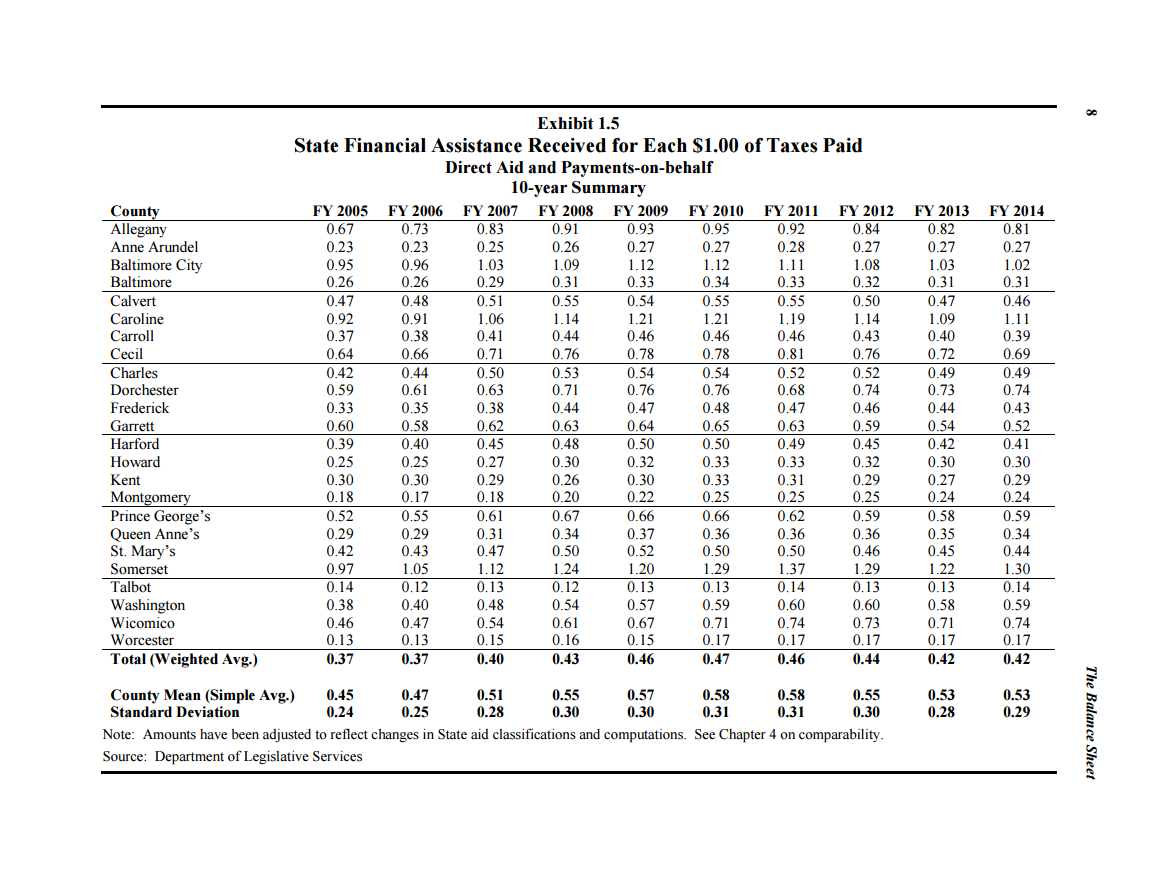
MoCo is already short-changed on state aid because of wealth formulas that disadvantage the county because of its high property values and high incomes but don’t recognize its high cost of living.  The result is that MoCo taxpayers get back just 24 cents for every dollar in taxes they pay to the state.  The state average for all residents is 42 cents.  Howard County, which has a higher average household income than MoCo, gets 30 cents.  Only Talbot and Worcester Counties get back proportionately less than MoCo.  If anything resembling the consultant’s report winds up being recommended by the Kirwan Commission and passed into state law, this imbalance will get a lot worse.

Your author has been told that the report is merely a “conversation starter” and thus is irrelevant.  But we are reminded of the last conversation the state had about public school funding.  For decades, the state covered the cost of teacher pensions as part of its commitment to K-12 education.  The program was particularly valuable to MoCo, which has higher teacher compensation costs than other jurisdictions because of its high cost of living.  A decade ago, state leaders began to have “conversations” about having the counties pay these costs despite the fact that Boards of Education, not county governments, set teacher compensation packages.  A spokesperson for the Speaker of the House said it was “a philosophical argument that we definitely need to have.”  In 2010, almost all MoCo state legislators promised to oppose a shift in their election campaigns.  But just two years later, Governor Martin O’Malley proposed a partial pension funding shift, backed by both the Speaker and the Senate President, and most MoCo lawmakers voted to support it.  The cost of the shift to the Montgomery County Government increased steadily from $27 million in FY 2013 to $59 million this year, with $6 million offset by the state.  This far exceeds the cost to any other local government and is more than a third of the amount collected by the county’s recent 9% property tax hike.  The county government now pays more for teacher pensions than it does for libraries, recreation, courts, IT, housing or environmental protection.  Its teacher pension payments easily swamp any money earned from the liquor monopoly, which will return $21 million to the general fund this year.

So goes these conversations.  Now that this new conversation has started, here is a suggested response from all of our state legislators and county leaders to this consultant’s report.

HELL NO.

Share

Give Kathleen Matthews a Chance

By Adam Pagnucco.

Former WJLA anchor and Congressional District 8 candidate Kathleen Matthews has been picked as the Interim Chair of the Maryland Democratic Party.  And as someone who was asked to run by the party’s senior elected leadership – namely, U.S. Senators Ben Cardin and Chris Van Hollen and Representative Steny Hoyer – she seems likely to be named the four-year Chair as well.  That has set off a round of protest among some liberals in the party, with echoes of last year’s primary battles.

Two comments are noteworthy.  First, former Montgomery County Council Member Valerie Ervin said that Matthews’s appointment “missed an opportunity to open up the space for a new and different kind of leadership.”  That was essentially the rationale for the U.S. Senate campaign of Ervin’s good friend, Donna Edwards.  Second, Maryland Matters columnist Josh Kurtz blasted Matthews as “an especially thin reed” and “the wrong candidate at the wrong time” who could not connect with either progressives or Hogan voters.

In evaluating these criticisms, it’s worth contemplating just how much trouble Maryland Democrats are in right now.

  • Governor Larry Hogan has rung up a string of job approval ratings of 60-70% or more, including majority approval in some polls among Democrats. He is on pace to raise tens of millions of dollars for his reelection campaign.  He is absolutely dominant in social media.  And he is only seven GOP votes away from having his vetoes sustained in the House of Delegates.  If Hogan returns to Annapolis with enough Republicans to support his vetoes, Maryland will have a real two-party state government.
  • Outside Annapolis, the Democrats’ hold on county offices has collapsed since the 2002 elections. The Democrats are almost extinct in most of Western Maryland, the Eastern Shore and Harford County.  The Republicans firmly control Anne Arundel and are competitive in Baltimore County.  The Howard County Executive is a Republican.  The Democrats dominate in Baltimore City, Montgomery, Prince George’s and Charles.  That’s about it.
  • The Maryland Democratic Party apparatus has degraded. It could not help Anthony Brown get elected Governor in 2014.  Some local parties complain about lack of support.  The party’s federal receipts in the 2016 cycle ($2.8 million) were the lowest in any two-year cycle since 2004.  The party’s state-level account raised just $6,650 last year, about one-eighth of what the Republicans raised.  There is little in the way of an aggressive communications program on the Governor’s record in office.  Individual Democratic state legislators complain about issues like Hogan’s Facebook page and his executive order on Labor Day, neither of which will result in electoral harm to the Governor.  The party lacks a battle plan for taking on the Governor other than associating him with Donald Trump.  It needs a plan, and fast.

Enter Kathleen Matthews.  As a candidate in CD8, she did a lot of things right: raising money, getting the Washington Post endorsement and running a competent, professional campaign.  She lost because she did not have David Trone’s money, did not spend ten years building a grassroots base like Jamie Raskin and did not sufficiently address local issues.  Since the campaign, she has played a key role in helping women run for office through Emerge Maryland, unquestionably a hugely important exercise in the Era of Trump.  Let’s recognize that unlike many other losing candidates who disappear after the election, Matthews has remained engaged.

Some of the criticisms of Matthews relate to her positions and conduct as a candidate.  But Matthews is not going to be a candidate for government office if she is Chair of the party.  Other people will run for Governor, state legislature and county office and they will face the judgment of the voters.  As Chair, Matthews’s job will be to raise money and rebuild the party’s communication and field capabilities.  She is as plausible a choice as anyone to accomplish those tasks.

Consider this.  One of the most effective techniques of political communication is story-telling.  Imagine a video interview with a Baltimore City teacher or family affected by Hogan’s cuts to city schools.  Or an interview with a provider of developmental disability services who would earn fast food industry wages under Hogan’s budget.  Or a profile of a family who would lose Affordable Care Act health insurance coverage while Hogan stands idly by.    Or a story about a positive initiative from a local Democratic elected official fixing a problem for constituents.  Imagine a mass email and social media program spreading these pieces to hundreds of thousands of voters.  Who in the entire state party is better suited to this kind of video story-telling than Kathleen Matthews?

Of course, we’re the Democrats.  We often fight harder against each other than against Republicans.  We could criticize Matthews as not liberal enough, not working class enough or not local enough.  We could keep fighting the Bernie vs Hillary battles, the Donna vs Chris battles or the Tom vs Keith battles.  We could keep arguing over who’s perfect and who’s not.  Sure, let’s do that.  Hogan would love it.  That’s exactly what he wants us to do.

Or we could unite all of our various factions, our passions and our abilities and take our case directly to the streets of Maryland.  We could spread far and wide what we know to be true, which is that Maryland can do a lot better than Larry Hogan and Donald Trump.  And we could take advantage of the fundraising and media skillsets that Kathleen Matthews has to help us do it.

Democrats of Maryland, the choice is yours.

Share

Will Taxpayers Fund Ficker’s Next Campaign?

By Adam Pagnucco.

As MCM and Seventh State have reported, MoCo political heckler Robin Ficker is running for County Executive.  That’s not shocking – Ficker has a long history of running for office and almost always losing.  What’s new is that Ficker is planning on acquiring a new source of campaign funds.

You, the public.

Ficker’s campaign website explicitly refers to the county’s new public financing system, under which the county matches campaign contributions made by individual residents (but not PACs, corporate entities or non-residents).  The system is opt-in; candidates can use the traditional financing system if they wish.  Ficker created a public financing account to run for Executive on February 8.  But that doesn’t mean he will necessarily get public funds.

Ficker’s campaign website home page.

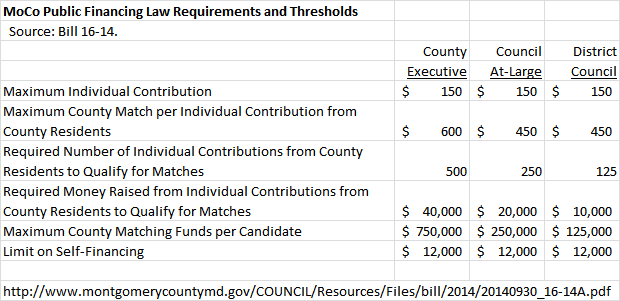
The county’s system does not distribute taxpayer money to everyone who participates.  Instead, it sets up a number of thresholds candidates must reach before they are eligible for public matching funds.  Under the law, a candidate for Executive must receive at least 500 contributions of $150 or less from county residents totaling at least $40,000 before he or she is eligible for public funds.  The candidate cannot accept money from PACs or businesses and cannot take individual contributions of higher amounts.  Once eligible, the candidate can collect up to $600 in taxpayer funds for each $150 contributed by an individual.  Lesser matching amounts apply to smaller contributions on a sliding scale.  Lower thresholds and different match levels apply to those running for County Council at-large and district seats.

Could Ficker get public money?  Ficker has used two campaign accounts over the last decade, the Robin Ficker for Homeowners Committee (which he used in two runs for County Council) and the Fickers for 15 Slate (which he used to run for the General Assembly along with his son in 2014).  The two accounts together raised $262,762.  Of that amount, Ficker self-financed $259,108, or 99% of his take.  A total of 33 individuals other than Ficker gave to the two accounts.  So Ficker has a long ways to go to get public money.  However, he does plan to use his term limits petition information to raise contributions.  Ficker gathered 17,649 signatures.  If just three percent of those folks contribute $150 or less to his campaign, Ficker will qualify for public matching funds.

And so here is the cost of public campaign financing.  If taxpayers are to fund the campaigns of candidates they might support, they may also have to fund the campaigns of those they do not.  Even the clown prince of political hecklers.  Even Robin Ficker.

Share

Ike Leggett’s Dump Fire

By Adam Pagnucco.

No one knows exactly when the worst dump fire in Montgomery County history started.  It was first reported to authorities on October 22, 1994.  A 40-foot high pile of trash at the Travilah Road dump had ignited and begun spreading airborne foulness throughout the vicinity.  The Washington City Paper reported, “The slow smolder spewed clouds of acrid smoke—filled with floating ashes and shreds of trash—and a putrid odor that engulfed the North Potomac area for miles around. The noxious fumes temporarily shut down Stone Mill Elementary School and forced residents from their homes; some had to take temporary refuge in motels.”  More than 200 people reported respiratory problems.

Incredibly, the county government did not act immediately to put the fire out.  Rather, it wanted dump owner Billy Mossburg and his family to put it out themselves despite their long history of bad blood with both the county and their neighbors.  The Washington Post reported, “The county doesn’t have the equipment to do the job, and it’s better for the company to spend its money under county supervision than for the county to spend tax money and bill Travilah Recovery later, said Capt. Ray Mulhall, a fire department spokesman.”  The county posted two environmental inspectors and three fire officials to the site to “ensure everything is done right.”

Internally, the administration of outgoing County Executive Neal Potter debated what to do.  Meetings of county officials went on for two hours or more without resolution.  Some in the administration worried about liability.  Others were concerned about who would pay to put out the fire.  Some worried about the difficulty of getting trucks into the dump or whether lights could be installed for night-time fire-fighting.  Just as a course of direction seemed in reach, someone would bring up more questions and the meetings would resume.  And the fire kept burning.

It was Paralysis by Analysis, then and now.

County Executive Ike Leggett has a dump fire, too.  It is otherwise known as the Department of Liquor Control (DLC).  Maligned for many years for its poor service to licensees and consumers, it was the subject of a landmark Washington City Paper story during Leggett’s first year in office.  The DLC is not a threat to public safety as Billy Mossburg’s dump once was.  But it chases away consumers, stunts the county’s restaurant industry and costs the county and state nearly $200 million a year in economic activity.  After a number of scandals including employee theft, employees drinking and driving on the job and use of an inventory system run with sticky notes, the County Council proposed a bill allowing private distributors to fulfill some special orders.  Delegate Bill Frick (D-16) went further, proposing a bill that would have allowed voters to decide whether to continue the liquor monopoly.  After initially supporting the council’s bill, Leggett opposed both of them and promised that he would fix the DLC through a task force.

The result of the task force?  Paralysis by Analysis, of course.  The task force’s eleven members included just two licensees and no consumers.  It had three meetings during which invited speakers extolled the benefits of government liquor monopolies.  It concluded with no task force statement and no proposal.  The administration completely ignored a proposal to recover DLC’s profits and pretended for months that the proposal never existed.  The Executive offered a tweak that no one else supported and later withdrew it, alleging that DLC’s problems were solved.  This is despite the fact that DLC suffered massive supply failures during the Christmas and New Year’s Eve week the prior two years.  On each occasion, Leggett defended the liquor monopoly just prior to its meltdowns.

The pattern here is the same as the reaction of County Executive Neal Potter to the Travilah dump fire.  Be cautious.  Worry about money.  Pretend that things aren’t so bad.  Play for time.  Maybe the problem will go away by itself.  Maybe public interest will move on to something else.

In the end, the Travilah dump fire was undone by an event it could not burn away: an election.  Incoming County Executive Doug Duncan raced from his inauguration directly to the Executive Office Building and demanded that county officials do everything possible to put out the fire.  Eight days later and roughly seven weeks after it was first reported, the fire was out.  The county later sued the dump owner to recover the cost of fighting the fire.

Here is the great lesson of the Travilah dump fire for today’s dump fire at the DLC.  Meetings and task forces won’t put it out.  Neither will consultants, financial analyses, promises, tweaks, defensive blog posts or PR campaigns.  One thing is needed to deal with the liquor monopoly.

Bold action.  From a new County Executive.

Share

A Reply to the County Executive on the Liquor Monopoly

By Adam Pagnucco.

Thanks to County Executive Ike Leggett for responding to my post on how his administration ignored my proposal to make up revenue for the Department of Liquor Control (DLC).  I stand by my piece and reply to several of his points as follows.

1.  Contrary to the Executive’s contention, my proposal was in fact never analyzed during the time of the DLC task force.  His consultant’s report never mentions it despite the agreement of his staff to include it.  Try finding my proposal, my name, a reference to Seventh State or an analysis of my idea for using cable funds to finance DLC’s debt in the report.  They are simply not there.

2.  The Executive alleges that I made a “basic math mistake” by omitting DLC’s debt service from the revenue needing to be replaced.  Not at all.  Anyone reading my proposal can see that I did not omit it.  I simply dealt with it separately from the return DLC sends to the operating fund since the two revenue streams require different fixes.

3.  The Executive is correct that the state has imposed numerous unfunded mandates and fees on the counties in recent years.  I should know.  I helped organize a campaign against the teacher pension shift in 2012 that included county governments, school boards, community groups and elected officials in both parties.  But rather than merely complain about the state, let’s recognize that it has a role to play in dealing with the liquor monopoly and the revenue question since DLC was created in state law.  A visionary Executive with a plan to transition away from the liquor monopoly would be invaluable in securing the state’s cooperation.

4.  The Executive is wrong about my proposal to use cable funds to service DLC’s debt in two ways.  First, he claims that I proposed raising the 5% fee the county currently levies on cable bills.  That’s not what I said, and in any case, the fee is already at the maximum level allowed by federal law.  Second, he claims that “Cable fund money cannot legally be used for purposes other than cable-related needs: technology and communication purposes. We cannot take Cable Funds to build roads and schools.”  That is absolutely wrong.  The county’s own cable lawyer advised the County Council in 2012 that the county has discretion over how the 5% fees can be spent, but not on amounts collected over that level or on behalf of municipalities.  Those amounts not subject to county discretion were excluded from my analysis.  In fact, the Executive transfers some money from the cable fund to the general fund right now.  The approved FY17 budget states, “Funds are transferred from the Cable Fund to the General Fund to cover the cost of certain administrative services provided by the County to the Cable Fund ($654,353) and other contributions ($5,163,433).”  That’s right, folks, the Executive’s statement in his reply to us is contradicted by his own budget.

Why is the Executive so resistant to the idea of using cable funds for DLC’s debt service?  Perhaps one reason is because cable fees are the source of millions of dollars for County Cable Montgomery and Montgomery Community Media, two public “news” outlets that provide “coverage” for county elected officials.  Try to locate an unflattering “news” article about county elected officials in any of the “coverage” provided by these outlets.  Good luck finding any because one of them is part of county government and the other is a non-profit that gets more than 80% of its budget from the county.  What’s the better use for this money?  Financing Pravda-style public relations or helping to fix the liquor monopoly?

5.  The Executive notes that Worcester County’s former monopoly on spirits may be coming to an end.  He is probably right about that.  Worcester’s monopoly, while not including wine and beer as Montgomery’s does, did an even poorer job of customer service than MoCo and was busted by the Comptroller for breaking numerous laws in 2010.  After Worcester’s monopoly was opened to competition in 2014, the county lost 42% of its wholesale business after a year (while keeping 96% of its retail volume) and its leaders may decide to exit alcohol sales altogether.  But if they do so, it will be because they have decided they can’t compete with private distributors.

That seems to be the rationale the Executive has for shielding DLC from competition: since (in his view) it can’t compete, competition shouldn’t be allowed.  How is that a good thing for licensees and consumers?  Isn’t there a chance that open competition could cause DLC to improve while making private wholesalers pick up their game?

Also, the Executive says, “In the liquor business it is the suppliers/manufacturers who decide which ONE distributor/wholesaler will sell their products.”  That may be true under most circumstances in Maryland, but COMAR 03.02.01.12 exempts county liquor dispensaries from this arrangement.  In other words, state law allows manufacturers to sell to both county liquor sellers and private distributors.  That is what happens now.  In fact, DLC couldn’t exist without this exemption.  Competition between DLC and the private sector can occur if the state allows it.  The Executive simply opposes it.

The County Executive’s response shows that he is sensitive to criticism on this subject.  If only that were enough to make real progress on the county’s shameful liquor monopoly.

Share

Exclusive: Ike Leggett Responds on the DLC

Today, I am pleased to present a guest blog by Montgomery County Executive Ike Leggett:

REALLY Setting the Record Straight…

Adam Pagnucco’s blog entry, Setting the Record Straight, does anything but set the record straight. Let’s be clear – I did not “throw in the towel” on privatizing the County’s Department of Liquor (DLC). The record clearly shows that I introduced State legislation that would have privatized our DLC while also protecting and maintaining the significant revenue stream of over $30 million a year it contributes to the County budget. Some on our County Council and in the State Delegation felt that, given the progress we’ve seen in DLC since we brought in a new management team with considerable liquor industry experience, and a number of substantive changes we had made to the organization already, we should give them additional time to make even greater improvements.

Philosophically, I am not opposed to privatization, but I also stand by my statement that not one of the critics of the County’s Department of Liquor Control (DLC) put forth a viable privatization proposal that would hold the County budget harmless by replacing the DLC’s profits. The County DLC is a taxpayer asset that produces a net profit of over $30 million a year and to privatize without replacing the revenue would be a disservice to our taxpayers.

After months of soliciting proposals, not one person or organization offered a viable plan to privatize DLC while maintaining the approximately $30 million in profits, including groups that assured us they would. While Mr. Pagnucco claims that his plan would have done so, his route to privatization, simply put, was based on faulty assumptions.

Mr. Pagnucco’s proposal was not ignored. It was carefully reviewed by us in the County and it was also reviewed by a consultant hired to review privatization options It was judged not viable because the underpinnings of the proposal were either unworkable, not legal or just plain wrong. Here’s why:

First, Mr. Pagnucco made a basic math mistake. He estimated that the County receives $20 million in “profit” in FY17, therefore starting with the faulty premise that to make the County whole, only $20 million in DLC profits each year need to be replaced. Unfortunately, he ignores that in FY17, the Department of Liquor Control earmarked $20.7 million for transfer to the General Fund and another $10.9 million to pay debt service on Liquor Bonds – bonds that have paid for road, and school construction in our County.

Therefore, the revenue to be replaced equals $31.6 million, not $20 million.

Mr. Pagnucco’s proposal then makes the argument that there will be a huge economic spinoff from privatizing by increased sales. He relies on a report done by the Comptroller’s Bureau of Revenue Estimates, which was itself built on an amazing number of alternative facts. But, for the sake of argument, say it was a sound analysis. Even Mr. Pagnucco admits that the tax revenue estimates presented in the report actually proves the county’s point that opening the alcohol market really only benefits the State coffers. He himself noted the county would receive less than $1 million of the revenue, while the rest of the estimated $35 million in economic spinoff benefit would go to the state’s general fund.

So he suggested that we pass a State law to compel the State to share its new revenue with us. The consultant, and everyone familiar with how Annapolis works, rightly pointed out that first, it requires the state to be a willing partner, and second and more importantly, there exists a legitimate concern about revenue sharing with the State. What the State giveth, the State taketh away. Just in the 1990s alone, the following County revenue sources were reduced or eliminated by the State:

  1. Liquor tax revenue sharing: eliminated; loss of $4.4 million to counties
  2. Beer tax revenue sharing: eliminated; loss of $4.2 million to counties
  3. Tobacco tax revenue sharing: eliminated; loss of $12.7 million to counties
  4. Property tax grant: eliminated; loss of $82.5 million to counties
  5. Teacher social security: eliminated; loss of $145 million
  6. Financial institution franchise tax sharing: eliminated; loss of $17 million to counties
  7. Transportation taxes revenue sharing (not highway user): eliminated; loss of $19.6 million to counties
  8. Abandoned property revenues: eliminated, loss of $5 million to counties
  9. Corporate filing fee revenues: eliminated; loss of $1.6 million to counties
  10. Security interest filing fee revenues: eliminated; loss of $1 million to counties

Mr. Pagnucco claims that the County can replace the bond money by raising our cable franchise fee and siphoning off dollars from the Cable Fund. With this statement he negates his own argument that his proposal would be “cost neutral” since it would in fact require raising fees.

But what he more importantly failed to realize is that Cable fund money cannot legally be used for purposes other than cable-related needs: technology and communication purposes. We cannot take Cable Funds to build roads and schools. Plus, utilizing this revenue would just create a budget hole elsewhere.

Another faulty assumption in Mr. Pagnucco’s proposal is using Worchester County as an example of how privatization in Montgomery County would work smoothly. He claims that after privatizing its liquor business, Worchester experienced reduced revenues but that the loss was negligible and that such a loss would equate to a mere $5 million per year for Montgomery. However, in reality, the unhappy ending to the Worchester story of privatization is that Worchester County is now going out of the liquor business forever and will generate exactly zero revenue for its budget in the future.

The final faulty assumption in Mr. Pagnucco’s proposal is his assumption that the county could just open up more liquor stores, which he notes would create additional profits.  See paragraph above: Worchester’s unhappy ending is testament that it just won’t happen.

Finally, Mr. Pagnucco says he was not proposing getting rid of the DLC – he just wanted to provide competition (i.e.; “end the monopoly”) by allowing our licensees to decide from whom to purchase products. But that’s not how it works. In the liquor business it is the suppliers/manufacturers who decide which ONE distributor/wholesaler will sell their products. The so-called monopoly doesn’t end, it simply transfers from the County to the private sector. Why turn over this asset that belongs to our county residents to the private sector for nothing?

We should be looking forward, not back. The DLC is, as they say, under new management. It has a new director, and is on course to continue making positive changes to improve operations and customer service.

Ike Leggett
County Executive

Share

Awkward!

By Adam Pagnucco.

On Tuesday, the County Council learned that their own spokesperson is planning on running for one of their seats.  Um, OK.  And… they learned about it like everyone else did by reading it on MCM.

Um… Awkward!

Neil Greenberger, who has been the council’s Legislative Information Officer since 2006, announced his potential candidacy by telling MCM, “I would chance to say I know as much about county government as anybody in the county.”  Including his bosses?  Um… well, you get the point.  Greenberger could run in District 2 if incumbent Craig Rice vacates his seat.  Otherwise, he would run at-large.  Greenberger said he would stay in his job while he runs for office and give it up only if elected.

To appreciate how strange this is, let’s understand that the two most sensitive staff positions for most elected officials are their Chief of Staff and spokesperson.  The former person is privy to the official’s most confidential discussions and decision-making.  The latter is the official’s conduit to the public.  Both individuals have to mirror the boss’s priorities exactly and can never diverge positions from them outside of closed doors.  That’s part of the deal when you work for an elected official.

Patrick Lacefield, Greenberger’s counterpart in the Executive Branch, works for one boss.  And Ike Leggett, by all accounts, is a good boss to have.  Greenberger has NINE bosses and not all of them are as gentlemanly as Leggett.  Imagine having nine ropes around your neck pulling in nine different directions and you have some idea of what it’s like to be Greenberger.  It is not an easy job.

Now imagine what happens if Greenberger actually runs.  During the day, he would continue to be the council spokesperson, working with the members and their staff to get out information to the public.  And then at night and on weekends, he would be a fellow candidate.  Let’s remember that open seat candidates are frequently asked what they would do differently than the incumbents.  So part of the time, Greenberger would be working for the Council Members and the rest of the time he would be critiquing them.

It gets even weirder.  If Greenberger runs at-large, he will be running against current at-large incumbent Hans Riemer, who is sure to seek a third term.  It’s also possible that he could run against District 5 Council Member Tom Hucker, who could run at-large.  Then there’s the matter of all the other at-large candidates (and there will be a lot of them).  Suppose Greenberger loses.  Will his victorious opponents then be required to retain him as their spokesperson?

We can’t recall another occasion when the council’s own spokesperson ran for one of their seats.  The closest recent analog to this situation happened in 2006, when George Leventhal’s Chief of Staff, Valerie Ervin, decided to run for the District 5 seat.  Since Leventhal was an at-large member, Ervin was not running against him.  But she still left her Chief of Staff position as the campaign started.

Greenberger has as much right to run for office as any other county resident.  But if he stays in his current job while he runs against one or more of his employers, he will be creating immense conflicts.  Council Members need to trust that their communications are written for their benefit and for the benefit of the institution – not for the personal political benefit of the individual writing them.  The fact that they were blindsided by the MCM article is not a good sign for future trust.

Unless adult supervision steps in – and we are talking about the council’s staff director, Steve Farber – this could be a wild ride.

Share

Setting the Record Straight

By Adam Pagnucco.

County Executive Ike Leggett has thrown in the towel on efforts to reform the county’s Department of Liquor Control (DLC).  We will have something to say about that soon.  But first, let’s address a claim the Executive has made in Bethesda Magazine: namely, that “the department’s critics have failed to put forth a proposal that included replacing the DLC’s profits.”

That is flat-out untrue.

On August 15, 2016, while the Executive’s DLC task force was meeting, your author posted a proposal on Seventh State for replacing DLC’s profits.  Our concept was to replace every dime of DLC’s net income with a combination of revenue sharing with the state, opening a few new liquor stores and financing the county’s liquor bonds with cable funds.  No new taxes or fees would be required.  In the email below, your author asked Bonnie Kirkland, the Executive Branch staffer running the task force, to have the proposal studied by the administration’s consultant.  Ms. Kirkland agreed to do that.  But the consultant’s report never examined our proposal and does not reference it at all.  And now the Executive claims that our proposal never existed.

Let’s give the Executive the benefit of the doubt.  No Executive is aware of every interaction his staff has with the public.  But it’s absolutely untrue that we had no proposal to replace DLC’s profits.  We did and we shared it with his staff.  It was simply ignored by his administration.

Below is the email exchange your author had with Ms. Kirkland as proof.  Let no one – not the Executive, not his staff, not anyone at the County Council and not anyone else – continue to claim that we presented no ideas for replacing DLC’s profits.

*****

From: Kirkland, Bonnie <Bonnie.Kirkland@montgomerycountymd.gov>

Sent: Thursday, September 1, 2016 3:47 PM

To: Pagnucco, Adam

Subject: Re: Proposal on liquor monopoly revenue

Adam – The proposal, along with the others, is under analysis by the consultant. They will present a preliminary report/analysis at the next meeting, September 15.

Bonnie

Sent from my iPhone

On Sep 1, 2016, at 2:28 PM, A P <acp1629@hotmail.com> wrote:

Hi Bonnie – have you had time to consider my request?  I believe it responds to the Executive’s view that he is prepared to depart from DLC’s monopoly status so long as the revenue gap is closed.  Adam

From: Bonnie.Kirkland@montgomerycountymd.gov

To: Acp1629@hotmail.com

Subject: RE: Proposal on liquor monopoly revenue

Date: Wed, 17 Aug 2016 17:13:08 +0000

Adam – Yes, I did receive your email. I am currently out of the office and will respond as soon as possible.

Bonnie

From: A P [mailto:acp1629@hotmail.com]

Sent: Wednesday, August 17, 2016 1:02 PM

To: Kirkland, Bonnie <Bonnie.Kirkland@montgomerycountymd.gov>

Subject: FW: Proposal on liquor monopoly revenue

Hi Bonnie – did you receive this email?  And if so, can you confirm that this proposal will be analyzed along with the others in the course of the DLC task force’s deliberations?

Thank you,

Adam Pagnucco

From: acp1629@hotmail.com

To: mcvim@aol.com; dwayne.kratt@diageo.com; mdharting@venable.com; molly@allsetrestaurant.com; rneece@esopadvisors.com; mmendelevitz@esopadvisors.com; mbalcombe@ggchamber.org; ggodwin@mcccmd.com; gitaliano@bccchamber.org; jredicker@gsscc.org; chris.gillis@montgomerycountymd.gov; joel.polichene@rndc-usa.com; bob.mutschler@rndc-usa.com; tbeirne@wineinstitute.org; jen@pwrjmaryland.com; sidney.katz@montgomerycountymd.gov; lisa.mandel-trupp@montgomerycountymd.gov; neal.insley@nabca.org; steve.schmidt@nabca.org; hgaragiola@alexander-cleaver.com; robert.douglas@dlapiper.com; sfoster739@comcast.net; mthompson@marylandrestaurants.com; jason@capstrategies.net; ashlie.bagwell@mdlobbyist.com; mcarter@vsadc.com; proddy@rwlls.com; lobbyannapolis@verizon.net; amy.samman@montgomerycountymd.gov; fariba.kassiri@montgomerycountymd.gov; bonnie.kirkland@montgomerycountymd.gov; ginanne100@aol.com

Subject: Proposal on liquor monopoly revenue

Date: Mon, 15 Aug 2016 12:00:24 -0400

Hi Bonnie:

I am requesting that this proposal on how to deal with liquor monopoly revenue be considered by the administration as part of its DLC deliberations.

https://www.theseventhstate.com/?p=6987

Thank you,

Adam Pagnucco

Share

Five Facts About MoCo School Construction Funding

By Adam Pagnucco.

School construction has been one of the hottest issues for years in Montgomery County.  Enrollment in Montgomery County Public Schools (MCPS) has been increasing by close to 2,000 students a year for a decade with no sign of stabilizing.  The result is crowded schools throughout the county.

According to the Superintendent’s FY18 Recommended Capital Budget, 109 of MCPS’s 197 schools were over capacity in the 2016-2017 school year.  Of those, 35 had enrollments of at least 120% of their capacity.  Even if the Superintendent’s request is fully funded, by the 2022-2023 school year, 87 schools will be over capacity and 29 will be at least 120% capacity.  Overcrowding will continue because construction will not keep pace with enrollment, which is projected to grow by nearly 10,000 students over that period.  MCPS is using 388 relocatable classrooms this year, a number that has not changed much over the last five years despite significant spending on school construction.

Over 80 percent of MCPS school construction costs are paid by county taxpayers with the remainder coming from state aid.  Here are five facts about school construction that all MoCo residents should know.

  1. MCPS enrollment is growing faster than the rest of the state COMBINED.

According to the Maryland State Department of Education, September enrollment in MCPS grew by 15,036 students between 2005 and 2014.  Over that period, public school enrollment in the rest of Maryland SHRANK by 543 students.  MCPS’s absolute increase and its growth rate (11%) were both first in the state.  Other systems are growing too (notably Howard and Anne Arundel) and all counties have maintenance requirements.  But in terms of new capacity needs, MCPS is in a category of one.

  1. MoCo gets less school construction money from the state per student than all but a handful of other counties.

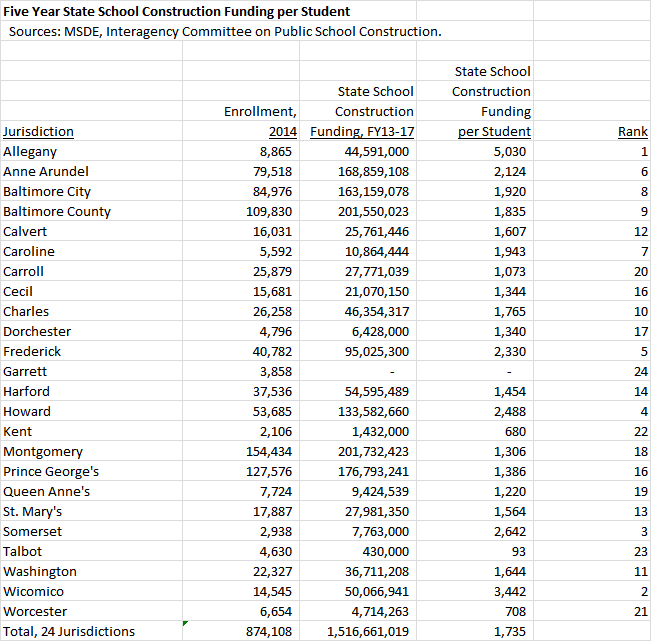
Over the five-year FY13-17 period, MoCo received $201.7 million in state aid for school construction, just ahead of Baltimore County and tops in the state.  That’s a substantial amount of money.  But relative to its September 2014 enrollment, MoCo’s construction aid per student ($1,306) ranked 18th of 24 jurisdictions.  MoCo had 18% of the state’s public school students but received just 13% of state construction dollars, the biggest gap in the state.

  1. The state’s funding formula discriminates against school construction in MoCo.

The state finances a percentage of eligible costs for school construction projects approved for state aid with the local jurisdiction paying the rest.  MoCo is one of seven jurisdictions for which the state covers 50% of funding for school projects approved by the Board of Public Works, the lowest rate available.  Other jurisdictions including Prince George’s (63%) and Baltimore City (93%) receive much higher cost splits.

  1. State legislators from the City of Baltimore extracted a billion dollars from the state for their school construction program.

In 2013, Governor Martin O’Malley and the General Assembly’s presiding officers made passing a revenue increase for transportation a high priority.  Despite the fact that one of the projects to be funded was Baltimore’s $2.9 billion light-rail Red Line, city legislators withheld their votes until they got more money to rebuild their aging schools.  (City school enrollment fell between 2005 and 2014.)  The result was a new seven-year billion-dollar state aid program for city schools that greased the wheels for the transportation funding hike.  The city delegation’s work shows that significant progress can be made on this issue.

  1. MoCo residents are now paying a new tax hike in part to fund school construction.

Last May, the Montgomery County Council approved a recordation tax increase on home sales projected to raise $196 million over six years.  The council justified the tax hike on the grounds that $125 million of the money was supposed to be spent on school construction.  No recent media reports indicate that any other Maryland county has raised local taxes for the explicit purpose of financing school construction.

Disclosure: Your author’s son attends Flora Singer Elementary School in Silver Spring.  Despite opening just four years ago to relieve overcrowding at nearby Oakland Terrace, the school is already over capacity.

Share