Tag Archives: Adam Pagnucco

A Mug Half Full

By Adam Pagnucco.

A General Assembly compromise passed on Sine Die will allow Diageo’s new brewery in Baltimore County to move forward.  But the amended Bill 1283 is a mug half full, with the state’s craft brewers inevitably seeking more in the future.

A brief refresher.  Diageo, owner of the world-famous Guinness brand, announced plans to open its first U.S. brewery in more than sixty years in Baltimore County a few months ago.  Diageo did not ask for a state subsidy, but it did ask for permission to sell 5,000 barrels per year from the brewery’s taproom, up from the state’s current 500 barrel limit (by far the lowest in the country).  A bill passed by the House of Delegates raised the barrel limit to 2,000 (with another 1,000 allowed if bought from a wholesaler), but it also cut back hours of operations and prohibited off-site contract brewing, a major hit on the industry.  After an outcry from brewers, the Senate amended the bill to allow a limited amount of contract brewing and to grandfather the hours of existing breweries and those in the approval process (including Diageo).  The House passed the amended bill on Sine Die.

The deal allows Diageo to come to Maryland, and that’s a good thing.  But it also contains two counter-productive elements.

The Concession to Wholesalers

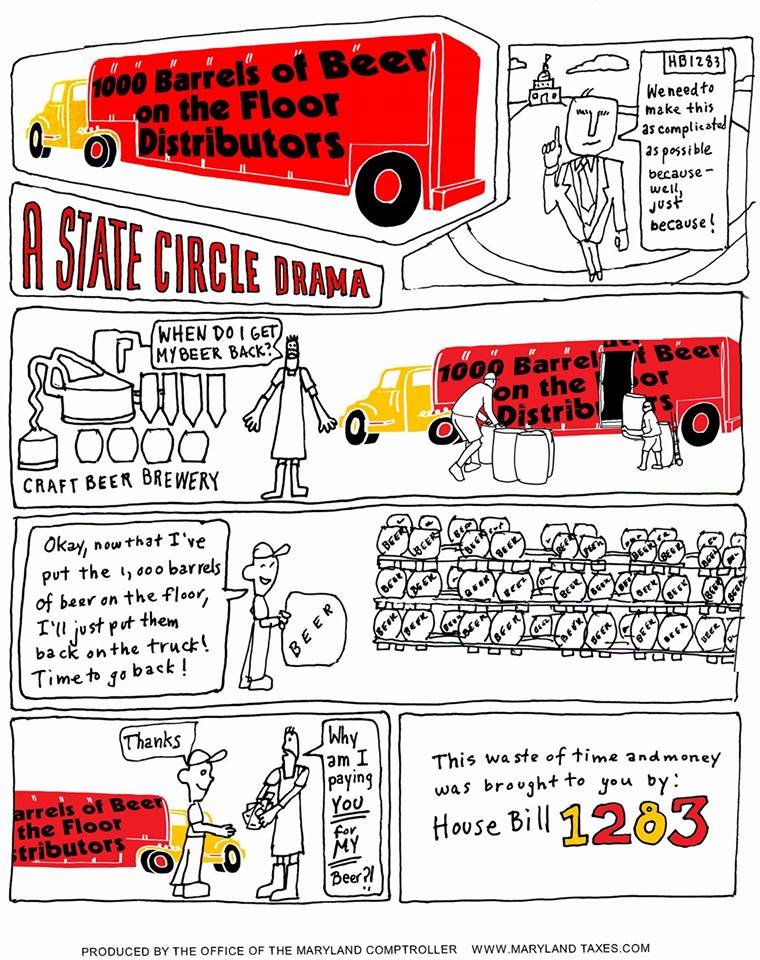
Brewery taprooms are now allowed to sell 2,000 barrels directly to customers each year.  (The next-lowest state, North Carolina, allows 25,000 barrels.)  Breweries can sell another 1,000 barrels, but to do so, they have to go  through a wholesaler.  That means loading the beer on a wholesaler’s truck, sending the truck to a warehouse where the beer is offloaded, then bringing it back to the brewery to unload it again.  FOLKS, YOU CANNOT MAKE THIS UP.  The graphic below from the Comptroller’s Office illustrates how absurd this is.
Grandfathering of Hours

Existing breweries and those holding on-site consumpion permits and licenses as of April 1, 2017 are allowed to stay open as late as their local jurisdictions permit them, usually between midnight and 2 AM.  All new breweries must close by 10 PM, slamming the door shut on further growth.

The State of Maryland is effectively telling the craft beer industry the following: We don’t like you.  We will tolerate those of you who are already here, but we don’t want any more of you.

Contrast this with Virginia.  The Commonwealth’s Governor, Terry McAuliffe, is a joyous deal-maker, back-slapper and salesman who loves bringing employers to his state – especially craft breweries.  McAuliffe promotes the industry every chance he gets, including the creation of Stone Brewing’s special beer in honor of Virginia, Give Me Stout or Give Me Death.  His term has seen almost 100 new breweries open in the state.  Perhaps his greatest achievement was a successful four-year campaign to entice Oregon’s Deschutes to open near Roanoke.

Virginia’s Beer Drinker in Chief.  Photo credit: Richmond’s Style Weekly.

Here is McAuliffe bragging about Virginia’s booming beer industry to Hampton Roads’ WAVY TV just last week.

Governor Terry McAuliffe spoke to the National Craft Breweries Association in Washington D.C. Tuesday evening to give his best sales pitch to attract new beer businesses to Virginia.

“We got Stone to move here, and we got Deschutes to move here, we’ve got Ballast Point to move here, Green Flash, I mean, no one has had the success we’ve had the last two years recruiting major known craft breweries,” McAuliffe told 8News Reporter Jonathan Costen, pointing out that the booming beer industry has brought hundreds of jobs to the area. “We have 190-craft breweries in Virginia today. It’s a billion dollar industry for us, so I believe it really helps our tourism.

“Folks come, they love to come to our craft breweries, but in addition to that, these craft breweries are all buying locally produced products, it is great for our farmers. We can’t produce enough hops here, so I tell people go out and start a hop farm here in Virginia,” McAuliffe added.

McAuliffe’s message is the polar opposite of Maryland’s.

One elected official who understands the economic and cultural potential of craft beer is Comptroller Peter Franchot, who aggressively defended the industry during the debate over Bill 1283.  The Comptroller is now convening a task force to study the state’s beer laws from top to bottom with the goal of producing model legislation next year.  An interesting question is whether Governor Larry Hogan will come on board.  The Governor has allied with Franchot on more than one of his ideas in the past, including school air conditioning and starting school after Labor Day.  Craft brewing is a natural issue for Hogan, given its potential for job creation and the Democrats’ near-fumbling of the issue this year.

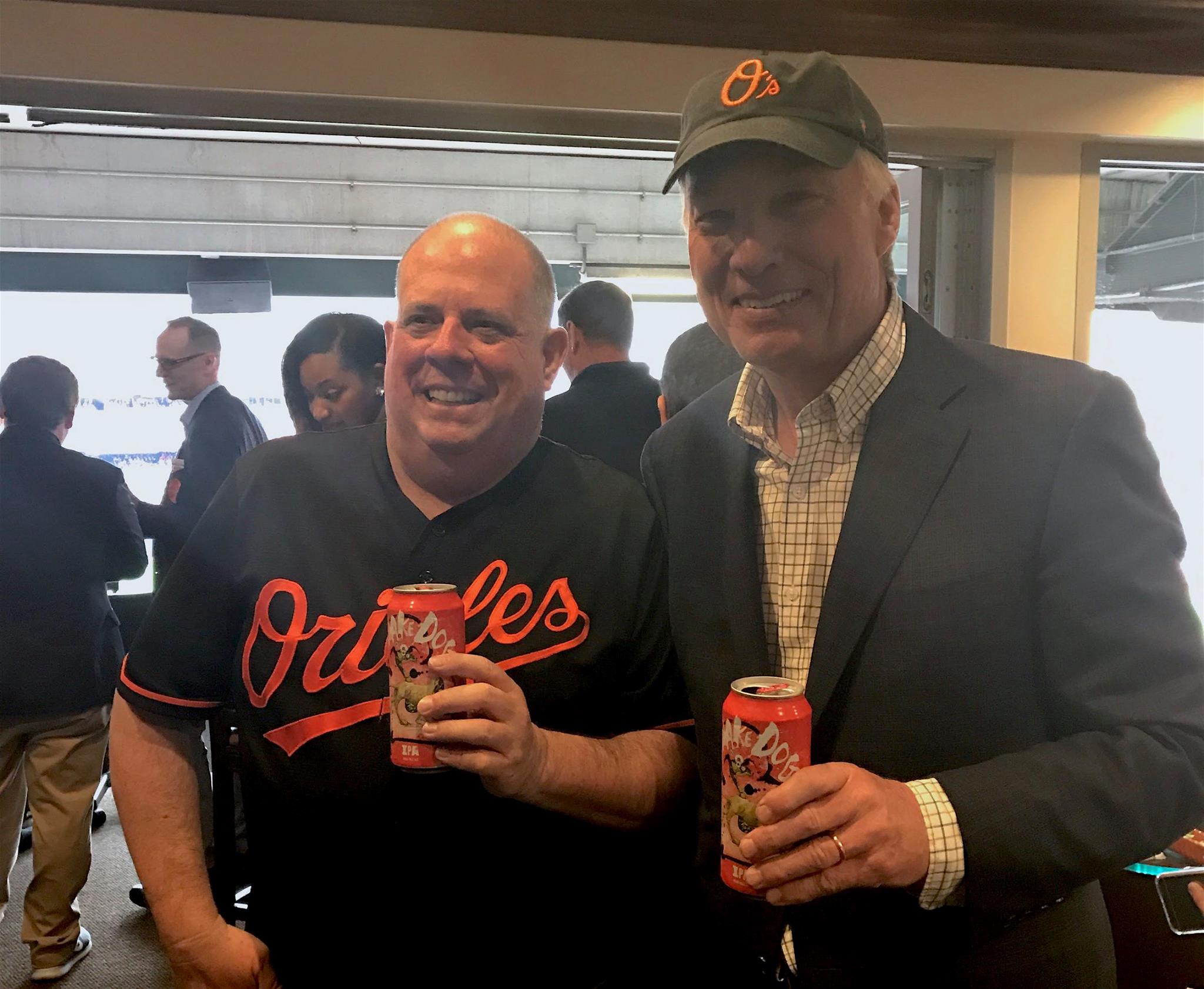
Just two guys enjoying some great Maryland craft beer.  Photo Credit: Peter Franchot.
Maryland’s iron cartel of manufacturers, wholesalers, licensees and supportive politicians has kept in place a stable, profitable system for a long time.  The just-concluded brewery bill is only the most recent manifestation of their control of Annapolis.  So opening up the beer industry is an uphill battle.  But if Franchot, the craft industry, its customers and maybe Hogan can make this a signature issue in an election year…?  Well, pull up a stool, grab a mug and get ready for the show!

Disclosure: Your author has done campaign-related work for Peter Franchot in the past.  His positions on issues like this one, including Montgomery County’s liquor monopoly, have earned my support.

Share

Barkley Blasts Annapolis

By Adam Pagnucco.

Delegate Charles Barkley (D-39) has just given the most astounding interview by a member of General Assembly leadership ever seen by your author.  In it, he broke the most important rule of Annapolis decorum there is: never throw your superiors under the bus.

Barkley is the Chair of the House Economic Matters Committee’s Alcoholic Beverages Subcommittee.   In theory, that makes him the proximate point person on alcohol bills in the House.  Some think of the alcohol industry as one industry, but in fact it is several, with the manufacturers, distributors, retailers, restaurants and several individual companies hiring their own lobbyists and making tons of political contributions.  That makes for complicated politics which, among many other things, has produced the much-criticized bill punishing craft breweries.  That bill has already caused one potential brewery owner to bail on the state.

The anti-brewery bill passed the House on a 139-0 vote.  One source tells us, “When a bad bill passes on a vote like that, someone f____d up.”  In an incredible interview with Maryland beer blog Naptown Pint, Barkley placed the blame on his superiors, specifically Economic Matters Committee Chair Dereck Davis and Speaker of the House Mike Busch.  The whole interview is a massive scoop and a must-read, but the key passages are this:

“We didn’t know what was in the bill until the day it came in front of our committee for the vote,” Barkley answered. But was that due to the rush of the process, or was it an intentional screen being put up around the bill’s contents?

“I don’t think they were trying to give out too many details,” he commented…

“I honestly thought we were moving in the right direction with Nick Manis [MCA], Steve Wise [MSLBA legal counsel] and [Jack] Milani [MSLBA, Monaghan’s Pub in Baltimore]. We thought we were making progress, and we had the guys talking to us.”

Barkley then paused for a moment.

“All of a sudden, they quit talking to us,” he continued. “And then the [Economic Matters Committee] Chairman [Dereck E. Davis] said, ‘This is what we’re doing.’”…

I asked him his thoughts on some of the statements by House members who voted in favor of HB 1283 that they now know it was a bad bill or that they were misled on the contents ahead of the committee vote that pushed HB 1283 over to the Senate.

“I would say absolutely they were misled. [The House] thought we worked out a compromise and this was it. We hadn’t,” he stated.

“Up until this point, I ran the subcommittee and I kept my chairman [Davis] informed. But this one left my hands. I’ve never had this kind of intervention before, until this year. I thought [Manis, Wise and Milani] were meeting with us. But I think we were getting too close to stuff they didn’t want. So I think they met with the Speaker and got things changed.”

Here is a sub-committee chair describing a major bill as a backroom, secret deal involving lobbyists, a powerful committee chair and the Speaker in cahoots to deceive the full House membership.  Your author has never seen a state legislator entrusted with leadership responsibility go on the record in this way before.  It is an almost certain firing offense.

Barkley has always been something of a maverick.  Once a Vice-President of the county teachers union, he has not always been their best friend in Annapolis.  In 2009, he was famously kicked off the Appropriations Committee and lost a subcommittee chair for defying leadership on the millionaire tax.  In 2012, Barkley was one of a handful of MoCo Delegates to vote against the immensely damaging teacher pension shift, a top priority of Governor Martin O’Malley and the presiding officers.  After losing the first vote, he introduced a floor amendment to the budget which would have cut the shift in half, which also failed.  Considering this record, it’s surprising that Barkley acquired the alcohol subcommittee chair at all.

Barkley’s candor is likely aided by his apparent decision to leave Annapolis and run for County Council.  We don’t know what the future holds, but we will say this: given Barkley’s iconoclastic ways, he would make an interesting County Council Member.

Share

Republican Delegates Protect Internet Scammers

By Adam Pagnucco.

After Republicans in Congress voted to allow Internet service providers to sell their customers’ browsing histories and other personal data without their consent, Delegate Bill Frick (D-16) took action to block such practices in Maryland.  But one group was able to prevent the General Assembly from even voting on whether to allow such conduct in the Free State.

You guessed it: Republican state lawmakers.

Bills in Annapolis face deadlines for introduction so that each chamber has adequate time to send them to committees, hold hearings and votes, and reconcile them if different versions pass.  But Congress’s action to legalize Internet providers’ scamming of their customers took place only days ago and Sine Die, the last day of the Maryland General Assembly’s 2017 regular session, is approaching on April 10.  Delegate Frick, who is known for introducing consumer protection bills, had to act fast.  The Maryland Constitution requires two thirds of state legislators to agree to let a bill be introduced in the last 35 days of session.  So Frick quickly drafted a bill to outlaw the scamming that Congress allowed and asked his colleagues in the House of Delegates to allow its introduction.  He needed 94 votes.  He got 90.

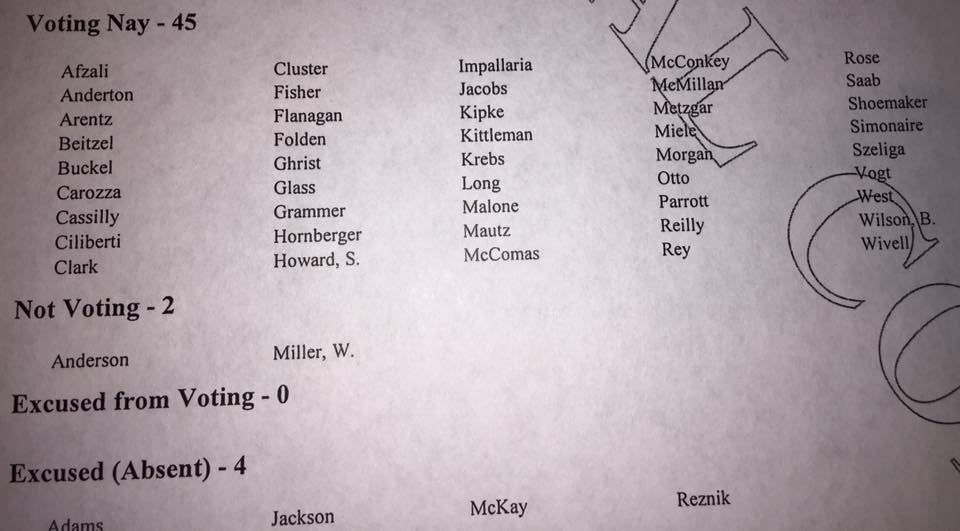
Frick posted a partial screenshot of the vote page on Facebook (below).  Delegate Kumar Barve (D-17) posted the full tally.  Every single Delegate who voted against the bill’s introduction was a Republican.  So were all the Members of Congress who voted to roll back federal Internet privacy rules in the U.S. House and the U.S. Senate.

What did the Republican Delegates block from being voted on?  Frick’s bill was a simple one.  It would have made it an unfair or deceptive trade practice in Maryland for Internet service providers to sell or transfer their customers’ names, social security numbers, addresses, IP addresses and browsing histories without their affirmative permission.  It also would have banned them from showing ads derived from browsing histories and denying service to customers who refused to allow their personal information to be shared.  The bill made an exception for information subject to a subpoena, summons, warrant or court order.

One Republican Delegate who voted against introducing Frick’s bill, Nic Kipke of Anne Arundel County, told the Associated Press that Internet privacy is “a national issue, and a Maryland bill would just drag Washington politics into the state.”  Great!  So when millions of Marylanders get scammed by Internet predators, the state legislators who represent them should do nothing.  Nigerian princes, British lottery officials and offshore bank investors rejoice!

GOP politicians have been known for their squabbling in recent years, but on this one thing, they agree: your personal Internet data should be bought and sold without your knowledge or consent.  Remember that in November 2018.

Share

Term Limits Vote by Precinct

By Adam Pagnucco.

The precinct results on Montgomery County’s Question B, the charter amendment imposing term limits on the County Executive and County Council, are in.  The message they contain has significant implications for the next election.

First, let’s look at the overall results by type of vote.  Term limits passed overwhelmingly among early voters, election day voters and absentee and provisional voters, though early votes were lower than the other two categories.  As an aside, check out how early votes comprised a third of all votes, reflecting the growing popularity of this type of voting.

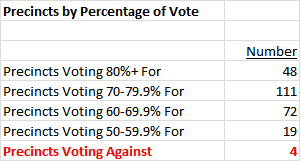
Next, let’s examine the distribution of precincts by vote results.  Ninety percent of the county’s 257 precincts passed term limits by at least twenty points.  Only four(!) precincts voted against term limits.  Of those, three were in Takoma Park and the other was in Silver Spring inside the Beltway.

Below are the results for Congressional, state legislative and council districts as well as a cut distinguishing inside vs outside the Beltway.  Again, every single split shows huge support for term limits, with Upcounty areas higher than Downcounty areas.

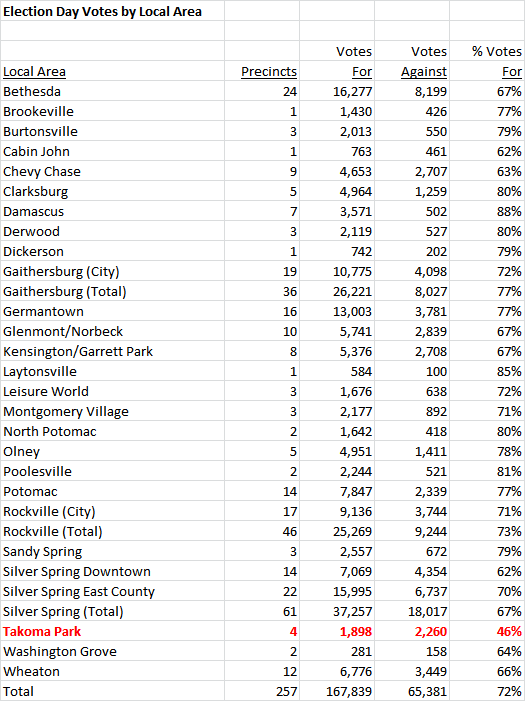
Now let’s look at results by local area.  Every area in the county passed term limits by at least 20 points except for Takoma Park – the only place that voted against term limits.  Clarksburg, Damascus, Derwood, Laytonsville, North Potomac and Poolesville had support for term limits of 80% or more.

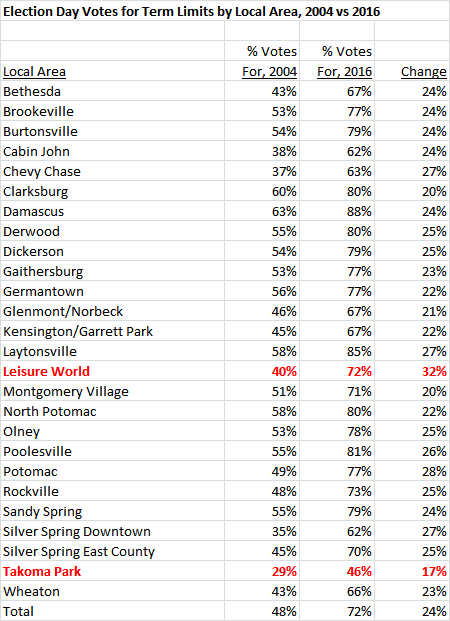
We contrasted the election day results of the term limits votes in 2004 and 2016 to calculate where support for term limits had grown the most.  An important caveat: early voting did not exist in 2004 so that may impact the nature of this presentation.  Overall, support for term limits among election day voters grew from 48% to 72%, a change of 24 points, and most areas had changes in that ballpark.  There are two exceptions.  Takoma Park, where term limits support grew by 17 points, had the least change.  Leisure World, where support grew by 32 points, had the most change.

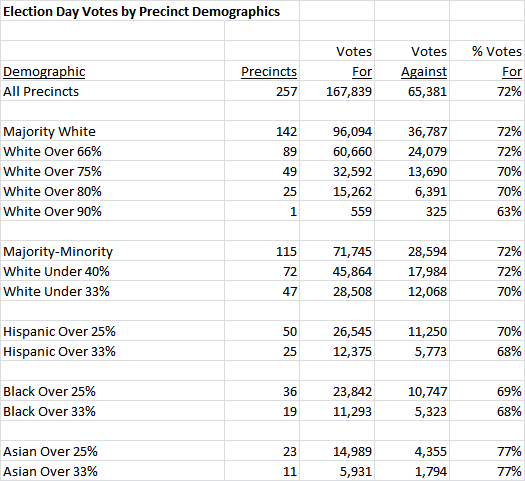
Below are the results on precinct demographics.  There is very little variation between heavily white, black, Hispanic or Asian precincts, indicating close to uniform support for term limits.

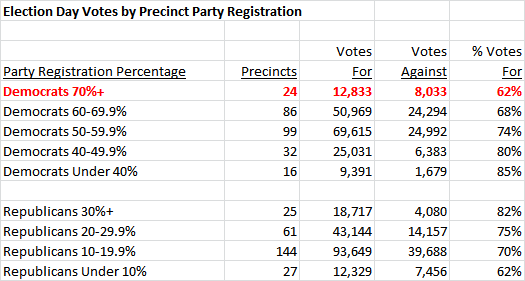
The partisan nature of precincts was an important predictor of term limits voting.  The chart below shows term limit votes by the precinct registration percentages of both major parties.  Precincts that were the least Democratic and the most Republican passed term limits with more than 80% of the vote.  Precincts that were the most Democratic and the least Republican passed term limits with more than 60% of the vote.  The correlation coefficient between these two measures was 0.60, indicating a significant relationship between them.

The big question now is how the term limits vote will affect the 2018 Democratic primary.  Let’s remember that the presidential general electorate and the mid-term Democratic primary electorate are two very different groups of people.  In 2014, Democratic primary voters supported every county-level incumbent running for reelection only to have presidential general voters effectively kick them out two years later.  Nevertheless, there is substantial evidence that many voters who supported term limits will be voting in the 2018 Democratic primary.

  1. At least half of county Democrats voted for term limits. Consider the following.  First, 60% of MoCo presidential general election voters are Democrats.  Second, if all the Republicans and unaffiliated voters supported term limits, that would be 40% of the vote.  However, term limits passed with 70% of the vote.  So that extra 30 points must have come from Democrats and would account for half of them.  If any Republicans or unaffiliated voters did not support term limits, then a slight majority of Democrats would have voted yes.  The point here is that term limits could not have hit 70% support without massive numbers of Democrats favoring them.
  1. Almost all of the Downcounty Democratic strongholds – Bethesda, Chevy Chase, Kensington and Downtown Silver Spring – passed term limits by more than 20 points. Only Takoma Park voted no.  These are the same areas that voted overwhelmingly for Jamie Raskin in the 2016 primary and are responsible for sending him to Congress.  In the 24 precincts where Democrats accounted for 70% or more of registered voters, term limits passed with 62% of the vote.
  1. Nearly two-thirds of regular MoCo Democratic primary voters are age 60 or older. This makes the term limits vote in Leisure World especially noteworthy.  In 2004, 40% of Leisure World voted for term limits, eight points below the county average.  In 2016, 72% of Leisure World voted for term limits, the same as the county average.  That 32-point shift was the biggest of any local area in the county.  The importance of seniors among Democratic voters cannot be overstated and their huge shift in favor of term limits is deeply meaningful.

The term limits vote was the biggest revolt of MoCo voters in at least fifty years.  Everyone running for office in 2018 – incumbents, challengers and open seat candidates alike – must take that into account.

Share

Gino Stands by His Man

By Adam Pagnucco.

Council Member Marc Elrich held his kickoff event for the County Executive race in Bethesda this past Sunday.  One of his guests was Gino Renne, President of the Municipal and County Government Employees Organization (MCGEO), the largest of MoCo’s non-education county employee unions.  The picture below says it all.

Photo by Kevin Gillogly.  More pictures available on Kevin’s Flickr account.

Elrich is a beloved figure by many in the local labor movement.  He has had support from almost all of the area’s major labor organizations in his recent runs for office.  His lead sponsorship of two minimum wage bills has strengthened those relationships.  Of specific importance to MCGEO, Elrich was the only Council Member to vote against cutting the union’s negotiated 8 percent raise in the last budget, which also included a 9 percent property tax hike.  Additionally, Elrich is a strong defender of the county liquor monopoly, famously accusing anti-monopoly restaurant owners of stealing and whining and then getting banned by one of them.  Protecting the monopoly is one of MCGEO’s highest priorities.

Gino’s thumbs-up is not an official endorsement.  The union has to go through its process, including candidate interviews and questionnaires.  But the symbolism of the picture above is hard to miss.  Elrich could very well be labor’s pick for Executive.

Share

Is Maryland Trying to Punish Craft Breweries?

By Adam Pagnucco.

Craft breweries have been growing rapidly in Maryland and elsewhere, forever changing the beer business.  Maryland scored a huge win a couple months ago when Diageo announced their intention to open a $50 million Guinness brewery in Baltimore County, creating a tourist attraction and dozens of jobs.  Best of all, unlike many employers, Diageo is not asking for one thin dime of public subsidy to come to the state.  But instead of welcoming the new facility with open arms, the House of Delegates reacted by making it harder for Diageo to do business here, as well as many other breweries in Maryland.

The debacle began when Diageo asked for a change in state law to allow them to sell 5,000 barrels of beer at a restaurant and tap room on the brewery site.  (Maryland’s current limit of 500 barrels is by far the lowest in the nation; the second-lowest state, North Carolina, has a limit of 25,000 barrels.)  Other brewers sought a limit of 4,000 barrels in on-site sales for their own operations and five different bills followed.  HB 1283 was the one that passed the House of Delegates and did three main things.

  1. It increased the on-site sales limit to 2,000 barrels. Breweries could apply to the Comptroller for permission to sell another 1,000 barrels on-site, but they would have to go through a distributor to do so.  That means the brewery would have to brew its own beer, then turn it over to a distributor, then receive it back from that distributor and of course pay the distributor a fee for its service.  Guess who ultimately pays that fee?  That’s right, you the customer!
  1. It established closing times for tap rooms of 9 PM during the week and 10 PM on weekends, down from local closing times ranging from midnight to 2 AM.
  1. It limited tap room sales to beer brewed on-site only. This repeals a long-standing practice in which brewery tap rooms supplement their own products with contract beer brewed for them by other breweries.  Such contract beer sales are major sources of revenue for some craft brewers and make tap rooms more attractive to customers.

Brewers characterized the combination of changes as “one step forward and two steps back” and predicted layoffs and business losses.  Why would the House pass such a bill?

One of the biggest opponents of liberalizing rules on craft breweries is the Maryland State Licensed Beverage Association, which represents restaurants and small alcohol retailers.  The group is particularly influential in Annapolis as its PAC has contributed over $180,000 to state politicians since 2005.  The association sees craft brewers as competition for its members.  From a zero-sum perspective, every pint purchased in a brewery tap room is a pint not purchased in a restaurant or package store.  But that view doesn’t recognize the synergies between these types of establishments as well as their differences.  Diageo’s brewery has the potential to be a major tourist facility, bolstering the entire local economy.  And if a consumer purchases a new product at the Diageo site and likes it, he or she will be motivated to buy that same product at restaurants and stores.  That means more business for everyone.

Some brewers would prefer that HB 1283 simply die in the Senate because of the problems it would cause, but it’s not so simple.  If the bill dies, the state’s current on-site sales limit of 500 barrels would stay in place.  That could cause Diageo to cancel its project, costing Baltimore County a $50 million tourist attraction that other states would kill to get.  Think of the impact that would have on the industry’s perception of Maryland.  If we lose Diageo, what other major brewer would ever relocate here?

Maryland has a number of anti-competitive laws on alcohol, including the much-loathed prohibitions on sales in most grocery stores and Montgomery County’s dysfunctional liquor monopoly.  The last thing we need is even more of these laws, especially if it causes us to lose a major employer and gives us a national black eye.  HB 1283 must be fixed.  Cheers to the State Senate if they can get it done.

Share

Leventhal Trolls Trone

By Adam Pagnucco.

Council Member George Leventhal, who is running for County Executive, is running the ad below on Facebook.  While ostensibly directed at President Donald Trump, it’s an obvious shot at a possible campaign opponent, Total Wine co-owner David Trone.

Leventhal has gone after Trone before, blasting him for illegal campaign signs and corporate contributions.  The latter charge is ironic considering Leventhal’s taking of more than $300,000 in corporate contributions over the last three cycles.

Negative campaigning has a long, LONG history in Montgomery County.  But it’s a bit unusual to target a person who is not yet officially running.  In any event, it is now crystal clear that if David Trone does run for Executive, George Leventhal will be ready.

Share

Washington Post Poll Shows Hogan Vulnerability

By Adam Pagnucco.

Governor Larry Hogan loves to discuss his high approval ratings in polls, which have usually been in the range of 60-70%.  But a new Washington Post poll that examines his reelection prospects shows that they are well below his approval numbers and provides hope to Maryland Democrats.

The Post poll of March 16-19 has sample sizes of 914 adults and 841 registered voters.  The margin of error for those two groups is 4 points, growing to 5.5 points for a half-sample and 6.5 points for the 317 respondents who live in Maryland’s D.C. suburbs.  These margins of error must be kept in mind when reading the poll –  effectively, only large gaps are meaningful for small sub-groups.

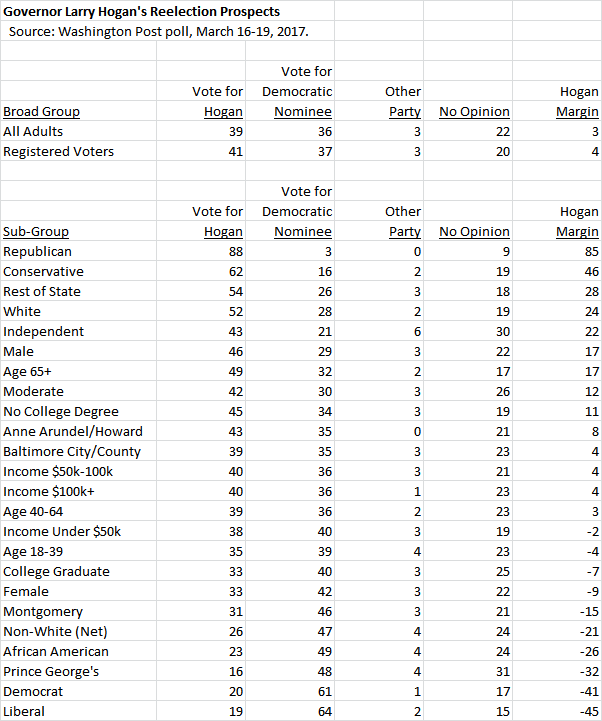
With that significant caveat in mind, let’s examine data on Hogan’s reelection prospects.  The Post asked respondents the following question: “Thinking about Maryland’s Governor’s race in 2018… if Larry Hogan ran for re-election as governor, do you think you would vote for him OR for the candidate nominated by the Democratic Party?”  Among adults, 39% said they would vote for Hogan and 36% said they would vote for the Democratic nominee, an advantage of 3 points for the Governor.  Among registered voters, 41% said they would vote for Hogan and 37% said they would vote for the Democrat, a margin of plus 4.  So far, this looks very much like Hogan’s 4-point victory in 2014.

But the sub-group results are more interesting.  We compiled the Post’s sub-group data on this question in the presentation below.

Let’s recall the margin of error estimates above.  Margins of 10-15 points or less for small sub-groups are probably not very meaningful.  That said, many of the Governor’s strengths are predictable.  He does well with Republicans, Conservatives, Whites and rural residents.  He is weak among Democrats, liberals, African Americans and Prince George’s residents.  One item that stands out is his strength with seniors, with whom he has a 17-point advantage.  Seniors are among the most reliable voters in any election.

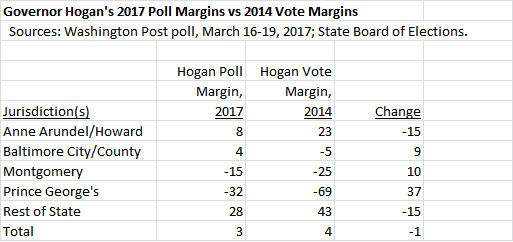
Now let’s compare the geographic results of this poll with how the Governor actually performed in 2014.

The Governor appears stronger in the poll in Baltimore and the Washington suburbs, but weaker elsewhere than in 2014.  This could be statistical noise due to large margins of error.  But it could also be the result of tax fatigue in some Democratic strongholds, like Montgomery (where voters recently passed term limits by 40 points) and Prince George’s (where the County Executive proposed a 15% increase in property taxes two years ago).  It’s hard to believe that the Governor is actually weaker in Anne Arundel and Howard, both of which have Republican Executives who are strongly favored for reelection.  (And a random question: what pollster combines Baltimore City and County in one estimate?  C’Mon, Man!)

The big takeaway from the poll is this: Larry Hogan will not be coasting to reelection.  Maryland is simply not wired that way.  It has too many Democrats, African Americans, liberals, immigrants and people who are either employed by or do business with government at some level to give any GOP statewide incumbent a blowout win.  From a purely political perspective, the Governor deserves credit for his focused message of tax cuts, job growth and reform (like redistricting) while trying his best to avoid distractions from the right, the left and Washington D.C.  His approach gives him a path to victory in a rather blue state.  But if the Democrats begin preparing now, play smart and field a good candidate for Governor, Larry Hogan can be defeated.

Share

Hogan Exploits Rape for Politics

By Adam Pagnucco.

Governor Larry Hogan is now exploiting the rape of a Rockville high school student to get a political edge over General Assembly Democrats.  It’s a clearly deplorable tactic.  But will it work?

Two big stories are colliding at the moment to further inflame the volatile issue of how to deal with illegal immigration.  First, the House of Delegates has passed a version of the Maryland Law Enforcement and Trust Act, a bill to limit state and local cooperation with U.S. Immigration and Customs Enforcement (ICE) so that immigrant communities will not hide from police for fear of arbitrary deportation.  Second, two students at Rockville High School have been arrested for raping a 14-year-old at the school and were subsequently alleged by ICE to be present in the country illegally.

Governor Hogan reacted with the Facebook post below, saying:

The post garnered 700 shares and 500 comments in its first five hours, accomplishing its purpose of throwing gasoline on the fire of the immigration debate.

The implication of the Governor’s post is that Montgomery County does not currently cooperate with federal authorities.  But in fact, it does.  The Washington Post’s Bill Turque summarized the county’s immigration policy a month ago:

Montgomery police operate under a 2009 directive that bars officers from conducting “indiscriminate questioning” of suspects, witnesses or prisoners about immigration status. Once in custody, all prisoners are fingerprinted, and arrest information goes into state databases, where it is available to ICE. If the agency identifies an undocumented prisoner, it can send the county a “detainer” notice, asking that the person remain in custody for at least 48 hours beyond the scheduled release date.

The county complied with detainers until 2014, when the Maryland attorney general’s office issued an opinion advising localities that they could be liable for damages by holding prisoners past their release date.

Since then, Montgomery officials said, the county honors detainers only if they are supported by a federal court order or warrant. It will also provide ICE publicly available release dates of undocumented immigrants who have committed felonies and whom the agency is seeking to deport.

The county has released hundreds of prisoners to ICE since 2012, though the pace of releases has dropped since the county stopped honoring 48-hour detainers.  The amended version of the House-passed Trust Act resembles county policy.  On the Rockville High School rape suspects, County Executive Ike Leggett said, “The county — consistent with our longstanding policy — will cooperate fully with ICE to see that the two are deported to their countries of origin.”

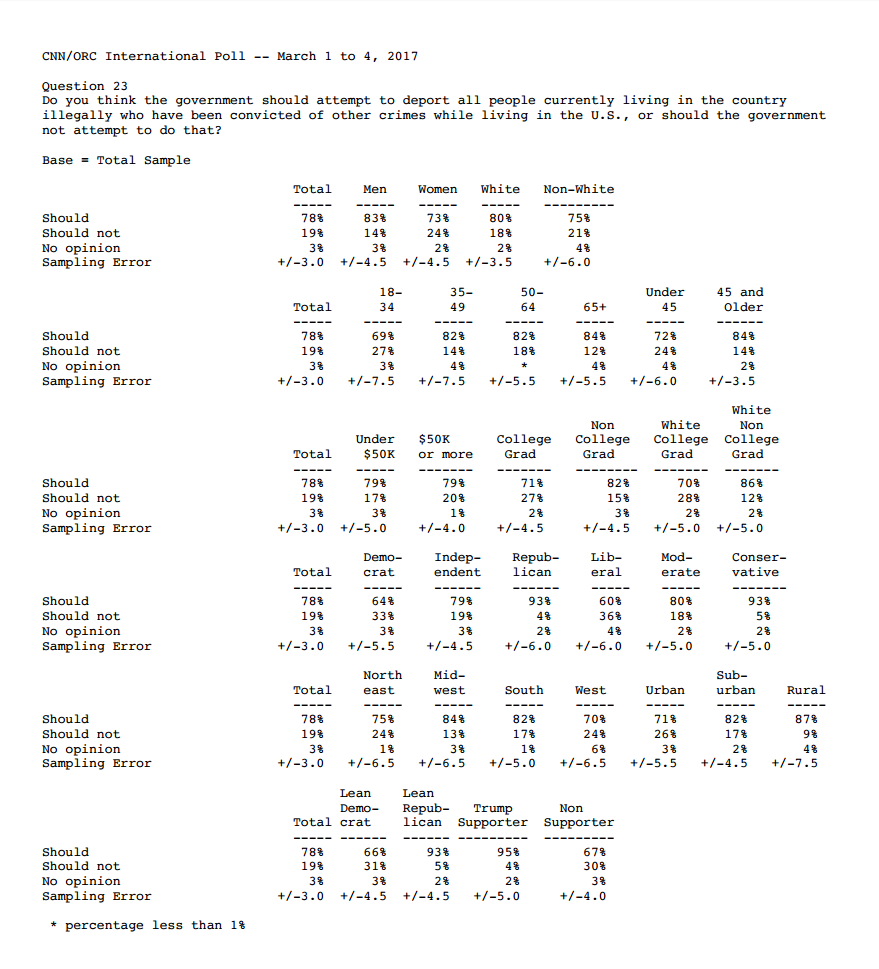
Why would Hogan insinuate that Montgomery County does not cooperate with federal law enforcement to protect its citizens?  Hogan knows that there is little support in the community for protecting violent criminals from deportation.  A new CNN poll finds that 60% of Americans believe the government should be “developing a plan to allow those in the U.S. illegally who have jobs to become legal residents,” but it also finds that 78% of Americans believe that “the government should attempt to deport all people currently living in the country illegally who have been convicted of other crimes while living in the U.S.”  Big majorities of every demographic group measured support the latter statement, including 64% of Democrats.

Depicting Maryland’s largest local jurisdiction as soft on crime is bad enough.  Exploiting a rape for political gain is even worse.  Such tactics expose just how hard the Governor can throw his elbows in partisan combat.  Forget about engaging with General Assembly leaders to develop good public policy; the Governor has never been interested in that.  But the cold political truth is this:

If Hogan can get away with characterizing Democrats as protectors of rapists and other criminals, he wins.

Share

Will You Be Paying Dan Snyder?

By Adam Pagnucco.

The Washington National Football League franchise is perhaps the only organization in America that could make Donald Trump’s White House seem like a smoothly running model of efficiency.  The club’s savage firing of its General Manager, the subsequent exodus of red chip starters like Pierre Garcon, DeSean Jackson and Chris Baker and the failure to sign star quarterback Kirk Cousins to a long-term contract have brought the franchise to its worst point in decades.  But here’s the kicker, folks.

One of these days, whether you want to or not, you could be paying for all this.

Daniel M. Snyder, the current majority owner of the Washington franchise, has often been described as the worst owner in pro sports.  Part of this is because of the team’s woeful performance on the field.  Snyder has owned the franchise for 18 years, over which it has compiled a 125-162-1 record, six winning seasons and only two playoff wins after winning three Super Bowls under the prior ownership.  The club just posted its first two consecutive winning seasons since 1991-1992 and the owner reacted by annihilating the team’s architect.  But it’s the franchise’s activities outside of the stadium, characterized by team President Bruce Allen as “winning off the field,” that are truly eye opening.  Consider this.

  • The team sued 125 season tickets holders between 2004 and 2009 to force them to honor their purchase contracts even though many were in financial distress. One of them was a 72-year-old retiree who claimed that the team’s judgment against her would force her into bankruptcy.
  • In 2006, the team tried to profit from 9/11 by selling “Pentagon Flag Hats” which featured “the team’s trademark curly ‘R’ in gold with a patch in the shape of the Pentagon and the colors of the American flag sewn on the side.” The club was the only one in the NFL to try to sell such merchandise.

  • Unhappy with negative coverage, Snyder has been buying up local media for years. It’s hard for journalists to criticize the team when they are on the owner’s payroll.  Snyder reacted to a harsh article by the Washington City Paper’s Dave McKenna by suing the newspaper and the journalist, an action he later dropped.

We could go on and on and ON.  But we know what you’re thinking.  I’m not a fan of the team, you might say.  Why should I care?

Because soon you could be paying for all this.

Dissatisfied with his twenty-year-old stadium in Landover, Snyder is now in the hunt for a new facility somewhere in the D.C. area.  The District of Columbia, home to the franchise in its glory years, is an iffy possibility given that the current Mayor has branded the team’s nickname as “offensive.”  Virginia Governor Terry McAuliffe, an enthusiastic dealmaker, is “in a hurry” to land the team before he leaves office.  And Maryland Governor Larry Hogan has said, “We will do whatever it takes to keep them.”  That could lead to a bidding war, and an expensive one at that.  NFL teams have extracted billions of dollars in public subsidies for their stadiums over the years.  Las Vegas has offered $750 million in tax money to the Raiders to entice them to move from Oakland.  And St. Louis, which just saw the Rams move out, still owes millions in bond payments on its now-empty football stadium.

Hogan loves corporate welfare, having approved millions in disbursements to Marriott and Northrop Grumman.  But those companies at least employ thousands of people in Maryland.  Snyder’s franchise is headquartered in Ashburn, Virginia and his millionaire players are almost all Virginia residents.  NFL teams are dubious candidates for public investment at best since most of them play just ten home games a year, but the Washington team’s Virginia ties make subsidizing it even more questionable.

So what can you do about this?  Snyder is only 52 years old, so he could be the team owner for decades to come.  But Hogan is another matter.  If the Governor insists on throwing hundreds of millions of dollars at this poor excuse for a franchise, you will have the last word in next year’s election.

Just do what Dan Snyder does and fire him!

Share