Council Rejects Hidden Tax Hike

By Adam Pagnucco.

Yesterday afternoon, the county council rejected the hidden tax hike that was buried in the county executive’s recommended budget.

The primary issue that bothered the council was the lack of transparency surrounding the tax hike. It was not mentioned in the executive’s budget but it would have raised $5.1 million next year and more money cumulatively in later years. Tax increase proposals attract major attention at budget time with much discussion and public testimony. But this one, which was not published but still included in revenue numbers, flew under the radar until near the end of the FY21 budget process.

Multiple council members complained about process issues. Council Member Hans Riemer noted the failure of the budget to mention the tax hike and said, “This is about our values and our approach to government… The reason why I am so concerned about this proposal is because I really think it flies in the face of our approach to good government and to transparency.” Council Member Andrew Friedson said, “Public policy means public input. And we cannot have transparent and accountable policy making unless there are transparent and accountable decisions for how we make those decisions, how we calculate the policies that we make.”

Council Member Evan Glass put on his CNN journalist hat to investigate what happened. Glass asked council staff how the issue surfaced. Staff replied, “I did not read anything published that this was included,” and said the issue was uncovered through discussions with executive staff. Glass then asked budget director Rich Madaleno why the administration proceeded with it. Madaleno defended the executive’s proposal as an appropriate calculation of the charter limit and said the executive would have discussed this upon release of the budget but that event was canceled because of COVID-19 concerns. Madaleno also said this:

Council Member Riemer is correct that in the final iteration of the budget book the piece that explained this was taken out for revision and did not make it back in before it went to the printer. For that I am profoundly sorry but other than that there would have been deep conversation and of course many of you have heard the county executive say over and over that he thinks the charter interpretation is wrong and has been talking about that for months.

Glass acknowledged that he had heard Elrich express various opinions at forums. (Remember those back in the good old days?) But he replied, “To say something in a forum but then not convey it to the council or not to, as you noted, not to even include the cover page in the budget for whatever reason is a problem.”

Even Council Member Gabe “Mr. Rogers” Albornoz had nothing nice to say about the process for considering the tax hike. When Mr. Rogers is unhappy, there is a problem.

Riemer proceeded to claim that the executive’s proposal was actually illegal because it allegedly violated the charter. The charter’s exact language on the property tax charter limit says:

Unless approved by an affirmative vote of all current Councilmembers, the Council shall not levy an ad valorem tax on real property to finance the budgets that will produce total revenue that exceeds the total revenue produced by the tax on real property in the preceding fiscal year plus a percentage of the previous year’s real property tax revenues that equals any increase in the Consumer Price Index as computed under this section. This limit does not apply to revenue from: (1) newly constructed property, (2) newly rezoned property, (3) property that, because of a change in state law, is assessed differently than it was assessed in the previous tax year, (4) property that has undergone a change in use, and (5) any development district tax used to fund capital improvement projects.

So the charter applies the rate of inflation to adjust “the total revenue produced by the tax on real property in the preceding fiscal year” to calculate the charter limit. The methodology used by the finance department for the last 30 years uses actual taxes paid on real property, including partial-year taxes on newly constructed property which was in use for only part of the year, to calculate current year total revenues. The executive’s new methodology would use taxes that new construction would have paid if billed on an annual basis to calculate current year revenue even though full-year taxes on those properties were not actually collected.

Riemer alleged that the use of hypothetical revenues rather than actual revenues to calculate the charter limit violates the plain language of the charter and asked a council attorney for his opinion. After explaining the technical issues and the possible steps for analysis by the courts, the council attorney replied, “My opinion is that the courts if asked – the court of appeals if asked – would ultimately rule for all the reasons I explained that this provision means actual revenue received during the relevant year for newly constructed property and not the potential revenue you could have received had everything been online for a full year.”

Riemer was bothered by both the transparency issue and the legal risks of the executive’s proposal and he linked the two.

The fundamental issue here is, given how risky it is, the fact that the county council and even more importantly, the public was not informed of this proposal is highly problematic. If you look at the county executive’s budget, you will not find an explanation of this decision. It’s not there. The county executive did not present a budget explaining this method of calculation. The fact is it is a $5 million increase in property taxes from all payers of property taxes in the county. But there is no explanation of that in the county’s budget. It is unthinkable to me that we would have a tax increase that has not actually been transparently presented to the community and, what more, is actually illegal. It is a violation of the charter. The combination of those two aspects of this proposal are just profoundly troubling.

Let’s remember that the principal charter limit activist in the county – Robin Ficker – is an attorney who has sued the county before and prevailed multiple times. A legal challenge to a change in charter limit administration is far from a hypothetical thing.

It’s not clear that a majority of the council agrees with Riemer on opposing the merits of the executive’s proposal. But there was obvious discomfort in dealing with this issue both late and without public input. That goes on top of other tensions with the executive branch on the budget and issues ranging beyond that. Add in stir craziness during the lockdown and these are strange times in Rockville.

After 40 minutes of discussion, the council killed the executive’s hidden tax hike on a 9-0 vote.

Share

Elrich’s Hidden Tax Hike

By Adam Pagnucco.

One month ago, I roasted the Montgomery County Republican Party for inaccurately claiming that the county was trying to “sneak in” a tax hike. At that time, the issue was a state notice requirement and not actual intent – at least not by the county council – to raise taxes. But it turns out that there actually was a hidden tax hike embedded in the budget on top of the executive’s open recommendation to raise property taxes. No one reading the budget would have found it. But county council staff did find it and now the matter is exposed.

Folks, I have been reading county budgets for almost 15 years and I don’t remember seeing anything like this.

The issue at hand is how the county calculates the charter limit on property taxes. In concept, it’s a simple procedure. The county’s finance department uses two data points: the estimated amount of real property tax revenues collected in the current fiscal year and the percentage growth of the consumer price index from the previous calendar year. Tack on inflation to the current fiscal year’s property tax revenue and that’s the charter limit for the next fiscal year. (The county can collect additional property tax revenues on a few other categories of property outside the charter limit.)

Sounds easy, yeah? But what about taxes collected from properties newly built during the current fiscal year? For the last 30 years, the county’s finance department has included the actual taxes paid on those properties in its calculation of current year revenues. So if a property was built halfway through the fiscal year, half of its annual tax bill is included in current year revenues. If a property was built nine months into the fiscal year, then one-quarter of its annual tax bill is counted. And so on. Add in these pro-rated tax bills to full-year tax bills for existing properties and that’s the current year property tax collections. Tack on inflation and that’s the charter limit.

The Elrich administration used a new methodology to calculate the charter limit in its FY21 recommended budget. Instead of using the actual tax bills paid by newly built properties in the current fiscal year, it included full-year tax bills in its estimate of current revenues even though those bills were not actually paid for the full year. That allowed the administration to calculate slightly higher current year property tax revenues. Tack on inflation and the charter limit is slightly higher. And so there is more room to raise the property tax rate than there would be otherwise.

In other words, it’s a tax hike.

It’s not a very large tax hike. Council staff estimates that the new methodology allows the county to raise an extra $5.1 million in the FY21 budget, or 0.24 cents per $100 of assessed value. (By contrast, the executive’s openly recommended tax hike was 3.18 cents.) But if this new methodology is adopted, it will compound over time and eventually raise tens of millions of dollars more than under the old methodology.

Basing tax estimates on taxes not actually received is a questionable practice at best, but let’s set aside the merits of the policy for now. The disturbing thing about this is that it was not disclosed to the public through the budget. Search the county’s 831 page budget for “charter limit” and you won’t find any discussion of this methodology change. Instead, the matter first surfaced in a council staff memo released late last week. The council held a closed session to discuss the legal ramifications of the change on Wednesday. The council will now decide the matter today.

Regardless of how one feels about taxes, let’s agree that decisions concerning them are important and warrant public scrutiny and participation. The issue was not publicly known when testimony was heard on the budget, so residents were denied the opportunity to weigh in. That is a direct result of the administration’s failure to disclose the issue in its published budget.

We deserve better.

Let’s see what the council makes of this.

Share

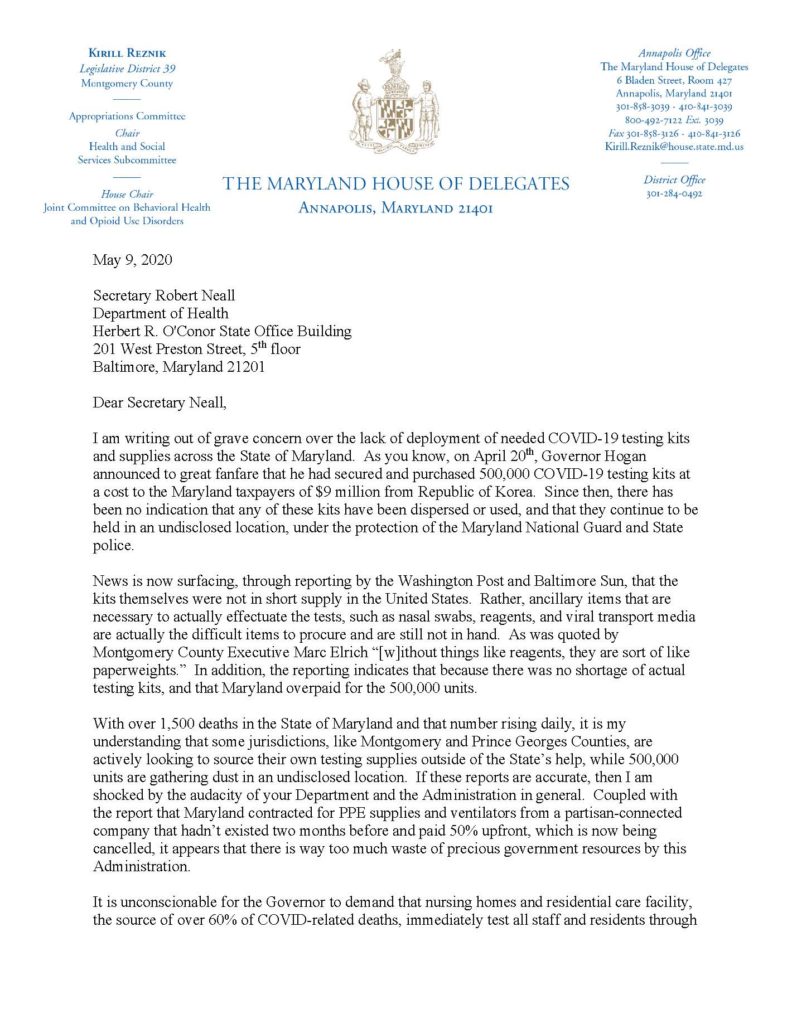
Reznik Demands to Know Why Korea Tests Haven’t Been Deployed

Like many, I was impressed and lauded Gov. Larry Hogan’s importation of 500,000 COVID-19 test kits from Korea. It looked like he had really filled the yawning leadership gap from the federal government. Unfortunately, there are rising concerns that the tests may not be useful. Indeed, they may have been widely available and Maryland may have overpaid for them.

In a letter reprinted below to the Health Secretary Robert Neall, Del. Kirill Reznik (D-39) asks a number of pointed questions about why they are not being used widely around the state. Reznik quotes Montgomery County Executive Marc Elrich explaining “without things like reagants, they are sort of like paperweights.”

Other legislators are similarly concerned. Del. Marc Korman (D-16) said on Twitter, “A great frustration I have heard is that 10 days after the Governor ordered testing at all nursing homes, these nursing homes have not received tests. . . . No timeline or schedule has been provided.”

Similarly, up in Baltimore, Del. Brooke Lierman reports that “My mother’s facility has tests only because they individually purchased them privately-the state provided nothing. I have talked to several people whose loved ones are in facilities who did not – this is a tragic unacceptable situation.”

Share

Post Endorses Harris and Evans for School Board

By Adam Pagnucco.

The Washington Post has endorsed Lynne Harris and Shebra Evans for school board. Evans is an incumbent running for reelection in District 4. Harris is a former PTA president running for an open at-large seat in a strongly contested and controversy-packed race.

The Post and the Apple Ballot are hugely influential in school board elections. Because Universities at Shady Grove professor Sunil Dasgupta already has the Apple, it will be hard (but not impossible) for candidates other than Harris and Dasgupta to make it out of the at-large primary.

I will have a lot more to say about this soon.

Share

Council Adds Staff

The Montgomery County Council voted 8-1 to fund additional staffing for councilmember offices. Councilmember Andrew Friedson (D-1) was the lone vote against. According to the official council staff recommendation, additional staffing is needed “to enable staff to provide services required to respond to COVID-19 issues and implement recently-approved legislation.”

Increasing spending on staff is not especially popular with the public even in good times. I tend to take a somewhat less jaundiced view than many members of the public of spending on staff as it can help create more professional legislatures and better legislation.

But with so many needs now begging for each public dollar, this simply boggles the mind and makes me wonder what on earth they are thinking. It strikes me as having extreme potential to become a symbol of a council uniquely out of touch with the extraordinary struggles faced by county residents in these very difficult times.

Share

Gov. Hogan Vetoes Kirwan, HBCU Funding & Many Other Bills

I’m posting Governor Larry Hogan’s veto messages below. The big ones are his veto of (1) the implementation of the Kirwan Commission recommendations for new spending on education and (2) funding for HBCUs (historically black colleges and universities). Both set up epic battles with Democrats in the General Assembly that will show the ability of new Speaker Adrienne Jones and Senate President Bill Ferguson to unite their caucuses behind key pieces of their agenda.

The governor vetoed a slew of other spending measures, justifying them based on the current COVID-19 crisis:

He also vetoed new taxes and fees:

Sponsored by Sen. Feldman and Del. Korman, the following vetoed bill made it easier for WMATA to spend more without losing the state’s contribution.

In his veto of a ban on pesticides sponsored by Sen. Lam and Del. Stein, the Governor claims he has accomplished essentially the same through more sensitive regulation:

Gov. Hogan vetoed legislation sponsored by Sen. Young and Del. Healey that would have limited the power of the Board of Public Works regarding land acquisition:

Gov. Hogan also vetoed this bill sponsored by first-term Del. Solomon that would have piloted MARC service between Union Station and Alexandria as well as between Perryville and Newark, DE:

Gov. Hogan vetoed a bill sponsored by Sen. Waldstreicher that would have banned certain outdoor signs along or near expressways.

Share

MoCo’s Nasty School Board Race, Part One

By Adam Pagnucco.

Negative campaigning has a long and brutal history in Montgomery County but this year’s school board election is emerging as one of the most contentious contests in decades. The arguments contain echoes of the titanic school board election battles of the early 1980s, in which a conservative faction led by Marian Greenblatt was eventually toppled. Then as now, race, school boundaries, accusations of busing and the shadow of national politics mixed in a bubbling witches’ brew that no cauldron could hold. There is nothing new here. Rather, skeletons emerge from the grave to refight battles that seem as eternal as they are ancient.

The immediate impetus of the current dispute is a change made to MCPS’s facility planning policy in September 2018. Prior to the change, four factors were weighted equally in picking sites for new schools and changing school boundaries: demographic characteristics of student population, geography, stability of school assignments over time and facility utilization. The new policy was revised to contain this sentence on demographics: “Options should especially strive to create a diverse student body in each of the affected schools in alignment with Board Policy ACD, Quality Integrated Education.” Jill Ortman-Fouse, who at that time was on the school board and helped lead the effort to change the policy, justified it by saying, “Diversity matters. Let’s weight that a little bit more.” MCPS followed up by hiring a contractor to study school boundaries and implementing a redistricting in Germantown and Clarksburg that spawned a lawsuit.

Now supporters and opponents of the new facilities policy and the boundary analysis are at war. The leader of the opposition is Stephen Austin, a newcomer to MoCo politics who set up a Facebook group last winter that now has almost 8,000 members. It’s unusual in the county for such a large group to form so quickly without external organization and funding, but schools are a hot issue here for folks with all kinds of perspectives. The other side is a group of MCPS activists favoring the boundary analysis, many of whom have been active on school issues for a long time. Their spiritual leader is Ortman-Fouse, who has made diversity her signature issue both during and after her tenure on the school board. Austin is one of 13 candidates running for an at-large school board seat in a field with varying views on school boundaries. Strong feelings run high on both sides.

My personal sympathies lie with those who favor diverse schools. My upstate New York elementary school was roughly 90% white. When I moved to MoCo, I deliberately chose to live near a diverse public elementary school so that my kid could benefit from being around others with different races, cultures and life experiences. My choice paid off in a BIG way. My kid has experienced both diversity and superb academic instruction at the same time. He is much better prepared for the modern world than I was at his age. So I won’t be voting for any candidate who opposes diversity.

But there is more going on here than just that one issue.

I read the posts in Austin’s Facebook group almost every day. There are statements on there with which I disagree. There is some nastiness directed at the other side (and the press). But there are also participants who express a mixture of curiosity, concern and skepticism. Some distrust what they see as a centralized school bureaucracy that does not communicate very well. (This is one sentiment they share with some on the other side!) There are plenty of folks there who are not white. There has also been discussion of issues other than the boundary analysis. It’s a more complicated place than Austin’s opponents might admit. However, some of the blame for that goes to the moderators who have kicked out people who disagree, causing the exiles to assume the worst since they can’t view the content themselves. Inflammatory tidbits sometimes leak anyway.

I’m not all that worried about the pugilists in the ring. In politics, anyone who throws a punch should be ready to take a punch. But I do wonder about the people in Austin’s group, as well as on other social media threads, who read all of this material and say nothing. What are they thinking? I bet more than a few believe there is no point in saying anything because if they do, and if they vary from the orthodoxy of either side, they will be subject to bitter, public personal attacks. How many folks who have something to contribute will never run for school board or get involved with school issues at all for fear of being hurled into the mud?

Here is a great irony. Austin’s supporters believe that the school board does not do enough to oversee or challenge MCPS management – a view shared by some on the left. It’s a common perception that some school board members get assimilated into the system after winning office (with the notable exception of the 2015 revolt against then-Superintendent Josh Starr). Bereft of a sizeable, independent staff of analysts reporting exclusively to them, the board risks being at the mercy of a management that can control information and set tight boundaries for policy decisions. One school board member who resisted that tendency was none other than Ortman-Fouse, who never backed down from management, regularly demanded (and released) data and engaged in actual constituent service – just like elected officials are supposed to do. Put aside their ideological disagreements and Ortman-Fouse could provide a model of independent-minded school board service that even Austin and his folks could appreciate were it not for their mutual loathing.

At this point, tribal politics has taken over this race. Each tribe fears what the other one will do if it wins. Non-tribe members are barely acknowledged even though at least 99% of the county has no idea what is going on in this election. The disengagement of so many voters and the sheer oddities of present times make this a hard race to divine.

In Part Two, I’ll assess the tactical environment in what might be MoCo’s strangest election ever.

And in Part Three, I’ll talk about a few issues that have been largely undiscussed so far but collectively will determine at least as much of MCPS’s future as any boundary analysis.

Share

How Can You Help? Webinar on Charitable Giving Tomorrow

Title: The COVID Crisis: Where and How You Can Help Our Community
Date & Time: Friday, May 8th, 11:30 AM – 12:30 PM

Participants:

  • Mark Bergel, Founder and Executive Director, A Wider Circle
  • Diego Uriburu, Executive Director & Co-Founder, Identity, Inc
  • Jackie DeCarlo, Chief Executive Officer, Manna Food Center
  • George Escobar, Chief of Programs and Services, CASA
  • Councilmember Gabe Albornoz – Update on County Emergency Assistance

If you’re interested in volunteering or looking for places to donate? The webinar will provide information on food assistance efforts, mask making opportunities, virtual tutoring, diaper and formula drives, grocery card collections, virtual job training, and future volunteer opportunities.

To Register: https://bit.ly/HelpingOurCommunity

h/t: @jaredssolomon.

Share

Help Fight Hunger

Normally, I avoid making my blog a place to make charitable appeals, but these aren’t normal times.

Even at the best of times, too many people in America wonder how they will pay for their next meal. The mass unemployment resulting from the COVID-19 crisis, exacerbated by the federal government’s poor, dithering response, has only made matters worse.

State and local authorities in Maryland are working to rise to the occasion. Here in Montgomery, I know our local government is doing its best to protect the most vulnerable in this nerve wracking time.

But it’s not enough when faced with such overwhelming need.

If you want to help bring just a little more peace of mind to parents trying to figure out how to feed their children or themselves, consider donating to a local food pantry.

In Montgomery County, Manna Food Center has long done outstanding work feeding the hungry. To combat rising hunger during the crisis, for example, they have set up 11 sites around the county where people can pickup food bags to help people stay put and fed. They are also providing meals for children at more than 40 sites around the county.

If you’re fortunate enough to still have your job or riding out the stay-at-home order in relative comfort, I hope you’ll consider a gift to Manna or another organization doing similar work.

Share

The State Must Produce Precinct Election Results

It’s tempting to dispense with precinct election results when a jurisdiction switches to vote by mail (VBM). But Maryland shouldn’t do it.

Voting Rights Act Compliance

The most important reason by far is to assure that redistricting plans around the state comply with the federal Voting Rights Act (VRA). Some mistakenly think that the VRA is longer in force since the Supreme Court’s decision in Shelby v Holder (2013) suspended federal preclearance of new voting and election laws previously required under Section 5 of the VRA for covered jurisdictions.

Section 2 nevertheless remains in force and continues to prohibit discriminatory redistricting practices. In any case, Maryland has never been a covered jurisdiction that had to submit its election practices to federal scrutiny under Section 5.

Precinct election results are critical evidence for both bringing and defending redistricting cases under Section 2 of the VRA. Matching race and ethicity data with precincts election results allows the application of statistical methods to estimate turnout rates and candidate support levels by race and ethnicity. These estimates are critical for both bringing and defending challenges under Section 2.

There is really no substitute for this approach. Polling data is unavailable for all but statewide contests and even then it cannot be broken down reliably to legislative or county council district levels. Consequently, precinct election data remains vital to make it possible for courts to adjudicate Section 2 cases properly.

In order to win a redistricting challenge under Section 2, plaintiffs must satisfy a three-prong test outlined by the U.S. Supreme Court in Thornburg v Gingles (1986). The minority must be: (1) sufficiently large and geographically compact to constitute a majority in a single-member district; (2) politically cohesive; and (3) racial-bloc voting usually defeats the minority’s preferred candidate.

The last two prongs rely on having estimates of voting behavior by race. In the absence of precinct election results, these will be impossible to generate. While results from earlier years will remain available, results from the most recent elections are considered the most valuable since they are closest to the current situation.

State defense attorneys might welcome making it more difficult to bring voting rights challenges. But it hardly seems the right approach for a state committed to racial equality and compliance with federal law. Choosing not to produce precinct election results for this reason could even become evidence of racially discriminatory intent.

Fortunately, VBM is not a barrier to producing precinct election results. It is little different than distributing early vote back to precincts. Undoubtedly, it takes more effort but longstanding VBM states do it. Maryland can look to these models for guidance as they continue to prepare for a different Fall election than expected.

The state claims that it cannot produce them for June – a claim that deserves close scrutiny. Lawmakers must continue to press them to change this decision for June and November and to make sure that our elections remain safe and top notch.

Preventing and Finding Fraud

Beyond the Voting Rights Act issues, precinct election results remain extremely valuable for fraud detection. Political scientists and statisticians have developed methods to sniff out outcomes that are highly unlikely absent fraud. They are equally useful for undercutting irresponsible and baseless fraud claims from the Left or the Right.

Share

Maryland Politics Watch