Tag Archives: Adam Pagnucco

Delaney Dominoes

By Adam Pagnucco.

From the perspective of political blogging (which we all know matters most!), Congressman John Delaney is the greatest Maryland politician of all time.  That’s not because of anything he has done in Congress.  (No one does anything in Congress these days!)  It’s because his decision-making has affected the races for Governor, Congress District 6, County Executive, County Council and several State Senate and House of Delegates seats.  This is an enormous bonanza for political junkies and will keep us VERY busy.  We love you, John Delaney!

Here’s a quick and dirty take on how the Delaney Dominoes are falling.

Governor

None of the Democratic candidates for Governor fit Delaney’s ideological center-left positioning.  Baltimore County Executive Kevin Kamenetz, who can claim that his jurisdiction has not increased either property or income taxes in twenty-five years, might come closest.  But the biggest impact of Delaney’s absence may be geographic.  With the Congressman out and former Attorney General Doug Gansler not showing signs of serious activity, Senator Rich Madaleno might be the only MoCo candidate in the race.  That’s a big deal.  If Madaleno consolidates MoCo while three African American candidates run hard in the City and Prince George’s, this race becomes very unpredictable.  (Disclosure: your author has done work for Madaleno.)

Congress District 6

Total Wine co-owner David Trone has been interviewing elected officials, activists, operatives and other local players for months as he figures out his options.  Our hunch is that he will see Delaney’s congressional district as his best play and run there.  He will join Delegates Bill Frick and Aruna Miller, Senator Roger Manno and former Democratic nominee Andrew Duck on the Democratic side.  The Republicans should have a vigorous primary too as they have a real shot at the open seat.

County Executive

If Trone runs for Congress, that will leave three term-limited Council Members – Roger Berliner, Marc Elrich and George Leventhal – as the only Democrats running for Executive at this moment.  But given the fact that most Democrats voted for term limits and anti-tax sentiment continues to linger, it’s hard to believe that a non-Council Member will not get in.  Trone’s absence creates a void that could very well get filled.

County Council

County Council candidates will all sigh in relief if Trone runs for Congress.  That’s because there have been rumors of a Trone Slate for months in which Trone would deposit his own money in a slate account to be drawn on by allied council candidates.  With that possibility off the table, the at-large candidates are on their own.   Since most are in public financing, it’s unlikely that very many of them will accumulate large financial advantages of 3-to-1 to 4-to-1 over their nearest rivals.  That makes for very competitive races in District 1 and at-large.

State Legislative Districts

If Miller, Frick and Manno stay in the race for Congress until the end, that means there will be open seats in Districts 15, 16 and 19.  In District 15, the recent custom has been for the incumbents to pick a new candidate to fill out their slate.  (That is a big reason why Miller originally won her seat in 2010.)  The question is whether any new candidate merits such a selection.  A District 16 open seat race is like an Italian Sunday dinner: everyone shows up.  An open seat in 2010 attracted thirteen candidates and an open seat in 2014 attracted eight candidates.  There will be no rest for Delegates Ariana Kelly and Marc Korman!  Manno’s Senate seat will draw the interest of at least one Delegate, thereby creating at least one House opening.  There are already three non-incumbents who have filed for the District 19 House seats with more probably on the way.

Add the above to actual or possible races in Council District 3, Legislative District 17 (House and maybe Senate), Legislative District 18 (House and Senate), Legislative District 20 (maybe House) and Legislative District 39 (House) and that makes 2018 the most politically active year in MoCo in decades.  Enjoy folks, and remember to thank John Delaney the next time you see him!

Share

Washington Post Looking for Turque Successor

By Adam Pagnucco.

The Washington Post has posted an employment ad seeking a successor to recently departed MoCo beat reporter Bill Turque.  We will have much more to say about Turque soon, but for now, we re-post the ad itself.  (Andrew Metcalf, do you see this?)

*****

The Washington Post’s Metro desk is looking for a reporter to cover government and politics in Montgomery County, Maryland’s largest and perhaps most powerful jurisdiction.

This is a crucial role, as our digital and print readers crave local news. We are looking for a reporter who can provide strong and authoritative coverage of county government and elections, which are unfolding in a new era of term limits and public campaign financing. As the Metro desk continues to try to redefine local news coverage, we are looking for someone who can spot trends in Montgomery and tell readers across the nation why what’s happening in Montgomery has resonance for them. Similarly, the successful candidate will be able to explain how national issues have real-world consequences right here in Montgomery County.

Covering Montgomery County is a great opportunity to write about issues facing 21st-century suburbs, including immigration, the growing importance of mass transit and the challenges posed by aging neighborhoods and infrastructure. It’s also a great place for accountability reporting, with a budget of $5.4 billion and thousands of employees. In addition, there are nearly a million people who live in Montgomery County, and there are human stories to tell.

We are looking for a reporter who can be a collaborative part of our Maryland politics team by helping to cover the upcoming governor’s race and Congressional mid-terms.

If you are interested, please contact Debbi Wilgoren (debbi.wilgoren@washpost.com) Monica Norton (monica.norton@washpost.com), Mike Semel (mike.semel@washpost.com) or Tracy Grant (tracy.grant@washpost.com) no later than Aug. 11.


Share

Blogs Were Right About “Ridiculous” Delaney Story

By Adam Pagnucco.

The John Delaney for President story was started by a blog.  It was kept alive by blogs.  And now the bloggers, irresponsible rascals that they are, have been proven right.

Ryan Miner of A Miner Detail kicked off the Delaney for President story on May 3.  He had two pieces of information: a prediction by former Attorney General Doug Gansler that Delaney would be running for President and a claim by MSNBC host Chris Matthews that Delaney had opened an office in Iowa.  That was enough to get The Daily Record’s Bryan Sears to investigate.  Sears wrote:

Will McDonald, a spokesman for Delaney’s campaign, said Delaney is not considering a run for president or opening an office in Iowa.

“Congressman Delaney does not have an office in Iowa or any other place other than Maryland and Washington, D.C.,” McDonald said in an email. “As he has said before, the Congressman and his wife plan to make an announcement regarding a possible run for Maryland’s governor by the end of June.”

The Sun followed up:

Rumors have swirled recently that Delaney is also taking a look at a run for president in 2020 — talk that was amplified when MSNBC host Chris Matthews, Kathleen’s husband, said during his program last week the congressman was setting up an office in Iowa. A Delaney spokesman denied that his boss had office space in the first-in-the-nation presidential caucus state.

On May 11, MCM asked Delaney directly if he was running for President.  Delaney said, “It was as ridiculous then as it is now… I’m not running for President.”

So the story was dead, yeah?  The problem was that the blogs wouldn’t let it die.

Right after Miner’s story, Seventh State noted that Delaney had three federal fundraisers scheduled in May and June.  If Delaney were running for Governor, why was he still raising federal money?  It did not seem necessary for a Congressional run as he could self-fund such a race.  Miner followed up on May 8 with a statement from Delaney’s spokesman shooting down speculation about his wife running for office and emphasizing his consideration of a race for Governor.  And on June 15, Seventh State noted even more federal fundraising by Delaney.

And now we have it: John Delaney ‘s Washington Post op-ed Why I’m Running for President.

Hail to the Great Big Mouths of Doug Gansler and Chris Matthews.  Hail to Ryan Miner for being first and sticking with his scoop even though few other outlets bothered to link to his work.  Hail to John Delaney for saying it was “ridiculous” that he was running for President and then confirming the rumor in his own words in the Washington Post.  And above all, hail to irresponsible rogue blogs.  Where would we be without them?

Share

The Zombie Bridge Returns

By Adam Pagnucco.

The long-discussed second bridge across the Potomac may never truly be dead.  Dubbed “the Zombie Bridge” by Council President Roger Berliner, the creature will continually claw from the grave as long as its living minions keep trying to shovel it out.  And this time, the zombie’s targets will include county candidates for office.

First, a bit of background.  Discussions of a second bridge date back to at least the time of the American Legion Bridge’s construction in 1962 as part of a possible Outer Beltway.  Montgomery County and the state even included the second bridge in their master plans until it was removed in 1974.  Nevertheless, the bridge has been examined several times.  Twenty years ago, the bridge and its associated roadway was known as “the Techway” and was the subject of a 2000 federal study requested by Virginia Congressman Frank Wolf.  Within months, Wolf asked that the study be canceled after constituents fearful of property seizures mobilized against it.  But the bridge was awakened yet again by a 2004 study of the American Legion Bridge which showed some demand among travelers in points west.

Anyone have any brains in Maryland?

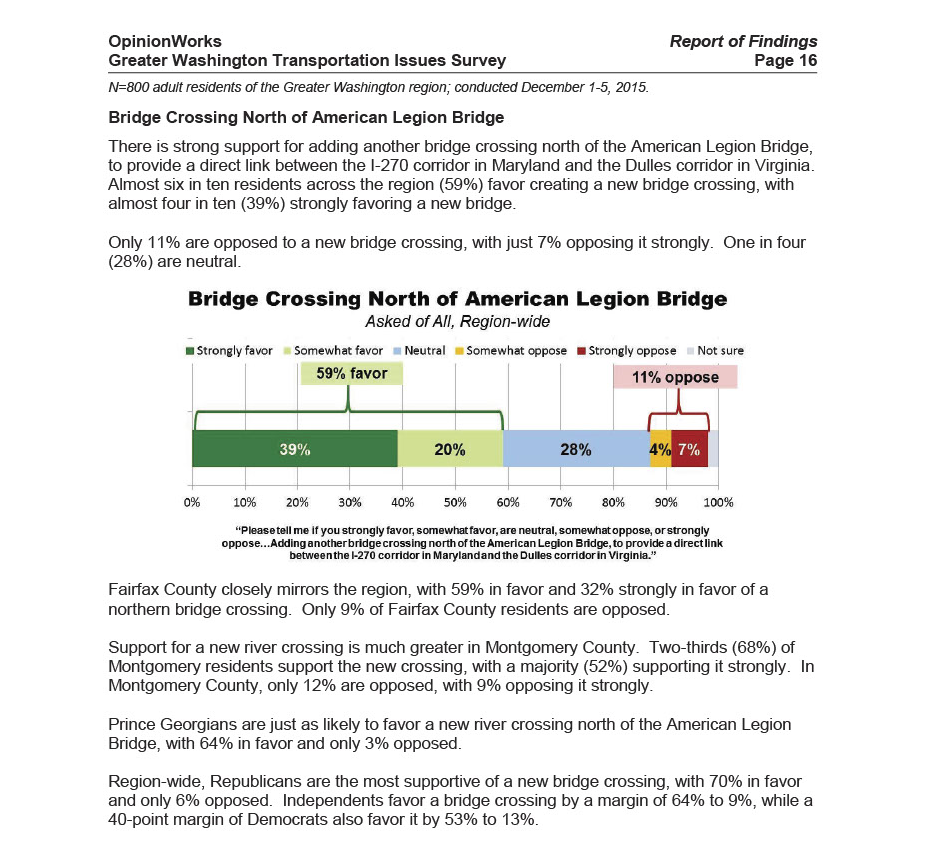
The bridge’s supporters are clustered in two organizations.   The first is the 2030 Group, an organization of major developers and construction firms with property in both Maryland and Virginia.  Members of the 2030 Group have significant overlap with the board of the Suburban Maryland Transportation Alliance, which also supports the bridge.  Advocates for the bridge cite a 2015 poll by OpinionWorks of 800 adults in the Washington region that shows substantial support.  According to the poll (shown below), 59% of respondents favor the bridge, including 39% who strongly favor it, and 11% oppose it.  In Montgomery County, 68% favor (52% strongly) and 12% oppose.  The poll does not mention the bridge’s cost (a figure that may not exist in any reliable form yet) or its location.

Opponents, including smart growth groups and environmentalists, point out that the project is not just about the bridge itself but also its connection to the county’s road network.  The bridge, proposed to extend north from Route 28 in Virginia, is not supposed to terminate at River Road but is intended to connect northeast to I-370 and the Intercounty Connector.  How much is that likely to cost?  (The ICC cost $2.4 billion.)  How much property will have to be seized for its route?  (Much of the right of way for the ICC was already in state or county hands as that road had been planned for decades.)  Another factor for consideration is that the State of Maryland owns the entire Potomac River between the District and West Virginia.  Virginia Governor Terry McAuliffe told Bethesda Magazine, “I don’t fund bridges that aren’t in our state. It doesn’t touch our border. That’s your simple answer… I take responsibility for bridges in Virginia.”  That leaves Maryland and MoCo to figure out how to pay for any new bridge.

Connect the red stars.  How would you plan a route from a new Potomac bridge to I-370?

Despite the unanimous opposition of the Montgomery County Council and no apparent support from Maryland Governor Larry Hogan, the National Capital Region Transportation Planning Board just voted to study a new Potomac bridge.  That has effectively resuscitated the project, which now shambles from the grave into the 2018 elections.  Because it is now under study, it is certain that we have not heard the last word on the bridge until the June primaries.  The deep-pocketed real estate and construction interests who support the bridge may fund an advocacy campaign to sway both candidates and voters on its behalf.  Meanwhile, environmental and smart growth groups will include questions about the bridge on every questionnaire they send to candidates and will likely consider it a litmus test issue.  All of this will squeeze candidates between major progressive organizations and traffic-hostile voters looking for alternatives to I-270 and the Beltway.

MoCo politicians may try to run, try to hide and cry out for help as they flee from the monster, but it will continue to stalk them no matter how hard they try to escape.  The Zombie Bridge has returned.

Share

MoCo County Candidate List, July 2017

By Adam Pagnucco.

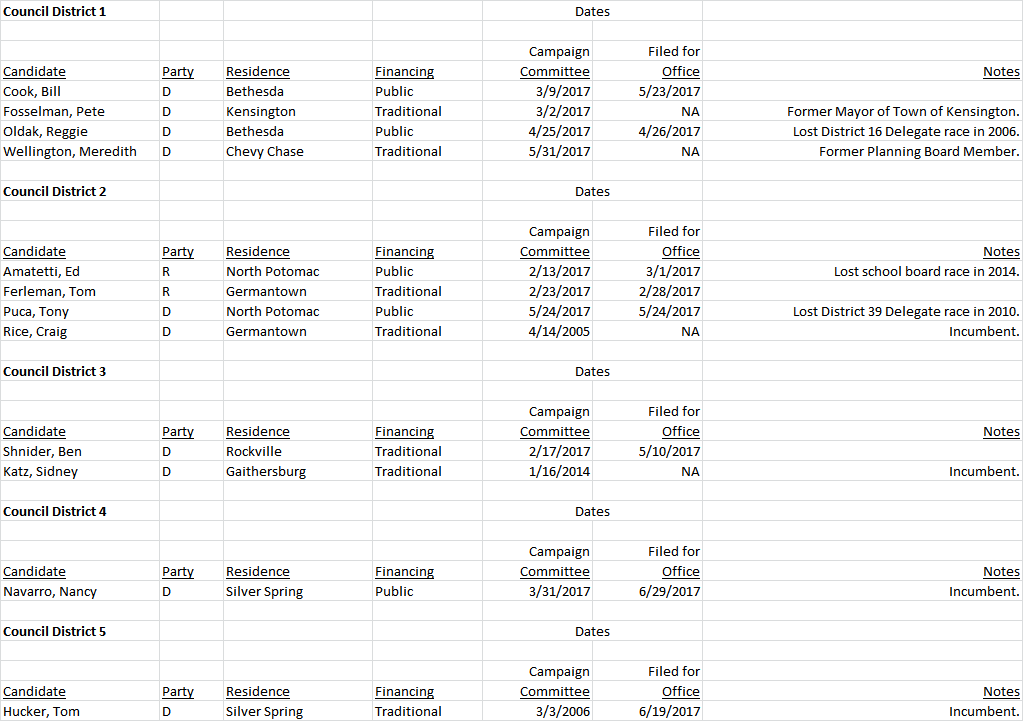
Significant speculation surrounds the number of candidates who could be running for county office in MoCo next year.  Some believe that fifty or more people are interested in running but the ultimate number will probably be much less.  Below are the candidates who are actually running for County Executive or County Council at this moment.  All of them have either established a campaign committee, have filed to run, have publicly announced their intent to run or are incumbents who are eligible for reelection.  If there are mistakes or omissions on this list, please let us know.  We will be posting regular updates.

Share

Does Takoma Park Dominate the At-Large Council Seats?

By Adam Pagnucco.

The county’s Charter Review Commission is considering recommending a charter amendment that would abolish or reduce the number of the County Council’s at-large seats, which account for four of the council’s nine seats.  One reason for this is that currently three of the four at-large seats are held by residents of Takoma Park, long regarded as the most left-wing jurisdiction in the State of Maryland.  Over the years, your author has heard sporadic complaints that Takoma Park’s alleged dominance of the council has pushed the council to the left and/or directed excessive resources to Downcounty and the city.

The fact is that Takoma Park’s current holding of three seats is very disproportionate relative to its population (roughly 18,000 in a county of a million people).  But it hasn’t always been that way.  Below is the residence history of at-large Council Members since the current council structure was created in 1990.

At-Large Council Member Residency, 1990-2018

1990-1994

Bruce Adams: Bethesda

Gail Ewing: Potomac

Ike Leggett: Burtonsville

Mike Subin: Gaithersburg

1994-1998

Gail Ewing: Potomac

Ike Leggett: Burtonsville

Neal Potter: Chevy Chase

Mike Subin: Gaithersburg

1998-2002

Blair Ewing: Silver Spring

Ike Leggett: Burtonsville

Steve Silverman: Silver Spring

Mike Subin: Gaithersburg

2002-2006

Nancy Floreen: Garrett Park

George Leventhal: Takoma Park

Steve Silverman: Silver Spring

Mike Subin: Gaithersburg

2006-2010

Marc Elrich: Takoma Park

Nancy Floreen: Garrett Park

George Leventhal: Takoma Park

Duchy Trachtenberg: North Bethesda

2010-2014

Marc Elrich: Takoma Park

Nancy Floreen: Garrett Park

George Leventhal: Takoma Park

Hans Riemer: Silver Spring/Takoma Park

Note: Riemer moved from Silver Spring to Takoma Park in the middle of his first term.

2014-2018

Marc Elrich: Takoma Park

Nancy Floreen: Garrett Park

George Leventhal: Takoma Park

Hans Riemer: Takoma Park

At-large terms with a resident on the council, 1990-2018

Takoma Park: 8.5

Gaithersburg: 4

Garrett Park: 4

Silver Spring: 3.5

Burtonsville: 3

Potomac: 2

Bethesda: 1

Chevy Chase: 1

North Bethesda: 1

It’s also worth noting that over these seven terms, only one term saw a Takoma Park resident representing Council District 5 (Tom Perez in 2002-2006).  The other elected District 5 Council Members – Derick Berlage, Valerie Ervin and Tom Hucker – have lived in Silver Spring.

Takoma Park’s dominance of the at-large seats began in earnest in 2006 and appears to be temporary.  Council Members George Leventhal and Marc Elrich are term-limited and leaving the council.  Council Member Hans Riemer will get one more term before he is out too.  Of the current field of Democratic at-large candidates, your author knows of just one – former City Council Member Seth Grimes – who comes from Takoma Park and intends to run.  A bigger issue is that most at-large members tend to come from Downcounty, but that’s natural considering that’s where most regular Democratic voters live.

There may be good reasons for going to an all-district council structure and your author does not have a strong opinion on that.  But instituting a permanent, structural fix like reorganizing the council is not an appropriate remedy for dealing with a temporary issue like Takoma Park’s number of at-large seats.  Proponents of reducing the at-large seats need a better argument.

Share

Did MoCo Term Limits Cause More Competition?

By Adam Pagnucco.

One theory making the rounds in MoCo’s political world is that the passage of term limits for county officials is responsible for creating the high level of candidate competition we are now witnessing.  An opposing point of view is that this competition would have happened anyway due to other factors, such as County Executive Ike Leggett’s retirement and the availability of public campaign financing.  Who’s right and who’s wrong?

In assessing these two views, we asked the candidates themselves which one has more truth.  Following are the perspectives of six people who are actual or potential candidates for seats with term limited incumbents.

Source 1: There is no doubt in my mind that term limits and the resulting open seats are among the most important reasons there are so many people running for council. I have heard that from a number of other candidates.

Source 2: I think there would have been healthy competition without term limits for the same reason that term limits passed. People are ready for some change. Public financing is also a big factor in bringing in new candidates. It would have emboldened challengers even without term limits. Now we have three term limited council members vying for Executive. Room there for new blood, don’t you think?

Source 3: I think Leventhal, Berliner and Elrich would have run anyway. Not sure about Floreen. So I think there would have been a large number of new people anyway. And then public financing probably doubled that number.

Term limits author Robin Ficker credits his successful charter amendment for promoting “fresh ideas.”  Is he right?

Source 4: I believe that Ike would not have sought a 4th term regardless of the term limit issue. This would have freed up seats because of the interest in running for CE. I’m also not confident that Nancy Floreen would have sought an additional term anyway. I’m more in the “competition would have occurred anyway” camp. In my opinion, the number of open seats because of an opening for CE plus retirement, coupled with public finance and the “Trump effect” have created the high level of interest and competition that we will see.

Source 5: You can entertain all sorts of theories and hypotheticals but at the end of the day, more people run when there’s an open seat.  And more seats (probably) opened because of term limits. I mean, might Elrich, Berliner and Leventhal have run for CE anyway? Maybe. But term limits seems to make the current scenario much more likely, and thus draw in more competition because there are more open seats. I also think some “perfect storm” effect of term limits and public financing landing in the same cycle probably enhanced the overall effect on competition. But I think term limits are more significant here than public financing is.

Source 6: Term limits were very helpful in demonstrating the mood of the electorate: an across the board and widespread feeling that they wanted new leadership and a different approach. But I honestly don’t think it made a material change in the number of open seats — just the feeling of those running, thinking about running and the electorate. Unless people think Ike would have run for a 4th term which I don’t but I imagine would have been possible.

Our Take

The key to understanding the impact of term limits is the decision-making of incumbent County Executive Ike Leggett.  After being elected to his second term as Executive in 2010, Leggett said that he was “originally inclined not to run again.”  That stance helped induce former County Executive Doug Duncan and Council Members Phil Andrews, Valerie Ervin and George Leventhal to consider running for Leggett’s seat.  But by November 2012, Leggett was considering another run and he made it official in June 2013.  Ervin (who had commissioned a poll) and Leventhal decided not to challenge Leggett and he went on to defeat Duncan and Andrews in 2014.

This time around, term limits robbed Leggett of the ability to change his mind.  He ruled out another run last October, but by that point it had become clear to nearly everyone that term limits were going to pass.  Once they did, Leventhal and fellow Council Member Marc Elrich were running for Executive in short order and their colleague Roger Berliner soon followed.  Might Leggett have retired anyway?  Sure, but term limits answered that question once and for all.  Term limits also ruled out another council run for at-large incumbent Nancy Floreen.  These open seats plus public financing have created a historic deluge of county-level candidates in MoCo.

Our sense is that term limits alone did not cause all the competition we are seeing.  But they did bring clarity to the political landscape and they accelerated the plans of many candidates.  One of them, at-large candidate Bill Conway, has already claimed to qualify for public matching funds in the county’s public financing system.  Others are on the way.  One more thing seems clear: almost no one is mourning the passage of term limits.  Many Democratic activists seem pleased with the abundance of choices they will have next year.  On to the future.

Share

Bill Conway to Qualify for Public Funding

By Adam Pagnucco.

Bill Conway, who is running for Council At-Large, has announced that he has raised enough small individual contributions in the county’s public financing system to qualify for public matching funds.  Assuming that the State Board of Elections agrees, Conway would be the second at-large candidate (after incumbent Hans Riemer) to collect public money.

We will have more to say about Conway and several other at-large candidates in an upcoming series.  His press release appears below.

*****

FOR IMMEDIATE RELEASE: Friday July 7, 2017

Bill Conway Is First Non-Incumbent, At-Large County Council Candidate  To Reach Threshold For Receiving Public Matching Funds

Bill Conway, a Democratic at-large candidate for Montgomery County Council, announced today that his campaign has collected more than 250 contributions from Montgomery County residents, totaling more than $28,000. Once the contributions have been certified by the Maryland State Board of Elections, Conway’s campaign will be eligible to receive more than $84,000 from the Public Election Fund.

Under the public campaign finance law, an at-large candidate for County Council qualifies for matching funds after receiving at least 250 contributions totaling at least $20,000 from county residents. Contributions are matched under the following schedule: first $50 is matched 4×1; second $50 is matched 3×1; third $50 is matched 2×1. This results in a $50 contribution becoming $250, a $100 contribution becoming $450 and a $150 contribution becoming $600.

Participation in the public finance program is voluntary.  Candidates who participate in the program may not accept contributions of more than $150 per individual and may not accept contributions from PACs, corporations or labor unions.

“I’m participating in the public finance program because I believe that every voter should have a meaningful voice in electing our leaders,” Conway said. “I am deeply grateful to my supporters for the confidence they have shown in me through their contributions. If elected to the Council I will bring substantial legislative and business experience, a record of policy innovation, and a commitment to listening to all sides of the issues.”

Visit Bill’s website:

www.billconwayforcouncil.com

and his Facebook page:

https://www.facebook.com/Bill-Conway-for-Council-294085764336433/

to learn more about his campaign.

###

Contact:

Doug Wallick – Campaign Manager

info@billconwayforcouncil.com

Share

MoCo Our Revolution Members Push Back on Early Endorsement

By Adam Pagnucco.

The Washington Post recently reported on the Maryland chapter of Our Revolution’s plans to issue an early endorsement of Ben Jealous for Governor of Maryland.  Among other things, the Post article said:

“A lot of Bernie Sanders’ supporters — and I was a Bernie Sanders supporter — were unhappy with the lack of transparency in the DNC process,” said Walter Ludwig, a spokesman for the gubernatorial campaign of state Sen. Richard S. Madaleno Jr. (D-Montgomery), who like Jealous is a progressive hoping to draw support from liberal Democrats. “This is no more transparent.”

Aides to several other declared or likely candidates declined to comment on the record, to avoid a potential rift with Jealous’s supporters. Speaking on the condition of anonymity, however, they said they found it strange that Our Revolution wanted to endorse so early in the process, before all the expected candidates had launched their campaigns.

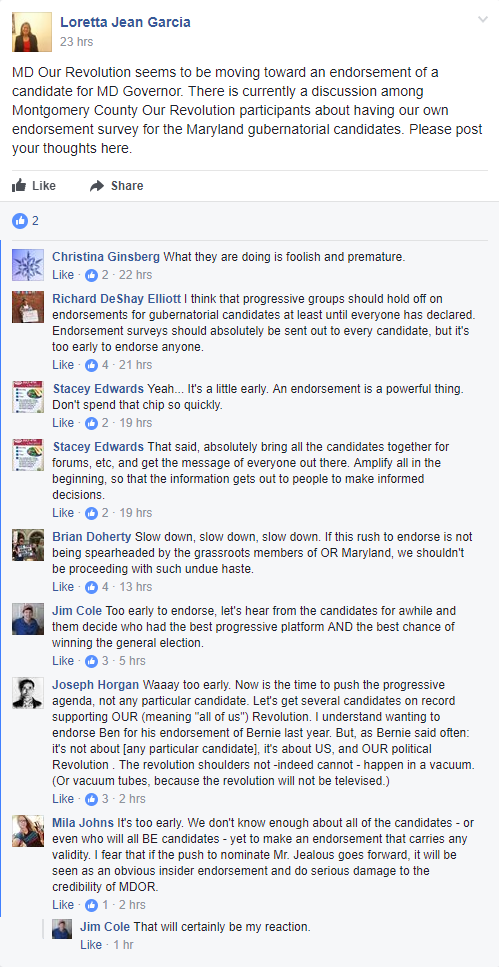
Montgomery County also has an Our Revolution chapter.  Recently, its members were asked on Facebook whether they should initiate their own endorsement process now.  The answer: a resounding no, with every responding member saying it was too early.  Is that what rank-and-file members of the state chapter also think?

Disclosure: Your author is an enthusiastic supporter of Senator Rich Madaleno, who is running as a progressive for Governor.

Share

What Can We Learn About 2018 from Google Trends?

By Adam Pagnucco.

A fascinating, but rather depressing, article in Vox makes the following allegation: political scientists can learn as much, or more, about political sentiment from Google Trends as they can from polls.  The reason?  People are more honest with Google in their search behavior than they are with pollsters.  Subjects that they might never admit would be of interest are in fact searched when no one is watching!  Search data may not tell us which candidate will get the most votes.  But it can tell us what voters are thinking about when they head to the ballot box.  And that is definitely politically relevant.

Let’s do an exercise using Google search trends by people in Maryland over the last twelve months.  First, let’s look at searches on five issues that Democrats often run on: public schools, transportation, health care, climate change and diversity.  The chart below shows relative search frequency on each of these terms.  The horizontal axis shows weeks over time.  The vertical axis shows search frequency as an index relative to the peak of the most popular search term in the data set (which is set at 100).  In this issue set, public schools wins out, with an average search index of 22 out of 100.  Health care gets 20, followed by climate change (18), transportation (11) and diversity (8).

Next, let’s look at five issues that Republicans often run on: guns, taxes, illegal immigration, crime and terrorism.  Taxes is number one here, with an average search index of 37 out of 100.  Crime gets 25, followed by guns (19), terrorism (3) and illegal immigration (1).

Now let’s compare the top two Democratic issues (public schools and health care) to the top two Republican issues (taxes and crime).  Public schools wins this set with an average search index of 24, followed by taxes (15), crime (10) and health care (8).  The fact that public schools gets a higher search index than taxes would seem to be good news for Democrats.

There is another search term that rivals these four: Donald Trump.  When Trump is inserted into the mix, he gets an average search index of 17 for the past twelve months, followed by public schools (13), taxes (8), crime (6) and health care (5).  Much of this is due to spikes in Trump interest around the general election and the inauguration, although he has held his own against the other search terms for most of this year.

So should Trump-chanting Democrats celebrate?  Not so fast.  There is a politically relevant search term that trumps Trump: jobs.  A straight-up comparison between jobs and Trump shows the former search term blowing away the Tweeter in Chief 54-17.  That three-to-one edge held up roughly the same in the Baltimore and Washington metro areas and on the Eastern Shore.  In fact, the only time in which Trump had more searches in Maryland than jobs was around the general election.

What does all this mean?  Maybe not much.  Google Trends is a very new source of data subject to much interpretation.  It has almost none of the mathematical science built around it that polling has.  That said, here’s a suggestion.  Donald Trump is indeed on the minds of Marylanders.  But they are thinking much more about jobs.  To the extent that Trump fixation detracts from the Democrats’ ability to promulgate a positive economic message, Governor Larry Hogan will benefit.

Share