Tag Archives: Adam Pagnucco

Candidates, Hug Your Treasurer

By Adam Pagnucco.

Political campaigns have all kinds of characters in them.  There are the campaign managers, the best of whom are data nerds, bartenders, therapists and trouble shooters all at once.  Then there are the hard core supporters, always ready to insist that their candidate is the reincarnation of Mandela and eager to pounce on dissenters online.  There are the cross-eyed pundits, tossing out great gobs of bloggy drivel onto an unsuspecting populace.  And of course there are the candidates, their toothy daytime smiles concealing roiling anxiety in the dead of night.

But no one pays attention to the true MVPs of political races: the Treasurers.  Money is the lifeblood of all campaigns and these are the people who control it.  Without a competent Treasurer, a campaign can’t collect its money, pay its bills, file its reports or do much of anything at all.  And the workload is often far greater than anyone, even the candidates themselves, can ever understand.

I was a Treasurer once.  Senator Rich Madaleno asked me to assume that role for the District 18 slate back in 2008.  It was not the first nor the last dumb thing I have done for a politician I like!  The account records (actually, the disorganized piles of random papers) were delivered to me in shoe boxes.  Shortly afterwards, I began receiving notices from the State Board of Elections that the previous report filings were deficient and needed to be corrected.  But the state didn’t say what the flaws were.  Phone calls to the state offices were laughably useless.  So I had to reconstruct every single transaction in the history of the account(!!!!!) and re-file every single report that had ever been sent in.  This required weeks of agony, but dammit, no account with my name on it was going to get fined.  Even bloggers have standards!

Dear future candidates: don’t ever ask me to be a Treasurer again.  I would rather gargle cockroaches.

This year, the normally substantial challenges of being a Treasurer are compounded for a uniquely unfortunate subset of them: the Treasurers responsible for MoCo’s public campaign financing accounts.  The reason is that the state requires evidence of a contributor’s in-county residency before approving public matching funds for that contribution.  That’s easy to do with online contributions: all a campaign has to do is add a couple fields illustrating residency and collecting a digital signature.  But what happens if a dinosaur (like, say, your author) pays with a written check?  Well folks, that’s when the fun begins!

All contributions eligible for matching funds must be accompanied by proof of residency that is provided to the state.  For physical checks or cash, that means the donor must complete and sign a written form indicating residency in Montgomery County.  Somebody (that might be you, Mr. or Ms. Treasurer!) has to make sure that form is filled out and collected.  If a check or cash shows up in the mail, that means tracking down contact information for the contributor and getting hold of them.  “Thank you for contributing to Politician X, ma’am.  Could you fill out and sign this form showing that you live in MoCo and send it back to us?”  “Well, I’m out of stamps and my scanner is busted.”  “I’m out of the country for two weeks.”  “I’ll think about it and get back to you.”  “I just donated to you.  Why are you bugging me?  I want my money back!”  And these are the G-rated responses.

Campaigns love this like they love tarantulas in the shower.  One campaign surrogate says his campaign “absolutely hates it” when they get paper checks because of the time required to chase down donors.  One candidate with prior electoral experience estimates that the time taken to deal with these administrative issues is 40% greater than it is under the old traditional system.  Another candidate simply says, “Oy.  Vey.”  And again, these are the G-rated responses.

Nothing can be done to remedy these issues in the short term.  And let’s remember: the state is within its rights to demand proof of residency to prevent mistaken distributions of public matching funds.  But candidates in public financing must absolutely do one thing.

Hug your Treasurer.  Do it today!  Tell them you love them.  Or it might be YOU who has to chase down those donors!

Share

First Time Ever: Elrich Reaches Financial Parity with Leventhal

 By Adam Pagnucco.

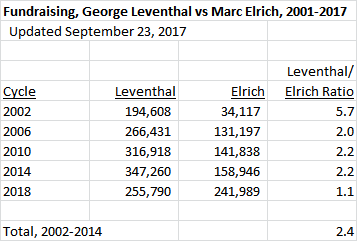
Many things have happened over the last four election cycles, but one thing has remained constant: George Leventhal has smoked Marc Elrich in fundraising.

Not anymore.

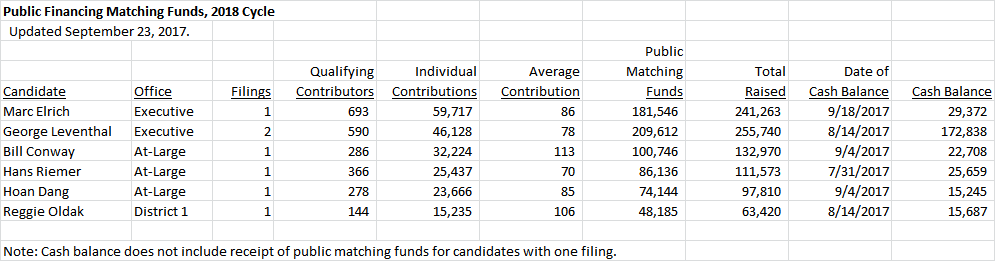
Elrich, who is running against Leventhal, Roger Berliner and Bill Frick to be the next County Executive, just filed his first application for public financing matching funds with the state.  So far, Elrich has more in-county contributors than Leventhal (693 to 590) and has raised more money from in-county individuals ($59,717 vs $46,128).  But Leventhal has received more public funds, leaving him with a slight lead in total fundraising.  Summary data for all qualifying publicly financed candidates appears below.

This is a dramatic turn of events from the past.  Leventhal and Elrich first ran against each other in 2002 as members of slates headed by County Executive Doug Duncan and Council Member Blair Ewing respectively.  Leventhal outraised Elrich by more than 5-1 that year and was backed by hundreds of thousands of dollars more in slate money from the real estate industry.  Over the next three cycles, Leventhal raised about twice as much as Elrich.

But public financing has eroded Leventhal’s edge.  That was predictable considering that both Leventhal and Elrich have had around 600 in-county individual contributors each in both the 2010 and 2014 cycles.  The ability of a candidate to raise money in the public financing system depends solely on the number of in-county contributors he or she has.  So if two candidates have similarly sized individual donor bases, they will raise similar amounts of money.

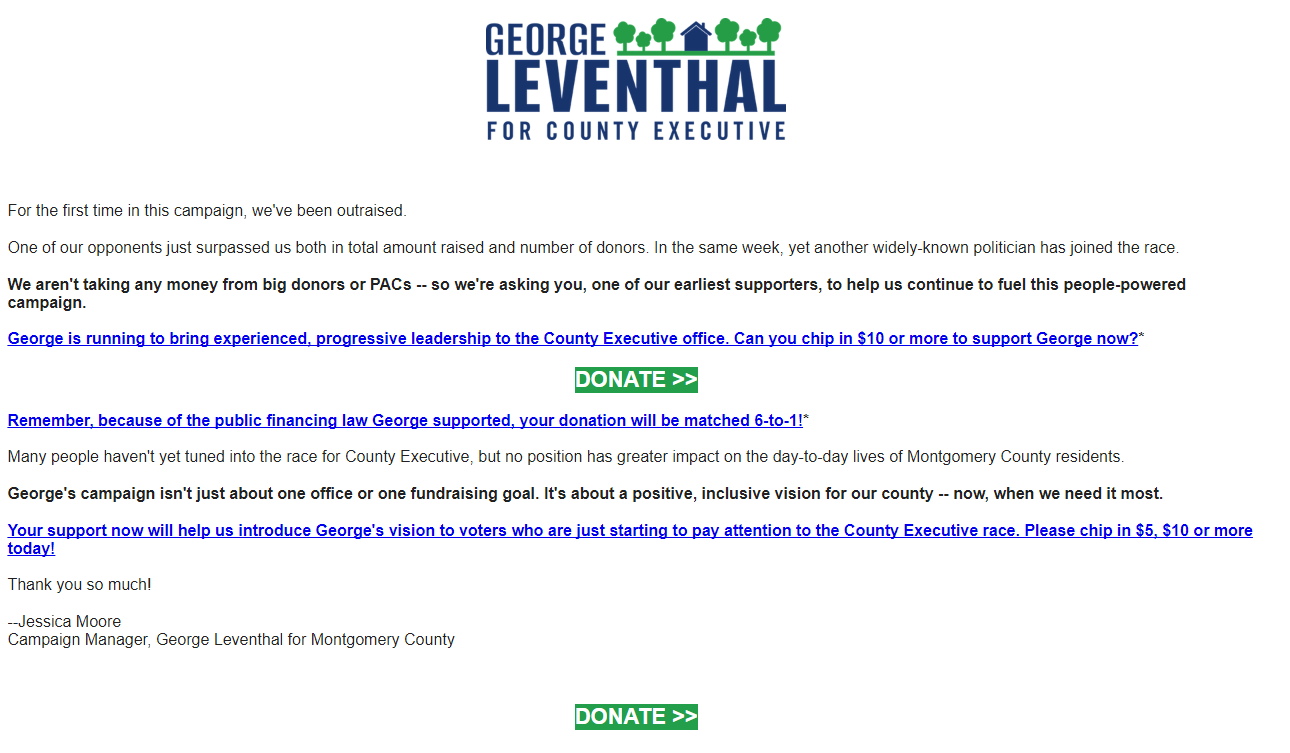
That fact is not lost on the Leventhal campaign, which sent out the fundraising email below shortly after seeing Elrich’s report.

Leventhal is right to be concerned about Elrich’s financial success.  Leventhal finished fourth and Elrich finished first in the last two at-large council elections despite the fact that Leventhal outraised Elrich 2-1.  What happens now when the two are at financial parity?

Share

Why Charity and Public Financing Don’t Mix

Adam Pagnucco was very kind in his discussion of problems regarding County Council Candidate Brandy Brooks’s desire to split funds raised for her campaign with disaster relief charities. He ascribed positive motives to the candidate and described her idea as ethical but not legal in contrast to behavior by some that is not ethical but nonetheless legal.

Charitable contributions from campaign funds, however, are heavily circumscribed to charitable events that are closely related to campaigns, such as buying tickets for an event or an ad in a program, for a number of good reasons.

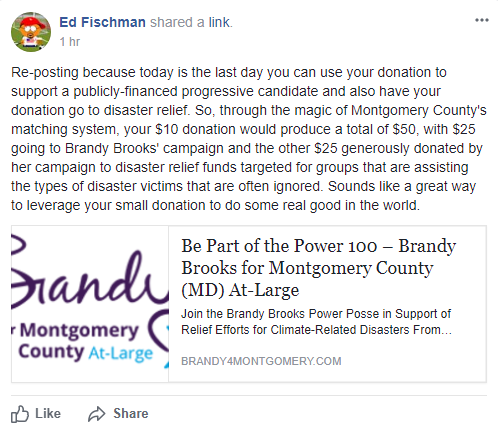
The first is to avoid the public having to fund a candidate’s chosen charities on top of funding their campaign—an idea that Our Revolution Montgomery County Ed Fischman thought was great in his original, later altered, post sharing Brooks’s idea. Beyond the considerable cost, the County did not adopt public financing to fund charities but to encourage behavior that limits the influence of large contributors and reins in spending.

Next, one can imagine candidates throwing fundraisers in the guise of raising money for charity as a means of meeting the threshold to receive matching funds for public financing. This would obviously subvert the intent of the law, which was to force candidates to raise money in relatively small amounts from a wide range of people. As a result, qualifying for matching funds would no longer demonstrate a certain level of grassroots support.

The definition of charity is also quite wide with many organizations engaged in activities much more controversial than disaster relief. One can, for example, set up 501(c)(3)—an organization that can accept tax-free charitable contributions—to educate people about the dangers of abortion or the benefits of abortion remaining a legal option.

On the other hand, how would government assess Brooks’s nice proposal to donate money for disaster relief in Sierra Leone if the charity is not a legally registered American organization and not subject to scrutiny? It’s a very worthy cause but hard for either officials or citizens to assess.

Donors might also start trying to claim a portion of campaign donations as tax write offs. My guess is they would be on shaky ground because there would be little concrete evidence that the money went to a legal charity beyond a candidate’s promise to spend it that way. Nevertheless, as Donald Trump has demonstrated vividly, not everyone fulfills promises to give to charity but many are willing to try to claim dubious tax benefits.

Unscrupulous people have organized charities in which the bulk of the money goes to employees, often relatives, rather to the charity’s avowed focus. Again, clearly not Brooks’s focus here, but a real problem that the State would need to guard against.

Relatedly, mixing charity and campaign finance would further burden government with trying to keep track of what portion of donations are charitable contributions and if they were then donated in a legal fashion. This is a task they are completely ill-equipped to conduct and would require more money and staff.

In short, this is a great example of how a well-intentioned idea can prove very problematic.

Brooks and Our Revolution Responses

Brandy Brooks gave a response on the Seventh State’s Facebook page that shows a candidate dealing with a campaign issue in a calm, measured way designed to reassure voters. Most will commend her commitment to adhere to the law and will (like Adam Pagnucco and myself) not think that she ever intended otherwise.

On the other hand, her plan to spend money on the legally allowed activities, such as buying tickets to events, does not comport with what most think of as disaster relief. A tendency to jump in without thinking through an idea can give voters pause, though her measured response and a willingness to correct problems shows character and limits any damage.

Our Revolution Montgomery County Chair Ed Fischman’s strong accusations against Adam Pagnucco and passionate use of naiveté as a defense on this page earlier today are less helpful. Voters like candidates with passion but also people and organizations, such as Our Revolution, to know what they’re doing.

Share

At-Large Candidate’s Proposal Breaks Campaign Finance Laws

By Adam Pagnucco.

Council At-Large candidate Brandy Brooks, who is participating in MoCo’s public financing system, would like to help natural disaster victims.  That’s a laudable goal.  But she is proposing to spend campaign contributions to do so.  The problem is that’s illegal under state and county campaign finance laws.

On her website and on Facebook, Brooks promotes an initiative that she calls “Power 100,” in which she invites 100 contributors to donate a combined $2,500 to her campaign, half of which would be paid out to a number of charities helping natural disaster victims.  The charities include organizations helping victims of Hurricane Harvey, Hurricane Irma, a mudslide in Sierra Leone and floods in South Asia.

Brooks supporter Ed Fischman went a step further in a posting on the Our Revolution in Montgomery County Facebook page, asserting that public matching funds would be used for disaster relief.  To be fair, it’s unclear whether Fischman speaks for Brooks and Brooks has not yet qualified for public matching funds.

State and county campaign finance laws prohibit these kinds of expenditures.  According to the State Board of Elections’ Summary Guide, there must be a nexus between campaign account expenditures and the promotion of a candidate’s campaign for those expenditures to be legal.  The guide specifically addresses charitable contributions, stating:

Generally, campaign funds may not be used solely for charitable purposes. Maryland law requires campaign funds to be used for the purpose of supporting or opposing a candidate, question, or political committee. Furthermore, it is important to keep in mind that contributors give to campaign committees for one important reason – they want to support the committee’s candidate, question, or political party. When campaign funds are spent for a non-campaign related purpose, it frustrates the intent of the contributor.

However, there are instances when a charitable donation is permissible because it is for a campaign purpose. For example, a candidate may permissibly use campaign funds to attend a charitable event since attending the event increases the candidate’s visibility and allows the candidate to network with potential voters and donors.

ง 13-247 of state election law does allow certain kinds of charitable contributions to be made by accounts that are closing and liquidating their assets, a case that clearly does not apply to Brooks.

Additionally, Montgomery County’s public campaign financing law states, “A participating candidate may only use the eligible contributions and the matching public contribution for a primary or general election for expenses incurred for the election.”  This statement is repeated in the county’s summary of the law.  No one could construe helping disaster relief victims as a primary or general election expense.  It’s noteworthy that the county’s language applies not just to public funds but also to individual contributions made under the public financing program.

Your author really hated to write this blog post but it had to be done.  Generally speaking, when we have examined campaign finance issues in the past, we have sometimes seen behavior that may not be ethical but is legal.  This case is the opposite: what Brooks is doing comes from the best of intentions but does not comply with the law.  Brooks is free to discuss the plight of disaster victims all she wants.  She could also organize a private fundraiser for victims separate from her campaign account.  But if she goes ahead and uses her campaign funds for disaster relief contributions, she will risk sanctions from the state, the county or both.

Share

Will There Be a Deal on MoCo’s Minimum Wage?

By Adam Pagnucco.

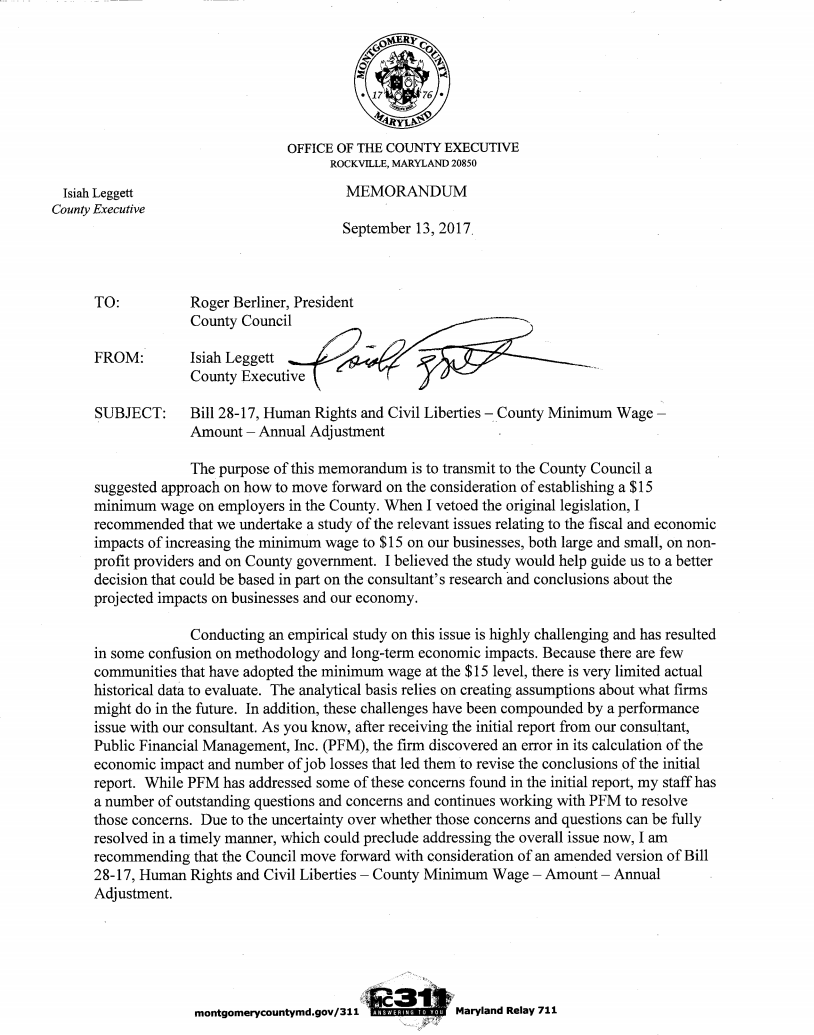
The question of whether Montgomery County will have a $15 minimum wage has simmered for months.  After County Executive Ike Leggett vetoed Council Member Marc Elrich’s bill last January, the county commissioned an ill-fated study on the effects of a wage hike that has been discredited.  But Elrich, not waiting for any study, introduced a new bill that was little different from his previous one.  The Executive has now announced his terms for signing it.  We reprint his letter to the council below.

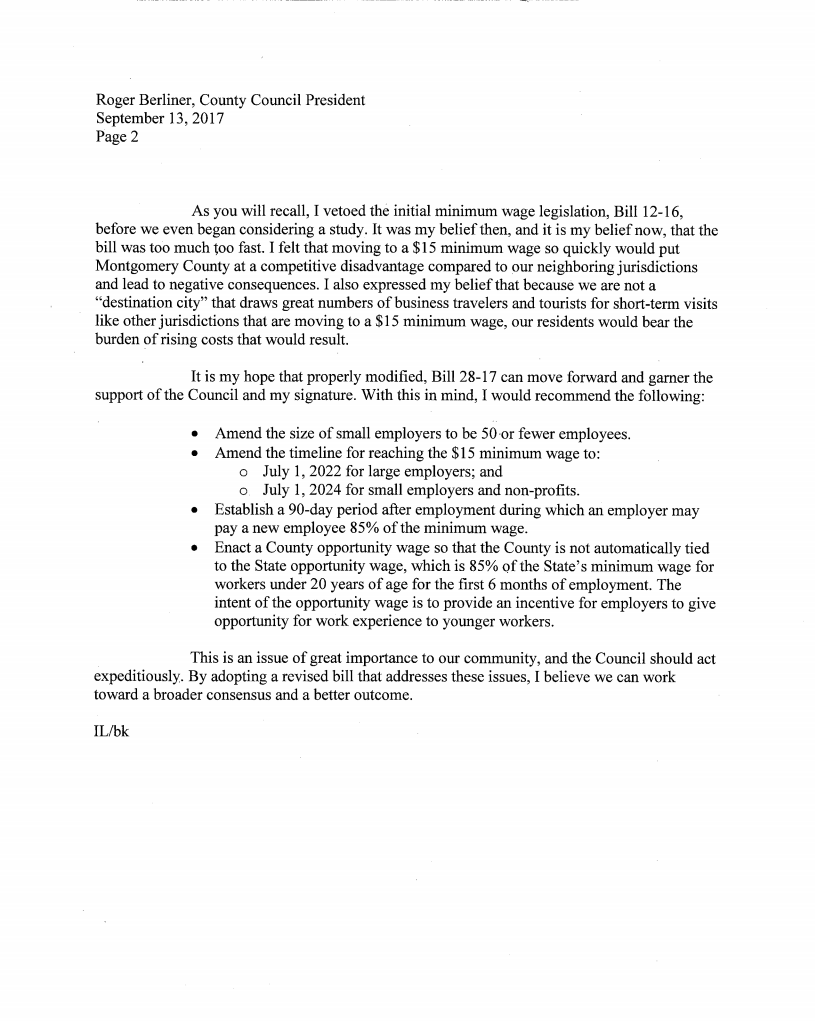
We summarize the differences between the bill and the Executive’s terms below.

Advocates for the bill reacted harshly to the Executive’s letter.  They sent out the following press release today.

*****

Economists, Community and Labor Groups Slam Executive Leggett Memo Say: “No More Delay Tactics, Working Families Need a Strong $15 Minimum Wage Now”

After Failed Study, Leggett Makes 2nd Attempt to Deny Low-Wage Workers a Living Wage

Rockville, MD- A coalition of economists, community and labor groups today condemned Montgomery County Executive Ike Leggett over his memo requiring County Council members to follow a set of criteria that would dramatically weaken Council’s $15 minimum wage legislation. The group also demanded that Leggett suspend his attempts to amend an irredeemable study and sign a strong bill before the end of session. Leggett’s minimum wage “study,” was widely criticized and eventually halted by the Executive himself.

The statement below is attributable to Maryland Working Families, the National Employment Law Project (NELP), 32BJ SEIU, Jews United for Justice, Progressive Maryland and CASA.

“In one of the nation’s wealthiest counties, County Executive Leggett is making a second attempt to avoid raising the wage like so many other economically prosperous cities have done successfully. His youth exemption would keep thousands of working men and women under the age of 20 in poverty, leaving them to continue struggling to support themselves and their families. County residents are counting on the Council and the Executive to resist corporate lobbyists whose self-interests are out-of-sync with the needs of working families. It’s time to stop looking for excuses and raise the minimum wage by passing and signing a clean bill, without delayed implementation or exemptions.”

Research has shown that overwhelmingly, cities that have raised the wage have not experienced job loss and the local economy continues to prosper. Moreover, a wage increase can reduce reliance on public assistance from a safety net that faces extreme cuts from the Trump administration, placing a heavier burden on local taxpayers.

With more than 163,000 members in 11 states, including 18,000 in the D.C. Metropolitan Area, 32BJ SEIU is the largest property service workers union in the country.

*****

So will there be a deal?  Under normal circumstances, the answer is yes.  The Executive is recommending a combination of delays and relatively modest adjustments for some categories of workers.  He is not proposing a fundamental overhaul of the bill.  A properly functioning legislative process would smooth out these details, probably by splitting the differences, and result in a 9-0 vote and a signed bill.  That’s how Rockville works most of the time.

But the circumstances are anything but normal.  Three Council Members are running for Executive and five more are running for reelection next year.  The two Council Members who are Executive candidates and are sponsoring the bill must decide if they prefer a signed bill or a campaign issue.  The bill advocates must decide whether they want another upheld veto which would cause further delay and take their chances with a new Executive and council.  These decisions, which are ultimately political in nature, will determine whether there is a deal on minimum wage.

Share

Friedson Rules Social Media in District 1

By Adam Pagnucco.

Political handicapping is a very subjective exercise.  That said, there are a handful of objective measures that give clues to the state of a race: fundraising, endorsements, surrogates, communications (like number of mailers sent and TV time purchased), and more.  The jury is still out on the importance of social media followers.  But if Facebook followings matter at all, Andrew Friedson is waaaaaay ahead on that measure in the Council District 1 election.

As of Monday, September 11, here are the Facebook followers on each of the District 1 candidates’ campaign pages.

Andrew Friedson: 4,822

Pete Fosselman: 461

Bill Cook: 224

Reggie Oldak: 154

Other candidates: no pages

That’s right, Friedson has almost six times as many followers as his competitors COMBINED.  And they have all been running for months before he got in.

One reason why Facebook followers are discounted by many is that they don’t reflect actual voters in the relevant jurisdiction.  They can come from all over Planet Earth.  So your author asked Friedson to provide a geographic distribution of his Facebook followers.  According to data from his page, roughly two-thirds of Friedson’s followers reported cities of residence.  Of those, 1,490 lived in Maryland, 971 lived in MoCo and 462 lived in the District 1 areas of Bethesda, North Bethesda, Potomac and Kensington.  An additional 700 reported living in D.C., but some of those people could actually live in the Maryland suburbs.

This is an impressive campaign page following for someone who just declared for the race a month ago.  It reflects Friedson’s ability to tap into a number of networks, including his friends and family as a MoCo native; his college network from the University of Maryland (where he was a class President); his professional network from his time as an aide to Comptroller Peter Franchot and Congressional candidate David Trone; and his non-profit networks stemming from his service as a Board Member on the Jewish Council for Public Affairs and the MoCo Collaboration Council for Children, Youth and Families.  These are real assets for any candidate for office.  And Friedson can leverage them through social media to raise money, spread his message and build name recognition in a way the other candidates can’t (yet) match.

Reggie Oldak has shown early success in the public campaign finance system but Andrew Friedson is off to a fast start.  Let the rest of the field beware!

Share

Updated: Preliminary Fundraising Totals in Public Campaign Financing, September 2017

By Adam Pagnucco.

This morning, we posted preliminary fundraising totals for candidates in public financing.  But one of those reports was wrong because of a problem with the State Board of Elections’ processing software.  This post contains updated information.

Shortly after our original post, we received the following communication from Council At-Large candidate Hoan Dang’s campaign.

Hi Adam, this is Jonathon Rowland, campaign manager for Hoan Dang.  Thank you for the article this morning.  I just want to correct the amount stated.  When we filed with the Board of Elections, our report was duplicated because of a glitch in the system giving us double the amount of donations.  We have been in contact with the Board of Elections since Monday to resolve this issue.  The actual amount of donations is 316.

When your author called Rowland for more details, he said that the Dang campaign found the error first and asked the board to correct it.  Board staff acknowledged the mistake and said that they were working with their IT developer to fix it going forward.  No public funds were ever distributed before the Dang campaign caught the mistake.

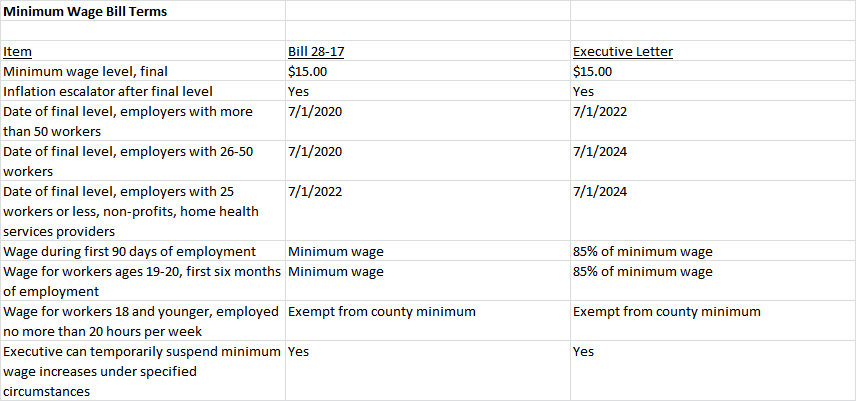
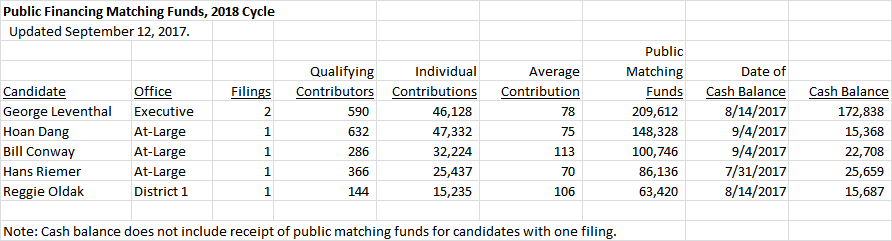
Including information provided by Dang’s campaign today, here is the updated comparison of the five campaigns who have applied for public financing.

Dang is not the leader in public financing.  George Leventhal, who is running for Executive, is the overall leader in qualifying contributors and receipts.  (Executive candidates get higher match rates than council candidates.)  Among the council candidates, incumbent Hans Riemer leads in qualifying contributors and Bill Conway leads in matching funds.  This should not discount a strong performance by Dang, whose financial numbers are not terribly different from Riemer’s.

Going forward, we hope the state prevents the kinds of mistakes that affected Dang’s campaign.  In the initial glitchy filing, Dang supposedly requested $148,328 in public matching funds.  (Again, the IT glitch was not Dang’s fault.)  In the updated filing, Dang requested $74,144 in public matching funds.  That’s a $74,184 difference.  If Dang had not caught the mistake, could that difference have conceivably been paid out?  There’s no evidence available on that point.  But for the good of public confidence in the county’s public financing system, we hope such a mistake never happens.

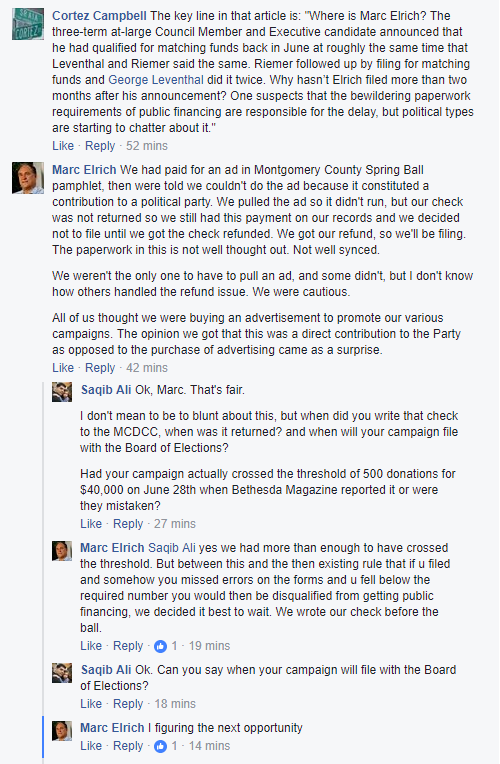
On a different issue, we asked what happened to Council Member Marc Elrich’s filing for public matching funds in our original post.  Elrich said he had enough contributors to qualify back in June but has not filed yet.  When asked about it on Leventhal surrogate Saqib Ali’s Facebook page, Elrich said his delay in filing was related to a payment his campaign had made to the county party, which was subsequently ruled to not be in compliance with public financing requirements.  We reprint Elrich’s statement below.

Share

Preliminary Fundraising Totals in Public Campaign Financing, September 2017

By Adam Pagnucco.

Correction: The numbers for Hoan Dang in this post are inaccurate.  For updated numbers on Dang and a response by Marc Elrich, please visit our updated post.

One of the virtues of public campaign financing is the rapid release of financial reports for participating candidates.  That’s right, folks – for this group of candidates, there is no need to wait until January to see fundraising numbers.  That’s because when they qualify for public matching funds and request them from the state, their financial reports are released almost immediately.  This is terrific for all data junkies like your author as well as inquiring minds among the readers!

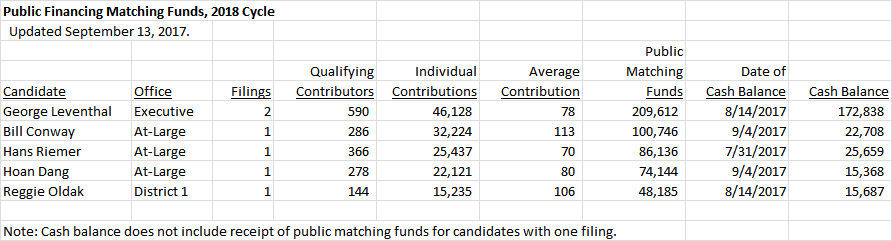
Below is a summary for the five candidates who have applied to receive matching funds from the state.  Bear in mind the following characteristics of the data.  First, the number of qualifying contributors means the number of contributors who live in Montgomery County.  Non-residents can contribute up to $150 each but the state will not authorize matching funds for them.  Second, the individual contribution amounts are the basis on which the state determines how much in public matching funds will be released.  Third, the date of cash balance is important because it varies depending on when the applications were sent in.  That is unlike the regular reporting dates on which financial positions are summarized at the same time for all candidates.  And fourth, for those candidates who have only filed once (which includes everyone except George Leventhal), the cash balances do not include public funds from the state.  To estimate the cash positions of those candidates, the cash balance should be added to the public matching funds they requested.

What do we make of this?

1.  Let’s start with the obvious: there are a lot of small checks out there!  While many contributors are probably donating to more than one of these five campaigns, it’s not a stretch to say that close to a thousand people will have contributed by some point in the near future.  It’s hard to make comparisons with the past without exquisitely detailed research to back it up (anyone want to pay us for that?) but our hunch is that this is a larger early donor pool than in prior cycles.

2.  The big story here is Council At-Large candidate Hoan Dang.  At-Large Council Members George Leventhal (who is running for Executive) and Hans Riemer (the only incumbent running for reelection) have a combined 22 years of representing the whole county.  But Dang had more in-county contributors than either one of them!  How does that happen?  Dang ran for Delegate in District 19 in 2010.  He was financially competitive, raising $103,418, but he finished fifth out of six candidates.  There was no reason going into this race to believe that Dang would receive more grassroots financial support than Leventhal or Riemer.  But so far, he has.

3.  Dang is not the only story.  Look at first-time candidate Bill Conway, who collected more private funds than Riemer primarily by having a larger average contribution.  In most elections, challengers struggle to be financially competitive with incumbents.  But the early performances of Conway and Dang relative to Riemer suggest that, at least among publicly-financed candidates, some or all of that gap may be closed.  Our hunch is that a group of at-large candidates will all hit the public matching funds cap of $250,000 and therefore have similar budgets heading into mail season.  The big question will then become how those totals compare to what candidates in the traditional system, like Marilyn Balcombe, Charlie Barkley, Ashwani Jain and Cherri Branson, will raise.

4.  Where is Marc Elrich?  The three-term at-large Council Member and Executive candidate announced that he had qualified for matching funds back in June at roughly the same time that Leventhal and Riemer said the same.  Riemer followed up by filing for matching funds and Leventhal did it twice.  Why hasn’t Elrich filed more than two months after his announcement?  One suspects that the bewildering paperwork requirements of public financing are responsible for the delay, but political types are starting to chatter about it.

That’s all for now.  Candidates, keep those reports coming in so your favorite blog has more material for the readers!

Share

How Much Will Emily’s List Spend in CD6?

By Adam Pagnucco.

Recently, Emily’s List announced its endorsement for CD6 candidate Aruna Miller, a move seen as significant in that race.  Emily’s List’s Super PAC, Women Vote, has made millions of dollars in independent expenditures (IE) in federal races over the last five cycles.  But how effective are they?

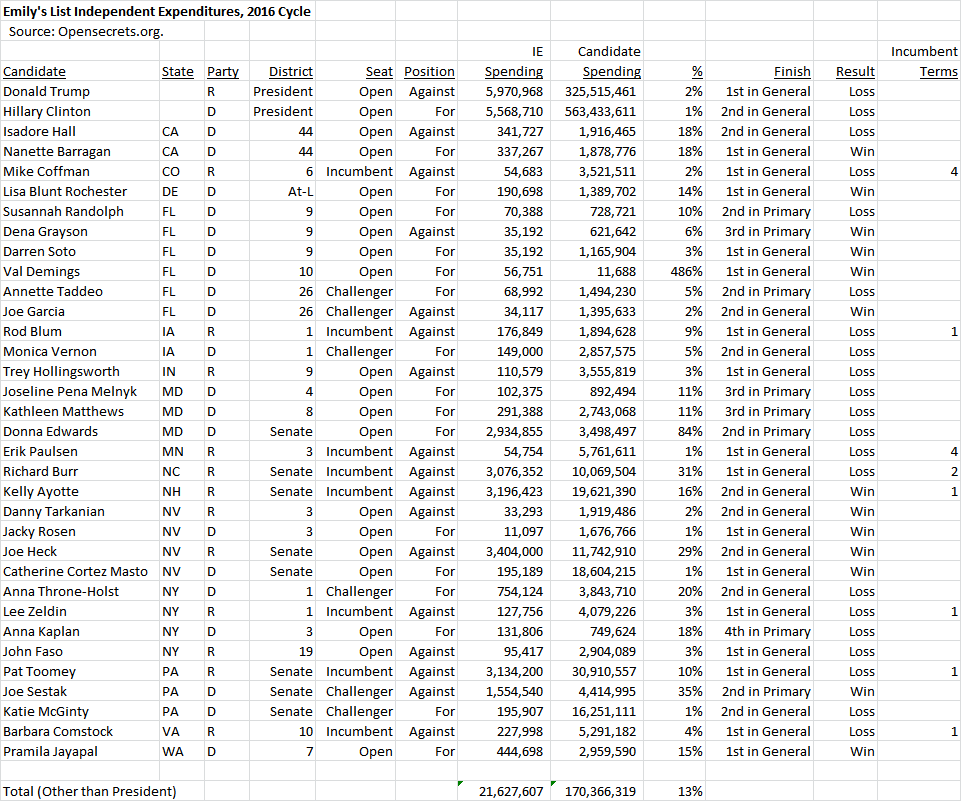
Let’s start in Maryland.  In 2016, Emily’s List invested in three federal candidates: Donna Edwards (U.S. Senate), Joseline Peña-Melnyk (CD 4) and Kathleen Matthews (CD8).  The group had an impact: they accounted for at least a million dollars in TV spending for Edwards and basically assumed the bulk of mail duty for Matthews.  But all three candidates lost, with Edwards finishing second in the primary and Pena Melnyk and Matthews finishing third (despite both having the Washington Post endorsement).  The group spent $3.2 million of IE funds on behalf of the three candidates, including $2.9 million for Edwards.  Edwards’ amount was one of the largest single-race investments made by Emily’s List in the 2016 cycle.  Data for the group’s IE spending in Maryland appears below.

Now let’s examine the group’s IE spending nationwide in 2016.  The group invested in 23 races, winning 7 and losing 15.  In the remaining race (Florida CD9), the group’s original pick lost in the Democratic primary, but they then spent on behalf of the Democratic nominee, who won in the general.  Let’s call that one a draw.  It’s important to note that Emily’s List did not spend in every race in which it endorsed.  Data for the group’s IE spending nationwide in the 2016 cycle appears below.

What can be learned from the results of Emily’s List’s chosen races?  Although their win rate and their experience in Maryland are not impressive, they had some notable successes.  Perhaps their biggest win was helping to knock out freshman Republican Senator Kelly Ayotte (NH) in a razor-tight win for then-Governor Maggie Hassan.  Emily’s List spent $3.2 million against Ayotte.  They also spent $3.6 million to hold Harry Reid’s Senate seat in Nevada, helping to boost Catherine Cortez Masto to victory.  But besides Ayotte, they tried and failed to knock out seven other GOP incumbents, spending $6.9 million on those races.  These were not crazy bets – GOP Senators Pat Toomey (PA) and Richard Burr (NC) were thought to be vulnerable at the time – but they did not work out.

In U.S. House races, Emily’s List spent an average of $218,675 per contest.  The group’s highest single IE in a House race was a combined $881,880 to defeat freshman New York GOP Congressman Lee Zeldin, who beat the group’s candidate by 16 points.  In many House races, the group spent less than $100,000, which was probably not enough to make a difference.  Maryland and New York are the only states in which the group lost three races.  We would not blame Emily’s List if they decided not to throw more money our way!

What does all of this mean for CD6?  The 2018 elections, in which opposition to Donald Trump is likely to play a significant part, may very well contain more opportunities for Emily’s List and other progressive groups to score victories against the GOP than in 2016.  That could draw Emily’s List’s money away from a blue-state primary like CD6 and into districts where GOP incumbents are vulnerable.  The group may also consider David Trone’s nearly unlimited finances, which helped outpoll their chosen candidate in CD8 last year, and conclude that it’s not worth opposing him again.  All of this means the group could do one of two things.  First, it could make a modest investment in CD6, perhaps a couple hundred thousand dollars at most.  That would only make a difference in a close race.  Or second, as it has done in many races over the years, it could invest nothing at all.

Share

First Impressions, Part Four

By Adam Pagnucco.

Seth Grimes, Takoma Park

Former Takoma Park City Council Member Seth Grimes’s edge is his experience.  Other than incumbent Hans Riemer and Delegate Charles Barkley (D-39), Grimes is the only candidate in the field who has served in elected office so far.  During his two terms in office (2011-2015), Grimes passed legislation allowing 16-year-olds to vote in municipal elections as well as banning environmentally harmful pesticides and polystyrene containers.  The latter two bills were models for similar county legislation.  He also pushed for better management practices in the city both before and after he started serving on the council.

In person, Grimes comes across as studious and tremendously substantive.  Those qualities are present in such abundance that he can struggle to convey ideas in layman’s terms.  He can go into significant detail on his favorite subjects, including affordable housing, food security, reducing poverty and municipal tax duplication.  On many other subjects, Grimes can relate them to his work in the city.  As a provider of many more services than a lot of Maryland municipalities (including a full service police department), the city provides a good laboratory for understanding the functions and problems of county government.

One major plus for your author is that Grimes is a blogger.  (Folks, we bloggers are sorely misunderstood and must stick together in the face of a sometimes unforgiving world!)  His blog shows a person who is fact-oriented, careful, versed in policy and extremely well informed.  It’s obvious that he would be ready to serve on the County Council from day one.  That fact alone makes him worthy of consideration for your vote.

Ashwani Jain, Potomac

Former Obama administration official Ashwani Jain has an inspiring story.  He is a first generation American whose father came here from India years ago with no connections and built a thriving family jewelry business.  He is also a cancer survivor, having contracted the disease at age 13 and undergone chemotherapy.  Jain understands the American dream as well as personal tragedy.  Lots of people will relate to him.

Jain’s claim to fame is his association with President Obama, dating from his volunteering for him ten years ago and ultimately culminating in positions at the White House and the U.S. Departments of Health and Human Services and Housing and Urban Development.  He is part of the local Obama network that also includes Council Member Hans Riemer, Delegate Marc Korman, former Maryland Obama Director Jason Waskey, former Delegate candidate Kyle Lierman, former MCDCC Member Oscar Ramirez and fellow at-large council candidate Will Jawando.  But Jain is not just a national-level person – he is also a native of the county and has lived in several parts of it, both east and west.  That gives him a gut-level knowledge of the county that most transplants don’t have.

Jain’s policy views on land use and budgetary issues are not well developed, though he does favor transit projects like the Purple Line and the BRT system, he supports a $15 minimum wage, he believes the county should be a sanctuary jurisdiction and he emphasizes the need for affordable housing.  He also thinks the county should consider ending its liquor monopoly.  But perhaps the biggest reason why voters will like him in addition to his Obama experience is his appealing personality.  Simply put, it is virtually impossible to dislike him.  That’s a major asset for any politician.  Local activists don’t know him yet, but he could really surprise people before this race is over.

That’s it for now, folks.  As we meet more candidates, we may renew this series in the future!

Share