Tag Archives: Adam Pagnucco

McGee Files for Matching Funds… And Then There is Ficker

By Adam Pagnucco.

Update: Council District 5 candidate Kevin Harris has also filed for matching funds on May 15, claiming $12,400 in qualifying contributions from 176 in-county residents.

Original Post: Council District 1 candidate Jim McGee filed for public matching funds on May 15.  His filing claims 157 qualifying contributors and $36,580 in qualifying contributions, above the respective thresholds for a district race of 125 and $10,000.  Two other District 1 candidates have qualified for matching funds, including Delegate Ana Sol Gutierrez and Reggie Oldak, who has already applied for the maximum amount ($125,000) available under the program.

On Monday, we wrote that county law stated that the qualifying period for matching funds ended 45 days before the primary, which this year fell on Saturday, May 12.  That is true.  But at the time, we did not know that the State Board of Elections had allowed candidates to file as late as May 15 with only qualifying contributions received by May 12 eligible for matching funds.  A reader brought that to our attention and we updated the post.  But we are gonna own this one: we screwed up.  Your author apologizes to Jim McGee and Seventh State readers.

Then there is Robin Ficker, who is running for Executive in the public financing program.  Ficker registered his public account on 2/8/17 and so far has not qualified for matching funds.  (The other Executive candidates in public financing – Marc Elrich, George Leventhal and Rose Krasnow – qualified some time ago.)  Ficker told Bethesda Magazine that he was unaware that he was subject to the 45-day qualifying period because he has no primary opponent.  In order to qualify for matching funds, Executive candidates need 500 contributions from individuals living in the county totaling at least $40,000.  Ficker then sent an application for matching funds on May 15 but it asked for… zero dollars.

Can anyone figure this out for us?  Because we admit it – we can’t!

Share

MoCo Diverts $62 Million of Retiree Health Money for General Spending

By Adam Pagnucco.

Remember the county’s $120 million budget shortfall?  While up to half of it may have been caused by tax planning by rich people, the rest was in broad shortfalls across a range of taxes.  The County Council approved a FY18 savings plan of $53 million in January, but what happened to the rest of the shortfall?  Nothing was published in the press.  In fact, the council did cut another $62 million last month and, it seems, no one noticed.

What happened?

One of the county’s long-term obligations is money it owes for retiree health benefits, also known as other post-employment benefits (OPEB).  These benefits are becoming rare in the private sector but they are still common in state and local governments.  In 2008, the Governmental Accounting Standards Board (GASB) told state and local governments that they had to begin accounting for OPEB and prefunding it in the same way that they do for pension benefits.  In other words, each government would have to publish a funding ratio and start saving for future benefits rather than simply paying as they went.  MoCo had a plan to ramp up OPEB prefunding, but the Great Recession hit and the county couldn’t contribute towards OPEB for a couple years.  Since then, the county has socked away $797 million to meet future OPEB benefits.

That sounds like a lot of money, but the county’s actuarial liability for OPEB is currently calculated at $3.3 billion, meaning that its funding ratio is 24%.  That would be terrible for a pension plan – consider that the county’s pension plan is currently 92% funded.  But 24% is actually decent for an OPEB plan considering that state and local governments have only been prefunding them for ten years.  The State of Maryland’s OPEB plan was just 3% funded in 2015 and MoCo’s ratio was better than 38 states.  Even so, the county has a lot of work to do to get its funding ratio up and it makes millions in contributions every year to get there.

In FY18, the county had budgeted $122 million for OPEB contributions.  But the county had a problem: less than half of its FY18 shortfall of $120 million had been eliminated.  As late April came around and the FY19 budget process was underway, the County Executive and the County Council had a choice.  They could cut over $60 million in current year spending two months out from the primary election.  Or they could find the money somewhere else.

You guessed it – in a resolution introduced and adopted on the same day, April 24, the council unanimously cut $62 million from the county’s FY18 OPEB contribution.  This fiscal year’s spending on services won’t take another cut, which is great news for incumbents running for reelection or higher office.  And as Bethesda Magazine reported, the council has proposed adding up to $21.6 million more to next year’s budget and has so far identified just $1.6 million in offsetting spending cuts.  How do you think they will make up the difference?

The County Council did not send out a press release headlining the diversion of $62 million of retiree health contributions to support general spending on April 24.  It was buried in a press release spotlighting a resolution on equity data.  As a result, the press totally missed it.

Now look, folks.  The county is good at saving money.  They are setting aside close to 10% of revenues as reserves, an important reform adopted during the Great Recession that helped save the county’s AAA bond rating.  The pension fund is in excellent condition at 92% funding.  And as stated above, the county has done a better job at prefunding retiree health benefits than most other places.

But grabbing retiree health contributions and using them for general spending is something that is normally done in a recession when the alternative is layoffs.  That’s what happened a decade ago and it was justified considering the financial trouble the county was facing.  Now, despite huge evidence to the contrary, county leaders are telling us that the economy is in great shape.  The Council President told Kojo Nnamdi a few days ago that we have “a very strong economy” and “this is a good time in Montgomery County.”  Well, if the economy is so great, then why redirect $62 million of retiree health money to prop up this year’s budget?

And if we are diverting retiree health money now when times are supposedly good, what will happen when the next recession comes?

Share

Marc Elrich Said He’s a Socialist – And I Believe Him

By Adam Pagnucco.

Council Member Marc Elrich, who is running for County Executive, has posted a guest blog denying that he is a socialist.  Since he made that claim in a rebuttal to our writings, it is only fair that your author responds.  Why have we said that he is a socialist?  It’s because we have an unimpeachable source who says he has been a socialist organization member for decades.  That source’s name is…

Marc Elrich.

In 2013, Bethesda Magazine asked Elrich flat out whether he is a socialist.

Elrich declines to say whether he considers himself a socialist. “It’s irrelevant,” he says.  “…I was in the business world. I appreciate how things are done. I’m not doing anything that will undo the business world or bring socialism to Montgomery County.”

If he is not a socialist, why not say so?

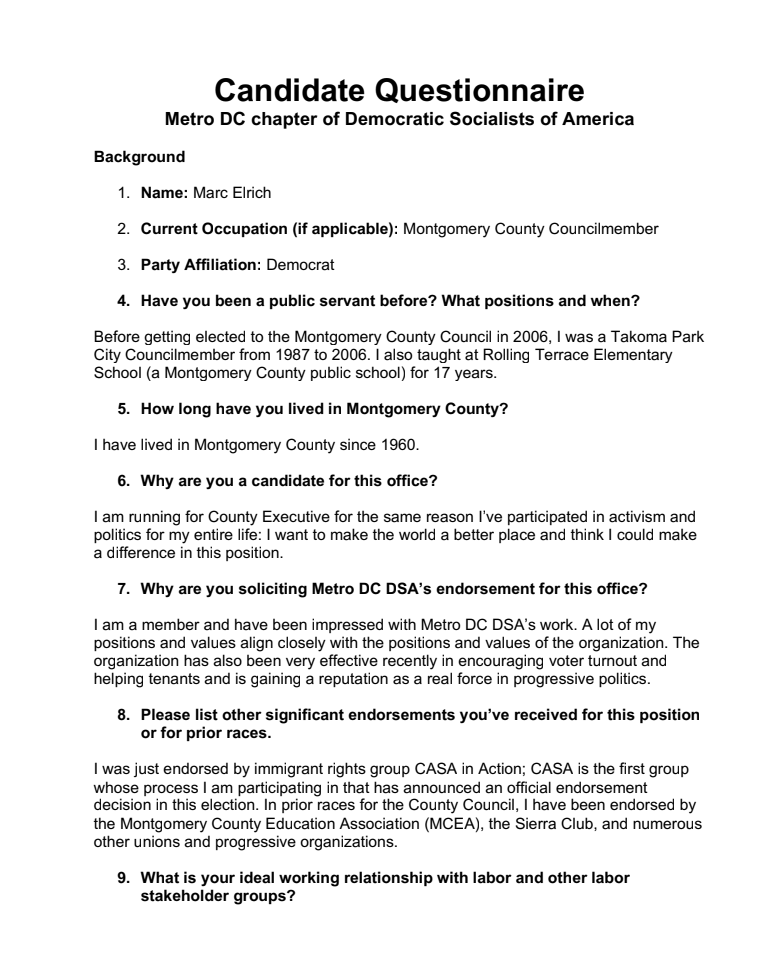
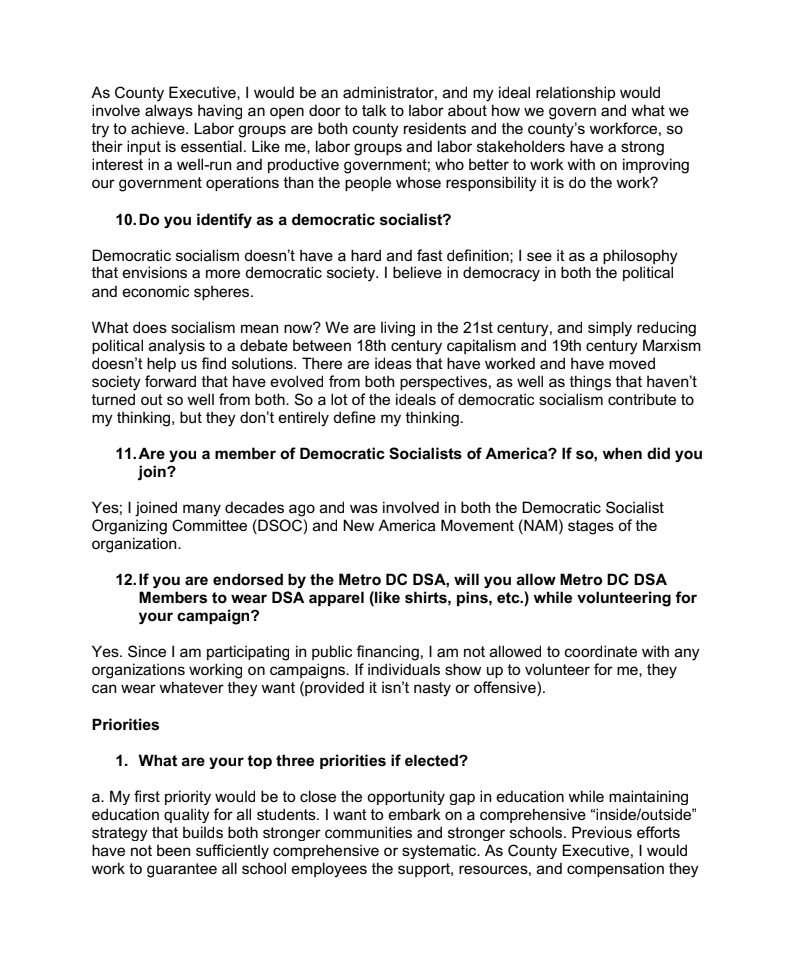
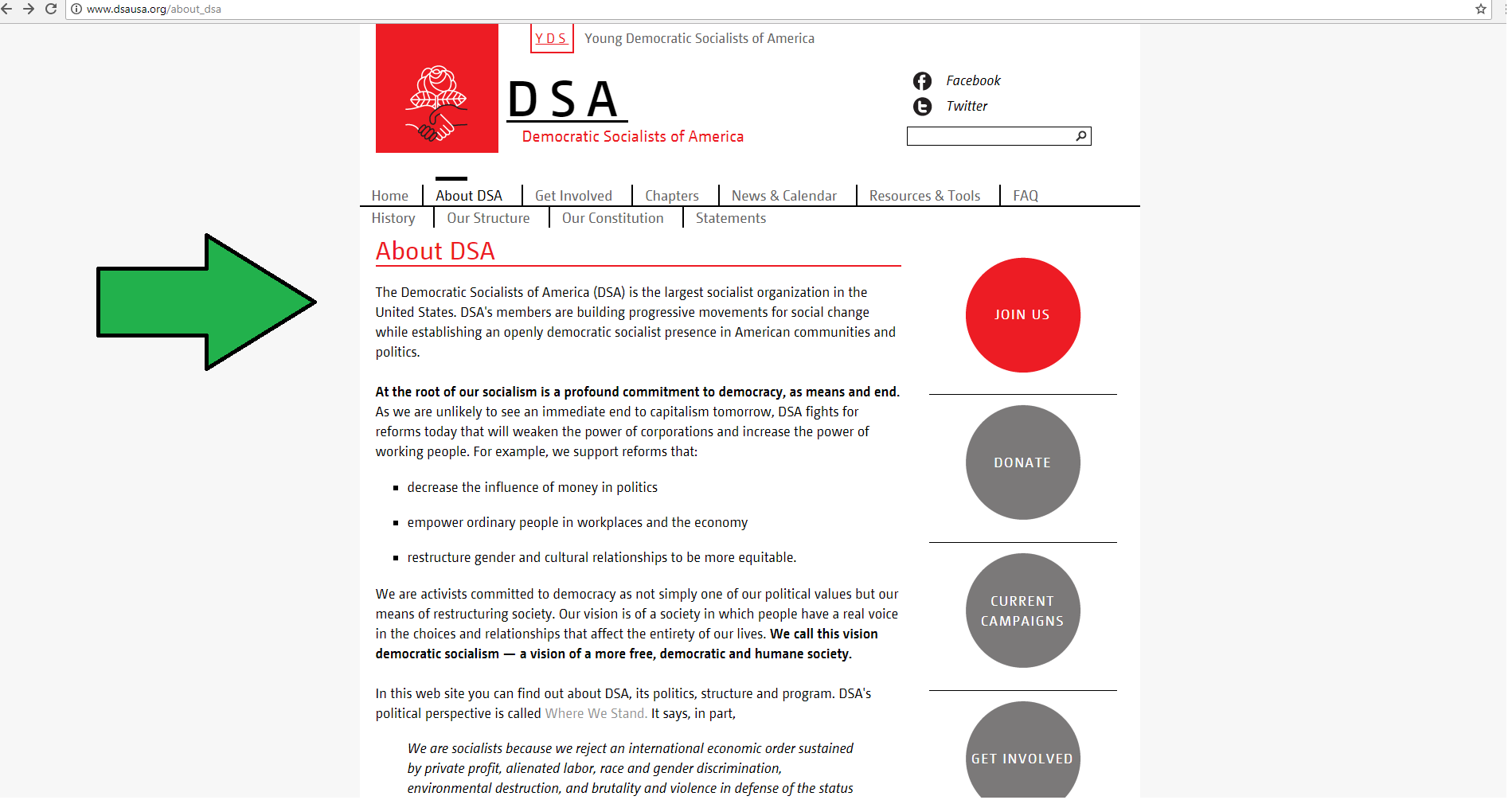
Elrich was more forthcoming with the Democratic Socialists of America (DSA), who describe themselves on their website as “the largest socialist organization in the United States.”  In his completed questionnaire for DSA, Elrich answered as follows to their questions on his membership and identification as a socialist.

Why are you soliciting Metro DC DSA’s endorsement for this office?

I am a member and have been impressed with Metro DC DSA’s work. A lot of my positions and values align closely with the positions and values of the organization. The organization has also been very effective recently in encouraging voter turnout and helping tenants and is gaining a reputation as a real force in progressive politics.

Do you identify as a democratic socialist?

Democratic socialism doesn’t have a hard and fast definition; I see it as a philosophy that envisions a more democratic society. I believe in democracy in both the political and economic spheres.

What does socialism mean now? We are living in the 21st century, and simply reducing political analysis to a debate between 18th century capitalism and 19th century Marxism doesn’t help us find solutions. There are ideas that have worked and have moved society forward that have evolved from both perspectives, as well as things that haven’t turned out so well from both. So a lot of the ideals of democratic socialism contribute to my thinking, but they don’t entirely define my thinking.

Are you a member of Democratic Socialists of America? If so, when did you join?

Yes; I joined many decades ago and was involved in both the Democratic Socialist Organizing Committee (DSOC) and New America Movement (NAM) stages of the organization.

It’s worth noting the history of the two organizations he cited in his response.  The Democratic Socialist Organizing Committee was founded by socialist leader Michael Harrington, who personally identified with socialists like Eugene Debs and Norman Thomas but preached advocating for a socialist agenda inside the Democratic Party.  The New American Movement was an openly socialist group.  According to its Wikipedia entry:

In its early years, NAM shared much of the political framework of the New Communist Movement, but rejected the strategy of building a “vanguard party”, a position prominent NAM members defended in a debate in the pages of The Guardian. The organization was built around local groups called “chapters,” which emphasized Marxist study, discussion of contemporary issues, support of local labor actions, and work in the community to raise awareness.

These two socialist organizations combined to form DSA in 1982.

The Democratic Socialists of America don’t hide the fact that they are socialists.  They say it openly on their website.

Now let’s be fair.  Today’s American socialists have come a loooooong way since dialectical materialism and the dictatorship of the proletariat.  Karl Marx wouldn’t recognize them as socialists.  Their platform is much closer to contemporary progressivism than to nineteenth century Marxism.  And like DSA’s co-founder, Michael Harrington, their agenda is not actual revolution but to join the Democratic Party and push it as far to the left as possible.  That’s a reasonable description of Marc Elrich’s three decades in public office and a big reason why he is so admired by many Montgomery County progressives.  In fact, if Elrich were to say in public that he has been a socialist organization member for decades, many of his supporters would probably love it and work even harder for him!

Elrich told Seventh State, “I don’t have a socialist agenda that I’m trying to bring here.”  Well, maybe.  A genuinely Marxist policy agenda would be precluded by federal and state law.  But Elrich’s socialist beliefs have manifested themselves at least twice during his time as a County Council Member.

First, he is arguably the strongest supporter of an indisputably socialist institution: the county’s liquor monopoly.  The notion that a county government should have a monopoly on the wholesale distribution of alcohol is about as socialist as one can get.  Not only is Elrich one of the monopoly’s biggest defenders – he actually accused restaurant owners who wanted freedom from it of “whining” and wanting to “steal everything.”  That got him banned from four restaurants that had protested the monopoly.  As a County Executive candidate, he promises to increase the monopoly’s sales, thereby expanding the reach of MoCo’s most prominent socialist institution.

Second, Elrich once recruited the socialist government of Venezuela’s Hugo Chavez to participate in providing county services.  In 2007, the Washington Post reported:

Montgomery County Council member Marc Elrich (D-At Large) invited Venezuela’s ambassador this month to meet community leaders and possibly get involved in funding local social programs, only to find himself yesterday at the center of a heated international political debate…

The visit, planned for Oct. 23, was conceived after Elrich met a representative from the embassy at a District rally to support domestic workers. They talked about poverty and the health-care needs of the county, and Elrich said the diplomat expressed interest in learning more about Montgomery’s community services.

In an e-mail to more than a dozen community leaders Tuesday, including to Leggett’s directors for economic development and health and human services, a legislative aide to Elrich described the visit as part of a “project currently underway to promote future socio-economic partnerships for the development of a common goal to address community needs.”

“The first step toward this goal is to convene a meeting to introduce the Ambassador” to the county and “to begin a dialogue on how to productively address those needs,” the e-mail said…

Talk of a visit was so potentially explosive that [County Executive Ike] Leggett issued a strongly worded statement from Israel. “We do not want to be involved in this visit. We are not involved with this visit,” he said. “Montgomery County can take care of its own problems. Thank you. No thank you.”

The visit did not happen and Elrich’s envisioned cooperation between the county and a socialist foreign government fell through.

Look folks, we respect Marc Elrich for having deeply held principles that have guided his political philosophy for many years.  Some politicians have no principles of any kind.  Elrich has deployed his on behalf of progressive causes like his signature minimum wage bills.  His supporters love him for that, and from their perspective, rightly so.  We have found him to be a creative, intelligent and thought-provoking Council Member.  And he deserves massive credit for authoring the county’s proposed Bus Rapid Transit system ten years ago.  But Elrich has told “the largest socialist organization in the United States” that he is a member who “joined many decades ago.”  He put that in writing.

So why not just admit it to the rest of us?

Disclosure: the author wrote this in reply to Marc Elrich’s guest blog and supports Roger Berliner for Executive.

Share

Marc Elrich Responds to Adam Pagnucco

Today, I am pleased to present a guest blog by Councilmember Marc Elrich (D-At Large), a candidate for county executive, that responds to a piece posted by Adam yesterday:

First of all, I’ve made my views pretty clear on “socialism.”  You would be hard-put to classify me, but I’ve been pretty clear that I think in terms of blending aspects of both major isms – which is pretty much what most European societies, which are largely democratic socialist, believe and what modern American society reflects, at least up to the present, with minimum wages, 40 hour weeks, social security, Medicare, child worker laws and health insurance.  My interest is in finding solutions that make sense – I’m not an idealogue. I have spent 12 years on the Montgomery County Council and I have yet to introduce a SINGLE piece of socialist legislation (whatever that is). I don’t think about my job that way.

 Most of what I’ve proposed over the years has been passed with 8-1 or 9-0 votes, so this fear of “socialism” is frankly nuts – I don’t have a socialist agenda that I’m trying bring here.  Now if socialism means expecting developers to adequately contribute to schools and transportation, I’ll point out that that’s not socialism, it’s simply not wanting to allow developers who substantially benefit from public decisions on zoning, to externalize the costs of providing infrastructure on to the public.  I do not believe in zero growth – I believe in responsible growth – and when I work with communities I’m pretty straight-forward about stating that change will come and my goal is to make sure that the people who live here participate in shaping that change. When there’s no viable plan for schools, or transportation, or other promised amenities in a Master or Sector Plan then, yes, I will and do vote against it.  Again, hardly socialism.

Second I never equated transit-oriented development with “ethnic cleansing”, I voted for the Purple Line which I wouldn’t have done if I thought that. I never said that TOD equates with “ethnic cleansing” and my BRT approach supports TOD.  I made a specific accusation about a specific planning board recommendation about a specific part of the plan that would have displaced thousands of people who would have had little to no chance of remaining in the area, let alone in the County.  The only nexus to the PL was that the plan was being done in response to it and, in this case, the Planning Board way over-reached. In a public session review of the plan, I said, “Couldn’t we for once just let the people who live here stay here after we fix a place up?” and no one responded or changed anything.  It was only when I dramatized it by calling it “ethnic cleansing”, in an onsite meeting with staff of the Council and PB, did anything get fixed: less than a week later the proposal was withdrawn; it was withdrawn on July 22, 2013 because of the possible implications of the zoning that had been proposed and its impacts on our affordable housing goals. The recommendation to remove was a 3-0 vote on committee, and it happened in a blink of the eye. Never seen so much land rezoned so fast. So in that particular instance, existing affordable housing was preserved because of my comments and involvement.   More broadly though, the PL will cause gentrification and almost everyone involved, except for a few who are uncomfortable with confronting anything that might taint their rosy scenario, knows it. The whole point of the Purple Line Compact was to create a multi-party agreement between the State and the Counties to have in place programs that would prevent, or at least minimize, the displacement of small businesses and existing residents. Everyone knew this was coming, and my saying it isn’t some stark new revelation.  But we all know that there is no compact because none of the parties would commit do anything to ameliorate what they know is coming down the road. So they changed the word “compact” to “agreement” which is toothless, devoid of funding or requirements to act; it is basically an agreement to worry about what might happen and to hope that someone comes up with a bright idea or two that, preferably, don’t have any costs attached.

Lastly, while I do favor a limited rent stabilization – one that would allow for larger rent increases for repairs or operating costs when they exceed the CPI, and it would not apply to new construction or buildings with existing MPDU’s or otherwise rent limited units – I never had the votes on the council to even discuss it and would expect the same from the next council. I would welcome an honest conversation about it, without any labels attached. I’ve always proposed that the County evaluate different strategies with an eye to what would result in the largest stock of affordable housing 20 or 30 years down the road.  And I’d be interested to hear how others would solve the problem of disappearing affordable housing: the recently approved Bethesda master plan would result in fewer affordable units than we have today. And we simply can’t build enough moderately priced dwelling units (MPDUs) to keep up. And we’re not building housing for the thousands who are too poor for MPDUs and spend 50-60% of their income on housing. By contrast, Takoma Park has had decades of rent stabilization, which has provided numerous families with stable housing. It’s not a perfect system but it has been an important tool to preserve affordable units as the area has grown in popularity and housing prices there have skyrocketed.  And Takoma Park has increased in desirability and popularity and is proud of its diversity of population.

So while the urban legends are amusing, they’re not who am and they don’t reflect what I do.

Share

These Public Financing Candidates Are Done

By Adam Pagnucco.

Update: Even though the deadline is May 12, the State Board of Elections said on March 30 that they will allow a candidate to file for matching funds as late as tomorrow (May 15) provided that all qualifying contributions were received by May 12.  We will see if any of the above candidates file reports by tomorrow night.

Original Post: According to Montgomery County’s public campaign financing law, candidates have until 45 days before the primary election to qualify for public matching funds.  Since the primary is on June 26, the qualifying period ended on Saturday, May 12.  According to filings with the State Board of Elections, the following candidates did not qualify for matching funds by then and will not be receiving them.

Rosemary Arkoian – At-Large

Richard Banach – District 1

Craig Carozza-Caviness – At-Large

Bill Cook – District 1

Robin Ficker – County Executive

Lorna Phillips Forde – At-Large

Richard Gottfried – At-Large

Neil Greenberger – At-Large

Kevin Harris – District 5

Kenge Malikidogo-Fludd – District 5

Jim McGee – District 1

Melissa McKenna – At-Large

Darwin Romero – At-Large

In addition, Bethesda Magazine reported that these candidates were ruled ineligible for matching funds because their submissions to the State Board of Elections did not meet the thresholds of either in-county contributors or in-county money received to qualify.

Shruti Bhatnagar – At-Large

Loretta Garcia – At-Large

Paul Geller – At-Large

Michele Riley – At-Large

Tim Willard – At-Large

These eighteen candidates represent almost half of the thirty-eight active candidates in public financing.  Starved of resources and unable to get their messages out, none of them will be elected.

Share

What the Post’s Endorsement of Blair Means

By Adam Pagnucco.

The Washington Post’s endorsement of businessman David Blair hit like a grenade this past weekend, blowing up the County Executive race.  What does it mean?

First, in reading the language of the Post’s endorsement, we are struck by how closely their views on the challenges facing the county resemble our own.  The majority of these opening three paragraphs mirror what we have been writing about the county economy for years.

These seem like boom times in Montgomery County, the mainly rich suburb that has absorbed roughly 100,000 new residents since 2010 to a population now approaching 1.1 million. Amazon (whose CEO, Jeffrey P. Bezos, owns The Post) has shortlisted the county for its second corporate headquarters; construction cranes tower over Bethesda and Silver Spring; and the public school system, one of the nation’s largest, includes some of the best high schools anywhere.

That’s why it’s easy to overlook some ominous signs of fiscal and economic trouble ahead. A burgeoning population of retirees, immigrants and other less affluent residents has strained local resources and budgets. Those moving into the county tend to be poorer than those leaving. The chasm between economically prosperous pockets (such as the ones dominated by cranes) and stagnant ones is widening. Most worrying, business and job growth are anemic.

That’s the unsettling backdrop for the June 26 Democratic primary, which is likely to determine who will run the county for the next four years. County Executive Isiah Leggett, a deft and capable manager, is retiring after 12 years in the job (and no Republican has won an election in Montgomery since 2002). The central question is which of the candidates for county executive is most capable of juicing a sluggish commercial environment — the only way to broaden the local tax base so it can sustain the county’s excellent schools and progressive services.

The Post framed the election’s central question correctly.  And their policy view, clearly established in the language above, will no doubt influence their choices for County Council.  That said, they do not share your author’s view that governing experience is useful for addressing these challenges.  So be it.

The Post has a pretty good record in top-tier MoCo Democratic primaries.  They endorsed Chris Van Hollen (CD-8) in 2002, Ike Leggett (County Executive) in 2006 and 2014 and John Delaney (CD-6) in 2012.  They also endorsed Kathleen Matthews (CD-8) in 2016, who finished third.

Even so, the Post is not a king-maker; one of the good things about MoCo politics is that we have no king-makers here.  But their endorsement matters, especially when five candidates are vying to be the chief rival for Marc Elrich.  Consider what Roger Berliner (your author’s choice), Bill Frick or Rose Krasnow would have said if they had gotten the Post endorsement.  If Berliner had received it, he would have told non-Elrich voters, “I am the one who combines the Sierra Club, moderates, District 1 voters and now the Post.  I’m the alternative to Elrich.”  Frick would have said something similar while substituting realtors for the Sierra Club.  If Krasnow had received it, she would have said, “I am the only woman in a primary in which sixty percent of voters will be women and now I have the Post.  I’m the alternative to Elrich.”  None of these things can be said now.  All three lose the opportunity to leverage the Post endorsement to expand outside their geographic bases.

It is sometimes said that Elrich has a ceiling.  Some voters will find a decades-long socialist who equates transit-oriented development with ethnic cleansing and favors rent control unappealing.  But Blair has a ceiling too.  That was expressed by a commenter on Seventh State’s Facebook page who wrote, “I don’t want a businessman political newcomer who is trying to buy the election.”  Fair or not, that is a common sentiment among Democratic activists, and those who feel this way are not persuadable on this point.  Blair can send them thirty mailers and they won’t budge.  How many rank-and-file voters have this view?  David Trone, who shares this handicap, received 22% of MoCo’s vote in the 2016 Congressional District 8 race.  That’s an imperfect analogy because CD8 omits some relatively moderate areas in MoCo’s Upcounty and Trone was not talking about the unpopular nine percent property tax hike in his campaign.  Still, Blair will need more than 22% to win.

Besides Blair, the other big winner from the Post’s endorsement is Elrich.  Elrich has been crusading against rival candidates who have been supported by wealthy businessmen for years; now he gets an ACTUAL wealthy businessman as perhaps his chief opponent.  Elrich is no doubt rubbing his hands together in glee as his progressive hordes gird for battle against plutocracy.  His field coordinator must be dizzy with joy.

Both the Elrich and Blair campaigns need to consider the following question.  Which group is larger in the Democratic primary electorate: the people who believe that taxes have gone up but their service quality has not or the people in Elrich’s base?  If the former outnumber the latter – not an impossible prospect considering that a majority of Democrats voted for term limits two years ago – then maybe an outsider has a shot.  It would be totally unprecedented given that every prior MoCo Executive has had governing experience before assuming office.  But Robin Ficker winning a charter amendment vote by forty points was also unprecedented.

Thanks to the Post, a wild election has gotten a little wilder.  There are only forty-three days to go before this story reaches its momentous conclusion!

Share

Realtors Endorse Frick, Council Candidates

By Adam Pagnucco.

The Greater Capital Area Association of Realtors (GCAAR) has endorsed the following candidates in MoCo races:

Bill Frick – County Executive

Gabe Albornoz, Marilyn Balcombe, Hoan Dang, Evan Glass – Council At-Large

Craig Rice – Council District 2

Sidney Katz – Council District 3

Nancy Navarro – Council District 4

Tom Hucker – Council District 5

No endorsement was made in Council District 1.

The Realtors are the most influential endorsing organization in MoCo’s business community because of their volume of activity at election time.  In 2014, they spent well into six figures on independent mail and PAC contributions.  Despite every one of their county-level candidates winning except District 5’s Evan Glass (who came close), their reward was a recordation tax hike that they bitterly opposed two years later.  Rarely has a group done so much and gotten so little in MoCo politics!

This time around, when they had a chance to oppose an incumbent who voted for the recordation tax hike, they did.  Council Members Roger Berliner, Marc Elrich, George Leventhal and Hans Riemer, all of whom are in contested races, were left off their list.  Rice, Navarro and Hucker have nominal opposition and are sure to be reelected.  Sidney Katz’s opponent, Ben Shnider, is running to his left and was probably not a realistic option.  The selection of Delegate Bill Frick for Executive, who is running scorching Facebook ads against the County Council, sends a message of discontent.

The big question now is how much the Realtors will do to support their candidates.  We are a little more than a month away from early voting.  Albornoz, Dang, Glass, Katz and Navarro are in public financing and cannot accept PAC checks.  After getting burned last time, will the Realtors sink six figures into mail again?  We will find out.  Meanwhile, the Washington Post endorsement looms.

We reprint the Realtors’ email below.

Share

Taxpayer Flight from MoCo, Part Five

By Adam Pagnucco.

Today, we conclude looking at jurisdictions with whom MoCo has had inflows and outflows of tax returns and adjusted gross incomes.

Loudoun County
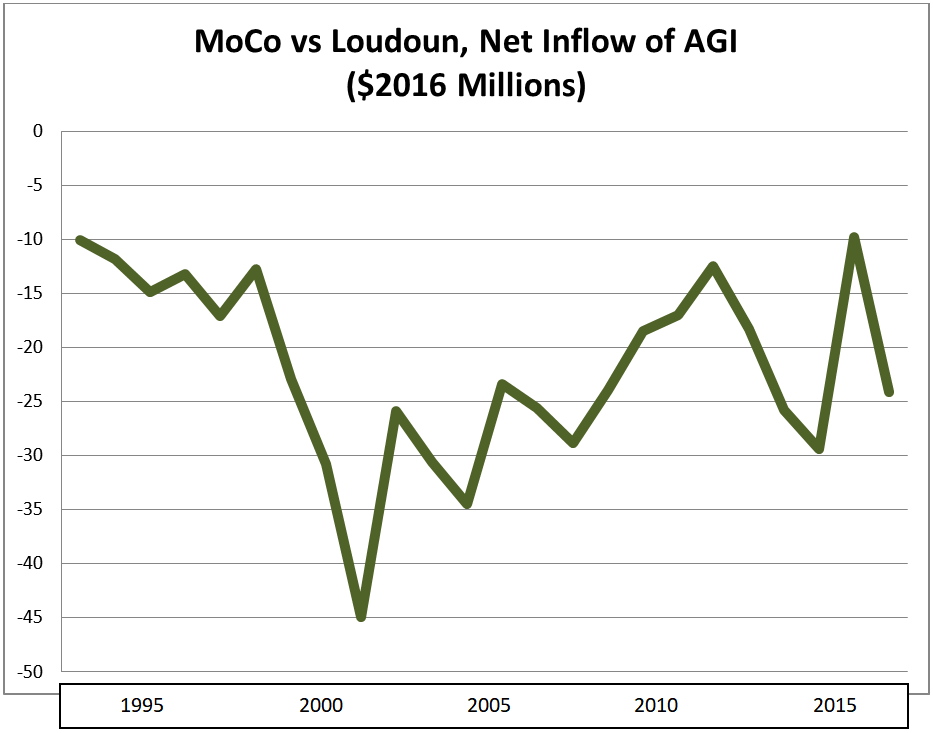
Net change in tax returns, 2006-2016: -1,507 (outflow)

Net change in adjusted gross income ($2016), 2006-2016: -$208 million (outflow)

Adjusted gross income of in-migrants ($2016), 2006-2016: $76,287

Adjusted gross income of out-migrants ($2016), 2006-2016: $100,587

Migrant income gap: Out-migrants earned 32% more than in-migrants

Loudoun has been the fastest-growing large jurisdiction in the Washington region for a long time and was once one of the fastest-growing places in the country.  Much of its growth has come from people relocating from Fairfax but it has gained some folks from MoCo too.  As the wealthiest county in the nation, it’s no surprise that its migrants from MoCo skew to high earners.

Howard County
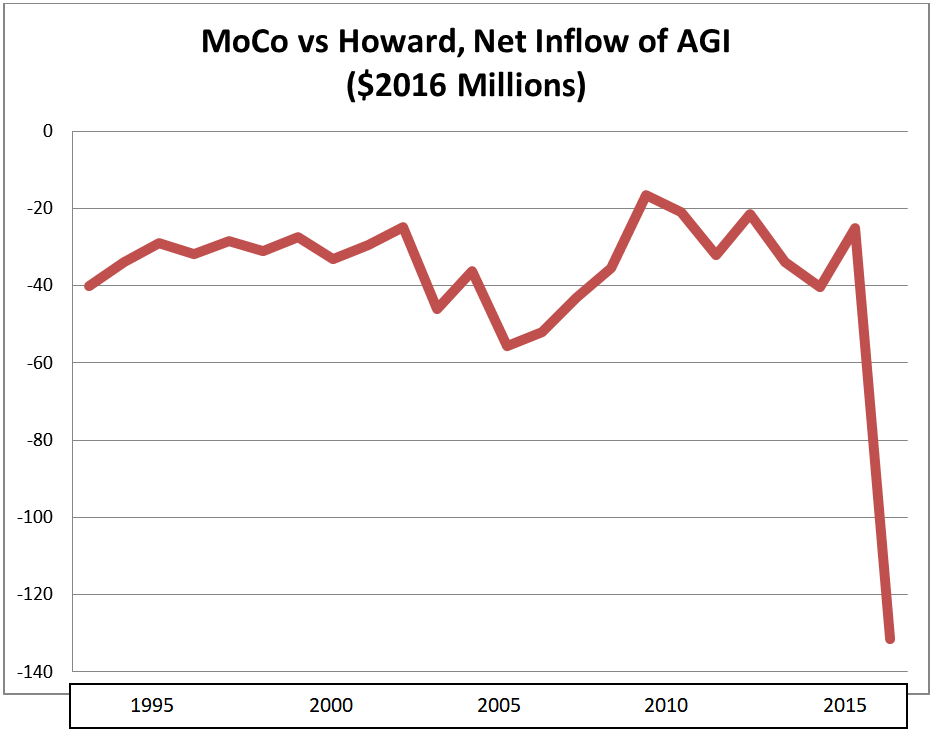
Net change in tax returns, 2006-2016: -2,859 (outflow)

Net change in adjusted gross income ($2016), 2006-2016: -$400 million (outflow)

Adjusted gross income of in-migrants ($2016), 2006-2016: $72,231

Adjusted gross income of out-migrants ($2016), 2006-2016: $90,724

Migrant income gap: Out-migrants earned 26% more than in-migrants

Howard is MoCo’s smaller and wealthier neighbor to the northeast.  It gains relatively small amounts from MoCo every year but set a record in 2016, when $131 million of taxpayer income left MoCo for Howard.  Howard’s schools and quality of life are comparable to MoCo but its significant distance from D.C. has limited its ability to compete for people who work downtown.  Ironically, the joint bus rapid transit route on US-29 that MoCo is working on with Howard could help remedy that disadvantage. 

Fairfax County
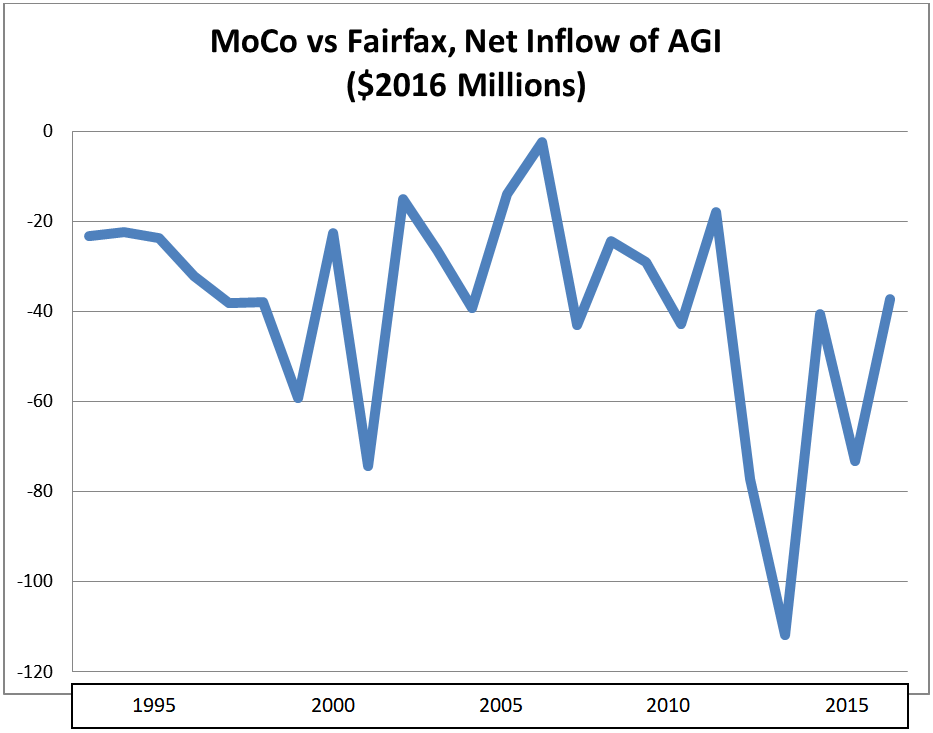
Net change in tax returns, 2006-2016: -2,382 (outflow)

Net change in adjusted gross income ($2016), 2006-2016: -$497 million (outflow)

Adjusted gross income of in-migrants ($2016), 2006-2016: $70,796

Adjusted gross income of out-migrants ($2016), 2006-2016: $93,521

Migrant income gap: Out-migrants earned 32% more than in-migrants

Fairfax has had more taxpayer flight than MoCo overall and is losing a ton of income to Loudoun ($2.5 billion over the last decade).  But in head-to-head competition, Fairfax siphons millions in taxpayer income from MoCo every year, setting a record in 2013 with a net gain of $112 million.  A big reason for Fairfax’s gains is that the people who move from MoCo to Fairfax made 32% more money than those who moved in the opposite direction over the last decade. 

Frederick County

Net change in tax returns, 2006-2016: -7,170 (outflow)

Net change in adjusted gross income ($2016), 2006-2016: -$582 million (outflow)

Adjusted gross income of in-migrants ($2016), 2006-2016: $59,150

Adjusted gross income of out-migrants ($2016), 2006-2016: $69,017

Migrant income gap: Out-migrants earned 17% more than in-migrants

MoCo’s smaller neighbor to the north has been feeding off the county for years.  Frederick’s biggest gains from MoCo occurred from 2002 through 2007 during the latter’s housing price boom.  Frederick is not siphoning off anywhere near the amount of income that Loudoun is getting from Fairfax, but the inflow of people from MoCo has helped change its county seat’s downtown, its demographics  and its politics.

Virginia
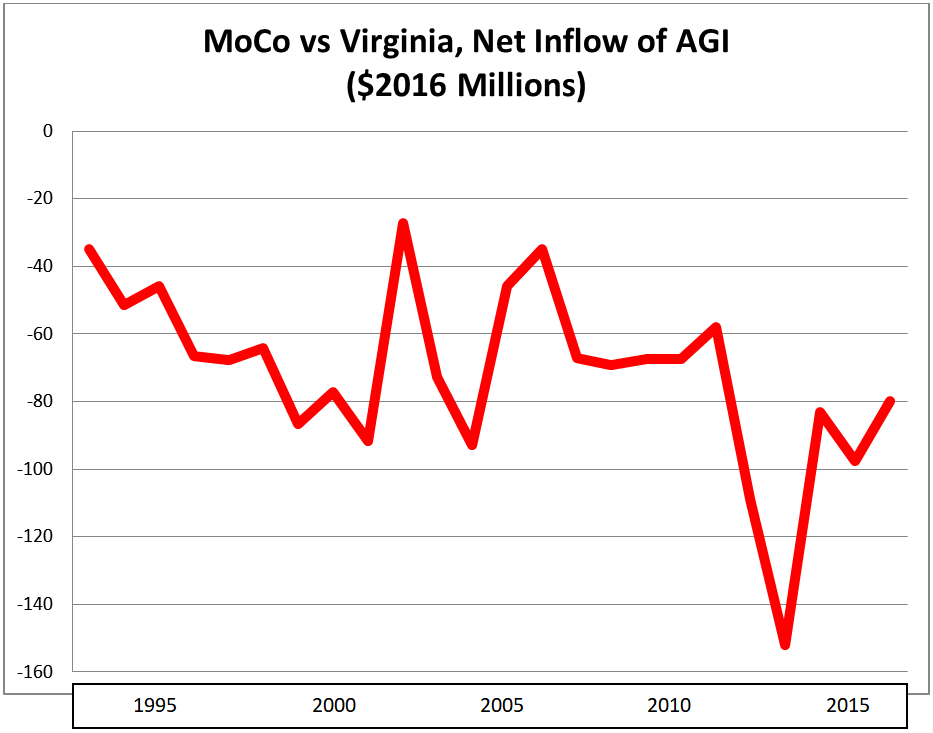
Net change in tax returns, 2006-2016: -5,638 (outflow)

Net change in adjusted gross income ($2016), 2006-2016: -$851 million (outflow)

Adjusted gross income of in-migrants ($2016), 2006-2016: $70,701

Adjusted gross income of out-migrants ($2016), 2006-2016: $83,010

Migrant income gap: Out-migrants earned 17% more than in-migrants

MoCo has lost significant amounts to Virginia over the years, with the biggest income losses occurring in 2013 ($152 million) and 2012 ($109 million).  Fairfax is the biggest culprit, followed by Loudoun and the rest of Northern Virginia.  The pace of income lost has picked up considerably since the early 1990s.

Florida
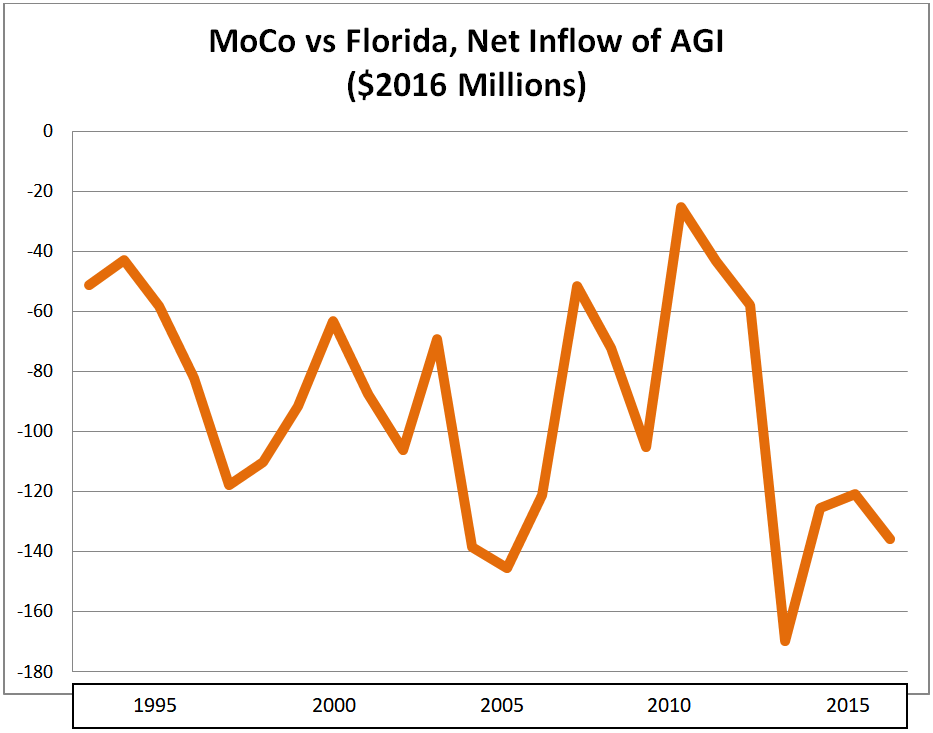
Net change in tax returns, 2006-2016: -2,769 (outflow)

Net change in adjusted gross income ($2016), 2006-2016: -$907 million (outflow)

Adjusted gross income of in-migrants ($2016), 2006-2016: $70,112

Adjusted gross income of out-migrants ($2016), 2006-2016: $132,459

Migrant income gap: Out-migrants earned 89% more than in-migrants

Everyone has heard the stories of rich people and/or retirees moving from MoCo to Florida.  Well, those stories might be true: more MoCo income has been lost to Florida than to Virginia over the last decade.  The number of people moving to Florida is less than those moving to Virginia.  But the average income of those moving from MoCo to Florida – $132,459 – is large in both absolute terms and when compared to those moving in reverse ($70,112).  One more thing: the last four years saw the biggest net loss of taxpayer income to Florida ($552 million) of any four-year period on record.

Share

Washington Post Endorsements Should be Coming Out Soon

By Adam Pagnucco.

Most influential endorsements have been made in our state and local races but one big one still has to drop: the Washington Post.  In contested races for Executive and County Council over the last three cycles, the Post has gone 18-7 – a 72% win rate.  Its misses included Howie Denis (Council D1, 2006), Mike Subin and Bo Newsome (Council At-Large, 2006), Royce Hanson (Council District 2, 2010), Duchy Trachtenberg (Council At-Large, 2010), Tom Moore (Council District 3, 2014) and Evan Glass (Council District 5, 2014).  Other than maybe Newsome, all of these were credible candidates and three (Denis, Subin and Trachtenberg) were incumbents.  In 2014, the first mid-term year in which Maryland had a June primary, the Post endorsed for Executive on May 2, for County Council on May 26 and for General Assembly on May 30.  Candidates are eager for the Post to endorse sooner rather than later because they would like to add the endorsement to their yard signs, mail and walk lit.

We know that the Post has been interviewing Executive and County Council candidates.  We would not be surprised if their endorsement for Executive comes out in a matter of days.

Share

Taxpayer Flight from MoCo, Part Four

By Adam Pagnucco.

In Part Three, we saw that MoCo’s problem of taxpayer flight is shared by most jurisdictions in the Washington region.  But what happens when we look at MoCo’s taxpayer inflows and outflows to and from each of its large neighbors?  From whom does MoCo gain income on net?  And to whom does MoCo lose income on net?

We looked at net gains and losses between MoCo and nine other local jurisdictions plus two states.  Let’s start with the two jurisdictions from which MoCo has net gains of taxpayer income: D.C. and Prince George’s.

District of Columbia

Net change in tax returns, 2006-2016: +1,070 (inflow)

Net change in adjusted gross income ($2016), 2006-2016: +$417 million (inflow)

Adjusted gross income of in-migrants ($2016), 2006-2016: $94,696

Adjusted gross income of out-migrants ($2016), 2006-2016: $83,038

Migrant income gap: In-migrants earned 12% more than out-migrants

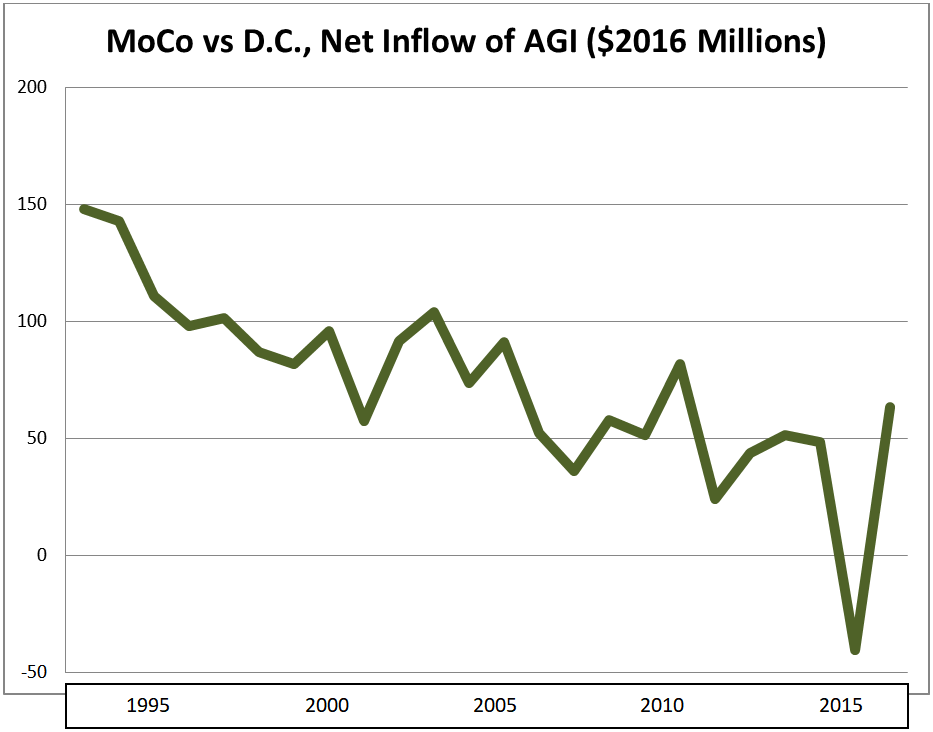
MoCo almost always drains tens of millions of dollars in taxpayer income each year from D.C.  That’s because it gets more in-migrants from D.C. than out-migrants and the in-migrants make more.  This fits a pattern of young people living in D.C. and then moving to the suburbs as their incomes grow and they are ready to have kids.  However, as D.C.’s economy has improved since the 1990s, the District’s net income flow to MoCo has diminished over time.  In 2015, D.C. even netted a gain of $40 million from MoCo, the first time the District ended up on the plus side of this ledger since this data series began in 1993.

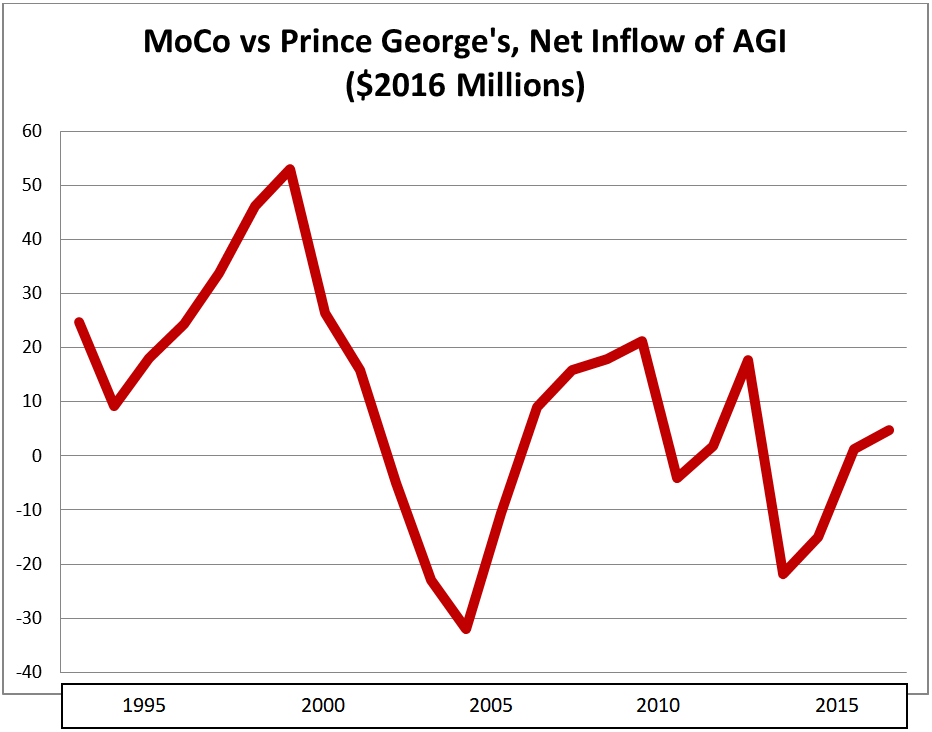
Prince George’s County

Net change in tax returns, 2006-2016: +834 (inflow)

Net change in adjusted gross income ($2016), 2006-2016: +$39 million (inflow)

Adjusted gross income of in-migrants ($2016), 2006-2016: $42,894

Adjusted gross income of out-migrants ($2016), 2006-2016: $42,802

Migrant income gap: In-migrants earned about the same as out-migrants

In the 1990s, MoCo consistently enjoyed positive income inflows from Prince George’s, but that began to change in the 2000s.  In the last fifteen years, MoCo lost money to Prince George’s seven times.  MoCo may still have a slight advantage but it’s very tenuous and could slip away.

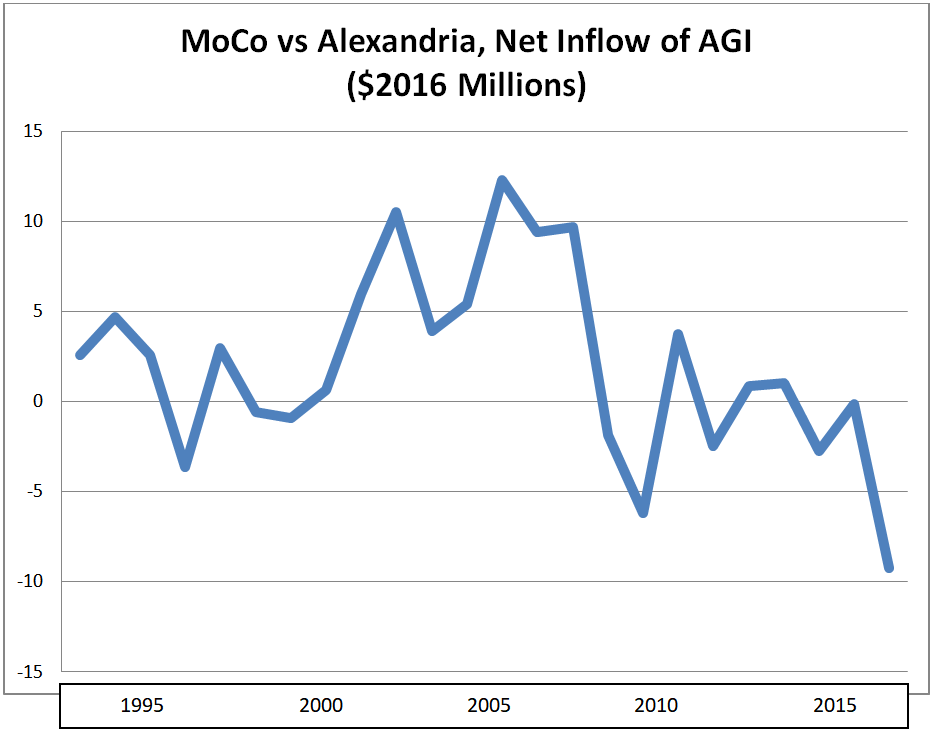
Alexandria City

Net change in tax returns, 2006-2016: -346 (outflow)

Net change in adjusted gross income ($2016), 2006-2016: -$7 million (outflow)

Adjusted gross income of in-migrants ($2016), 2006-2016: $78,961

Adjusted gross income of out-migrants ($2016), 2006-2016: $73,304

Migrant income gap: In-migrants earned 7% more than out-migrants

There’s not a ton of migration between MoCo and Alexandria and the two jurisdictions roughly break even, although MoCo’s balance has deteriorated a bit in recent years.

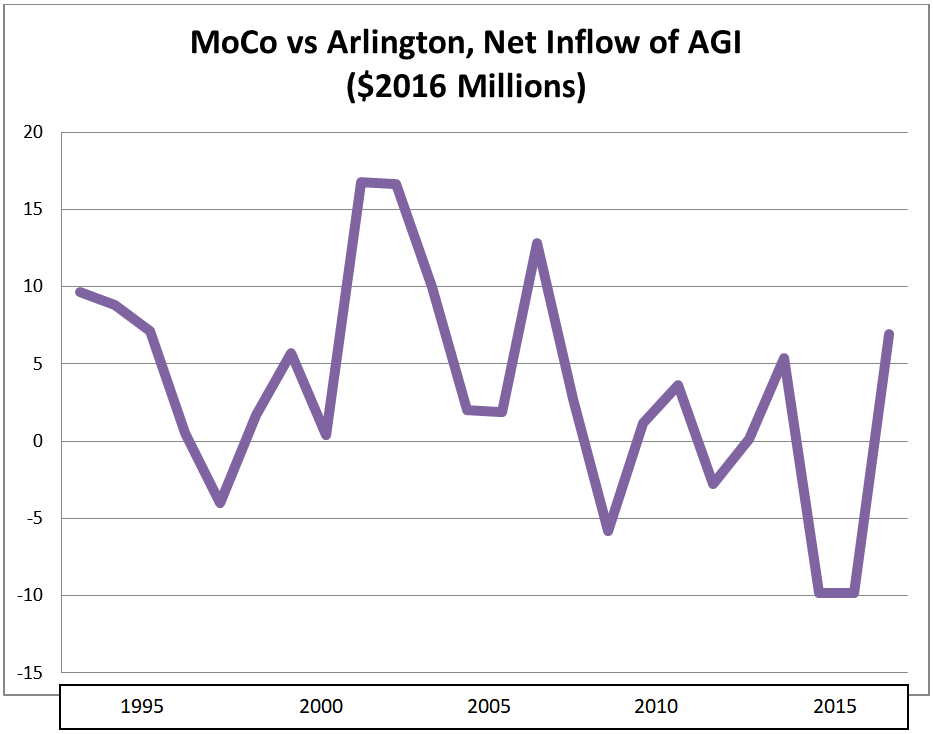
Arlington County

Net change in tax returns, 2006-2016: -1,103 (outflow)

Net change in adjusted gross income ($2016), 2006-2016: -$8 million (outflow)

Adjusted gross income of in-migrants ($2016), 2006-2016: $85,154

Adjusted gross income of out-migrants ($2016), 2006-2016: $72,852

Migrant income gap: Out-migrants earned 14% more than in-migrants

As with Alexandria, MoCo roughly breaks even with Arlington.  Again, MoCo’s balance has gotten slightly worse in recent years.

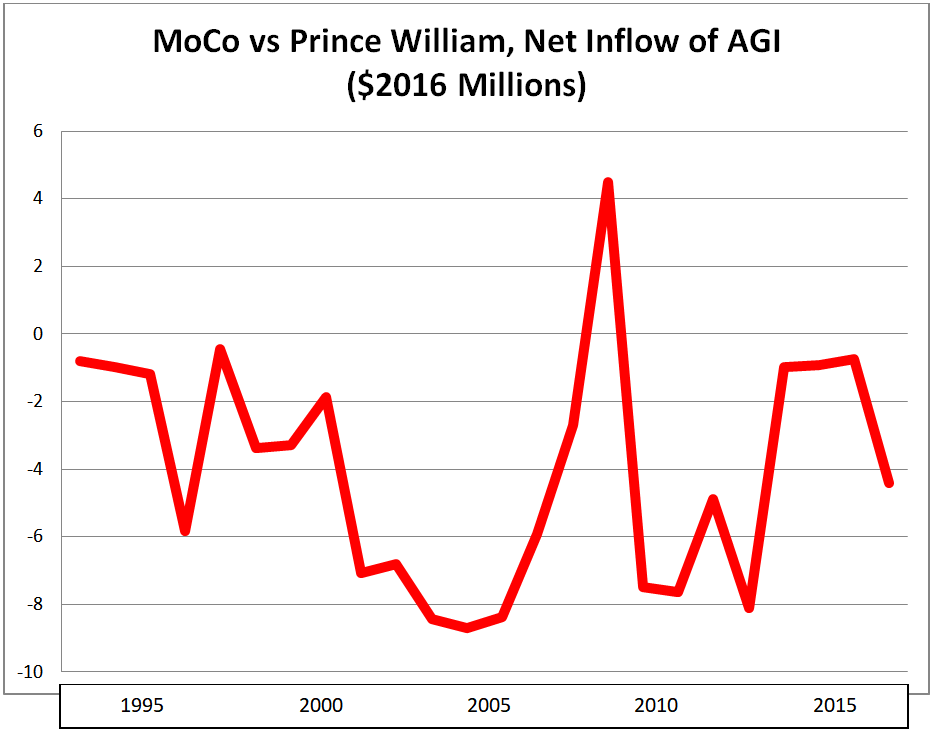
Prince William County

Net change in tax returns, 2006-2016: -289 (outflow)

Net change in adjusted gross income ($2016), 2006-2016: -$33 million (outflow)

Adjusted gross income of in-migrants ($2016), 2006-2016: $50,076

Adjusted gross income of out-migrants ($2016), 2006-2016: $57,436

Migrant income gap: Out-migrants earned 15% more than in-migrants

Prince William has received small inflows of income from MoCo that have diminished in recent years.  Most people moving between the two counties fall in the lower end of the region’s income distribution.

We will conclude tomorrow.

Share