MoCo’s Giant Tax Hike, Part Five

By Adam Pagnucco.

The untold story about the Giant Tax Hike is that it could have been cut substantially while still maintaining every dime of funding for MCPS in the Executive’s recommended budget.  How could that have been done?

The Executive called for an increase in property taxes of $140 million over the charter limit.  Three sources of savings were available to offset it.  First, Senator Rich Madaleno’s state legislation enabling the county to extend the time necessary to pay tax refunds mandated by the U.S. Supreme Court’s Wynne decision freed up $33.7 million.  Second, the County Council had obtained $4.1 million by not funding some elements of the employees’ collective bargaining agreements.  Third, county agencies other than MCPS were due to receive a combined $36.3 million in extra tax-supported funds in the Executive’s recommended budget.  Using some or all of that money for tax relief would have reduced the tax hike even more.  If all of that money were redirected, the tax hike could have been cut in half with MCPS still getting the entire funding increase in the Executive’s budget.

Instead, the council kept the entire 8.7% property tax hike and distributed $25 million of it throughout the entire county government, as well as its affiliated agencies and partner organizations.  While MCPS may have undergone seven straight years of austerity, most of the other agencies and departments had already received double-digit increases over their pre-recession peak amounts.  This new money was on top of those increases.

Council President Nancy Floreen was very honest about this, writing:

While this is an “education first” budget, it isn’t an “education only” budget. As much as many people care about our outstanding school system, we know that others have different priorities. This budget is very much about those people as well.

This budget provides a much-needed boost to police and fire and rescue services as we will be adding more police officers and firefighters and giving them the equipment they need to continue to make this one the safest counties in America. This budget is about libraries, recreation, parks, the safety net, Montgomery College, and transportation programs that help get people around this county better.

This budget means that no matter where you live in the county, if you call an ambulance, you can count on a life-saving response time. Our police force will now be equipped with body cameras. Potholes will be filled, snow will be plowed, grass in parks and on playing fields will be mowed and trees will get planted in the right-of-way. While our unemployment rate has fallen steadily over the past couple of years, our newly privatized program for economic development promises an even better job market in the future. We are going to help new businesses in their early stages and hope they will remain here once they become successful. We are going to aggressively seek to get established businesses to relocate here and we are going to fight to keep the great businesses of all sizes that already call Montgomery County home. Our avid readers and researchers will appreciate the interim Wheaton Library and extended hours at several branches. And students will have better access to after-school enrichment programs.

As Council President Floreen demonstrates above, this is not so much an Education First budget as it is an Everything First budget, with nearly every department and agency getting a piece of new tax revenues.

Let’s compare what happened this year to what occurred in 2010.  Back then, the county was suffering from the full effects of the Great Recession.  Its reserves were dwindling to zero, revenues were in freefall and its AAA bond rating was on the verge of being downgraded.  The County Council responded by passing a budget with furloughs, layoffs, no raises for employees, a cut in the county’s earned income tax credit, an absolute reduction in spending and a $110 million increase in the energy tax.  Given the dire economic emergency, all options were bad ones, but the council really had no choice.  The cuts and tax hike were forced upon them.

This year, there is a stagnant economy (which we will discuss in Part Six) but no Great Recession.  Reserves are substantial and have been on track to meet the county’s goal of ten percent of revenues.  There is no threat to the bond rating.  And yet, the council chose to pass a $140 million property tax increase – larger than the energy tax hike during the recession – when it could easily have reduced the tax increase, funded MCPS’s needs and not cut any other departments.  But it did not.

Like all big choices, this one will have consequences.  We will explore them in Part Six.

Share

MoCo’s Giant Tax Hike, Part Four

By Adam Pagnucco.

The tax hike is the part of the budget that is getting the most attention, but the County Council took another unusual step: it refused to fund part of the county employees’ collective bargaining agreements.  Labor has taken notice.

Salary increases in the county’s collective bargaining agreements are comprised of three main components.  First, there is a general wage adjustment that all employees receive.  Second, there is a service increment, also called a step increase, that employees who are not at the top of the salary scale for their classification receive.  Third, there is a longevity increment that is received only by employees who are at the top of their scale and have completed twenty years of service.  All of these items, along with many others, are negotiated by the three county employee unions (MCGEO, the Fire Fighters and the Police) and the Executive and codified in collective bargaining agreements.  The agreements then go to the council, which can decide to fund all, some, or no items that create economic costs.

During the Great Recession, the employees received no raises of any kind in Fiscal Years 2011, 2012 and 2013.  Afterwards, the unions negotiated for and received general wage adjustments, steps and longevity increments as well as “make-up steps.”  The latter were intended to compensate the employees for steps they did not receive during the recession.  The unions won make-up steps in Fiscal Years 2014, 2015 and 2017 (this year’s budget) with the exception of the Fire Fighters this year.  During these years, the combined general wage adjustments, steps and make-up steps ranged from 6.8% to 9.8% per year.

This year, the council approved MCPS’s funding increase on the condition that some of the money scheduled to fund MCPS employees’ raises be instead redirected to hire teachers and other staff.  The school board agreed.  In order to maintain equity between MCPS employees and county employees, the council insisted that the county unions give up some of their raises and primarily targeted their make-up steps.  The council refused to fund eight items in the collective bargaining agreements which together totaled $4.1 million in savings in Fiscal Year 2017, leaving the unions with raises of 4.5 percent.  Only Council Member Marc Elrich voted with the unions.

The county unions were outraged.  MCGEO, the largest of them, published a scathing response on its website, blasting the council as “hypocrites” who engage in “public manipulation in order to achieve what looks like sound fiscal management while achieving nothing.”  The council had approved make-up steps and total salary increases of 6.8-9.8% in both 2014 and 2015, so what had changed now?  The difference is that few people were paying attention in those two years because a tax hike was not on the table.  Now that a large tax hike was being considered, big raises were not politically feasible.  Hence MCGEO’s anger.

Justified or not, the council had achieved $4.1 million in savings by trimming employee salary increases.  That money could have been used to reduce the property tax increase, but that’s not what happened.  Why not?  We will have more in Part Five.

Share

MoCo’s Giant Tax Hike, Part Three

By Adam Pagnucco.

The need to fund MCPS was one reason given by county officials for their recent hike in property taxes.  Another reason was the effects of the U.S. Supreme Court’s decision in the Comptroller of The Treasury of Maryland vs Wynne case.  We examine that issue today.

The Wynne case started when two Howard County residents with income from a firm that did business in other states applied for an income tax credit to offset their out-of-state earnings.  While they received a credit against their state income taxes, they were denied a credit against their county income taxes.  The residents sued, and the case made it all the way to the U.S. Supreme Court, where the court sided with the plaintiffs on a 5-4 vote.  There were two consequences for local jurisdictions.  First, they could no longer tax out-of-state income.  Second, they owed refunds to residents who had paid taxes on out-of-state income dating back to 2006.  Between the two changes, Montgomery County’s Department of Finance estimated lost county income tax revenue of $76.7 million in FY17 and FY18, $31.5 million in FY19, and $16.4 million annually after FY19.

When the Executive sent the council his recommended budget in March, then-current state law required that Montgomery County pay an estimated $115 million in refunds and interest in nine quarterly installments stretching into FY19.  The hit in FY17 was $50.4 million.  But Montgomery County State Senator Rich Madaleno, Vice Chair of the Senate’s Budget and Taxation Committee, passed a state bill that extended the refund payment period out to FY24.  This reduced the county’s immediate liability and the Executive responded by asking the council to reduce his recommended property tax hike from 3.9 cents to 2.1 cents per $100 of assesable base.

Senator Madaleno’s legislation enabled the council to cut the Executive’s original $140 million tax hike by $33.7 million and still increase county funding for MCPS by $110 million.  But the County Council did not take advantage of it.  They increased property taxes by the Executive’s original amount anyway, a tax hike of 8.7 percent.  Why did they do that?  We will explore that question soon, but first we will examine another source of potential reductions in the tax hike: savings from collective bargaining agreements.

More in Part Four.

Share

MoCo’s Giant Tax Hike, Part Two

By Adam Pagnucco.

The County Council is calling its recently passed budget an “Education First” budget since it included an increase above the state-required minimum level for Montgomery County Public Schools.  Let’s evaluate that claim.

The council and the school system have had strained relations for a decade.  The problems began under former Superintendent Jerry Weast, who antagonized several Council Members with his hard-charging, overdriven style.  Nevertheless, Weast won several major budget increases for MCPS during his tenure.  Then came the Great Recession, which forced the county to make substantial spending cuts across all of its agencies.  One obstacle to cuts at MCPS was the state’s Maintenance of Effort (MOE) law, which sets a local jurisdiction’s per-pupil contribution to public schools as a base which cannot be lowered in future years unless a waiver is obtained from the state’s Board of Education.  In Fiscal Years 2010, 2011 and 2012, the county cuts its per-pupil contribution to MCPS, and in 2012, it did so without applying for a waiver.  As a result, the General Assembly changed the MOE law to force counties to apply for waivers or else have their income tax revenues sent directly to school systems.  At the same time, the General Assembly shifted a portion of teacher pension funding responsibilities, once solely the province of the state, down to the counties.  The combination of these two changes provoked outrage from county officials, some of whom vowed to never support a dime over MOE for MCPS in the future.

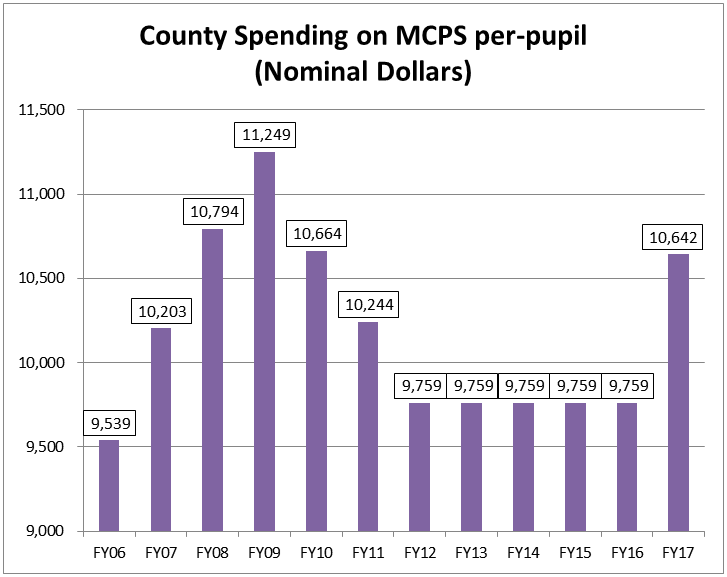
The chart below, which shows the recent history of Montgomery County’s local per-pupil contribution to the schools, illustrates the effects of these events.  After rising through FY09, the per-pupil contribution fell for three straight years and then was frozen for four straight years.  This year, the Executive proposed and the council approved an increased per-pupil contribution.  (Roughly $300 of the increase is accounted for by the county’s payment of teacher pensions.)  This is why the County Council is calling its budget an “Education First” budget.

County Per-Pupil Spending on MCPS Nominal

But three items of context apply here.

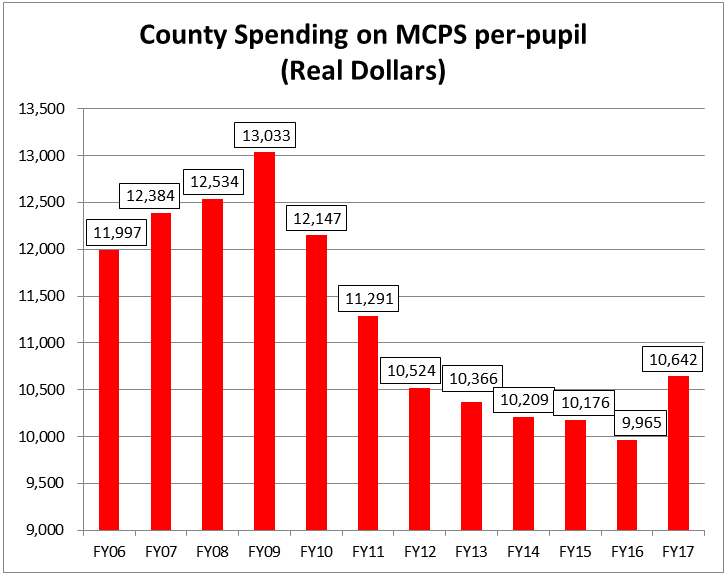
First, the above chart does not include the effects of inflation, which erode dollar contributions over time.  The chart below shows per-pupil contributions in real dollars using 2017 as a base.  (Inflation in 2016 and 2017 is assumed to be 2.1%, the average of 2007-2015.)  Adjusted for inflation, the county’s current per-pupil funding is nowhere close to what it was before the Great Recession struck.

County Per-Pupil Spending on MCPS Real

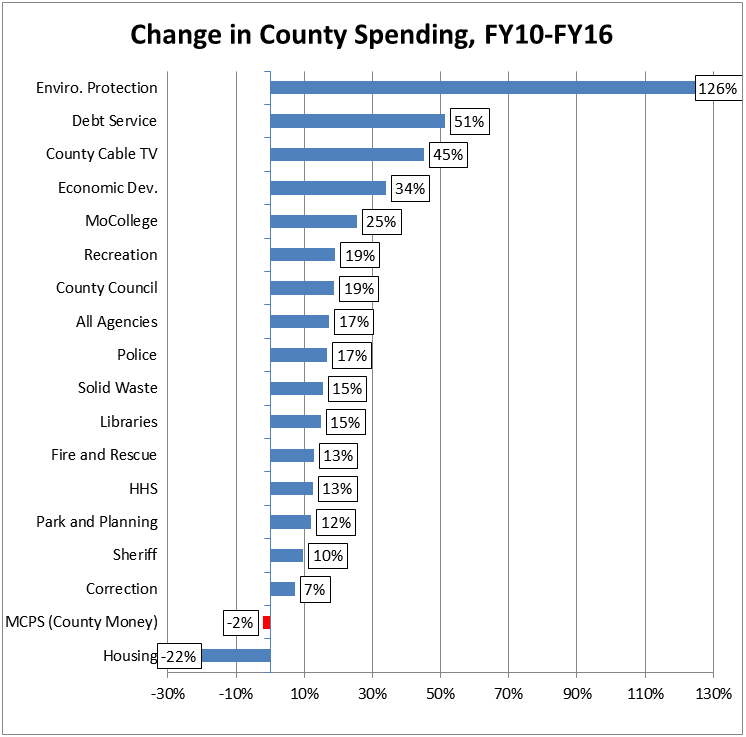
Second, while MCPS was living under austerity, other county departments were receiving sizeable funding increases.  The chart below compares funding increases across several county departments and agencies including MCPS between FY10 (the pre-recession peak year) and FY16.  In terms of county dollars only, MCPS’s budget was cut from $1.57 billion to $1.54 billion over this period, a 2% cut, while many other departments enjoyed double-digit increases.  Can one good year make up for seven years of austerity for the public schools?

Change in County Spending FY10-FY16

Third, while county officials criticize the General Assembly for tightening the MOE law and shifting teacher pensions, it is the state that has been pumping substantial funding increases into MCPS’s operating budget.  The chart below shows that while county funding for MCPS was cut by $33 million between FY10 and FY16, state aid to MCPS rose by $192 million.

MCPS Local Money vs State Aid

The bottom line is that the new FY17 budget does add $110 million in local money to MCPS, an amount which exceeds the state-required maintenance of effort by $89 million.  But this one funding increase comes after seven years of reduced and frozen per-pupil contributions, a period during which the rest of the government enjoyed double-digit increases.  Council President Nancy Floreen has described the budget as “a historic partnership with the Board of Education” and “a plan for the future.”  Does that mean that the council will continue to exceed maintenance of effort and give the school system increases that match the rest of the government in future years?  Or will this be a one-year respite, after which austerity will return?

We will have more in Part Three.

Share

MoCo’s Giant Tax Hike, Part One

By Adam Pagnucco.

As part of the Fiscal Year 2017 budget, the Montgomery County Council has voted to increase property taxes by 8.7 percent.  This is a landmark event that is drawing attention from a large number of people who hold differing views.  While it is a dramatic development, it is also the product of several factors that have been building for a number of years.  This series will explore those factors, explain how it happened, and look at the future.

First, a bit of background.  Property taxes are the number one source of revenue for Montgomery County Government, as they are for most, if not all, county governments in Maryland and Virginia.  In recent years, property taxes have accounted for 35-40% of the county’s total revenues, and the average household paid $4,154 in FY16.

In 1978, the nationwide property tax revolt that produced Proposition 13 in California came to Maryland.  That year, Prince George’s County voters passed the Tax Reform Initiative by Marylanders (TRIM) charter amendment, which placed a hard cap on property tax collections, and replaced it with a rate cap in 1984.  A 1996 referendum to repeal the cap failed.  Montgomery County voters also saw a TRIM charter amendment in 1978, but they voted it down by a 52-48% margin.  In 1990, Montgomery civic activist Bob Denny authored a charter amendment limiting growth in property tax collections to the rate of inflation, and county voters passed it.  But the charter amendment contained an override provision allowing the County Council to exceed the limit on a 7-2 vote.

By the 2000s, the charter limit’s constraint on the council began to evaporate.  The council voted to exceed the limit in FY03, FY04, FY05 and FY09, thereby prompting Robin Ficker to place one of his many anti-tax charter amendments on the ballot in 2008.  After years of failure, the same general electorate that voted for Barack Obama for President by 45 points approved Ficker’s amendment by 5,060 votes.  Ficker’s amendment did not convert the property tax limit to a hard cap, but it did require all nine Council Members to vote in favor of exceeding it.  The council has not done that until this year’s budget.

It’s worth understanding how Montgomery County’s charter limit works.  Section 305 of the charter states the following.

Unless approved by an affirmative vote of nine, not seven, Councilmembers, the Council shall not levy an ad valorem tax on real property to finance the budgets that will produce total revenue that exceeds the total revenue produced by the tax on real property in the preceding fiscal year plus a percentage of the previous year’s real property tax revenues that equals any increase in the Consumer Price Index as computed under this section. This limit does not apply to revenue from: (1) newly constructed property, (2) newly rezoned property, (3) property that, because of a change in state law, is assessed differently than it was assessed in the previous tax year, (4) property that has undergone a change in use, and (5) any development district tax used to fund capital improvement projects.

This is not a cap on rates.  It is a cap on collections, which are not allowed to grow faster than the rate of inflation with certain exceptions unless all nine Council Members vote to override.  Collections are a product of both rates and assessments.  If assessments grow rapidly, it’s possible for the county to cut the tax rate and still grow collections to the limit (or beyond).  Conversely, if assessments fall, the rate could rise and collections might grow slowly (or even shrink).  This distinction is key to understanding how the county makes decisions on this item.

In the new FY17 budget, County Executive Ike Leggett proposed increasing the property tax rate by 3.94 cents per $100 of assessed real property, an increase of 8.7 percent that would have raised $140 million more than the charter limit.  The Executive cited two main reasons for doing so: the challenge of dealing with the adverse consequences of the U.S. Supreme Court’s Wynne decision, which required large refunds to be paid to some county taxpayers, and the fiscal needs of the public schools.  We will look at both of those items as this series continues.

Share

Former GOP Delegate Candidate Jumps to the Democrats

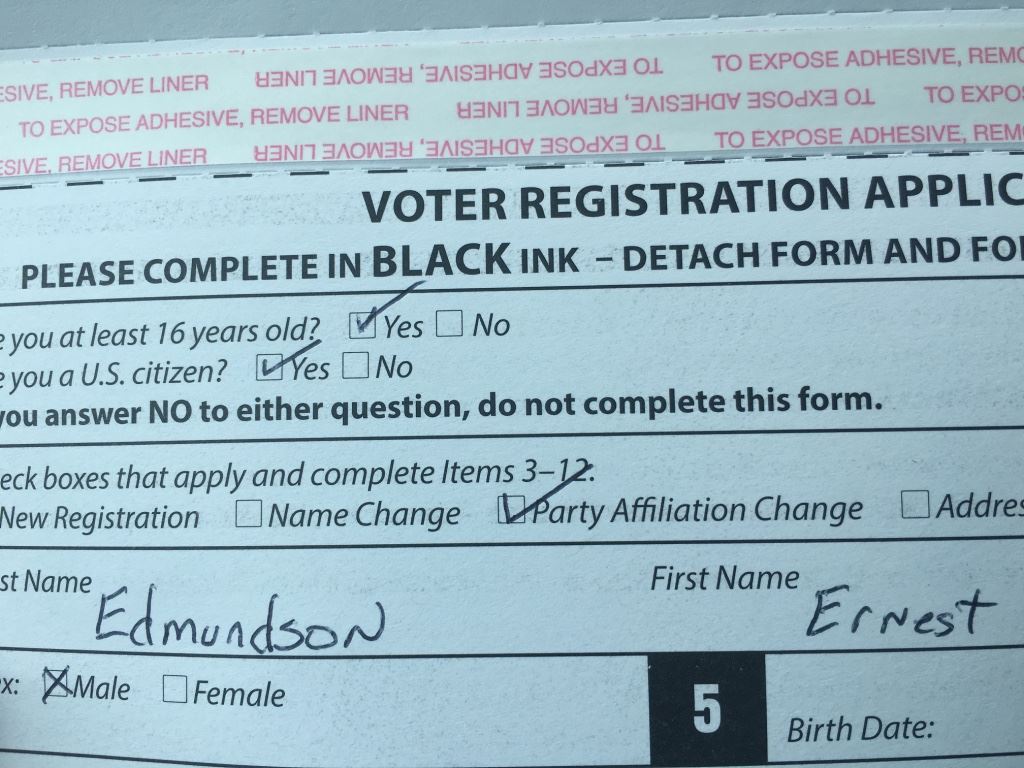
Edptychange

Former District 15 Republican Delegate Candidate Ed Edmundson announced his switch from R to D on Facebook yesterday, stating: “Done and Done. Bye-Bye GOP. I will not be part of a Party that picks a racist bigot to head the top of the ticket.” A real loss for the Montgomery GOP because they “desperately need people like him,” as I commented in this space two years ago.

In other news, Gov. Larry Hogan continues his silence on “racist bigot” Donald Trump becoming the nominee of his party.

Share

County Council Hopping Mad Over DLC Price Hike on Special Order Wines

Montgomery County Councimembers Tom Hucker and George Leventhal have objected vehemently to the Department of Liquor Control’s 10% price hike on special order wines.  Both have been staunch defenders of the County’s liquor monopoly and amazed that the DLC is taking exactly the opposite approach advocated by the County earlier this year.

Here is George Leventhal’s email to DLC Acting Director Fariba Kassiri:

Dear Fariba,

Last year, the County Council unanimously recommended that special order beer and wine sales should be handled by the private sector. County Executive Leggett initially agreed to this recommendation, but then changed his mind and our state legislative delegation deferred to his wishes, so no change occurred to beer and wine sales in Montgomery County. Now, according to your message below, the county has decided that because special order beer and wine sales cost DLC substantially more to process, DLC will impose a substantial price hike on licensees for these products. This decision was made without informing the County Council ahead of time and without the benefit of any advice from a Task Force on Liquor Sales, which Mr. Leggett promised to appoint but has yet to appoint.
Once again, DLC is acting in a manner that is adverse to the interests of the county’s restaurants and retail sector. I am disappointed in this decision and even more disappointed by the failure of the executive branch to take this issue seriously. The County Council’s Ad Hoc Committee on Liquor Control delved into the issue and came up with a compromise last year that would have preserved significant revenue to the county while freeing restaurants and retailers from the most onerous challenges of working with the county-controlled system. I am done apologizing for the failure of the executive branch to handle liquor sales responsively and efficiently. The responsibility for this failure rests squarely with Mr. Leggett.
With great concern,
George Leventhal
Montgomery County Councilmember

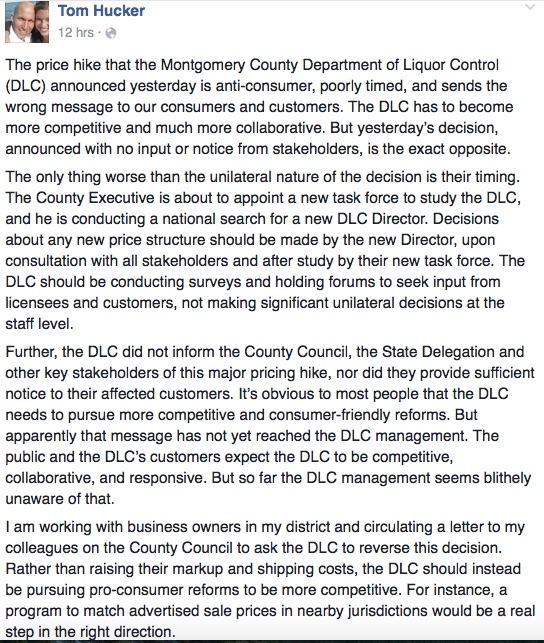
Councilmember Tom Hucker issued a press release and also posted this on his Facebook page:

huckerliquor

Share

DLC 10% Price Hike on Special Order Wines

The General Assembly session is over and the Montgomery County Department of Liquor Control (DLC) is safe from competition for another year. As the DLC no longer has to make the case that its prices are competitive, it has decided to celebrate by raising prices by 10% on special order wines over $18 per bottle.

Essentially, this is a tax increase. The County is using its monopoly power to increase the price on these wines by 10%. Businesses have a choice of either eating the cost or passing it on to the consumer. In any case, the change flies in the face of Councilmember Hans Riemer’s much vaunted reform proposal to free up special orders. MoCo is moving in the other direction.

Justin McInerny of Capital Beer and Wine sent out the following notice in response yesterday:

risingprices1

risingprices2

DLC INCREASES SPECIAL ORDER WINE WHOLESALE PRICES EFFECTIVE JUNE 1, 2016

Hi Everyone,

DLC has announced effective June 1, 2016 wholesale prices for all wines will be 25% over DLC’s cost. This is a huge, costly and burdensome increase for those of us who focus on small production, family owned and operated vineyards. Currently, the mark ups are as follows on wine:

  • 25% on special order wines whose cost to the DLC is under $18 per bottle,
  • 35% over cost for stock wines and
  • 15% for special order wines which wholesale for $18 per bottle.

Note that the percentage based markup is capricious and arbitrary to begin with. Shipping charges should not be based on how much an item costs. Shipping charges should be based on what it costs to ship the product. The DLC has no wholesale sales staff and originates no wholesale business. The DLC, like FedEx, is a delivery service which fulfils wholesale orders taken by third parties. A wine that wholesales for $10 per bottle costs the same to ship as a wine which wholesales for $12 per bottle.

HERE IS WHAT YOU CAN DO

I have made it easy for you to do something about this. Contact County Executive Leggett and the County Council members below and protest this decision.  

You can also call County Executive Leggett directly 240-777-0311, the DLC runs under his supervision.

You can also call the Councilmembers directly or e-mail them directly through the County Council website here.

Thank you for your help.

Share

CD8 Primary Election Results, Part Four

A guest blog by Adam Pagnucco.

Let’s put together the previous three parts and look in detail at the strengths and weaknesses of the top three candidates.

Senator Jamie Raskin

Strongest Performances

Takoma Park: 64.2% (1st)

Legislative District 20: 51.9% (1st)

Silver Spring Inside the Beltway: 49.9% (1st)

Inside the Beltway: 47.9% (1st)

Montgomery County Council District 5: 47.2% (1st)

Chevy Chase: 45.5% (1st)

Cabin John: 41.6% (1st)

Bethesda: 41.3% (1st)

Montgomery County Council District 1: 41.3% (1st)

Legislative District 16: 40.6% (1st)

Weakest Performances

Derwood: 11.0% (3rd)

Carroll County Total Votes: 12.0% (3rd)

Damascus: 12.5% (3rd)

Frederick County Total Votes: 12.7% (3rd)

White Population Over 90%: 13.6% (3rd)

Glenmont/Norbeck: 15.0% (4th)

The above areas illustrating Raskin’s greatest strengths have something in common: they are all totally or primarily inside the Beltway.  (Most of the portion of Council District 1 that is outside the Beltway is in Congressional District 6.)  The areas showing his greatest weaknesses also have something in common: they are all totally or primarily outside the Beltway, some of them a considerable distance outside.  Raskin expanded his geographic base successfully since 74% of his votes came from outside District 20, but his votes began to dry out north of Norbeck Road.  His 6.5 point victory was due to his ability to consolidate the vote in Downcounty precincts while pulling just enough votes from the north to prevent David Trone or Kathleen Matthews from winning.

David Trone

Strongest Performances

Carroll County Total Votes: 51.8% (1st)

White Population Over 90%: 51.4% (1st)

Frederick County Total Votes: 51.2% (1st)

Damascus: 44.9% (1st)

Montgomery County Council District 2: 41.5% (1st)

Legislative District 15: 38.6% (1st)

Derwood: 36.9% (2nd)

Glenmont/Norbeck: 36.1% (1st)

Potomac: 35.1% (1st)

Legislative District 14: 34.2% (1st)

Weakest Performances

Takoma Park: 11.7% (3rd)

Chevy Chase: 13.9% (3rd)

Inside the Beltway: 15.8% (3rd)

Legislative District 20: 16.8% (3rd)

Silver Spring Inside the Beltway: 17.0% (3rd)

Bethesda: 18.1% (3rd)

Montgomery County Council District 1: 18.4% (3rd)

Montgomery County Council District 5: 18.5% (2nd)

Legislative District 16: 19.3% (3rd)

Cabin John: 19.7% (3rd)

Trone’s strengths and weaknesses are the mirror image of Raskin’s.  He lost to both Raskin and Matthews inside the Beltway, but as the precincts went farther north, Trone got stronger.  Trone’s success in the northern Counties as well as Upcounty Montgomery will no doubt cause him to take a hard look at the Congressional District 6 seat should John Delaney run for Governor.  Western Maryland accounts for a fifth of CD8’s Democratic primary voters, but in CD6, it accounted for roughly 40% of the vote in both the 2016 and 2014 Democratic primaries.  One interesting thing not shown here: Trone was the leader in majority-minority, heavily Hispanic and heavily Asian precincts.

Kathleen Matthews

Strongest Performances

Derwood: 40.8% (1st)

Leisure World: 33.1% (1st)

Bethesda: 32.5% (2nd)

Legislative District 16: 32.3% (2nd)

Cabin John: 32.0% (2nd)

Chevy Chase: 32.0% (2nd)

Montgomery County Council District 1: 31.6% (2nd)

Weakest Performances

Takoma Park: 8.4% (3rd)

Silver Spring Inside the Beltway: 13.4% (3rd)

Blacks Over 33% of Population: 15.2% (3rd)

Montgomery County Council District 5: 15.2% (3rd)

Hispanics Over 33% of Population: 16.0% (4th)

Whites Under 40% of Population: 16.6% (3rd)

Majority-Minority Precincts: 17.7% (3rd)

Matthews finished second in most parts of CD8, which isn’t bad, but she finished first in just two local areas: Leisure World and Derwood, which has only one precinct in the district.  If she had also finished first in, say, Bethesda and Chevy Chase, she might have gotten close, but Raskin owned the areas inside the Beltway.  Matthews told the Washington Post that she was thinking of running for local office in the future. Here’s an idea for her: in a County Council at-large race, the top four vote-getters triumph.  A candidate who finishes second everywhere would be a lock to win.

Now here’s an interesting thought.  With Raskin going to Congress, Matthews thinking about running again and Trone not ruling it out either, could all three of them ultimately be in office after the next election?

Share

Maryland Politics Watch