The Next Senator from District 20

The battle to replace Jamie Raskin in the State Senate is currently the object of much speculation but the logical and likely appointment by the Montgomery County Democratic Central Committee (MCDCC) seems obvious: Del. Will Smith.

All three sitting Montgomery senators who gained that office via appointment were already delegates: Craig Zucker in District 14, Brian Feldman in District 15, Nancy King in District 39. Each had served at least one full term in the House before moving to the Senate.

Beyond experience, selection of a delegate also make sense because the exact same constituency has already elected them to the General Assembly. The three delegates are not just the most obvious but most democratic choices.

Among the three delegates, Del. Sheila Hixson could have it if she wanted it but doesn’t. That leaves Del. David Moon and Del. Will Smith. Both are former campaign managers for Sen. Jamie Raskin’s past campaigns and won election in 2014.

Prior to their election, highly diverse District 20 had an all white state legislative delegation. The election of Korean American Moon and African American Smith changed that. Beyond personal ties, Sen. Raskin and Del. Hixon’s desire to diversify the delegation no doubt played a role in their joint endorsements of Moon and Smith.

The Montgomery County Democratic Party remains interested in promoting greater racial diversity in the delegation. MCDCC will be under enormous pressure to take this into account during its deliberations.

This factor weighs heavily against David Moon. No African American has ever won election or appointment to the Senate from Montgomery County. According to the Census, African Americans now form roughly 19% of the County’s population.

In contrast, there is currently one Asian American Senator–District 16 Sen. Susan Lee. She forms one of eight, or 12.5%, of the Montgomery County Senate delegation–not far off the estimated 15% of the County’s population that is Asian American.

There are currently three African Americans (Dels. Al Carr, Pam Queen and Will Smith) and four Asian Americans (Dels. Kumar Barve, Aruna Miller and David Moon along with Sen. Susan Lee) in the entire Montgomery state legislative delegation, so African Americans have less overall representation in terms of absolute numbers and percentages.

David Moon has advocated for increased minority representation in the General Assembly. He has promoted minority candidates and helped to pass along his considerable campaign skills. Nonetheless, the logic of these very ideas will work against him in a jurisdiction and party attuned to racial balance, especially since District 20 has the highest share of African Americans in the County.

Other African Americans have thrown their hat into the ring, notably former County Councilmember Valerie Ervin and Will Jawando. Both are well qualified but have political strikes against them that mitigate against an appointment over Smith.

Ervin has touted that her appointment would be a double win, as her appointment would bring the share of women in the Senate delegation to parity. However, she abandoned her seat on the County Council before the end of her term to take up another job, which annoyed many activists.

Additionally, Ervin supported Edwards for Senate–not the popular position in Montgomery. While this is not nearly as problematic as her resignation, Ervin’s quotes in the media expressing ambivalence about endorsing Van Hollen in the immediate aftermath of the election are much more damaging.

Jawando faces an uphill climb for different reasons. Smith beat him for a delegate seat in 2014. Why should MCDCC second guess the choice of the voters? Second, after losing that race, he made a quixotic bid for the congressional seat against Raskin.

If Jawando had supported Raskin, he would have been very well positioned for the delegate seat. Opposing Raskin, who has long had very strong support among this same constituency, has made winning that seat far more difficult, especially since he received even fewer votes in his congressional bid than his delegate race.

Share

WaPo Didn’t Just Bury the Lede, It Interred It

Read Adam Pagnucco’s critique of the Democratic response to the Hogan/Franchot proposed post-Labor Day school start posted this morning.

The Washington Post played monkey-see, monkey-do this morning in its coverage of last night’s debate. On page A1 (yes, I still get the print edition) and on its homepage, the Washington Post covered Matt Lauer’s questions about Clinton’s email that dominated the forum supposedly about national security.

It buried on A6 and left off the homepage the story that Clinton was absolutely right about Colin Powell’s advice regarding the use of her cell phone. As The Hill reported in a story titled “Powell told Clinton how to bypass State security measures:”

Powell says that he used a private phone line to keep his communications out of the State Department servers.

“What I did do was have a personal computer that was hooked up to a private phone line (sounds ancient.),” Powell wrote. “So I could communicate with a wide range of friends directly without it going through the State Department servers.”

“I even used it to do business with some foreign leaders and some of the senior folks in the Department on their personal email accounts. I did the same thing on the road in hotels,” he said.

Powell was responding to a question from Clinton about the restrictions on using a BlackBerry while in office. 

[Rep. Elijah] Cummings added that Republicans’ pursuit of Clinton over her server was politically motivated, otherwise they “would be attempting to recover Secretary Powell’s emails from AOL.”

Powell also told Clinton that he would frequently take his cell phone into Sensitive Compartmented Information Facilities (SCIF) — secure rooms where classified information was processed and mobile devices were prohibited.

In the print version, the WaPo truncated the story that appeared online, leaving out key paragraphs at the end about Powell taking devices into secure rooms with classified material. And the Republicans howl that the press is biased to the Democrats?

Share

Democrats, Be Careful on Labor Day

By Adam Pagnucco.

Last week, Governor Larry Hogan caused a splash in Ocean City with his new Executive Order mandating a post-Labor Day start for public schools.  A few Democrats, led by Baltimore City Senator Bill Ferguson, Montgomery County Delegate Eric Luedtke and Montgomery County Senator Rich Madaleno, have pushed back hard.  The two sides occupy their natural political territory: Hogan touts the economic benefits that employers in resort areas could receive from busy Labor Day weekends, while the Democrats reassert their traditional defense of public schools (whose officials overwhelmingly oppose the order).

Some Democratic lawmakers are spoiling for a fight, but wiser heads should prevail.  If the Democrats try to overturn Hogan in the next general session, they will be handing the Governor a nice win for three reasons.

  1. A post-Labor Day start is popular.

The Governor’s use of polls, especially those showing his high job approval ratings, clearly gets under the Democrats’ skin.  But Hogan is not the first politician to leverage polls to his advantage and he certainly won’t be the last.  Three different polls taken by Goucher College in the fall of 2014, the spring of 2015 and the fall of 2015 find support for starting school after Labor Day at 71%, 72% and 72% respectively.  The most recent poll finds support at 69% or above for every gender, racial, age and party group isolated, including 72% approval among Democrats.  Support for starting school after Labor Day is about even with support for sick leave and redistricting by an independent commission (another signature Hogan issue) and is above support for legalizing marijuana and opposition to fracking.

  1. The Democrats are divided.

A number of Democrats have sponsored at least one of three recent bills mandating Labor Day school start times.  They include the following five Senators and nineteen Delegates:

Senator John Astle (Anne Arundel)
Senator Ed Kasemeyer (Baltimore County/Howard)
Senator Katherine Klausmeier (Baltimore County)
Senator James Mathias (Eastern Shore)
Senator Jim Rosapepe (Prince George’s/Anne Arundel)
Delegate Curt Anderson (Baltimore City)
Delegate Darryl Barnes (Prince George’s)
Delegate Kumar Barve (Montgomery)
Delegate Pamela Beidle (Anne Arundel)
Delegate Eric Bromwell (Baltimore County)
Delegate Mark Chang (Anne Arundel)
Delegate Diana Fennell (Prince George’s)
Delegate Barbara Frush (Prince George’s/Anne Arundel)
Delegate Tawanna Gaines (Prince George’s)
Delegate Cheryl Glenn (Baltimore City)
Delegate Keith Haynes (Baltimore City)
Delegate Anne Healey (Prince George’s)
Delegate Sheila Hixson (Montgomery)
Delegate Carolyn J. B. Howard (Prince George’s)
Delegate Aruna Miller (Montgomery)
Delegate Sheree Sample-Hughes (Eastern Shore)
Delegate Theodore Sophocleus (Anne Arundel)
Delegate Jay Walker (Prince George’s)
Delegate Alonzo Washington (Prince George’s)

In addition to those Democrats who support the Governor’s position (even if they’re not happy with implementing it through an Executive Order), many more will be loath to vote against something that has more than 70% public support.  If the General Assembly leadership tries to ram through a bill next year overturning the Executive Order and they cannot get enough votes to override a veto, that would be a nightmare scenario.  The Governor would look strong on a popular issue and the Democrats would look weak – VERY weak.

  1. It’s a regional wedge issue.

If the Democrats try to overturn Hogan, understand what that could look like to Marylanders who live near places like Deep Creek Lake and the Eastern Shore: an effort by politicians from MoCo and the City to prevent economic prosperity in their areas.  As one Democratic lawmaker who is not from the resort counties told us, “The jurisdictions that need the tourism are desperately in need of local government revenues, they are among the poorest in the state.  To ignore that borders on public policy malpractice.”  Governor Hogan wants to depict Democrats as pointy-headed, urban elitists who don’t care about the rest of Maryland.  Democrats need to be careful about giving him ammunition for that argument.

Some may point out that Labor Day is not as strong a voting issue as education, transportation and taxes (the latter being OWNED by Hogan) and that the numbers may move as school systems rearrange their calendars.  Fair enough: poll numbers can and do move, with those on marriage equality being the prime example.  But making them move far enough and fast enough to justify a legislative response will likely require a massive PR campaign to do it.  Who is going to wage such a campaign?  It won’t be the Democrats themselves, whose communication capacity is dwarfed by the Governor’s – a problem on which no apparent progress is being made.  It probably won’t be the state teachers union, which opposes the Executive Order but told the Post that overturning it was not a focus of theirs in the next general session.  If not the Democrats or the teachers, who else is going to do this work?

ItsaTrap

Hogan WANTS the Democrats to fight him.  There’s a reason why he did this through an Executive Order and a press conference rather than simply having the State Board of Education do it for him.  The Governor wants this story to go on for months to maximize his benefits from it.  So does the original architect of the issue, Comptroller Peter Franchot, whom the high priests of the Democratic establishment regard as an apostate.  Do General Assembly Democrats really want to give these two a bigger win than what they already have?

Let’s remember the Governor’s goals here.  First, he wants to increase his reelection vote percentage above the 51% he received last time.  Second, he wants to get enough Republicans elected to the General Assembly so that his vetoes can be upheld, thus forcing Democrats to negotiate with him on virtually everything (including redistricting).  The easiest way to do that is to pick up seven GOP seats in the House of Delegates, which the Republicans did in 2014.  And third, he would like to eradicate the Democratic Party from all areas outside the Baltimore-Washington corridor, a feat that is already dangerously close to reality.  If the Governor can accomplish all three objectives, he will change Maryland into a genuine two-party state, at least at the level of state and local government.  And he thinks the Labor Day issue will help him get over the top.

The Governor is dangling the bait.  Will the Democrats take it?

Share

David Moon for Senate


By Adam Pagnucco. (Editor’s Note: As always, this post–and endorsement–reflects the views of the author. No broader support or opposition to David Moon is meant by this post or note.)

I still remember the day I first met one of the great masterminds of MoCo politics.

It was March 2008.  A group of us gathered at SEIU Local 500’s headquarters to discuss how to help Nancy Navarro win the upcoming Council District 4 special election.  The room was full of progressive activists, ace operatives and labor people, most of whom had lots to say.  Your author, not being shy, ranted and raved with the best of them.  Off at the end of the table sat a quiet, scrawny little guy who looked like he weighed about 80 pounds.  He stared into his computer and said almost nothing during the two hour meeting.  I elbowed the attendee next to me and asked, “Who’s that?”  “Oh, that’s David Moon.”

Moon was already a household name among MoCo activists at that point, having been the campaign manager behind Jamie Raskin’s 33-point State Senate victory two years before.  But he was just getting started.  Moon’s skills were put to the test during the two special elections that followed as he endured a close loss by Navarro the first time, followed by an even closer win the next year.  I had been involved with union organizing and political campaigns during my time in the labor movement, but I had not met many campaigners of his caliber before.  Moon was simultaneously creative and disciplined – a rare combination for anyone.  He would do the tedious, mind-numbing work of producing the walk sheets and handling the follow-up data entry, and then turn around and come up with something new on the fly.  He could think big picture and then slap Apple Ballot stickers on lit all night.  He seemed to live on Diet Coke and junk food.  If you wanted to find him, the best way was to locate the largest pile of empty cans and wrappers and see who was sitting in the middle of it.  Most remarkable of all, Moon was almost without pretense.  All campaign managers have egos and some are unbearable.  But Moon would meet any suggestion, whether brilliant or stupid, with a shrug and grab the good ones while quietly disposing of the clunkers.

The David Moon of today was still evolving in the 2008-2010 period, but even then you could see where he was headed.  Most operatives are motivated by some combination of the thrill of winning, wanting a job with the victorious candidate, wanting to run for office themselves or just the fun of the game.  None of that was enough for Moon.  He had a Plan, and it was wildly ambitious.  He wanted to build a base for true progressivism in Montgomery County.  And by that I don’t mean just electing people who toss goodies to liberal interest groups while trying to move up the ladder.  Moon’s vision was to combine the political and economic forces of new residents, economic development, labor rights, people of color, environmentalism, smart growth and political reform into a movement for real change.  For a while, he did that through running other candidates’ campaigns and working with organizations like Action Committee for Transit, Communities for Transit, Casa de Maryland and FairVote.  But like most good quarterbacks, he eventually called his own number and ran for office himself.  He outwitted, outlasted and outplayed a number of capable opponents on his way to Annapolis.

As a Delegate, Moon has not backed away from any of the causes he supported early in his career, but he picked a focus: social justice.  Most freshman Delegates regard the House Judiciary Committee as a backwater.  They have to deal with the dominance of crusty old committee chair Joe Vallario and they can’t get the fundraising connections that members of other committees can (especially Economic Matters).  But Moon wanted to be on Judiciary; in fact, he actively lobbied for it because it is the place where criminal justice issues are decided.  And that’s where Moon has planted his flag.

Moon has been nothing less than a prophet on unfairness in the criminal justice system.  When he was running for Delegate, he wrote:

It’s time for a grown-up conversation about our criminal justice system. Maryland leads the nation in marijuana arrests, and black residents of Montgomery County are over 3 times more likely to be arrested for possession than white residents. This costs us between $100-$200 million a year and ruins the lives of young people by barring them from employment, student loan eligibility and more. Let’s look at the evidence and start rolling back the failed “War on Drugs” in Maryland.

Months later, the Baltimore riots erupted partly as a result of these issues.  Moon has been advocating on them ever since.  He has introduced numerous bills to rein in justice system excesses.  In 2015, he passed a bill through the House that would have excluded possession of a small amount of pot as a reason for parole violation.  (It died in the Senate.)  He has proposed letting voters decide whether to legalize marijuana and fought against efforts to recriminalize it.  Slowly but surely he is helping criminal justice reform advance, and in the years to come, the work of Moon and his allies will pay off.

Moon also returned to his political reform roots by teaming up with Republican Delegate Kathy Szeliga on a bill that would stream live video of General Assembly sessions, something that the Montgomery County Council has been doing for years.  He opposed tens of millions of dollars of corporate welfare given to Northrop Grumman even while many Democrats (including some from Montgomery County) supported it.  His greatest triumph was passing a constitutional amendment that would allow special elections for U.S. Senate, Comptroller and Attorney General vacancies.  (This is subject to approval by voters.)

Moon’s work on criminal justice has produced something that’s uncommon for MoCo legislators: growing collaboration on a key priority with lawmakers from the City of Baltimore and Prince George’s County, who often co-sponsor his bills.  Moon has also helped create an informal group of cooperating progressives who resist reactionary bills no matter their source – even including the Democratic leadership.  A progressive caucus is a long-time dream of the left, but Annapolis leaders have always prevented it through a combination of pressure and cooptation.  Such tactics do not work on the indefatigable Moon.  He will not and cannot be deterred.

David Moon is an unusual elected official.  His experience as one of MoCo’s top campaigners has given him the ability to pursue big picture goals through patience, methodical assemblage of leverage and the implementation of tactics designed to build momentum.  He has demonstrated that capacity throughout his entire career, both in office and out.  He has worked on nearly the entire spectrum of progressive issues.  His priorities are perfectly in line with District 20 Democrats, who are probably the most progressive constituency in the entire state.  He is the natural heir to Jamie Raskin.  While I can appreciate the perspective of those who would like to appoint a caretaker to serve out the rest of Senator Raskin’s term and there are other good people available, the prospect of sending Moon to the upper chamber has too much upside to resist.

David Moon for Senate.

Share

Self-Deported Dan Bongino Melts Down

After losing a close race for the Sixth Congressional District, Dan Bongino self-deported to Florida, where this self-proclaimed non-politician has decided to run for Congress again.

It’s not going well.

Showing the cool calm when under fire for which former members of Secret Service are known, Bongino lashed out when a reporter accused him of being a carpetbagger. Apparently, he asked the reporter repeatedly “to carry out a sexual act that is not physically possible” as well as using much other ungentlemanly vocabulary that doesn’t exactly read grace under pressure.

Share

Montgomery Republicans Now Muslim Baiting

If you’re hoping that Donald Trump falls into the category of “this too shall pass,” you need look no further than the Montgomery County Republican Party to see that Trumpism isn’t an aberration but is the Republican Party.

The Montgomery County Republican Party and 7S have been having a lively debate on Twitter (140 characters being so amenable to thoughtful discussion) about the relative importance of Clinton’s emails versus Trump’s willingness to give Crimea to Putin and his hiring of a campaign manager illegally.

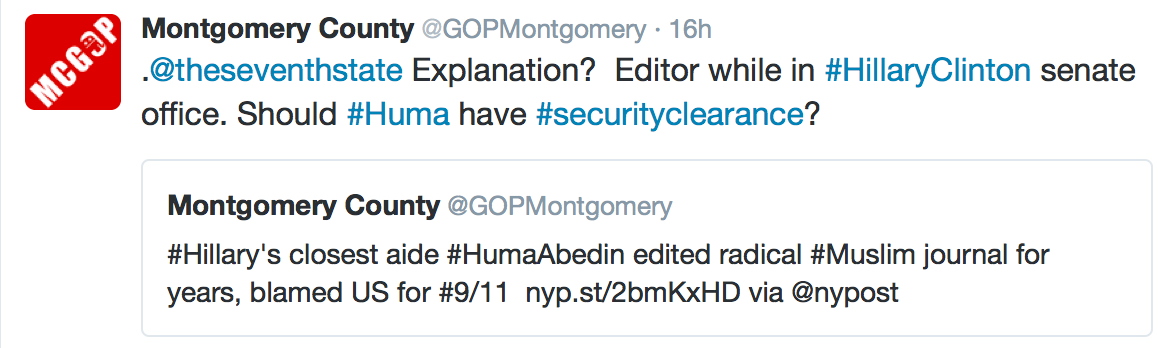
In its desperation to change the subject, the Montgomery GOP resorted to Muslim baiting about longtime Hillary Clinton aide Huma Abedin:

Huma1

They doubled down on this line of attack later:

huma2

In case you’re wondering if these recycled accusations have any merit, here is what Sen. John McCain has to say in response to Rep. Michelle Bachmann’s efforts to scaremonger:

These sinister accusations rest solely on a few unspecified and unsubstantiated associations of members of Huma’s family, none of which have been shown to harm or threaten the United States in any way. These attacks on Huma have no logic, no basis, and no merit. And they need to stop now.

Ultimately, what is at stake in this matter is larger even than the reputation of one person. This is about who we are as a nation, and who we still aspire to be. What makes America exceptional among the countries of the world is that we are bound together as citizens not by blood or class, not by sect or ethnicity, but by a set of enduring, universal, and equal rights that are the foundation of our constitution, our laws, our citizenry, and our identity. When anyone, not least a member of Congress, launches specious and degrading attacks against fellow Americans on the basis of nothing more than fear of who they are and ignorance of what they stand for, it defames the spirit of our nation, and we all grow poorer because of it.

Our reputations, our character, are the only things we leave behind when we depart this earth, and unjust attacks that malign the good name of a decent and honorable person is not only wrong; it is contrary to everything we hold dear as Americans.

Yet the Montgomery County Republicans continue to promote this scurrilous agitprop.

My twitter response to the Montgomery Republicans:huma3

Share

Help Save Maryland, GOP Push Term Limits

By Adam Pagnucco.

Brad Botwin, Director of the anti-immigration group Help Save Maryland, has sent out the following email promoting term limits.

*****

UPDATE ON THE MONTGOMERY COUNTY TERM LIMIT PETITION – CITIZENS WORKING TOGETHER CAN SUCCEED!

Recent e-mail I received on the status of the Term Limit Petition which will revitalize the MoCo County Council and County Executive if passed this November 2016 by the voters.  The professional politicians are getting nervous!

Dear Concerned Voter:

Thank you for signing the non-partisan term limits petition for Montgomery County.

We did it!  You and nearly 18,000 registered voters in Montgomery County signed the term limits petition (only 10,000 signatures were required).  The signatures were submitted on August 8, which means you’ll be able to vote on the term limits question on the November 2018 general election ballot.   When passed — and we need your vote to pass the measure — it will limit County Council members and the County Executive to serving no more than three consecutive terms, or 12 years.

One week from today, on Wednesday, August 24, you will have an opportunity to support term limits at a Montgomery County Charter Commission hearing.

Here is information about the hearing: http://www2.montgomerycountymd.gov/mcgportalapps/Press_Detail.aspx?Item_ID=16281

In order to testify, you must notify the commission in advance by e-mailing them at: charterreview.commission@montgomerycountymd.gov

If you can’t attend, but still want to convey your support for the term limits petition; email the commission at the same e-mail address in the previous sentence.

If you don’t want to speak out publicly on the 24th, please come to the hearing and stand with your neighbors in support of term limits for the County Council and County Executive.

If you want to know how you can help or need more information, let us know.

Thank you,

Montgomery County Citizens group in support of Term Limits   sohenc@gmail.com

*****

The gmail account above belongs to Sharon Cohen, a member of the Montgomery County Republican Party’s Central Committee.  This reinforces the central role played by both Help Save Maryland and the Republicans in pushing Robin Ficker’s terms limits charter amendment.

The state’s election law requires groups advocating on ballot questions to register with the State Board of Elections and file campaign finance reports.  According to the state’s summary guide on campaign finance laws, “Once the petition process to place a question on the ballot is completed, a ballot issue committee must be formed before money is collected or spent to promote the success or defeat of the ballot issue.”

So far, no committee on Montgomery County term limits has registered with the state.  Hopefully, any group advocating on the issue will obey the law, file reports and show their funding.  Voters may find that information useful as they consider whether to support term limits.

Share

Targeting Navarro


By Adam Pagnucco.

It was the spring of 2008.  Five-term County Council Member Marilyn Praisner, who had represented District 4 since 1990, had passed away and eight candidates were running for her seat.  One of them was a woman.  One of them was a person of color born in another country.

Her name was Nancy Navarro.

At that time, District 4 included most of US-29 north of Downtown Silver Spring to the Howard County border and the areas south of Olney, east of Rockville and north of Wheaton.  It had little in the way of restaurants or shopping.  There was the aging, emptying business district in Burtonsville.  There was the decrepit, asphalt-covered shopping center in Glenmont.  Here and there, small and mid-size retail strips clung to the sides of New Hampshire Avenue and other major roads.  A tiny colony of fast food and lowbrow restaurants had just sprung up on US-29 at Tech Road.  Walkable urban shopping was nowhere to be found.  If residents wanted that, they would have to drive to Downtown Silver Spring to get it.

None of this was an accident.  For years and years, the civic leaders and activists who dominated the district’s politics had worked hard to keep development out.  Mrs. Praisner was their champion.  They regarded development as a bad thing, attracting both traffic and “undesirables.”  But newer residents, including people of color, wanted the restaurants, jobs and shopping that most other people around the county had.  Colesville resident Nancy Navarro was one of them, and soon she became their champion.

Navarro stood out during the 2008 special election, and not just because of her gender and heritage.  The other seven candidates running for Mrs. Praisner’s seat, including her husband Don, adhered to her vision of little or no growth.  (Don Praisner’s campaign slogan was literally “Fulfilling the Vision.”)  Navarro instead talked about the benefits of economic development, such as creating jobs for residents and giving them amenities that they had not previously had.  Navarro was also supported by many in the business and real estate communities and the public employee unions.  None of this sat well with the old guard, who regarded developers as evil and unions as tax-happy.  Navarro quickly became a target.

The March debate at the Aspen Hill library typified the direction of the campaign: nearly every other candidate concentrated their fire on Navarro.  Their attacks centered on the allegation that she was allegedly a “tool” of developers and unions.  (It didn’t help that MCPS Superintendent Jerry Weast invited union leaders to his house to get them to endorse Navarro.)  But there was more to it than that.  To Navarro’s supporters, the implication of this “tool” argument was that women and people of color were supposedly not intelligent or strong enough to make up their own minds, and that when they made common cause with others, they would inevitably fall under their “control.”  Furthermore, while Don Praisner’s supporters criticized Navarro for taking contributions from developers and businesses, Mrs. Praisner had done the exact same thing for years.  Later, it was revealed that Don Praisner himself accepted money from a property owner in the district seeking redevelopment.

Much of this is par for the course in the rocky world of political campaigns.  After all, opposition to change frequently arises in politics and outrage can be selective.  But with Navarro on the ballot, it mutated into something far darker: a toxic stew of racism and xenophobia.  Don Praisner defeated Navarro in the 2008 Democratic primary and would serve on the council for less than a year before he passed away.  When Navarro returned to run again in the 2009 special election, the forces of extremism were prepared.

First came the illegal anonymous robocalls, a repeat of a tactic used against Navarro in 2008.  Then came rumors circulated both on-line and off linking Navarro (who was born in Venezuela) to the Hugo Chavez regime.  Help Save Maryland, labeled by the Southern Poverty Law Center as a “nativist extremist group,” began targeting Navarro for her alleged support of “illegal aliens.”  Their challenge to Navarro was posted on a racist website equating President Obama to Satan.

Most bizarre of all was an email sent to Navarro’s campaign asking about her immigration status.  The author wrote, “I am informally involved with a group of Independents and we are trying to identify a candidate that we feel comfortable endorsing. It would be great if you could put the rumors to rest and provide information as to when (what year) and where, which state, Ms. Navarro received her naturalization or citizenship. Thank you.”  In fact, the author – who used a fake name – was a GOP activist who wrote for the party and had testified against drivers licenses for illegal immigrants.

Robin Ficker was involved too.  The 2008 GOP nominee, Mark Fennel, was a Ficker protégé, had spread the Hugo Chavez rumors and threatened to unleash “the Dogs of War” on Navarro.  In 2009, Ficker “moved” to District 4 to run for the seat and promptly began sending out illegal flyers.  During a televised campaign debate, Ficker waved a set of decade-old tax liens against Navarro and her husband in his opponent’s face.  Ficker did not use Help Save Maryland’s race-baiting tactics directly, but he did not repudiate them either.

Given this history, it’s no surprise that Help Save Maryland’s participation in Ficker’s term limits initiative was spurred in part by a desire to knock off Navarro.  The group has never made its peace with Navarro’s election and has sent out numerous emails slamming her over the years.  Supporters of term limits have many motivations, but Help Save Maryland is quite clear about theirs: they want to slam the county’s gates shut to “illegal aliens.”

Will any of this make a difference in the current debate over term limits?  Probably not.  Few voters have heard of Help Save Maryland and understand what the group believes.  Even Ficker is less infamous now that his NBA heckling days are mostly over.  In any event, voters are more likely to see term limits through the prism of their own perceived self-interest rather than how they impact specific elected officials.

But make no mistake: the treatment of Nancy Navarro during the 2009 special election is a shameful blot on the county’s political history.  It must not be forgotten.  It must not be repeated.  And hopefully, her successors will be treated with the honor and respect that all upstanding candidates deserve.

Share

Maryland Republican Party Ashamed of Trump

The relationship between Donald Trump and the Maryland Republican Party is the love that dare not speak its name. Donald Trump is all but an unperson on the Maryland Republican Party twitter account, @mdreps.

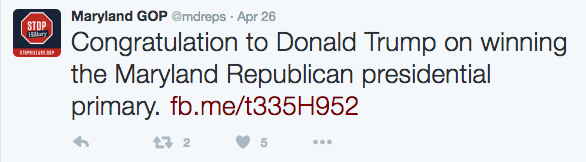
The Maryland GOP would rather pretend their presidential nominee doesn’t exist. @mdreps hasn’t mentioned Donald Trump since the Republican Convention. Indeed, “Trump” has appeared a mere five times @mdreps since the Maryland Republican Primary, including the following tweet on primary night:

MDGOP3

Next up, from the Republican salad days:

MDGOP5

Video received from a Trump voter in honor of this tweet:

The following is the only tweet in which the Maryland Republican Party expresses direct approval of Trump:

MDGOP4

Though Trump gets mentioned in the next tweet only in the cited article description, it’s worth a mention if only because the Maryland Republican Party’s own words, “It’s about ideas, not race,” are as Orwellian as they come.

MDGOP2

The next day they retweeted an innocuous shout out to the Republican delegation in Cleveland that copied Trump.

In short, you’d never guess that the a thumping majority of Maryland Republicans support Donald Trump.  There is not one picture. No tweets proudly touting his latest utterance.

I imagine some Republicans will claim they’re just too focused on state issues to mention Trump. Except that you may’ve noticed that their logo is a “Stop Hillary” sign. Maryland Republicans also have no problem using @mdreps to attack Democratic Nominee Hillary Clinton and President Barack Obama.

The lack of Trump mentions is really a good sign. Shame is the right emotion if Donald Trump is your party’s nominee. Let’s hope the second stage of grief for the party entails repudiation.


Share

How to End the Monopoly and Recover the Money

By Adam Pagnucco.

In the latest development in the county’s continuing liquor monopoly saga, the County Executive has established a task force to explore options for scaling back or eliminating the monopoly.  One condition applies: the monopoly earns money for the county and the Executive does not want to lose it.  Last February, he told Bethesda Magazine, “I have no problem with privatization per se, but we need to make sure the county’s residents and taxpayers are protected on the financial issue.”

That’s a reasonable point of view.  Here’s a proposal to End the Monopoly without taking a financial hit.

First, let’s recall that the goal of last winter’s End the Monopoly campaign was never to abolish the Department of Liquor Control (DLC).  Rather, we were seeking to allow private sector competition with the DLC at both the wholesale and retail levels.  Licensees would be able to buy from the county, private wholesalers or both and consumers would be able to buy all beverages, including spirits, from county stores, private stores or both.  That does not mean that DLC would get wiped out.  Indeed, it has one competitive advantage that no private wholesaler has: it is a one-stop shop for all alcoholic beverages.  Some licensees are willing to tolerate DLC’s problems in return for the convenience of dealing with one bill and one truck.  DLC’s Acting Director claims that their performance is improving and the county employee union President told the latest meeting of the task force that he has spoken to dozens of retailers who wish to stay with DLC.  If they are correct, private competition will not eliminate DLC, but it could reduce its revenues.

The closest relevant example to what would happen if DLC were exposed to competition is Worcester County, Maryland, which opened up its spirits monopoly in 2014.  Worcester’s DLC Director testified to the MoCo Delegation that within a year, the county had lost 42% of its wholesale business to private competition but had kept 96% of its retail business.  Now Worcester County’s monopoly was run far more poorly than MoCo’s DLC as it was found guilty of massive violations of state law back in 2010, so MoCo’s DLC could fare much better with competition.  But for the sake of argument, let’s use its experience as a starting point.

Any analysis of what would happen to MoCo’s DLC under competition must recognize that the liquor monopoly makes two payments to the county: a direct return to its general fund and debt service paid on bonds guaranteed by liquor profits.  Potential shortfalls in both those areas must be addressed.

The General Fund

DLC’s operating profits, projected to be $20.7 million in FY17, are paid directly into the county’s general fund.  That amount accounts for 0.4% of the county’s $5.3 billion operating budget.  What would happen to those profits if the private sector were allowed to compete with DLC?  According to the county’s Office of Legislative Oversight, DLC’s FY14 revenues were split pretty evenly between wholesale ($136 million) and retail ($127 million) operations.  If Worcester County’s experience occurred in MoCo, 42% of the wholesale revenue and 4% of the retail revenue would be at risk from competition, so DLC’s total revenue would decline by 24%.  If DLC’s operating costs scale with its operating revenues, its net income would fall by $5 million.

How do we make up that money?

First, the county could open up more county liquor stores.  (Indeed, it is already doing so.)  In FY13, the county earned $795,000 in annual gross profit per liquor store.  So if that gross profit figure still holds, seven new liquor stores could cover a $5 million gap.

Second, new tax revenues will be available in a world of competition.  The state’s Bureau of Revenue Estimates released a report last year finding that if DLC were completely abolished, $22.8 million in tax revenues would be generated, mostly from customer repatriation.  (That is actually larger than DLC’s return to the county’s general fund.)  The problem is that only $1.8 million would accrue to the county in local income taxes, while the rest would go to the state (primarily through sales taxes).  The solution is to have the state share its incremental revenue increase with the county for a period of time.  After all, if the county is giving up a financial asset, it should share in the returns from that.

A formula could be constructed that ties incremental increases in state revenue from alcohol sales in MoCo to DLC’s reduced income.  For example, in Year X, if DLC earns $5 million less than its baseline and the state earns $6 million more than its baseline, up to $5 million could be returned to the county.  The formula should cap returned receipts to the county at the amount that the state gains so that the state doesn’t lose money.  And it could be temporary and transitional since at some point MoCo would be expected to behave like nearly all other counties in the nation and pay its bills with no liquor monopoly.

The math is clear: it’s entirely possible for the county to suffer no net losses at no cost to the state with incremental revenue sharing and a few more liquor stores.

The Bonds

The county has issued three tranches of revenue bonds guaranteed by liquor profits, the last of which matures in FY33.  The outstanding balance on the bonds is $114 million as of June 30, 2014 and DLC is projected to pay $10.9 million in debt service on them in the current fiscal year.  If the liquor profits available to pay for these bonds were to disappear, another source of revenue must be found to replace them.

Such a revenue source can be easily found in the county’s budget: county cable franchise fees.  Federal law allows local jurisdictions to charge cable companies in return for using public right-of-way.  The maximum amount allowed by federal law – 5% of cable bills – is contained in the franchise agreements the county negotiates with Verizon, Comcast and RCN.  Because cable bills rise every year, the county gets more money out of this as time passes.  Also, because this money is unencumbered by DLC’s employee and capital expenses, it is not subject to cost changes like DLC’s profits are.  Cable franchise fees are actually a more stable revenue source to guarantee bonds than are liquor profits.

According to the county’s cable budget, the county is projected to collect $17.7 million in cable franchise fees in FY17.  Of this amount, $3.8 million is passed on to the Cities of Rockville and Takoma Park and the Maryland Municipal League in compensation for use of municipal rights of way, leaving $13.9 million available.  The county has obtained legal advice holding that the county can do virtually whatever it wants with the 5% cable franchise fees.

How is the cable money currently spent?  Most of it is given out to the PEG (public/education/ government) TV channels.  The two largest are the county’s in-house news channel, County Cable Montgomery, and the non-profit Montgomery Community Media, which is also financed by private sector contributions.  The problem is that no one knows how many people actually watch this programming.  The huge majority of their YouTube clips get a few dozen views each at best.  Is this truly worth millions of dollars of public money?

The county could easily retire its current liquor bonds and replace them with new bonds that are guaranteed by both liquor profits and cable franchise fees.  Liquor profits would be the first source of debt service payment, with any shortfall covered by cable fees as a supplement.  Even if liquor profits entirely disappear, the $13.9 million in annual cable fees – an amount that has been growing steadily for years – could cover the $11 million in annual debt service by themselves.  And over the long term, this arrangement would be temporary as the bonds will eventually be paid off.

There you have it.  Through a combination of a few more stores, incremental revenue sharing with the state and restructuring of the liquor bonds, the county could free itself from its liquor monopoly with no significant financial consequences.  No new taxes or fees are necessary.  And the county would see the creation of new jobs, more income, more economic activity and greater competitiveness with its neighbors as a result.

It’s a huge opportunity.  Will Montgomery County go for it?

Share

Maryland Politics Watch