Cory McCray to Announce for Senate

By Adam Pagnucco.

Next Saturday, freshman Delegate Cory McCray (D-45) is holding a campaign event in which he is expected to announce a challenge to long-time Baltimore City Senator Nathaniel McFadden.  It’s a gutsy move that will be one of the marquee races in the city.  The Baltimore Sun and Maryland Matters have both covered the impending race.  We reprint McCray’s announcement below.

*****

Special Announcement about the 2018 Elections

What: Friends, family, and neighbors across Baltimore’s 45th Legislative District will gather for a special announcement from Delegate Cory McCray

When: Saturday, September 16, 2017 @ 10:00 A.M.

Where: Clifton Park – 2555 Harford Road, Baltimore, MD 21218 (Across From Fairmount Harford High School)

Who: Lifelong Baltimore resident and member of the House of Delegates, Delegate Cory McCray

Why: Baltimore is a strong community filled with potential, and we deserve political leadership who will help turn that potential into a reality.

Growing up in Baltimore, Cory could have easily become a statistic. He changed his life when he found an opportunity to do better. He wants to provide those same opportunities to the residents in the 45th district. Though the challenges Baltimore faces are significant, Cory is prepared to deal with those challenges head on. Baltimore is a town that has passion and determination to push through these difficult times. September 16th, Cory will make an announcement regarding his plans to fight for the community that raised him. The 45th district deserves a leader who will listen and provide services to improve the quality of life, where the community are partners in progress.

Cory McCray, is a husband, father of four, union electrician and, he’s willing to make the hard choices necessary to begin the healing in Baltimore.

Cory V. McCray

corymccray@gmail.com

www.corymccray.com

Facebook – http://on.fb.me/gAIEJ0

Twitter – @corymccray

“Human progress is neither automatic nor inevitable… Every step toward the goal of justice requires sacrifice, suffering, and struggle; the tireless exertions and passionate concern of dedicated individuals.” – Martin Luther King, Jr.

Share

First Impressions, Part One

By Adam Pagnucco.

The combination of County Executive Ike Leggett’s retirement, public campaign financing and term limits is producing an unprecedented flood of candidates running for the County Council’s four at-large seats.  By the time of the filing deadline next February, thirty or more people could be in the race.  Your author has previously written about those who may be running who have prior electoral experience.  Starting today, we will be sharing first impressions of seven new at-large candidates, all of whom have been subjected to withering, multi-hour interrogations by your author.  We are pleased to report that all seven survived these encounters and any damage is hopefully temporary.

The at-large council race is a fascinating and historic affair.  Since the current council configuration was established in 1990, there have never been three at-large vacancies.  Normally, your author considers the past in evaluating what the future will be.  But in some respects, the past may not be as useful a guide as usual because of the sheer unprecedented nature of what is now happening.

The best analogy for this current at-large race is a giant, open air bazaar.  Voters enter it and encounter dozens of kiosks, each with a candidate selling his or her candidacy.  Each candidate promises the best deal – just for you! – as the voters stroll by.  Which ones can cut through the noise?  Which ones can attract the most people?  The four kiosks that sell their wares to the most voters will win the competition.  And it could very well be that those wares will be very different from each other as different segments of the market drive their favored candidates to victory.

Overall, the at-large field is shaping up to be deep and talented.  The only shame here is that there are many more good candidates than available seats, meaning that some highly qualified people are going to lose.  On to our first impressions of the new candidates, given in no particular order.

Marilyn Balcombe, Germantown

Some liberals stereotype business leaders as anti-union, anti-government (except when collecting corporate welfare), anti-tax and primarily – perhaps solely – concerned with accumulating profits.  Your author once worked on union organizing campaigns in the South and met a few corporate owners who fit that bill!  But if that’s what you think of business leaders in general, Marilyn Balcombe is going to surprise you.

The long-time President/CEO of the Gaithersburg-Germantown Chamber of Commerce, Balcombe is representative of MoCo’s chamber leaders who tend to be very different from their counterparts elsewhere.  All of the full-time, paid local chamber presidents are women.  Some of them are moms who have been active in their PTAs.  Most are Democrats who tend to be liberal on social issues.  All favor funding for public education.  All are pragmatic rather than ideological.  And absolutely none of them are tea partiers.

Balcombe, who holds a Ph.D. in industrial and organizational psychology, is analytical by nature.  She does not prejudge issues on the basis of ideology and continually seeks out evidence in making her decisions.  She agrees with the county’s emphasis on education but wants to augment it with robust economic development.  She’s a good listener who prefers policy to politics.  (She will admit to not being crazy about the political parts of running for office!)  Above all, she is a grown-up.  If you’re looking for a serious, hard-working, center-left candidate who will focus on making the county more competitive with its neighbors, Marilyn Balcombe should get your vote.

More to come in Part Two.

Share

Union Density in Maryland, 1983-2016

By Adam Pagnucco. 

Labor Day is the one day of the year when the press discusses one of America’s great historic institutions, the labor movement.  Much of the press’s discourse contains annual descriptions of labor’s decline, some sympathetic and some not.  Whatever its causes, the story is true: union influence over the economy and American quality of life has been shrinking for decades.  Maryland is not immune.

Labor unions are important protectors of working class and middle class people.  Unlike political parties, corporations and the press, labor unions were created directly by working people, are governed by leaders those working people elect and are accountable to their memberships.  In their heyday from the 1930s through the 1970s, they played indispensable roles in passing laws on social security, civil rights, wage and hour standards and benefit protections.  They also reversed the income inequality that prevailed from the Gilded Age through the 1920s and built America’s first large, influential middle class.  Under assault by corporate America, hostile politicians, problematic trade policies and economic change as well as – in some cases – handicapped by myopic leadership, they have mostly retreated to the public sector and a few urban strongholds in the Northeast, the Midwest and the West Coast.  Many of today’s economic problems, like stagnant wages, vanishing pensions and the increasing dominance of the one percent can be linked to union decline.

The ultimate source of union power is labor’s percentage of the workforce, commonly called union density.  When unions establish collective bargaining for a critical mass of employees in a given market, whether industrial, geographic or both, their compensation becomes the standard that even non-union employers must meet.  That’s right – even non-union workers benefit from unions.  But when unions are unable to organize significant percentages of workers in their markets, they struggle to maintain high levels of wages and benefits in the face of overwhelming non-union competition.  Hence, union density is a critical measure of union effectiveness.

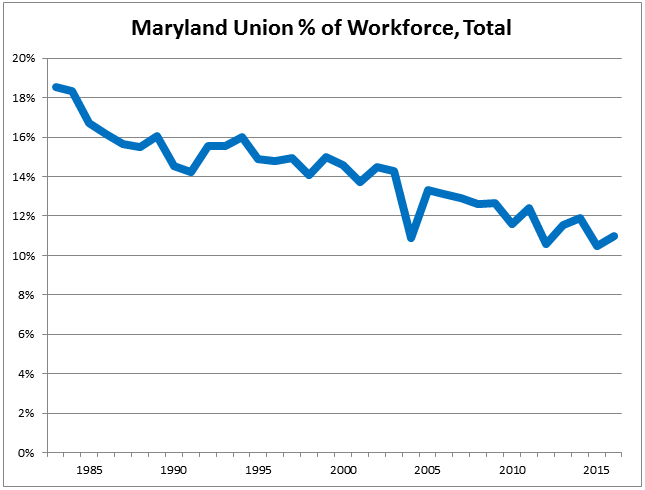
According to data from the U.S. Bureau of Labor Statistics, union density in the United States was 10.7% in 2016, down from 24.0% in 1973.  Maryland’s union density in 2016 was 11.0%, almost exactly the national average.  New York was the only state in 2016 to have a union density of more than 20% while 27 states had densities of less than 10%.

One might suppose that Maryland would be an exception to the rule of declining unionization given the size of its public sector, its long-time control by labor-friendly Democrats and the status of Baltimore as a once-great manufacturing and shipping center.  But the truth is that Maryland has mirrored the rest of the country in falling union density.  In 1983, 18.5% of its total workforce was in unions.  By 2016, that share had fallen to 11.0%.

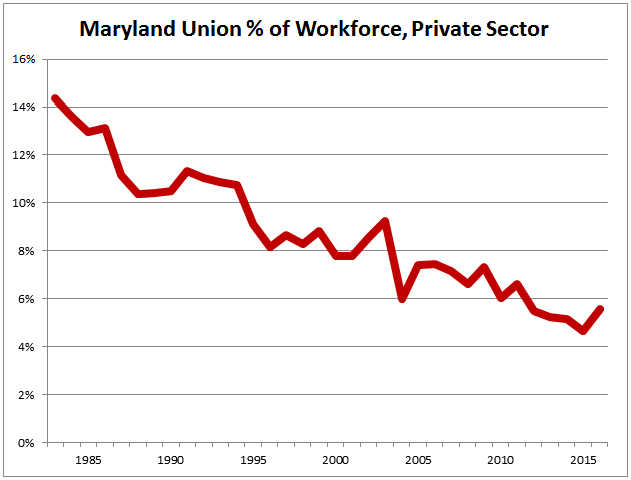
Union decline in Maryland has been uneven.  Protected by laws allowing state and local government collective bargaining and friendly politicians, public sector unions have mostly held onto their power.  Their density in 2016 (27.4%) was little changed from 1983 (29.9%).  The real fall of Maryland unions has taken place in the private sector.  In 1983, 14.4% of Maryland private sector workers were union members.  In 2016, that share had dropped to 5.6%.

Private sector union collapse in Maryland has been broad and deep.  Construction unions saw their density fall from 16.0% in 1983 to 12.7% in 2016.  In the services sector, the drop was from 10.7% to 5.0%.  And in private manufacturing, unions in Maryland have been almost obliterated.  Union density in that sector fell from 29.2% in 1983 to a shocking 3.9% in 2016.

Progressive elected officials and advocacy groups have focused on measures like minimum wage laws, sick leave laws, tax legislation, health care reform and education funding to help the working and middle classes and reverse income inequality.  All of those things matter.  But a long-term, sustainable progressive agenda may be impossible without a healthy labor movement.  Independent labor organizations are critical to passing good laws, holding corporations and politicians accountable and preserving the gains made by working people against constant attempts to reverse them.  Without them, the one percent will continue their march to total domination.

Disclosures: Your author holds two degrees in Industrial and Labor Relations from Cornell University and worked for sixteen years as a strategic researcher in the labor movement.

Share

Evan Glass Announces Kickoff

By Adam Pagnucco.

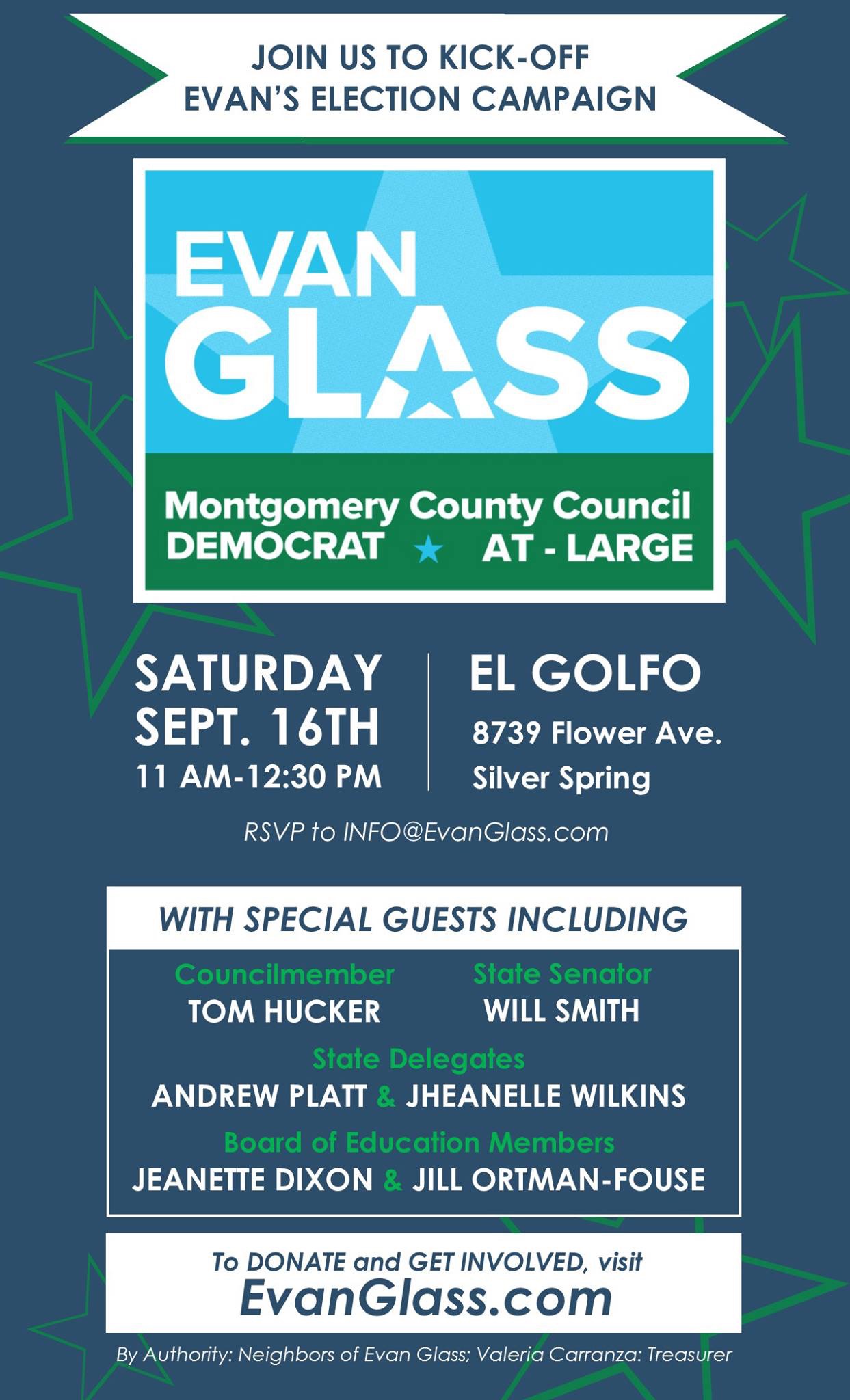
Council At-Large candidate Evan Glass has announced his campaign kickoff event at El Golfo in Silver Spring on September 16th.  (For those who have not been to El Golfo, it is absolutely one of MoCo’s best Latino restaurants!)  An interesting detail of his kickoff is the advertised presence of District 5 County Council Member Tom Hucker, who defeated Glass by a tiny margin in 2014.  We reprint the announcement below.

Share

Evaluating the Candidates for County Executive: George Leventhal

Today, I conclude my series on the current major declared Democratic candidates for county executive with a discussion of George Leventhal’s candidacy. Previous posts took looks at Marc Elrich and Roger Berliner.

Introducing George Leventhal

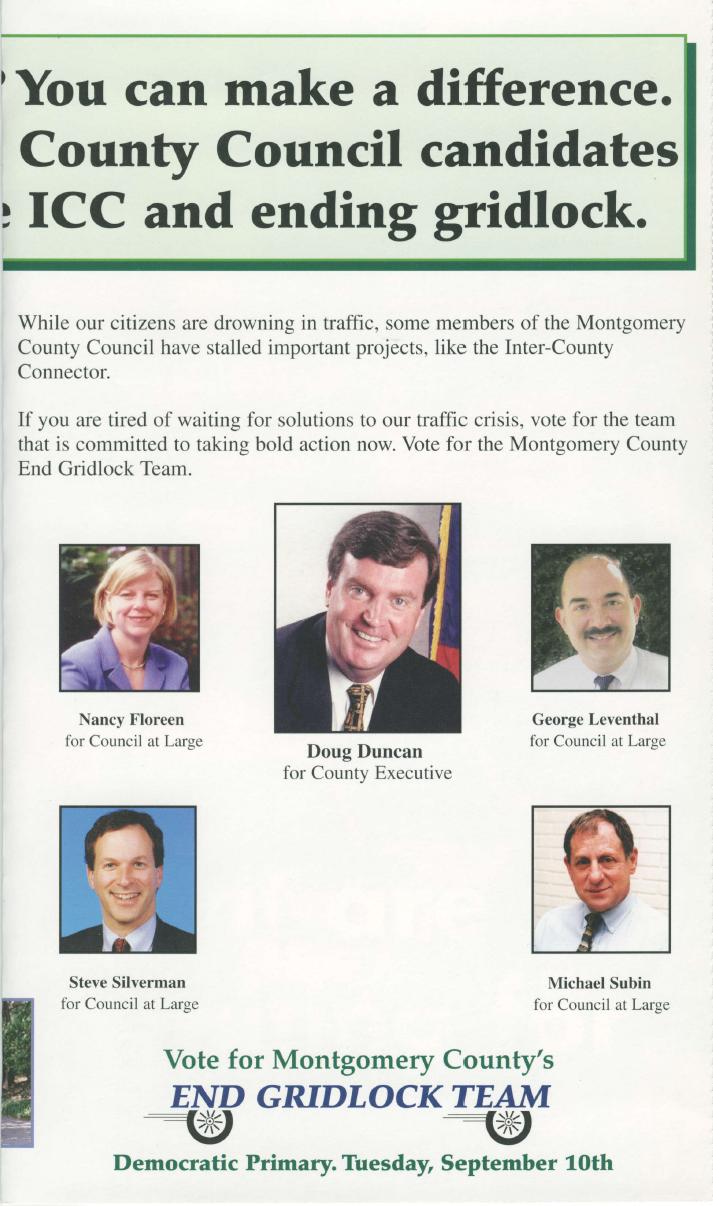
Like Nancy Floreen, George won election initially on Doug Duncan’s “End Gridlock” slate. Since then, he has won reelection three more times and is now completing sixteen years on the County Council, including two terms as its chair. In his last reelection, George came in fourth among the candidates for at-large seats in the Democratic primary, winning 20% fewer votes than leader Marc Elrich. George is unquestionably passionate about his positions and unafraid of arguing for them forcefully.

His proudest accomplishment is seeing the Purple Line to fruition but, like most significant political acts, this is a victory with many parents. Since it’s a done deal and all the candidates favored the Purple Line, it’s difficult to campaign on the question. One cannot differentiate when voters cannot perceive a difference.

Who is the Leventhal Voter?

In previous profiles, I’ve outlined the core constituency for the candidate. George Leventhal’s central problem is that his core constituency remains hard to identify even after four terms on the Council. He’s been on too many sides of too many different issues to have a natural base. Previously, he opposed a minimum wage increase but now he’s for it. While he was elected on a road-building platform, he now says that he was not elected to build roads. He is pro-immigrant yet lost CASA’s endorsement in the last election.

This leaves George adrift in County politics. Unions don’t trust him because of his past position on the minimum wage and his complete willingness to vilify them when he opposed them on such issues as breaking contracts during the recession and his correct decision, endorsed by the voters, to overturn the overly restrictive bargaining practices with the police union.

Business doesn’t trust him for the same reason. George has been a strong supporter of development, but he now dismisses opponents of the minimum wage increase. George would argue that he evolved and learned on these issues and only a fool never changes his mind. He’s certainly right about that but heaven and earth have changed places a few times too often to attract any of the County’s natural core constituencies.

George has also alienated many in the western half of the County through his repeated denigration of their interests and concerns on any number of issues. George knows he has a problem here. At the at-large Council debate held in Chevy Chase four years ago, George  attempted to prove this inaccurate by reading a thank-you note from a constituent. He got hot under the collar when the audience was visibly unimpressed.

Personality

Supporters would describe George as passionate and pugnacious. George is unquestionably extremely passionate but too many of the people active in politics he now needs as validators for him as a candidate see him as a rude bully. George’s view is that your gentle blogger invented this notion and that his strong convictions excuse any occasional excesses. Unfortunately for George, many others have identified the problem, including the Washington Post, and George’s temper toward colleagues and constituents alike is well known.

George has now learned at an intellectual level what he needs to say and do. He does his best to smile more and to talk about how he wants to bring people together and respect those who disagree. I wish him well in these efforts–we all have room for growth and self-improvement. The problem is that he’s just not there yet and his reputation is well-established after so many years.

Conclusion

Being unable to identify your voter is like a firm being unable to identify its client base. Your business is in trouble. Sixteen years on the Council, including two terms as Council president, also make it difficult to present yourself as the new kid on the block and argue that you’re a force for reform and change. Accordingly, I see George as a second-tier candidate, though the votes he gains may nevertheless sway the race one way or another.

Share

Evaluating the Candidates for County Executive: Roger Berliner

Today, I continue my look at the current crop of candidates for county executive with Roger Berliner.

Introducing Roger Berliner

Like Marc Elrich, Roger Berliner didn’t make it to the Council on his first try. He lost the Democratic nomination for District 1 in a special election in 2000 in a bitter primary battle against Chevy Chase Village Board Chair Pat Baptiste. However, he won the nomination without opposition in 2006 and then went on to defeat the well-liked Howie Denis, among the last of the moderate Republicans elected in Montgomery. Indeed, Denis was often more liberal than his Democratic colleagues.

In many ways, Roger faces the toughest district on the Council. The most affluent district in the County, his constituents are extremely well-educated and possess a sense of their own agency that render them far less likely to be intimidated by government officials. At the same time, precisely because he represents a successful area, it can be difficult for him to gain attention for his district’s real concerns even if his constituents pay a disproportionate share of taxes. On top of that, Roger has maintained his support for the Purple Line in the area that contains the strongest opposition and where many see little benefit but much expense.

Nonetheless, Roger has navigated the political currents well. In the last election, former at-large County Councilmember Duchy Trachtenberg tried for a second act with strong support from her erstwhile enemies in the unions. Roger didn’t just win; he annihilated Duchy with almost 80 percent of the vote. A nice validation from his constituents.

Roger’s Niche in the Race

Almost by default, Roger has become the pro-business candidate in this race. I write by default because it’s not because Roger is a right winger or the ideal business candidate. In politics, one often has to choose the least bad option. From the business perspective, Roger is that candidate and they even hold out hope that he could be a good option.

Roger will likely center his case on the claim that he can get the County’s stagnant economy moving again—a vital concern both for citizens and the County budget, which desperately needs more revenue to avoid service cuts and to repair aging infrastructure and voters look unwilling to stomach another set of tax and fee increases.

Roger has taken enough liberal stands that he should remain within the comfort zones of those who have liberal impulses but remain more practical (read: centrist). In particular, Roger has carved out a strong environmental record and pushed consistently for efforts to reduce carbon emissions in our populous county.

He has also made himself Pepco’s leading critic—not a bad place to be with consumers–as the company firmly believes it should always earn a profit whether or not it can keep the electricity flowing. However, under much scrutiny after the derecho, service has improved, so this issue has declined in salience, even if few County residents will object to Roger’s efforts to fight the latest hike in utility rates.

Making the Case

Marc Elrich’s candidacy centers around economic justice. Roger Berliner will need to articulate his own vision if he wants to win. Specifically, he will need to explain how he will get the County moving again economically. He’ll need to do it with enough specifics that it convinces voters that it’s not just the usual puffery. At the same time, he can’t get caught up in the minutiae, as Democrats tend to do, so that voters lose the plot and get bored. Roger will also need to make the case for why focus on growth and new jobs matters.

Within this vision, Roger will also include liberal values and principles. He might also choose to pair his economic vision with another non-economic progressive notion to attract voters more to the left or at least stay within their comfort zone. A tricky balancing act, as he also wants to avoid being so wishy-washy that business doesn’t have to curb their enthusiasm, but Roger has proved adept at figuring out a route through these political currents.

Weaknesses and Challenges to Roger’s Candidacy

Roger’s central problem is communication. More specifically and to be overly blunt, it is one of authenticity. It is not that Roger lacks authenticity—he has adhered tenaciously to a set of core values through his three council terms—but a problem of presentation. Perhaps due to his training as an attorney, Roger comes across frequently as just a bit too practiced and too careful when responding to voters.

Politics is about connecting with voters, so Roger will have to reveal more of that underlying authentic passion if he wants to win. I don’t want to overstate the issue—Ike Leggett has been a very careful and very successful politician—but Sanders and Trump resonated for a reason. Still, Montgomery was Hillary country and Roger has won tough contests before, so he won’t need to take it too far.

Conclusion

Roger dodged a bullet when David Trone decided to take his business experience and his wallet to the Sixth Congressional District. If he can consolidate business support and continue his past successful outreach to other communities, he should be a top-tier candidate. He remains highly vulnerable, however, to new candidates who could do the same from outside County government, as voters remain desirous of turning over the reins to new leaders.

Share

EMILY’s List Endorses Aruna Miller

Big news in the Sixth Congressional District. EMILY’s List has endorsed Del. Aruna Miller. We’ll have to see how much cash EMILY’s List invests in this contest but they put huge resources into Donna Edwards’ bid for Senate. David Trone may not be the only one with real money in the race.

It is yet another sign that Del. Miller is running a serious, focused campaign. She has raised significant dollars on her own and now has the backing of the major national Democratic organization that promotes pro-choice women.

Money doesn’t make someone a good Member of Congress. But it sure makes it a lot easier to run a viable congressional campaign. If anyone didn’t already think Aruna is among the candidates to watch, this should get across the message.

Here is the press release from her campaign:

GAITHERSBURG, MD – Delegate Aruna Miller is pleased to announce that she has been endorsed by EMILY’s List for her campaign for Congress in the 6th Congressional District of Maryland.

EMILY’s List is the nation’s largest resource for women in politics and has raised over $500 million to support Democratic women candidates. Their grassroots community of over five million members helps Democratic women wage competitive campaigns. Since their founding in 1985, they have helped to elect 116 women to the House of Representatives, 23 to the Senate, and over 800 to various state and local offices.

“I am honored to have been endorsed by EMILY’s List. This is an organization founded on bringing more people to the table, and I am so excited to see our message catching the attention of progressives who share our values,” said Delegate Miller. “We have learned this year that motivated and organized grassroots supporters can move mountains, and we know that with EMILY’s List support, we will take the fight to Donald Trump to protect our healthcare and our choices, to invest in our public education and programs like STEM, and to show that government works for the people.”

Aruna Miller has been a civil engineer, working for 25 years for Montgomery County. She began her political career by volunteering for her local Democratic Central Committee, going door to door and serving as a precinct captain. In 2010, she was elected to the Maryland Legislature where she represents the 15th District and serves on the Appropriations Committee. Delegate Miller officially entered the campaign for Congress earlier this year and has already surpassed $350,000 in fundraising.

Share

Evaluating the Candidates for County Executive: Marc Elrich

The field is incomplete but we already have three major Democratic candidates for county executive in Councilmembers Roger Berliner (D 1), Marc Elrich (D At-Large), and George Leventhal (D-At Large). All three have eyed this office for some time. Now, thanks to term limits, they have to move up or out. Today, I begin a series taking a look at each of their candidacies, starting with Marc Elrich.

Introducing Marc Elrich

Former Takoma Park Councilmember Marc Elrich had to run repeatedly before he won a seat on the County Council. Once he did, he flourished with the voters but less so with his colleagues. In his last two elections, despite relatively small campaign kitties, Marc emerged clearly on top of the primary for the four at-large seats.

But he finds himself on the end of 8-1 Council votes more often than others, and George Leventhal defenestrated him from the Planning, Housing and Economic Development (PHED) Committee when he became council chair. He has never been elected Council chair, though that could work to his advantage, as it aids his efforts to position himself as an outsider running against the status quo during a time when even people in Montgomery County seem dissatisfied with the establishment.

The Progressive Champion

Marc’s lane in the race is as the solid progressive candidate. Put another way, if you liked Bernie’s strong stand in favor of taking meaningful action to do something about economic inequality and aid people who are struggling, you should love Marc. He has been the most consistent and staunch progressive on the Council, most recently championing increasing the minimum wage to $15. He is popular with County employee unions with MCGEO’s Gino Renne hugging him especially tight in an embrace that could get uncomfortable. Marc doesn’t take large contributions from developers, though he’s hardly popular among them in any case.

Personal Strengths

His strengths, however, go beyond his natural appeal to the Democratic progressive base centered in Takoma Park and Silver Spring. Marc is extremely well-liked among civic activists around the County because he listens and takes their concerns more seriously than any other councilmember.

Though some find him brusque, more appreciate his individualized attention to neighborhoods all around the County, and his general willingness to have a respectful conversation even if you disagree. A former teacher, Marc possesses the rare ability to explain complex issues in ways that people can understand and without resorting to insider argot.

His Big Idea: Bus-Rapid Transit

Marc can also claim to have brought the major (only?) out-of-the-box idea to the Council in the last twelve years in his plan for a bus-rapid transit network around the County. I’ve long found the idea appealing because it provides a means to give Montgomery County a real public transit system at a far more reasonable price than either light or heavy rail. It also has the potential to reduce tension between civic and business organizations, as it would genuinely address transportation concerns and simultaneously allow for more development.

Marc, however, has found it more difficult to promote his vision among his colleagues despite strong voter support. Indeed, his fellow at-large councilmembers—Nancy Floreen, George Leventhal, and Hans Riemer—have taken a jaundiced approach to BRT even though they have remained nominally supportive. (The at-large councilmembers have a natural habit of looking jealously at each other since they compete at election time.) After twelve years, we are only now getting ready to take action to construct a pilot BRT line, and Roger Berliner would argue that it took his leadership to obtain unanimous Council support to move forward.

Challenges for Marc’s Candidacy

While having many strengths, Marc also faces challenges in his bid for county executive. Business is terrified of the idea of him, perceiving as madness his advocacy for left-wing ideas from rent control to a higher minimum wage to making commercial developers pay more for improvements that benefit them to his support for retaining the County’s antiquated liquor monopoly.

His advocacy against a system that he perceives as screwing over most people to benefit the wealthy fits within his political brand and has real appeal to much of the Democratic base. Still, Montgomery remains an affluent place with many card-carrying members of the establishment. Neighborhoods at all income levels espouse conventional middle-class values and are filled with people who want to move up rather than tear the system down.

Marc will need to operate within their comfort zone if he wants to win and his occasional burst of hardcore left-wing sentiments on non-economic questions may be off putting to more skittish supporters and provide ammunition to his opponents. His recent sharing of a video attacking Winston Churchill on Facebook provides a good example. While Marc sees it as balancing the hagiography of Churchill’s wartime leadership to create a more historically honest picture, it looks bizarre and distracts from his fundamental economic message and political brand. It weakens the valuable bonds that Marc has built with many communities through long-term cultivation and hard work.

Conclusion

Regardless of who runs, Marc will be a top-tier candidate. He will run as the progressive champion and should harvest the lion’s share of their votes. Other candidates will find it hard to challenge him on this terrain and among this constituency.

Share

Looking for the Next County Executive, Part II: The Future

The next county executive will face major challenges. Montgomery County’s economy is not performing well. While it’s a long-time cliché that we’re losing business to Northern Virginia—Ellen Sauerbrey campaigned on that theme in 1994—the County has not done well in creating new employment over the past several years.

Jobs, of course, are critical to success of county residents and also the tax base. Employment is the best social justice program ever invented. If the tax base stagnates, there will not be enough money to maintain the array of services for which Montgomery County is renowned, let alone spend more to lend people who need it a helping hand.

I’m hoping that whoever is elected county executive will have a forward-thinking plan for economic development. Though the newly launched Montgomery County Economic Development Corporation imitates the highly successful efforts of Howard and Fairfax to pursue business opportunities, I remain skeptical that it will achieve the same levels of success, as currently managed and structured.

We also need someone who is willing to break a few eggs and not see barriers as they launch more ambitious projects in a manner reminiscent of Doug Duncan. Even though they will not all work out, new ideas both for the County and how to organize County government to work better and more efficiently need to be tried or the County’s relative decline will start to feel a lot less genteel very soon.

The challenge will be especially great because tax increases are not a real option. Though we are now out of the recession, the income tax remains set at the charter limit. In 2016, the County Council achieved the unanimity required to increase property taxes significantly above the charter limit. Fees have also gone up for everything from recording property to public parking. The one area of tax opportunity may be making commercial development pay for improvements that clearly aid their own efforts.

While being inventive, the new county executive should maintain certain key policies of the Leggett Administration. In particular, the County must continue to adopt budgets and fund future obligations in a manner that retains its AAA bond rating. The County Executive also needs to focus on the core priorities of local government. Too often, the County Council has spent an inordinate amount of time on issues peripheral to core functions.

Finally, and perhaps most important in our era of seemingly toxic politics, we need someone who continues Ike’s outstanding record of listening respectfully to people who disagree, often vehemently, and is a model for civility in governance. That should be possible even as the new executive presses forward with new ideas and needed reforms.

Share

Looking for the Next County Executive, Part I: Ike’s Legacy

After three terms, Ike Leggett is stepping down as Montgomery County Executive. Ike arrived in office at a very tough time, just before the bubble burst in 2007 causing revenues to collapse even as need soared. He had to make extremely difficult budget choices and he made the right ones, choosing to protect education and public safety even though that meant he had to slash funding for other treasured items, like libraries.

The other great talents that Ike Leggett brought to the office were calm and civility. Even as the economy came crashing down, he projected cool stability—a welcome contrast to the approach taken by many other leaders. Ike is also rightly known for treating constituents consistently with respect and dignity that remains a welcome model in an era of increasingly harsh politics.

While Ike made the right choices in where to cut the budget, he did not use the recession to reshape Montgomery County government. This was a missed opportunity to reorganize the County to try out potentially more efficient ideas designed not to just meet current budget challenges but to also set the County up ready for the future.

Tomorrow, I continue with a discussion of what sort of focus and approach that Montgomery County needs in its next county executive.

Share

Maryland Politics Watch