Hogan’s Political Coup

Gov. Larry Hogan’s plan to add four new toll lanes to I-270, I-495, and the BW Parkway is a political coup. Here’s why:

Most Still Drive

it doesn’t take a poll to know that concrete proposals to expand capacity on the Washington suburban region’s major highways will be very popular. Though most of the discussion among Democrats has centered on public transit, the great majority of commuters in the Maryland suburbs of DC take a car to work.

According to the 2010 American Community Survey, among those who live and work in the same county, 71% drive alone or in a carpool. Just 11% ride public transit and the remainder get there some other way (e.g. walking, biking).

However, as evidenced by daily traffic snafus, many have to travel to another county or state to get to work—over 40% in Montgomery and Frederick, and over 60% in Prince George’s and Charles. Among those who travel to another county but stay within Maryland, 93% drove alone or as part of a carpool.

At 69%, the share is lower for those who work in another state with the bulk of public transit riders going to DC. Nevertheless, even commuters to DC still tend to drive as opposed to taking public transit—56%-43% in Montgomery, 64%-34% in Prince George’s, 68%-31% in Frederick, and 76%-24% in Charles.

Divides Democrats

Republican strategists must be enjoying immensely the bind that Hogan’s plan places Democrats. While it will be highly popular among most voters, key core Democratic constituencies will line up to oppose the plan.

Environmentalists will oppose Hogan’s plan for the same reason they intensely fought the Intercounty Connector. Road construction destroys natural habitats and contributes to global warming by feeding our addiction to the fossil fuels needed to power most cars. Montgomery County’s Sierra Club has already announced opposition.

This dovetails nicely will smart growthers’ philosophical opposition due to their firm convictions that roads do nothing to alleviate traffic and that transit-oriented development produces more livable communities. The Coalition for Smarter Growth is already making these arguments.

Democratic politicians will be spending a lot of time either placating voters or members of these core constituencies, who are disproportionately active in politics.

The Bill Comes Later

In the Purple Line public-private partnership, we are building the line with the federal money and Maryland will pay its share later. More specifically, late enough that Larry Hogan will be gone from public office before the major costs hit the state. Convenient.

The proposal for a PPP here that will cost the voters “nothing” sounds right out of the same playbook. By the time voters relearn that nothing in this life is free, Larry Hogan will have long moved out of the Governor’s Mansion.

Opposition Much Harder to Explain

Hogan can take a victory lap claiming that he is building roads that will reduce traffic while Democrats did nothing. In contrast, Democratic opponents will need to explain ideas like induced traffic and their concerns regarding hidden costs.

Good luck with that.

Nuance and complexity are harder to explain than simple solutions. Even thoughtful critiques understandable to non-traffic and non-budget experts–and I have seen several since Hogan made his proposal–take much longer than a soundbite.

Strengthens Claims on Washington Suburbs

Hogan’s support for the Purple Line pleased transit advocates. His new plan will do the same among the even greater number of voters who want new roads. Even though the roads remain a gauzy idea, it is now harder to label the Governor– the king of small, poll-tested ideas–as having done nothing for the region.

Share

First Time Ever: Elrich Reaches Financial Parity with Leventhal

 By Adam Pagnucco.

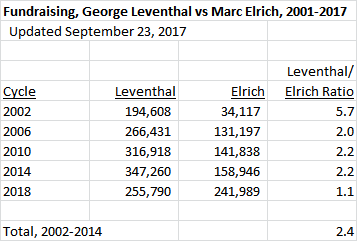
Many things have happened over the last four election cycles, but one thing has remained constant: George Leventhal has smoked Marc Elrich in fundraising.

Not anymore.

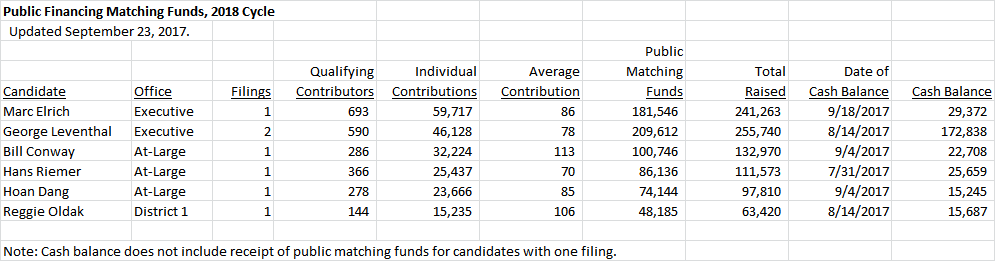
Elrich, who is running against Leventhal, Roger Berliner and Bill Frick to be the next County Executive, just filed his first application for public financing matching funds with the state.  So far, Elrich has more in-county contributors than Leventhal (693 to 590) and has raised more money from in-county individuals ($59,717 vs $46,128).  But Leventhal has received more public funds, leaving him with a slight lead in total fundraising.  Summary data for all qualifying publicly financed candidates appears below.

This is a dramatic turn of events from the past.  Leventhal and Elrich first ran against each other in 2002 as members of slates headed by County Executive Doug Duncan and Council Member Blair Ewing respectively.  Leventhal outraised Elrich by more than 5-1 that year and was backed by hundreds of thousands of dollars more in slate money from the real estate industry.  Over the next three cycles, Leventhal raised about twice as much as Elrich.

But public financing has eroded Leventhal’s edge.  That was predictable considering that both Leventhal and Elrich have had around 600 in-county individual contributors each in both the 2010 and 2014 cycles.  The ability of a candidate to raise money in the public financing system depends solely on the number of in-county contributors he or she has.  So if two candidates have similarly sized individual donor bases, they will raise similar amounts of money.

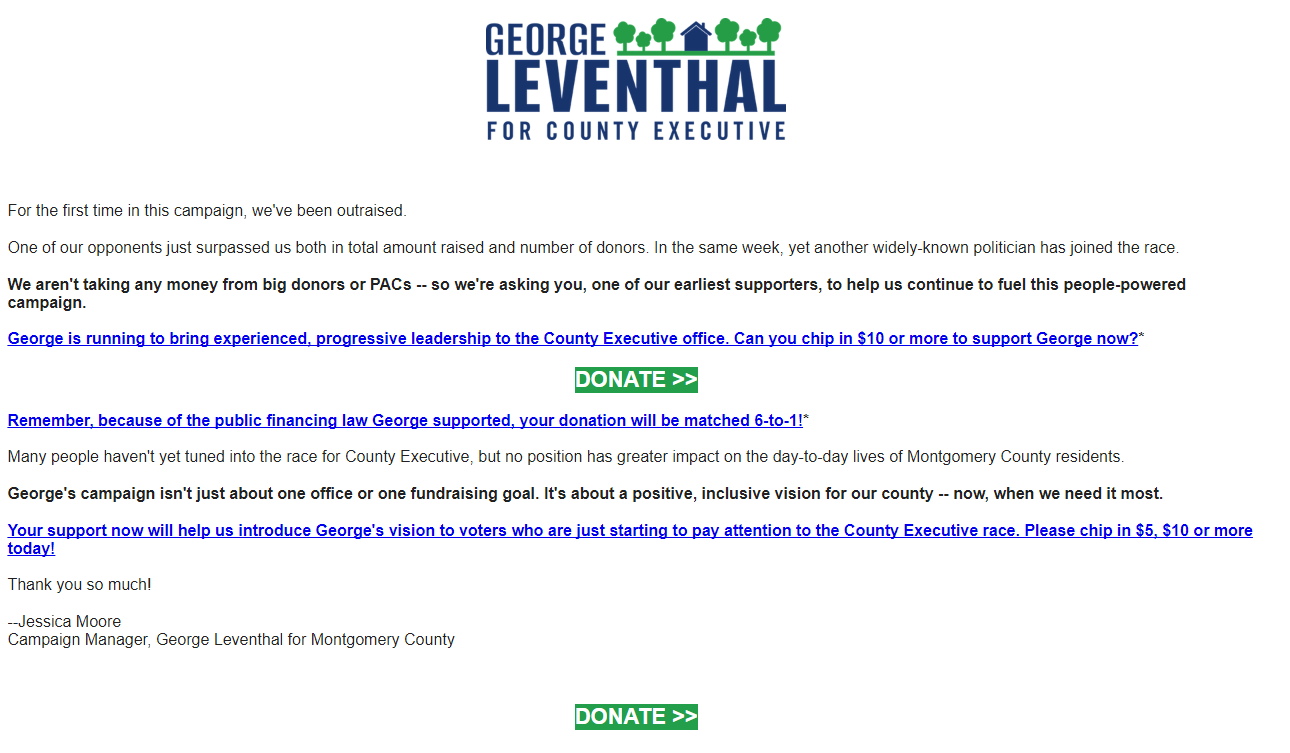
That fact is not lost on the Leventhal campaign, which sent out the fundraising email below shortly after seeing Elrich’s report.

Leventhal is right to be concerned about Elrich’s financial success.  Leventhal finished fourth and Elrich finished first in the last two at-large council elections despite the fact that Leventhal outraised Elrich 2-1.  What happens now when the two are at financial parity?

Share

Action on Puerto Rico and the Virgin Islands

It’s no secret that Puerto Rico and the Virgin Islands have been devastated by Hurricane Maria. What is unknown is if anyone in federal leadership cares or is doing anything about it. If nothing else, being a territory should bring aid in time of crisis.

We know the President virtually does not care. Between his ravings on other topics, he barely had time to spare a tweet for Puerto Rico. He did have time to feed red meat to a all-white hard-right crowd in Alabama by attacking African-American NFL players.

In general, I try not to rush to “go there” because there enough hate in the world without suspecting it in ambiguous situations. But Donald Trump has enough of a record that it seems more than fair to ask if he might express more than an iota of interest if these were not overwhelmingly Latino and Black territories?

Fortunately, the federal bureaucracy is professional and carries on its key tasks despite the absence of leadership from the top. But FEMA is stretched very thin after Hurricanes Harvey and Irma wrecked terrible damage in Florida and Texas.

This is a humanitarian disaster unfolding on American soil and we need to demand more action. The federal government needs to devote more resources now. Congress needs to expand the disaster relief package so there is money to rebuild power and water systems now.

For that matter, our good friends among the small island nations of the Caribbean also deserve our help. In tiny Dominica, which has always stood with us in when needed, even the Prime Minister lost the roof on his home.

Helping is not just the neighborly thing to do by the far larger and wealthier country, it is also smart strategic policy to further bind the ties between us and these already friendly countries, including Antigua and Barbuda as well as Dominica.

We remain the richest and best resourced country in the world. We can do it and we should. Frankly, it all seems so obvious that I remain surprised that I feel the need to write it. Everyone from citizens to elected officials should be saying it.

If you want to aid relief efforts yourself, here are a few links to Go Fund me pages to make it a bit easier:

Puerto Rico and the Virgin Islands
Dominica
Antigua and Barbuda

Support the efforts of the American Red Cross throughout the country at this link.

Share

Democratic Voter Canvasses This Weekend

Information from the Montgomery County Democratic Central Committee:

Before the 2018 elections we need to reach as many Democrats as possible, especially infrequent voters. Please join the Montgomery County Democratic Party to canvass voters in one of three locations this weekend!

P.S. Can’t make it this weekend? Email office@mcdcc.org for other canvass opportunities in Montgomery County or check out www.mcdcc.org.

Share

Analysis: Bill Frick Announces Campaign for County Executive

Frick Announcement by David Lublin on Scribd

Del. Bill Frick (D-16) has announced his bid for county executive. He should attract a lot of attention and interest because he’s the first person who is not a member of the County Council to jump into the race in a year when many voters are looking for someone new yet seems up to the job.

As Adam Pagnucco has analyzed, based on the support for term limits among Democrats, it’s a real plus that Frick is not associated with the current gang running the County. While other candidates will definitely hold him accountable for his actions in Annapolis, it is not at all clear to me that voters will rush to blame the State for decisions made in Rockville.

Being new to most voters also gives Frick a chance to introduce himself along with his ideas simultaneously. He’ll probably want to take a few more daring, clearcut positions that existing candidates in order to claim some issues and set himself apart from the pack.

Frick should also be an appealing campaigner. When he went for the delegate vacancy in District 16, he was not the favorite for the appointment. He won it when he blew away the Montgomery County Democratic Central Committee with his presentation.

Ironically, though Frick is thus far the only non-Jewish candidate in the race, he has real potential to appeal to Jewish voters. Growing up where he did in Montgomery County, my bet is that he attended more Bar Mitzvahs than I did. Remember that many Jewish areas in MoCo voted for Ike Leggett over Steve Silverman.

Frick will face some challenges as well as opportunities. After an abortive race for attorney general four years ago and dabbling heavily with running for Congress, he will need to sell observers on his real commitment to County government.

He will also need to work fast to define himself in an appealing way that stands out before others do it for him–something that will require money whether inside or outside the new public financing system. Even attacks, however, can create opportunities. MCGEO’s Gino Renne, for example, has criticized Frick in the past but could serve as a useful foil.

Among the existing candidates, Roger Berliner is the big loser and Marc Elrich is the big winner from Bill Frick’s entry. Berliner was positioned to be the more practical, pro-business candidate. Frick could attract much of that support if business decides to unify around a fresh face who is more willing to forthrightly support aspects of their agenda.

As the leading progressive candidate in the race, Elrich will benefit if less strongly left-wing candidates split up the vote. He could benefit further if other candidates in the same political space enter the race. Leventhal may also try to claim the progressive mantle but will likely lack the validators needed to make it credible.

Bill Frick’s entry certainly shakes up the race. My guess is that voters welcome his candidacy as a breath of fresh air. Whether his campaign catches fire remains to be seen.

UPDATE: Bethesda Beat’s Andrew Metcalf reports that Frick does not plan to participate in the public financing system: “‘I’d rather raise my own funds than spend the taxpayers’ dollars on my campaign,’ Frick said about his decision.”

Share

Why Gabe Albornoz is Running for County Council At-Large

Today, Seventh State is pleased to present a guest post by Gabe Albornoz.

Not long after the final results were announced in the 2016 Presidential cycle a sense of frustration and sadness spread through our county and country. There was a documented increase in reported hate crimes. Not even Montgomery County was immune to the hate and bigotry that was spreading across the country. In response to the tension inflicting our community, County Executive Leggett appointed a team of senior officials from his administration to produce an event that reaffirmed Montgomery County values. I was honored to have been appointed to that committee and serve as the emcee for an event that would be called the The Montgomery Way.

The event took place a few weeks after the election on a cold November day on Veterans Plaza. The elements did not stop over a thousand residents from hearing messages of love, tolerance and peace from elected officials, public officials, inter-faith leaders, and students. The Montgomery Way celebrates our diversity and inclusion; promotes economic prosperity for all; ensures the best possible education for all children; and establishes a high quality of life for its residents, especially those most vulnerable. The event reaffirmed everything I love about Montgomery County and played a big role in my decision to run for Elected Office.

I have deep Montgomery County roots as a lifelong resident, a graduate of MCPS and have lived in Gaithersburg, Bethesda, Silver Spring, and now in Kensington with my wife Catherine, also a native of Montgomery County, and our four young children. My parents immigrated from Chile and Ecuador; both attended Montgomery College and instilled in me the value of hard work and to treat everyone with dignity and respect. It is a gift to have been raised here. I believe it is my responsibility, elected or not, to pass its opportunities on to all of our children and future generations.

I have dedicated my career to public service and fighting for just social policies through my work in the non-profit sector and more recently as a member of County Executive Ike Leggett’s cabinet. I have always considered my work as Director of the Department of Recreation, Chair of the Montgomery County Democratic Central Committee and service in other public sector roles to be a privilege.

I have worked to improve the quality of life for County residents by growing our recreational programs, addressing the opportunity gaps among our children through expanded after-school programs, and leading efforts to keep our senior citizens in their homes and active in the community. I have learned much from my hands-on experiences working collaboratively with diverse communities and constituencies and have the skill, passion and perspective to promote respectful engagement and unity in our County.

Maintaining the greatness and opportunity of our County will require commitment and effort, which is why I am running for County Council. We are facing difficult challenges including aging infrastructure, a fast-growing school system, a stretched safety-net struggling to keep pace with the complex needs of our more vulnerable residents, growing economic disparity among communities, difficult traffic challenges and unmet affordable housing needs.

These challenges come as financial support from federal and state governments are at significant risk of being cut and our local fiscal options to respond are limited. What is not limited is this county’s ability to be imaginative, thoughtful and determined in efforts to address our challenges justly, creatively and effectively. I will bring experienced, inclusive and bold leadership to the next County Council as it carries out its role in charting our county’s future.

I believe that elected office is a noble profession and provides a clear and tangible opportunity to impact social change and serve as a bridge between communities and sectors.  I intend to work closely with other key public stakeholders including the Board of Education, Planning Board, Executive Branch, State Delegation, Montgomery College and others along with leaders in the Non-profit, Business, LGBTQ, Labor, Faith, Health and Civic Communities to collaboratively address the known and unknown challenges ahead.  I humbly seek this office knowing I will follow many other political leaders, among them my current boss, Ike Leggett.

I want to thank my friends, family and especially my wife Catherine and our kids for their incredible support. For the next year, I will meet with residents across the County to better understand your interests, aspirations, and concerns. I invite you to join me on this journey.  To learn more, please visit my website www.gabeforcouncil.com.

Gabe Albornoz is running for Montgomery County Council At-Large.

Share

David Blair is Polling

Sources report that David Blair, a businessman and prospective candidate for Montgomery County Executive, has a poll in the field. The poll tests views on a number of topics and messages, including:

  • Support for the Purple Line
  • Whether Takoma Park has an unfair advantage over the rest of the County.
  • Messages based on running against Trump using national issues.
  • Impact of a series of positives about Blair, including his support for an interactive children’s center in Rockville and providing glasses for the needy.
  • Support for Del. Bill Frick and former Councilmember Mike Knapp in addition to declared candidates and Blair.
Share

Ana Sol Gutierrez Files for Public Financing in Council District 1

By Adam Pagnucco.

Delegate Ana Sol Gutierrez, who has served District 18 since 2002, has created a public financing account for a run in Council District 1.  While Ana is known for running up big vote totals in Wheaton, she actually lives in Chevy Chase and is eligible to run in the increasingly jam-packed D1 race.  Ana is known for her passionate work on behalf of immigrants and her enthusiastic support for the Purple Line, the latter being unusual among District 18 state legislators.  Her run for council will have a huge impact on both the District 1 and District 18 races, subjects on which David Lublin and I will have plenty to say in the near future.

Share

Why Charity and Public Financing Don’t Mix

Adam Pagnucco was very kind in his discussion of problems regarding County Council Candidate Brandy Brooks’s desire to split funds raised for her campaign with disaster relief charities. He ascribed positive motives to the candidate and described her idea as ethical but not legal in contrast to behavior by some that is not ethical but nonetheless legal.

Charitable contributions from campaign funds, however, are heavily circumscribed to charitable events that are closely related to campaigns, such as buying tickets for an event or an ad in a program, for a number of good reasons.

The first is to avoid the public having to fund a candidate’s chosen charities on top of funding their campaign—an idea that Our Revolution Montgomery County Ed Fischman thought was great in his original, later altered, post sharing Brooks’s idea. Beyond the considerable cost, the County did not adopt public financing to fund charities but to encourage behavior that limits the influence of large contributors and reins in spending.

Next, one can imagine candidates throwing fundraisers in the guise of raising money for charity as a means of meeting the threshold to receive matching funds for public financing. This would obviously subvert the intent of the law, which was to force candidates to raise money in relatively small amounts from a wide range of people. As a result, qualifying for matching funds would no longer demonstrate a certain level of grassroots support.

The definition of charity is also quite wide with many organizations engaged in activities much more controversial than disaster relief. One can, for example, set up 501(c)(3)—an organization that can accept tax-free charitable contributions—to educate people about the dangers of abortion or the benefits of abortion remaining a legal option.

On the other hand, how would government assess Brooks’s nice proposal to donate money for disaster relief in Sierra Leone if the charity is not a legally registered American organization and not subject to scrutiny? It’s a very worthy cause but hard for either officials or citizens to assess.

Donors might also start trying to claim a portion of campaign donations as tax write offs. My guess is they would be on shaky ground because there would be little concrete evidence that the money went to a legal charity beyond a candidate’s promise to spend it that way. Nevertheless, as Donald Trump has demonstrated vividly, not everyone fulfills promises to give to charity but many are willing to try to claim dubious tax benefits.

Unscrupulous people have organized charities in which the bulk of the money goes to employees, often relatives, rather to the charity’s avowed focus. Again, clearly not Brooks’s focus here, but a real problem that the State would need to guard against.

Relatedly, mixing charity and campaign finance would further burden government with trying to keep track of what portion of donations are charitable contributions and if they were then donated in a legal fashion. This is a task they are completely ill-equipped to conduct and would require more money and staff.

In short, this is a great example of how a well-intentioned idea can prove very problematic.

Brooks and Our Revolution Responses

Brandy Brooks gave a response on the Seventh State’s Facebook page that shows a candidate dealing with a campaign issue in a calm, measured way designed to reassure voters. Most will commend her commitment to adhere to the law and will (like Adam Pagnucco and myself) not think that she ever intended otherwise.

On the other hand, her plan to spend money on the legally allowed activities, such as buying tickets to events, does not comport with what most think of as disaster relief. A tendency to jump in without thinking through an idea can give voters pause, though her measured response and a willingness to correct problems shows character and limits any damage.

Our Revolution Montgomery County Chair Ed Fischman’s strong accusations against Adam Pagnucco and passionate use of naiveté as a defense on this page earlier today are less helpful. Voters like candidates with passion but also people and organizations, such as Our Revolution, to know what they’re doing.

Share

Maryland Politics Watch