Greater Silver Spring Chamber Unhappy with Planning Board, Councilmembers

The Greater Silver Spring Chamber of Commerce’s (GSSCC) county council candidate questionnaire (embedded in full below and also viewable at this link) contains statements revealing deep frustrations with the county’s approach to planning and development extend to the business community.

Though Silver Spring is widely viewed as one of the most vibrant parts of the county, the lack of commercial development outside of restaurants and retail remains a real problem:

The Silver Spring Central Business District was envisioned to become a smart-growth, live, work, and play community.  However, in the past 10-plus years, Silver Spring has evolved into a primarily residential neighborhood (bedroom community), with virtually no commercial office development.  At this point, the County seems to be focused on just the “live” and “play” aspects.  But local retailers and restaurants are feeling the brunt of having fewer and fewer customers during office hours.

If efforts to build what the Planning Board terms “complete communities” with places to live, work and play fall short even in Silver Spring, one wonders how well they can succeed as the model for the whole county as envisioned in Thrive 2050. GSSCC also sees the Planning Board’s approach to this problem as inadequate:

The Planning Board’s Silver Spring Downtown and Adjacent Communities Plan’s sole answer to reviving and expanding Silver Spring’s office market is to simply “improve the public realm (i.e., build more sidewalks, bikeways, parks, etc.).

This is part of GSSCC’s support for a “balanced approach to transportation” that includes roads and parking as well as transit and bike lanes. It clashes with that articulated by the Planning Board in Thrive 2050 as well as some members of the County Council:

The Chamber supports a balanced approach to transportation policies that takes into account the needs of our member businesses, their employees, their customers, and their vendors. That balance must accommodate those who use public transit, drive on our roads, travel by bicycle and on foot, and need sufficient parking options at their destination.

Finally, even in liberal Montgomery County, the focus has shifted from “defund the police” to rising crime:

In recent months, Silver Spring has experienced a dramatic increase in violent crime, which threatens our economy, our business owners, and our residents.  The expansion of our “nighttime economy” has been accompanied by some unintended consequences.  Two recent surveys show that the top concern of most residents is crime and safety.

Share

Thrive 2050: The Good

The county’s proposed general plan for the next thirty years is a long document that not only takes time to read but can be hard to decode if you’re not hip to the lingo. Today, I draw out what I see as some of the positives contained in the plan.

Mixed-Use Density on Commercial Land

Thrive 2050 continues with existing practice of promoting high density mixed-use commercial and residential development in commercial districts near transit. The planned developments along Wisconsin Ave. north and south of the Bethesda Metro and west of Chevy Chase provide good examples of this type of development.

Converting current office parks into mixed-use and more pedestrian friendly areas is also a positive idea. The integration of housing into the array of office building towers near the old Marriott Headquarters just east of Montgomery Mall is one good example that should continue. It provides an opportunity to make the area more welcoming as well as to add residential units. Though served by bus, the area’s prime transportation attraction is ts proximity to both I-495 and I-270 as well as major road arteries.

Other aging commercial shopping centers provide similar opportunities. They cannot accommodate the same levels of density if they aren’t located near transit–a bus stop or two doesn’t count–but nonetheless provide good locations to add residential components while reinvigorating and better designing existing retail centers. The mostly completed Cabin John Shopping Center redevelopment provides a good example of better use and design.

Bus-Rapid Transit

Thrive 2050 give further impetus to moving forward with the bus-rapid transit network originally proposed and developed by County Executive Marc Elrich. The Flash BRT is now up and running on Colesville Rd. The advantages of BRT are manifest. Unlike traditional buses, it provides fast transit. It will enable Montgomery to develop the full lungs of a transit system separate from constantly troubled Metro.

It can be built relatively quickly and adjusted over time to accommodate unanticipated developments. Critically, BRT provides fast transit at a fraction of the cost of Metro or light rail. Consider that the unfinished Purple Line, which has now ballooned to billions more than the original cost, could have been built as a BRT line at one-half of the original cost. It would also already be up and running—like the Flash line which started being planned much later.

One key missing element that Thrive 2050 needs to incorporate is a cost-benefit analysis in terms of how to best use our transit dollars. It needs to add evaluation as a principle for infrastructure improvements. Not all transit lines, bike lanes etc. provide equal bang for the buck.

BRT also expands development opportunities by placing more locations within transit nodes. Even with tight definitions of what is walkable to a BRT line, one could develop properties to house a lot more people as well as new locally focused retail. All of this would expand transit, housing and retail opportunities far beyond those who live on pricey land near Metro. It’s smarter smart growth.

More Development in the East County

I don’t know nearly enough to say how it should be done or where it should be done but the idea of creating additional residential, commercial and retail opportunities in East County is a fine one. The Racial Equity and Social Justice (RESJ) review has raised questions about how to do this in a way that protects and enhances the interests of existing low-income residents.

That doesn’t mean, however, that the basic idea is bad. It just suggests that Thrive 2050 needs fewer gauzy good intentions and more concrete strategies to implement to achieve this end. Towards that end, the RESJ review suggests conducting more meaningful consultations, hopefully ones that listen to their concerns rather than implicitly direct people to or recruit people who will give the “right” answers.

Removing River Road as a Growth Corridor

One bizarre moment during the 2018 election was when the Greater Greater Washington blog attacked Marc Elrich in a candidate interview for not wanting to concentrate large amounts of density on River Road. Except that even the most grandiose transit plans did not envision a transit line on River Rd., so Elrich argued instead for concentrating density near existing transit in line with smart growth planning. Thrive 2050 acknowledges the sense of that approach and removes River Rd. from the Beltway through Potomac Village as a growth corridor.

It should probably be extended to the DC line. The major expansion and redevelopment at Westbard shopping center has already added significant density at the one location with major potential to combine residential and retail. It has already taxed what that area can accommodate, suggesting steering additional density elsewhere.

Share

Racial Equity and Social Justice Review Slams Thrive

The Office of Legislative Oversight (OLO) has released its preliminary Racial Equity and Social Justice (RESJ) review of Thrive 2050 (text embedded below or click this link). Its analysis attacks Thrive at its core.

Thrive leads with a vision for economic development that focuses on attracting new businesses and workers to the County who can afford to reside and/or work in mixed-use, transit-oriented town centers. Yet, this economic development approach could widen racial and social inequities as it primarily offers benefits to affluent and disproportionately White people.

That’s got to hurt for Thrive 2050 proponents. They routinely tout it as an extremely progressive document and attack people who have concerns with part or all of it as racists or classists. The RESJ review suggests that Thrive supporters have been casting stones from comfortable glass houses.

The RESJ review also creates a huge procedural problem for moving forward with Thrive 2050:

OLO finds that the request to develop a RESJ impact statement for Thrive 2050 was premature as the PHED Committee draft is not yet ready for a comprehensive RESJ review. Instead, this memo offers six sets of observations and recommendations for updating Thrive, so it better aligns with best practices for advancing RESJ.

The Council adopted the RESJ review process with much fanfare and intense commitment. The Council is not supposed to move forward with the matter until it has received an RESJ review. If the Council truly believes in the importance of the process it created, its review process should halt until Thrive is updated so that OLO can undertake a proper RESJ analysis.

It’s not my preference but it’s that or they can ignore their own law.

Contrary to claims made within Thrive, the OLO believes that people of color and low-income residents have not been adequately consulted during its preparation. One of OLO’s key recommendations for updating Thrive for a proper RESJ review is:

Elicit the meaningful input of residents of color from communities of color and low-income residents to co-create and update Thrive so that it reflects a consensus of land use policies and practices aimed at advancing RESJ.

This suggestion was reiterated a second time later in the document. Some who want the Council to move forward might well find fault with the ideological spin underpinning the RESJ review. But this is exactly what the Council asked for with RESJ analyses.

In short, Thrive proponents face quite a conundrum. They have sold this document precisely on racial equity and social justice grounds. Yet the RESJ review says that the process failed to conform to equity standards and that the core approach adopted by the Planning Board and the PHED Committee will worsen these problems.

Share

Riemer Flip Flops on Liquor Control

Calling the laws governing the sale of liquor in Montgomery “antiquated and byzantine,” Councilmember Hans Riemer (D-At Large) came out in favor of abolishing the county liquor monopoly in an email blast sent out yesterday by his campaign for county executive.

This is quite a change.

Over three terms on the County Council, he has opposed doing away with the monopoly. The Nighttime Economy Task Force, which Councilmember Riemer chaired in 2013 studiously stayed away from recommending its abolition even though it was the obvious way to stimulate restaurant growth and nightlife.

Two years later in 2015, Riemer wrote here on Seventh State: “I strongly believe our county alcohol regime holds back the vibrancy of our restaurant and nightlife economy and negatively impacts the choices residents get in stores.” But even as he recognized its faults, he opposed ending the monopoly.

Instead, he championed an unworkable bill that would have allowed businesses to buy directly “boutique brands” that weren’t among the 4,500 carried by the then-Department of Liquor Control (DLC). Except that distributors were never going to run nearly empty trucks to stores or restaurants to deliver a case or two of their more obscure brands.

Meanwhile, Riemer worked to kill a bill sponsored by Del. Bill Frick (D-16) to allow county voters to decide whether to retain the monopoly. Even after the fiasco surrounding deliveries to bars and restaurants right before New Year’s just a couple of months later, Riemer stuck to his position against abolition.

Now, after three terms on the Council, Riemer has come out against the monopoly as part of his campaign for county executive.

He even argues that he is somehow more radical than David Blair because:

David Blair, on the other hand, also wants to keep the County in the liquor business. Rather than just getting out, Blair wants the County operations to compete with the private sector – creating a gigantic mess that will cost taxpayers dearly while needlessly subjecting employees to conditions that would be extremely stressful and demoralizing.

Keeping the county in the liquor business would increase competition, which is the entire point of abolishing the monopoly, while simply shutting it down as Riemer proposes would decrease it. The county liquor business might not survive this competition, but they are already established and positioned to give it a go. It’s hard to imagine that this would be more “stressful and demoralizing” than being fired, as Riemer suggests.

But the real story remains that Riemer has upended his position after twelve years on the Council as part of campaign for higher office.

Share

Planning Board Proposes to Redefine “Public Hearings” Instead of Holding Them

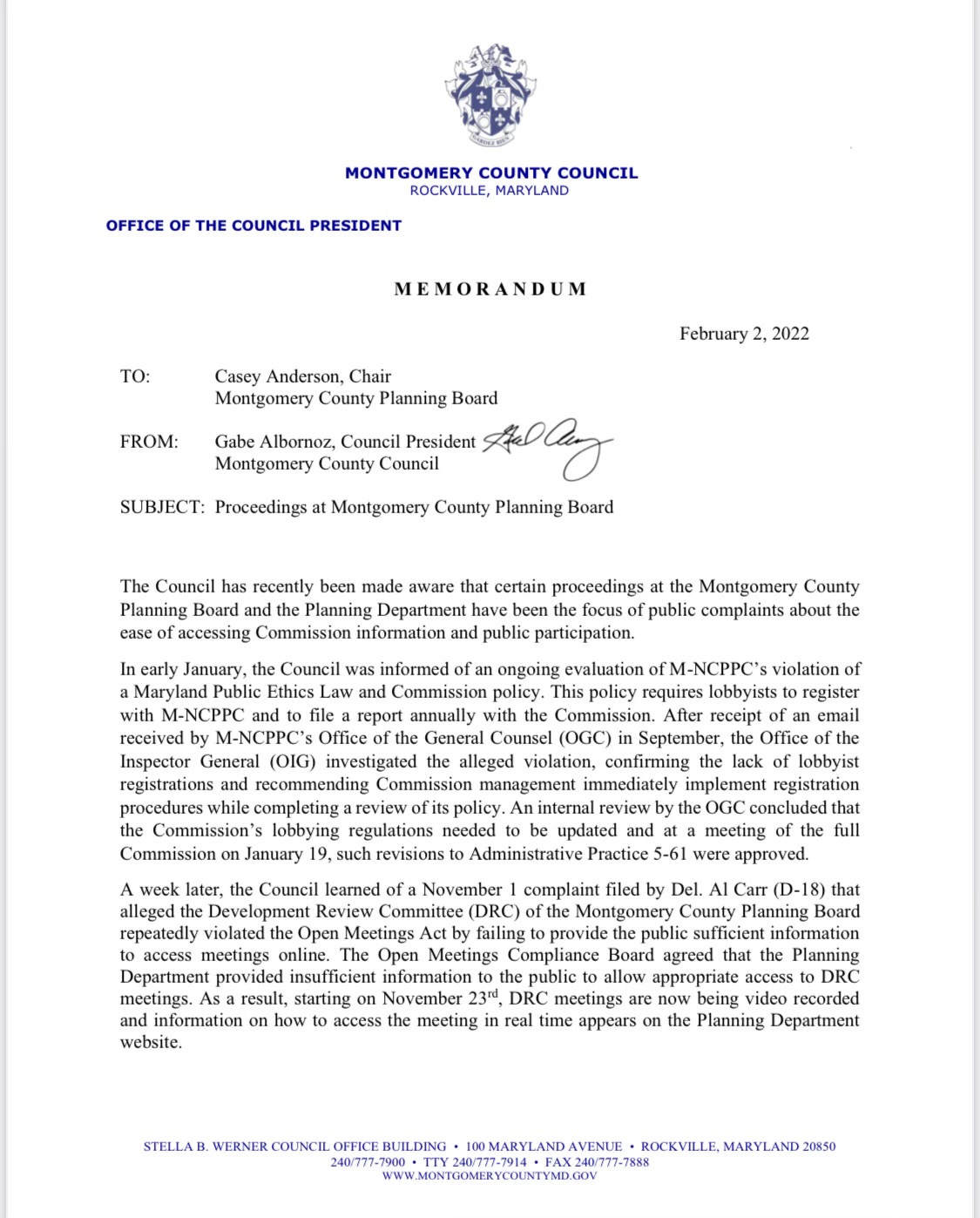
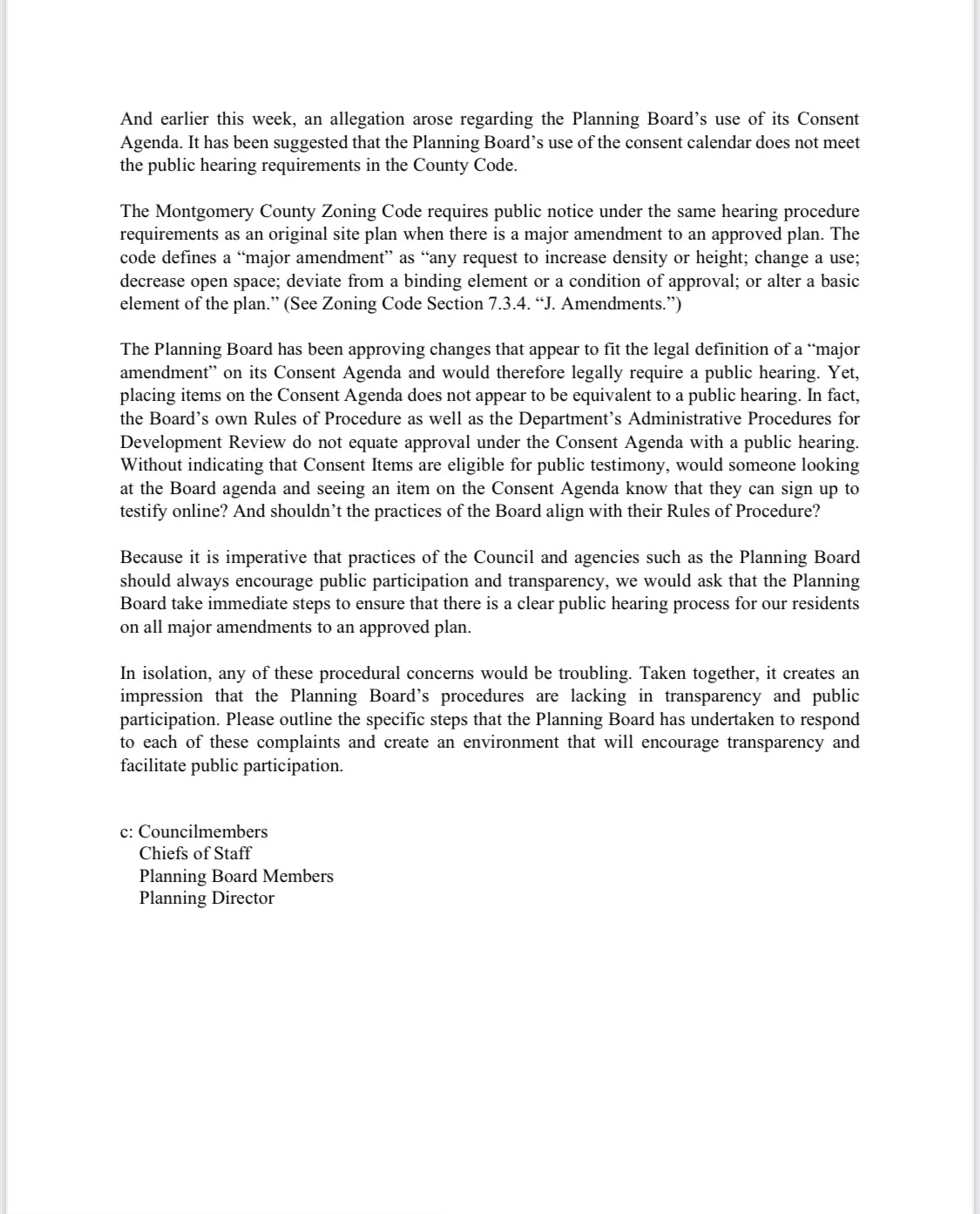
Yesterday, Montgomery County Council President Gabe Albornoz sent a letter to the Planning Board demanding more transparency, including that they cease abusing their Consent Agenda for discussions of “major amendments” to plans that require public hearings.

They don’t seem to have received the message.

Instead of offering a mea culpa for their past flagrant violations of the zoning code, they excuse themselves, claiming: “Items are placed on the Consent Agenda for votes when they have not generated controversy.” Except that how do you know there is no controversy without holding a public hearing? And if there is no controversy, why not just put it on the regular agenda and just move along if no one wants to testify instead of signalling and pre-judging the question?

Beyond offering no apology, the Planning Board’s proposed “solution” is to redefine “public hearing” to include Consent Agenda items:

“Public Hearing” or “hearing” means a duly-noticed Summary Hearing (emphasis added) or Full Hearing held before the Planning Board, open to the public, and providing an opportunity for any Person, including the general public or Applicant, to appear and present written or oral evidence, cross examination, or rebuttal, all subject to the provisions in these Rules.

Buried in the Rules of Procedure are also new explanations that items can easily be moved from the Consent to Regular Agenda. However, unless a member of the public goes spelunking in the Rules, they are unlikely to know. Meanwhile, the item remains on the Consent Agenda even though the clear intent of the Code is to require genuine public hearings on major amendments.

Poof! Problem solved!

If Planning Board members were really interested in transparency, they could start by providing a tracked changes version of the document, instead of forcing the public to suss out the changes. These legalistic changes might not even solve their problem as they may still violate common law–not to mention common sense–definitions of a “public hearing.”

It is clear that Planning Board Chair Casey Anderson and possibly the rest of the Board have missed Council President Albornoz’s message. After all, Albornoz could have proposed an amendment to the zoning code instead of pushing for transparency. Nevertheless, the Board has chosen the route of less transparency by redefining “public hearing.”

The Planning Board’s statement begins “We take transparency very seriously.” They then proceed to provide excuses for all of their violations of lobbying registration and open meeting requirements along with this “fix” of their Consent Agenda problem. Their response further undercuts confidence in the ability of the Planning Board to conduct the public’s business in a genuinely fair and transparent manner.

If you wish to testify regarding the proposed changes on February 10 at 9am, you can sign up here. Perhaps the Planning Board might consider holding the hearing on this issue before it goes through its lengthy Consent Agenda.

Share

Council Investigating Planning Complaints

Montgomery County Council President Gabe Albornoz sent a letter to Planning Board Chair Casey Anderson looking for answers on a series of complaints regarding transparency at the Board, including M-NCPPC’s failure to register lobbyists as required under law, and violation of the Open Meetings Act, and inappropriate use of the Board’s Consent Agenda for matters requiring a public hearing.

He concludes by writing:

In isolation, any of these procedural concerns would be troubling. Taken together, it creates an impression that the Planning Board’s procedures are lacking in transparency and public participation. Please outline the specific steps that the Planning Board has undertaken to respond to each of these complaints and create an environment that will encourage transparency and facilitate public participation.

The full letter is posted below (pdf first, images follow):

Share

Thriving Together

The Tweeters have been active since the Coalition for Smarter Growth (CSG) condemned me. I’ve been threatened with physical violence and another prominent smart growth blogger says I “must be stopped.” Twitter suspended the account of the person who threatened me.

While not pleasant, a friend with good sense reminded me to “ignore the trolls” and that the “Twitter echo chamber is not representative of the real world.” The bile seemed to go far beyond anger at my criticizing a lobbyist for not filing required reports.

What I rapidly learned is that my series of posts about problematic ethics at the Planning Board and lobbying raised the ire of advocates for Thrive 2050 —the county’s general plan that the County Council is set to consider. Apparently, similar treatment has been meted out to others deemed to be critics, though I have literally not written a word on Thrive prior to today.

Well, they got me much more interested. I have not followed the Thrive debate closely. Like many, I’ve been focused on my job and getting through the pandemic, so I stopped blogging completely. Over the weekend, I’ve started to gain a quick education.

The key takeaway so far is that new County Council President Gabe Albornoz and Vice President Evan Glass have their work cut out for them. The intense divisions and acrimony around Thrive mirror the ugly mood and tenor of debate in the country. Confidence isn’t increased by the Planning Board’s failure to register lobbyists, violations of the open meetings law and abuse of the consent calendar to constrain public input on other matters.

The good news is that I cannot think of two people more suited to address it. While I sometimes disagree with them strongly, you won’t find two more fundamentally even-keeled public officials than Councilmembers Albornoz and Glass. As a result, I remain optimistic that they can lead the county to a document that brings people together. Put another way, I hope they can move the process forward to a conclusion but in a way that makes residents feel included and heard.

That doesn’t mean “paralysis by analysis”—the county’s unfortunate moniker for its tendency to study matters into eternity—but it does mean heading towards the end in the right way. How can that be accomplished?

It’s an unfortunate truth of public policy that many people only start to pay greater attention once matters come to a head. (Consider me Exhibit A in this case.) This is especially true because the key parts of the process took place during the pandemic and the 2020 election. So many people still have a lot of questions they would like answered, and many would like to know how the comments they have already provided will be incorporated.

Thrive proponents may be technically correct that the document itself changes nothing with respect to zoning, but it is strongly linked to potential major zoning changes (zoning text amendments) that have also been proposed and are already under discussion. So saying it has no impact on zoning comes across, intentionally or not, as too clever and insincere.

It’s especially important because the Planning Board, led by Casey Anderson, removed certain references to the importance of the Master Planning process. The document is now written to pre-determine outcomes, while simultaneously claiming not to have decided anything. Put another way, we are now being told that it is too early to know its impact on zoning but, once Thrive is passed, it will be too late because “Thrive says . . .”

People want to know what Thrive means for them—how will it affect their home and their neighborhood? What about nearby areas? People care a lot about how changes impact their family and their largest investment or their rent. Using plain language and including specific metrics would go a long way to help residents better understand outcomes Thrive expects to realistically achieve,

In my time as mayor and other leadership positions, I’ve found that listening is far more important than talking. I’m not saying it’s easy or my natural strength, but I work on it. People like to be heard. They also justifiably loathe performative “consultations” where leaders claim to want input, but the outcome has been pre-determined. Councilmembers must incorporate comments from the very broad range of opinion thoughtfully with an open mind.

Which brings me to why this effort is needed to get the process back on track. Many in the community believe that the process has been highly structured to produce a particular outcome supported by a nexus between the Planning Board Chair, activist/business groups like CSG, and certain councilmembers.

The Planning Board staff presented a draft that was amended “in a very surgical way” at the behest of Planning Board Chair Casey Anderson according to insiders. While avowedly done in response to community comment, for example, it’s hard to imagine that this very pro-environment county demanded the excision of Thrive’s specific environmental chapter. Did anyone actually request this? The changes reflect exactly what one would imagine Casey Anderson preferred.

The Thrive appendix outlining planned outreach states:

Blog and vlog: To get involvement from and perspectives of different people in the community — residents, community leaders, business leaders, county officials — we’ll ask different people to be involved in writing or being interviewed for Thrive Montgomery stories to share on the blog.

But the blog is uniformly supportive of Thrive and the concepts behind it. If you do a search for “Thrive” in the blog, almost all of the posts are written by Casey Anderson or other people at the Planning Board. This is what an orchestrated campaign looks like–not an effort to involve diverse voices and different perspectives.

The three-member Council Committee which then reviewed Thrive for the Council is chaired by Hans Riemer, a very good friend and close ally of Casey Anderson. People happier with the original staff document, such as the Civic Federation, understandably see the consultation process as set up to emphasize supporters and limit input from people who might have a contrasting vision.

Former Council President and powerful PHED Committee Chair Riemer’s statement that CSG, a regional organization fiscally sponsored by an out-of-state group with substantial contributions by developers, has been “chairing the conversation” confirms their fears.

Anderson, Riemer and CSG are understandably happy with a document which utterly mirrors their views. That doesn’t make it a bad document in terms of public policy per se, or any of their policy preferences “wrong,” and it certainly doesn’t make any of them remotely bad people. It’s a fine example of structuring a political process to achieve one’s preferred outcome. But it doesn’t provide for an open, transparent, and inclusive process that achieves buy-in from the community.

Finally, as the Council goes through the document, they should go through section by section with both the PHED version and the original Planning Staff version on hand. That will allow the Council to better discuss whether they agree with the changes. Again, they need to discuss how the feedback they’ve received that differs from recommendations is considered and incorporated. This sort of deliberative work session process, conducted in public, will allow for an open process that permits a variety of issues and concerns to be discussed and considered.

There shouldn’t be a complete restart. We need to answer questions, to consult meaningfully, and then the Council can make the decisions we elected them to do. Not everyone will be happy with their decisions, but they’ll likely feel much more included and respected if they are genuinely heard and the document reflects the diverse views in the county.

Share

In Lane 2: The Wealthy Businessman

David Blair has more or less been running for county executive since he had a heartbreakingly close 80 vote loss to then-Councilmember Marc Elrich in the 2018 Democratic primary. It’s safe to say that no one will mistake the politics of one for the other.

The most promising issue for Blair—and one that leans into his business experience—is Montgomery’s record in attracting business and jobs. Not only is it substantive issue and a genuine problem, it is also one his opponents have left wide open. Far too often, county government treats real estate development as the one and only issue. The County Council focuses heavily on zoning and various ways to spur development but gives seemingly short shrift to the rest.

But residential development doesn’t do much to grow the tax base. Residents are expensive, especially if they have children who use the public schools. If they do, chances are that they receive more in spending than they pay in taxes towards the one-half of the county budget dedicated to the Montgomery County Public Schools.

Montgomery has always provided its residents an impressive array of services beyond the schools. Unlike in some jurisdictions with comparable tax rates, you can look around and see a fair amount being provided for your money. But if we want to continue to grow the tax base to maintain it, we need more non-development business. That gives Blair both a subject that he can claim as his as well as a message.

Blair, however, is not running as an anti-tax candidate. Like the County Executive and the County Council, he strongly supported Question A in 2020, which will have the effect of raising property taxes higher than would have been possible in the past.

Instead, Blair promises to bring the executive leadership that made him so successful in business to Montgomery County government. While many would argue that shaking up the tree might well be a good thing, government is very different from business. As Truman once said regarding his successor: “He’ll sit here and he’ll say, ‘Do this! Do that!’ And nothing will happen. Poor Ike—it won’t be a bit like the Army.” Does Blair know how to operate the levers of government?

At times, Blair has sent mixed or unconvincing messages on that question and what he thinks. For example, he recently set himself apart by coming out in favor of ending Montgomery County’s antiquated liquor monopoly. But this is after previously hiring Robert Dorfman—the former head of the then-Department of Liquor Control—as his campaign manager. Dorfman is no longer with the Blair campaign.

Moreover, how does Blair plan to get either the county council or state legislative delegation to vote for his plan? Egged on by MCGEO, both have been adamantly opposed to dismantling the monopoly. He’ll have to do a lot of persuading to make it happen.

Blair’s Economic Development Plan is a grab bag. Some appear to be more wish list items than plans, such as “Attract Venture Capital Funding” and “Attracting Hospitality Tech Companies.” Others sound like old ideas repackaged, such as creating a “microincubator program” for life sciences.

I like his idea of cutting barriers to doing business but more specifics would help. His plan states that businesses should not be “bogged down by strict regulations, cost-prohibitive processes and unsatisfactory customer service.” Great, but concrete examples are badly needed to make it meaningful instead of a campaign slogan like his catchily named “Montgomery County Business Bill of Rights.”

People voted for Elrich and Blair last time in a rejection of the status quo.. Blair needs to show that he knows the real nuts and bolts of creating change even as he identifies with the problems faced by ordinary businessmen and residents. And show that it isn’t just a redux of focusing on development interests yet again.

Blair’s huge advantage, of course, will be his cavernously deep pockets. I imagine that, as in 2018, he will spend incredible sums to dominate the airwaves, internet ads and any other form of communication. He’ll also be able to pay an army of campaign advisors and workers. It worked for Reps. David Trone (who used his resources very skillfully) and John Delaney, so I don’t see why it couldn’t work for him.

No doubt his business record will come under close scrutiny. Many will also ask “If he wasn’t so wealthy, would anyone be interested in what he had to say?”

Even if the answer is no, opponents would do well to remember that Americans, including poor ones, tend to admire successful businessmen and women. We don’t hate them; we want to be them. After all, it’s the American Dream.

Share

CSG Snaps Back

The Coalition for Smarter Growth seems to think I was wrong to expose their and Jane Lyons’s ethical violations and put out a statement to that effect.

Before they get to attacking me for exposing their dirty laundry, the executive director says he takes “full responsibility” and says that they “have implemented an improved tracking system to ensure such an oversight does not happen again.” It’s great that he takes full responsibility, though it’s unclear that this has resulted in any consequences for him or Jane Lyons.

Nonetheless, they quickly move from taking “full responsibility” to attacking the messenger:

Mr. Lublin’s two posts impugn the reputation of a young and extremely accomplished person — a 2019 graduate of the University of Maryland who has demonstrated utmost integrity in advocating for policies which she and the Coalition for Smarter Growth believe to be important for our collective future.

We believe Mr. Lublin’s attack on Ms. Lyons is driven primarily by his policy disagreements with CSG. Of greatest concern to us is that Mr. Lublin has ignited a round of online harassment and intimidation on Twitter, Facebook, and NextDoor that is is all too common today, as he must certainly be aware.

I don’t see how not registering as a lobbyist in a timely manner demonstrates “utmost integrity” in lobbying. I mentioned Ms. Lyons’s credentials and accomplishments in my post yesterday. It doesn’t explain why she didn’t register or why CSG failed to make sure she did. College educations make people better able to navigate bureaucracy. One reason education is the demographic that best predicts voting is that it gives you the skills to navigate the barriers to getting on the rolls.

In terms of my views, I agree with CSG on some issues and disagree on others. If you summed up my perspective, it would probably be that I agree with the broad thrust of where they want to go but think they are sometimes are overzealous. In any case, it’s a strange and new notion that people can only point out failings on the part on people with whom they agree all of the time.

It’s certainly not an approach that CSG and their allies have taken in their own attacks and would seemingly have prevented them from issuing their own “personal attack” to discredit me. Recently, CSG attacked both an individual homeowner as a hypocrite and anti-Thrive 2050 protestors generally in a press release. And they and their friends haven’t shied away from attacking the ethics of their opponents.

One area I do very much agree with CSG is the lamentable state of social media. That’s why (unlike CSG) I stopped putting out blog posts on Twitter and Facebook. (I’m sufficiently a philistine that I had to look up NextDoor after reading their statement.) While some people manage the rare feat of holding thoughtful discussions, social media promotes incredible negativity and piling on.

Again, I have never seen CSG object when their supporters engage in this behavior and attack people who disagree with them. Today, in fact, CSG Executive Director Stewart Schwartz liked a tweet by former Councilmember George Leventhal (a guy not exactly known for being unwilling to attack people) suggesting that I’m a misogynist. I haven’t seen the harassment of Lyons mentioned here but I hope it is no worse than served to me on occasion. “Politics ain’t beanbag” so I’m not surprised people are unhappy with me on occasion even if, like CSG and Lyons, I might wish they were kinder about it.

I received a polite email from a friend of Lyons telling me that they have found her an ethical and thoughtful person. I don’t know Lyons but I am not surprised that people find her this way. Effective advocates usually are personable and, while CSG and Lyons have their perspective on the issues, they are certainly informed and knowledgeable–as are their opponents. But she and CSG should have been on top of these problems. I’m glad they’ve taken the time to address them.

CSG is an influential, effective organization with tight links over at the Planning Board and the County Council as well with business interests. Indeed, Councilmember Hans Riemer complimented Jane Lyons for “chairing” the discussion on Thrive 2050. Clearly, I’ve stepped on some powerful and influential toes.

Share

Coalition for Smarter Growth Lobbyist Didn’t Register with State

Coalition for Smarter Growth Lobbyist Jane Lyons did not register with the State of Maryland despite having testified before the Montgomery County delegation on behalf of the Coalition for Smarter Growth in December 2020. Lyons is the paid Maryland Advocacy Manager of the Coalition, so she is required to register under the law. Paid lobbyists must register unless they earn under the $2500 minimum compensation for related activities.

This new violation of state lobbyist law follows on last week’s report that Lyons failed twice to register as a lobbyist with Montgomery County. She did this despite knowing about the county legal requirement since she had registered previously.

This repeated failure to comply with lobbying laws contrasts with CSG’s touting that Lyons’s experience “spans multiple levels of government” including the “Maryland General Assembly” and a “fellowship at the Montgomery County Council.” Lyons has an BA and Master’s in Public Policy from the University of Maryland, College Park.

Share

Maryland Politics Watch