Category Archives: Adam Pagnucco

Hogan’s Campaign Against Public Schools

By Adam Pagnucco.

Governor Larry Hogan is the most dedicated opponent of Maryland public schools in recent memory.  And now, new rankings of states in a respected education publication show how effective he has been.

Education Week, which ranks public school systems by state, rated Maryland’s public schools as fifth in the nation as of 2017.  That’s a decent rank, except when you consider that the publication rated Maryland number one every year from 2009 through 2013.  Maryland scored particularly low on its achievement gap between low-income and high-income students, ranked as 42nd in the country.

The decline in the state’s ranking is no surprise since it’s perfectly consistent with Governor Hogan’s record on public schools.  Consider what he has done in his first two years in office.

  1. He cut public school funding in his first budget.

The Governor of Maryland has enormous budgetary powers under the state’s constitution.  When he submits an operating budget to the General Assembly, the state legislators generally cannot add spending to it – they can only set aside spending for particular purposes or cut it.  Over the years, the General Assembly has established funding formulas for certain spending items in state law, and that includes most state aid programs for K-12 education.  But the Governor identified one program that was not protected by state law – a program that sent extra money to school systems with higher costs of educating students.  The Governor cut half of that money, a total of $68 million, in his very first budget.  Here are the counties that were affected and their dollar losses:

Prince George’s: $20 million

Montgomery: $18 million

Baltimore City: $12 million

Anne Arundel: $5 million

Frederick: $3 million

Baltimore County: $3 million

Howard: $3 million

Others: $4 million

Note that almost three-quarters of the cuts applied to three jurisdictions: Prince George’s, Montgomery and the City.  What do they have in common?  You guessed it: they all voted against Hogan by large margins.

Hogan resisted calls from the General Assembly to restore the cuts, so they passed a law making the program mandatory.  Hogan waved the white flag of surrender, admitting that he did not have the votes to sustain a veto.  If he had gotten them, those cuts would have continued every single year.

  1. He withheld teacher pension aid for counties in his second budget.

Since FY2013, counties have been responsible for paying part of the cost of teacher pension funding, with the remainder covered by the state.  After passage of his second budget, Hogan withheld $19 million in state aid the General Assembly set aside to help counties pay for teacher pensions, a move that threatened their credit ratings.  Here are the counties that were affected and their dollar losses:

Montgomery: $6 million

Howard: $2 million

Baltimore County: $2 million

Anne Arundel: $2 million

Prince George’s: $1 million

Frederick: $1 million

Others: $5 million

Ultimately, Hogan agreed to release the money but only when the General Assembly agreed to provide an equal amount in corporate welfare to Northrop Grumman, one of Hogan’s top policy priorities.  What kind of Governor plays games with school funding in order to get more money for corporate welfare?

  1. He is jamming public school boards with public school skeptics.

As Governor, Hogan has the power to appoint members of the State Board of Education as well as numerous local school boards.  He has used that prerogative to stack these boards with skeptics of public schools.  The President and Vice-President of the State Board of Education, both Hogan appointees, are nationally-known promoters of charter schoolsOther State Board appointees are a religious school principal and “a consultant who works on charter school conversions.”  It is no coincidence that the State Board is now considering an expansion of vouchers for private schools.  Another Hogan appointee is Ann Miller of the Baltimore County school board, who has a history of criticizing LGBT people and immigrants.  Another Baltimore County school board appointee, retired private school teacher and non-voter June Eaton, was asked by the Baltimore Sun “if she had any public school issues that needed to be addressed.”  Eaton replied, “I really haven’t given it much thought. This is all new to me.”

  1. He is pushing hard for tax dollars to be sent to private schools.

At the same time that Hogan has been trying to cut funding for public schools, he is doing everything in his power to send tax dollars to private schools.  Last year, he got the General Assembly to agree to $5 million in funding for vouchers.  Now, he is pushing to expand the program to $10 million.  The Governor continues to support a corporate tax credit for businesses contributing to private schools and introduced a bill that would have allowed charter schools to compete for state public school construction funding.

Hogan’s behavior is straight out of the playbook of Donald Trump’s nominee for U.S. Secretary of Education, Betsy DeVos: starve public schools and send the money to the private sector.  Hogan even put his own twist on it by using public school money as a bargaining chip to get corporate welfare for defense behemoth Northrop Grumman.  The Governor’s intentions are beyond doubt.  Only one question remains.

Can he be stopped?

Share

Is Larry Hogan Capable of Telling the Truth?

By Adam Pagnucco.

What’s the old saying about lying and telling the truth?  There are lots of variations, but most of them go something like this:

It’s easier to tell the truth than it is to lie.  That’s because when you tell the truth, there’s only one version to remember.  But when you lie, you have to keep all the details straight and say it the same way every time.  Otherwise, you’ll get caught!

Governor Larry Hogan has probably never heard of this.

As we have noted before, the Governor is waging an all-out campaign to repeal the General Assembly’s transportation project scoring law.  The law requires the Maryland Department of Transportation (MDOT) to score every major state transportation project on a variety of criteria, but gives the administration ultimate authority to fund projects of its choice regardless of their scores.  The Governor despises the law because it creates potential for embarrassment – he would have to publicly defend any decisions to fund low-scoring projects.  So he has falsely claimed that the law requires him to kill projects and said falsely that it was passed without hearings.  The Governor even released a list of projects that the law would allegedly kill even though the plain language of the law contradicts him.

One of the projects the Governor says will be killed is the widening of I-81 in Washington County.  His kill list describes it as “I-81 Reconstruction from West Virginia line to Pennsylvania line.”

A week after saying that I-81 and dozens of other projects would be killed, the Governor showed up in Hagerstown to announce funding for – you guessed it – I-81 widening.  The Hagerstown Herald-Mail reported:

Maryland Gov. Larry Hogan came to Hagerstown bearing gifts on Thursday, announcing more than $115 million in funding commitments for local and regional projects.

The largest chunk, $105 million, is for the first phase of widening of Interstate 81, which recently got underway to widen the heavily-traveled interstate to six lanes from the West Virginia line to Md. 63 near Williamsport.

The first phase of work is from U.S. 11 in West Virginia to Md. 63, including the Potomac River bridges in between…

Another $5 million has been budgeted for design work for the second phase of I-81 widening, Hogan said, allowing the project to progress north to the Interstate 70 interchange.

The Governor’s office issued a press statement reiterating that work on I-81 would proceed.  Neither the Herald-Mail article nor the press statement noted that the Governor had already said that I-81 would be killed by the transportation scoring law.  There were no caveats in the article or the press statement such as “I-81 will proceed so long as the scoring law is repealed.”  Let’s note that the project kill list and the press statement about I-81 were issued only EIGHT DAYS APART.

In which of two alternate realities does the Governor live?  The one in which a major transportation project is killed by a new law?  Or the one in which the project proceeds without obstruction?  It seems to vary by the day.

This is no longer about transportation policy, folks.  You can’t rant and rave at a press conference that a project is going to be killed and then show up a week later like Santa Claus to announce that it’s going to be built.  Reasonable, sane and trustworthy people don’t behave like that regardless of their political beliefs.  That raises a critical question.

Is Larry Hogan capable of telling the truth?

Share

Governor Trump

By Adam Pagnucco.

One of the reasons why Donald Trump was elected President is that he made things up out of thin air and the press, for the most part, let him get away with it.  Now Governor Larry Hogan is doing the same thing.  And so far, it’s working.

We refer of course to the Governor’s all-out campaign to repeal this year’s transportation transparency law.  The law, passed over the Governor’s veto, would require the Maryland Department of Transportation (MDOT) to rank transportation projects according to a variety of numerical criteria to bring transparency into what has been an opaque funding process.  The Governor claims that it would require him to kill most state transportation projects.  But in fact, the plain language of the law lets the Governor have final say over which projects get funded.  It states, “Nothing in this Act may be construed to prohibit or prevent the funding of the capital transportation priorities in each jurisdiction.”

So just like Trump, the Governor is making things up and trotting them out to the press.  How did the press react?  Erin Cox of the Baltimore Sun got the facts right, quoting both the law’s language and an advisory letter from the Attorney General’s office to demonstrate that Hogan is wrong.  A reader had to review the article carefully to glean these things, however, as it also included lots of back-and-forth between politicians.  The Washington Post and the Capital Gazette also quoted the law’s language, though only in passing.

Other press outlets got suckered.  The Hagerstown Herald-Mail, Frederick News-Post, Ocean City Today, WMAR (Baltimore), WJLA (Washington), Bethesda Magazine, Afro-American, WMDT, WTOP and Montgomery Community Media (MCM) never mention what the law actually says, depicting the issue as a he-said-she-said dispute between politicians.  Ocean City Today, WJLA and WMDT never bothered to quote any Democrats, giving the Governor free rein.  WJLA, WMAR, MCM and the Afro-American stated falsely that certain transportation projects either “were,” “will be” or “have been” canceled.  Again, the law says no such thing and a simple fact-check could have uncovered that.

The real story here is that one side is accurately characterizing state law and the other side is making stuff up.  No one in the press wrote that story.

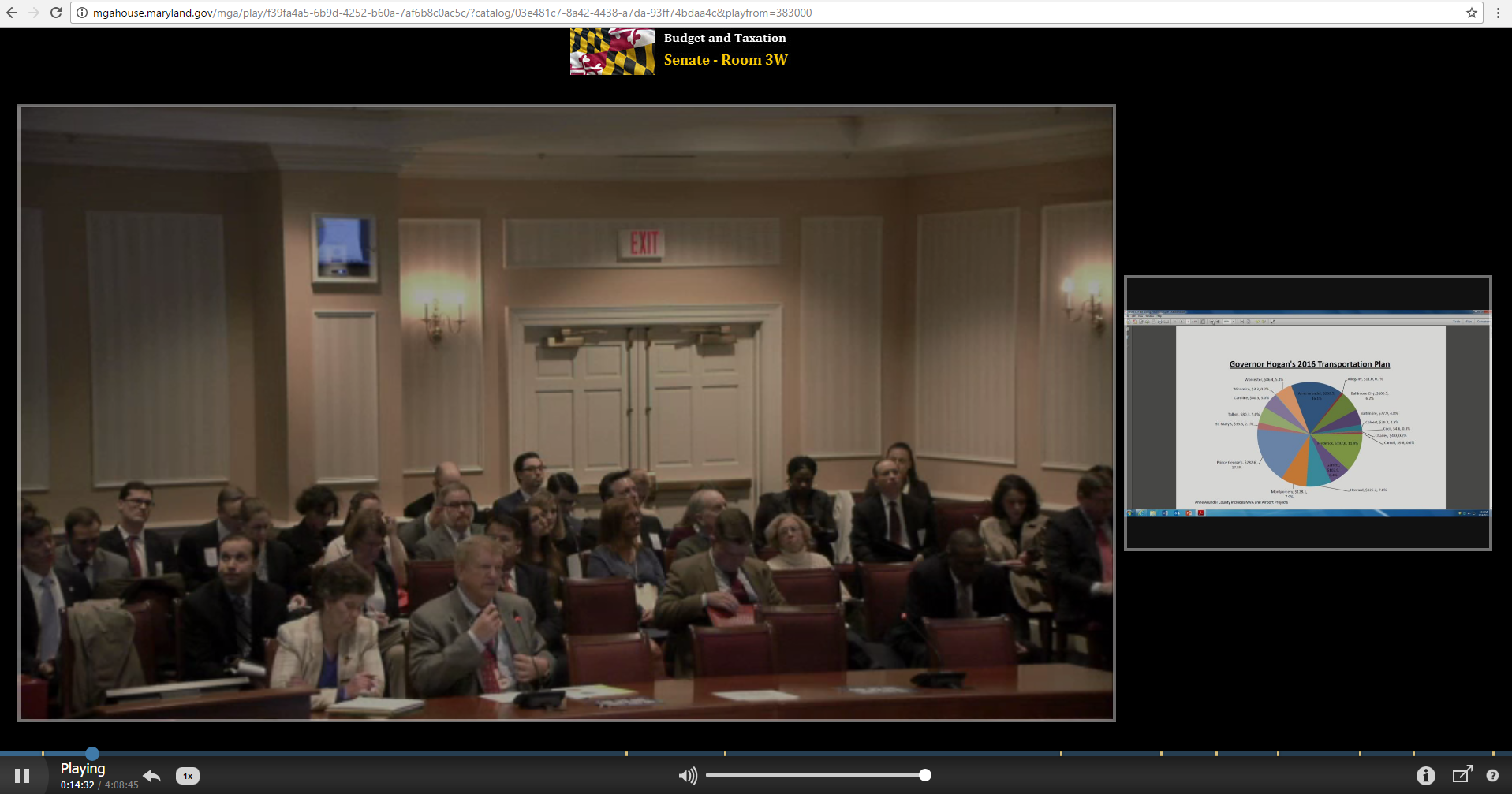
Even more incredibly, the Governor said in his press conference about the law that the General Assembly “rammed it through without hearings or any public input.”  You can see that in the video below at the -10:40 mark.

In fact, video of the hearings in both the Senate and the House are available on the General Assembly’s website.  Pete Rahn, the Governor’s Secretary of Transportation, attended both.  This is a pants-on-fire lie that no press outlet exposed.

rahn-testimony

Secretary of Transportation Pete Rahn testifying at the Senate hearing that Governor Hogan says never happened.

For a person who is known as not being a fan of Donald Trump, the Governor is remarkably quick to embrace his tactics: make stuff up, ignore the truth and bully anyone who disagrees.  Most of the press is letting him get away with it.

Will the Democrats?

Share

Larry Hogan’s Alternate Reality

By Adam Pagnucco.

Everyone knows that elected officials sometimes disagree on issues.  They may have differences of philosophy or values.  They may emphasize different sets of conflicting data.  They may prioritize one thing over another.  But how many of them actually make stuff up and use that as a basis for policy arguments?

One does.  His name is Larry Hogan.

The Governor’s target is a law passed by the General Assembly over his veto known as the Maryland Open Transportation Investment Decision Act of 2016.  The law was intended to open up the opaque process used by the Maryland Department of Transportation (MDOT) to decide which transportation projects to fund in the state’s capital budget.  The law requires MDOT to use a scoring procedure to evaluate future proposed major projects using measurements of safety and security, system preservation, quality of service, environmental stewardship, community vitality, economic prosperity, equitable access, cost effectiveness and local jurisdiction priorities.  The score of each project included in MDOT’s capital budget would be released publicly.  But the law makes clear that the scores themselves would not determine a project’s fate.  MDOT would have the final say over which ones get funded.  The law says explicitly that “the Department may include in the Consolidated Transportation Program a major capital transportation project with a lower score over a major capital transportation project with a higher score if it provides in writing a rational basis for the decision.”  The law also says, “Nothing in this Act may be construed to prohibit or prevent the funding of the capital transportation priorities in each jurisdiction.”

Sounds harmless, yeah?  Not to Governor Hogan.  He is calling the law “the Road Kill Bill” and has released a huge list of transportation projects it would allegedly cancel.  The Governor said in a public statement that the law was a “disastrous bill which will absolutely be responsible for the elimination of nearly all of the most important transportation priorities in every single jurisdiction all across the state… It will wreak havoc on the entire state transportation system and usurp important authority away from local governments and away from the executive branch of state government, giving authority instead to lobbyists and special interest groups.”  He has launched a fierce social media campaign to repeal it.

And yet the plain language of the law itself would not kill any transportation projects.  Not a single one.

Think that’s bad enough?  It’s even worse.  One of the projects the Governor says the law would kill is the Watkins Mill/I-270 interchange in Gaithersburg.  This is a top priority for MoCo’s state legislators and was a significant reason for their support of a 2013 transportation funding increase.  And yet the Hogan administration indefinitely postponed it and later mulled cutting exit ramps to save money.  Only after the MoCo delegation introduced legislation to mandate funding the project did MDOT relent and reluctantly put it back on track.  And now the Governor is falsely blaming the transportation scoring law for killing a project that his own administration tried to kill!

Folks, what we have here is not a failure to communicate.  It is a failure to live in reality.  The Governor’s attacks on this law are contradicted by the plain language of the law itself.  It does not kill ANY projects.  In fact, it explicitly preserves MDOT’s ability to decide which projects get funded.  This dispute is not about killing projects at all.  What it’s really about is that the Governor can’t stand any law that subjects his decisions to public scrutiny.  And this concept is so alien to him that he is willing to make false statements in public about what the law actually does.  This is not a matter of right vs left or Democrats vs Republicans.  It’s a matter of making stuff up to justify what you want.

Now what other soon-to-be GOP officeholder does this remind you of?

Share

MoCo Democrats, It’s Time for Change

By Adam Pagnucco.

December 13 will be an important date for the fortunes of Democrats across the State of Maryland.  It’s not because that is the date of a primary election; that won’t happen for another year and a half.  It’s not because a critical piece of legislation will be passing; the General Assembly won’t be in session.  And it won’t be because Donald Trump will decide that being President isn’t worth it (although one can dream).

December 13 is the day on which the Montgomery County Democratic Central Committee (MCDCC) will select its new officers.  And it comes at a critical time for county Democrats, as well as party members all over the state.

When MCDCC is acknowledged by the general public at all, it is usually because of its power under the state’s constitution to fill state legislative vacancies.  But the Central Committee does far more than that.  Its principal purposes are to build the party, support Democratic candidates and turn out its members to vote.  Every four years, the county party raises more than $200,000 for state and local elections and more than $700,000 for federal elections.  Major uses of funds include voter registration, production of the party’s sample ballot, coordinated campaigning with Democratic candidates in general elections and overhead associated with the party’s office in Kensington.

MoCo’s Democratic Party has played a fabled role in state politics for many years.  It is by far the wealthiest local party organization in the state.  It draws on hundreds of precinct officials and other activists for volunteer activities.  It has delivered hundreds of thousands of votes to statewide candidates like former Governors William Donald Schaefer, Parris Glendening and Martin O’Malley, none of whom represented MoCo in their prior positions.  The party’s influence has been so extensive that statewide Democratic nominees could offset their losses in Western Maryland and the Eastern Shore by racking up votes in MoCo, thereby leaving the Baltimore suburbs as the battle ground in which most races are decided.

But those halcyon days are coming to an end.  The MoCo Democratic Party is in trouble, and that means the state Democratic Party is also in trouble.  Consider the following.

Turnout of MoCo Democrats Has Plummeted in Gubernatorial General Elections

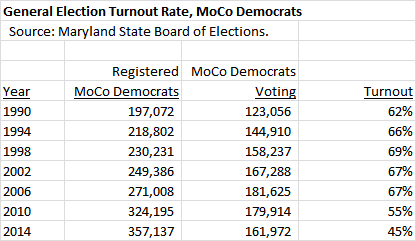
In recent years, federal Democratic candidates almost always win across Maryland in presidential elections outside of the GOP-packed First Congressional District.  The real purpose of the party apparatus is to win the races for Governor.  From 1990 through 2006, MoCo played an outsize role in Democratic gubernatorial victories.  Turnout rates among MoCo Democrats varied from 62% to 69% and, aside from Robert Ehrlich’s win in 2002, contributed heavily to Democratic victories.  But turnout among MoCo Democrats fell to 55% in 2010 and 45% in 2014.  Part of that was due to soaring voter registrations during the Obama years.  But the absolute number of MoCo Democrats who voted declined by nearly 20,000 between 2006 and 2014.  Simply put, the county party has lost its ability to turn out its members for gubernatorial general elections.

moco-turnout-gub-generals

MoCo Democrats Contribute Fewer Votes to Statewide Races

From 1990 through 2006, roughly 10% of all votes in gubernatorial general elections came from MoCo Democrats.  This was a major factor in wins by Schaefer, Glendening and O’Malley.  But MoCo Democrats accounted for 9.6% of total votes in 2010 and 9.3% in 2014, the lowest percentages in decades.  Let’s put it another way.  Between 2006 and 2014, the total number of votes in gubernatorial elections decreased by 60,928.  The number of votes cast by MoCo Democrats declined by 19,653.  That means MoCo Democrats accounted for nearly one-third of all voter losses statewide over two cycles.

moco-democrats-share-of-gub

Finally, consider this.  Larry Hogan won the Governor’s race in 2014 by 65,510 votes.  If the turnout rate among MoCo Democrats in 2014 was the same as it was in 2006, they would have cast an additional 77,375 votes.  The decline of the MoCo Democratic Party played a huge role in putting Larry Hogan into Government House.

Why is this happening?  Let’s recall that 2006 was a recent peak of party performance and two massive changes in campaigning have happened since: the rise of political email and the rise of political social media.  Those two things contributed mightily to the success of Barack Obama.  State and local candidates across Maryland use them aggressively.  But not MCDCC.  The party’s Facebook page is devoid of interesting content and has just over 1,000 likes in a county that has nearly 400,000 registered Democrats.  Its email program is practically non-existent.  The party does almost nothing to promote the successes of Democratic elected officials and makes no case against the state’s GOP Governor, who has a 66% job approval rating in MoCo.  Even the party’s clunky sample ballot, a vestige of a time when paper was the primary means of political communication, was only mailed out this year to newly registered Democrats when it was once mailed out to all.

MCDCC desperately needs new, aggressive and modern leadership.  It needs leaders who understand how to campaign in the 21st Century.  It needs leaders who are committed to reaching out to people of color and immigrants who disproportionately do not vote in gubernatorial general elections.  It needs a new culture of innovation, a culture which values trying new things over and over until some of them actually work.

MoCo Democrats, it’s time for change.

Will we get it?

Share

The Growing Popularity of Special Elections

By Adam Pagnucco.

With an appointment for the District 20 Senate seat approaching, the time is right to revisit the issue of whether to have special elections for General Assembly vacancies.  David Lublin and I have been writing about this for nearly a decade, but the issue will not die.

Under the state’s constitution, when vacancies occur for State Senate and Delegate seats, special elections are not held to fill them.  Instead, the county Central Committee of the same party as the seat’s former occupant must submit a name of a successor to the Governor within thirty days, after which the Governor appoints the new legislator.  If the Central Committee does not meet the thirty day timeline, the Governor has fifteen days to appoint a successor from the same party as the person formerly holding the seat.  If the legislative district covers more than one county, each county Central Committee can send a name with the Governor deciding between them if they differ.  The bottom line of the process is this: under most circumstances, the county party Central Committees, who themselves are elected in party primaries, have effective appointment power over these vacancies.  And they use that power frequently.

A growing body of evidence shows that Maryland voters prefer special elections over appointments to fill vacancies in elected office.  Consider the following:

  1. In 1998, Montgomery County voters approved a charter amendment providing for special elections for County Council vacancies with 90% of the vote. Montgomery was the second county in Maryland to have special elections for Council Members since Prince George’s already had them in its charter.
  1. In 2004, Howard County voters approved a charter amendment providing for special elections for County Council vacancies with 88% of the vote.
  1. In 2014, Maryland voters approved a statewide constitutional amendment providing for special elections for County Executive vacancies with 81% of the vote. The amendment did not require special elections, but it did allow county charters to be amended to allow them upon approval by voters.
  1. In 2016, Maryland voters approved another statewide constitutional amendment mandating special elections for Comptroller and Attorney General vacancies. Prior to the amendment, vacancies in those offices were filled by gubernatorial appointment.  Seventy-three percent of voters supported it.
  1. Also in 2016, voters in Montgomery and Wicomico Counties voted in favor of charter amendments allowing special elections for their County Executives, which were made possible by the 2014 state constitutional amendment. The charter amendments received 90% of the votes in Montgomery and 75% in Wicomico.  Wicomico voters also supported a charter amendment for County Council vacancies with 77% of the vote.

With such overwhelming support among voters for special elections, why aren’t they used for state legislator vacancies?  Some lawmakers, including Senators Rich Madaleno, Jamie Raskin and Brian Feldman and Delegates David Moon and Christian Miele (a Republican), have tried to pass constitutional amendments providing for them in various forms.  Moon’s 2015 bill had bi-partisan support from very progressive as well as very conservative legislators.  But officials from both parties always oppose these bills because they strip power from Central Committees and they teamed up to help kill Moon’s bill last year.

Most of the time, appointees serve about as well in the state legislature as those who are elected, but there are exceptions.  A glaring example is the District 24 (Prince George’s) appointment in 2013.  Incumbent Delegate Tiffany Alston was removed from office and the Prince George’s County Democratic Central Committee recommended Gregory A. Hall to replace her.  But Governor O’Malley refused to accept the appointment because Hall participated in a shooting incident resulting in a murder years ago.  O’Malley instead appointed former Delegate Darren Swain to the seat.  A year later, Swain was victimized in a bizarre beating and car-jacking in which his assailants accused him of using drugs with them and groping one of them.  Alston, Hall and Swain all ran against each other for Delegate in 2014 and all of them lost.

This issue might not be such a big deal if appointments were rare, but they happen all the time.  Ten of MoCo’s 32 state legislators – four Senators and six Delegates – were appointed to a seat at some point in their careers.  That number will go up to eleven or twelve depending on what happens in District 20.  Let’s be clear.  We do not intend to imply that these appointed lawmakers are bad elected officials.  In fact, some of them have turned out to be excellent.  But when voters don’t get to pick more than one third of the people who represent them, something has gone badly wrong.

Gerrymandering is often criticized because it allows politicians to pick their voters.  Legislative appointments might be even worse because they allow politicians to pick other politicians.  And the power structures of both parties endorse this even though gigantic majorities of their rank-and-file oppose it.  The survival of special elections after all these years prompts us to ask a question of all state policy-makers.

What’s more important?  The prerogatives of party officials?  Or the rights of the voters?

Share

Meet the New Liquor Monopoly

By Adam Pagnucco.  

Meet the New Liquor Monopoly.  It’s the same as the Old Liquor Monopoly, except with less accountability.

OK, now that the applause is dying down, let’s look at the details.  The New Liquor Monopoly proposed by County Executive Ike Leggett would be a quasi-governmental authority rather than a county department.  It would have the same warehouse, the same equipment, the same trucks, the same ordering and billing systems, the same employees, the same front-line and middle management, the same union and – of course! – the same state-sanctioned monopoly status.  This is “change” that only a monopoly would love!

But wait.  There is one significant difference.  Under the current system, the Executive Director of the Department of Liquor Control (DLC) is a department director who serves at the pleasure of the County Executive.  Should the Executive become displeased with his or her performance, that person could be dismissed.  The County Council has a role (at least hypothetically) in holding DLC accountable through its power to approve DLC’s operating and capital budgets as well as any debt secured by liquor profits.

Those sources of accountability disappear in the New Monopoly.  The proposed authority would be governed by a Board, which would be nominated by the Executive and approved by the County Council, and that Board would hire a CEO.  The CEO would not report to the Executive.  The council would no longer have approval authority over the New Monopoly’s operating or capital budgets.  The New Monopoly would also have unfettered authority to issue debt.  Here’s a question, folks – what do you think will happen to liquor prices if the New Monopoly screws up and takes on too much debt?  Pish posh – it’s not like the existing Monopoly has ever screwed up, yeah?

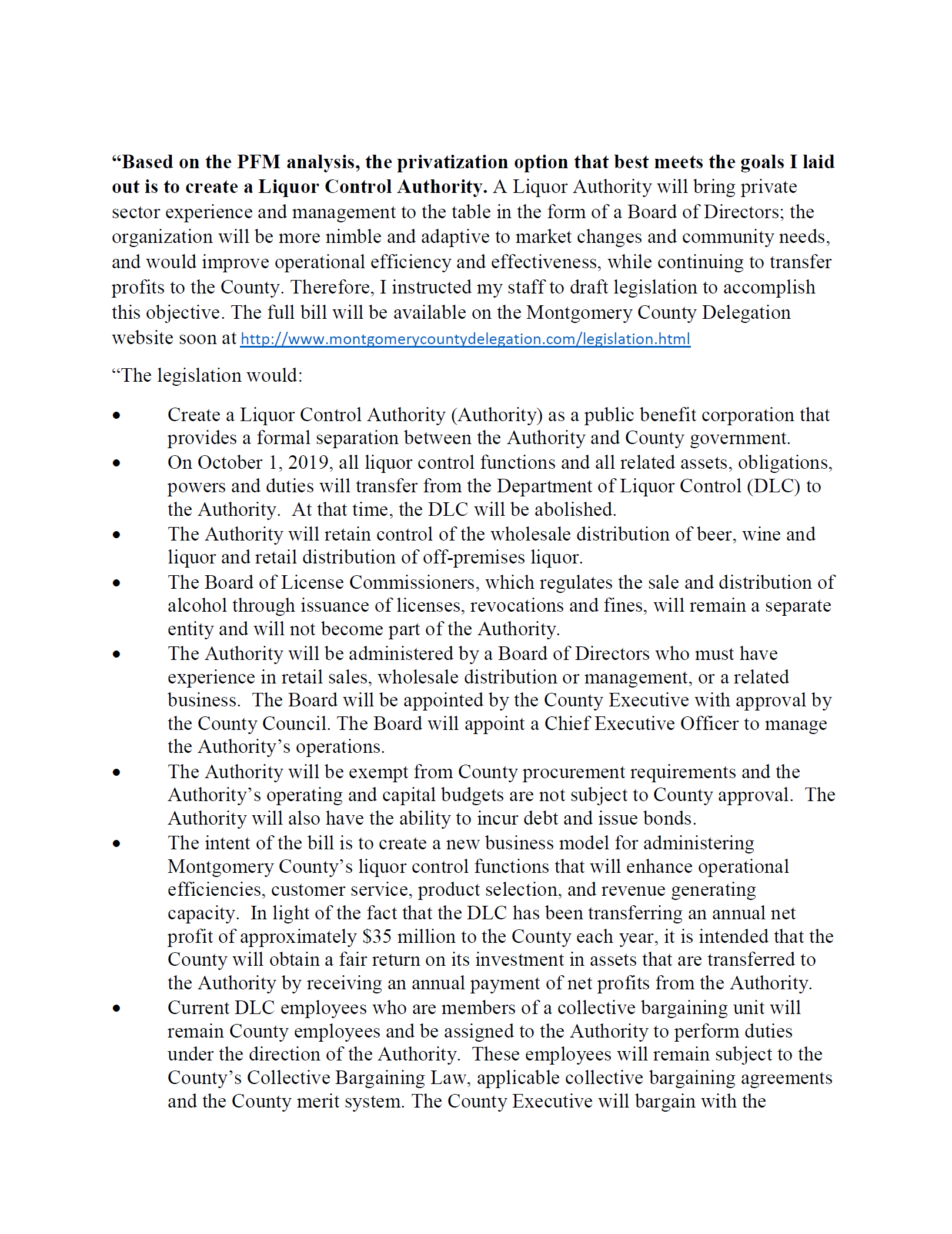
We know you can barely contain your excitement.  Here is the County Executive’s statement so you can absorb all the dirty details!

exec-statement-1

exec-statement-2exec-statement-3At first glance, the New Monopoly is little different from the Old Monopoly.  From top to bottom, it is the same entity in terms of capital, labor and processes.  But this new beast could be much more dangerous than the old one.  It is neither accountable to its customers nor to elected officials.  In fact, it is accountable to no one at all.
Folks, it’s time for brutal honesty: our county government has failed us.  The liquor monopoly’s problems have been apparent since the first year of the current County Executive’s first term.  For nine long years, the county did nothing as the monopoly continued to get worse, culminating in the epic 2015 New Year’s Eve disaster.  Thousands of consumers and licensees signed a petition to End the Monopoly and residents even voted for term limits in part due to fury over DLC.  And what do we get?  A proposal for Endless, Unaccountable Monopoly.

We, the residents and business owners of this county, have not been heard.  Our demands for freedom have been subjugated to the crushing burden of alcohol totalitarianism.  There is only one thing left to do.

Vote for candidates who will End the Monopoly in the next election.

Share

MoCo Revolts

By Adam Pagnucco.

In a thundering rebuke to Montgomery County’s governing establishment, voters have passed term limits by a 38 point margin with early votes and election day votes counted.  Folks, let’s call this what it is.

A Revolt.

This year will see one of the largest electorates in Montgomery County history.  While the absolute number of voters may be declining in our mid-term elections, it has been steadily rising in presidential general elections.  County residents voted overwhelmingly for Hillary Clinton over Donald Trump (by 54 points as of this writing).  But they also voted for term limits despite the fact that most county voters are Democrats and all county elected officials are Democrats.  This year was reminiscent of the 2008 general election, during which MoCo voted for Barack Obama by 45 points but also approved Robin Ficker’s charter amendment restricting property tax hikes by just 5,060 votes.  This demonstrates the capacity of county voters to keep national issues and local issues separate when they so desire.  The big difference between 2008 and now is that the margin of term limits’ passage was so titanic that it’s possible that half of all Democrats voted for it.

The scale of this upheaval is virtually unprecedented.  Sure, County Council incumbents have been defeated here and there and a sitting County Executive was beaten in 1990.  But the voters voted against all the incumbents this year, or at least put an expiration date on their services.  To find something comparable, you would have to go back to 1962, when five of seven Council Members were ejected, and 1966, when six Council Members were defeated.

Former County Council Member Steve Silverman astutely characterized term limits supporters as “a convergence of strange bed-fellows.”  County employees upset about reduced raises, business people unhappy about what they see as an unfriendly business climate, residents opposed to new master plans with more density, Republicans and unaffiliated voters angry about being marginalized, opponents of the county’s liquor monopoly, people upset about the recent Giant Tax Hike and nanny state laws, and those who genuinely regard term limits as facilitating good government came together as they never have before.  As David Lublin wrote, these groups may have had incompatible visions of what county government should be, but all of them believed the way to get there was to get rid of the incumbents.

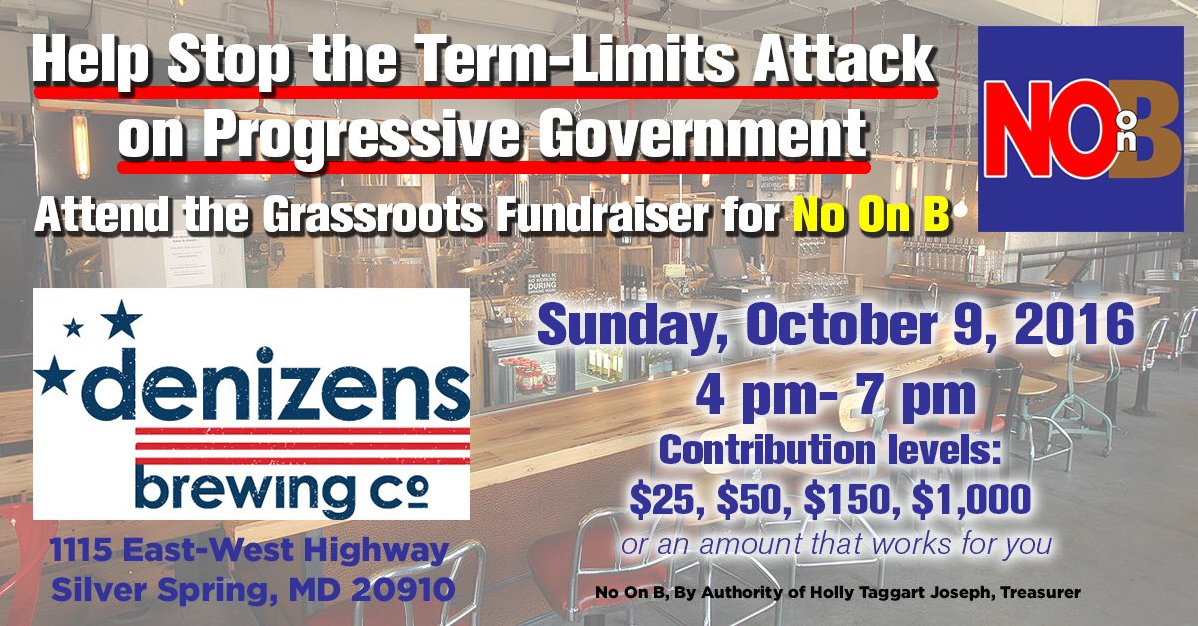
Term limits opponents made two primary arguments.  First, they described term limits as “an attack on progressive government.”  This had the effect of making the term limits question a referendum on current county elected officials, a perspective actually shared by many supporters.

term-limits-opposition-fundraiser

And second, they tried to make term limits toxic by emphasizing their support by figures like Donald Trump, Robin Ficker and Help Save Maryland.

term-limits-trump-ficker

That strategy didn’t work for two reasons: the opponents were vastly under-funded as they were going uphill and the message itself was not calibrated for a general electorate that is less liberal than Democratic primary voters.  Social media proved to be the weapon of choice for both sides, and in terms of Facebook likes, supporters outgunned opponents by a ratio of 13-1.  Opponents were counting on the Democratic sample ballot and the Apple Ballot, both opposing term limits, to win.  But whereas the sample ballot is often mailed to all county Democrats, this time around it was mailed only to those who had newly registered.  And the teachers union did not supplement its Apple Ballot poll coverage with multiple mass mailings as they do in mid-term years.  Accordingly, the impact of both ballots was blunted.  Opposition organizer Tom Moore made a valiant effort, but this was an unwinnable campaign from the start.

To be fully understood, this year’s vote must be put into the context of recent history.  Since 2008, county voters have decided four major ballot questions and each time they took what was arguably the less progressive position.  Put those four votes together and here is the message from the voters:

We don’t want more property taxes.  We don’t want more government fees.  We don’t want a labor union running the police department.  And even though most of us are Democrats, we are telling the Democrats who run the county government that twelve years in office is long enough.

This is pretty much the opposite of the long-standing posture of the county’s political establishment.  And it’s not just coming from flakes, fanatics and fringe types like Robin Ficker and Help Save Maryland – it’s coming from a majority of county voters.  If there was ever a moment for the governing class to do some soul searching, this is it.

Opponents of term limits may be right about one thing – they may change the names of elected officials, but not the type of them.  Democrats, often very liberal ones, will continue to be elected because of our closed primary system.  But the combined message of the last four ballot questions imposes a hard choice on the elected officials of today and tomorrow.  They can try to balance the interests of various constituencies across the political spectrum at the possible cost of losing the progressive support that influences Democratic primaries.  Or they can stay the course and watch more moderate general election voters pass even more restrictive ballot questions, including perhaps the ultimate bane of progressivism – a hard tax cap.

Share

MoCo Solicits for Liquor Monopoly Propaganda Video

By Adam Pagnucco.

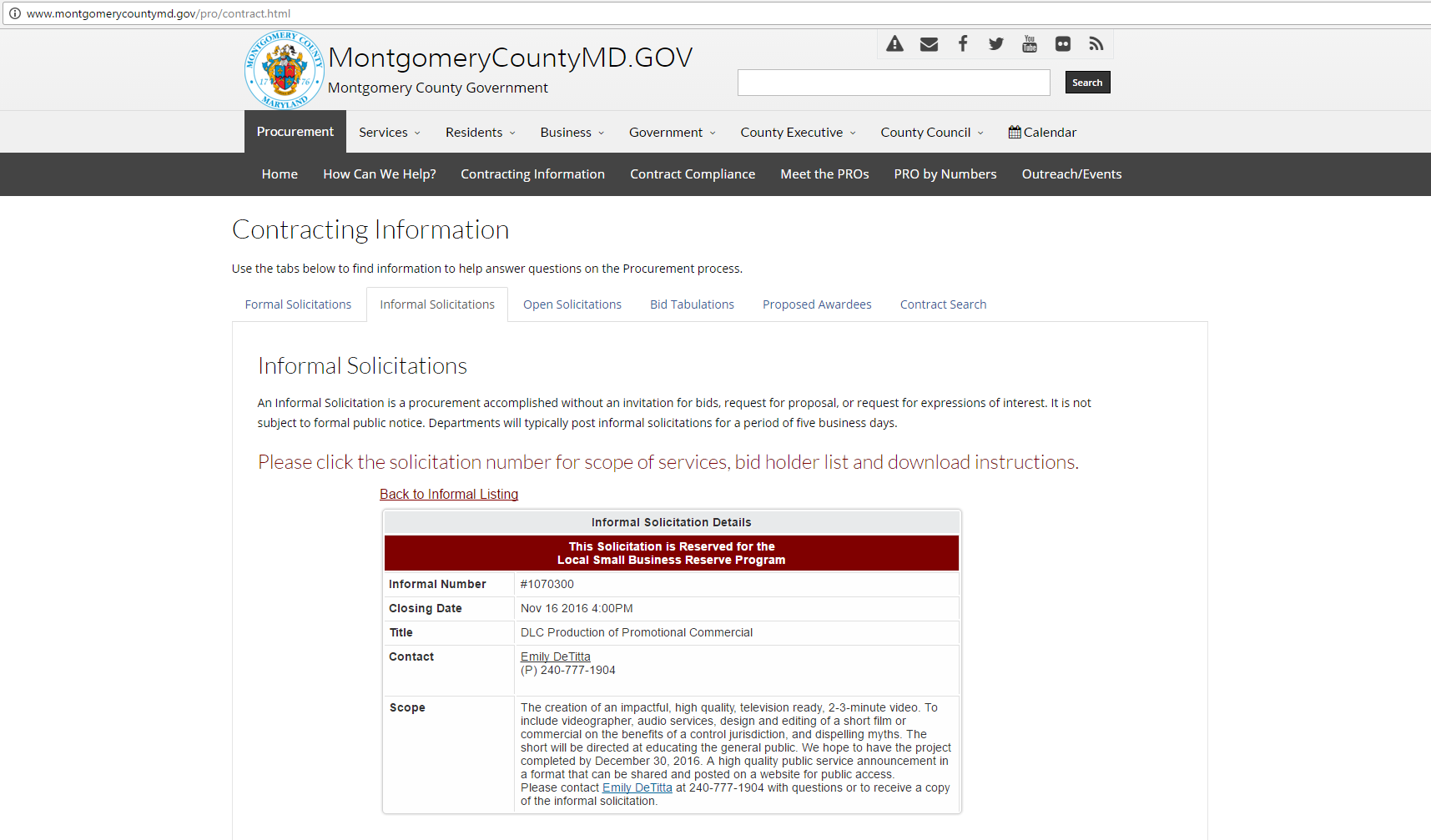
The Montgomery County Government has issued a solicitation seeking bids on a propaganda video defending the county’s liquor monopoly.  The solicitation comes after the County Executive’s task force on the issue concluded its meetings with (so far) no apparent resolution.

The informal solicitation, captured in a screenshot from the county’s website below, invites companies in the county’s Local Small Business Reserve Program to bid on an opportunity to create a video about the Department of Liquor Control (DLC).  The solicitation describes the project scope as, “The creation of an impactful, high quality, television ready, 2-3-minute video. To include videographer, audio services, design and editing of a short film or commercial on the benefits of a control jurisdiction, and dispelling myths. The short will be directed at educating the general public. We hope to have the project completed by December 30, 2016. A high quality public service announcement in a format that can be shared and posted on a website for public access.”

video-solicitation

This is not the first time the county has used public resources to spread political propaganda supporting the liquor monopoly.  Last January, the county distributed flyers defending DLC at county liquor stores while the county’s state legislators were debating its fate.  The flyer distribution ended shortly after it was exposed by Fox 5.

The cost of the video will not be known until a bid is accepted, although the solicitation’s fine print states that it cannot exceed $25,000.  The cost of distribution could be much more, especially if the county runs the video as an ad on private television channels.

All of this comes after the county’s state legislators, who have purview over DLC since it is established in state law, asked the County Executive last year to consider various models of liberalizing the liquor monopoly.  The Executive agreed and convened a task force to study various options, but the task force’s three meetings ended without a visible result.

With this solicitation, the county appears to be digging in to defend the monopoly despite its massive failures and the protests of thousands of residents against it.  The liquor monopoly is one of several reasons why MoCo residents voted for term limits and yet the county is staying the course.

Will they ever learn?

Share

MoCo’s Two Electorates, Part Three

By Adam Pagnucco.

Part Two presented a host of demographic data comparing Democrats who voted in all three of the 2006, 2010 and 2014 primaries (“Super Dems”) to voters from all parties who voted in both of the 2008 and 2012 general elections (“Super Generals.”)  Let’s compare the two groups more concisely below.

In summary, when compared to Super Dems, Super Generals are more likely to:

  1. Be age 29 or younger.
  2. Be ages 30-39.
  3. Live in Clarksburg.
  4. Live in Damascus.
  5. Live in Germantown.
  6. Live in Council District 2.
  7. Live in Legislative District 39.
  8. Live in precincts that are 25% or more Asian.
  9. Live in Legislative District 15.
  10. Live in Montgomery Village.

When compared to Super Dems, Super Generals are less likely to:

  1. Be ages 70-79.
  2. Be age 80 or older.
  3. Live in Takoma Park.
  4. Live in Chevy Chase.
  5. Be ages 60-69.
  6. Live in Legislative District 20.
  7. Live in Bethesda.
  8. Live in Kensington.
  9. Live in Legislative District 18.
  10. Live in Council District 5.

The above items are ranked in order of likelihood.  So for example, the biggest difference between the two electorates is in age, but that is far from the only difference.

Super Dems are mostly from Downcounty, tend to be seniors or close to it, have a lot of voting history and may be majority liberal.  They elect MoCo’s county officials and state lawmakers, who tend to be responsive to them.  Super Generals are geographically diverse, younger in age, have less voting history and are much more diverse ideologically.  Liberals probably do not account for a majority of Super Generals.  It is the Super Generals, not the Super Dems, who decide charter amendments and ballot questions, including this year’s amendment on term limits.

Two more facts are relevant to Super Generals.

First, on the last three major county ballot questions, the general electorate voted in favor of stricter limits on property tax hikes, against the ambulance fee and against broad collective bargaining rights for the police union.  These were arguably the less progressive positions on all three questions.  If these questions were submitted only to Democratic primary voters, they may all have had different outcomes.

Second, a Washington Post poll in September found that MoCo voters from all parties together gave Governor Larry Hogan a 66% job approval rating.  This was not significantly different from the Governor’s statewide approval rating of 71%.  It’s hard to imagine a majority progressive electorate approving of an anti-tax GOP Governor to that extent, but this is further evidence that liberals may not in fact be a majority of MoCo voters.

Term limits is the issue of the day and will be decided soon enough.  But a broader question looms.  Given the differences between MoCo’s Two Electorates, what happens when elected officials cater to one of them at the heavy expense of the other?  The recent large property tax hike, which was spread all across county government, was aimed at the priorities of liberal Democratic voters.  It also became the core of the push for term limits which is aimed at the general electorate.  This suggests a need for balance and restraint by those running the government.  Because if one of the two electorates feels unheeded, either one has the tools to strike back – either by unseating incumbents or by shackling them with more ballot questions and charter amendments.

Share