Category Archives: Adam Pagnucco

Elrich Sends Budget Letter to the Council

By Adam Pagnucco.

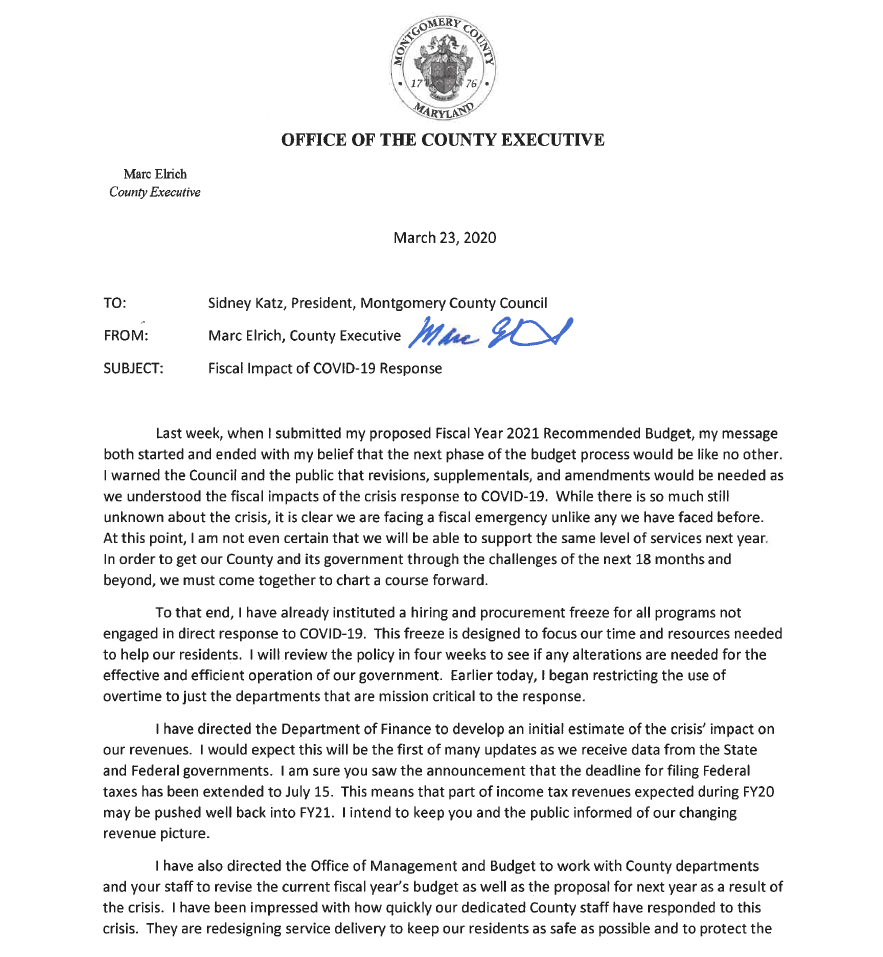
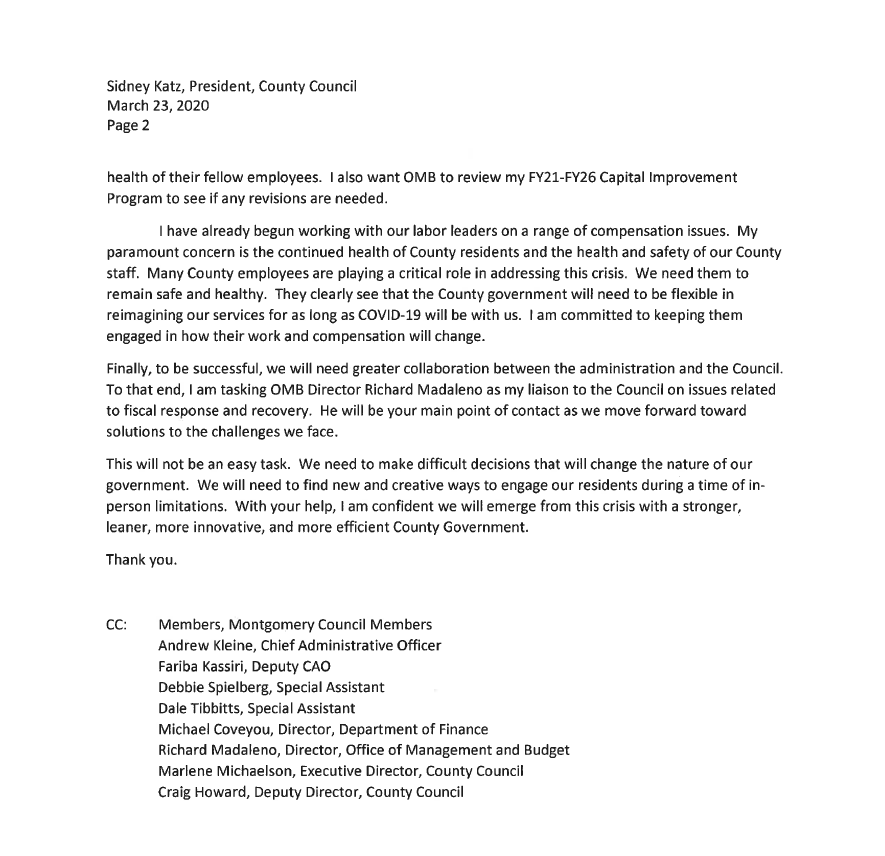
Facing severe crises to public health, the county’s economy and its budget, County Executive Marc Elrich sent the letter below to the county council about the budget.  The main takeaways are:

1. The executive has instituted freezes on hiring and procurement for functions not related to COVID-19 response.  Overtime has also been restricted to COVID-19 response departments.

2. The finance department has begun estimating the crisis’s impact on county revenues.

3. The executive has begun talking to the county’s unions about “a range of compensation issues.”  No further details were provided.

4. Office of Management and Budget Director Rich Madaleno has been designated as the liaison to the council on “issues related to fiscal response and recovery.”  When Madaleno was a State Senator, he was a key player in working on the state’s budget problems during the Great Recession.  Few people in Maryland understand the state budget better than Madaleno.

We reprint Elrich’s letter below.  Bethesda Beat has reactions from some members of the county council.

Share

Liquor Monopoly Ends Takeout Cocktail Ban

By Adam Pagnucco.

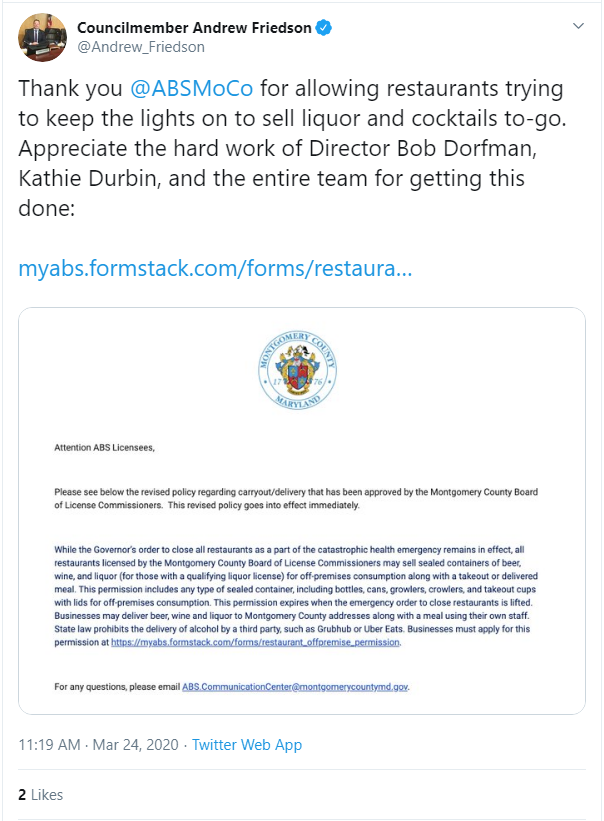
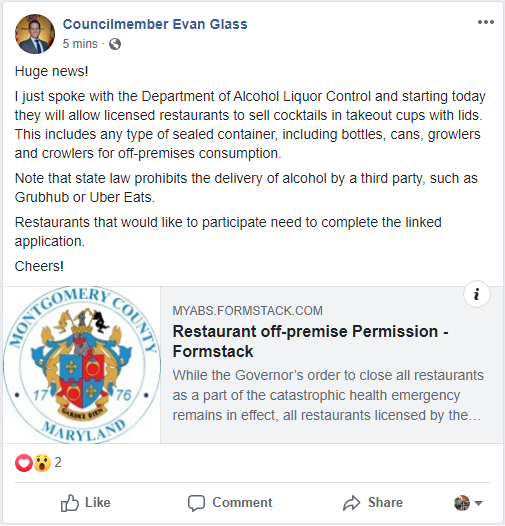
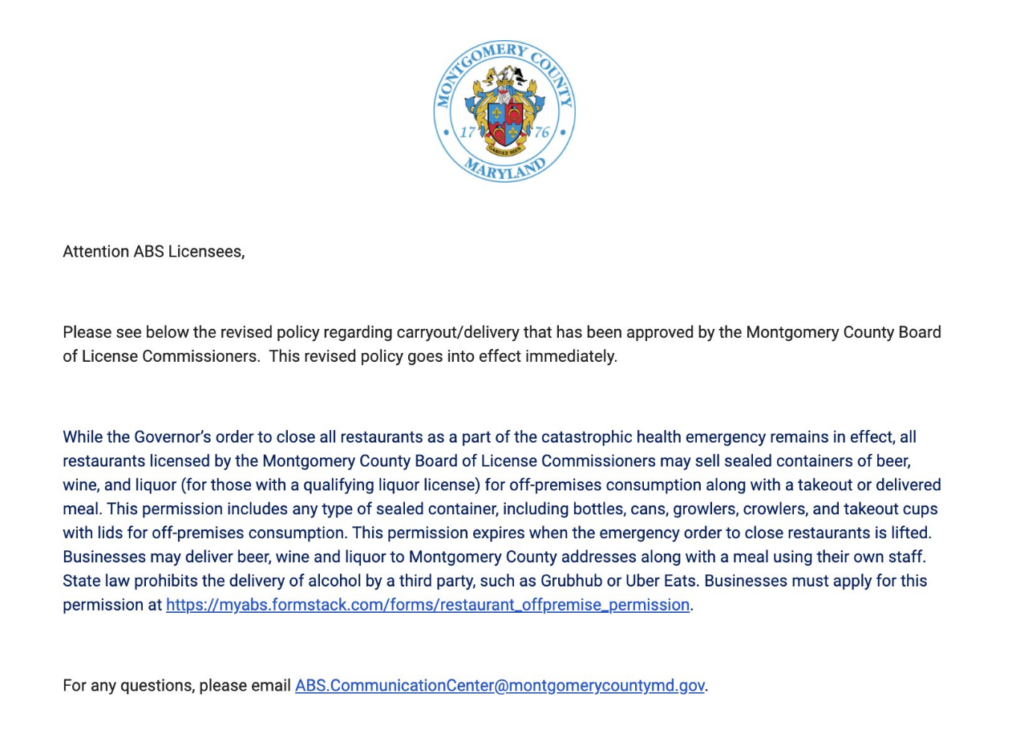
Council Members Andrew Friedson and Evan Glass have announced that the liquor monopoly has ended its ban on takeout cocktails.

Friedson announced the news on Twitter.

Glass announced it on Facebook.

The official announcement from Alcohol Beverage Services appears below.

And here is a link to the application form for licensees.

Thank you to Council Members Friedson and Glass, Comptroller Peter Franchot and everyone else who worked to turn this around!

Share

Franchot Blasts Liquor Monopoly

By Adam Pagnucco.

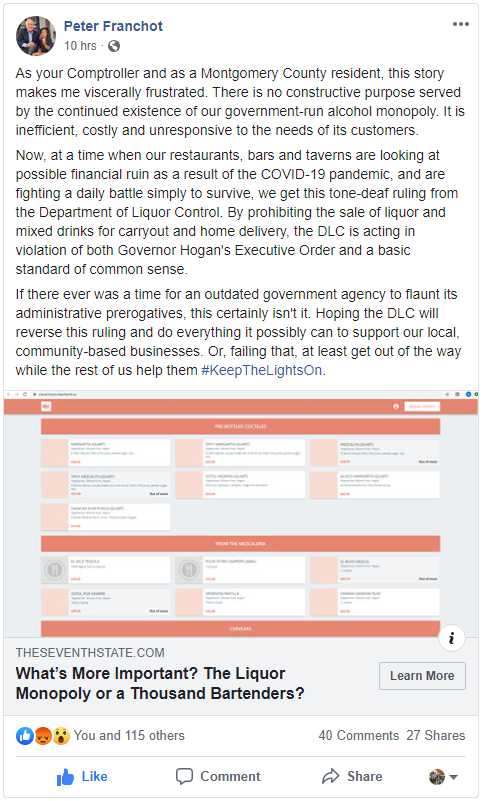
After reading our post on the county liquor monopoly’s takeout cocktail ban, Comptroller Peter Franchot has come out swinging against the monopoly.  The Comptroller wrote on his Facebook page:

As your Comptroller and as a Montgomery County resident, this story makes me viscerally frustrated. There is no constructive purpose served by the continued existence of our government-run alcohol monopoly. It is inefficient, costly and unresponsive to the needs of its customers.

Now, at a time when our restaurants, bars and taverns are looking at possible financial ruin as a result of the COVID-19 pandemic, and are fighting a daily battle simply to survive, we get this tone-deaf ruling from the Department of Liquor Control. By prohibiting the sale of liquor and mixed drinks for carryout and home delivery, the DLC is acting in violation of both Governor Hogan’s Executive Order and a basic standard of common sense.

If there ever was a time for an outdated government agency to flaunt its administrative prerogatives, this certainly isn’t it. Hoping the DLC will reverse this ruling and do everything it possibly can to support our local, community-based businesses. Or, failing that, at least get out of the way while the rest of us help them #KeepTheLightsOn.

Franchot even took out a Facebook ad for this post.  At the moment, his post has 116 reactions, 40 comments and – most critically – 27 shares.  The original blog post has been shared countless more times across Facebook.

With outrage growing against the monopoly, it must lift the ban or face a renewed push to abolish it.

What will it do?

Share

What’s More Important? The Liquor Monopoly or a Thousand Bartenders?

By Adam Pagnucco.

Battered by shutdowns of dine-in service, restaurants across Maryland and beyond are taking a severe beating.  As a measure of modest compensation, Governor Larry Hogan has allowed restaurants and bars to engage in something unprecedented: takeout and delivery service of alcohol.  That partly applies in MoCo too, but there is a holdup.

The county liquor monopoly.

The monopoly has approved takeout and delivery of beer and wine but not of cocktails and other spirits-related products.  Meanwhile, California, New York, Florida, Colorado, Vermont, Iowa and the District of Columbia allow takeout and/or delivery of cocktails, although they often require them to be offered in sealed containers and only with food.  Governor Hogan’s executive order allows takeout and delivery of spirits too but that is subject to additional restrictions imposed by local jurisdictions.  The City of Baltimore has chosen to allow takeout and delivery of cocktails.  MoCo has not.  Its grant of takeout and delivery authority explicitly says, “This permission does not include liquor.”

Nepenthe Brewing Company in Baltimore advertises takeout cocktails.

The liquor monopoly enjoys a retail monopoly on spirits sales and jealously protects it.  For example, after the General Assembly passed a law three years ago allowing the monopoly to contract with private stores to sell spirits, the monopoly simply refused to enter into any such contracts.  Loosening its retail spirits sales monopoly might damage its profits, which are the only reason it continues to exist.  (Profits are no problem at the moment as the monopoly’s business is booming while folks are stocking up.)

The issue matters because it affects the employment of a key category of personnel in the restaurant industry: bartenders.  Data from the U.S. Bureau of Labor Statistics indicates that MoCo and Frederick establishments together employed 1,410 bartenders in 2017, so at least 1,000 of them work in MoCo owing to the comparative size of the counties.  The two counties employed an additional 2,680 people classified as “dining room and cafeteria attendants and bartender helpers.”  When takeout and delivery is restricted to beer and wine, bartenders are not needed because anyone can handle bottles and cans.  But when spirits beverages are allowed, bartenders are necessary.

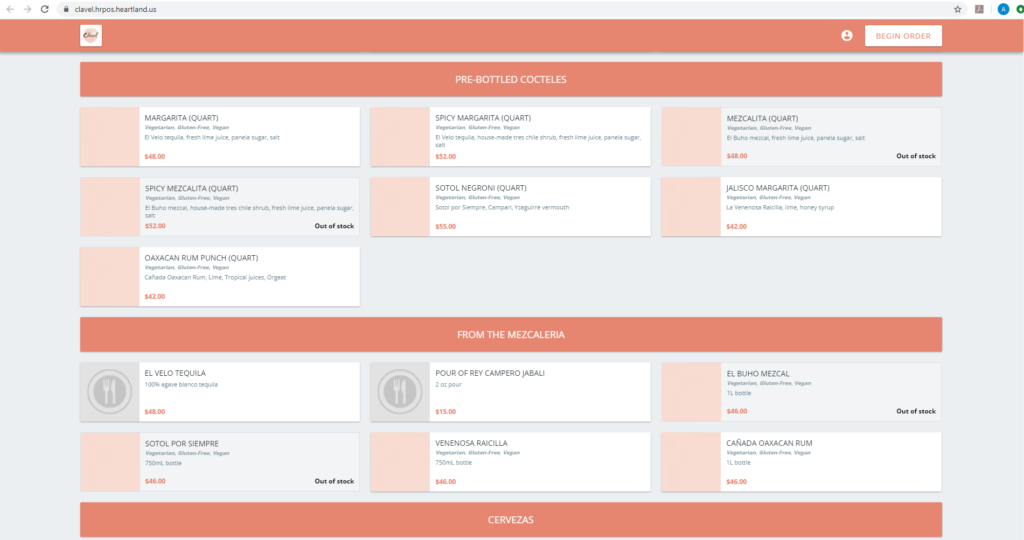
Clavel Mezcaleria – Taqueria in Baltimore has an online menu of pre-bottled cocktails.

One restaurant owner who contacted me put MoCo’s cocktail ban in economic terms.  “Maryland allows it.  Montgomery County does not.  Baltimore can sell a margarita to go.  We cannot.  That’s my point. The DLC [liquor monopoly] restricts us again.  If they allowed it I could keep some of my staff employed instead of on the unemployment line.”

So what’s more important?  The continued employment of a thousand MoCo bartenders?  Or the liquor monopoly’s long-time retail spirits monopoly?  County officials, you decide.

Share

Navarro Claims Council Majority for Spending Restraint

By Adam Pagnucco.

Last night, Council Member Nancy Navarro, who chairs the council’s Government Operations Committee, wrote on my Facebook page that she intends to introduce a council resolution on Tuesday calling for major spending restraint in the county’s budget.  Specifically, the resolution calls for a same services budget for each department and agency; holding Montgomery College and MCPS to maintenance of effort (which is the state’s mandated minimum for local appropriations to those agencies); and providing flexibility to assist residents and businesses as well as to revisit spending after the coronavirus crisis ends.  Navarro claims that Council Members Andrew Friedson, Gabe Albornoz, Craig Rice and Hans Riemer are co-sponsoring her resolution.

It’s worth noting that Navarro is the only current council member who was on the council during the budget crisis of 2010.

The resolution does not yet appear on the council’s agenda for Tuesday, but the current text as shared by Navarro appears below.

SUBJECT:​ Options for the Approval of and Appropriation for the FY 2021 Operating Budget Background

1. ​As required by Section 303 of the County Charter, the County Executive sent to the County Council the FY 2021 Operating Budget on March 16, 2020.

2. ​As required by Section 304 of the County Charter, the Council must hold public hearings on the proposed operating budget.

3. ​A new coronavirus disease, called Covid-19, has spread extremely quickly, making its way to over 100 countries, including the United States.

4.​ On March 11, the World Health Organization officially declared the Covid-19 viral disease a pandemic.

5.​ The number of new cases in the United States is growing quickly and has spread to each of the 50 States, the District of Columbia, Puerto Rico, Guam and the US Virgin Islands.

6.​ To slow the spread of this communicable disease, Governor Hogan issued several emergency orders closing all non-essential businesses, restricting public transit, closing schools, prohibiting public gatherings of 10 persons or more, and postponing the Presidential Primary Election in Maryland.

7. ​Although County government operations are continuing during this pandemic, County employees are using situational teleworking wherever possible to perform their duties. Due to the need to limit person to person contact, many County residents have lost paychecks and many County businesses have lost revenue.

8. ​The Executive was required by the Charter to develop his recommended FY2021 Operating Budget before the most recent events clarified the full extent of the pandemic.

9. ​Considering this unprecedented global pandemic and national state of emergency, the Council must move expeditiously to provide continuity of operations in approving an operating budget for FY2021 that provides additional flexibility to help County residents and businesses recover.

Action​

The County Council for Montgomery County, Maryland approves the following resolution:

1. ​The Council directs staff to develop viable options to streamline our budget process, so that for FY 2021, the Council may adopt an aggregate operating budget for our departments and agencies that reflects a continuation of the services provided at the same level as FY2020.

2. ​These viable options must include funding the Operating Budgets of the County Board of Education and Montgomery College at the required Maintenance of Effort level and should avoid funding any new programs unrelated to relief for County residents and businesses from the Covid-19 viral disease pandemic.

3.​ These viable options should include flexibility for possible future appropriations:

a. ​to assist County residents and businesses to recover from the Covid-19 viral disease pandemic; and

b. ​to provide additional resources for other County programs and employee wage and benefit enhancements, if available, after the crisis is over.

This is a correct copy of Council action.

_________________________________

Selena Singleton

Clerk of the Council

Share

Hucker, Elrich Stop Takeout Tickets

By Adam Pagnucco.

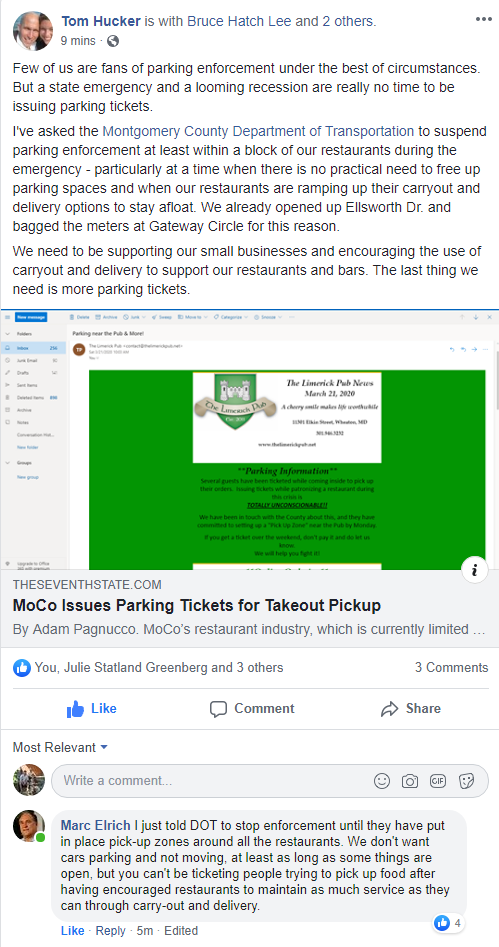
Within minutes of seeing our post on parking tickets being issued for restaurant takeout pickups, Council Member Tom Hucker asked county officials to stop the practice. When Hucker announced this on Facebook, County Executive Marc Elrich replied, “I just told DOT to stop enforcement until they have put in place pick-up zones around all the restaurants. We don’t want cars parking and not moving, at least as long as some things are open, but you can’t be ticketing people trying to pick up food after having encouraged restaurants to maintain as much service as they can through carry-out and delivery.”

All of this happened in less than an hour.

Elrich and Hucker deserve praise for acting with such speed.

Hucker’s Facebook post, along with Elrich’s comment, is reprinted below.

Share

MoCo Issues Parking Tickets for Takeout Pickup

By Adam Pagnucco.

MoCo’s restaurant industry, which is currently limited to takeout and delivery, is in crisis.  Many elected officials at both the state and county levels are asking constituents to patronize the county’s restaurants to keep them afloat.  And yet, one prominent restaurant – the Limerick Pub in Wheaton – is complaining that customers who have picked up takeout food from the pub have been issued parking tickets.

Can the elected officials and other county officials reading this get a handle on this issue?  Let’s all agree with Limerick that now is not the time for aggressive ticketing.

Limerick’s blast email to its customers is reprinted below.

Share

The County Budget is in Crisis. What Now?

By Adam Pagnucco.

After arguably the worst communications debacle in county government history, the Elrich administration is now belatedly defending its recommended FY21 operating budget.  But we are waaaaaaay past that now.  Whatever one thinks of Elrich’s budget, it is obsolete.

That’s because it is based on revenue projections from an economy that no longer exists.

Virtually everyone paying any attention understands that the economy is in ruins.  That’s not just true for MoCo; it’s true for the entire country and beyond.  J.P. Morgan is now projecting that the nation’s second-quarter gross domestic product could decline at an annualized rate of 5-10%.  In Maryland, unemployment claims are at nearly five times their regular levels.  Here in MoCo, tens of thousands of employees are now enduring cuts in work hours – if not outright layoffs – in the industries most affected by the “social distancing” used to combat the coronavirus.  Consider 2018 Montgomery County employment in the following industries from the U.S. Bureau of Labor Statistics.

Restaurants and other eating places: 29,647

Services to buildings and dwellings: 13,585

Personal and laundry services: 5,852

Child day care services: 4,854

Fitness and recreational sports centers: 4,005

Accommodation: 3,416

Performing arts and spectator sports: 1,469

Motion picture theaters: 494

Wage losses in these industries are certain to show up in reduced income tax receipts.  Because of the nature of these kinds of jobs, the affected workers will likely never recover that income.  All of this is going to profoundly hit the county budget.  And it is coming in the middle of the county’s budget process, which normally concludes in mid-May.

As Fred Sanford used to say, this is the big one!

We haven’t seen anything quite like the coronavirus pandemic in a century, but we have seen economic crises before.  The last one MoCo encountered happened a decade ago.  The Great Recession had been underway since 2008 but did not truly destroy the county’s budget until the spring of 2010.  As required by the county’s charter, then-County Executive Ike Leggett released his recommended FY11 budget on March 15.  Just ten days later, Leggett sent a memo to the county council explaining that circumstances had changed since his budget was transmitted.  Leggett wrote:

I am sending this memorandum to recommend that we jointly take additional actions to strengthen the County’s financial position in the current fiscal year and for FY11.

There is no perfect time to formulate a budget. Since I recommended my budget earlier this month, we have already received more bad news that points to additional fiscal deterioration. This includes a dramatic increase in the County’s unemployment rate from 5.2% to 6.2% and may signal further erosion of income tax revenue. In addition, Anne Arundel County’s bond rating was recently downgraded from a AA+ to a AA rating due to several factors including the deteriorating condition of Anne Arundel’s reserves. At the same time, the Department of Finance has been in discussions with the bond rating agencies relative to an upcoming bond sale and is concerned about feedback they have received from the rating agencies on our fiscal position.

At that time, Leggett recommended increasing the energy tax and transferring money from non-tax supported funds into the general fund, which is the county’s main vehicle for funding most governmental functions.

On April 5, Leggett followed with a second memo explaining that the county’s March income tax distribution had fallen significantly and that Moody’s had placed the county on a watch list for a potential bond rating downgrade.  Things were getting worse.  Leggett wrote that he “asked the OMB and Finance Directors to meet with the department heads of all large County Government departments to identify outstanding, remaining purchases and reimbursements for FY10 or early FY11.”

On April 22, Leggett sent a third memo to the council outlining a $168 million writedown in income tax revenue and a resulting total fiscal gap of “approximately $200 million.”  Leggett forwarded a long list of recommended spending cuts along with a larger increase to the energy tax to close the gap.  By this point, Leggett had essentially re-written his recommended budget, which was released just 5 weeks earlier.

The resulting budget passed by the council in May was the ugliest budget in county history.  It broke collective bargaining agreements, furloughed county employees, doubled the energy tax and spent 4.5% less money than the prior year’s approved budget, the first actual dollar spending cut that anyone could remember.  But it did not resort to mass layoffs and the county kept its AAA bond rating.  For all its fiscal brutality, this budget saved the county from financial disaster.  It was Leggett’s greatest achievement and it was shared by a county council that did its job.

Today’s policy makers should heed the lessons of 2010.  (The only current elected officials who were in county office that year were Council Member Nancy Navarro and then-Council Member Marc Elrich, who is now the executive.)  Chief among them are that teamwork, honesty, speed, an absence of finger pointing and political courage were all crucial to success.  No one was trying to score points.  Everyone was trying to do their best.  Amazingly, it all happened in an election year.

Here is what must happen now.

1.  Elrich must stop defending his recommended budget.  It no longer matters whether it was a good budget or not.  It’s not going to happen now.  The actual revenues generated from the county’s emaciated economy will not support it.  And once the council starts making changes, he has to be constructively involved, as Leggett was.  Standing aside and taking potshots from the sidelines would be a failure of leadership.

2.  The finance department must revise its revenue estimates, especially for income taxes.  Leggett’s finance department was able to see a deterioration in income tax receipts within three weeks of the release of his recommended budget.  Today’s finance department must react with the same speed.

3.  The office of management and budget must prepare a menu of savings options for the council.  Everything – Elrich’s collective bargaining agreements (which now contain raises of up to 7-8%), hiring freezes, attrition and more – needs to be on the table.  The council must know what number it needs to hit and they need to have choices on how to get there.

4.  A discussion must take place about the county’s reserves.  As of FY20, the county’s reserves (including its agencies) were estimated to be more than $500 million, or 10.5% of revenues.  That’s a lot higher than the 6% reserve level possessed by the county in 2010 and is a direct result of Leggett’s long-term plan to bolster reserves and maintain the bond rating.  It’s a great goal to have a 10% reserve, but that money is kept available for emergencies – and that’s exactly what we have now.  County leaders should discuss whether we need to maintain reserves at that level or if they can be used to plug government spending holes and/or to fortify the economy.  Comptroller Peter Franchot has already recommended that $500 million be allocated from the state’s rainy day fund to assist small businesses.

5.  With public participation in the budget process limited by the coronavirus, the county must keep residents and businesses informed of the latest budgetary and economic developments.  The county has a large media apparatus that it can tap for doing so.

Ike Leggett proved that he was up to the task of dealing with a crisis.  Now it’s time for today’s elected officials to show that they are too.

Share

County Screw-Up Led to Tax Hike Proposal

By Adam Pagnucco.

Buried in the fine print of County Executive Marc Elrich’s recommended FY21 operating budget is a shocking revelation: the executive claims that a mistake made by county revenue estimators two years ago has caused tens of millions of dollars in losses for the county.  One reason why the Elrich administration is proposing a tax hike now is to recover that money.

To understand what happened, we have to understand how the county’s charter limit on property taxes functions.  Here is the exact text of the charter limit.

Unless approved by an affirmative vote of all current Councilmembers, the Council shall not levy an ad valorem tax on real property to finance the budgets that will produce total revenue that exceeds the total revenue produced by the tax on real property in the preceding fiscal year plus a percentage of the previous year’s real property tax revenues that equals any increase in the Consumer Price Index as computed under this section. This limit does not apply to revenue from: (1) newly constructed property, (2) newly rezoned property, (3) property that, because of a change in state law, is assessed differently than it was assessed in the previous tax year, (4) property that has undergone a change in use, and (5) any development district tax used to fund capital improvement projects.

In plain English, what this means is that the county’s real property tax receipts (with a few exceptions) may not rise at an annual rate exceeding inflation unless the entire council votes to exceed it.

Calculating the charter limit involves three basic steps.  First, one must estimate the value of the assessable base subject to the charter limit.  Second, one must calculate the value of the many property tax credits offered by the county.  Third, one must calculate the levels of real property tax rates that, when applied to the assessable base and taking account of the credits, produce an increase in receipts equal to the rate of inflation.

Hence, estimating the size of the assessable base is critical.  If it is underestimated, property tax rates will be set too high and the charter limit will be violated.  If it is overestimated, property tax rates will be set too low and the county will not collect as much revenue as it could at the charter limit.  These are extremely technical considerations but this affects tens of millions of dollars (at least) for the county budget.

In his recommended budget, the county executive makes this statement:

I am proposing this supplemental tax rate this year to partially offset an unexpected underperformance of the property tax for the last two years. In preparing the FY19 County budget, the taxable property base of the County was overvalued. As a result, the property tax rate needed to generate revenues at the Charter limit for the past two years was set too low. This resulted in lost revenues of $80 million, now permanently embedded in our revenue projections.

The amount of revenue lost by this mistake was $35 million in FY19 and $45 million in FY20.  Because of compounding, the lost revenue will rise each year unless it is recovered.

It’s important to note that Elrich was not yet the county executive when the FY19 charter limit was estimated.  That was done by the finance department in former County Executive Ike Leggett’s last year.

Must the losses be stanched?  The county usually allows property tax receipts to rise up to the charter limit each year, but there is nothing in county law requiring that.  For example, in FY13, Leggett recommended level-funding of property tax receipts, which actually kept them below the charter limit.  The amount of forgone revenue was estimated at $26 million that year, which would have risen in subsequent years.  However, this was not the result of an estimation mistake.  The county had doubled the energy tax two years before and had not sunset it as was promised.  Forgoing a bit of property taxes was something of a consolation.

This issue must be frustrating for all concerned.  County leaders have a choice.  They can live with the mistake and move on.  Or they can tell voters, “We screwed up and now we need to raise your taxes.”

If option number two is selected, how do you think folks will respond to that?

Dear reader, if you are someone who is considering running for office someday, remember this story.  Something terrible could happen to you when you run.

You could win!

Share

Elrich Then and Elrich Now

By Adam Pagnucco.

The big news coming out of County Executive Marc Elrich’s recommended Fiscal Year 2021 budget is that he is proposing a tax hike.  As you might imagine, I will have something to say about the specifics of that tax proposal in future days.  But first, it’s worth remembering what Elrich said about taxes when he was running for executive two years ago.  Over and over, he made statements ranging from saying that he did not want to raise taxes all the way to flatly refusing to raise them.  Consider the following:

1.  In July 2018, Elrich told WAMU that he “doesn’t want to raise taxes, but would like to see developers pay a greater share of infrastructure costs in the county.”

2.  In a candidate forum in October 2018, Elrich said, “I’m not raising taxes and I’m not raising fees.”  Check out Elrich’s remarks at 1:25 of this video.

3.  In May 2018, Bethesda Beat reporter Lou Peck asked Elrich this question:

As county executive, could you foresee yourself proposing a property tax increase above the charter limit of the rate of inflation, requiring another unanimous council vote?

Elrich replied:

I would seriously hope not. I feel that before you go talk about a tax increase, I would have to demonstrate to people that I’ve done everything I can do to lean out the county, to make sure we’re as efficient as possible, that I’ve taken people and been able to repurpose them, rather than just going to taxes first. I think the days of going to taxes first are over.

4.  In November 2018, Elrich said the following to Source of the Spring:

“A lot of people ask me about taxes,” Elrich said. “One of the issues in the campaign, people said, ‘Oh, Marc is going to bring in all these massive numbers of social programs and raise taxes on everybody.’ And actually that’s not what we’re doing. We know that the budget is going to be constrained.

“We’re pretty committed to staying inside the box and trying to run the government more efficiently,” he continued. “I’ve been telling people I’ve got $5.5 billion or more in revenue, and if I’m going to look for doing new things and being creative, I’m going to look at the revenue I have [and] figure out how to use it better. I think we can do a better job.”

5.  Immediately after he was elected, WAMU asked Elrich about taxes.

Despite being Maryland’s largest county with more than a million people, Montgomery County tax revenues aren’t growing fast enough to keep up with rising costs, Elrich said.

But, he said, a tax increase is out of the question.

“If you don’t handle the money you have better, you’re gonna have a hard time doing what you’re doing today, let alone doing things that you need to [in the future],” Elrich said. “But I think it’s actually a good thing to have this decision that there’s not going to be additional taxes because it means you actually have to think about what you’re doing.”

As a candidate, Elrich proposed an alternative to tax hikes: restructuring the government to increase efficiency and save money.  In a November 2018 op-ed in the Washington Post, Elrich wrote:

Far from saddling taxpayers with higher bills, I will streamline county government. Unions and their members, our county’s workforce, know and trust me. That is why we announced our plan to restructure county government together. Our county is facing difficult financial times; without thoughtful changes, employees will face across-the-board cuts.

Elrich elaborated on his restructuring plans in his 2018 questionnaire response to the Greater Silver Spring Chamber of Commerce.

I have explained how I would begin to rethink government in my First 90 Days Financial To-Do List, which you can find on my website. In this list, I lay out how I would initiate a long-term financial plan, increase the net profit contribution from the Department of Liquor Control, begin a structural review of county departments in partnership with the county workforce, implement a labor-management partnership called gainsharing (in which both parties agree on targets for improving performance and reducing cost and everyone receives a share of the savings generated), leverage a business process improvement system called Lean, assess the appropriateness of county reserve levels, improve data practices, review non-competitive county contracts, establish an innovation fund, increase government accountability, and develop budgets that prioritize spending and ensure that the county meets financial commitments in a sustainable way.

After Elrich’s election, the Sentinel interviewed him and reported, “Elrich said he plans to restructure the County government to make it run more efficiently, saying that doing so will help pay for the new programs he proposes without needing to raise taxes.”

So according to candidate Elrich, there would be no need for tax hikes because he would work with the unions to restructure government and save money.  What is his actual governing record through his first two budgets?

1.  Elrich’s recommended FY20 operating budget contained an increase of 82 full-time equivalent (FTE) positions in county government.  This does not include position increases in other agencies like MCPS, the college or park and planning.  The personnel cost increase recommended for county government was $37 million.  For the three county government unions, Elrich negotiated contracts containing raises of up to 9.4% for some employees.

2.  Elrich’s recommended FY21 operating budget contains an increase of 189 FTEs in county government with a personnel cost increase of $21 million.  Again, this omits increases in MCPS, the college and park and planning.  Elrich’s negotiated contracts with the three county government unions contain raises of up to 8% for some employees plus lump sum bonuses of $1,000 and longevity increases for some employee categories.

3.  The county council trimmed Elrich’s contract with MCGEO last year but his contracts and increases for managers and non-union employees this year will cost a combined $27.4 million in FY21 and $37.7 million each year thereafter.

And so, if there has been any restructuring at all, it has not saved any money or created any obvious new efficiencies.  Instead of streamlining government – as he said he would do – Elrich just wants a tax hike.

Would anyone like to rerun the 2018 county executive election right about now?

Share