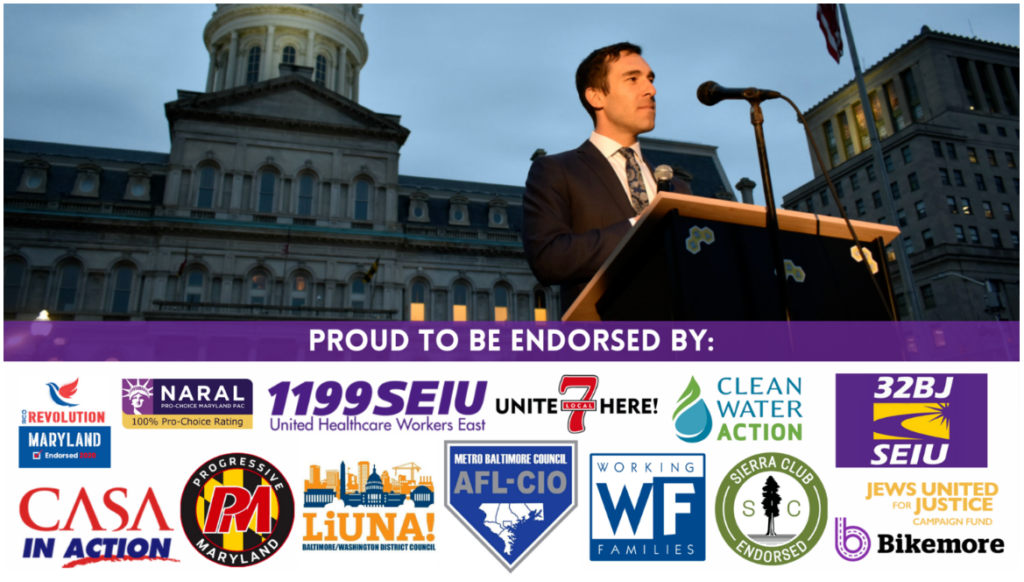
Baltimore City Council Member Zeke Cohen was riding high. A first term incumbent in District 1 (Southeast Baltimore/Canton/Fells Point), Cohen was running for reelection and was endorsed by most of the major progressive institutional players in city politics.
Cohen’s challenger, Paris Bienert, was a credible candidate but her endorsement list was no match for the incumbent.
For the cycle, Cohen outraised Bienert by $322,837 vs $170,795 through May 17, a nearly 2-1 edge. Cohen also outspent Bienert by $194,015 vs $124,069. Cohen was so confident of victory that he reported a cash balance of $206,174 on May 17.
So this looks like a big win for the incumbent, yeah?
Not exactly.
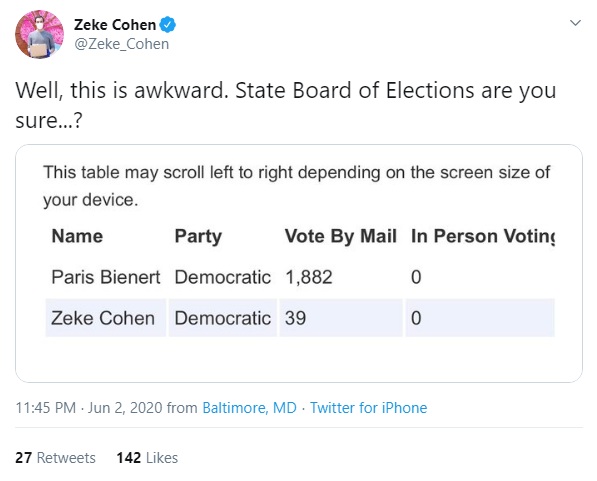
Last night, Cohen tweeted the following after seeing early results showing Bienert getting 98% of the vote.
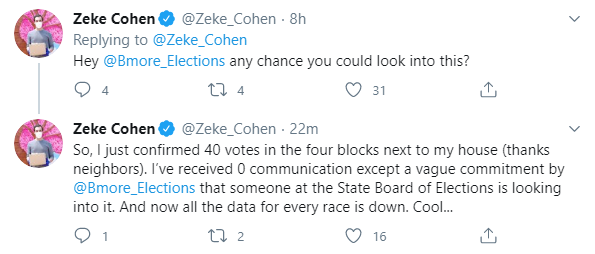
Cohen called out the county board of elections and the results came down.
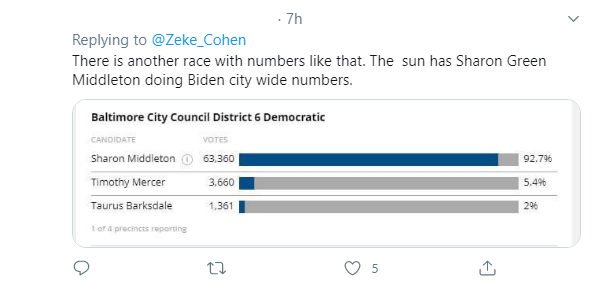
Another person caught this aberrant result. (I redacted the person’s identity from the tweet.)
Even Bienert didn’t believe it. She told the Baltimore Sun, “I’m very excited by these numbers, but I do think there’s been a misreporting.”
All of this will remind folks of the botched city election of four years ago, when activists alleged “irregularities, including late-opening polling stations; alleged conflicts of interest among campaign staffers who worked as election judges; polling-machine memory sticks that were missing for about 24 hours; and problems with resources, including shortages of ballots and ballpoint pens at some centers.” Future federal convict Catherine Pugh wound up winning the race for Mayor.
I am hearing that the State Board of Elections will address the matter today. For now, this tweet on Cohen’s thread says it all.
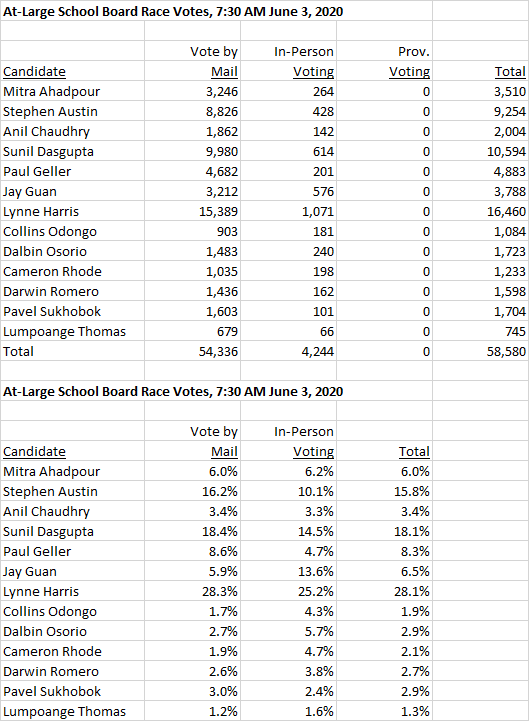
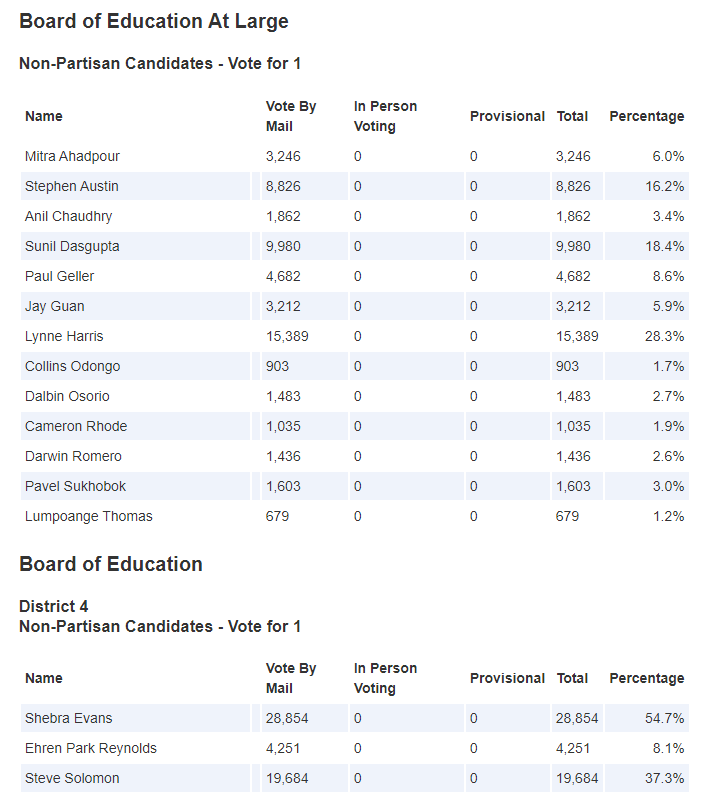
Last night’s first results in MoCo’s at-large school board race had a partial count of vote-by-mail ballots. In that count, Lynne Harris had 28.3% of the vote, followed by Sunil Dasgupta (18.4%) and Stephen Austin (16.2%). Dasgupta led Austin by 1,154 votes.
This morning, in-person votes have been posted along with the early vote-by-mail votes. Jay Guan did really well on in-person votes but not enough to break into the top three overall. Meanwhile, Dasgupta added another 186 votes to his lead over Austin. The top two candidates advance to the general election.
Tens of thousands of votes remain to be counted. Final results won’t be available for a while, so keep watching!
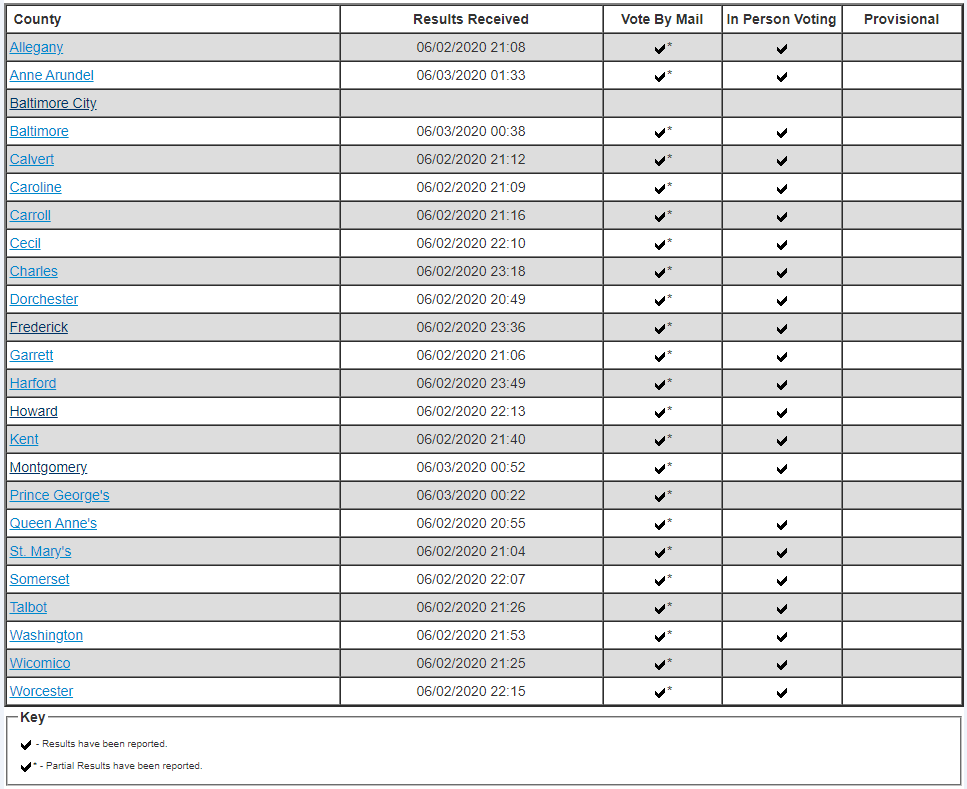
Last night, the State Board of Elections’ county status page showed Baltimore City as sending in partial vote-by-mail results. Below is what that page looks like now. The city is the only jurisdiction shown as not sending any results despite the early returns posted last night.
The first batch of MoCo school board results released by the State Board of Elections (SBE) at approximately 11:20 PM tonight favor former county PTA president Lynne Harris.
The results below were posted by SBE minutes ago.
This is still a very early report. The number of votes cast in the at-large school board race (54,336) is roughly half the 103,555 ballots reported as received by the county’s board of elections this morning. The tally does not include in-person voting today, provisional ballots or ballots not yet received. So far, 59,627 votes have been cast for president, indicating that many ballots have not yet been counted. (Joe Biden has received 42,203 votes from MoCo Democrats for 86% of their vote and Donald Trump has received 8,142 votes from MoCo Republicans for 77% of their vote.)
Harris was endorsed by the Washington Post. Universities at Shady Grove professor Sunil Dasgupta, currently in second place, was endorsed by the Montgomery County Education Association. Financial analyst Stephen Austin is in striking distance of Dasgupta in third place. The top two finishers in the primary advance to the general election.
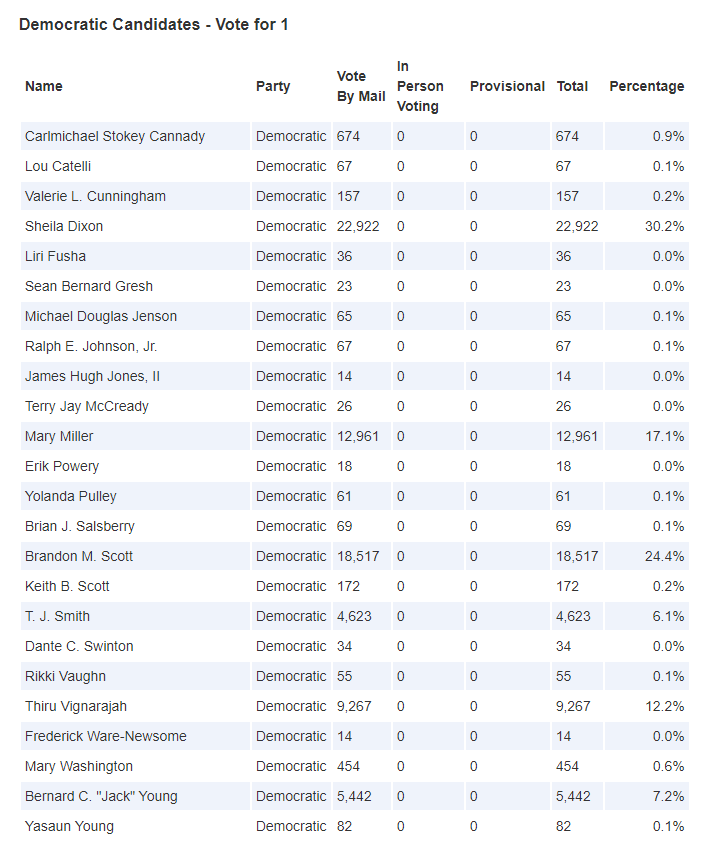
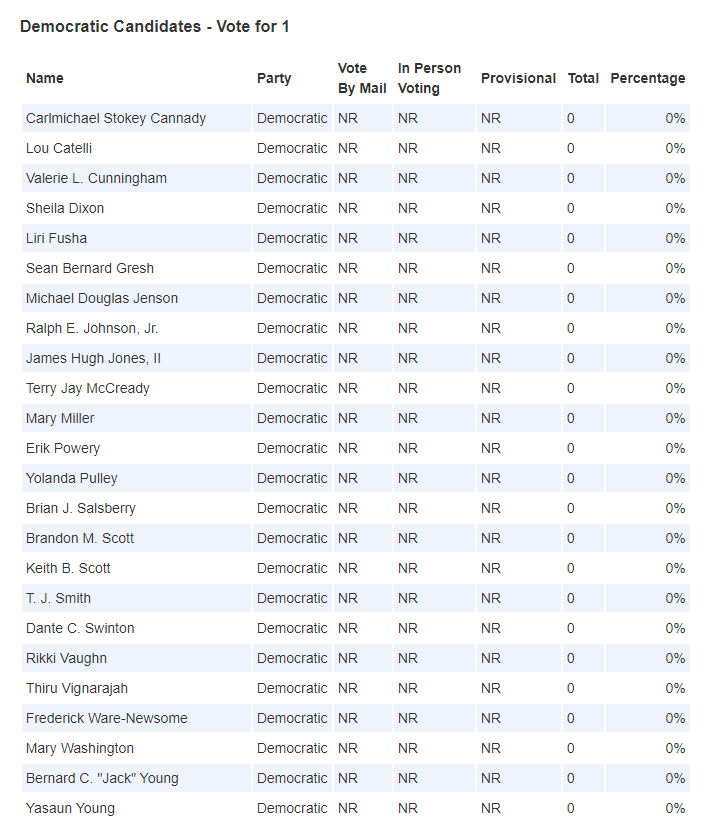
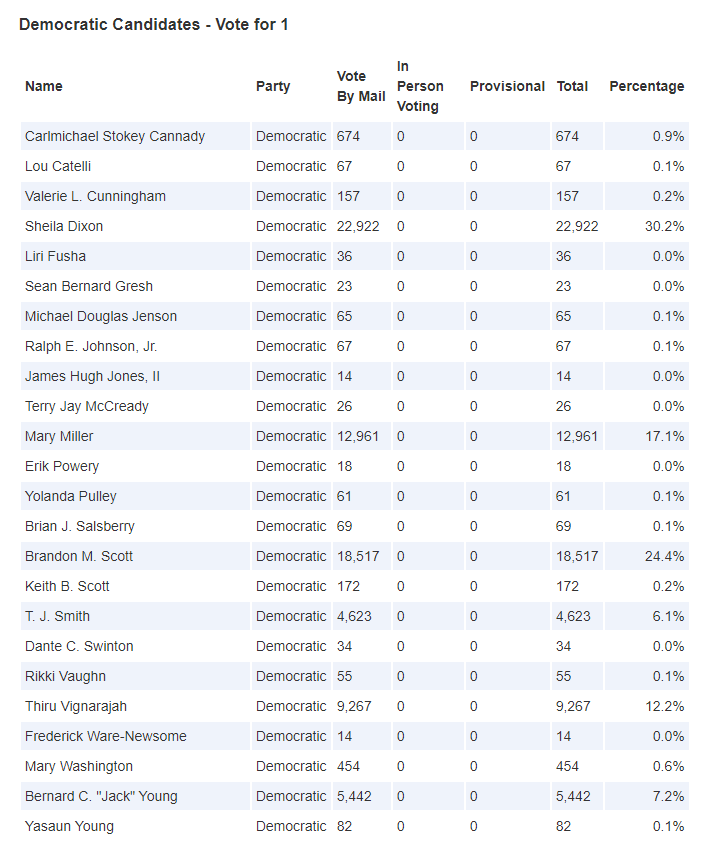
Sheila Dixon, who resigned her office as Mayor of Baltimore in 2010 after being convicted by a jury of misdemeanor embezzlement, is currently leading in the city’s Democratic primary for mayor. Like MoCo’s school board race, a lot of votes remain to be counted.
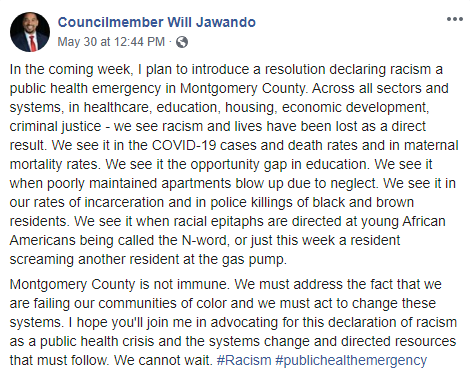
Over the weekend, Council Member Will Jawando announced his intention to introduce a resolution “declaring racism a public health emergency in Montgomery County.” His statement on Facebook appears below.
Of course, the county already has a law designed to deal with racial disparities of all kinds: the Racial Equity Law.
What happened to it?
Work on the law began in April 2018, when the county council passed a resolution lead-sponsored by Nancy Navarro and Marc Elrich calling for “an equity policy framework in county government.” The resolution stated:
The Council is committed to examining the data needed to develop an equity policy framework that would require the County to question how budget and policy decisions impact equity.
This effort must be a partnership between the County Council, County Executive, County Government, county agencies, institutions, and our community. The County Government must challenge itself to bring new and different partners to the table. Partnering with other jurisdictions as members of the Government Alliance on Race and Equity (GARE) will also enhance the County’s effort and commitment to fostering equity.
Equity analyses should be part of capital and operating budget reviews, appropriation requests, and legislation. Program and process oversight should be undertaken viewing programs and processes through an equity lens. Equity targets and measures of progress must be put in place.
So what are the major provisions of the law and how is the county doing on implementing them? Let’s discuss a few.
1. The executive must appoint, and the council must confirm, a 15-member Racial Equity and Social Justice Advisory Committee that would develop and distribute information about racial equity, promote educational activities and advise the executive and council on the issue.
Status: The council’s cumulative agenda for the year does not record any nominations sent over by the executive for this committee.
2. The executive must adopt a “racial equity and social justice action plan” by Method 2 regulation that would provide for community engagement and a host of requirements and metrics for every department in county government. Under Sec. 2A-15 of the County Code, a Method 2 regulation must be sent to the council for approval or disapproval.
Status: Four different sources inside the council building reported not seeing this regulation yet. The council’s cumulative agenda has no record of it.
3. The executive must “explain how each management initiative or program that would be funded in the Executive’s annual recommended operating and capital budgets promotes racial equity and social justice.” This is a time-consuming requirement as the executive’s operating and capital budgets contain hundreds of items each.
Status: The executive’s FY21 recommended operating budget, which was released after the racial equity law took effect, contains none of this language.
4. The law requires that “racial equity and social justice impact statements” must be drafted to accompany each bill introduced at the county council. The statements are due no less than 21 days after a bill’s introduction and no less than 7 days before the bill’s hearing, although the council president may change the deadlines.
Status: As of this writing, 13 bills were introduced after the racial equity law took effect on March 2. Six of the bills were passed. None of their action packets contained racial equity and social justice impact statements. The bill specifies that the Office of Legislative Oversight (OLO), which is part of the legislative branch, is responsible for drafting the impact statements. To be fair, the part of the bill referring to the impact statements takes effect on August 1, 2020 – five months after the rest of the bill – and $119,170 was added to OLO’s budget to pay for a “Racial Equity Legislative Analyst Position.”
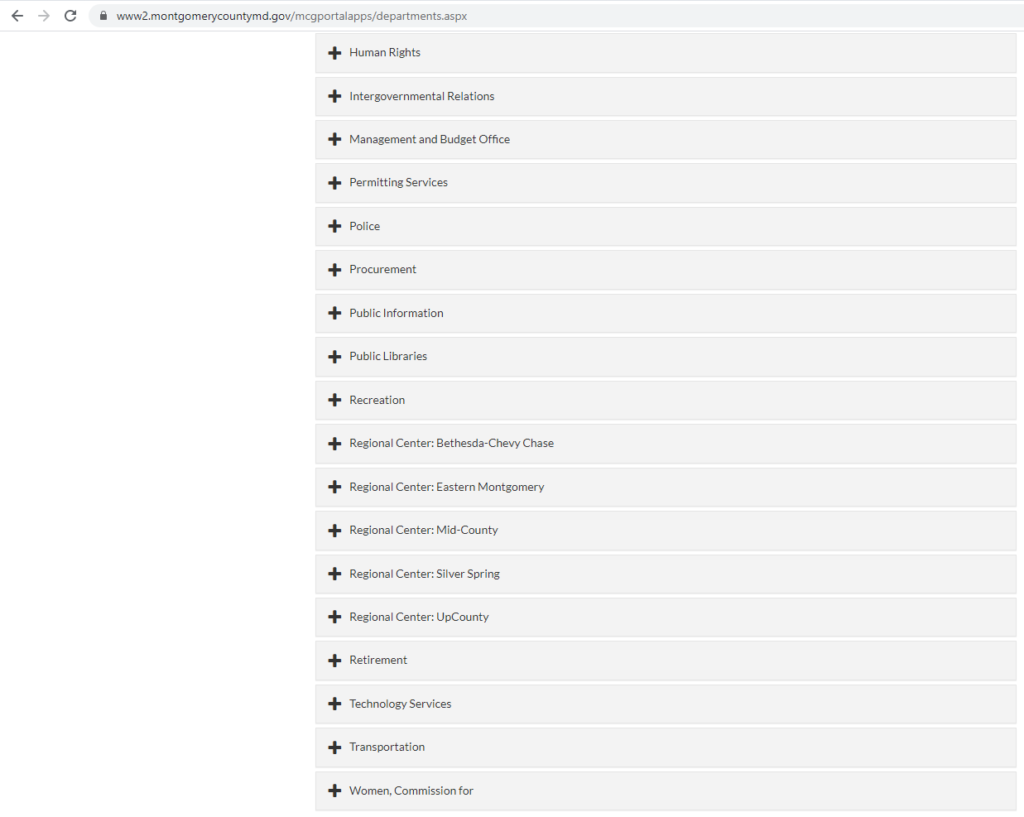
5. The bill creates an “Office of Racial Equity and Social Justice” to perform “equity assessments” on county policies, provide racial equity and social justice training to county employees, develop short and long term goals with metrics to redress disparities, work with departments to create the county’s “racial and social justice action plan” and staff the racial equity advisory committee.
There are a host of other requirements in the law, such as one mandating that every department designate a “racial equity and social justice lead” to work with the racial equity office. Has that been done?
Because of its sweeping nature, the racial equity law goes beyond the bare bones of its structure in the legislation. For example, it mandates that “equity assessments” must be performed “to identify County policies and practices that must be modified to redress disparate outcomes based on race or social justice.”
One program for which that might have been helpful was the county’s grant program to small businesses affected by the COVID-19 crisis. When the county’s grant program went live on April 15 at around 3 PM, the first wave of applicants found out mainly through emails from chambers of commerce or direct notifications from council members. The county’s official blast emails announcing the grants started going out around 4:30 PM and continued into the evening. That means that the best-connected, best-informed businesses got first dibs on the grants. Did that have an impact on the demographic distribution of the grant recipients? We will never know because the grant application did not ask for the applicant’s race. Think about this: in the aftermath of the racial equity law’s passage, the county launched its biggest business assistance program ever – $25 million for more than 6,700 businesses – and the county has no apparent way to measure how much of this money went to minority business owners.
And so at this writing, the only tangible outcome from MoCo’s much-publicized racial equity law is the budgeting of roughly $700,000 in tax dollars and the creation of three full-time positions. If anything else has been accomplished after the law’s passage, there is no evidence of it.
MoCo officials have talked a lot about racial equity over the last two years. The reality is that they have a ton of work to do.
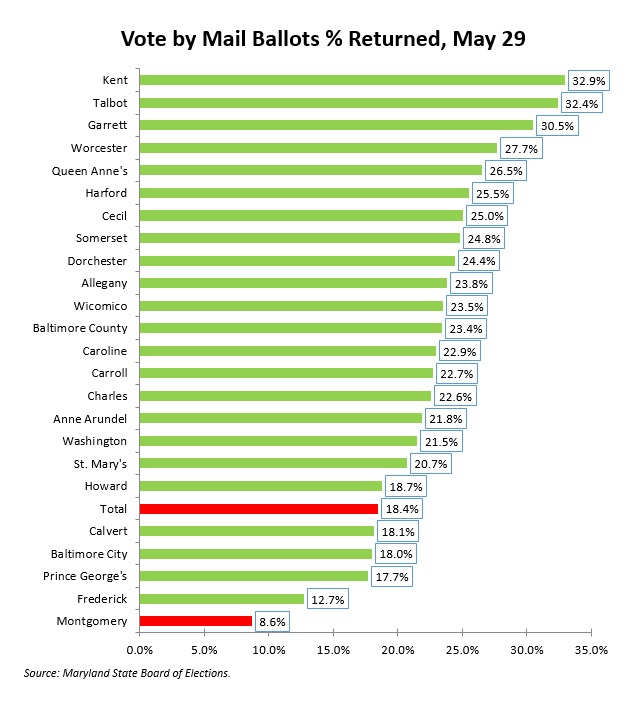
Just as I reported yesterday and the day before, MoCo’s rate of returning vote-by-mail ballots remains the lowest in the state. The chart below shows return rate by county through May 29.
The data is also bad when looking at party splits. MoCo’s return rate among Democrats (10.2%) is the worst in the state, which had a return rate among Democrats of 19.6%. MoCo’s return rate among Republicans (8.6%) was also the worst in the state, which had a return rate among Republicans of 20.2%. MoCo is one of thirteen counties in which unaffiliated and third party voters vote in presidential primaries. Among those thirteen, MoCo’s return rate among unaffiliated and third party voters was 5.0%, ranking 9th and not much lower than the statewide rate (6.0%).
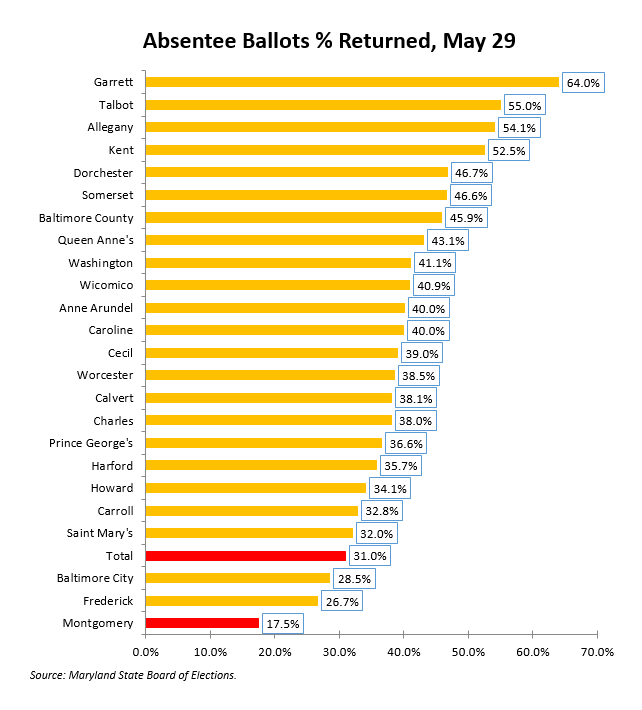
As if that were not enough, MoCo is also last in return rate of absentee ballots. Even though the state sent 3,488,628 regular ballots to voter addresses, an additional 97,373 absentee ballots were requested and mailed. MoCo’s return rate of absentee ballots was the worst in the state among Democrats, Republicans and unaffiliated and third party voters. Here is an interesting fact: despite having about a sixth of the state’s population, MoCo voters requested a third of all absentee ballots in the state.
I’m not going to speculate on what is happening here. But with 4 days to go until election day, MoCo’s abysmal turnout rate has emerged as a consistent trend which has not yet gone away.
In the meantime, if you have received your ballot, don’t let it sit with the bills and junk mail. Fill it out and vote!
It was supposed to be a good moment for Montgomery County. County Executive Marc Elrich was set to announce a phase 1 reopening of county businesses, mirroring in part the recent announcement by Governor Larry Hogan. It was an occasion for cautious optimism with sober recognition of the challenges ahead.
Instead, it turned into a mud-splattered free-for-all.
That was probably inevitable given how the event was staged. The county announced through a press release the night before that the event was taking place at the Kentlands and Bethesda Beat published it. That gave protesters time to prepare and they weren’t planning on handing out cupcakes and milk. Just two weeks ago, they descended on Annapolis – many without masks – to resist “tyranny” and “trampling the U.S. Constitution.” Why would they behave differently in Rockville?
The smart thing to do would have been to hold the event in a controlled environment in the executive office building with attendance limited to press. But the administration decided to go for a photo-op in the Kentlands’ business district instead. Well, a photo-op was had – for the protesters. They got ample coverage from NBC4, WJLA, WTOP, Bethesda Beat and even Baltimore TV that they would not have received at a controlled indoor event.
“Dictator!” “Fascist!” “Nazi!” “Liar!” “Recall!” “Trump 2020 baby, that’s what this is all about!” Those were the nice comments. The protesters repeatedly interrupted and shouted down the executive, preventing others from hearing him. At an event with such heckling, a communications person normally steps forward to cut it off early. Instead, Elrich actually took questions and prolonged the event, which went on for more than 20 minutes. The sign language interpreter even interpreted the hecklers’ comments while standing right next to Elrich.
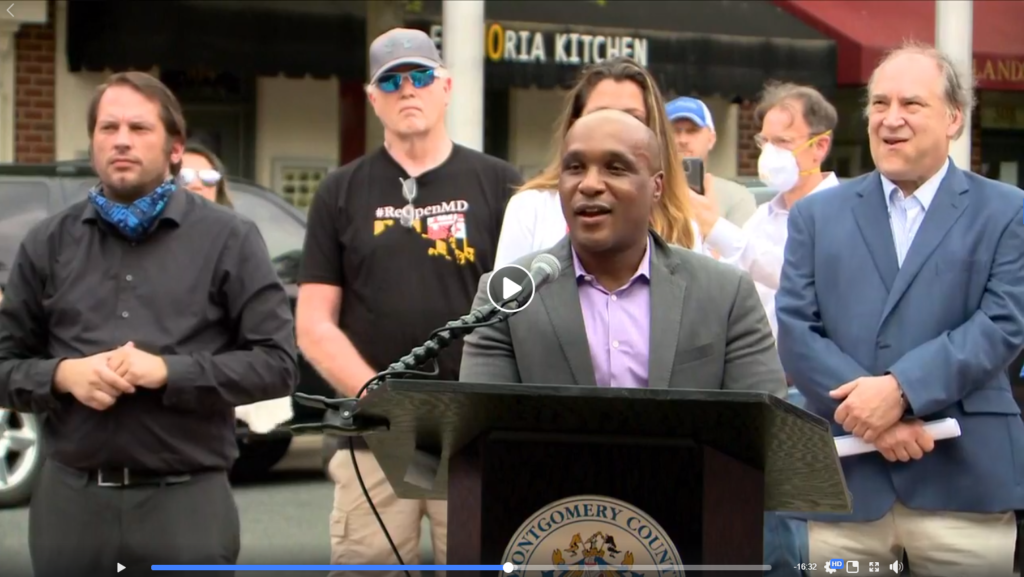
The look on Elrich’s face (far right) says it all. Also appearing: county health officer Travis Gayles (at podium) and the sign language interpreter (far left). Credit: WJLA Facebook stream.
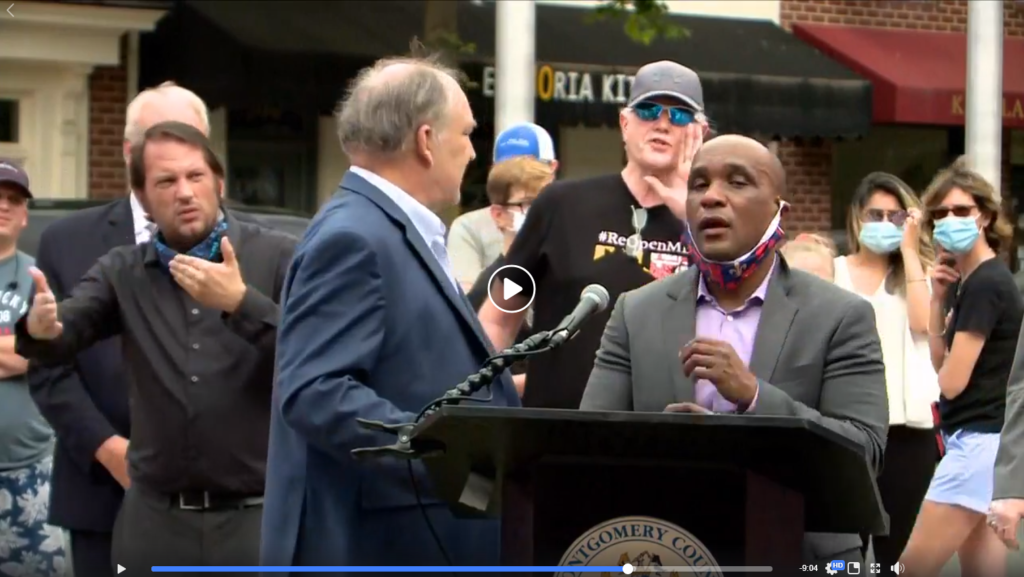
Besides the relentless yelling, a number of unmasked protesters stood within spitting distance of the executive and his staff. One unmasked fellow in a hat and sunglasses stood behind him for nearly 15 minutes and, at one point, got dangerously close to the executive. Police officers were present. Why did they not move unmasked protesters away from the executive and his staff to protect their health?
How could security allow an unmasked man to get this close to the executive? Credit: WJLA Facebook stream.
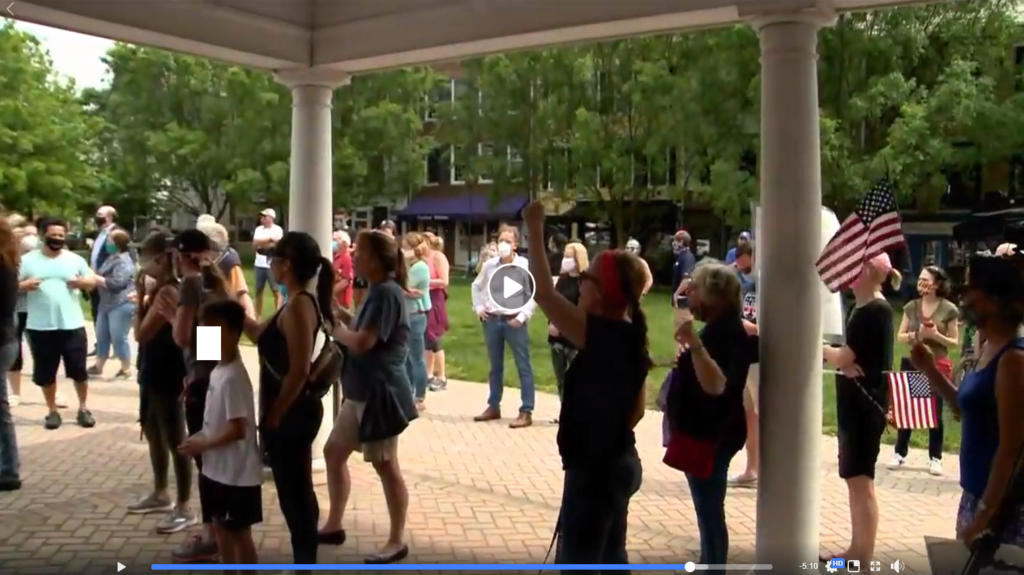
As for the protesters, there were enough of them to make serious noise. Just like in Annapolis, the event turned into a mass gathering with unmasked people. The COVID-19 crisis is not over. It’s a complete contradiction to the county’s message to allow – much less to CREATE – a mass gathering including unmasked individuals. It’s not just a PR blunder, it’s a threat to public health.
Let’s not mince words: the protesters were boorish miscreants who should be held responsible for their own actions. They are an embarrassment to the county. All of that said, they should never have been given a grand stage on which to run amok in front of TV cameras. Someone on Elrich’s communications team should have raised what a bad idea it would be to hold the event in public with notice to anyone who wanted to attend. Some shutdown protests around the country have turned violent and armed protesters even stormed the Michigan Capitol. The protesters succeeded in turning an announcement which should have furthered stability and progress into one that spotlighted division and chaos.
This event should not have happened.
But it did. And once again the administration has endured a communications debacle that could have been avoided.
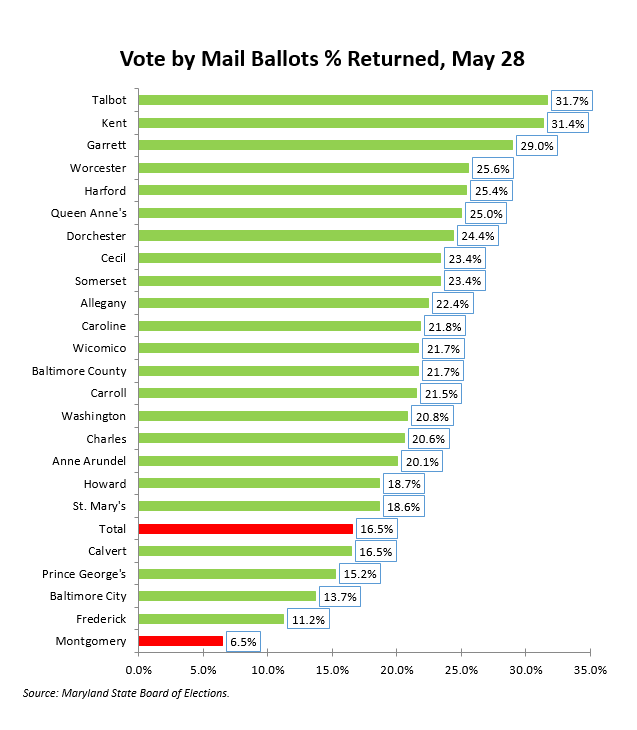
Yesterday, I published turnout data through May 26 showing that MoCo was dead last in Maryland. Today, I am publishing turnout data through May 28 showing the same thing. Folks, with 5 days to go until election day, it’s time to wonder what’s going on.
On May 26, 3.9% of those who received a mail ballot in MoCo were recorded as returning it. The return rate for the state was 14.1%. On May 28, MoCo’s return rate was 6.5%, still lagging the state’s rate of 16.5% and still the last in Maryland.
Compare MoCo to Frederick. On May 26, MoCo’s return rate was 3.9% and Frederick’s was 6.4%. On May 28, MoCo’s return rate was 6.5% and Frederick’s was 11.2%.
Another comparison worth noting is Baltimore City, which was plagued with late mailouts of ballots. The city’s return rate was 12.1% on May 26 and 13.7% on May 28, far higher than MoCo.
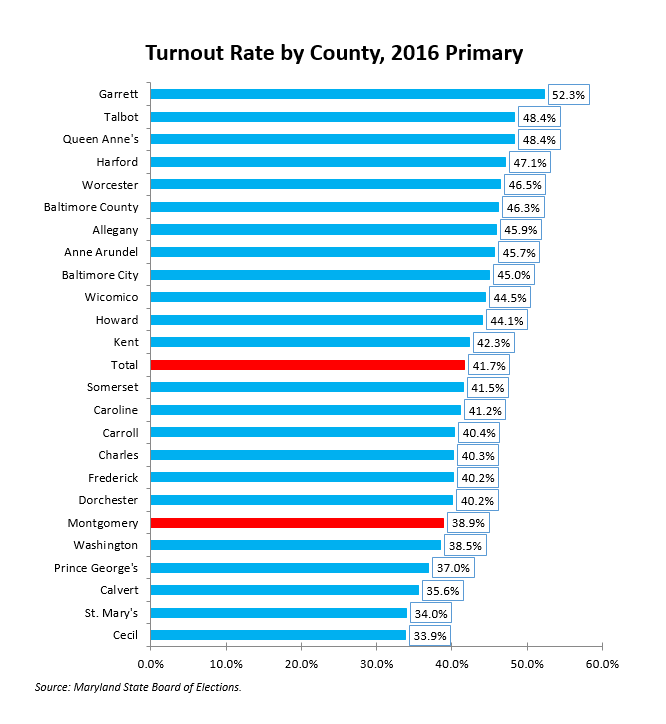
It’s worth noting that MoCo had one of the lower turnout rates in the state in the 2016 primary, although it was not at the bottom.
So what’s going on here? It’s a little early to say. Stories of folks getting late ballots or even getting ballots for people no longer living at their address are common on social media here. The county boards of election could also have different processing times for ballots. (David Lublin described how this works earlier today.) Or it could all be a timing fluke and MoCo could wind up in the bottom quarter of turnout, but not be an outlier, as happened four years ago.
If you’re concerned about this, the best thing to do is vote!
Maryland is holding its first-ever mostly vote-by-mail election. The State Board of Elections (SBE) has been mailing ballots to voters for weeks. Voters may mail ballots back to SBE, drop them off at vote centers or vote at the vote centers on election day (June 2).
SBE has had some delays in mailing ballots, especially in Baltimore City and Montgomery County. The fact that the ballots are marked with the wrong date may be an issue for some voters. And since this is the first primarily vote-by-mail election, there may be voters who have not adjusted and anticipate voting at their precincts.
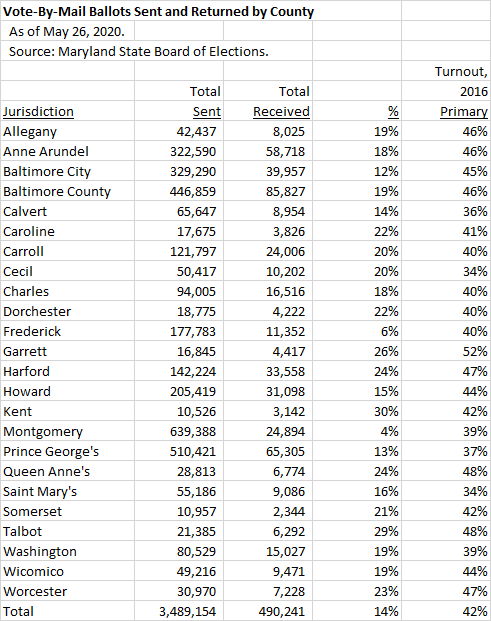
Could the potential problems above have impacted voting? The table below shows ballots sent by SBE and received by SBE by county as of May 26 (yesterday). Also included are turnout rates from the 2016 primary. Turnout is waaaaaaay down – so far. Montgomery County’s turnout rate of 4% is particularly abysmal. But let’s bear in mind that there were still seven days to go until the election when this data was released.
These totals are going to increase in coming days. I’ll issue periodic updates.
The at-large race, easily the most contentious MoCo school board contest since the early 1980s, has many overtones of race and class owing to its discussion of school boundaries. In MoCo, race and class are synonymous with geography. The county has huge differences in race, language and economics between its various subdivisions. Indeed, most of the county’s wealth is concentrated in a handful of zip codes. The county has noticeable racial segregation in its schools as well as significant inequity between them.
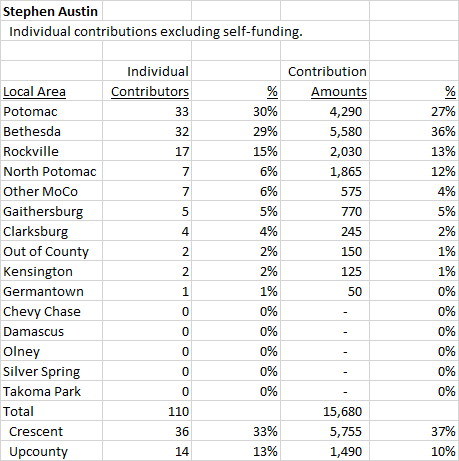
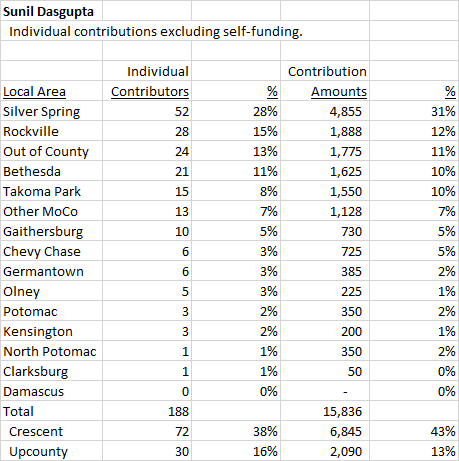
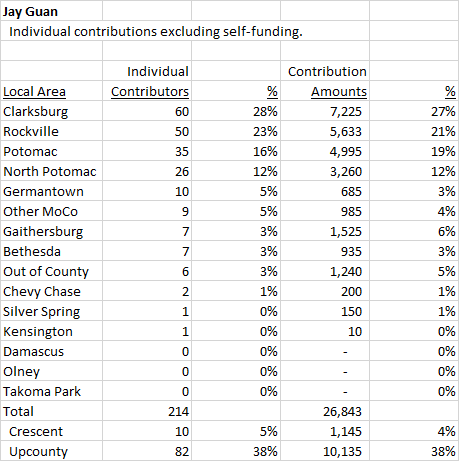
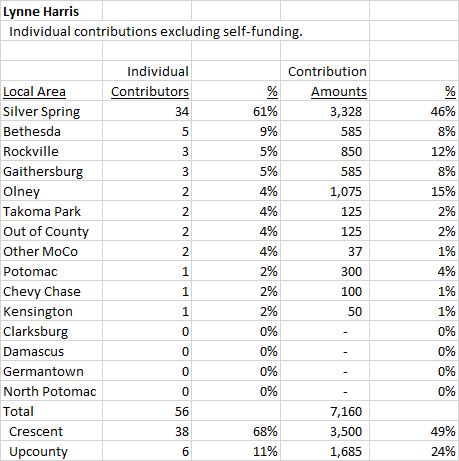
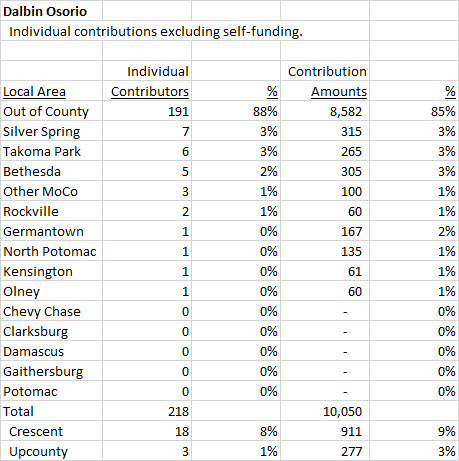
I broke down the geography for individual contributions to five candidates – Stephen Austin, Sunil Dasgupta, Jay Guan, Lynne Harris and Dalbin Osorio. (Pavel Sukhobok, the 4th-leading fundraiser, only has 7 contributors other than himself.) For each candidate, I tabulated the number of contributors and total contributed by individuals for each major local area in the county. These figures exclude self-funding, PACs, businesses and unions.
Two areas require definitions. The first is the Downcounty Crescent, the areas in and around the Beltway that play a disproportionate part in Democratic primary voting. The Crescent includes Bethesda, Cabin John, Glen Echo, Chevy Chase, Kensington, Takoma Park and the Silver Spring zip codes of 20901 and 20910. This area trends left – with some places going far left – and is largely responsible for sending Jamie Raskin to Congress. The second is Upcounty, which I define as including Ashton, Barnesville, Boyds, Brookeville, Clarksburg, Damascus, Dickerson, Gaithersburg, Germantown, Laytonsville, Montgomery Village, Olney, Poolesville, Sandy Spring and Spencerville. This area contains a greater proportion of moderate Democrats, Republicans and unaffiliated voters than other parts of the county.
Now let’s look at the candidates.
Stephen Austin
Almost two-thirds of Austin’s contributors and 75% of his individual funding comes from Bethesda, Potomac and North Potomac. These areas are home to some of the highest-performing high school clusters in the county. Austin is a leading critic of MCPS’s recent school boundary analysis. It makes sense that parents in these areas would be skeptical of having their kids sent to other schools.
Sunil Dasgupta
Silver Spring, the county’s largest geographic unit, accounts for 28% of Dasgupta’s contributors and 31% of his individual fundraising. The rest of his contributions are well dispersed.
Jay Guan
The vast majority of Guan’s contributors are east Asian so it makes sense that his geography would match the most heavily Asian high school clusters in the county (like Wootton, Churchill, Richard Montgomery and Clarksburg). Guan lives in Clarksburg so it’s no surprise that he is the runaway fundraising leader there.
Lynne Harris
Silver Spring is Harris’s biggest source of campaign funds – by far.
Dalbin Osorio
A huge majority of Osorio’s fundraising is coming from outside the county, with most of that coming from out of state.
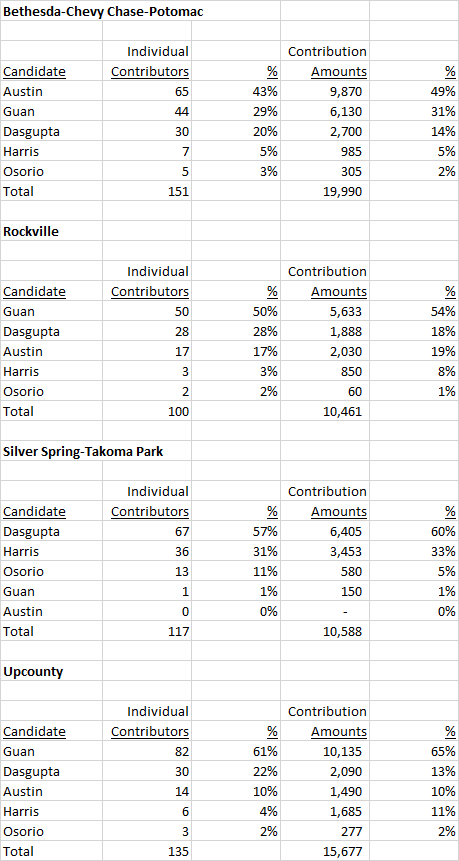
Here is a summary of fundraising from four key areas in this race.
And so the contribution geography reveals the appeal of each of these candidates, at least in terms of fundraising. Austin has raised the most from Bethesda and has split Potomac with Guan. Guan has raised the most from east Asians, Rockville and Upcounty. Silver Spring and Takoma Park are going with Dasgupta and (to a lesser extent) Harris, although Dasgupta has the most geographic diversity of any candidate. Osorio needs to find more contributors who live in MoCo.
It’s a shame that the State Board of Elections won’t be releasing precinct-level data in the primary because then we could see if votes follow money. Let’s hope that we can get precinct results in the general election.