All posts by Adam Pagnucco

Who’s the Boss?

By Adam Pagnucco.

One of the challenges of running the executive branch is to present a unified front to the public. The executive branch has thousands of employees and hundreds of subject matter experts in fields ranging from transportation to IT to law to environmental management to social services to… you get the idea. It’s incredible how much the county government does and how much its employees know. But at the same time, it works for one person: the county executive. He or she is the ultimate policy maker for the executive branch. After hopefully listening to input far and wide, the executive’s decision on an executive branch position is final. And every person inside the executive branch must respect it.

Or at least that’s the theory.

This principle broke down in full public view with regards to MC 4-21, a state bill affecting only Montgomery County introduced by Delegate Vaughn Stewart (D-19). The bill would enable, but not mandate, the county to transfer administration of speed cameras from the police department to the transportation department. Stewart believes it makes sense to have one agency in charge of both traffic safety and road improvements, and since the police department does not manage road projects, he thinks the transportation department should do both. County Executive Marc Elrich supports the bill and there is no indication in documents sent to the county council that he has any reservations about it. That should be the end of the story; the executive (as well as the council) supports the bill and the state delegation, which will decide its fate, will take that into account when deciding how to vote on it.

But that’s not the end of the story. The county’s director of intergovernmental relations wrote this to the council in addition to noting the executive’s support:

The Office of the County Attorney (OCA), the Department of Transportation (MCDOT), and the Department of Police (MCPD) have expressed concerns about MC 4-21. Specifically, OCA explained that while the local bill is only enabling, “DOT is not a law enforcing agency and is not equipped to act as one.” It pointed out that the bill “would have Montgomery County as the only jurisdiction in the State where no law enforcement individuals are reviewing speed camera citations and signing off on violations.”

Well, OK. The bill is an enabling bill, not a mandate. If the bill passes, the executive would have a voice in determining whether the shift in responsibility is actually implemented. Is the Office of County Attorney arguing that its boss – the executive – should not have that voice when the executive openly desires it?

There is more. When the MoCo state legislators’ land use committee convened to consider the bill on December 17, representatives of the police department acknowledged that the executive supported the bill and then proceeded to argue against it. Among their statements were that Baltimore City allegedly screwed up a similar program, the MoCo police had 15 years of experience in speed camera management that was a “national model,” and the state legislators should “make sure this is not an emotional decision.” They also characterized D.C.’s speed camera program, which was shifted to their transportation department, as “the worst program in the nation, hands down, by far.” One police official proudly declared, “We do not succumb to political influence!” in front of – you guessed it – seven state politicians in the meeting. He concluded that a transfer of responsibility “would do irreparable damage to this program as well as programs throughout the state.”

But the executive supports the bill.

Set aside the specifics of the bill for a moment. When the executive makes a policy decision, such as whether to support legislation, it is not merely a personal gesture. The executive is elected by voters to make decisions on behalf of the executive branch. Its employees are bound to carry out those decisions. Sure, the executive branch doesn’t exist in a bubble – it has to respond to other governmental bodies as well as a host of outside circumstances. But within its boundaries, the executive’s decisions must be respected. If not, then the departments turn into free agents and no one is really running the place.

You can bet that when the police openly tried to kill a bill supported by the executive, the state legislators who witnessed it noticed. They are not the only ones. The county council knows about it. No doubt other departments are watching. It’s impossible to say what gave rise to the police rebellion. Do they feel that the executive does not listen to them? If so, the executive’s information gathering process needs improvement. But if the executive does not remind his subordinates who their boss is, then the executive branch won’t have a boss. And that would make the county damn near ungovernable.

Share

What Happened to White Flint?

By Adam Pagnucco.

Ten years ago, White Flint was regarded as the future crown jewel of MoCo. With a shiny new master plan, a tax district for infrastructure and an assortment of regulatory breaks, the area was supposed to create new high-end high-rises combining office, retail and residential uses that would generate billions of dollars in county revenues over coming decades. Everyone who lives here knows that vision is still largely unrealized. And now a new report by county planning staff lays out why.

First, let’s revisit what White Flint was envisioned to become in its 2010 master plan: a smart growth, walkable mecca around a transformed Rockville Pike which would be transit-heavy and pedestrian friendly. The plan required substantial infrastructure investment including streetscaping, a new road network and a bus rapid transit route. Unlike many county master plans, this one had a mechanism for financing infrastructure: a new special taxing district. Properties inside the taxing district would pay into a fund used to pay for the new infrastructure needed to bring the plan to life. In return, impact taxes were set to zero. The council set an infrastructure project list through a resolution and projects in the district were exempted from county traffic reviews. This combination of high density, infrastructure investment and regulatory exemptions was revolutionary for MoCo at the time and still has not been fully replicated. MoCo politicians love to throw around the word “bold” like peanut shells, but White Flint (now marketed as the Pike District) truly deserved the adjective.

So what happened?

In simple terms, the planning staff describes a negative, self-reinforcing feedback loop that has no identifiable end. The loop functions like this. Low levels of development led to low proceeds for the tax district. It was supposed to raise $45 million in its first 10 years but only generated $12-15 million. Low tax district revenues held back the construction of some of the transportation improvements and other infrastructure necessary to make the area more attractive to investment. Developers seeking financing for projects were hindered by the inadequate infrastructure along with the “prominence of underutilized properties.” One of those properties, the mammoth White Flint Mall site, was tied up by years of litigation. The lack of financing, along with construction costs and market conditions, has held back development. And of course the lack of development holds back tax district revenues necessary to pay for infrastructure, so the cycle continues.

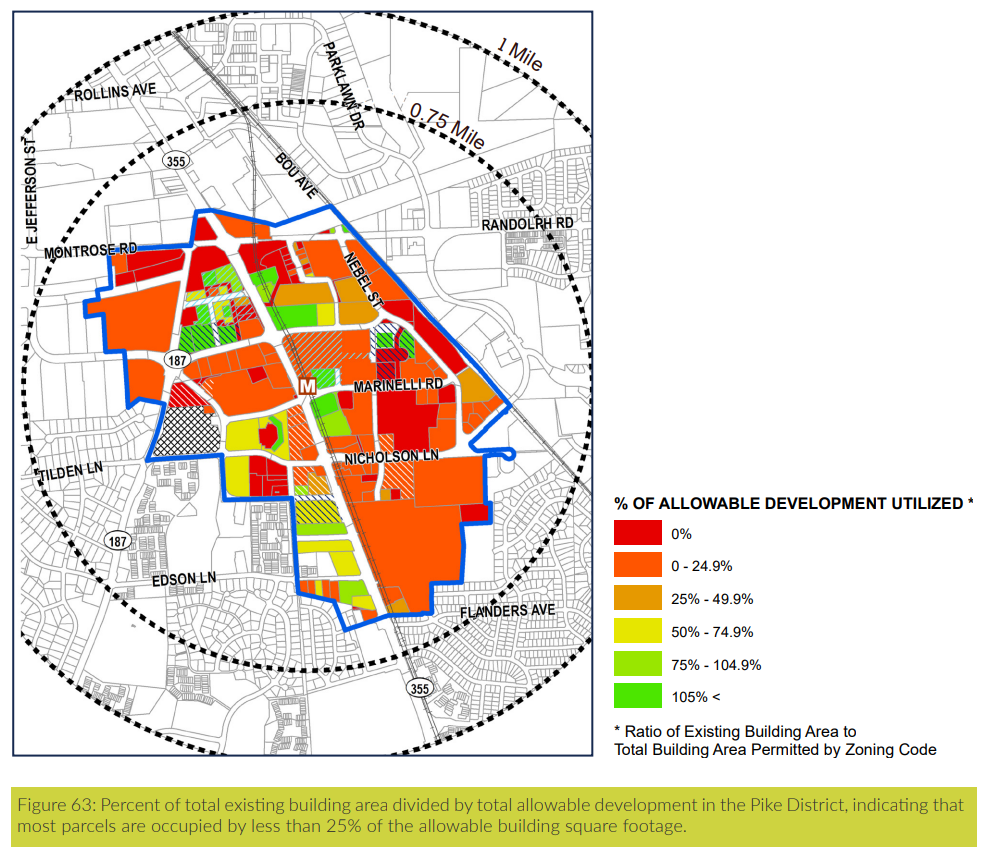
This map from the report shows the vast majority of land in White Flint is underutilized (areas marked in red and orange) relative to its zoning.

The most interesting part of the report summarizes comments from White Flint property owners, who comprise a who’s who list of prominent MoCo developers. First, let’s identify what they don’t complain about. They don’t complain about the plan itself; indeed, they think the area still has potential. They don’t complain about market demographics; they find the wealth and education levels in the area attractive. They don’t intend to sell their existing properties, which generate enough cash to cover operating costs and taxes, but they’re not in a hurry to redevelop them. And not a single one of them complained about taxes or requested a tax abatement.

Here are a few excerpts from the report on their take on White Flint’s problems.

*****

All developers interviewed cited Montgomery County’s limited job growth as a fundamental challenge to continued construction in the Pike District. Low levels of new jobs limit the number of new families seeking to occupy units in the county (household formation), decreasing demand for new development. In addition to limited employment growth, construction costs increased dramatically since 2010, office users occupied less space per employee, and retail demand declined with the rise of online shopping, all factors that continue to reduce demand for or limit the financial feasibility of new development.

Multiple developers noted without providing details that their firm managed to solve issues of high construction costs in other submarkets where there is a higher pace of job growth and household formation, which in turn supports rent growth.

Developers interviewed affirmed that the Pike District is accessible to fewer jobs within a reasonable commute than its peer non-downtown submarkets, and that this reduced access to job centers limits demand for additional multifamily units.

All developers interviewed cited Montgomery County’s limited job growth as a fundamental challenge to continued construction in the Pike District. Low levels of new jobs limit the number of new families seeking to occupy units in the county (household formation), decreasing demand for new development. Developers cited the reduced pace of household formation as a key contributor to stagnant rents, a major concern for the feasibility of future projects.

Several developers independently stated that the attraction of a major employer to the Pike District, such as a life science campus, would significantly increase the feasibility of new multifamily projects.

Developers are not currently willing to build speculative office projects in Montgomery County due to the lack of underlying job growth and the uncertainty about the future of the office sector. Several developers mentioned that they would still consider speculative office construction in Tysons and along the Silver Line corridor, highlighting the continued job growth in Northern Virginia and the contrast with suburban Maryland.

Several interviewees contrasted recent Northern Virginia economic development wins, such as the expansion of Microsoft in Reston, with news that a large distribution center project in Gaithersburg for Amazon is in jeopardy due to delays in the entitlement process. These interviewees stressed that while the number of jobs in these deals is modest, there is a constant drumbeat of positive economic news from Northern Virginia that is unmatched from suburban Maryland.

*****

Let’s boil this down to three words: jobs, Jobs, JOBS. Employment growth was the dominant theme for these developers, but they had a few things to say about business climate and regulations too.

*****

Interviewees related that development projects ultimately deliver equivalent profits as similar projects in neighboring jurisdictions, but that Montgomery County’s reputation as generally “a difficult place to do business” limits developer interest.

Developers agreed that the difficulty of the business environment issue is primarily about perception rather than the ultimate profitability. Interviewees cited as examples a range of policy issues such as a minor energy efficiency tax that Montgomery County leadership presented and implemented as a temporary measure but that never expired.

Multiple interviewees stated that in competitor counties they feel that the entitlement review process is oriented to enabling and facilitating a project, whereas in Montgomery County it feels like an oppositional relationship. Related to this, developers feel the County continually creates new policies and initiatives that adversely affect development, and which ultimately encourages them to focus on assets elsewhere in the region.

*****

The county council and the planning staff are focused on tax abatements as a way to stimulate development, especially housing. But developers in White Flint weren’t complaining about taxes. In fact, tax revenues are NECESSARY to finance infrastructure required to make development happen and function well. It is the absence of tax revenues that resulted in under-financing of infrastructure in White Flint, a key part of the area’s negative feedback loop.

Instead of taxes, the key issue identified by White Flint developers is the absence of job growth, which they believe would stimulate demand for housing and eventually make the economics of housing construction work even with high construction costs. In short: if you want more housing, create more jobs. All of these developers know what we have been saying on Seventh State for years: MoCo has one of the worst records on job growth and business formation of any large jurisdiction in the metro area.

The county’s terrible record on job growth and business formation must be reversed.

All of this points to the need for a strategic decision. MoCo can focus like a laser on job creation, doing everything possible to help entrepreneurs grow their organizations and create employment for residents. If the county does that, the vision of White Flint and other smart growth plans can be realized. Or MoCo can keep handing out tens of millions of dollars in corporate welfare as it has done for decades, thereby depleting its ability to construct infrastructure that facilitates economic growth. Or it can do nothing.

Those are the choices. What will MoCo choose?

Share

Is Smart Growth Getting Married to Corporate Welfare?

By Adam Pagnucco.

On October 27, the county council overrode County Executive Marc Elrich’s veto of Bill 29-20, which mandates 15-year property tax breaks for developers at Metro stations. This seemingly ended – for now – the debate over whether huge tax abatements should be written into law for transit-accessible development projects. But in fact, the debate may just be getting started. That’s because a little-noticed discussion eight days before offered a prelude of many more tax expenditures than just the amount contained in that one bill.

On October 19, the council’s Planning, Housing and Economic Development (PHED) Committee held a work session on the upcoming Thrive Montgomery 2050 Plan. The plan, still in its early stages, is conceptualized in a mammoth 167-page public hearing draft authored by planning department staff. Among the MANY recommendations in the draft is this goal:

Goal 5.2: Ensure that the majority of new housing is located near rail and BRT stations, employment centers and within Complete Communities that provide needed services and amenities for residents.

And one of the action steps recommended for this goal is this one:

Action 5.2.1.a: Provide appropriate financial incentives, such as tax abatements, Payment in Lieu of Taxes (PILOTs), and Tax Increment Financing (TIFs) to increase housing production in targeted locations near high-capacity transit.

The adjective “near” is not defined.

At the PHED Committee’s work session, county planning director Gwen Wright commented on before and after sketches of development on Georgia Avenue and said:

One of the items, and I put this specifically because I know we’ve had a very challenging conversation just recently, about the idea of PILOTs to try to target development near high capacity transit. To do, to change what you see on the left into what you see on the right is going to take more than just zoning. It is going to take financial incentives. It is going to take different kinds of public investment.

Wright’s comments on incentives start at 38:27 of the video below.

It’s worth remembering one of the rationales for the Metro property tax break bill. Supporters of the bill said that its tax abatement was necessitated by the unique costs of building on top of Metro stations. They stressed over and over that the bill would not apply to other sites. It’s clear now that much broader tax abatements for all kinds of sites – not just Metro stations – have been under consideration by at least the planning staff and maybe other actors too for some time. Back on September 24, I wrote, “Developers of sites near but not on Metro stations might demand concessions too. As with the county’s Economic Development Fund, which began by handing out small grants to companies twenty years ago and eventually distributed 7-digit and 8-digit grants, the subsidies in the current bill may only be the beginning.” It didn’t take long for that prophecy to amass evidence of its accuracy.

Another rationale for the WMATA tax break bill is that it applied to largely empty Metro-owned sites that were not generating tax revenues. Supporters of the bill said that waiving taxes on new development did not cost the county real money if the new development would not have occurred without the tax break. But that argument does not apply to areas around Metro stations, which tend to have low-rise, mid-rise and – in Downtown Bethesda – high-rise buildings in existence now. These properties pay property taxes. Offering tax abatements to them to redevelop converts them from revenue generators into non-payers. It would actually SHRINK the tax base. This contradicts one of the primary reasons why economic development is good for the county: it is supposed to ADD to the tax base. That wouldn’t happen under the planners’ proposal.

Sure, this is just a staff draft. And sure, the draft has not been approved by the planning board much less the county council. But this is how policy is formed – it starts as a proposal, it turns into a recommendation, it is incorporated into official planning and then it becomes law. Unless something changes, these are the first baby steps towards what could ultimately become billions and billions of dollars in subsidies that the rest of us will pay for.

In MoCo politics, the number one attack made against smart growth organizations and activists is that they are supposedly tools of developers. It’s a line of argument used to shut down – and shut up – anyone who wants to see more commercial development or more housing here. It took smart growthers many years to get beyond the epithets, to present their agenda of community building, walkability, environmental preservation and sound transportation management and to truly break through into the county’s mainstream. It helped that transit-oriented projects were supposed to make money for the county’s budget. Ten years ago, redevelopment in White Flint was predicted to generate $6-7 billion of revenue over the next 20-30 years.

If smart growth indeed becomes married to corporate welfare, some of that political progress will be lost. The smart growth movement will be cast by its opponents as anti-progressive and in thrall to corporate masters whose primary goal is tax avoidance. It will face increasing impediments to its political growth and hence its ability to affect policy and influence votes. That is exactly what opponents of transit-oriented development want. The push towards corporate welfare plays right into their hands.

All of this will be a huge political gift to County Executive Marc Elrich, the man who built his career on voting against transit-oriented development and whom many smart growthers desperately want to see out of office. Elrich relishes vetoing tax abatements and tax cuts for developers because it reminds a large part of his base why they voted for him. The only thing that could be better for Elrich is if the next round of huge tax breaks is proposed in legislation a couple months before the next primary.

Share

Methodology Note: Precinct Analysis

By Adam Pagnucco.

In coming days, I’ll be crunching precinct-level results from the 2020 general election. This post summarizes the methodological choices I made and I’ll refer back to it in the future.

General election precinct results for candidate races and ballot questions are available here for every county in Maryland. In prior years, precinct results were available only for election day voting. For this year’s general election (but not the primary), they are available for all voting modes. That’s an improvement but it means that precinct results for this year aren’t strictly comparable to earlier years.

This year, Montgomery County has 258 precincts. Three of them are “ghost precincts,” which do not report results because no people live in them. If you see the number of precincts alternatively represented as 258 or 255, the three ghost precincts are the reason. Don’t worry about it because vote tallies are unaffected.

All precincts are assigned to congressional, state legislative and council districts. Their town designation is determined by the location of the voting place. This gets a little blurry at times as folks from one town can have a voting place in another, but this shouldn’t have a huge impact on geographic results.

The Democratic Crescent, a term I used two years ago to identify regularly voting downcounty Democrats, includes precincts in Bethesda, Cabin John, Chevy Chase, Kensington, Takoma Park and Silver Spring inside the Beltway. Upcounty includes precincts in Brookeville, Clarksburg, Damascus, Dickerson, Gaithersburg, Germantown, Laytonsville, Montgomery Village, Olney, Poolesville, Sandy Spring and Washington Grove. Residents of smaller nearby communities vote in these precincts, including people who live in Ashton, Barnesville, Beallsville, Boyds and Goshen. Wheaton includes zip code 20902. Glenmont/Norbeck includes zip code 20906, except for Leisure World, which is tracked separately. Silver Spring East County includes all other Silver Spring precincts outside the Beltway and located in zip codes 20901, 20903, 20904 and 20905.

I may refer to how precincts voted for term limits in 2016. Term limits voting is correlated both with partisan turnout and certain other voting behavior this year.

I included estimates of average household income by zip code from the Census Bureau for the five-year period of 2014-2018. I wish I had recent estimates by precinct but that will hopefully be released with the next batch of decennial census data.

Finally, I took a shot at demographics by precinct. This was a huge and imprecise exercise. Using 2010 census data, I matched census blocks to precincts. This is challenging because the two frequently don’t match exactly and precinct definitions have changed over the years. After a great deal of work, I was able to generate rough estimates of percentage Asian, Black, Latino and white for each precinct’s population and use them to gauge crude patterns of voting associated with race. I can’t stress how rough and dated this is and I look forward to getting updated 2020 census data to plug in.

That’s about it. We’ll start digging into data soon!

Share

Follow the Money

By Adam Pagnucco.

To understand the growing strains on MoCo’s pandemic-stricken budget, it helps to follow the money. Here is an example.

Follow This Money

Last spring, the county council voted down compensation increases contained in the collective bargaining agreements negotiated by County Executive Marc Elrich with the three county employee unions: MCGEO, the fire fighters and the police. The increases totaled $22 million in the current fiscal year and $29 million annually thereafter. This was the sixth time that the county trimmed or eliminated raises for employees in the last eleven fiscal years. (The county zeroed out raises in FY11, 12, 13 and 21 and reduced collectively bargained raises in FY17 and 20.)

At around the same time, the executive granted the three unions indefinite COVID pay without seeking the consent of the council. There is no question that workers exposed to hazardous conditions deserve extra compensation. The issues are that the executive’s COVID pay far exceeds what any other government in the region (and maybe the entire nation) has granted and that it has no fixed end date. The cost of this pay is $4 million a pay period or roughly $100 million a year, more than three times the compensation increases contained in the now-abrogated contracts. Employees of the college, school district and park and planning are not getting the money. It must be noted that the president of the largest county union said two years ago, “Marc Elrich won the primary thanks to our shoe leather.” Subsequently, the inspector general found that workers were getting pay to which they were not entitled in at least one county department.

No county leaders argue that employees should get zero emergency pay. Instead, the problem now is that the county has little clue how to pay for it even as its budget has been crippled by the COVID recession. Originally, the extra pay was supposed to be mostly reimbursed by FEMA, but the county’s emergency management director called that into question in October. The emergency pay liability grows every day and the need to pay it off grows more desperate.

Now Follow This Money

The county received a $183 million allocation of federal CARES Act money last spring to help it pay for COVID expenses, including aid for pandemic-stricken residents and businesses. But there’s a catch: if the county doesn’t use the federal money for eligible purposes by December 30, it forfeits it. In October, the county council went nuclear upon finding out that the executive branch was slow to spend the federal money it had appropriated for various assistance programs, including aid for rent, food security, child care and more. Administration representatives said that they were trying to prevent fraud and waste and dealing with frustrating FEMA paperwork requirements.

Now it turns out that the money won’t all be spent by December 30. Council staff wrote last week:

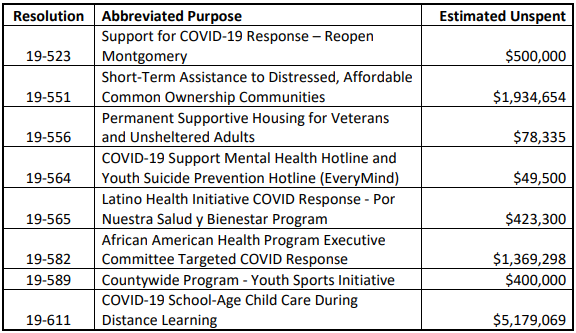
CRF [Coronavirus Relief Fund] monies received by Montgomery County must be spent on costs incurred on or before December 30, 2020. Since March 2020, the County Council has enacted special appropriations to help Montgomery County residents and businesses endure the pandemic and its effects. Due to the restrictions on spending imposed by Congress, the Administration expects that $9,934,156 in CRF dollars will be unspent based on current spending patterns and demands. The list below details the special appropriations where funds will likely go unspent.

The table below shows the $9.9 million in unspent federal money by assistance program. The three biggest programs are child care, assistance to distressed common ownership communities and African American health care.

So it appears that families needing child care, residents of distressed common ownership communities and African Americans needing health care may not be getting the federal grant money the council allocated to them. (They might not be completely out of pocket as the executive has recommended the use of county reserves to help.) That said, the $9.9 million in federal grant money still needs to be used by December 30 or forfeited. What’s the administration’s plan for that?

The executive branch sent the council a resolution that says essentially: trust us. The resolution suggests a number of alternate uses for the federal grant money and then says this:

If any of the $9,934,156 is unable to be spent on the Council priority uses identified above in advance of the deadline established by Congress, these funds may also be used for any eligible expense previously authorized by the Council by Resolution 19-498.

And what does Resolution 19-498 authorize? Lots of things, including this:

Payroll expenses for public safety, public health, health care, human services, and similar employees whose services are substantially dedicated to mitigating or responding to the COVID-19 public health emergency, including any pay differential provided to employees responding to the public health crisis. [Bold added for emphasis]

Last Tuesday, the council approved the executive’s resolution to allow a potential transfer on an 8-1 vote with only Council Member Andrew Friedson dissenting.

And so federal grant money set aside by the council for families needing child care, residents of distressed common ownership communities and African Americans needing health care is now subject to diversion to pay off part of the soaring emergency pay liability created by the executive. But even if that happens, it’s not the end of the story. There is only $9.9 million in unspent federal money in play here whereas the total emergency pay liability accounts for $4 million a pay period, or $100 million a year. A reallocation would buy the county about five weeks of time. After that, the liability resumes spraying red ink.

What will happen next as the day of reckoning draws near?

Share

Dorfman Out at Liquor Monopoly

By Adam Pagnucco.

According to a mass email sent by Deputy Chief Administrative Officer Fariba Kassiri, Alcohol Beverage Services (ABS) Director Bob Dorfman is leaving his position effective today. The email is reprinted below.

*****

Subject Line: Bob Dorfman/Acting ABS Director

From: Kassiri, Fariba
Sent: Monday, December 14 2020
To: #ABS All
Cc: #MCG.Department and Office Directors; #MCG.SeniorEAAContacts; #MCG.Legislative Branch Directors

ABS Employees,

Effective today, Bob Dorfman will be moving on from his position as Director of Alcohol Beverage Services. On behalf of the County Executive, I want to thank Bob for his 4 years of service to Montgomery County Government and acknowledge his significant accomplishments during that time. ABS would not be the success it is today without his leadership and vision. I thank him for his many contributions and wish him well in his future endeavors.

Kathie Durbin will be Acting ABS Director until a permanent director is appointed.

*****

It’s difficult to describe just how badly the liquor monopoly was doing when Dorfman, a former Mariott executive, was hired to run it four years ago. The monopoly had suffered critical delivery outages in the week between Christmas and New Year’s two years in a row. It was riddled with crime and abuse, with employees skimming booze and selling it for cash, driving drunk in county trucks and running the warehouse with sticky notes. Licensees were so upset at the monopoly’s failures, especially with regards to special orders, that Delegate Bill Frick (D-16) introduced a bill to allow county voters to end it. (I organized a coalition to support Frick’s bill.)

Dorfman’s success was to do what prior leaders had promised to do for years: run the organization like a business. Even some of the monopoly’s harshest critics conceded that, under Dorfman, the department’s delivery accuracy and service improved. Special orders were still an issue but there were no more week-long outages during holiday periods. Dorfman’s performance was good enough that pressure to abolish the monopoly eased off, at least for a little while. One caveat: Dorfman’s pursuit of the bottom line was great for the monopoly but not always for licensees. He instituted a new bottle fee for licensees at county liquor stores and blocked reform passed by the General Assembly to allow private stores to sell spirits.

Dorfman was also an aggressive defender of his organization, going after both Council Member Hans Riemer and Seventh State founder David Lublin in public. When Riemer found out that county liquor stores were losing money and suggested shutting them down, Dorfman called him “ill informed” and said he “obviously doesn’t care much” about county employees. No other department head has said such things about a sitting Council Member in recent memory!

Departing department directors often take extended departures, with their last days scheduled for weeks or months after their announcements. That’s not the case with Dorfman, who is out effective today. That makes me wonder whether he is leaving on good terms with the administration. In any case, his example offers a lesson: if the county wants the liquor monopoly to perform like a business, it has to hire someone to run it who knows how to run a business. Dorfman was that guy. We shall see if County Executive Marc Elrich heeds that lesson when hiring Dorfman’s successor.

Share

Trump vs Hogan: Votes by MoCo Town

By Adam Pagnucco.

In what amounts to an early Christmas for this number cruncher, the State Board of Elections has released precinct voting data for candidate races and ballot questions. We are going to have a lot more of this in coming days, but here is a very quick cut comparing outgoing (yes, outgoing) President Donald Trump with Governor Larry Hogan.

In the 2020 general election, Trump received 19% of the vote in MoCo. In the 2018 general election, Hogan received 44% of the vote in MoCo, probably the highest percentage for a Republican in a MoCo gubernatorial general since Spiro Agnew won the county in 1966.

In comparing the two, there are two caveats. First, the electorate in the 2020 general election (more than 517,000 voters in MoCo) was bigger than the electorate in the 2018 general election (413,137). That means these are different groups of voters, although the Democratic percentage of the electorate in 2020 (64%) is about the same as in 2018 (65%). (The state has not released official turnout numbers yet for 2020, making these numbers approximate.)

Second, 2020 precinct level data includes all voting modes whereas 2018 included election day votes only. Election day votes accounted for 61% of all MoCo votes cast in the 2018 general election, and the Democratic percentage of the electorate (61%) was lower than the Democratic percentage of other voting modes (71%). That skews the 2018 precinct results in Hogan’s favor a bit. Hogan won 47% of MoCo’s election day votes whereas he won 44% of MoCo’s general election votes overall.

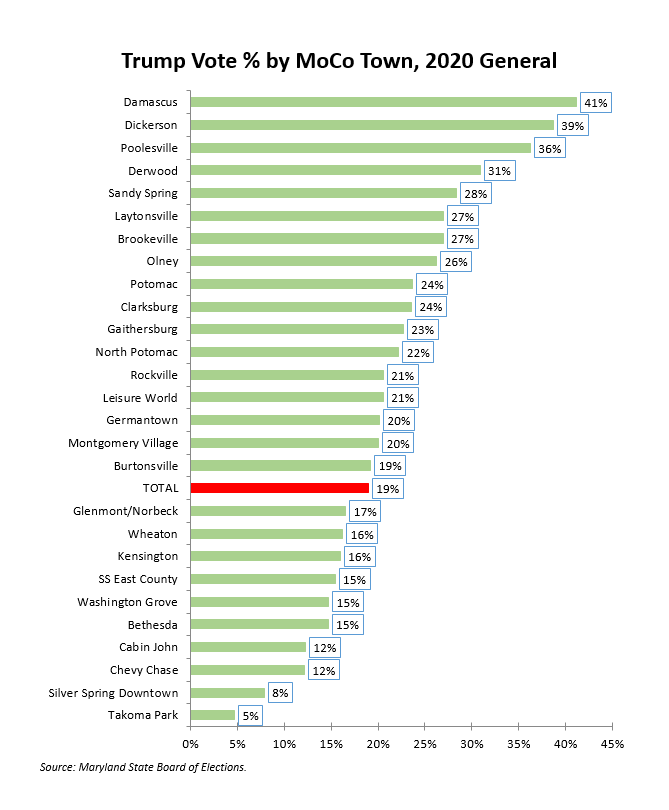
All of the above said, the chart below shows Trump’s vote percentage by MoCo town in the 2020 general election.

These results are predictable. Trump only won one precinct out of MoCo’s 258 precincts: 12-1 in Damascus, where he tallied 962 votes vs Joe Biden’s 926. Trump did particularly badly in the Democratic Crescent, pulling in the teens and single digits there.

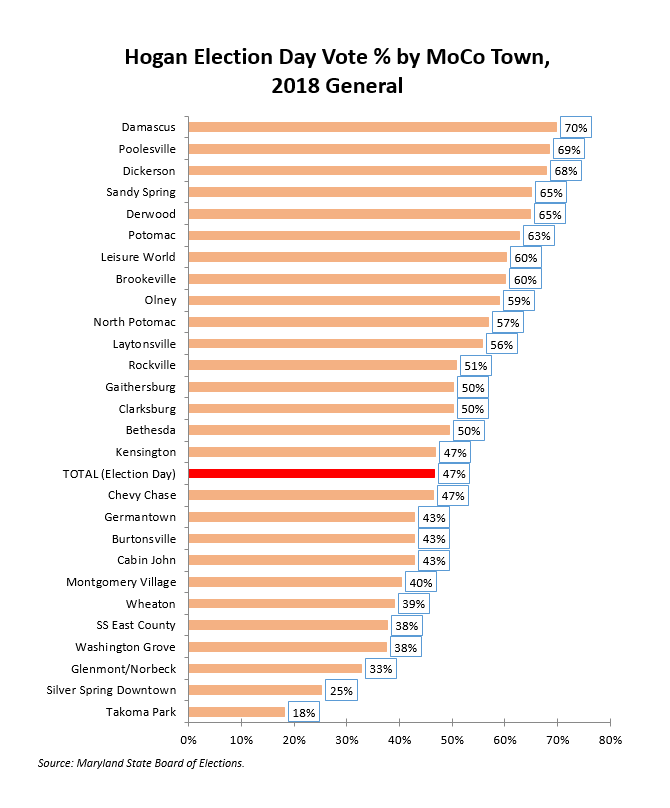
The chart below shows Hogan’s election day vote percentage by MoCo town in the 2018 general election.

In terms of election day votes only, Hogan won many areas in MoCo. Even if other voting modes were included, Hogan probably won in Brookeville, Damascus, Derwood, Dickerson, Laytonsville, Leisure World, North Potomac, Olney, Poolesville, Potomac and Sandy Spring. Hogan’s overall loss in MoCo was due to lopsided defeats in Silver Spring and Takoma Park, not to geographically broad unpopularity.

This goes to show that a fiscally conservative, socially agnostic and politically strategic Republican can get a lot of votes here, especially in upcounty. But Trumpism is a huge loser in MoCo.

Share

MCEA to School Board: Reopening Should be Safe

By Adam Pagnucco.

In a letter written to the school board today, Montgomery County Education Association (MCEA) President Chris Lloyd called for a number of measures to ensure that any reopening of schools would be as safe as possible.  Among those measures are the installation of effective air handling systems in every classroom, a health and safety committee at every school, strict social distancing, personal protective equipment and a choice of work location for educators.

Lloyd’s letter is reprinted below.

*****

December 11, 2020

Sent Via Email

Office of the Board of Education
Montgomery County Public Schools
Carver Educational Services Center
850 Hungerford Drive, Room 123
Rockville, Maryland 20850

Dear President Wolff and Members of the Board of Education,

I write to you today on behalf of the Montgomery County Education Association in relation to the Tuesday, December 15, 2020 Board of Education meeting, and the discussion/action around the return to physical workspaces.

We affirm the value of in-person learning, in support of the needs of our young scholars and their academic and social-emotional well-being. We call upon you to demand that our state and county leaders make the required investments in physical workspaces and institute policies to curb the significant community spread of this virus.

All of us need to be advocating for policies and funding needed for the safe schools our communities deserve. There is a fierce urgency in this work, so that we can return to schools as soon as possible. It is incumbent on policy makers to prioritize public education and the safety of adults and children in our care, not through proclamation, but through investment and policies.

We want to return to school safely and soon, and we can do this by stopping the rampant community spread, and by simultaneously providing proper health and safety protocols at the worksite. Acting immediately on these two items will allow our schools to thrive.

We have the knowledge and understanding of how to stop community spread. We’ve seen countries such as Australia institute polices that not only bent the curve of transmission but caused a precipitous and effective drop in cases and deaths, which allowed for safety in a community and its schools. Stopping the rampant community spread in our community is a matter of public policy and will, and it can be done if we decide to do so.

We have the knowledge, understanding and the resources to make workplaces safe. The Silver Diner in Rockville safely uses UV light in its air handling to eradicate the virus, and transmission there is significantly lower than average. Other worksites such as grocery stores have installed plexiglass barriers, used face masks and face shields, while simultaneously and significantly increasing the air exchange rate and air filtration in their buildings, aggressively moving air up and out of the building. These are examples of ways critical and essential businesses are seeking to eradicate the virus in their buildings. For one of the wealthiest counties in the nation, with $184 million in CARES Act funding, there is an obligation to act in this way in our public buildings.

We believe schools are essential, and therefore deserve essential funding to make the buildings and the inhabitants safe. Instituting a paycheck protection program for county businesses will allow us to stop the spread, and to open up the most important buildings for our children – our schools. By prioritizing schools and protecting our most vulnerable workers, we can both control the virus, keep our economy strong, and invite students back into buildings.

We call on the immediate funding and installation of effective air handling systems in each classroom, that provide for necessary air transfer, filtration and virus eradication.

We call for a laser focus on instruction, that educators can teach either online or in buildings, so that we can meet the needs of young scholars in our care and focus our efforts either in-person or online.

We call for Health and Safety Committees at each school, to look after the physical and emotional security of our students.

We call for every inhabited space in our schools to have the safety we’ve come to know and expect, and just like other emergencies, for educators to have the ability to remove themselves and their students from life-threatening situations.

We call for strict social distancing measures and needed PPE so that we can protect our children, families and staff.

We call for the choice of work location for educators, either remote or in-person, so that we can meet the needs of our teachers, and all of the children in their care.

All of this is possible with action now, so that we can bend the pandemic curve and have our buildings safe for occupancy. It will require funding and policies that make clear the top priority of this community is its schools and other people’s children. Fierce urgency and moral courage demands nothing less.

We alone cannot make our schools safe. We alone cannot stop the rampant spread of the virus. But we can lead the efforts to make this happen. It took weeks, and not months, for other countries with strict policies to bring the spread of the virus under control. It took investment by a community to make workplaces safe. We should do the same, demand the same, and then return to school safely and soon after executing such policies and infrastructure investments.

Sincerely,

Christopher Lloyd, NBCT

President, MCEA

Share

Come On Now

By Adam Pagnucco.

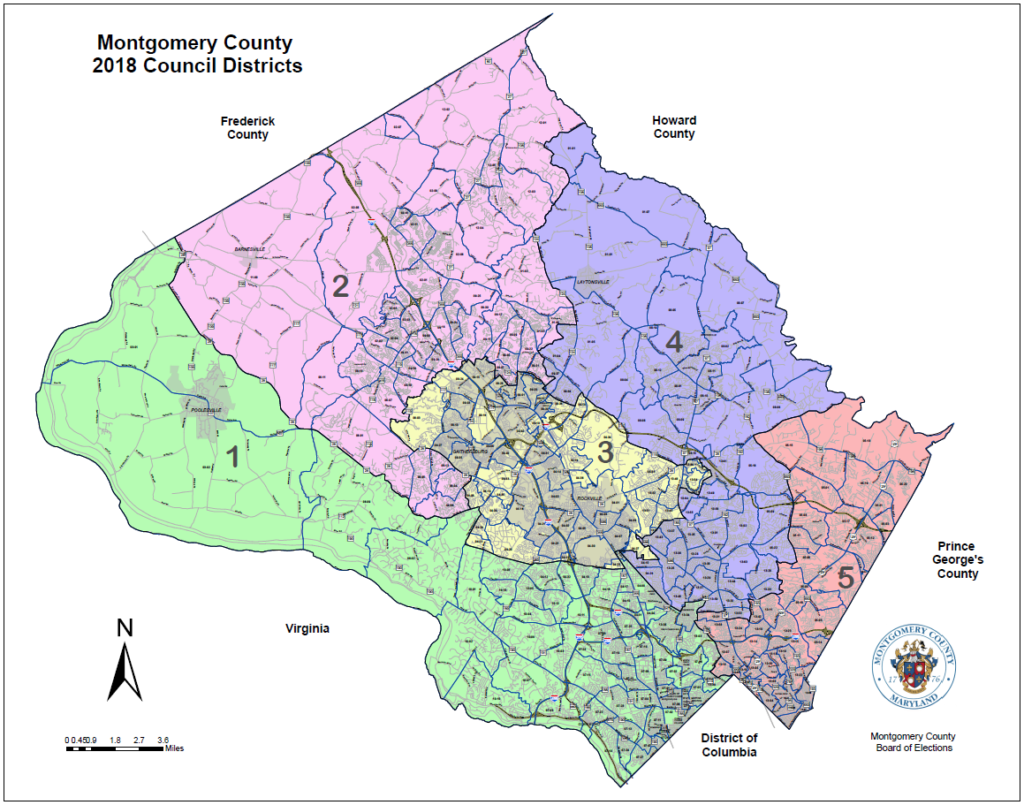
MoCo is about to embark on one of its most important tasks of the decade: redrawing county council districts. The county’s charter mandates redistricting every ten years in line with the release of new U.S. Census data. The charter also states that the council must pick a redistricting commission to recommend new boundary lines (although the council retains the final say). The current redistricting will be particularly intense given the recent passage of Question C, which expanded the number of districts from five to seven.

MoCo’s current county council districts.

More than 100 people applied to be on the 11-member redistricting commission and 32 were scheduled for interviews. The interviewed applicants include:

1. Two former elected officials, including one who used to be a council member and has run for two different offices in the last five years.

2. Five other former candidates for office, including one who has run for office seven times since 2009. Three of these former candidates have run at least once since 2018.

3. Two political consultants, one of whom has worked for MoCo politicians, including sitting council members.

4. Two spouses of sitting municipal elected officials. Both of these officials unsuccessfully ran for higher office before being elected to their current positions. One of the spouses also ran for office, including for council in 2017-18.

5. A sibling of a 2018 council candidate who has managed multiple local political campaigns.

These are not bad people. To the contrary, most – if not all – of them have done good things and can serve the county well in other roles. But the redistricting commission is a critical body that will play a key role in designing council districts for the next decade. The importance of this exercise to county residents cannot be overstated. The public interest should be the sole determinant of redistricting. Given the fact that the public is watching how this plays out:

It would be wise to avoid the appearance of a candidate designing his or her own district for a future run.

It would be wise to avoid the appearance of a political operative designing a district for a client.

It would be wise to avoid the appearance of a commission member designing a district for a family member.

Redistricting is an official and supremely important act of county government but it’s also a very sensitive one. Many people are jaded about “gerrymandering” and the county just had an all-out ballot war over the appropriate number of council districts. I can’t count how many times I have seen the word “machine” used to describe the county’s politics this year. In this climate, it won’t take much to get people to believe the worst about redistricting, and given the recent popularity of charter amendments, who knows how far such sentiment could go.

There are plenty of qualified applicants who could do a good job and don’t have any of the above issues. Come on now, council members! Please consider them when choosing who serves on the redistricting commission.

Share