All posts by Adam Pagnucco

Purple Line Transit Partners Announces Timeline for New Contractor

By Adam Pagnucco.

Purple Line Transit Partners (PLTP), the consortium partnering with the state to build the Purple Line, has announced a timeline for selecting a new design-build contractor to complete the project. The previous contractor left the project in November. PLTP’s press release is reprinted below.

*****

For Immediate Release
January 8, 2021

Contact: John Undeland
Purple Line Transit Partners

Purple Line Transit Partners Takes First Step in Procuring a New Design-Build Contractor

Riverdale, MD – In collaboration with the Maryland Department of Transportation (MDOT) Maryland Transit Administration (MTA), Purple Line Transit Partners (PLTP) today took the first step in engaging a new design-build contractor to complete the project. PLTP shared a Request for Qualifications (RFQ) with a host of highly qualified contractors that had previously expressed interest in being considered for the work.

As per the settlement agreement approved by the Board of Public Works on December 16, PLTP is responsible for procuring the replacement contractor. During the weeks since the terms of the settlement were agreed to, PLTP and MTA have been working closely to prepare the RFQ.

“Today marks the start of a sprint to bring on a new contractor, enabling us to swiftly resume full-scale construction and deliver the Purple Line to the people of Maryland as soon as possible,” said Jane Garvey, Chairman of PLTP. “We again thank Governor Hogan, Secretary Slater, Administrator Quinn and our MTA Purple Line counterparts for helping us get to this milestone and for their participation in the rapid-paced process going forward.”

“A great deal of progress has been made on the Purple Line since the Board of Public Works approved the settlement agreement three weeks ago,” said MDOT Secretary Greg Slater. “We have an in-depth construction plan in place during this interim period, and today’s solicitation for qualified, experienced design-build firms represents another positive step in advancing this important project to completion. Every step and investment that we make during this interim period is designed to create value on the rebid.”

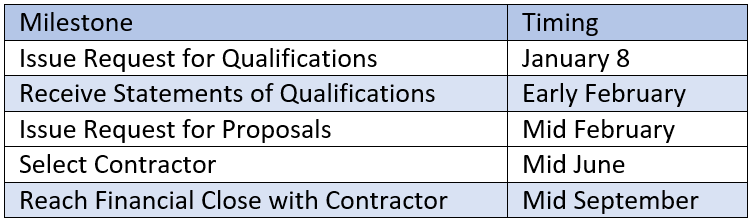
The following are the key milestones in the procurement process. After reaching terms with the selected contractor, PLTP anticipates a rapid mobilization and full-scale construction to resume as quickly as possible:

Purple Line Transit Partners is headquartered in Riverdale Maryland and holds the Public-Private Partnership Agreement (P3 Agreement) with MDOT MTA to design, build, finance, and operate the Purple Line Light Rail Project. PLTP is comprised of majority partner Meridiam and Star America. Meridiam is a leading equity investor, developer, asset manager, and long-term partner with $8 billion of assets under management and over eighty P3 projects in U.S., Canada, Europe, and Africa. Star America, a subsidiary of Tikehau Capital, is a U.S.-headquartered developer and manager of infrastructure assets in North America with investments in projects that have a total asset value of more than $5 billion as of September 30, 2020.

Share

Raskin Chief of Staff Writes About Attack on the Capitol

By Adam Pagnucco.

Julie Tagen, who is the Chief of Staff to Congressman Jamie Raskin, wrote the following account of her experience during the attack on the U.S. Capitol this week. We are reprinting it with her permission.

*****

Friends, here is my story of what happened to me yesterday. I am writing this because the process is cathartic for me, and I don’t want to EVER forget the details of January 6, 2021. Forgive me, it’s a long read.

As most of you know, I am Chief of Staff to Representative Jamie Raskin, who had an unbearable family tragedy on December 31 when he lost his beloved son Tommy. You may also know that Jamie is a constitutional scholar, and Speaker Pelosi gave him the high honor of being one of the four key players during the electoral college vote on the House floor.

The day started out normal. I picked up Jamie and drove him to work (masks on, windows down). We live near each other, and pre-COVID, were daily commuting partners. As we drove on 3rd Street NW in front of the Capitol, we could see people with Trump, QAnon and Confederate flags milling around and heading toward the White House (or so it seemed).

We went up to our office in the Rayburn House Office Building, where Jamie worked on his speech in preparation for his big day. Jamie’s family wanted to be with him and see him in action on the floor, so they decided that his daughter, Tabitha, and his son-in-law, Hank, would come to the Capitol. Jamie’s other daughter, Hannah, and Tabitha’s boyfriend, Ryan, would watch the proceedings at home with Jamie’s wife, Sarah. At around noon, Jamie and I walked to the Capitol through the tunnels, the only direction that Capitol Police had ever given us for this momentous day, to meet Tabitha and Hank in a ceremonial room off the House floor. The wonderful staff of Majority Leader Steny Hoyer gave us the Hoyer ceremonial office (H-219) for the week so Jamie could have privacy in his time of mourning and be closer to the House floor.

This is when things began to get crazy; a lot is still hazy to me. The Joint Session started at 1 p.m. The plan was that shortly before Jamie was to speak on the floor, at around 1:30 p.m., Tabitha and Hank would be taken to one of the viewing galleries by security (this was a special privilege, as only Members of Congress were permitted in these galleries during the Joint Session). Jamie left for the floor, which was around 50 feet from our door, and Tabitha, Hank and I started looking out of the large office window at what was taking place outside.

Our windows faced the West Front of the Capitol, in the direction of the Washington Monument. All of the major news channels were showing the activities on the floor, so we only received information about outside activities through Twitter and information other friends and staffers were sending us. Tabitha, Hank and I knew something was very wrong. Our view was slightly obstructed by the inaugural scaffolding and platform, but it was clear that the crowd was getting bigger and more aggressive and there definitely were not enough Capitol Police officers. We could see them taking one or two people away in handcuffs, and smoke, likely tear gas, covering the growing crowd.

After everything the Raskin family had been through over the course of the last week, it became my goal to keep Tabitha and Hank as calm as possible. I told them that we were very safe, that we would be protected, and that there was absolutely no way that anyone could get into the Capitol. I said that because I truly believed it. I was on the Hill in 2010, when the ACA passed and loonies were roaming the halls of the House office buildings since they were open to the public. I figured since the buildings were closed due to COVID, we would be safe. It never once entered my mind that something bad could happen.

I had my laptop on my desk and started getting large pop-up alerts on my screen. I first saw that the Madison Building of the Library of Congress was evacuated. This was concerning, but it seemed like things were under control. Although the floor activities were on the office’s large TV, Tabitha, Hank and I could not stop looking out the window at the chaos outside. At this point, it began to look like mayhem. Scores of angry white men with Trump and Confederate flags stomped around, clad in camouflage and flak jackets.

Despite the mobs outside, Jamie was scheduled to speak on the floor around 1:30pm. Jason Gandolph, a member of Capitol Police Security, came by and said that he could take Tabitha and Hank one floor up to the viewing gallery. They left just as I got an alert that the Cannon House Office Building, where Member’s offices were located, was being evacuated. Jason came back and said, very calmly, that the Capitol was about to go into lockdown. They would have to lock us in the room once Tabitha and Hank returned from the gallery.

Once they came back, Tabitha, Hank and I looked out the window again. We could see that the rioters had gotten onto the inaugural platform and were climbing the scaffolding. The police, who did not have riot gear on, remained below. At one point, it looked like they were trying to move forward, and then it looked like they were retreating; one thing was clear –they were not handling or controlling the mob. We watched as one of the barriers was broken down or opened by police and a rush of rioters headed on West plaza toward the Senate side of the building. I assumed by letting them rush the Senate side that it was a strategy to arrest or disperse them. There was a strong line of police holding off the mob from the plaza’s House side. On TV, the electoral proceedings were still taking place, so I figured things couldn’t be that bad.

Suddenly, we started getting alerts on the computer and our phones. Calls and texts from team members came pouring in: the Capitol had been BREACHED!! The House floor was quickly adjourned. The alerts told us to turn off all sounds in our offices and to take cover. Tabitha and Hank crammed under Steny Hoyer’s desk, and I took the chairs in the room and barricaded the door.

I was looking out of the side window at the chaos. I began to panic inside at the thought of the Raskin kids being traumatized again and what was happening to them after everything they’d been through. Outwardly, I was calm. I told Tabitha and Hank that we would be okay. Inwardly, I wanted to crawl up in a ball and hide. I was scared.

Perhaps it was the adrenaline or the reality of the moment, but I had an epiphany, for lack of a better word. I was trapped in a room with a giant photograph of John Lewis on the wall and a bust of Abraham Lincoln on the fireplace mantel. I said to myself, and perhaps out loud, “These people are TERRORISTS, They cannot win.” Some who know me might say that at that moment, I got my “Philly On!!” I gathered anything in the room that I could use as a weapon and put them by the door: a fireplace stocker, busts, a bronze award of a buck with large and pointy horns.

By then, the terrorists had made their way into the Capitol. We could hear their heavy footsteps outside our door as they tried to breach the House floor. We could hear them chanting, “USA, USA!” and “We want Trump!” and “Stop the steal!” We could hear them trying to ram the door of the House Chamber just a few feet away. There were bangs all over the place. Someone jangled our door handle. I picked up the heaviest item I could find (not sure why), the bronze buck bust, and stood in front of the door, waiting for them to arrive.

I started receiving texts from Jamie, who had been evacuated from the House floor, asking if we were okay. I lied and told him we were fine, because I didn’t want to worry him too. I also started getting calls from Pelosi’s floor staff, who were trying to locate and evacuate us. Texts started arriving from friends all around the country, asking if I was okay. I only told a few close buddies how terrified I was. I talked to my wife, De, very quickly, and told her that we were safe and fine. I asked Hank if it was convincing enough.

After what felt like 30 minutes, the chants began to die down. I could hear police in the hallway. They knocked on our door and told us they were there to help. Tabitha and Hank got out from under the desk. We all looked at each other and said nothing. There was a delay to get us out as a result of being locked in – and I hadn’t remembered that I had locked the 3 inside locks too. Five Capitol police officers opened the door. It was clear they were amped up. The said “Let’s Roll!!” and whisked us through the tight stairwells of the Capitol and we finally made it to the “secure location” where we were joyously joined by a super-relieved and grateful Jamie. In the secure location, everyone was exhausted and there was little food or water. Little by little small food items were handed out: Goldfish crackers, berry gummies, Skittles. After four hours, pizza and drinks arrived. I pretty much survived that night on candy and Diet Coke.

At around 9:15 p.m., I was able to get Tabitha and Hank a ride home to Maryland. I stayed with Jamie until the end until 4:00 AM. It was an honor and a privilege to be in the Capitol when Joe Biden and Kamala Harris were declared winners, and the next President and Vice President of the United States. I arrived back home a little past four in the morning.

I am still processing all of this but I could never imagine this happening to the US Congress.

There is a long list of people that helped me through the day. I hope you know who you are, and I thank you from the very bottom of my heart. More formal thanks will come later.

Share

Mizeur Threatens to Run Against Harris

By Adam Pagnucco.

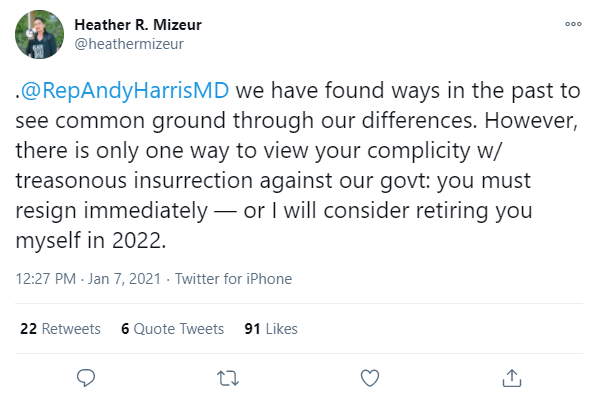
Former District 20 Delegate Heather Mizeur, who once represented Silver Spring and Takoma Park but now lives on the Eastern Shore, has told District 1 Congressman Andy Harris to resign or face a possible challenge. Mizeur wrote on Twitter, “You must resign immediately – or I will consider retiring you myself in 2022.”

Mizeur is a strong progressive who finished third in the 2014 Democratic gubernatorial primary. Harris’s district was gerrymandered to elect a Republican a decade ago but its boundaries could change in the coming redistricting. Harris made news by objecting to President-Elect Joe Biden’s electoral votes in Congress and nearly starting a brawl on the House floor.

Mizeur’s tweet appears below.

Share

MoCo Republicans Condemn Violence at the Capitol

By Adam Pagnucco.

Moments ago, the Montgomery County Republican Party issued the statement below.

Statement from MCRCC Chairman Reardon Sullivan:

Today’s rioting and violence in our nation’s capital is an absolutely devastating development during a time of historic upheaval and unrest.

The Montgomery County Republican Party unequivocally and wholeheartedly condemns all acts of lawlessness, rioting, and violence and disavows the actions of those demonstrators who illegally entered the U.S. Capitol Building. While we support peaceful protest, we reject any attempt to disrupt Congress’s certification of the election results. Congress must be allowed to conduct its business uninterrupted.

This is not who we are…

Share

The Top Twenty Seventh State Posts of 2020, Part Two

By Adam Pagnucco.

Yesterday, we listed posts 11 through 20 in terms of page views for the year 2020. Here are the top ten.

  1. Volcano in Rockville

In the wake of former Chief Administrative Officer (CAO) Andrew Kleine’s admitted ethics violations, County Executive Marc Elrich wanted him to stay in his job. But the county council was outraged by the scandal and exploded in public fury. The council’s anger wound up forcing Kleine out and opened the door to the ascension of the new CAO, former county budget director and state senator Rich Madaleno.

  1. Repeal the Linda Lamone for Life Law

The problems with the 2020 primary election prompted this historical post summarizing why the state has a law protecting its elections administrator, Linda Lamone, from accountability. Comptroller Peter Franchot and Lieutenant Governor Boyd Rutherford called for Lamone’s resignation but she survived for the thousandth time. Thankfully, the general election was a smoother affair than the primary.

  1. Sitting Judges Get Temporary Restraining Order Against Pierre
  2. Progressive-Backed Judge Candidate Courted, Donated to Republicans
  3. Judge Candidate on Floyd Cops: “Lock Em Up”

It’s fitting that these three posts finished back-to-back-to-back because they all concern the nastiest judicial election in recent MoCo history: the challenge by attorney Marylin Pierre to four sitting judges. This one had a LOT going on: partisanship, charges of racism, charges of lying and even a temporary restraining order. The whole thing cast a foul odor over the ballot box and led me to conclude that judicial elections should mostly be abolished.

  1. Harris Blasts MCEA Over School Reopening

School board elections are mostly sleepy affairs in which candidates agree at least 90% of the time and the only difference between them is which ones are endorsed by the Apple Ballot and the Post. Not this year! MCPS’s boundary study dominated the primary and school reopening took the spotlight in the general, with Lynne Harris (the Post’s candidate) blasting the teachers union for allegedly resisting reopening. Harris told Blair High School’s Silver Chips newspaper that the teachers “were obstructionist, inflammatory, and just said ‘no’ to everything.” That provoked a furious response and the teachers are unlikely to forget it.

  1. What’s More Important? The Liquor Monopoly or a Thousand Bartenders?

Early in the COVID crisis, Governor Larry Hogan gave counties discretion to allow restaurants to offer takeout and delivery of mixed drinks. Many other states and the City of Baltimore allowed it, but MoCo’s liquor monopoly did not. The issue prompted a mass revolt by restaurants and consumers and the county ultimately allowed it.

  1. IG Investigates “Overtime Scam” in the Fire Department

County Inspector General Megan Davey Limarzi blew the lid off county government with her landmark report on an overtime scam in the fire department. The scandal involved more than $900,000 of overtime which exceeded limits set by the fire chief and was scheduled outside of the system usually used by county public safety agencies. Readers were all over this but I have not heard of anyone being disciplined for it. As of this writing, this is the sixth most-read post in the history of Seventh State measured by page views.

  1. Restaurant: My Staff Will Not Wear Face Masks

Last July, The Grille at Flower Hill in Gaithersburg posted this on Facebook: “Let me be very clear…my staff will not wear face masks while working here at the Grille. If that bothers you then please dine elsewhere and please try to find something more important to occupy your time such as volunteer at a nursing home or soup kitchen. Whoever you are that filed the complaint, you need to take a good look in the mirror and try to find some real meaning in your life.” The post provoked a huge firestorm from irate customers resulting in the permanent closure of the restaurant four days later. As of this writing, this is the fifth most-read post in the history of Seventh State measured by page views.

  1. MoCo Democrats Issue Statement on Ballot Questions

This post reprinted the Montgomery County Democratic Party’s statement on the four ballot questions. It was originally published on September 17 and initially attracted little site traffic. But it started to pop in early and mid-October and dominated page views in the latter part of the month. Most of the traffic was generated by Google searches. This provided valuable intel: thousands of people were seeking out what the Democratic Party had to say about a group of arcane and confusing ballot questions. And if they were coming to Seventh State, they were no doubt also visiting other sites with similar information like news outlets and the party’s own site. In the end, it seems likely that the party was the dominant force in driving voter reaction to the ballot questions as its positions carried the election by double digits. It was also a huge boon to us as this post ranks third in page views in the history of Seventh State.

On to 2021!

Share

The Top Twenty Seventh State Posts of 2020, Part One

By Adam Pagnucco.

The year 2020 was hugely eventful for the entire world and MoCo was no exception. In our county, 2020 saw a public health crisis, a resulting economic crash and huge challenges to our quality of life. In political terms, it also saw unusually contentious elections for school board and circuit court judge, four historic ballot questions and numerous fights inside county government. We wrote about it all on Seventh State. Here are the top twenty posts measured by page views from the people who count the most – YOU, our readers.

  1. Miscreants Run Wild at Elrich Press Conference

This was a poorly organized public event gone wrong, culminating with an unmasked protestor getting within spitting distance of the county executive. For those who question the need for the executive to have a security detail, this is Exhibit A for why it can be necessary.

  1. Elrich Vetoes WMATA Property Tax Bill

County Executive Marc Elrich’s first veto, this one targeting a council-passed bill giving Metro station developers 15-year property tax breaks, set off a fight on corporate welfare that has not ended by a long shot. That will prove especially true if a proposal by the planning staff to grant tax abatements to other properties near Metro stations advances.

  1. The Squeaky Wheel and Inequities Hiding in Plain Sight

MoCo PTA Vice-President Laura Stewart wrote this guest blog on inequities in MCPS’s capital budget. It’s a must-read for everyone who cares about school construction.

  1. Will MCPS Reopen?

In early November, MCPS told the public that it was planning a phased-in reopening of schools for some in-person instruction. But the winter surge of COVID quickly overtook that plan and cast the timing of reopening in doubt. The issue is still unsettled.

  1. MCEA: MCPS Reopening Plan “Wholly Inadequate” to Protect Students and Staff

Back in the summer, MCPS’s original reopening plan was drenched in controversy, ultimately resulting in a pitched battle with the county teachers’ union (MCEA). MCPS wound up going with virtual learning for the fall, like most other large school systems in the region, but the mechanics and safety of reopening are still subjects of debate.

  1. What Happened to White Flint?

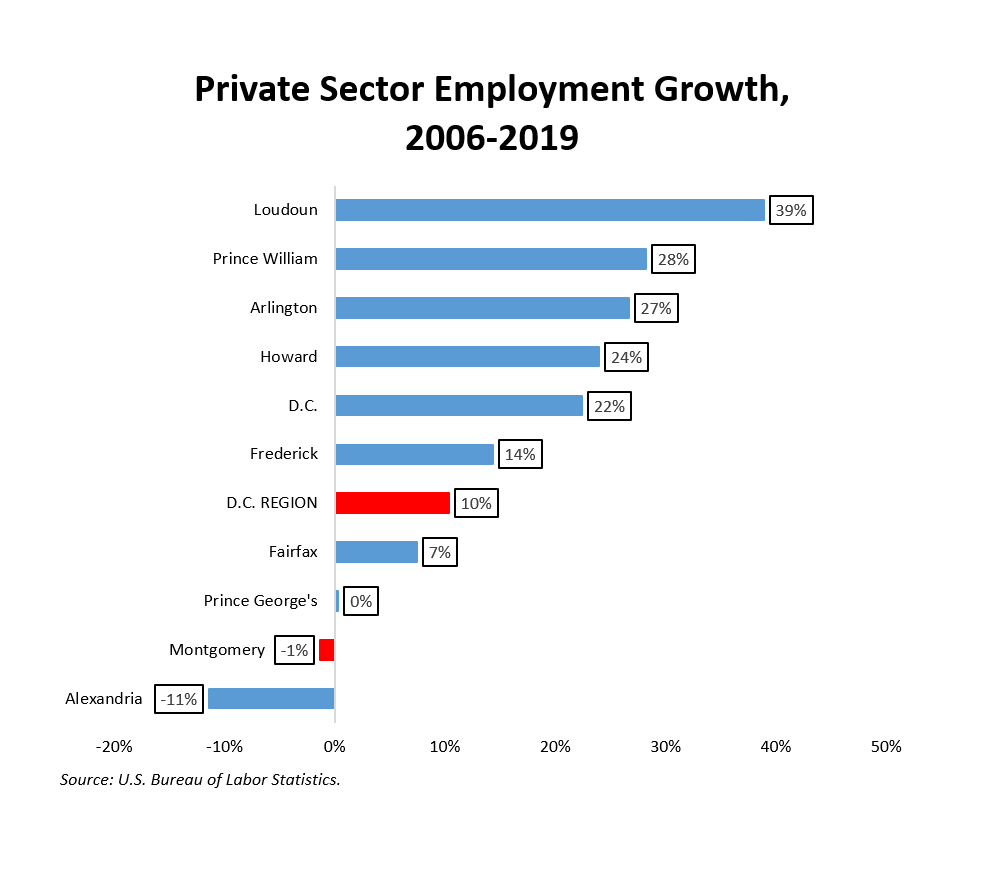
Jobs, jobs, JOBS. According to White Flint developers, MoCo’s slow rate of job growth was one reason that they could not get financing to proceed on the county’s preeminent development plan. The chart below says it all. And when the COVID pandemic finally ends, county leaders must dedicate themselves to creating jobs, Jobs, JOBS or MoCo’s stagnation will continue.

  1. Baltimore City’s Election Has a Problem

Back in June, incumbent Baltimore City Council Member Zeke Cohen, who had a big lead in money and endorsements over his challenger, appeared on election night to be getting just 2% of the vote. That was the first sign of a primary gone wrong, which led to many misgivings about the state’s processes with mail ballots and the performance of its long-time election administrator Linda Lamone.

  1. Why Montgomery County Ballot Questions B and D Are Truly Bad Ideas You Should Vote Against

2020 was a year of surprises, and one of the bigger surprises was the emergence from political retirement of former County Executive Ike Leggett. Question B (Robin Ficker’s latest anti-tax charter amendment) and Question D (nine council districts) disturbed Leggett enough that he started a ballot issue committee to defeat them. This post was Leggett’s guest column on why they were bad ideas and it got a big reaction from our readers.

  1. Teachers Respond to Lynne Harris

After school board candidate Lynne Harris blamed MCEA for allegedly resisting school reopening (a post that also appears on our top 20 list), a group of rank-and-file teachers pushed back in this guest post. It achieved wide readership that was probably concentrated among teachers as the general election approached.

  1. Free-For-All

In non-COVID news, 2020 was the year that the county’s police department (along with departments around the country) became a political football. This post describes how the executive, the county council and Annapolis all jumped into the issue of policing with little coordination. Lost in the debate was the central fact that crime in MoCo is at its lowest level in decades. Policing will continue to be a hot topic in 2021.

Tomorrow we will list the top ten Seventh State posts for the year!

Share

Top Seventh State Stories, December 2020

By Adam Pagnucco.

These were the top stories on Seventh State in December ranked by page views.

1. What Happened to White Flint?
2. The Day of Reckoning is Near
3. Jawando Calls for a Tax Hike
4. Come on Now
5. Who’s the Boss?
6. MCEA to School Board: Reopening Should be Safe
7. Trump vs Hogan: Votes by MoCo Town
8. Council Overrides Veto, Attacks Elrich, Cuts Revenue for School Buildings
9 (tie). Minority Members of the U.S. House
9 (tie). Corporate MoCo Council Adopts Supply-Side Economics

The top three stories fit together and have meaning for the new year and beyond. The Day of Reckoning is Near summarizes the county’s dire fiscal picture as it heads into a challenging FY22 budget discussion in the spring. Jawando Calls for a Tax Hike kicks off an inevitable dialogue about taxes, one which will only get hotter before the executive makes his budget recommendation on March 15. And What Happened to White Flint? – December’s runaway winner – lays out the story of how the county’s premier development plan has been held back by our slow rate of job growth. Budget headaches, taxes and economic problems are about to collide.

Welcome to 2021, folks!

Share

How Mike Miller Helped Save the Purple Line

By Adam Pagnucco.

The Purple Line is the subject of much drama today, but the truth is that the project has always been wrapped in drama and almost died several times. Indeed, it could have met its end back in 2013. The fact that it survived was a near miracle, and that is in part because of one critical person: retiring Senator Mike Miller. For the first time ever, here is the untold story of how Mike Miller helped save the Purple Line.

As the summer of 2013 approached, the Purple Line was facing a critical deadline: the state had to show the federal government that it could afford its share of the rail line’s cost to be eligible for nearly a billion dollars in federal funding. The problem was that the state didn’t have the money. Depleted by revenue declines during the Great Recession, the state’s transportation trust fund was broke. Without new money, we could never show the federal government that we could meet our part of the cost. Baltimore’s Red Line had the same problem. With no adequate state funding, the feds were bound to send their money to other projects around the country. Both the Purple Line and the Red Line would then die.

A group of advocates then put together a coalition called Get Maryland Moving to lobby for new transportation revenues. Our members included smart growth groups, environmentalists, business organizations and local governments from all over the state. We had a website, social media, press hits, lobbying, day-to-day coordination and all the accoutrements of a mass campaign, all thrown together in a few weeks. We wanted the Purple Line and the Red Line, but we understood that the rest of the state needed their projects too. Our approach was to get enough money for everyone because that was the only way new funding would pass.

Right off the bat, my contacts in the General Assembly told me that a transportation revenue increase was dead on arrival. The legislature had passed a variety of tax increases in the 2007 special session, leading to GOP gains in the House of Delegates in the following election. Nevertheless, the Democrats raised the income tax in 2012. Developer Larry Hogan, who had served in the administration of GOP Governor Bob Ehrlich, had founded Change Maryland largely on the tax issue and was a year and a half away from becoming governor. Democratic state legislators conceded privately that more transportation money was necessary, especially for the Red Line and the Purple Line, but they were extremely reluctant to raise taxes again.

We were underdogs but we had two aces in the hole.

Senate President Mike Miller

Miller seemed like an unlikely ally for MoCo as he had masterminded both an income tax increase and a teacher pension shift the year before, both of which disproportionately crushed the county. But Miller was an absolute warrior on the issue of transportation funding. He knew that the entire state had massive infrastructure needs that had no chance of getting built without more money. Ever since the state’s last gas tax hike in 1992, Miller had never stopped talking about transportation funding. As far back as 1997, Miller told the Baltimore Sun: “The money for these projects doesn’t come out of the sky… It’s going to take a tax increase. It’s a bad word, but it’s got to happen.” In 2008, Miller told me in an interview that he had pushed for a 12-cent gas tax increase, declaring, “We need to move forward as quickly as we can on mass transit.”

Miller never gave up when he cared about an issue, and he cared a lot about transportation funding. He also had no fear of Governor Martin O’Malley, who was reluctant to get out front on a revenue increase that voters opposed. In January, Miller introduced his own revenue bill and put O’Malley on the spot, telling the Washington Post, “This needs to be an initiative by the governor… It doesn’t poll well, but that’s what leadership is all about.”

To hell with the naysayers. We had Mike Miller on our side. That meant we had a shot.

Virginia Governor Bob McDonnell

Former Virginia Governor Bob McDonnell is now known primarily for his gifts scandal in 2014, which led to a conviction that was later overturned by the U.S. Supreme Court. But before that, McDonnell was a rising star in the national GOP who seemed to be going places. As unlikely as it seems now, in the world of 2013, it was not out of the realm of possibility that both McDonnell and O’Malley would someday be on the presidential tickets of their respective political parties.

In his final year in office, McDonnell put together a giant transportation funding bill, showing a level of boldness that contrasted with the reticence of his rival across the Potomac. Annapolis felt the pressure. O’Malley could not be seen as failing on transportation while McDonnell got a new funding package through a state legislature controlled by Republicans. And McDonnell did just that, scoring a huge success in late February as bipartisan majorities passed his multi-billion dollar transportation bill. McDonnell’s success in Virginia along with Miller’s constant urging prompted O’Malley to get off the bench, as he finally sent over an administration bill in early March. The train was starting to move.

But there was one more problem: Baltimore’s lawmakers were resisting the bill. We thought that the prospect of funding the Red Line gave them reason enough to support it. But some city legislators were indifferent to the Red Line, others were outright opposed, and one even told one of our organizers that the state would build it even without new money because “they owe it to us.” The city wanted something different: state school construction money to fix their aging schools. That could have meant the end of transportation funding right there as not everyone was enthralled with the idea of sending more money to Baltimore. And without the city’s votes, our bill would have died.

So state leaders cut a deal with the city: they would get a billion dollars in school construction money, financed with lottery proceeds, in return for voting for the transportation bill. The city got a great deal but the Washington suburbs got the Purple Line. (Hogan canceled the Red Line two years later, causing city leaders to cry injustice on behalf of a project that many of them never truly wanted.) O’Malley’s bill was amended and passed, generating hundreds of millions of dollars for transportation and keeping the Purple Line alive.

Raising transportation revenue required a team effort. Local governments, advocacy groups, the business community and key elected officials all played a part. But Mike Miller was absolutely critical to the effort. He was the first powerful state leader out of the box on the issue. He had talked about the necessity of raising money for transportation projects for years and years while many other politicians cowered under their desks. He wouldn’t let it go and he publicly took on a sitting governor from his own party to get the money. Having Miller in our corner gave us a fighting chance even when it looked like we would lose. When it was time to cut the final deal, we knew that he had both the desire and the capability to work with others and get it done. And he did. To this day, I believe the Purple Line wouldn’t have survived without him.

Here’s an idea. When the Purple Line opens, the state should name its station on the University of Maryland’s College Park campus for Miller. He loves the university, from which he graduated with two degrees, and he has done as much for the state’s infrastructure as any other Marylander. If anyone deserves recognition of this kind, it is surely Mike Miller.

Share

Flashback: Mike Miller Meets the Bloggers

By Adam Pagnucco.

With the retirement of Senator Mike Miller, who ruled the Maryland Senate for decades, many stories are being told of his long tenure. This is one of many records he holds: more stories are told about Mike Miller than any other Maryland politician, hands down. My contribution comes from the archives of Seventh State’s predecessor and our first blog, Maryland Politics Watch. It relates what happened the first time I met Miller.

It was January 2008. Believe it or not, there were many more state and local politics blogs back then than there are now. (David Lublin, Just Up the Pike’s Dan Reed and I are some of the rare survivors.) Blogs were new back then and they were starting to get the attention of politicians and the mainstream press. So then-Senator Rich Madaleno convened a group of us to interview the Senate President on the record in Annapolis. Besides Miller and Madaleno, Senator Jamie Raskin and Delegate Kumar Barve also attended.

I was nervous as hell. This was Mike Miller after all! I had heard the stories of how he would chew out reporters when he thought they were wrong. I knew how powerful he was. Here was a man who was elected to the legislature when I was less than a year old and became Senate President when I was a bass guitarist in a high school rock band. He knew more about Maryland politics than the rest of Annapolis put together, much less a rookie blogger like me. So I put on my best suit and my favorite tie and tried to act like I knew I what I was talking about. I hope I amused him!

The passage I reprint below comes from a three-part series I wrote called “Mike Miller Meets the Bloggers.” The issues we discussed are long settled but were hot back then: the 2007 special session, slots, drivers licenses for immigrants, comparing Governors Ehrlich and O’Malley and so on. The interesting thing about the discussion is that it shows how Miller dealt with the media. Most politicians are careful, even guarded, when they are on the record with the press. They leave themselves wiggle room. They avoid antagonizing key groups. They might strategically antagonize some others. (How many Democrats are delighted to take on the gun lobby?) They speak in generalities. You know the drill. It’s politico-speak.

That was not Mike Miller’s way. He spoke in direct, sometimes graphic language. His positions were stark and understandable to everyone. His policy positions were often stated in provocative terms. (You don’t like slots? Fine. How would YOU pay for schools??) The press didn’t have to ask him a question twelve different ways to get something interesting from him. He would get right to the point with a pithy quote – sometimes without even having to be asked. Reporters may not have liked being called out from the rostrum as he sometimes did, but he made their jobs easier by explaining his side of the story in simple terms readily grasped by readers.

Why was Miller, the ultimate politician, so different from other politicians in dealing with press? First, Miller was unusual in that he was absolutely secure in both his Senate seat and his hold on the Senate presidency. Most politicians feel at least some insecurity related to their electoral prospects but not Miller. He could fire at will. Second, Miller was a busy fellow and he did not have time – or any appreciation – for BS. His personality was direct, sometimes to a fault, and he made no effort to adjust that for politics. Third, Miller was often doing his caucus members a favor by being so blunt in the newspaper. Suppose Senator X wanted to pass a bill badly and Miller said it was dead in the Baltimore Sun. No one blamed X for not rounding up the votes; he could say, “Mike Miller killed my bill.” That made life easier for X and no amount of heat could affect the Senate President. He would just go right on being Mike Miller – a role he created and no one else could play!

We may have a few more things to say about the Senate President, but for now, I’ll reprint this column from January 2008. And I’ll leave you with this: whatever you think of him, let’s all recognize that there will never, ever, EVER be another Mike Miller.

*****

Mike Miller Meets the Bloggers, Part Two

In Part One, we laid the scene for you: on one side of the table sat the fearsome, powerful old bull, the indomitable Senate President Mike Miller. On the other side sat a gangly, geeky band of bloggers, united only by their common desire for a post-meeting trip to Ram’s Head Tavern.

A few comments on the Senate President. For more than twenty years, Mike Miller has reigned over the Senate with a gregarious combination of ego, fear and patronage. His personal magnetism is so overwhelming that he could likely charm a bird out of its nest and onto his open palm. But if the bird voted the wrong way on a must-have bill, the hapless creature would be quickly crushed and tossed to the back of the Senate chamber. This demonstrates the Miller Rule, which is a simple one: “Work with me and prosper. Work against me and suffer.” Most Democratic Senators respond to this rule predictably, although there have been exceptions.

We asked Miller a lot of questions, and he gave us a lot of answers. For the benefit of our readers, I did my best to keep up with the exchange. Following are the Senate President’s responses to a few of our prods and pokings. If anyone else in the room recollects it differently, please comment and we’ll adjust the record.

On Governor Ehrlich
A few people remember that at the beginning of Governor Ehrlich’s term, Miller was ready to establish a pragmatic working relationship with him. But that approach ran into problems. “Ehrlich was a nice guy, but he didn’t work, and the state suffered,” Miller grumbled. He was “surrounded by yes-men” and rarely came out of his office. “All he did was put bandages on things!” The old warhorse was clearly relieved to see him gone.

On Governor O’Malley
Miller gave O’Malley lavish credit for moving to act on a deficit that he inherited, even if it cost him politically. “O’Malley knew his numbers would go in the toilet no matter what he did, so he did the right thing.” Miller attacked some of the Governor’s opponents, criticizing them for being “mean-spirited” and spreading rumors. “The Governor is a very progressive person,” Miller insisted. But he warned, “This Governor, in order to get his numbers up, will have to do some things you won’t like.” As an example, he mentioned a new emphasis on crime prevention, not always the highest priority of liberals.

On Slots
As perhaps the greatest champion of slots in the state, Miller’s views are well-known. “We have got to have that money!” he cried. The Senate President predicted that a possible recession would hurt tax revenues, thereby making slots money all the more necessary. “We need to get the slots bill passed whether you like it or you don’t like it!” Miller thundered. So in case you were wondering if Mike Miller had changed his mind on slots, the answer is NOPE!

On Transit
I asked Miller if he had a choice to fund the Washington suburbs’ Purple Line or Baltimore’s Red Line, but not both, which of the two he would pick. I was sure he would dodge this one, but to his credit, he did not. “The Purple Line!” he declared. “You know, I was a University of Maryland – College Park graduate.” Miller pointed out that he proposed a 12-cent gas tax last year but he could not round up enough votes for it. “We need to move forward as quickly as we can on mass transit.”

On Illegal Immigration
“There aren’t more than 2% of the people that understand immigration,” Miller snorted. “If you crack down on illegal immigrants too much, they’ll just bring their families over here.” The Senate President does not support the draconian measures implemented in parts of Virginia, saying, “John McCain tells the truth on this issue.” As for drivers licenses, Miller says, “The Governor has spoken on this. He considers this a national security matter. It’s a tough issue.” Miller did not contest the Governor’s decision to abide by the federal RealID law and end the state’s practice of issuing drivers licenses to illegal immigrants.

On the Regressive Nature of the Special Session Tax Package
Regular readers will recall how I criticized the Senate President for the regressive character of the special session tax package. Leaping into the jaws of the lion, I asked him the following question:

“The tax package that was passed by the special session collected the majority of its revenues from raising the regressive sales tax. If you could have that one back and do it over, would you have taxed the rich a bit more to give the working people a break?”

Miller did not back down from the sales tax. He described it as “the most regressive but also the most acceptable” of the taxes, claiming that he received little protest on it. “But I wish I could have had more from the income tax.” Miller noted, accurately, that part of the Montgomery County delegation, backed by their County Executive, pushed back against the Governor’s rate increase for the top income tax brackets, thereby limiting the legislature’s ability to raise them. “You need 24 votes to pass something through the Senate and I didn’t have the votes to spare!” For the record, let’s stipulate that nobody – absolutely nobody – knows more about getting 24 votes in the Maryland Senate than Mike Miller.

The Senate President has a point and perhaps I was unfair with him. It is true that a substantial portion of MoCo legislators pushed back against the top income tax rate hikes but did not criticize the sales tax. If that part of the MoCo delegation did not protest the tax hikes on the rich, there would have been less need to rely on the more regressive elements of the package. And who knows? Perhaps there would have been less pressure to resort to the much-hated computer services tax.

So while I don’t agree with Miller’s assertion that the sales tax increase is in any way “acceptable,” I will no longer criticize him as primarily responsible for encouraging regressivity in the tax package. There’s plenty of responsibility to go around for that.

On the Computer Services Tax
“The computer tax is not a good tax, but it’s $200 million and I’m going to fight to keep it!” The principal reason for keeping it? “No one can agree on a replacement.”

So other than David Lublin’s Big Question, which I’ll address in Part Three, that’s what I have from Mike Miller. Even though many liberals occasionally disagree with the Senate President, let’s give him his due. He implemented a tough agenda of deficit reduction on the Governor’s behalf. He is more straightforward in answering questions than most politicians. And he keeps a lid on the natural parochialism that might otherwise prevail in the Senate through a hardened mix of guile, intimidation and pragmatism. With a weaker Senate leader, the special session may very well have failed and the need to raise taxes this year would be much greater. So you may not like Mike Miller. But you should respect him.

Even though Senator Jamie Raskin of District 20 (Silver Spring/Takoma Park) attended our blogger fest, we did not flay him as we did his colleagues. In Part Three, you’ll hear from House Majority Leader Kumar Barve.

Share

MoCo Gets the Vaccine

By Adam Pagnucco.

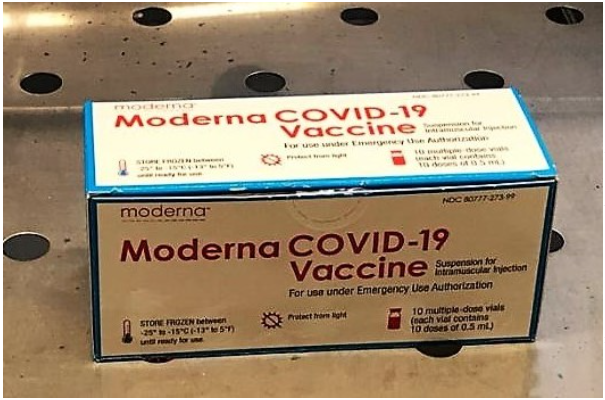
Montgomery County Government has announced that it has received its first shipment of Moderna’s COVID-19 vaccine. The first doses are earmarked for county health staff engaged in pandemic response with more shipments to come. The county’s press release is reprinted below.

*****

First Round of COVID-19 Vaccine Arrives in Montgomery County
For Immediate Release: Wednesday, Dec. 23, 2020

The first round of COVID-19 vaccine doses, manufactured by Moderna, arrived in Montgomery County this morning at the Department of Health and Human Services (DHHS). This initial shipment will be earmarked for County health staff engaged in managing the pandemic response.

The first group to receive the vaccine in Montgomery County is the core team of public health clinicians who will become responsible for vaccinating residents across the County once additional vaccine arrives.

The shipment that arrived today from the Maryland Department of Health is only a small fraction of the entire supply expected to ultimately arrive in Montgomery County and across the United States. This first, small round of vaccine is in addition to the supply that the six hospitals across Montgomery County have or will receive directly from the Maryland Department of Health (MDH). Once MDH receives vaccine from the federal government, DHHS will learn more details about how much vaccine the County will receive and when.

County Health Officer Dr. Travis Gayles will be among the first recipients this afternoon as the lead on the active response to the pandemic.

“​I think the vaccines are safe, and are a new tool to help alleviate the burden of COVID-19 in our communities, particularly in those communities hit disproportionately,” said Dr. Gayles. “I want to be candid and transparent in sharing my experience with the vaccine to help address any concerns, questions, or anxiety around receiving it.”

Montgomery County is following the priority designations outlined by Governor Larry Hogan and that all Maryland counties will follow:

1A: Frontline health care workers, staff and residents of nursing homes, and first responders
1B: Essential workers and residents over the age of 75
1C: Individuals over the age of 65

The process for identifying the order by which all recipients within Priority Group 1A will be vaccinated will be determined by the quantity of vaccine the County receives and when it arrives.

The second priority group includes people in critical, essential infrastructure roles as well as those people at moderately higher risk of severe illness. The general public will have the chance to be vaccinated when the initial priority groups have been fully vaccinated. It is estimated that the general public will have the opportunity to receive the vaccination sometime in the spring of 2021.

In addition to County-operated vaccination clinics, when there is an adequate supply of vaccine, there will be additional places to get vaccinated, including physician’s offices and other primary care providers.

Health care providers in the County should complete this survey to let DHHS know how many of their staff may need coverage.

Visit the County’s COVID-19 website for frequently asked questions about vaccinations. The page will be continually updated to reflect the latest information available on the ongoing effort to slow and stop the spread of COVID-19.

#

Media Contact: Mary Anderson, mary.anderson@montgomerycountymd.gov

Share