All posts by Adam Pagnucco

Leggett Backs Away from Junk Science Study

By Adam Pagnucco.

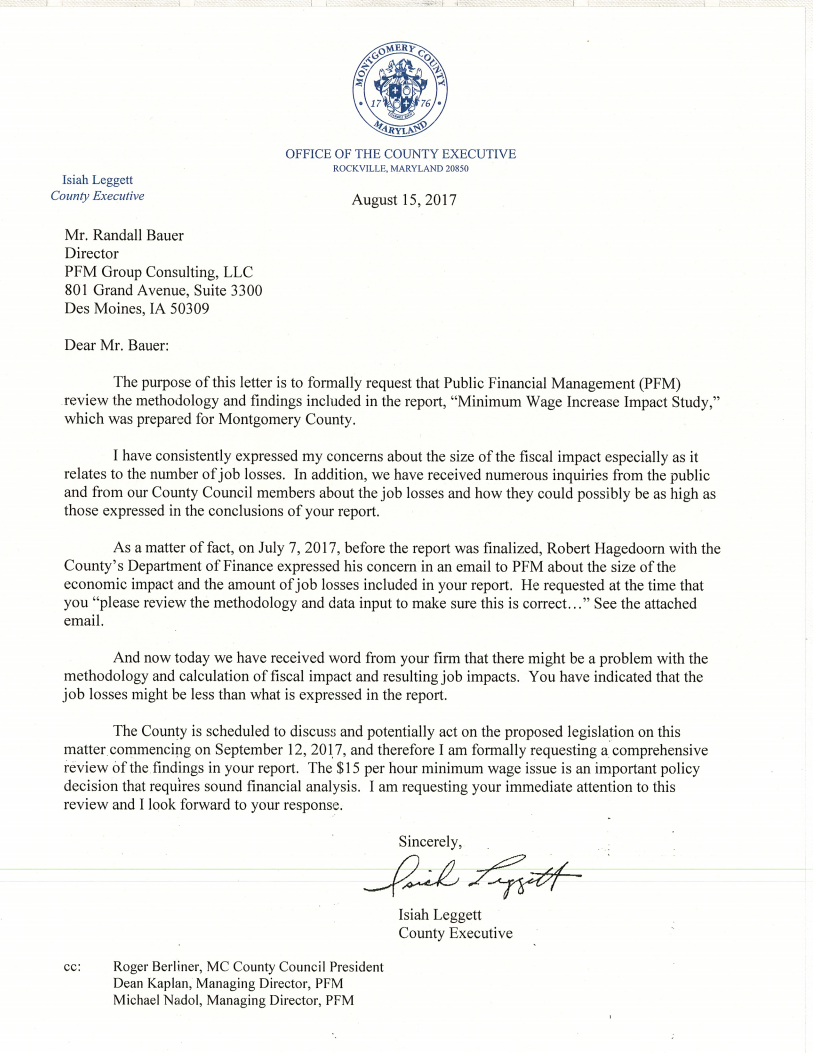
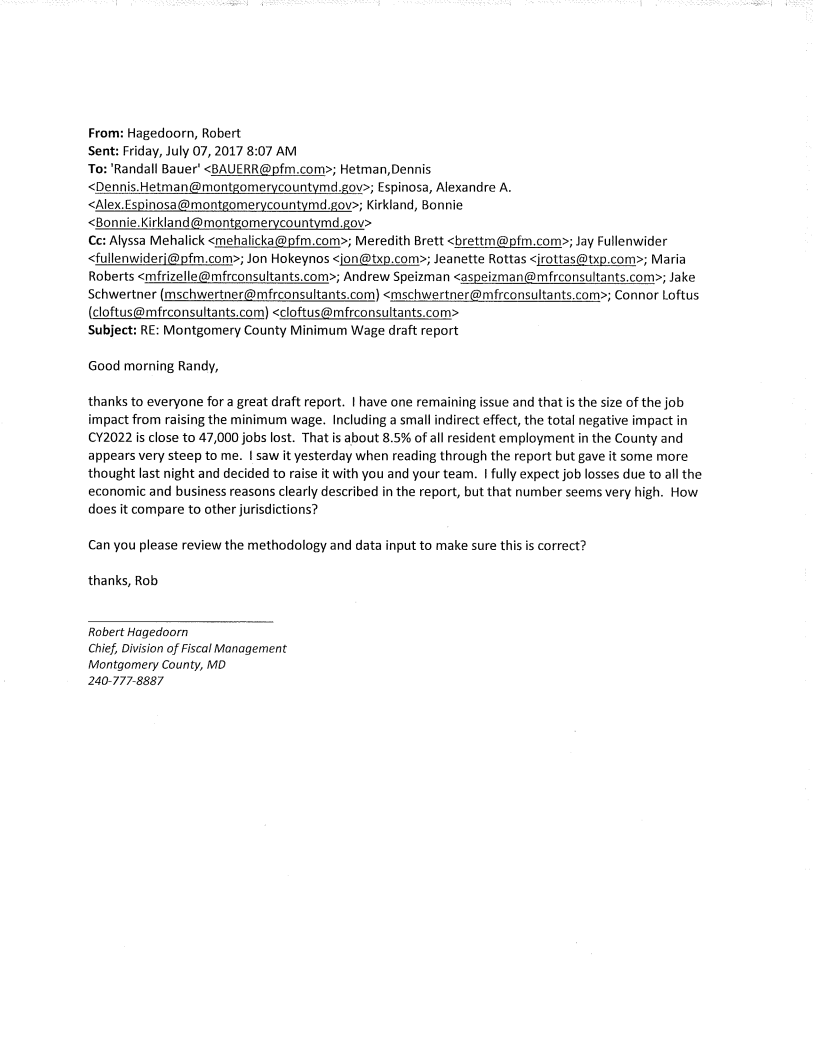
County Executive Ike Leggett, who commissioned a county-financed study on the impact of a minimum wage increase blasted by the Economic Policy Institute as “absurd junk science,” is backing away from its results.  Leggett asked in a letter to the study’s authors that they review the methodology and findings in their report.  He also revealed that his administration had “received word from your firm that there might be a problem with the methodology and calculation of fiscal impact and resulting job impacts.  You have indicated that the job losses might be less than what is expressed in the report.”

Let’s recall that this very same firm prepared a study recommending retention of MoCo’s liquor monopoly – a study that did not include review of your author’s proposal to replace its revenue.  If the minimum wage study is so flawed that the Executive is retreating from it, what does that say about this same company’s work on the liquor monopoly?

It’s worth noting that the Executive’s letter to the study’s authors comes at the exact same time that the County Council is sending him an exhaustive list of questions about the study’s methodology.  The council is set to review the study in public next month.  One line of questioning examines the minimum wage bill’s impact on county labor costs, which could range into the tens of millions of dollars.  That issue is sure to become more prominent in time.

We reproduce the Executive’s letter below.

Share

MoCo’s Essential Man

By Adam Pagnucco.

Ever wonder why some politicians stay in office waaaaaay too long?  One reason is that some of them believe they are truly essential and that government would collapse without them.  We will give them this: some politicians really do leave a lasting mark, and even sometimes for the better!  But the true operations of government depend on legions of competent, honest and experienced public servants who are almost totally unknown to the public.  These are the essential men and women who keep the trains of government running on time.  And in Montgomery County, the most essential man of all is unquestionably Steve Farber.

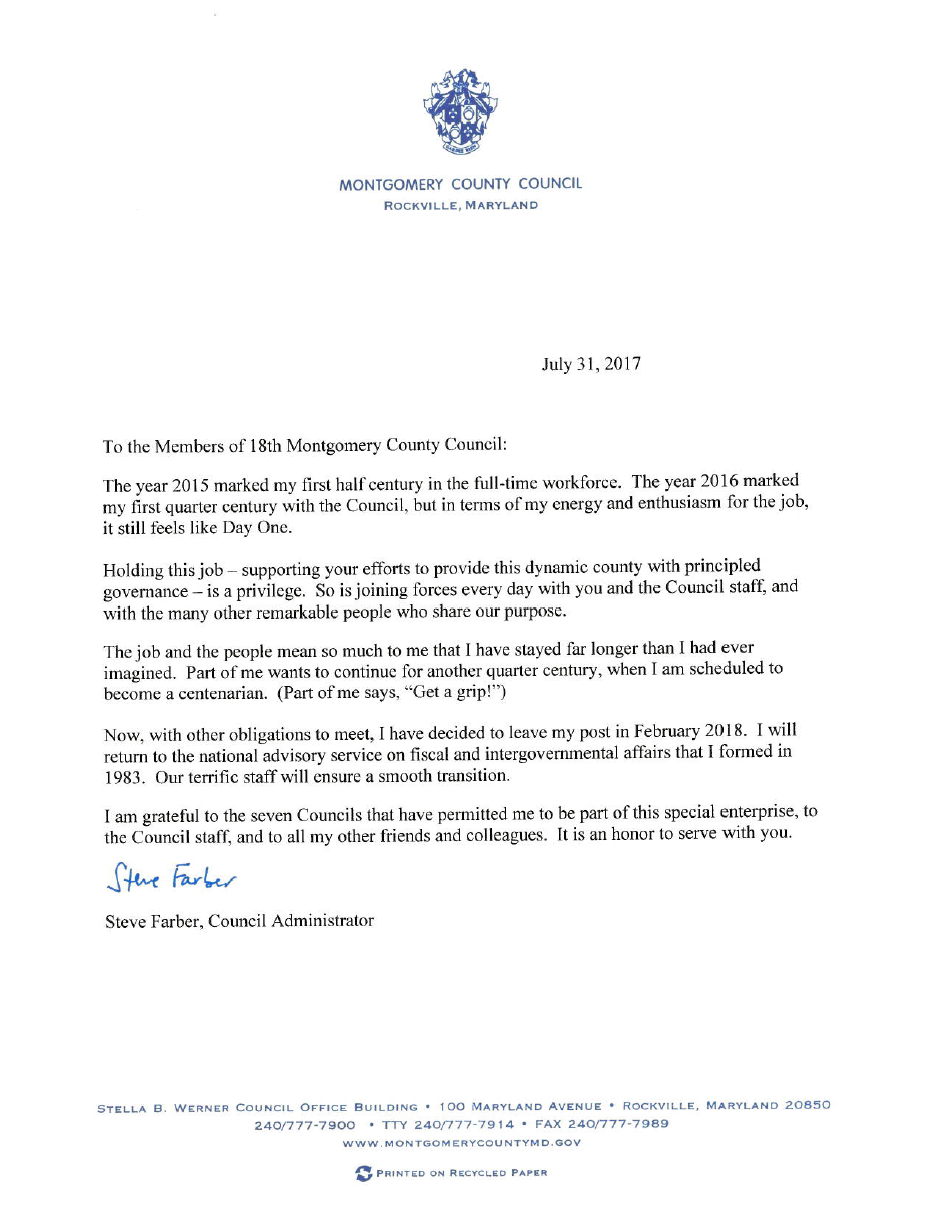
Farber has one of the most mundane titles of all time: council administrator.  At first glance, such a title connotes unglamorous tasks like emptying garbage pails, cleaning windows, wiping the dais and changing toilet paper rolls.  But in fact, the position is crucial to the proper functioning of the County Council and Farber excels at it.  Unfortunately for all of us, he is retiring.

Part of Farber’s job is to be the leader of the council’s Fifth Floor staff.  These employees are not part of the personal staff retained by Council Members in their offices but are rather central, merit system analysts who advise the institution as a whole.  They are subject matter experts, each overseeing the operations of a few departments and/or agencies on behalf of the council.  When legislation is introduced, briefings are held or budget items are considered, the Fifth Floor analyst who covers the relevant subject areas gathers pertinent information and writes it up for the council to consider.  Occasionally, the analyst will make recommendations with the understanding that Council Members have the final word.  At its best, the Fifth Floor acts as a check and balance on the views of the departments and agencies overseen by the council.  It is hugely important for Council Members to have their own independent sources of expertise; otherwise, they might tend to see primarily what the Executive Branch and the agencies want them to see.  The Fifth Floor predated Farber’s arrival, but he expanded their ranks, protects their independence and champions their contributions.

But Farber is so much more than the merit staff’s leader.  He is the ultimate consigliere, the quiet adviser in the shadows who knows all and says little – at least in public.  His immense and largely secret power derives from three sources.

Institutional Knowledge

Farber has been at the council since 1991 and has an incredible memory.  No matter what the council deals with in the present, he has seen something like it in the past and recalls it like yesterday.  Names, dates, policies, documents – whatever it is, Farber either knows it or knows how to get it.  Few people in county government compare to him on this measure and no Council Member comes anywhere close.  That gap in knowledge can put Farber in the driver’s seat when no one can really see that he’s driving.

Cautious Use of Political Capital

Another secret of Farber’s success is that he spends his political capital very carefully.  He is concerned with budgetary and fiscal issues, especially ones affecting long-term sustainability and the bond rating, but it is otherwise rare for him to weigh in directly on legislation or policy issues.  By picking his spots carefully and not squandering his power, Farber maximizes his ability to influence the big picture events that he cares about most.

Finding Money for the Reconciliation List

Every year, the council proposes to add millions of dollars to the Executive’s recommended budget.  Their vehicle is the reconciliation list, which is a ledger of spending additions and reductions that must be balanced out at the end.  One of Farber’s tasks is to find a way to pay for this list.  No one else in the building fully understands how he does this.  His unique, encyclopedic knowledge of the county budget enables him to locate money under the couch cushions that few others know about.  Try as they might, it is impossible for the Executive Branch to hide money from Farber.  He never funds the entire reconciliation list – and constantly warns the Council Members (often futilely) not to overstock it – but he finances enough of it that the council is usually satisfied.  It’s an incredible and invisible source of power.

How does he pull all of this off?  It’s a great mystery, but sometimes there are clues.  First, he never gets involved in politics, NEVER.  He never takes sides in spats between Council Members or tries to steer politically sensitive things like who gets selected as Council President.  Second, he never takes credit for anything.  If you listen to Farber, he has never had a good idea.  Instead, it’s Council Members from the past who have done great things – even if they really originated with Farber.  When he talks to current Council Members, he will remind them of these past accomplishments and suggest similar monumental undertakings.  If a Council Member agrees, then the idea becomes his or hers – and not Farber’s.  The consigliere will then praise the enlightened ideas of the boss!  Third, he never makes arguments based on personal or political concerns, only on facts – of which he is the undisputed master.  And fourth, his discretion is second to none.  The CIA could waterboard every person in the council building and Farber is the one who would never talk.  Everyone knows this.  That’s why they talk to him.  And that’s why the consigliere knows more than the rest of them.

For all his greatness, Farber has had ups and downs like everybody.  For many years, he was a lonely voice calling for fiscal restraint, occasionally joined by Council Members Phil Andrews and Marilyn Praisner.  That earned him the resentment of union leaders and agency heads who prefer loose purse strings.  Farber got his way during the Great Recession, when the council had little choice but to cut spending and abrogate labor contracts, and he played a big role in saving the county’s bond rating.  But the subsequent easing of fiscal pressure allowed the council to start spending again, resulting in the Giant Tax Hike and the passage of term limits.  If the council had listened to Farber all along and passed regular modest, restrained budgets, there’s a chance those things may not have happened.

County residents have benefited mightily from Farber’s service even though the huge majority of them have no idea who he is.  His dedication to facts over rhetoric, his devotion to sound fiscal management, his work to have the council act as a real check on the Executive Branch and above all his iron integrity have made county government more honest and efficient than it would otherwise be.

Farewell to MoCo’s Essential Man.

Share

Conservatives Spread MoCo Junk Science Far and Wide

By Adam Pagnucco.

Discussion of Montgomery County’s minimum wage study, branded “absurd junk science” by the Economic Policy Institute (EPI), is spreading like wildfire through online conservative outlets.  It is now fortifying right-wing arguments against minimum wage hikes all over the United States.

The study, exposed by EPI, Seventh State and economists interviewed by Bethesda Magazine as possessing numerous crippling methodological problems, has nevertheless been embraced by right-wing online media.  That includes articles by Fox News, Breitbart, Townhall.com, Young Conservatives, the New Right News, the Heritage Foundation’s Daily Signal, Glenn Beck’s The Blaze, Ben Shapiro’s The Daily Wire, L. Brent Bozell’s CNSNews, the Job Creators Network’s Information Station, the Washington Free Beacon, a Washington Examiner columnist, a Forbes Magazine columnist, the Competitive Enterprise Institute and Economic Collapse News. Because the conservative echo chamber cross-pollinates its content, it’s probably just a matter of time before the study makes its way to Rush Limbaugh, Sean Hannity and other big-time right-wing hosts.

It’s worth noting what a few of these outlets are saying.

Forbes Magazine columnist Tim Worstall:

The study’s findings are pretty bleak:

The county’s current minimum wage is $11.50. The study concluded that an $11 hourly wage was the local market rate needed to attract and retain employees. It found that increasing the wage would cost the county an additional $10 million per year to increase county employee wages.

The report found there are about 88,000 “low-wage jobs” in the county, in which employees make $1,250 or less per month that could be affected by the minimum-wage increase.

Economic Collapse News:

Study after study, report after report, common sense continually highlight a crucial fact: a $15 minimum wage results in lost jobs, lower pay, less work for workers and jobs that are not being created.

The Daily Wire:

In all, raising the minimum wage to $15 would result in the loss of $396.5 million of income in the county by 2022.  And even Democrats — or smart ones — know what a $15 minimum wage would do to low-income workers.

Washington Examiner Columnist Ron Meyer:

A county considering raising the minimum wage to $15 per hour commissioned a study on the impacts of the hike, and the results are staggering. It should serve as a wake-up call to other localities considering large increases…

For those who care about empowering low-income Americans and lifting workers out of poverty, the mounting evidence and data show raising the minimum wage to $15 isn’t compassionate, just, or charitable. It kills opportunity and creates more poverty, especially for young Americans trying to build their skill sets and make ends meet.

Those still doing #FightFor15 have important questions to answer: Why are you ignoring evidence that hurts low-wage workers? If you don’t care that it hurts low-wage workers, what are your real motives? Aren’t there other anti-poverty policy measures you can fight for that would be more productive?

None of these right-wing publications question the study’s methodology.  They embrace it uncritically because it agrees with their worldview.  And as other governments consider their minimum wage policies, the study will be used to discourage increases.  State Senator Rich Madaleno (D-18), lead sponsor of a $15 state minimum wage bill last year, debunked the study on WBAL radio but it will surely come up again.

We do not criticize County Executive Ike Leggett for being concerned about the employment effects of the minimum wage bill.  At some point, an excessively high minimum wage will lead to employment losses and business shutdowns that outweigh the positive benefits for workers who keep their jobs.  At present, no one knows what level of minimum wage that is.  But the MoCo junk science study, which cost the county $149,600, does not help us determine that wage level one bit.  What it does is give aid and comfort to right-wing ideologues who are willing to use any “information,” however flawed, to push their agenda.

Is that a worthy purpose for your tax dollars?

Share

Is an Incumbent Delegate Getting Pushed Out?

By Adam Pagnucco.

In 2006, Senator P.J. Hogan and Delegates Nancy King and Charles Barkley became fed up with their District 39 colleague, Delegate Joan Stern.  Four months before the election, Hogan, King and Barkley announced that they would not be running with Stern for reelection.  Barkley told the Gazette, “She’s being dropped… I would say it just was not working as a team. I think the three of us [Hogan, King and Barkley] really work well as a team, but not the four of us.”  That left Stern vulnerable to challenger Saqib Ali, who later picked up the Apple Ballot and defeated her.

Is this happening again in Anne Arundel County?

Legislative District 32, which occupies the northern tip of Anne Arundel, is currently represented by four Democrats: Senator James “Ed” DeGrange (first elected in 1998), Delegate Ted Sophocleus (1998), Delegate Pam Beidle (2006) and Delegate Mark Chang (2014).  The Republicans have not come close to knocking out DeGrange in recent years, but they sometimes come within a thousand votes or so in the House races.  (Chang ran unsuccessfully as a Republican in 2006.)

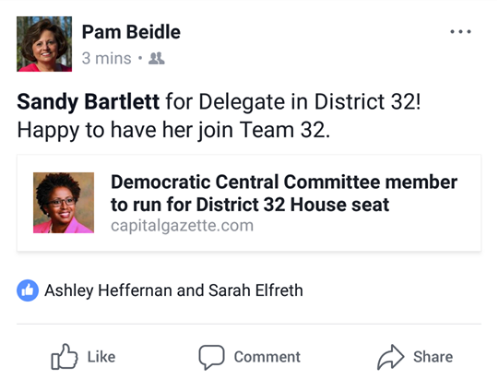
Democratic Central Committee Member Sandy Bartlett is running for Delegate in District 32 and here’s where it gets interesting.  Since December, Bartlett’s campaign account has received contributions from DeGrange ($1,000), Beidle ($500), Senator Jim Rosapepe ($500) and Delegate Joseline Pena-Melnyk ($500).  Rosapepe and Pena-Melnyk represent a district that includes parts of Prince George’s and Anne Arundel.  Soon after Bartlett’s announcement, Beidle wrote on Facebook, “Sandy Bartlett for Delegate in District 32!  Happy to have her join Team 32.”

Wait a minute!  DeGrange, Beidle, Chang and Sophocleus are all members of the Team 32 Slate account.  Bartlett is not.

Unless a fourth House seat is magically created (it won’t be!), someone is on the outs.  The Capital Gazette notes that none of the incumbent Delegates has announced plans to retire, although it reports speculation that Sophocleus (who is 78) might leave.  Let’s remember that Sophocleus had bypass surgery in 2014.  Additionally, Bartlett (who is African American) brings diversity and gender balance to the delegation ticket.

All of this begs the obvious question.  Is Sophocleus getting pushed out the door?

Share

Ashwani Jain Announces Run for Council At-Large

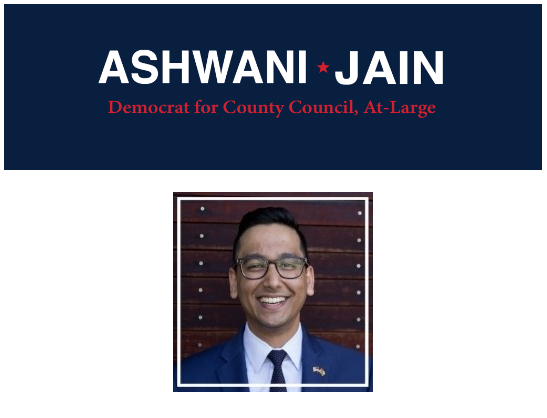
Ashwani Jain, a former Obama administration official and campaign coordinator, has announced that he is running for County Council At-Large.  His announcement appears below.

*****

IN SILVER SPRING SATURDAY: ASHWANI JAIN, FORMER OBAMA APPOINTEE, ANNOUNCES CAMPAIGN FOR MONTGOMERY COUNTY COUNCIL, AT-LARGE

Media Advisory for Wednesday, August 9th, 2017 — Saturday, Ashwani Jain will host a campaign kick-off event to announce his candidacy for Montgomery County Council, At-Large. Ashwani will be joined by friends, family and supporters to celebrate the launch of his campaign, his birthday, and the 15th anniversary of becoming cancer-free. The event is free and open to the public.

Ashwani is a first generation Indian-American, the son of local small business owners, a lifelong native of Montgomery County, and a former appointee of the Obama Administration. Ashwani has built his career as a political organizer and coalition builder in the public, private, and nonprofit sectors as well as through extensive political campaign experience in Montgomery County.

Ashwani is running for County Council because he believes that responsible, diverse, and accountable government doesn’t have to be a pipe dream. He hopes to engage more Montgomery County residents in the political process and to ensure our political institutions are more representative, responsive, inclusive and accountable.

WHAT:          Ashwani Jain for Montgomery County Council Campaign Kick-Off Event

WHEN:          SATURDAY, August 12th, 2017 at 3:00 p.m. ET

WHERE:       Kaldi Social House, 918 Silver Spring Avenue, Silver Spring, MD 20910

LINK:             https://www.eventbrite.com/e/ashwani-jain-for-montgomery-county-council-campaign-kick-off-tickets-36309625066

Note:  Media interested in attending should RSVP to Jaan Williams (jwilliams@voteashwanijain.com) or 202-630-5226

###

Share

Will Jawando Files for Council At-Large

Will Jawando, who ran for District 20 Delegate in 2014 and Congress District 8 in 2016, has filed to run for County Council At-Large.  Following is his statement.

*****

Today, I filed to run for Montgomery County Council, At-Large.  Montgomery County is an amazing place. I was born and raised here and have had great opportunities in my life. Opportunities which afforded me a quality education, the chance to work for great leaders and public servants, and with my wife, Michele, the ability to raise our three daughters in a safe, friendly and diverse community.

But as Montgomery County has grown, not everyone has been given the same opportunities that I had growing up here. That needs to change. At this critical moment in the history of both our county and our nation, we need new leaders in Rockville who will bring fresh ideas to the many challenges and opportunities we face. This is our county, and our future together, and that is why I am asking for your vote.

If I earn the honor of serving you on the county council, I promise I will fight for affordable and accessible child care, to make sure our students have access to the best education and training, to support small businesses and grow our local economy, and to keep the promises to our aging Americans and give them the support, dignity and respect they deserve.

We will officially launch our campaign in September. But I am already at work on these issues, talking to fellow county residents and leaders, and I look forward to more discussions with you in the weeks and months to come.

In the meantime, if you are interested in becoming more involved or learning about my positions on the issues before us, please visit my website at www.willjawando.com. Please note, I plan to opt into Montgomery County’s new public campaign finance system, the first of its kind in Maryland designed to limit the influence of special interests. I believe we can run a campaign driven by the small donations of everyday people – people like myself and my neighbors – who want to chart a new course for Montgomery County.

Thank you!

Share

The Post Should Hire Andrew Metcalf Right Now

By Adam Pagnucco.

MoCo’s most feared man, former Washington Post reporter Bill Turque, has left to terrorize hapless local politicians in Kansas City.  In a rare moment of self-reflection, the newspaper’s bosses have come to realize that “our digital and print readers crave local news” and have posted an ad seeking a Turque successor.  (Let’s remember that this is the same company that killed the Gazette!)  We are sure they will get many qualified applicants, but there’s one name that’s a total no-brainer:

Bethesda Magazine reporter Andrew Metcalf.

Metcalf is a Young Turque.  Just like his older counterpart, Metcalf has been ripping off political band-aids since he arrived here three years ago.  He has covered nearly everything in the county, including budgets, taxes, term limits, legislation, last year’s Congressional election, the Purple Line and much, much more.  His coverage of the liquor monopoly has been second to none, especially his exposure of Delegate Ben Kramer’s conflict of interest as a county liquor store landlord.  He obtained video of Governor Larry Hogan accusing a judge who had ruled against the Purple Line of living at a nearby country club (an inaccurate statement).  He was the first mainstream news reporter to break the news that John Delaney was running for President.  Finally, Metcalf is the author of one of our favorite local stories of all time: “Supposed Nigerian Prince, Robert Lipman Imposter File Public Information Requests with County.”  African monarchs everywhere are writing him into their wills!

Perhaps even more important than his body of work is this fact: Metcalf knows us.  He knows our elected officials, their staffers, the activists, the players and lots of people involved with our political culture.  He knows the structure of the government at both the state and county levels.  He knows our issues: schools, transportation, crime, taxes, jobs, inequality, immigration, cultural diversity and so many others.  He has a deep source network.  And he is developing that combination of respect, trust and wariness that local reporters have with political establishments.  Politicians know they need to be ready when Metcalf calls!

All of these things take time for reporters to develop.  The problem is that we don’t have a lot of time in this county.  One of the most historic elections in our county’s history is approaching in less than a year – and that’s the amount of time it takes most decent reporters to get established.  If the Post hires a brand new person who knows nothing about our county, by the time that person figures out where the bathrooms are, the election will be over.  The obvious solution is to hire a good reporter who already has years of experience covering us and that’s Metcalf.

We understand that Bethesda Magazine publisher Steve Hull is preparing to fire mortar shells at our beloved Limerick Pub in retaliation for this post.  We can’t blame him!  But for the good of the community, the good of local journalism and the good of its own bottom line, the Washington Post needs to hire Andrew Metcalf.  Right.  Frickin.  Now.

Share

When You’re In a Deep Hole

By Gaithersburg City Council Member Neil Harris.

In a recent meeting with the capital improvements team at MCPS, I suggested that it would take $1 billion in extra capital funding to provide enough classrooms and to fix dilapidated schools. The staff responded that the number was more like $2 billion or more. Ouch.

My guess was based on the basic cost for classroom space of $40K per student. So, an elementary school for 750 kids would cost $30 million. And we have 9,000 kids in portables ($360 million worth of classrooms) and we’re adding 2,500 new students each year ($100 million). I guessed at double that for renovations, but apparently that number is way worse than my rough guess.

In transportation, the situation is even worse. Not only is our system the most congested in the country, but in 25 years the congestion is projected to be 72% worse! In the past 15 years, we’ve added several hundred thousand new residents to the mid- and up-county, and the population will grow by 20%. We’re not keeping up.

The National Capital Region Transportation Planning Board (TPB) made projections based on the regional long-range plan, which includes all the projects proposed and expected to be funded. The TPB recently looked at the 500 projects proposed but not expected to be funded, and building all of them “only” makes congestion 28% worse. I repeat: building every project proposed still makes congestion 28% worse!

One problem for the TPB is that the projects on their list are proposed by local jurisdictions: the states, counties, and cities, and are most often focused on local needs. There is no central authority over regionally significant ideas that will serve to improve transportation for everyone.

Another challenge is that there is such a huge focus on new transit that it crowds out roads. If you build a new Transit-Oriented Development (TOD) on a Metro Station and 60% of the new residents use Metro, then there are still 40% of the new residents in cars. One mode is not enough, and the current plans look like they are out of balance, with the vast majority of trips by auto in 25 years but most funding going to transit and not highways. To be clear: in 25 years with $100 billion spent on transit in our region, we increase ridership by 2% for work trips, with a huge increase in auto trips and little improvement in our road network.

The TPB bravely took it upon ourselves to develop a list of 10 “potentially game changing” projects, programs, and policies to study, to learn if there are ways to actually reduce congestion instead of surrendering to it. This has been a controversial process thanks to inclusion of a new northern Potomac crossing, but the TPB has recognized that desperate times require desperate measures.

So, where would the money come from to fix these problems, assuming we find good answers and the political will to address them?

For transportation, Northern Virginia has taken the lead. The Northern Virginia Transportation Authority collects a small surcharge on some taxes to create $330 million in new funding to reduce congestion. Under this new program, the state and the local jurisdictions are not allowed to reduce transportation funding, so the money goes directly to new programs.

For schools as well as transportation, Adam Pagnucco suggested that Montgomery County’s annual revenue grows by about $140 million each year due to increased income and property tax revenue. How about dedicating all this growth to infrastructure for the next few years, instead of operations? In five years or so, we could be all caught up.

These aren’t the only ways to get out of the hole. We could build schools like the Monarch Global Academy in Laurel, which cost one-third to one-half what MCPS spends on each school. That would stretch our dollars. We could look at the cost-effectiveness of transportation projects already in the pipeline and refocus on ones that make more of a difference.

I hope with the big election year in Montgomery County next year, we can direct the candidates to solve these big challenges as their top priority. We need to understand what projects will actually help and then find ways to pay for them.

Whatever we do, we know one thing – when you are in a hole, first stop digging.

Neil Harris is Vice President of the Gaithersburg City Council and a voting member of the Transportation Planning Board and TPB’s Long Range Plan Task Force.

Share

MoCo’s Dubious Minimum Wage Survey

By Adam Pagnucco.

The Executive Branch has released its long-awaited study of the impact of MoCo’s $15 minimum wage bill and it is taking fire.  The primary objection from bill supporters is that much of the study, including the assumptions for its economic modeling, is based on an unscientific, self-selected sample of business owners who were asked to predict what they would do if the minimum wage were raised.  A senior economic analyst with the Economic Policy Institute labeled it “absurd junk science” and wrote:

The closest analogy I can think of would be if the FDA was considering approval of a new drug and instead of reviewing any studies or trials, they instead simply asked the drug company “what percentage of patients do you think this drug will harm versus help?”

Your author agrees with these criticisms.  Want to know why?  Because your author was asked to fill out the minimum wage survey!

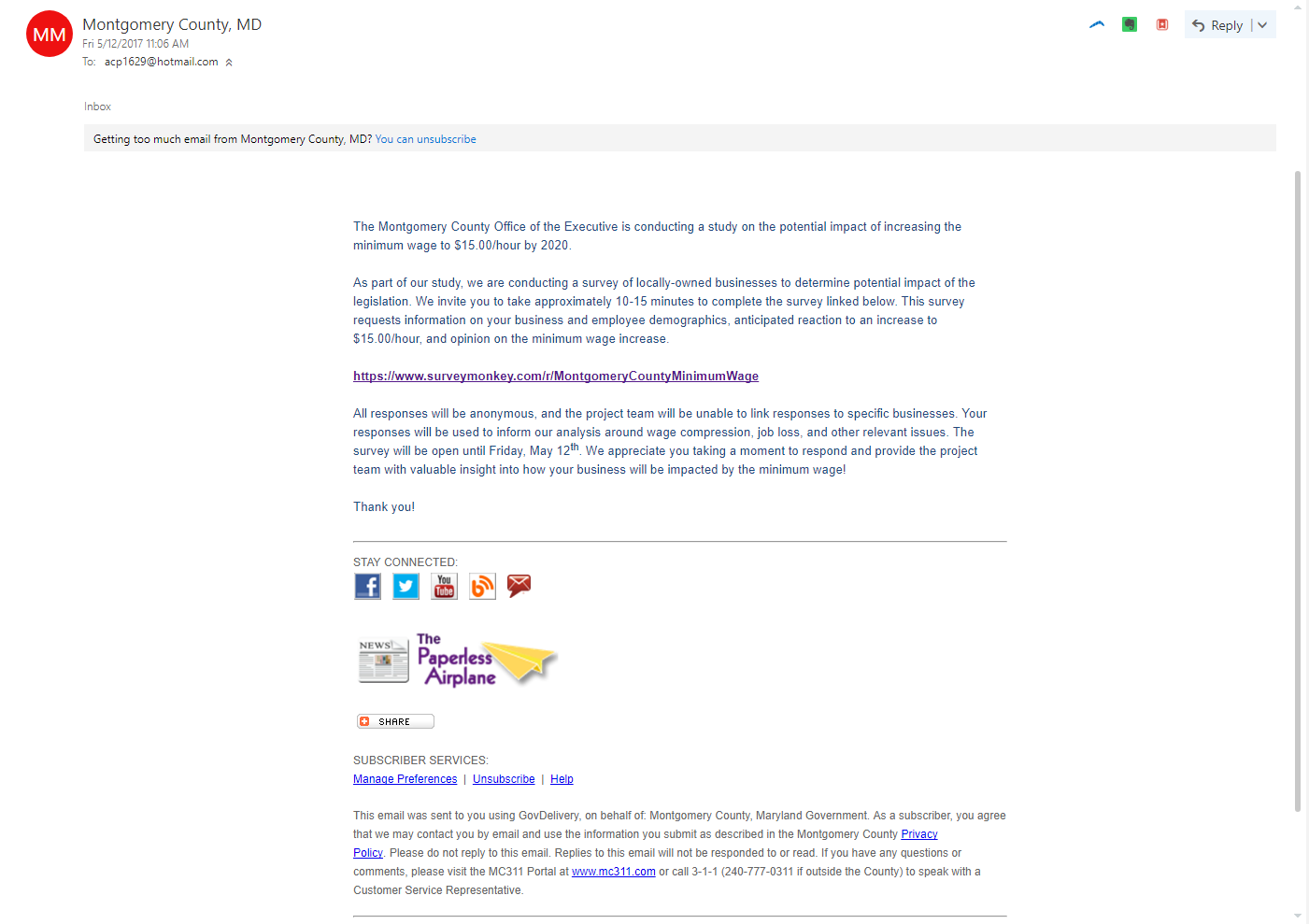
On May 12, the county sent me the email below asking for participation in the minimum wage survey.  Note that the email says, “All responses will be anonymous, and the project team will be unable to link responses to specific businesses. Your responses will be used to inform our analysis around wage compression, job loss, and other relevant issues.”

Now, I am self-employed, but I do not own an incorporated business or employ other people.  Just out of curiosity, I clicked on the Survey Monkey link right after receiving the email.  Yes, the link worked and the survey was ready to accept responses.  If I had filled it out (and I didn’t!), by its own admission above, the survey administrator would have had no way to filter out my responses or flag them as fraudulent.

Lord knows who else got the email and exactly who filled out the survey!

Your author does not express an opinion on the policy merits of the $15 minimum wage bill.  That’s a topic for a future post.  But the minimum wage business survey is a different matter.  It was obviously subject to self-selection bias and even potential manipulation.  The fact that it was administered in flagrant violation of all known scientific surveying techniques disqualifies it from being used as a tool to evaluate public policy.

Share