All posts by Adam Pagnucco

Mizeur is Getting Fired Up to Take On Harris

By Adam Pagnucco.

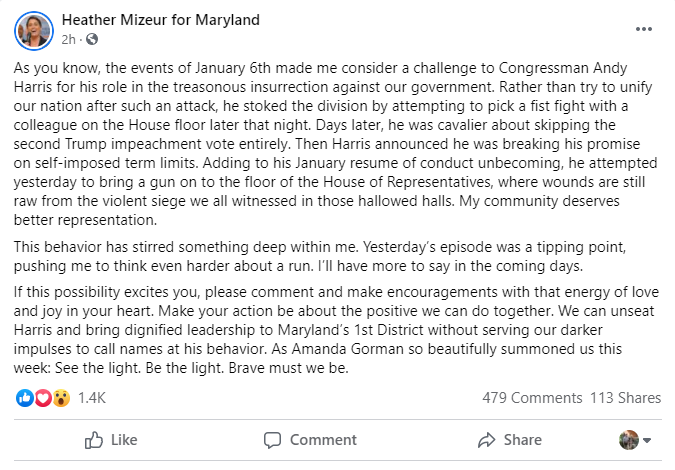
Former Delegate Heather Mizeur, who lives on the Eastern Shore, issued the following statement on Facebook this morning about Congressman Andy Harris.

*****

As you know, the events of January 6th made me consider a challenge to Congressman Andy Harris for his role in the treasonous insurrection against our government. Rather than try to unify our nation after such an attack, he stoked the division by attempting to pick a fist fight with a colleague on the House floor later that night. Days later, he was cavalier about skipping the second Trump impeachment vote entirely. Then Harris announced he was breaking his promise on self-imposed term limits. Adding to his January resume of conduct unbecoming, he attempted yesterday to bring a gun on to the floor of the House of Representatives, where wounds are still raw from the violent siege we all witnessed in those hallowed halls. My community deserves better representation.

This behavior has stirred something deep within me. Yesterday’s episode was a tipping point, pushing me to think even harder about a run. I’ll have more to say in the coming days.

If this possibility excites you, please comment and make encouragements with that energy of love and joy in your heart. Make your action be about the positive we can do together. We can unseat Harris and bring dignified leadership to Maryland’s 1st District without serving our darker impulses to call names at his behavior. As Amanda Gorman so beautifully summoned us this week: See the light. Be the light. Brave must we be.

Share

Are Maryland Vaccine Deliveries Fair?

By Adam Pagnucco.

COVID vaccine distribution is a hot issue in Maryland. COVID case rates have spiked since October and death rates are at their highest levels since the spring. Elected officials’ inboxes are filling up with inquiries from residents and the press is paying attention. Lots of folks are looking to their local governments but the vaccines are delivered by the state. How is the state doing?

Vaccine distribution in the U.S. is a multi-tier process. Pfizer and Moderna manufacture the vaccines. The federal government determines their allocations to states. (You can see open data on distribution of both the Pfizer and Moderna vaccines by state.) State governments then distribute the vaccines they receive to their local jurisdictions.

Maryland has established a three-phase hierarchy for determining the order in which groups receive vaccines. The state has progressed through Phase 1A (health care workers, residents and staff of nursing homes and first responders, public safety, and corrections staff) and is now in Phase 1B (assisted living, independent living, behavioral health and developmentally disabled group homes, and other congregate facilities; adults age 75 and older; and education and continuity of government). Further phases will expand to larger populations.

The state is currently distributing vaccines primarily to three different kinds of entities. Hospitals, who are expected to vaccinate their own staff members and associates, received 320,200 vaccines as of 1/18/21. Pharmacies, including CVS and Walgreens, are responsible for vaccinating nursing homes and received 73,125 vaccines as of 1/18/21. Local health departments are responsible for vaccinating other people in Phases 1A and 1B, especially health workers and first responders, and received 137,425 vaccines as of 1/18/21. Other agencies, including the National Institutes of Health, the D.C. Department of Health and a few state agencies, received another 20,950 vaccines.

And so the counties, hospitals and pharmacies don’t control how many vaccines they get. They do control the rates at which they administer vaccines to residents. As of 1/18/21, vaccine administration percentages were 61% for local health departments, 40% for hospitals, 39% for pharmacies and 69% for other agencies.

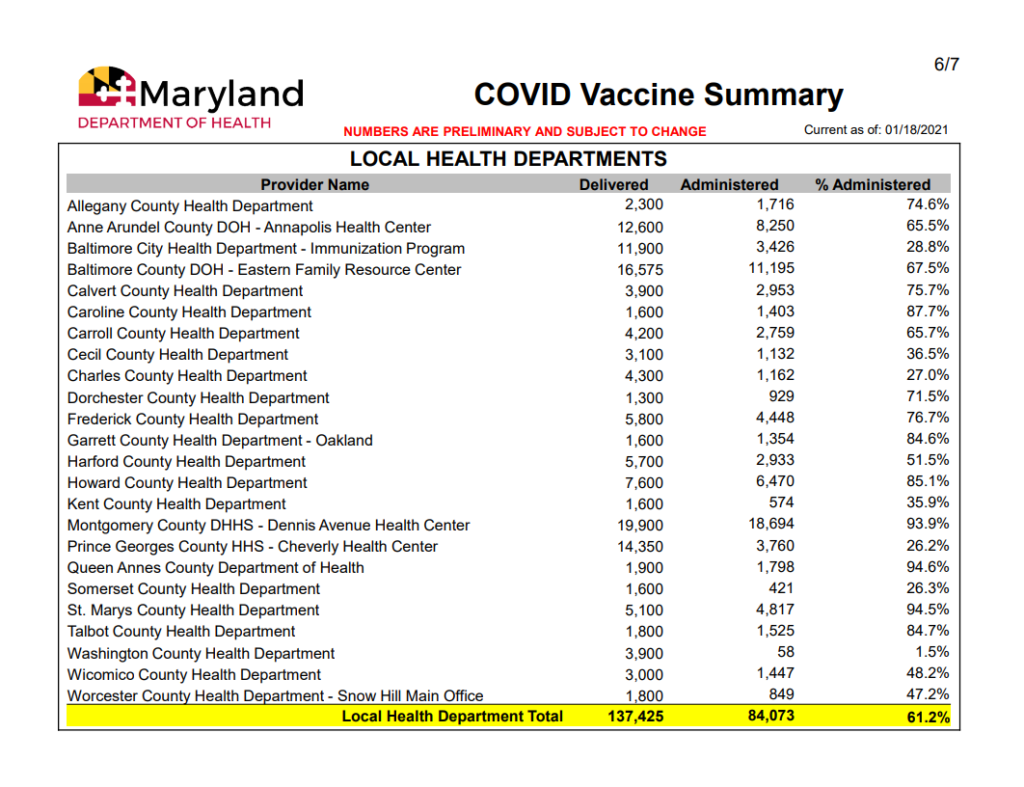
The table below shows administration rates by county health department. Queen Anne’s, St. Mary’s and Montgomery counties have all administered more than 90% of the vaccines they received from the state as of 1/18/21, the best in Maryland. Baltimore City and Charles, Prince George’s, Somerset and Washington counties have administered less than 30% of the vaccines they received as of 1/18/21.

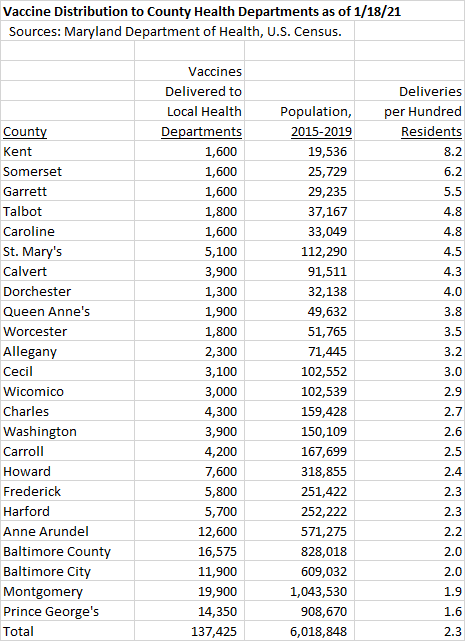
Administration rate is one factor in vaccinating a population. The other factor is deliveries relative to population. It’s hard to know the location of residents being vaccinated by hospitals and pharmacies. However, local health departments are presumably vaccinating residents who live (or at least work) mostly within their jurisdictional boundaries. The table below compares vaccination deliveries to local health departments with U.S. Census estimates of their populations in 2015-2019.

There are large discrepancies in the state’s delivery of vaccines to local health departments on a per capita basis. Relative to their populations, Kent, Somerset, Garrett, Talbot and Caroline counties – each having less than 40,000 residents – received the most vaccines, varying from 4.5 to 8.2 per hundred residents. Montgomery County (1.9 vaccines per hundred residents) and Prince George’s County (1.6 vaccines per hundred residents) are at the bottom. Baltimore County and Baltimore City are also below the state average delivery rate per capita.

A county with an excellent vaccine administration percentage but a low delivery rate from the state could wind up with a low vaccination percentage of its population. In fact, that’s what the table below shows for Montgomery County. Despite having one of the best administration percentages in the state, MoCo is below average on the percentage of its population receiving a first and second shot because of its low per capita delivery rate.

It’s still an early moment in the state’s vaccination program. There is time to improve. But there is also a role for elected officials who represent counties with low vaccine delivery rates and their constituents to press the state to do better.

Share

Collective Sloppiness

By Adam Pagnucco.

Yesterday, the county council’s Office of Legislative Oversight (OLO) released a stunning report on collective bargaining between the county and Fraternal Order of Police (FOP) Lodge 35. The report shows incredible sloppiness by the county in administering labor relations with the police that likely goes back far before the current county executive was in office.

The FOP is one of three unions representing employees of the Montgomery County Government. The other two are the International Association of Fire Fighters Local 1664 and MCGEO. Since 1982, the county has negotiated collective bargaining agreements (CBAs) with the FOP, including many provisions on wages, benefits and working conditions. The OLO report examines bargaining between the county and FOP but does not include the other two unions.

OLO makes many findings of concern, including on issues of transparency. Two major findings leap out of the report.

The county and the FOP did not agree on what their agreement actually was.

OLO wrote:

First, the Executive Branch and the FOP use different versions of the primary agreement and do not agree on a singular document as the primary CBA. Second, the parties also do not agree on which side letters and MOAs [memorandums of agreement] are part of the current agreement and which are not. OLO was told by representatives both in the Executive Branch and from the FOP that the County Government and the FOP have not had a signed collective bargaining agreement for over a decade. OLO has also been told by the Executive Branch that an agreement is in place and the Office of Labor Relations and the FOP are working towards a unified, written document. OLO notes that despite the state of the documents, the parties report that they work together to implement the collective bargaining agreement on a day-to-day basis and use an agreed-upon arbitration process to resolve disagreements, when necessary.

OLO’s primary finding is that it is impossible for a third-party reader to identify the terms and provisions of the collective bargaining agreement between the County and FOP Lodge 35 because the parties do not agree on the primary document. In addition, while the County and the FOP agree that certain side letters and MOAs are in effect, they do not agree on the current status/effect of all side letters and MOAs. This disagreement adds to the inability of a third-party to know or understand all the provisions that make up the collective bargaining agreement.

In other words, MoCo voters have no idea what they’re paying for and, as of the writing of the report, have no way to find out.

An aside. When I was working in the labor movement, I worked with an old, wily jurisdictional director from Brooklyn named Stan. Stan was responsible for negotiating international union agreements with our contractors. Stan had seen every trick in the book over his decades of negotiating. One trick was when company attorneys made changes to agreements that were not negotiated and tried to sneak them in. For example, if the union and the company agreed to changing Articles 12, 15 and 28, the company attorney might insert those changes but also make a change to Article 30. If that change went unnoticed and the union president signed it, that became part of the new agreement.

To stop that kind of thing, Stan would summon me into his office and give me a copy of his version of the agreement. Then he would read aloud from the company’s version – every single word in that New Yawk accent of his – including the sections that had not been renegotiated. If we found one punctuation mark that was out of place, BAM! Stan would be on the phone with the company lawyer, demanding to know how that happened. That’s how much we cared about making sure the agreement was exactly what we agreed to, every single word.

And that’s why I am surprised by the county’s sloppiness here. From my own experience in the labor movement, when the parties don’t agree on what their agreement is, that “agreement” can be hard to administer.

The agreement that expired on June 30, 2020 provided benefit levels that exceeded maximum amounts set in county law.

OLO identified the following examples of benefits in the agreement that exceeded what is allowable under county law.

Agreement: Most current employees contribute 4.75% of salary for retirement.

County law: Employee contributions are set at 6.75% of salary for service after June 30, 2012.

Agreement: The pension cost of living adjustment is tied to the consumer price index with a cap of 7.5%.

County law: The pension cost of living adjustment is tied to the consumer price index with a cap of 2.5%.

Agreement: The minimum pension for a service-connected disability is set at 66.6% of final earnings.

County law: The minimum pension for a service-connected disability is set at 52.5% of final earnings.

Agreement: The health insurance premium split is set at 80% County / 20% employee.

County law: The health insurance premium split is set at 75% County / 25% employee.

The county council made several changes to benefit levels through legislation passed during the Great Recession. The legislation preempts any contents of collective bargaining agreements. It may be that subsequent agreements were not updated to reflect these changes because of the kind of sloppiness seen above. The OLO report authors told me, “FOP members received benefits as stipulated in law and Council resolutions (not what is written in the contracts).”

In responding to the report, Chief Administrative Officer Rich Madaleno wrote, “…The draft report notes that the County and the Fraternal Order of Police (FOP) have been unable to agree upon a unified collective bargaining agreement. This is no longer accurate. OLR [Office of Labor Relations] and the FOP have been engaged in a year-long project to reconcile those differences and have agreed to a single version of the collective bargaining agreement. Attached for your information is the unsigned agreement. The signed version will be forwarded to you next week.”

Unfortunately, the new agreement received by OLO contains the same benefit levels that exceed the maximums contained in county law. That issue has not been cleaned up. Neither have a host of issues I identified last June, the most disturbing of which requires the county to fight certain Maryland Public Information Act (MPIA) requests in court. OLO identified the latter issue as well, writing that that provision appears to conflict with state law.

OLO recommends that all collective bargaining documents, including supplementary ones, be posted on the county’s website for public view; that outdated and/or moot language be purged; that the county council be notified of changes; and that the agreements be consistent with federal, state and county law. Given the county’s past mistakes, these are hard recommendations to argue against.

Share

Two Negotiating Strategies, Two Outcomes

By Adam Pagnucco.

In justifying the county’s creation of a $4 million per pay period emergency pay liability, representatives of county government depict it as a good deal for taxpayers. They say that the county’s collective bargaining agreements set much higher levels of emergency pay than the amount the county is now paying, so $4 million a pay period is actually a bargain. Setting aside whether the county’s existing emergency pay provisions actually apply to a pandemic – there is some doubt about that – the county’s claim is called into question by the emergency compensation program of one of its sister agencies, the Maryland-National Capital Park and Planning Commission, commonly referred to as Park and Planning.

MCGEO is the largest county employee union of both Montgomery County Government and Park and Planning. It is led by the fearsome Gino Renne, who has a long and famous history of playing hardball with politicians. The union’s prior collective bargaining agreements with both the county and Park and Planning had preexisting emergency pay provisions which the county cited in providing COVID pay. Unlike MCGEO’s preexisting agreement with the county, its preexisting agreement with Park and Planning has an emergency pay provision explicitly referring to “epidemics.” Despite that fact, negotiations between MCGEO and the two agencies yielded outcomes that were worlds apart.

MCGEO’s agreement with the county

Signed on April 3, the agreement gives employees in “front facing onsite work” an extra $10 per hour and employees in “back office onsite work” an extra $3 per hour. Teleworking employees do not receive extra pay. The differential counts for the purpose of calculating overtime pay.

The agreement is indefinite. Here is its language on duration:

This Agreement may re-open on June 20, 2020. However, if the declared Maryland State of Emergency related to COVID-19 extends beyond that time, the terms of this Agreement shall continue, or after collectively bargaining with MCGEO, will be modified based upon the circumstances at the time. In the event that the declared Maryland State of Emergency related to COVID-19 is rescinded before June 20, 2020, the date of the Declaration’s rescission shall be considered the last day of this Agreement, notwithstanding the pay periods indicated above defining when the COVID-19 Differential will be paid.

The county could renegotiate the agreement if MCGEO agrees to do it. Otherwise, the agreement lasts as long as the state’s declared emergency does. As of this writing, the emergency continues and so does the agreement. County council staff has previously noted that it provides by far the most generous COVID pay of any jurisdiction in the region.

MCGEO’s agreements with Park and Planning

MCGEO has had two memorandums of understanding and six agreements on the COVID emergency with Park and Planning through late January. Their effective dates are:

MOU signed 3/15/20
Agreement 1: 5/4/20 – 6/30/20
MOU signed 7/2/20
Agreement 2: 7/10/20 – 8/8/30
Agreement 3: 8/5/20 – 8/29/20
Agreement 4: 9/8/20 – 10/3/20
Agreement 5: 10/5/20 – 11/28/20
Agreement 6: 11/25/20 – 1/30/21

Of the agreements, only the first (lasting through June 30) contained extra pay. That agreement gave an extra $2.75 per hour for “onsite work” and an extra $4.50 per hour for child care aides performing “front facing onsite work.” Unlike the county’s agreement, emergency pay was not included in the calculation of overtime pay. The later agreements provided varying levels of leave and paid time off and have other language on health and safety, teleworking and scheduling but they do not provide emergency pay. Let’s note that time away from work does more to protect employee health than requiring them to report on-site with a pay differential.

No one will ever accuse MCGEO President Gino Renne of being an ineffective negotiator. He has delivered outstanding value to his members for many years. The difference here is in the negotiating strategies taken by the two agencies. Park and Planning utilized a series of short, time-limited agreements to adjust its compensation to changing circumstances. The county signed one open-ended agreement that locked in extra pay negotiated during the height of COVID’s first wave. Gino signed the agreements with both agencies despite their vast differences.

That’s not all. The county’s agreements with the police and fire fighters both provide indefinite emergency pay of $10 per hour for onsite work, with the extra pay counting for calculations of overtime. Of Park and Planning’s five agreements with its police union through late November, only one – lasting through June 30 – provided emergency pay and that was for $4.50 an hour. Once again, Park and Planning got a different result with a different negotiating strategy.

The results of these differing agreements are two-fold. First, there is a huge gap in the costs faced by the agencies. The county has about 9 times the employees of Park and Planning. The county has paid $4 million per pay period since April, which translates to $78 million as of last week. Park and Planning paid a total of $400,917.

Second, there is a tremendous inequity between county employees (many of whom are receiving an extra $3 or $10 per hour) and Park and Planning employees (who are getting paid time off and leave but not extra pay since June 30). That inequity extends to employees of MCPS and Montgomery College, who are not getting anything resembling the county’s pay. Expect these employees to ask – with justification – why they aren’t getting the same extra money as county workers.

The question of how to pay for the county’s huge new liability – one that was avoided by Park and Planning – will be a big factor in writing the next operating budget. We shall find out the consequences of all this when it arrives on March 15.

Share

How Does MoCo’s Vaccination Rate Compare to the Rest of Maryland?

By Adam Pagnucco.

Last night, Montgomery County Government sent out a blast email claiming, “Montgomery County is has [sic] taken swift steps to administer the vaccines it has received—proceeding at one of the highest rates of vaccine administration in Maryland.” The same claim is repeated on the county’s website.

Is this true?

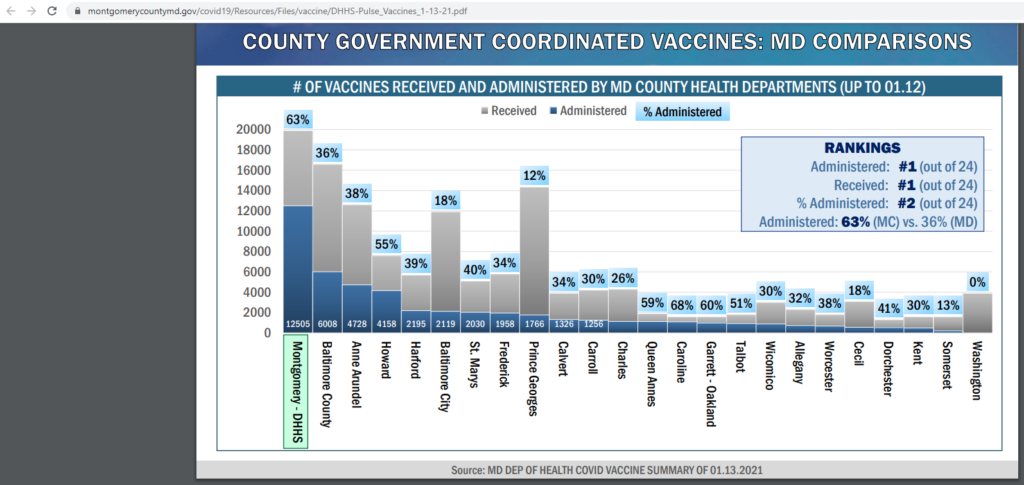
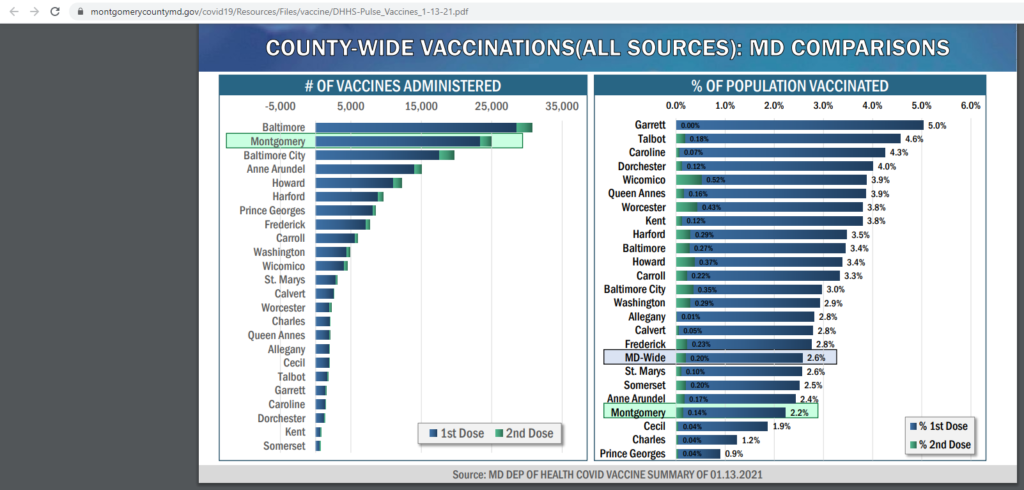
The county doesn’t elaborate on this claim in great detail but it has support from the slide below from its Department of Health and Human Services. The slide shows the percentage of received vaccines that has been administered by each county in the state. As of January 13, MoCo administered 63% of the vaccines it has received, trailing only Caroline County (68%) and far above the state average (36%).

However, the county trails badly on another key measure: the percentage of population vaccinated. Another slide from the same presentation shows that just 2.2% of MoCo’s population has been vaccinated with at least one dose, a rate that trails 20 of the state’s 24 jurisdictions.

To be fair, MoCo doesn’t have full control of its population vaccination rate because the state allocates vaccines by county. At this point, Baltimore County has received more vaccines than MoCo even though its population is smaller.

County Executive Marc Elrich has posted a good explanation of the complications in distributing vaccines, especially the role played by the need to vaccinate people twice. It’s very informative for folks who would like to understand how the process works and what bottlenecks lie within.

In any event, by one measure, the county is exceeding the state’s vaccination rate and by another, it is falling short. The story is a complex one and, at this point, not reducible to emailed success stories.

Share

Superintendent Jack Smith Announces Retirement from MCPS

By Adam Pagnucco.

MCPS Superintendent Jack Smith has announced his retirement. Smith, who once worked in the State Department of Education and is a former superintendent in Calvert County, was hired by MCPS in 2016 and had his contract renewed last year. Smith’s announcement is reprinted below.

Superintendent Jack R. Smith Announces Retirement

Dear Colleagues,

I write to you with very mixed emotions today. After much consideration, I have shared with the Board of Education that I will be retiring as superintendent of schools this spring. I have tentatively set my retirement date as June 1, 2021.

As I have shared with some of you, my two-year old grandson had significant open heart surgery in May 2019 to reconstruct his malformed heart. While the surgery was successful, my wife, Gayle, relocated to Maine to help my daughter and son-in-law care for him. Her stay in Maine to support our grandson was extended with the COVID-19 pandemic.

Given his health needs, our family’s circumstances are not going to change for at least the next few years. I need to join Gayle in Maine as I find I can no longer tolerate living most of the time separately.

I have loved my time in Montgomery County Public Schools and have no desire to leave. The staff in the school system is among the most talented and dedicated in this country. The work we have done together around the equity accountability framework, the allocation of resources, student well-being, upgrades to current technology, our expansion of pre-K and language programs are among a host of system improvements that I am so happy to have been involved with.

I will greatly miss being a part of this organization. The 17 school board members I have worked with here have been committed, dedicated professionals, and they consistently have made decisions with the best interest of students in mind, as well as a very real desire to maintain the excellence of the system, while increasing the access and opportunity to provide a truly equitable experience for every child we serve.

I’ve truly been fortunate to work with these school board members, the staff, our elected officials and the community in Montgomery County.

I am confident that MCPS will continue to do great work on behalf of our 160,000 students—it always has. I am also confident that working together, we can and will implement a comprehensive recovery of education plan that will get students back in school buildings and address the significant learning loss as a result of the COVID-19 pandemic.

This is a wonderful community, a strong public school system and a great place to live. I wish only the very best for Montgomery County Public Schools going forward.

Dr. Jack R. Smith
Superintendent

Share

MoCo Seeks Feedback on COVID Vaccine

By Adam Pagnucco.

Montgomery County Government is seeking resident feedback on how and whether they would like to receive COVID vaccines through an online survey. The county’s press release is reprinted below.

*****

Montgomery County Seeks Feedback on Residents’ Demand for Receiving COVID-19 Vaccine

For Immediate Release: Thursday, Jan. 14, 2021

Montgomery County today launched an online survey to hear from residents and get an informed understanding of how residents feel about taking the COVID-19 vaccine. The survey is not scientific but will help to identify any possible concerns residents may have about the vaccine. With a goal of vaccinating 75 to 80 percent of the community, County employees will use the feedback to address questions and to better reach communities hit hardest by COVID-19 and who have historically been apprehensive about trusting vaccines or medical research. The County plans to incorporate the feedback from the survey into its robust outreach plan and communications efforts to educate the public on the importance of taking the vaccine.

The survey is open from Jan. 14 through Feb. 4, 2021 and is on the County’s COVID-19 vaccine website. The survey is anonymous and is available in the top seven spoken languages in the county. It is also available on the County’s Facebook page and Twitter feed. With 12 multiple choice questions, the survey takes approximately five minutes to complete. In addition to the survey being available online, the survey will also be offered to residents at several of the County’s COVID-19 testing sites.

For the latest COVID-19 updates, visit the County’s COVID-19 website and follow Montgomery County on Facebook @MontgomeryCountyInfo and Twitter @MontgomeryCoMD. Residents can also sign up to receive text or email updates about COVID-19 vaccinations.

Share

Is Rent Stabilization Dead on Arrival?

By Adam Pagnucco.

After successfully passing a temporary rent stabilization bill in April, Council Member Will Jawando has introduced a permanent rent stabilization bill for many properties within one mile of Metro stations or a half mile from bus rapid transit stations. The bill would exempt certain properties, such as licensed health care facilities, non-profit properties, owner-occupied group houses, religious buildings, transient lodging, dormitories, nursing homes and accessory apartments. It would apply to new buildings after five years of operation as rentals. Buildings not exempted would be allowed to charge annual rent increases up to the county’s (currently) voluntary rent guideline, which was 2.6% in 2020. The guideline is pegged to the rental component of the Washington-Baltimore CPI-U, which is produced by the U.S. Bureau of Labor Statistics, and has varied between 1.5% and 4.0% over the last decade.

This bill was always going to have a rough ride but now it has a formidable, perhaps even fatal, obstacle – an economic impact statement predicting mayhem to MoCo’s housing market if it passes.

In MoCo, economic impact statements on legislation are prepared by the Office of Legislative Oversight (OLO), a group of merit analysts housed in the legislative branch. OLO has long produced subject matter reports that are often eye-popping reading, but under legislation sponsored by Council Member Andrew Friedson last year, it has taken over the preparation of economic impact statements from the executive branch.

The economic impact statement on Jawando’s bill, reprinted at the end of this column, was prepared by former county council and planning department analyst Jacob Sesker, whose work draws much respect from the council and beyond. It is a lethal indictment of rent stabilization both generally and specifically in MoCo. The statement begins with this blunt declaration:

The Office of Legislative Oversight (OLO) expects Bill 52-20 to have a negative economic impact overall. Residents of rent stabilized units would periodically benefit from lower rent increases. Residents of non-rent stabilized units would likely face increased rent costs. The economic benefit to households is smaller than the economic cost to businesses, in part because the household sector would absorb employment and earnings losses associated with decreased revenue for businesses in the real estate industry. Artificially constrained rents will also have a negative impact on asset values and property tax revenues.

Research indicates that rent stabilization could lead to reduced supply of rental housing and upward pressure on the prices of unregulated units (including owner-occupied units). This reduced supply could occur as a result of condominium conversion or reduced construction activity. Research also indicates that rent stabilization programs often result in disinvestment by owners, including deferred or foregone maintenance. There is evidence that rent stabilization has led to neighborhood deterioration or increased crime in some locations.

The statement’s next three and a half pages contains a literature review summarizing many negative findings of rent control, including higher rents for non-controlled units; poor targeting to people in need as wealthy people secure rent-controlled units; increased conversions of rental units into condos; and maintenance issues for controlled properties. These findings are nothing new – they mirror my own review in 2017, which found that economists have recounted problems with rent control for decades. Even the communist government of Vietnam abandoned it, with one official telling the press, “The Americans couldn’t destroy Hanoi, but we have destroyed our city by very low rents. We realized it was stupid and that we must change policy.”

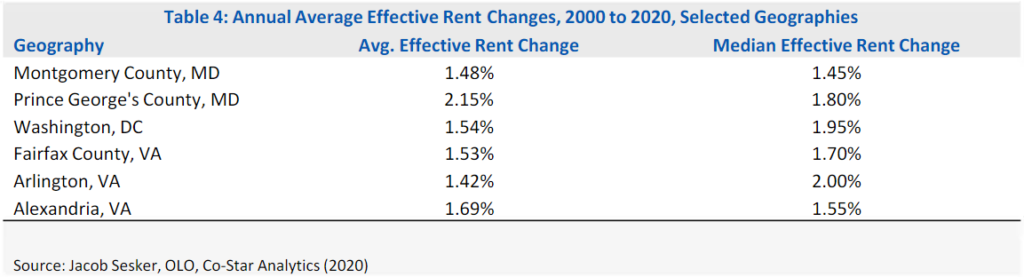
The interesting part of the statement is its research on MoCo’s housing market. Using data from Costar, the statement finds that from 2001 through 2020, rents in MoCo rose by an annual average rate of 1.48%. In properties within 1 mile of rail transit, the average rent increase was 1.28%. Rent increases in MoCo have been among the lowest in the region as shown by the statement’s chart below. If MoCo already has some of the lowest rent increases in the region, what problem is the bill attempting to fix?

While the statement does attempt to model the potential negative economic impacts of rent control on the county’s economy, it omits discussion of MoCo’s two major housing challenges: inadequate rates of construction and slow job growth that deters initiation and financing of housing projects. The District of Columbia has a rent stabilization law and has not seen those problems because it exempts buildings constructed after 1975. (The D.C. Policy Center estimated that just 36% of the District’s rental units were covered by rent stabilization in 2019.) Jawando’s bill applies to new construction after a five-year grace period. Takoma Park’s rent stabilization law applies to new construction and the city is losing rental units. Given the above, what would Jawando’s bill do to housing construction in MoCo?

There will be a lot more to say about this bill from folks with lots of different views on it. That said, since economists overwhelmingly oppose rent control, the advocates have a lot of work to do.

The economic impact statement is reprinted below.

Share

Political Awards 2020

By Adam Pagnucco.

It’s that time: here are the political awards for 2020, the year that was!

Politician of the Year: Governor Larry Hogan

There is really no other choice. Because of the unique demands of the COVID-19 crisis, it’s possible that no Governor of Maryland has wielded more power than Hogan did in 2020 since the colonial era. Local governments, employers and residents all over the state have had to react to his many executive orders. He has had successes, such as Maryland’s relatively low COVID case rate compared to the rest of the country, and he has had failures, such as the flawed test kits from South Korea. Above all, he has been incredibly consequential – far more than any other political figure in the state – and that is enough for this award.

Debacle of the Year: The Purple Line

Again, there is no other choice. The Purple Line’s public-private partnership (P3) was supposed to protect taxpayers from liability, but its collapse will cost us $250 million that would otherwise be available for other transportation projects. The state is promising to complete the project, which will someday generate real benefits for the Washington region, but no one knows its completion date or its ultimate cost. With another P3 pending for the Beltway/I-270 project, the Hogan administration owes it to Marylanders to report on lessons learned from the Purple Line so that its mistakes are not repeated.

Runners Up
Two powerful officials – Hogan Chief of Staff Roy McGrath and MoCo Chief Administrative Officer Andrew Kleine – lost their jobs due to scandal. The McGrath story may not be over.

Worst Move of the Year: Robin Ficker’s Question B

Ficker thought he could get MoCo voters to approve a draconian tax cap that would handcuff county government forever. Instead, not only did voters reject his idea, but they approved a competing ballot amendment (more below) that will actually generate more revenue for the county over time.

Runners Up
MoCo Republicans badly wanted the nine council district charter amendment to pass but they wound up helping to defeat it because of their prominent embrace of it in the toxic year of Trump. Talbot County officials insisted on keeping a confederate statue at their courthouse, a long-term loser for the county.

Best Move of the Year (Tie): Andrew Friedson’s Question A and Evan Glass’s Question C

Former Obama Chief of Staff Rahm Emanuel once said, “Never allow a good crisis to go to waste.” Council Members Andrew Friedson and Evan Glass sure didn’t, drafting competing ballot questions against Ficker’s anti-tax charter amendment and another amendment providing for an all-district council structure. The result of the passage of Friedson’s Question A and Glass’s Question C is a more rational, liberalized property tax structure and a larger county council to service a larger population.

Runner Up
Baltimore County Executive John Olszewski Jr. issued an executive order capping third party food delivery app fees at 15%, preventing excessive fees ranging as high as 30%. The order also bans them from reducing driver compensation and tips to comply with the fee cap.

Missing in Action Award: Almost Everyone Planning or Thinking of a Run for Governor

Comptroller Peter Franchot is the only declared candidate for governor. He has a war chest, a statewide profile and a consulting firm. Right now, he has no competition. As Roger Waters would say, is there anybody out there?

Big Deal of the Year: Moratorium Repeal

The county council repealed the county’s illogical housing moratorium policy, which did not accomplish its intended purpose (alleviating school crowding) but did prevent housing construction in the face of MoCo’s affordable housing shortage. Housing construction still has challenges – including financing problems stemming in part from slow job growth – but the council was right to junk moratoriums that did no good and made housing problems worse.

Just Because She’s Great Award: Delegate Anne Kaiser

She never asks for attention or takes credit for anything. But Delegate Anne Kaiser is everything you could want in an elected leader: smart, practical, savvy, mentors younger politicians and plays the long game. Best of all, she’s a down to Earth person who doesn’t let success go to her head. She’s a worthy successor to the great Sheila Hixson as chair of Ways and Means. Long may she serve.

MoCo Feud of the Year: JOF vs Stephen Austin

In one corner: political newcomer Stephen Austin, running for school board on a platform of opposing MCPS’s boundary analysis. In the other corner: former school board member Jill Ortman-Fouse (universally known as “JOF”), leader of a movement favoring boundary studies in the interest of equity. This was never going to be a great relationship, but this feud set a record for most screenshots in a MoCo political dispute. Here’s to more in the new year!

Runner Up
County Executive Marc Elrich vs Governor Larry Hogan. This one runs hot and cold but it flared big-time when Hogan stopped MoCo from instituting a blanket shutdown of private schools. These two can’t stand each other so expect more this year.

Media Outlet of the Year: Baltimore Brew

If you’re not reading Baltimore Brew, you need to start doing it right now! No city scandal can hide from the Brew’s hustling, dirt-digging journalists, whether it’s document shredding, scams, SLAPP suits, politician tax liens, travel expenses, or other questionable activities. Baltimore Brew is a must-read and a true gem of Maryland journalism.

Game Changer Award: Len Foxwell

For more than a decade, the Franchot-Foxwell partnership roiled Annapolis, grabbed headlines and marched steadily towards Government House. Now Foxwell is a free agent and available for hire as a communications, public relations and political strategist. Few people combine knowledge of politics, policy, press and all things Maryland like Len. Having him on the market is a game changer, especially for anyone who hires him.

County Employee of the Year: Inspector General Megan Davey Limarzi

Limarzi is MoCo’s dynamite inspector general, whose reports on mischief in county government regularly rock Rockville. Two especially notable reports revealed an “overtime scam” in the fire department and overpayment of COVID emergency pay in at least one county department. In Fiscal Year 2020, complaints to the inspector general increased 92%, suggesting confidence in her work. Count me as her biggest fan!

Runners Up

Like Calvin and Hobbes, Travis Gayles (the county’s health officer) and Earl Stoddard (the county’s emergency management director) come as a pair. Both of them have played critical roles in responding to COVID. Gayles is a happy warrior who shrugs off criticism and is indefatigable in his job. Stoddard is a stand-up guy who earned a lot of respect in taking responsibility for the county’s grant management issues. Given the nature of their jobs, Gayles and Stoddard are not always loved, but they deserve credit for taking the heat and carrying on when so many other health officials are leaving around the country.

Quote of the Year: “Hope is Not a Fiscal Strategy”

Council Member Andrew Friedson has said this so many times that his colleagues (and executive branch officials) are probably sick of hearing it. But it’s true: the county has been praying since the summer for a federal bailout that has yet to arrive while the day of reckoning is near. We could have done better.

Gaffe of the Year: “Can I Say the Council is Fact Proof?”

Here is an instance in which County Executive Marc Elrich’s snarky sense of humor was not appreciated by the county council in this hot mic moment. Can we get more hot mics please?

Survivor of the Year: Linda Lamone

After numerous glitches in the primary election, state elections administrator Linda Lamone looked like she might finally be run out of Annapolis. But she outlasted calls for her resignation and the general election went better, so she remains in her job. Given her many problems and a string of bad audits, Lamone isn’t just a survivor of the year – she is THE survivor of the last twenty years. State leaders need to restructure the accountability of her position after she finally retires.

Departure of the Year: Bob Dorfman

We’re not fans of the county liquor monopoly here at Seventh State, but former monopoly director Bob Dorfman was a capable manager who tamed some of its worst problems. Depending on who succeeds him, the county could really miss him.

Most Ignored Story of the Year: Public Information Act Suspension

The Elrich administration’s indefinite suspension of public information act deadlines is the single biggest setback for open government in MoCo that I have seen in almost 15 years of writing. And yet to my knowledge, not a single politician said anything about it publicly and not a single D.C. area press outlet has followed up. I’m not surprised by the politicians. But I am surprised by how meekly the press surrendered to the suspension of one of the greatest tools of investigative reporting available – the public information act. To quote Roger Waters again, is there anybody out there?

That’s all for 2020, folks!

Share

State Legislators Call on Harris to Resign

By Adam Pagnucco.

A group of state legislators including 13 State Senators and 71 Delegates has called on District 1 Congressman Andy Harris to resign. In a letter addressed to Harris, the legislators tell him, “You have for months joined in cynical, politically motivated attempts to undermine the legitimate, free, and fair election that selected Joe Biden as the next President of the United States. You have joined with those who have trafficked in lies and conspiracy theories, who have incited division and hate, in the furtherance of a political agenda.” They conclude, “You have done enough harm to our country and our state, Representative. It is time for you to go, and for a person who will serve Marylanders with honor to take your place.”

Every member of MoCo’s state delegation except for Senator Craig Zucker (D-14), Senator Susan Lee (D-16), Senator Cheryl Kagan (D-17), Senator Nancy King (D-39) and Delegate Kumar Barve (D-17) signed the letter.

The letter is reprinted below.

*****

Representative Andrew P. Harris
Maryland’s 1st Congressional District
2334 Rayburn House Office Building
Washington, DC 20515

Representative Harris,

The foundational principle of our nation is democracy. The right of Americans to select their leaders is and should be inviolate. It is a right that all of us who serve in public office are sworn to uphold and protect in our oaths of office.

That oath is a sacred commitment to all Marylanders, and all Americans. It is an oath that requires us to support the democratic process in both words and actions. It is an oath that requires that we always put loyalty to our Constitution and our country above loyalty to any political party, candidate, or elected official.

Representative Harris, we believe that you have violated that oath. You have for months joined in cynical, politically motivated attempts to undermine the legitimate, free, and fair election that selected Joe Biden as the next President of the United States. You have joined with those who have trafficked in lies and conspiracy theories, who have incited division and hate, in the furtherance of a political agenda.

Our nation watched in horror on January 6th as a seditious mob, riled up and fueled by Donald Trump and his loyalists, assaulted the very seat of American democracy. As they tore into the marble halls that have been worn by the steps of our greatest leaders, the walls that have borne witness to our most profound national debates. As one of America’s most sacred spaces was desecrated, and as a member of the United States Capitol Police who was defending it was murdered.

These insurrectionists were motivated by the very rhetoric and disinformation that you and far too many of your colleagues have been trafficking in for months. Any student of the history of the United States knows that words have the power to move nations and citizens. Words like, “We the people.” Words also like, “Stand back, and stand by.”

Rather than recognizing that your words and behavior in office have damaged our democracy, have threatened our Constitution, and have undermined the nation you are sworn to, your response to the attack on our Capitol was to continue to use the same words and behavior. To vote with too many of your colleagues to undermine a free and fair election. To give comfort to the enemies of democracy within our borders and around the world.

We, the undersigned members of the Maryland General Assembly, believe that you have disgraced yourself, your state, and your country. We have heard from constituents who would like us to pass a resolution of censure against you. As our censure process is reserved for members of our body, we are not able to do so. But we add our voices to the chorus of your constituents who have called for you to resign.

You have done enough harm to our country and our state, Representative. It is time for you to go, and for a person who will serve Marylanders with honor to take your place.

Sincerely,

Delegate Carol Krimm
Delegate Karen Lewis Young
Delegate Ken Kerr
Delegate Carl Jackson
Delegate Harry Bhandari
Delegate Benjamin Brooks
Senator Delores Kelley
Delegate Jon Cardin
Delegate Lisa Belcastro
Delegate Dana Stein
Senator Shelly Hettleman
Delegate Jessica Feldmark
Delegate Eric Ebersole
Delegate Terri Hill
Senator Clarence Lam
Delegate Shane Pendergrass
Delegate Jen Terrasa
Delegate Vanessa Atterbeary
Delegate Eric Luedtke
Delegate Pamela Queen
Delegate Anne Kaiser
Delegate Kathleen Dumais
Delegate David Fraser-Hidalgo
Delegate Lily Qi
Senator Brian Feldman
Delegate Marc Korman
Delegate Sara Love
Delegate Ariana Kelly
Delegate Julie Palakovich-Carr
Delegate Jim Gilchrist
Delegate Emily Shetty
Delegate Al Carr
Delegate Jared Solomon
Senator Jeff Waldstreicher
Delegate Bonnie Cullison
Senator Benjamin Kramer
Delegate Vaughn Stewart
Delegate Charlotte Crutchfield
Delegate Jheanelle Wilkins
Delegate Lorig Charkoudian
Delegate David Moon
Senator Will Smith
Delegate Ben Barnes
Delegate Joseline Pena-Melnyk
Delegate Mary Lehman
Delegate Alonzo Washington
Delegate Nicole Williams
Senator Paul Pinsky
Delegate Marvin Holmes
Delegate Andrea Harrison
Delegate Jazz Lewis
Delegate Kriselda Valderrama
Delegate Michael Jackson
Delegate Edith Patterson
Delegate Debra Davis
Delegate Brian Crosby
Delegate Shaneka Henson
Delegate Dana Jones
Senator Sarah Elfreth
Delegate Mark Chang
Delegate Mike Rogers
Delegate Sandy Bartlett
Senator Pamela Beidle
Delegate Heather Bagnall
Delegate Kirill Reznik
Delegate Gabriel Acevero
Delegate Lesley Lopez
Delegate Melissa Wells
Delegate Marlon Amprey
Delegate Michele Guyton
Delegate Regina T. Boyce
Delegate Maggie Mcintosh
Senator Mary Washington
Delegate Pat Young
Delegate Sheila Ruth
Senator Charles Sydnor
Delegate Stephanie Smith
Senator Cory McCray
Delegate Luke Clippinger
Delegate Brooke Lierman
Delegate Robbyn Lewis
Delegate Diana Fennell
Delegate Julian Ivey
Delegate Wanika Fisher

Share