All posts by Adam Pagnucco

Friedson Rules Social Media in District 1

By Adam Pagnucco.

Political handicapping is a very subjective exercise.  That said, there are a handful of objective measures that give clues to the state of a race: fundraising, endorsements, surrogates, communications (like number of mailers sent and TV time purchased), and more.  The jury is still out on the importance of social media followers.  But if Facebook followings matter at all, Andrew Friedson is waaaaaay ahead on that measure in the Council District 1 election.

As of Monday, September 11, here are the Facebook followers on each of the District 1 candidates’ campaign pages.

Andrew Friedson: 4,822

Pete Fosselman: 461

Bill Cook: 224

Reggie Oldak: 154

Other candidates: no pages

That’s right, Friedson has almost six times as many followers as his competitors COMBINED.  And they have all been running for months before he got in.

One reason why Facebook followers are discounted by many is that they don’t reflect actual voters in the relevant jurisdiction.  They can come from all over Planet Earth.  So your author asked Friedson to provide a geographic distribution of his Facebook followers.  According to data from his page, roughly two-thirds of Friedson’s followers reported cities of residence.  Of those, 1,490 lived in Maryland, 971 lived in MoCo and 462 lived in the District 1 areas of Bethesda, North Bethesda, Potomac and Kensington.  An additional 700 reported living in D.C., but some of those people could actually live in the Maryland suburbs.

This is an impressive campaign page following for someone who just declared for the race a month ago.  It reflects Friedson’s ability to tap into a number of networks, including his friends and family as a MoCo native; his college network from the University of Maryland (where he was a class President); his professional network from his time as an aide to Comptroller Peter Franchot and Congressional candidate David Trone; and his non-profit networks stemming from his service as a Board Member on the Jewish Council for Public Affairs and the MoCo Collaboration Council for Children, Youth and Families.  These are real assets for any candidate for office.  And Friedson can leverage them through social media to raise money, spread his message and build name recognition in a way the other candidates can’t (yet) match.

Reggie Oldak has shown early success in the public campaign finance system but Andrew Friedson is off to a fast start.  Let the rest of the field beware!

Share

Updated: Preliminary Fundraising Totals in Public Campaign Financing, September 2017

By Adam Pagnucco.

This morning, we posted preliminary fundraising totals for candidates in public financing.  But one of those reports was wrong because of a problem with the State Board of Elections’ processing software.  This post contains updated information.

Shortly after our original post, we received the following communication from Council At-Large candidate Hoan Dang’s campaign.

Hi Adam, this is Jonathon Rowland, campaign manager for Hoan Dang.  Thank you for the article this morning.  I just want to correct the amount stated.  When we filed with the Board of Elections, our report was duplicated because of a glitch in the system giving us double the amount of donations.  We have been in contact with the Board of Elections since Monday to resolve this issue.  The actual amount of donations is 316.

When your author called Rowland for more details, he said that the Dang campaign found the error first and asked the board to correct it.  Board staff acknowledged the mistake and said that they were working with their IT developer to fix it going forward.  No public funds were ever distributed before the Dang campaign caught the mistake.

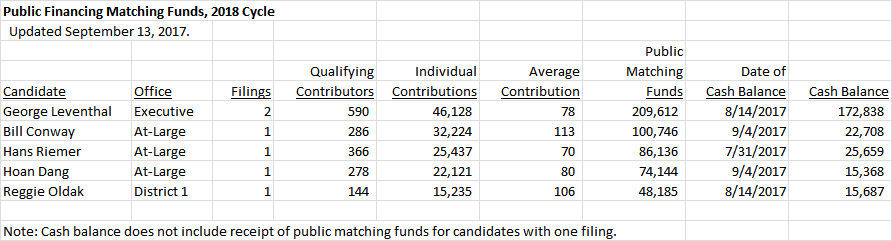
Including information provided by Dang’s campaign today, here is the updated comparison of the five campaigns who have applied for public financing.

Dang is not the leader in public financing.  George Leventhal, who is running for Executive, is the overall leader in qualifying contributors and receipts.  (Executive candidates get higher match rates than council candidates.)  Among the council candidates, incumbent Hans Riemer leads in qualifying contributors and Bill Conway leads in matching funds.  This should not discount a strong performance by Dang, whose financial numbers are not terribly different from Riemer’s.

Going forward, we hope the state prevents the kinds of mistakes that affected Dang’s campaign.  In the initial glitchy filing, Dang supposedly requested $148,328 in public matching funds.  (Again, the IT glitch was not Dang’s fault.)  In the updated filing, Dang requested $74,144 in public matching funds.  That’s a $74,184 difference.  If Dang had not caught the mistake, could that difference have conceivably been paid out?  There’s no evidence available on that point.  But for the good of public confidence in the county’s public financing system, we hope such a mistake never happens.

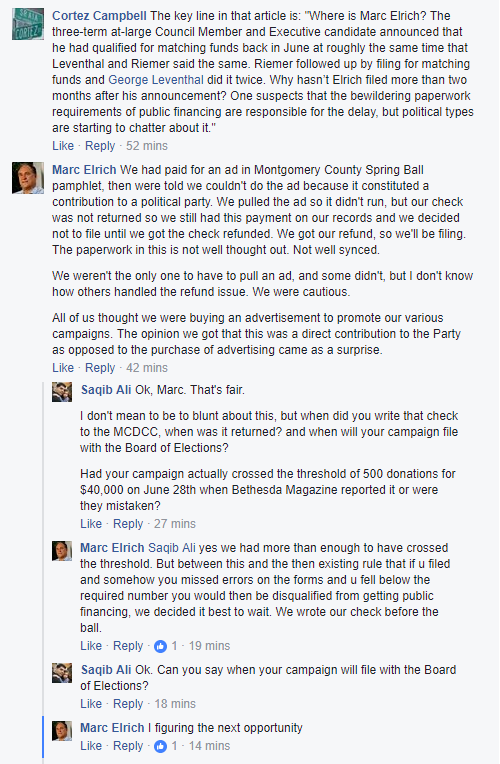
On a different issue, we asked what happened to Council Member Marc Elrich’s filing for public matching funds in our original post.  Elrich said he had enough contributors to qualify back in June but has not filed yet.  When asked about it on Leventhal surrogate Saqib Ali’s Facebook page, Elrich said his delay in filing was related to a payment his campaign had made to the county party, which was subsequently ruled to not be in compliance with public financing requirements.  We reprint Elrich’s statement below.

Share

Preliminary Fundraising Totals in Public Campaign Financing, September 2017

By Adam Pagnucco.

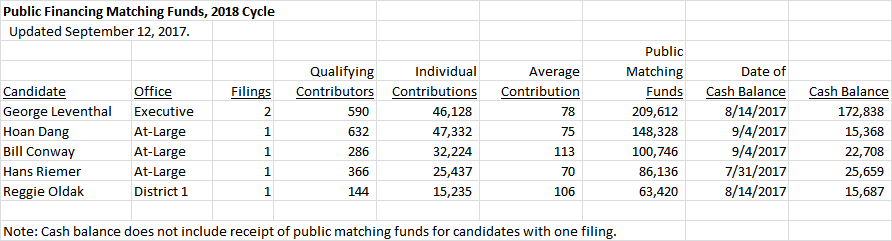
Correction: The numbers for Hoan Dang in this post are inaccurate.  For updated numbers on Dang and a response by Marc Elrich, please visit our updated post.

One of the virtues of public campaign financing is the rapid release of financial reports for participating candidates.  That’s right, folks – for this group of candidates, there is no need to wait until January to see fundraising numbers.  That’s because when they qualify for public matching funds and request them from the state, their financial reports are released almost immediately.  This is terrific for all data junkies like your author as well as inquiring minds among the readers!

Below is a summary for the five candidates who have applied to receive matching funds from the state.  Bear in mind the following characteristics of the data.  First, the number of qualifying contributors means the number of contributors who live in Montgomery County.  Non-residents can contribute up to $150 each but the state will not authorize matching funds for them.  Second, the individual contribution amounts are the basis on which the state determines how much in public matching funds will be released.  Third, the date of cash balance is important because it varies depending on when the applications were sent in.  That is unlike the regular reporting dates on which financial positions are summarized at the same time for all candidates.  And fourth, for those candidates who have only filed once (which includes everyone except George Leventhal), the cash balances do not include public funds from the state.  To estimate the cash positions of those candidates, the cash balance should be added to the public matching funds they requested.

What do we make of this?

1.  Let’s start with the obvious: there are a lot of small checks out there!  While many contributors are probably donating to more than one of these five campaigns, it’s not a stretch to say that close to a thousand people will have contributed by some point in the near future.  It’s hard to make comparisons with the past without exquisitely detailed research to back it up (anyone want to pay us for that?) but our hunch is that this is a larger early donor pool than in prior cycles.

2.  The big story here is Council At-Large candidate Hoan Dang.  At-Large Council Members George Leventhal (who is running for Executive) and Hans Riemer (the only incumbent running for reelection) have a combined 22 years of representing the whole county.  But Dang had more in-county contributors than either one of them!  How does that happen?  Dang ran for Delegate in District 19 in 2010.  He was financially competitive, raising $103,418, but he finished fifth out of six candidates.  There was no reason going into this race to believe that Dang would receive more grassroots financial support than Leventhal or Riemer.  But so far, he has.

3.  Dang is not the only story.  Look at first-time candidate Bill Conway, who collected more private funds than Riemer primarily by having a larger average contribution.  In most elections, challengers struggle to be financially competitive with incumbents.  But the early performances of Conway and Dang relative to Riemer suggest that, at least among publicly-financed candidates, some or all of that gap may be closed.  Our hunch is that a group of at-large candidates will all hit the public matching funds cap of $250,000 and therefore have similar budgets heading into mail season.  The big question will then become how those totals compare to what candidates in the traditional system, like Marilyn Balcombe, Charlie Barkley, Ashwani Jain and Cherri Branson, will raise.

4.  Where is Marc Elrich?  The three-term at-large Council Member and Executive candidate announced that he had qualified for matching funds back in June at roughly the same time that Leventhal and Riemer said the same.  Riemer followed up by filing for matching funds and Leventhal did it twice.  Why hasn’t Elrich filed more than two months after his announcement?  One suspects that the bewildering paperwork requirements of public financing are responsible for the delay, but political types are starting to chatter about it.

That’s all for now.  Candidates, keep those reports coming in so your favorite blog has more material for the readers!

Share

How Much Will Emily’s List Spend in CD6?

By Adam Pagnucco.

Recently, Emily’s List announced its endorsement for CD6 candidate Aruna Miller, a move seen as significant in that race.  Emily’s List’s Super PAC, Women Vote, has made millions of dollars in independent expenditures (IE) in federal races over the last five cycles.  But how effective are they?

Let’s start in Maryland.  In 2016, Emily’s List invested in three federal candidates: Donna Edwards (U.S. Senate), Joseline Peña-Melnyk (CD 4) and Kathleen Matthews (CD8).  The group had an impact: they accounted for at least a million dollars in TV spending for Edwards and basically assumed the bulk of mail duty for Matthews.  But all three candidates lost, with Edwards finishing second in the primary and Pena Melnyk and Matthews finishing third (despite both having the Washington Post endorsement).  The group spent $3.2 million of IE funds on behalf of the three candidates, including $2.9 million for Edwards.  Edwards’ amount was one of the largest single-race investments made by Emily’s List in the 2016 cycle.  Data for the group’s IE spending in Maryland appears below.

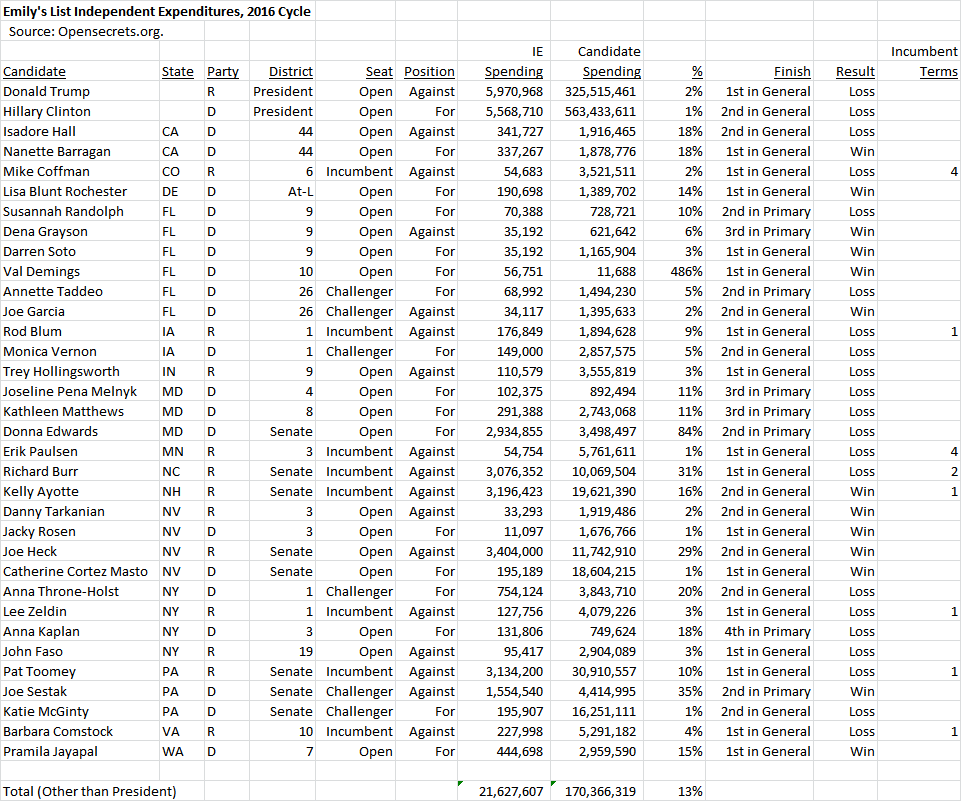
Now let’s examine the group’s IE spending nationwide in 2016.  The group invested in 23 races, winning 7 and losing 15.  In the remaining race (Florida CD9), the group’s original pick lost in the Democratic primary, but they then spent on behalf of the Democratic nominee, who won in the general.  Let’s call that one a draw.  It’s important to note that Emily’s List did not spend in every race in which it endorsed.  Data for the group’s IE spending nationwide in the 2016 cycle appears below.

What can be learned from the results of Emily’s List’s chosen races?  Although their win rate and their experience in Maryland are not impressive, they had some notable successes.  Perhaps their biggest win was helping to knock out freshman Republican Senator Kelly Ayotte (NH) in a razor-tight win for then-Governor Maggie Hassan.  Emily’s List spent $3.2 million against Ayotte.  They also spent $3.6 million to hold Harry Reid’s Senate seat in Nevada, helping to boost Catherine Cortez Masto to victory.  But besides Ayotte, they tried and failed to knock out seven other GOP incumbents, spending $6.9 million on those races.  These were not crazy bets – GOP Senators Pat Toomey (PA) and Richard Burr (NC) were thought to be vulnerable at the time – but they did not work out.

In U.S. House races, Emily’s List spent an average of $218,675 per contest.  The group’s highest single IE in a House race was a combined $881,880 to defeat freshman New York GOP Congressman Lee Zeldin, who beat the group’s candidate by 16 points.  In many House races, the group spent less than $100,000, which was probably not enough to make a difference.  Maryland and New York are the only states in which the group lost three races.  We would not blame Emily’s List if they decided not to throw more money our way!

What does all of this mean for CD6?  The 2018 elections, in which opposition to Donald Trump is likely to play a significant part, may very well contain more opportunities for Emily’s List and other progressive groups to score victories against the GOP than in 2016.  That could draw Emily’s List’s money away from a blue-state primary like CD6 and into districts where GOP incumbents are vulnerable.  The group may also consider David Trone’s nearly unlimited finances, which helped outpoll their chosen candidate in CD8 last year, and conclude that it’s not worth opposing him again.  All of this means the group could do one of two things.  First, it could make a modest investment in CD6, perhaps a couple hundred thousand dollars at most.  That would only make a difference in a close race.  Or second, as it has done in many races over the years, it could invest nothing at all.

Share

Growing Our Local Economy and Shrinking Our Wealth Gap

By Ben Shnider.

To drive along Montgomery County’s I-270 corridor is to pass countless “For Lease” signs in front of near-vacant office parks. And to speak with service industry workers along this corridor is to encounter our community’s widening gap between the top 1% and other 99% — for whom it’s becoming harder and harder to afford living in the County.

How we address these twin challenges of affordability and economic development will define our community over the next decade. Thankfully, by proactively seizing every opportunity to prioritize smart growth, we can make significant progress on both fronts.

Consider the recent foreclosure sale of Lakeforest Mall in Gaithersburg. The mall was purchased for one-fifth of what the previous owner spent to acquire it in 2012. This drop in value coincided with, among other factors, the growth of the more walkable Crown Farm neighborhood about four miles down the road. The County is already studying a modernization of the well-used Ride-On transit center adjacent to Lakeforest Mall. A comprehensive mixed-use redevelopment of the property would complement this investment far better than retaining the dated mall by boosting foot traffic and economic activity. After all, the numbers are clear: walkable, transit-oriented areas in our region produce 80% more in retail sales than their auto-centric counterparts. And it’s these more walkable, transit-oriented neighborhoods that have recently drawn many regional employers.

Mixed-use redevelopment of properties like Lakeforest can also be an important tool in addressing the affordable housing crisis in Montgomery County. Over one-third of County residents now rent and half of those renters are cost-burdened. Those looking to buy are often forced to choose between inadequate options that squeeze prospective buyers for unnecessary space and/or acreage. Walkable and transit accessible communities provide an opportunity for a broader range of housing choices. They also provide additional opportunities for existing affordability initiatives like the County’s Moderately Priced-Dwelling Units (MPDU) — a program that Gaithersburg and Rockville have also adopted.

Of course, there are challenges involved when re-envisioning underutilized properties like Lakeforest, including adequate public infrastructure, individual property owners in need of an incentive to relocate, and developers who don’t want to contribute their fair share for infrastructure improvements. In this case, the City of Gaithersburg — a leader in smart growth — has wrestled with these hurdles for some time. And, of course, not every mall in the region is failing. For instance, Westfield’s Bethesda and Wheaton malls are doing relatively well.

But these challenges can’t be an excuse for running on autopilot and the fact that some indoor shopping malls are doing better than others shouldn’t distract us from the overall trend. Instead, we must embrace opportunities to reinvent dated properties in the County with a sense of urgency. Otherwise our economy will fall behind those of neighboring jurisdictions, our residents will lack adequate housing and employment opportunities, and our government will lack the tax revenue necessary for critical investments like pre-K and enhanced access to Montgomery College.

The County, therefore, must work with our municipalities and the business community to leverage every tool at its disposal to move away from shopping malls and cavernous office parks and toward more sustainable and affordable communities — from master plans and zoning text amendments (outside of cities, like Gaithersburg and Rockville, that have their own zoning ordinances), to reinvigorated and innovative economic development and affordable housing policies.

This overall approach will help uproot the “For Lease” signs along I-270 while extending more economic opportunities to the low-wage workers working in their shadows.

Ben Shnider is a Democrat who is running for Montgomery County Council in District 3.

Share

First Impressions, Part Four

By Adam Pagnucco.

Seth Grimes, Takoma Park

Former Takoma Park City Council Member Seth Grimes’s edge is his experience.  Other than incumbent Hans Riemer and Delegate Charles Barkley (D-39), Grimes is the only candidate in the field who has served in elected office so far.  During his two terms in office (2011-2015), Grimes passed legislation allowing 16-year-olds to vote in municipal elections as well as banning environmentally harmful pesticides and polystyrene containers.  The latter two bills were models for similar county legislation.  He also pushed for better management practices in the city both before and after he started serving on the council.

In person, Grimes comes across as studious and tremendously substantive.  Those qualities are present in such abundance that he can struggle to convey ideas in layman’s terms.  He can go into significant detail on his favorite subjects, including affordable housing, food security, reducing poverty and municipal tax duplication.  On many other subjects, Grimes can relate them to his work in the city.  As a provider of many more services than a lot of Maryland municipalities (including a full service police department), the city provides a good laboratory for understanding the functions and problems of county government.

One major plus for your author is that Grimes is a blogger.  (Folks, we bloggers are sorely misunderstood and must stick together in the face of a sometimes unforgiving world!)  His blog shows a person who is fact-oriented, careful, versed in policy and extremely well informed.  It’s obvious that he would be ready to serve on the County Council from day one.  That fact alone makes him worthy of consideration for your vote.

Ashwani Jain, Potomac

Former Obama administration official Ashwani Jain has an inspiring story.  He is a first generation American whose father came here from India years ago with no connections and built a thriving family jewelry business.  He is also a cancer survivor, having contracted the disease at age 13 and undergone chemotherapy.  Jain understands the American dream as well as personal tragedy.  Lots of people will relate to him.

Jain’s claim to fame is his association with President Obama, dating from his volunteering for him ten years ago and ultimately culminating in positions at the White House and the U.S. Departments of Health and Human Services and Housing and Urban Development.  He is part of the local Obama network that also includes Council Member Hans Riemer, Delegate Marc Korman, former Maryland Obama Director Jason Waskey, former Delegate candidate Kyle Lierman, former MCDCC Member Oscar Ramirez and fellow at-large council candidate Will Jawando.  But Jain is not just a national-level person – he is also a native of the county and has lived in several parts of it, both east and west.  That gives him a gut-level knowledge of the county that most transplants don’t have.

Jain’s policy views on land use and budgetary issues are not well developed, though he does favor transit projects like the Purple Line and the BRT system, he supports a $15 minimum wage, he believes the county should be a sanctuary jurisdiction and he emphasizes the need for affordable housing.  He also thinks the county should consider ending its liquor monopoly.  But perhaps the biggest reason why voters will like him in addition to his Obama experience is his appealing personality.  Simply put, it is virtually impossible to dislike him.  That’s a major asset for any politician.  Local activists don’t know him yet, but he could really surprise people before this race is over.

That’s it for now, folks.  As we meet more candidates, we may renew this series in the future!

Share

SEIU Targets Senator Shirley Nathan-Pulliam for Defeat

By Adam Pagnucco.

The Service Employees International Union (SEIU), one of Maryland’s most powerful labor unions, has targeted District 44 Senator Shirley Nathan-Pulliam for defeat by running one of their own against her.  Aletheia McCaskill, a rank-and-file leader in SEIU Local 500, is announcing her challenge to the incumbent on Saturday.  Nathan-Pulliam has antagonized SEIU and several other progressive organizations by dragging her heels on last session’s sick leave bill, which she ultimately voted for.

Several things make this race interesting.

1.  SEIU has a record of defeating Senate incumbents, including Nat Exum and David Harrington (Prince George’s County), Rona Kramer (Montgomery County) and George Della (Baltimore City). Their negative mail against Exum was particularly devastating.

One of at least seven anti-Exum mailers from SEIU.

2.  Nathan-Pulliam has not had a truly competitive election in her entire career. She walked into her current Senate seat after the incumbent retired and had five straight cakewalk House races before that.  She is also not a great fundraiser, raising $77,695 in the 2006 cycle, $72,363 in the 2010 cycle and $124,732 in the 2014 cycle.  She reported $33,533 in the bank in January.  Those are easy numbers for a big organization like SEIU to overcome.

3.  Many labor organizations have supported Nathan-Pulliam over the years, including AFT Maryland, MSEA, the Fire Fighters, the Police, UFCW Local 400, several building trades local unions, the AFL-CIO and SEIU. Those unions have given her more than $30,000 over the last four cycles.  How many of them will follow SEIU’s lead and dump the incumbent?

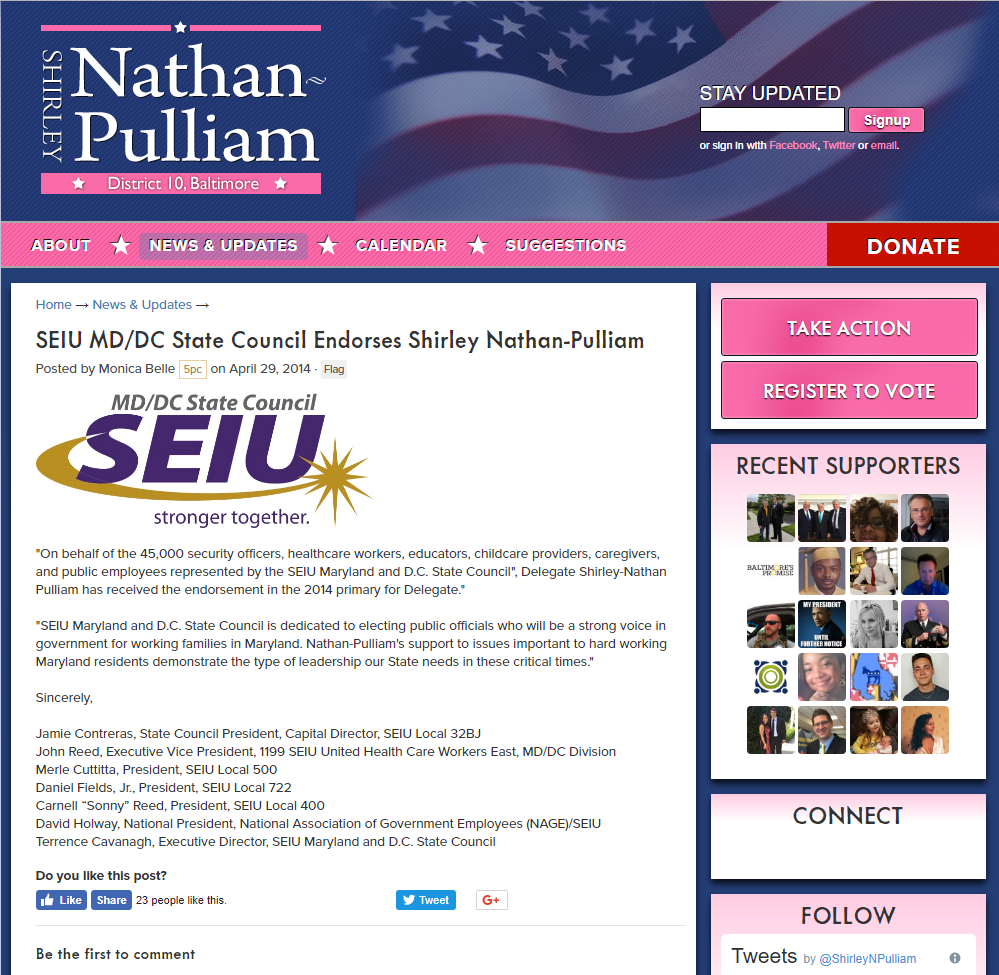
SEIU endorses Nathan-Pulliam in 2014.

4.  Nathan-Pulliam has not represented many of her current constituents all that long. True, she has been in office since 1994.  But her district has changed substantially since then.  District 44 now includes a portion of the western part of Baltimore City along with Lochearn, Woodlawn, Catonsville and the areas around US-40 and I-70 in Baltimore County.  Prior to that, Nathan-Pulliam represented District 10.  During the 2000s, District 10 did not include any part of the City and during the 1990s, the City portions it did include are not part of today’s District 44.  This somewhat erodes the advantage a decades-long incumbent would normally have.

5.  At age 78, Nathan-Pulliam could decide not to fight SEIU and simply retire.

We reprint McCaskill’s kickoff announcement below.

*****

Event: Working Families Democrat and SEIU Union Leader Aletheia McCaskill announces a Democratic primary challenge in Maryland’s 44th State Senatorial District

Date:  September 9, 2017, 2:00-4:00

Where: Karate Family Center 1101 N. Rolling Road, Catonsville, MD 21228

Aletheia McCaskill is a wife, mother, activist and advocate who has owned her own small business providing early learning child care services to the residents of West Baltimore and Western Baltimore County for over 20 years.  She got involved on issues of economic justice such as the fight for fair wages and earned sick leave legislation because of the reality she saw in the lives of the families whose children she provided care for.  She has been the Statewide Political Member Leader for the largest Maryland local in the Service Employees International Union and has been a leader in the fight in Baltimore and Annapolis to pass the Women’s Economic Security Agenda- a package of bills aimed at  providing some measure of economic stability for the working families of the 44th.  Aletheia believes that the 44th District deserved a choice, she wants to be our voice in Annapolis fighting for stronger schools and for finally giving our Seniors the services and facilities WITHIN the 44th, that they deserve.

https://www.mccaskill44.com/

For Press or scheduling, please contact:

Mark Jason McLaurin, Political Director

SEIU Local 500

901 Russell Avenue, Suite 300

Gaithersburg, MD 20879

(301) 740-7100 – Voice

Share

First Impressions, Part Three

By Adam Pagnucco.

Danielle Meitiv, Silver Spring

Danielle Meitiv is from Queens.  You can hear it in her voice.  But she is also quintessentially MoCo.  Our county is full of people who moved here from somewhere else and are principally concerned with national or international issues.  Some keep up with local issues and vote regularly, but many others have little idea who their state or county elected officials are.  Meitiv was once in the former group.  But then she had a Great Awakening.

We are of course referring to Meitiv’s international fame as the Free Range Mom, during which she battled – and defeated – MoCo’s Child Protective Services (CPS).  Nearly everyone in the county has heard the story of how CPS detained Meitiv’s children for walking alone in public and how her family fought back.  For Meitiv, the incident drove home the importance of local government and the unequal resources possessed by residents who have to deal with its bad side.  It left a permanent mark on a person who was once little different from so many other MoCo voters.

In many ways, Meitiv is a conventional county liberal.  The issues she brings up – BRT, walkable neighborhoods, the Purple Line, civil rights, climate change – are mostly the same as the other at-large candidates.  But Meitiv adds something else: her calls for greater transparency and responsiveness by county government based on her own searing experience with CPS.  Few voters have gone through what she did, but virtually everyone has a story to tell of unresponsive bureaucracy and/or unresponsive elected officials.  That plus Meitiv’s appealing combination of passion and intelligence make her relatable and brings potential to her run for office.

Chris Wilhelm, Chevy Chase

MoCo has a reputation as the most progressive county in Maryland.  But Chris Wilhelm doesn’t think we are progressive enough.  He writes on his website, “Yes, the biggest threat to our progressive priorities is coming from the current occupant of the White House and Republicans in Congress.  But too many leaders in our County and Party act in ways that go against the progressive agenda that residents are demanding.”

Wilhelm sees many local issues as reflections of national issues.  Senator Bernie Sanders, whom Wilhelm admires, made free college a key element of his platform.  Wilhelm thinks the state and the county should do everything they can to make Montgomery College free for county residents.  After all, if deep-red Garrett County is doing it, why can’t we?  He supports Roger Berliner’s fossil fuel divestment bill because he sees it as a way for MoCo to contribute to a nationwide movement towards clean energy.  He deplores corporate welfare for big companies and favors local support for small businesses both across the country and here at home.  And his demand that all county candidates enroll in public financing is rooted in a belief that corporate campaign money is a problem both nationally and locally.

Wilhelm has two advantages over his competitors.  First, he is an ESOL teacher in MCPS.  He can speak in very detailed, compelling terms about the school system – always a huge issue in local races – and the things it can do to improve.  Second, he has more campaign experience than most of his rivals, having worked in the field for Barack Obama (2008) and David Moon (2014).  The principles of how to run an effective campaign are not new to him.

Chris Wilhelm is clearly positioning himself in the most liberal part of the field.  If you want a serious, thoughtful progressive who will help move the council to the left, you should give him a close look.

We will conclude in Part Four.

Share

First Impressions, Part Two

By Adam Pagnucco.

Bill Conway, Potomac

Many readers have encountered Diana Conway, one of MoCo’s most tenacious and effective environmental activists.  As she is someone who has long been involved in local elections, your author had long assumed that a Conway might someday appear on the ballot.  Well, we were half-right – the Conway who is running is her husband, Bill.

Bill Conway is a recently retired energy lawyer who is a nationally recognized expert on the electric power industry.  He once worked as a U.S. Senate staffer and played a key role in designing wholesale electricity deregulation in the early 1990s.  He’s a heavy hitter and with a profile like that, one might assume that Conway would come across as a know-it-all.  But then you meet him.

Conway’s intelligence is as obvious as his immense likability.  But his greatest asset is his curiosity.  Your author has interviewed dozens of candidates over the years.  Most of them are reluctant to admit ignorance on anything for fear of coming across as unready for elected service.  Not Conway.  While he certainly has plenty of knowledge and opinions – he is just as animated in discussing social justice as he is about the need to grow the economy – he is comfortable enough in his own skin to ask questions.  LOTS of questions.  Your author has never met a candidate who took such deep dives on policy issues right off the bat – for HOURS – as Conway.

Intellectual curiosity may be the single most underrated trait in great elected officials.  Their job is to deal with a tremendous variety of issues that demand attention and expertise, often many in the same day.  The best of them learn quickly and love to learn.  Bill Conway has a lot going for him but he has that trait in spades.  It will serve him and his constituents well if he gets elected.

PS – Right now, no at-large candidate is working harder than Conway on the campaign trail.  Here’s the proof.

Gabe Albornoz, Kensington

Imagine working your way up the ladder quickly and landing a dream job.  Everything is great, yeah?  And then less than two years later, the cuts begin.  By the time it’s all over, your budget is down 23% and your employees’ work years are down 22%.  Is it still a dream job?

Gabe Albornoz would say yes even though that actually happened to him.  As the county’s Director of Recreation, his department took those cuts between Fiscal Years 2008 and 2012, some of the biggest cuts to any part of the government.  Albornoz had to look people in the eye and let them go, something almost all managers hate to do.  But he got through it by concentrating reductions in force at the middle management level and empowering front-line employees to make more decisions.  No recreation centers were closed and Albornoz recruited non-profits and community groups to help fill the gap.  That’s one reason why Albornoz is considered one of the best managers in county government.

But that’s not all he is.  Albornoz is also the former Chair of the Montgomery County Democratic Central Committee and steered the party through some difficult conflicts with labor.  Many new candidates have to spend time building relationships with players across the county – and it’s a BIG county.  Albornoz already has those relationships – with elected officials, civic associations, community groups, faith groups and everyone else he has worked with in county government over the last decade.  Unusually, he seems to be almost devoid of enemies.  (Explain how you do that to this blog author, Gabe!)  It’s a large network that could pay big dividends.

The knock on many people in legislative positions is that they know nothing about running a government, or a large organization of any kind.  No one could say that about Gabe Albornoz.  He is among the best prepared people to ever run for Montgomery County Council.

More to come in Part Three.

Share