All posts by Adam Pagnucco

Bill Fricks Up the Executive Field, Part Two

By Adam Pagnucco.

Delegate Bill Frick’s candidacy for Montgomery County Executive raises a number of questions that will impact both him and his rivals.  Here’s our shot at asking them and teasing out some answers.

Question 1: The Path Not Taken

Four years ago, the higher office Frick really wanted was Attorney General.  His path at that time was blocked by his district’s Senator, Brian Frosh, but it could be much more viable in the near future.  Frosh will be 76 years old at the end of his second term.  If Frick were to remain in the House and raise money, expand his connections and build a statewide network, he would be a strong contender to succeed Frosh.  Frick would also have a great rationale for an AG candidacy: his legislative history on consumer issues demonstrates that he would be an aggressive crusader against predatory banks, rapacious credit card companies and sleazy Internet scammers.  That’s a politically powerful message.  But a losing race for Executive would let other candidates jump ahead of him for an AG run.  It’s a huge opportunity cost that should not be paid lightly.

Question 2: Geography

How much are Frick and Council Member Roger Berliner handicapped by the fact that they represent much of the same area?  Berliner’s District 1, which includes Bethesda, Chevy Chase, Kensington, Potomac and Poolesville, contains 31% of all Super-Democrats (Dems who voted in all three of the 2006, 2010 and 2014 primaries).  Frick’s Bethesda-based District 16, which is inside District 1, contains 19% of all Super-Dems.  These areas are excellent bases from which to launch a countywide campaign.  But Frick and Berliner could split these votes, hurting both of them.  Also worth considering is that Council Member Marc Elrich will get votes in this region as well owing to his criticism of unpopular master plans passed by the County Council.

Question 3: Prior Races

Consider this.  In the last four years, Frick has run for four different offices: Attorney General, Delegate, Congress and now Executive.  No other MoCo politician can say that.  Accordingly, there is some skepticism in the political community that he will be in the Executive race to the end.  That is going to play itself out with large contributors, who are critical since Frick will be using traditional campaign financing and there are only nine months left until the primary.  The last thing a big donor who cares about county government wants is to go all in for a candidate who drops out and runs for something else.  This is huge considering that Frick reported a balance of $45,818 in his state account in January and he cannot transfer funds directly from his federal account.  Frick needs to have a convincing argument to address this with donors or he will be unable to fund a competitive campaign.

Question 4: Counter-Attacks

Frick’s early strategy is to attack the County Council, a message that should get some traction among the majority of county Democrats who voted for term limits.  Frick told the Washington Post, “Our demands exceed our capacity, on our roads and in our classrooms… Too often, local leaders have been complacent, content to raise taxes and resist vital reforms, and our small businesses and parents grow more and more frustrated.”  In Bethesda Magazine, he criticized the “Rockville bubble” and blasted the council for protecting the liquor monopoly.  (Berliner is the one Council Member who agrees with Frick on that issue.)

But Frick has a record too and his new rivals are sure to bring it up.  While Frick attacks the county’s giant property tax hike, he voted for numerous state tax increases during the O’Malley years, including a 2012 state income tax hike of which MoCo residents paid 41% of the increase.  The Council Members will grill Frick on the state’s anemic performance in financing school construction in MoCo, a major issue for voters.  And Council Members Marc Elrich and George Leventhal, both of whom have co-sponsored a bill establishing a $15 minimum wage in MoCo, will ask Frick why he was not a co-sponsor of the state’s $15 minimum wage bill in the last General Assembly session.  In politics, no one gets to throw a sharp elbow without taking one in return.

Question 5: Other Candidates

We suspect that Frick may not be the last non-Council Member to enter the race.  Senator Cheryl Kagan (D-17) is sure to look at a field that includes four men and think, “In a primary electorate that is roughly 60% female, maybe there’s room for a woman in this race!”  Former Council Member Valerie Ervin, who polled an Executive race in 2013, might think, “Yeah, I got that, plus I have a base that no one else has!”  Businessman David Blair, who can self-finance, is polling and would be a true outsider candidate – even more than Frick.  Elrich, who has an immovable base of true believers who could be a fifth of the electorate or more, would no doubt welcome a large field.

And there could be even more surprises in an election that is shaping up to be one of the wildest in MoCo history.

Share

Bill Fricks Up the Executive Field, Part One

By Adam Pagnucco.

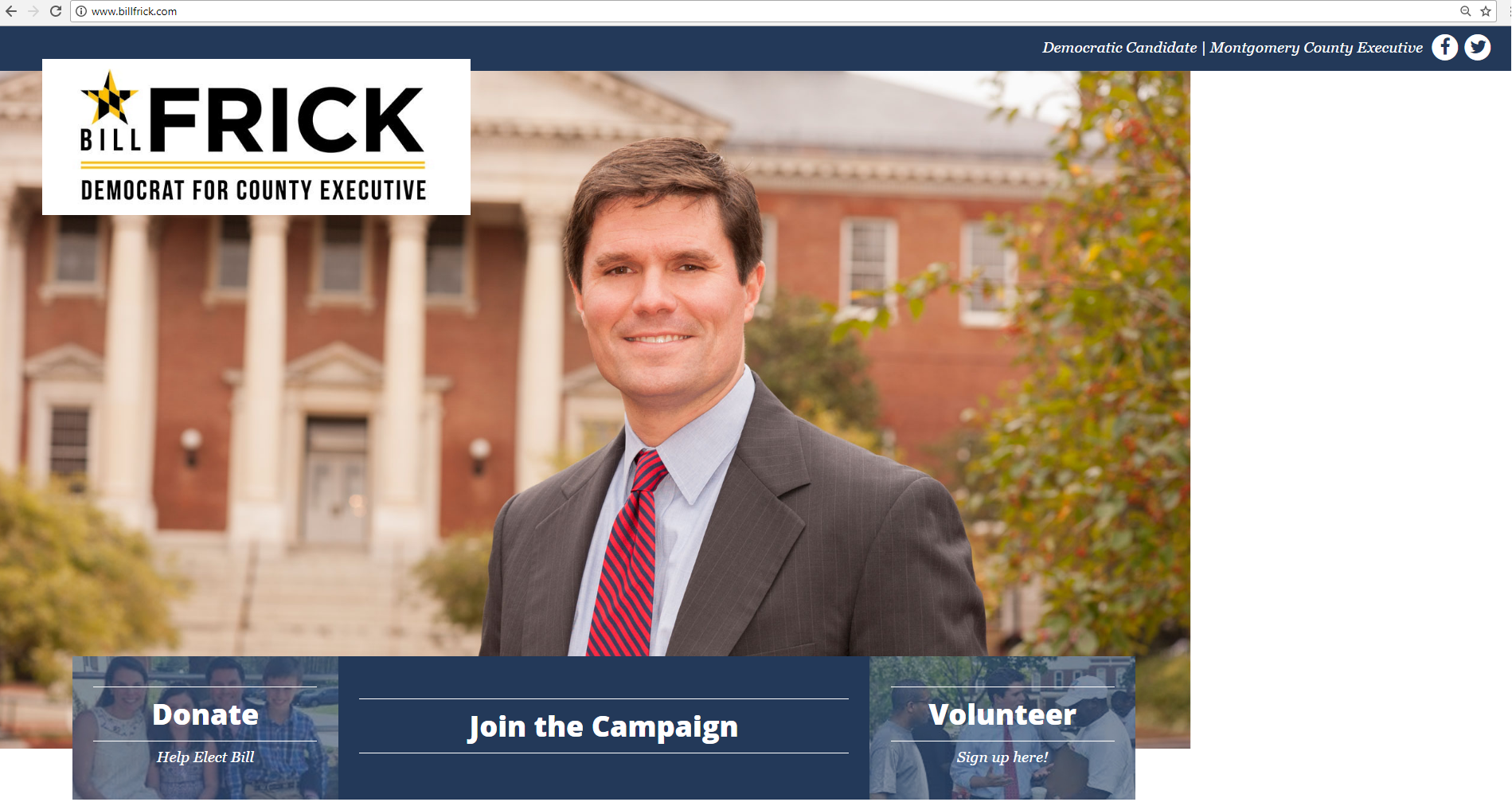
Delegate Bill Frick (D-16) has dropped out of the Congressional District 6 race and is running for County Executive.  This is the biggest story so far in the Executive race.  Council Members Roger Berliner, Marc Elrich and George Leventhal have been preparing to run for Executive for years but Frick has never before expressed interest in county office.  Additionally, Frick is the first person who is not a term-limited Council Member to declare for Executive and he may not be the last.

So  who is Bill Frick?  He’s a MoCo native who went to Northwestern and Harvard and is an attorney with Akin Gump downtown.  He was little known to the MoCo political community until he stunned the establishment by defeating a formidable field for a Delegate appointment in 2007.  He worked his way up in the House to become Parliamentarian and later House Majority Leader.  After first serving on Ways and Means, he joined the powerful House Economic Matters Committee, which decides all issues connected to alcohol, public utilities, insurance, banking, economic development and workers compensation.  He is the Chair of the Property & Casualty Insurance Subcommittee.  Frick is generally liked by his colleagues, often pranking them by stealing their phones and typing worshipful Facebook posts (“Bill Frick is my hero!”), but he is also respected as a substantive lawmaker.  His multiple, aborted runs for higher office (Attorney General in the prior term and CD6 until just recently) have raised questions among some of his colleagues about his political savvy but have not dented his popularity in Annapolis.

Frick has been a busy legislator over the years with a focus on consumer issues.  He has attracted news by introducing legislation to crack down on credit card companies and Internet scamming.  His bill to tighten renewable energy standards was vetoed by the Governor but passed after an override by the General Assembly.  Frick achieved countywide renown by introducing legislation in 2015 to allow MoCo voters to decide whether to end the county’s liquor monopoly.  It was a tremendous act of political courage that few MoCo politicians can match.  It provoked the county government employees union, which represents liquor monopoly workers, to target his wife and call for an investigation, none of which went anywhere.  The union may never endorse Frick in a future race, but for those who want to End the Monopoly, Frick is an eternal hero.

One more thing:  He is one of the most witty, charming and likable humans on Planet Earth. No one other than George Clooney, Bill Clinton or Bono is going to win a personality contest with Bill Frick.

Frick holds court in 2010.  Is this how MoCo voters will react to him?

For all of his undeniable assets as a candidate, Frick’s entry into the race provokes more questions than answers.  We will examine those questions in Part Two.

Share

Candidates, Hug Your Treasurer

By Adam Pagnucco.

Political campaigns have all kinds of characters in them.  There are the campaign managers, the best of whom are data nerds, bartenders, therapists and trouble shooters all at once.  Then there are the hard core supporters, always ready to insist that their candidate is the reincarnation of Mandela and eager to pounce on dissenters online.  There are the cross-eyed pundits, tossing out great gobs of bloggy drivel onto an unsuspecting populace.  And of course there are the candidates, their toothy daytime smiles concealing roiling anxiety in the dead of night.

But no one pays attention to the true MVPs of political races: the Treasurers.  Money is the lifeblood of all campaigns and these are the people who control it.  Without a competent Treasurer, a campaign can’t collect its money, pay its bills, file its reports or do much of anything at all.  And the workload is often far greater than anyone, even the candidates themselves, can ever understand.

I was a Treasurer once.  Senator Rich Madaleno asked me to assume that role for the District 18 slate back in 2008.  It was not the first nor the last dumb thing I have done for a politician I like!  The account records (actually, the disorganized piles of random papers) were delivered to me in shoe boxes.  Shortly afterwards, I began receiving notices from the State Board of Elections that the previous report filings were deficient and needed to be corrected.  But the state didn’t say what the flaws were.  Phone calls to the state offices were laughably useless.  So I had to reconstruct every single transaction in the history of the account(!!!!!) and re-file every single report that had ever been sent in.  This required weeks of agony, but dammit, no account with my name on it was going to get fined.  Even bloggers have standards!

Dear future candidates: don’t ever ask me to be a Treasurer again.  I would rather gargle cockroaches.

This year, the normally substantial challenges of being a Treasurer are compounded for a uniquely unfortunate subset of them: the Treasurers responsible for MoCo’s public campaign financing accounts.  The reason is that the state requires evidence of a contributor’s in-county residency before approving public matching funds for that contribution.  That’s easy to do with online contributions: all a campaign has to do is add a couple fields illustrating residency and collecting a digital signature.  But what happens if a dinosaur (like, say, your author) pays with a written check?  Well folks, that’s when the fun begins!

All contributions eligible for matching funds must be accompanied by proof of residency that is provided to the state.  For physical checks or cash, that means the donor must complete and sign a written form indicating residency in Montgomery County.  Somebody (that might be you, Mr. or Ms. Treasurer!) has to make sure that form is filled out and collected.  If a check or cash shows up in the mail, that means tracking down contact information for the contributor and getting hold of them.  “Thank you for contributing to Politician X, ma’am.  Could you fill out and sign this form showing that you live in MoCo and send it back to us?”  “Well, I’m out of stamps and my scanner is busted.”  “I’m out of the country for two weeks.”  “I’ll think about it and get back to you.”  “I just donated to you.  Why are you bugging me?  I want my money back!”  And these are the G-rated responses.

Campaigns love this like they love tarantulas in the shower.  One campaign surrogate says his campaign “absolutely hates it” when they get paper checks because of the time required to chase down donors.  One candidate with prior electoral experience estimates that the time taken to deal with these administrative issues is 40% greater than it is under the old traditional system.  Another candidate simply says, “Oy.  Vey.”  And again, these are the G-rated responses.

Nothing can be done to remedy these issues in the short term.  And let’s remember: the state is within its rights to demand proof of residency to prevent mistaken distributions of public matching funds.  But candidates in public financing must absolutely do one thing.

Hug your Treasurer.  Do it today!  Tell them you love them.  Or it might be YOU who has to chase down those donors!

Share

First Time Ever: Elrich Reaches Financial Parity with Leventhal

 By Adam Pagnucco.

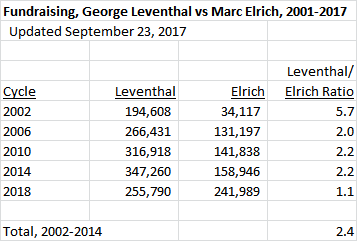
Many things have happened over the last four election cycles, but one thing has remained constant: George Leventhal has smoked Marc Elrich in fundraising.

Not anymore.

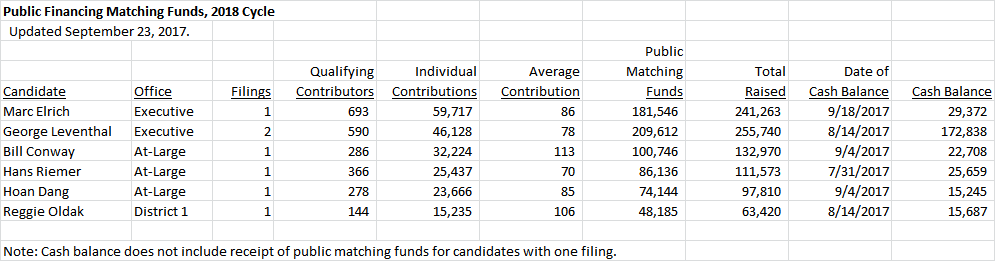
Elrich, who is running against Leventhal, Roger Berliner and Bill Frick to be the next County Executive, just filed his first application for public financing matching funds with the state.  So far, Elrich has more in-county contributors than Leventhal (693 to 590) and has raised more money from in-county individuals ($59,717 vs $46,128).  But Leventhal has received more public funds, leaving him with a slight lead in total fundraising.  Summary data for all qualifying publicly financed candidates appears below.

This is a dramatic turn of events from the past.  Leventhal and Elrich first ran against each other in 2002 as members of slates headed by County Executive Doug Duncan and Council Member Blair Ewing respectively.  Leventhal outraised Elrich by more than 5-1 that year and was backed by hundreds of thousands of dollars more in slate money from the real estate industry.  Over the next three cycles, Leventhal raised about twice as much as Elrich.

But public financing has eroded Leventhal’s edge.  That was predictable considering that both Leventhal and Elrich have had around 600 in-county individual contributors each in both the 2010 and 2014 cycles.  The ability of a candidate to raise money in the public financing system depends solely on the number of in-county contributors he or she has.  So if two candidates have similarly sized individual donor bases, they will raise similar amounts of money.

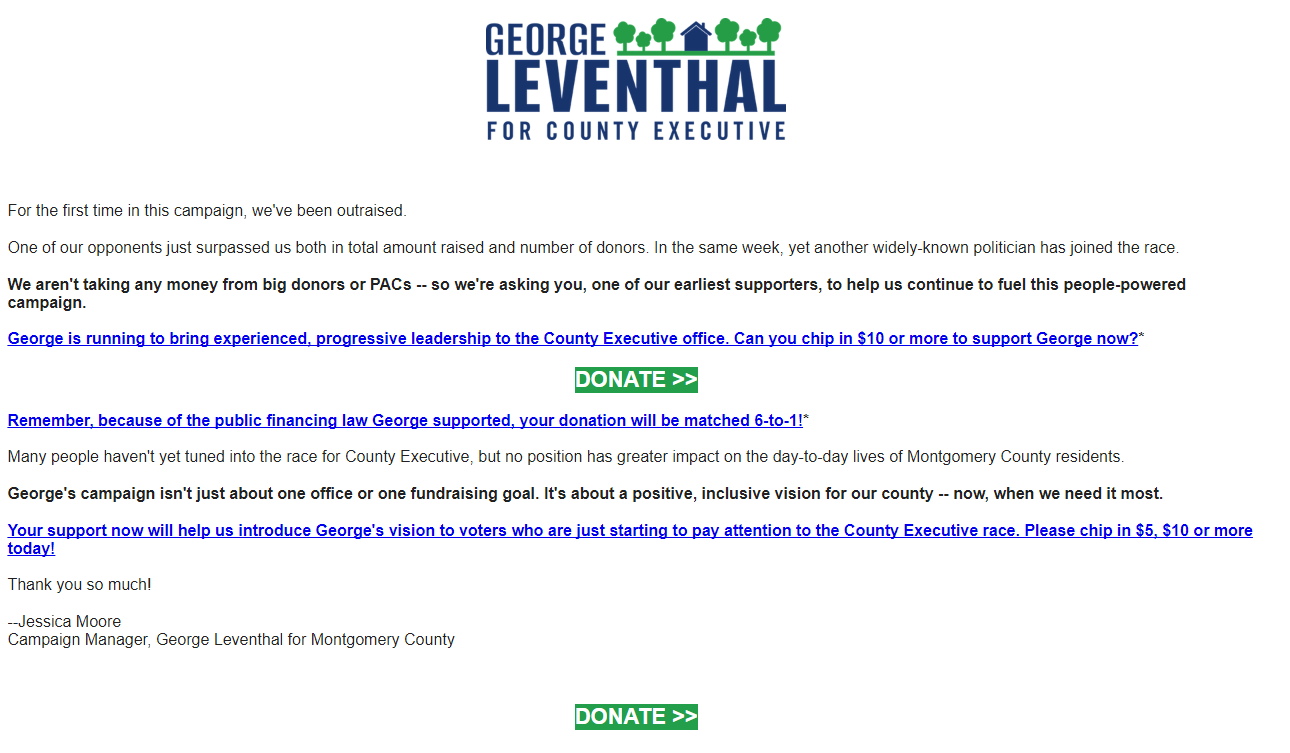
That fact is not lost on the Leventhal campaign, which sent out the fundraising email below shortly after seeing Elrich’s report.

Leventhal is right to be concerned about Elrich’s financial success.  Leventhal finished fourth and Elrich finished first in the last two at-large council elections despite the fact that Leventhal outraised Elrich 2-1.  What happens now when the two are at financial parity?

Share

Ana Sol Gutierrez Files for Public Financing in Council District 1

By Adam Pagnucco.

Delegate Ana Sol Gutierrez, who has served District 18 since 2002, has created a public financing account for a run in Council District 1.  While Ana is known for running up big vote totals in Wheaton, she actually lives in Chevy Chase and is eligible to run in the increasingly jam-packed D1 race.  Ana is known for her passionate work on behalf of immigrants and her enthusiastic support for the Purple Line, the latter being unusual among District 18 state legislators.  Her run for council will have a huge impact on both the District 1 and District 18 races, subjects on which David Lublin and I will have plenty to say in the near future.

Share

At-Large Candidate’s Proposal Breaks Campaign Finance Laws

By Adam Pagnucco.

Council At-Large candidate Brandy Brooks, who is participating in MoCo’s public financing system, would like to help natural disaster victims.  That’s a laudable goal.  But she is proposing to spend campaign contributions to do so.  The problem is that’s illegal under state and county campaign finance laws.

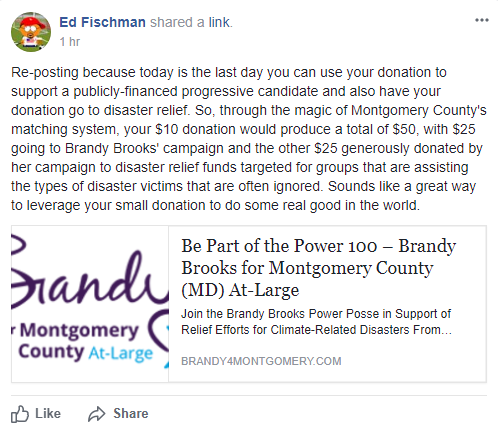
On her website and on Facebook, Brooks promotes an initiative that she calls “Power 100,” in which she invites 100 contributors to donate a combined $2,500 to her campaign, half of which would be paid out to a number of charities helping natural disaster victims.  The charities include organizations helping victims of Hurricane Harvey, Hurricane Irma, a mudslide in Sierra Leone and floods in South Asia.

Brooks supporter Ed Fischman went a step further in a posting on the Our Revolution in Montgomery County Facebook page, asserting that public matching funds would be used for disaster relief.  To be fair, it’s unclear whether Fischman speaks for Brooks and Brooks has not yet qualified for public matching funds.

State and county campaign finance laws prohibit these kinds of expenditures.  According to the State Board of Elections’ Summary Guide, there must be a nexus between campaign account expenditures and the promotion of a candidate’s campaign for those expenditures to be legal.  The guide specifically addresses charitable contributions, stating:

Generally, campaign funds may not be used solely for charitable purposes. Maryland law requires campaign funds to be used for the purpose of supporting or opposing a candidate, question, or political committee. Furthermore, it is important to keep in mind that contributors give to campaign committees for one important reason – they want to support the committee’s candidate, question, or political party. When campaign funds are spent for a non-campaign related purpose, it frustrates the intent of the contributor.

However, there are instances when a charitable donation is permissible because it is for a campaign purpose. For example, a candidate may permissibly use campaign funds to attend a charitable event since attending the event increases the candidate’s visibility and allows the candidate to network with potential voters and donors.

ง 13-247 of state election law does allow certain kinds of charitable contributions to be made by accounts that are closing and liquidating their assets, a case that clearly does not apply to Brooks.

Additionally, Montgomery County’s public campaign financing law states, “A participating candidate may only use the eligible contributions and the matching public contribution for a primary or general election for expenses incurred for the election.”  This statement is repeated in the county’s summary of the law.  No one could construe helping disaster relief victims as a primary or general election expense.  It’s noteworthy that the county’s language applies not just to public funds but also to individual contributions made under the public financing program.

Your author really hated to write this blog post but it had to be done.  Generally speaking, when we have examined campaign finance issues in the past, we have sometimes seen behavior that may not be ethical but is legal.  This case is the opposite: what Brooks is doing comes from the best of intentions but does not comply with the law.  Brooks is free to discuss the plight of disaster victims all she wants.  She could also organize a private fundraiser for victims separate from her campaign account.  But if she goes ahead and uses her campaign funds for disaster relief contributions, she will risk sanctions from the state, the county or both.

Share

Robinson, Platt Endorse Shnider in Council District 3

Montgomery County Council District 3 candidate Ben Shnider has been endorsed by Delegates Shane Robinson (D-39), Andrew Platt (D-17) and the leader of a hotel employees local union.  Former Council Member Valerie Ervin (D-5) has also offered praise for Shnider’s candidacy.  We reprint Shnider’s press release below.

*****

FOR IMMEDIATE RELEASE

September 15, 2015

Contact:  Ilya Braverman

Email:     ilya@shniderforcouncil.com

Website: https://www.shniderforcouncil.com

Progressive Leaders Endorse Ben Shnider for Montgomery County Council in District 3

Delegates Robinson and Platt join Unite Here Local 23 in endorsing Shnider’s council campaign ahead of kick-off event

Rockville, MD – On Saturday, Sept. 16 at 1 PM, Ben Shnider’s campaign for Montgomery County Council will host a canvass kick-off event at the Lincoln Park Community Center in Rockville.

Among those in attendance will be several notable community leaders who are endorsing Shnider’s campaign for progressive change in District 3.

  • Delegate Shane Robinson (D-39), Chair, Montgomery County House Delegation:

“I’ve known Ben for years and have seen him in action. I’m confident he’ll work tirelessly to ensure all members of our community can afford to live and thrive in Montgomery County. I know he also shares my commitment to keeping pesticides out of the Chesapeake watershed and a solid waste management strategy that moves aggressively toward zero-waste. I’m proud to endorse his campaign.”

  • Delegate Andrew Platt (D-17):

“I hear from families that I represent in Rockville and Gaithersburg every day who are struggling to keep up with the skyrocketing cost-of-living. I’m endorsing Ben’s campaign for County Council because I know he’ll be a tireless advocate for these working families.”

  • Bert Bayou, President, Unite Here Local 23:

“Our 1,000+ members in Montgomery County are hungry for leaders who will work with us to ensure we’re treated fairly on the job and paid a living wage. We’re confident Ben will be such a leader and enthusiastically endorse his campaign.”

In addition to these three endorsements, former County Councilmember Valerie Ervin said the following about Ben’s candidacy:

  • Former County Councilmember Valerie Ervin (D-5):

“I’m thrilled Ben is running and can’t wait to join him for his kick-off. Ben’s a talented organizer and a principled progressive who would be a passionate advocate for the underserved on the County Council. It’s time to pass the torch to the next generation of progressive leaders in this county. Ben is such a leader.”

About Ben:

Ben Shnider is a civic activist running to represent District 3 on the Montgomery County Council. He’s running to ensure that all families can afford to live and thrive in our community. Ben has dedicated his life to fighting for progressive values. Prior to running, he worked as an organizer for then-Senator Barack Obama’s historic 2008 Presidential campaign, launched the political arm of the advocacy organization Bend the Arc, and served as Political Director for the pro-diplomacy group J Street. Ben is a former Board Member for the Montgomery County Action Committee for Transit and serves as Vice Chair of Rockville’s Human Rights Commission.

He lives with his wife, Sheri, and their rescue dog, Twist, in Rockville’s King Farm neighborhood. To learn more about Ben, visit www.shniderforcouncil.com

Share

Will There Be a Deal on MoCo’s Minimum Wage?

By Adam Pagnucco.

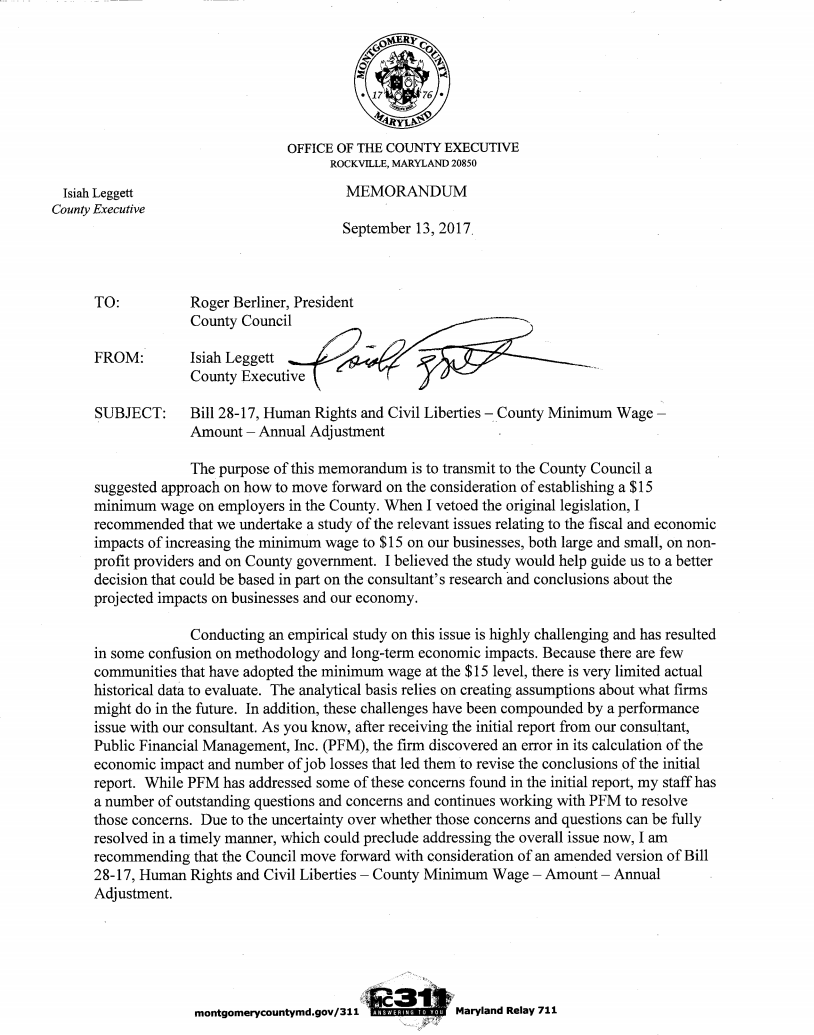
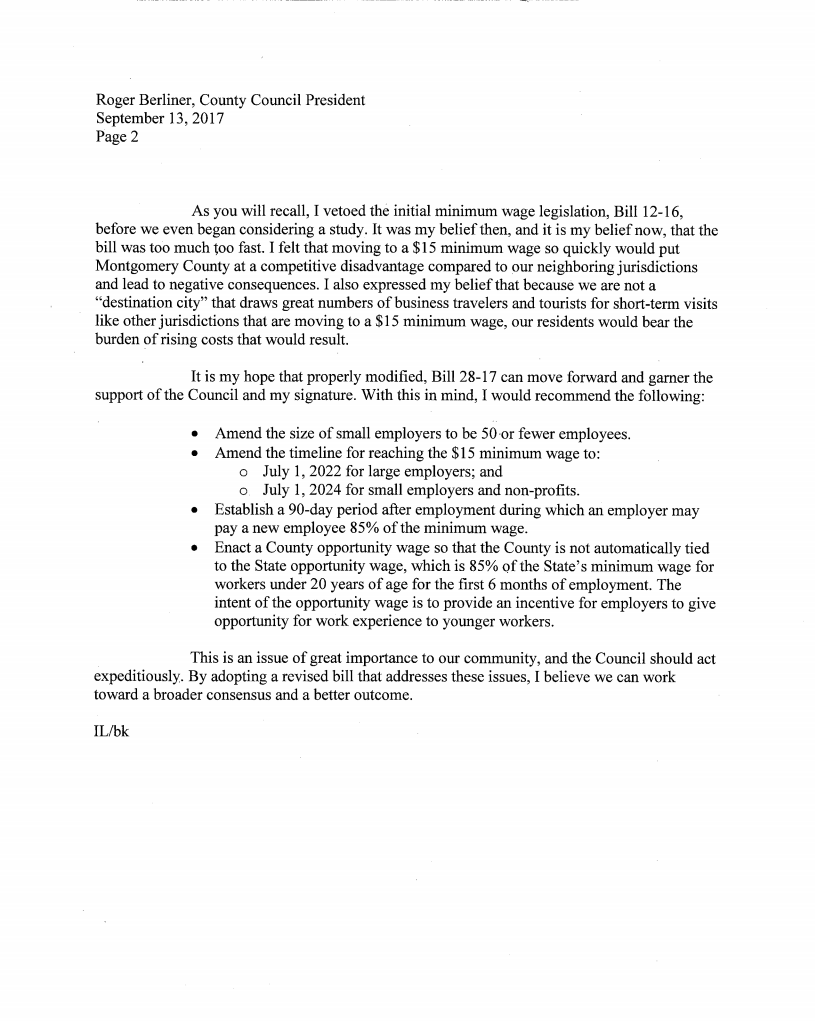
The question of whether Montgomery County will have a $15 minimum wage has simmered for months.  After County Executive Ike Leggett vetoed Council Member Marc Elrich’s bill last January, the county commissioned an ill-fated study on the effects of a wage hike that has been discredited.  But Elrich, not waiting for any study, introduced a new bill that was little different from his previous one.  The Executive has now announced his terms for signing it.  We reprint his letter to the council below.

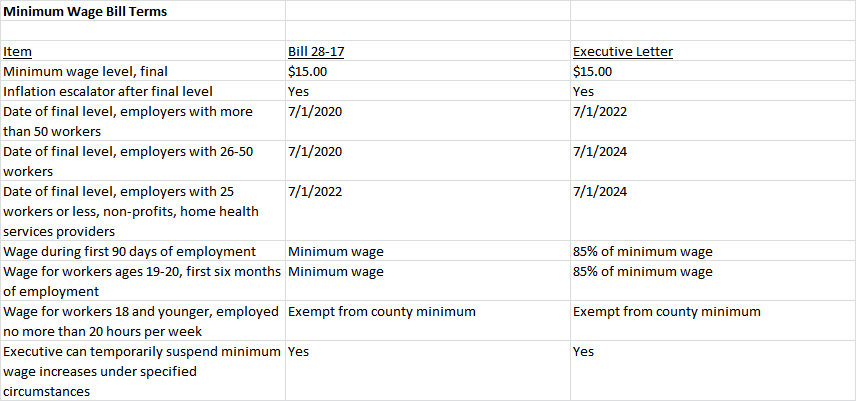
We summarize the differences between the bill and the Executive’s terms below.

Advocates for the bill reacted harshly to the Executive’s letter.  They sent out the following press release today.

*****

Economists, Community and Labor Groups Slam Executive Leggett Memo Say: “No More Delay Tactics, Working Families Need a Strong $15 Minimum Wage Now”

After Failed Study, Leggett Makes 2nd Attempt to Deny Low-Wage Workers a Living Wage

Rockville, MD- A coalition of economists, community and labor groups today condemned Montgomery County Executive Ike Leggett over his memo requiring County Council members to follow a set of criteria that would dramatically weaken Council’s $15 minimum wage legislation. The group also demanded that Leggett suspend his attempts to amend an irredeemable study and sign a strong bill before the end of session. Leggett’s minimum wage “study,” was widely criticized and eventually halted by the Executive himself.

The statement below is attributable to Maryland Working Families, the National Employment Law Project (NELP), 32BJ SEIU, Jews United for Justice, Progressive Maryland and CASA.

“In one of the nation’s wealthiest counties, County Executive Leggett is making a second attempt to avoid raising the wage like so many other economically prosperous cities have done successfully. His youth exemption would keep thousands of working men and women under the age of 20 in poverty, leaving them to continue struggling to support themselves and their families. County residents are counting on the Council and the Executive to resist corporate lobbyists whose self-interests are out-of-sync with the needs of working families. It’s time to stop looking for excuses and raise the minimum wage by passing and signing a clean bill, without delayed implementation or exemptions.”

Research has shown that overwhelmingly, cities that have raised the wage have not experienced job loss and the local economy continues to prosper. Moreover, a wage increase can reduce reliance on public assistance from a safety net that faces extreme cuts from the Trump administration, placing a heavier burden on local taxpayers.

With more than 163,000 members in 11 states, including 18,000 in the D.C. Metropolitan Area, 32BJ SEIU is the largest property service workers union in the country.

*****

So will there be a deal?  Under normal circumstances, the answer is yes.  The Executive is recommending a combination of delays and relatively modest adjustments for some categories of workers.  He is not proposing a fundamental overhaul of the bill.  A properly functioning legislative process would smooth out these details, probably by splitting the differences, and result in a 9-0 vote and a signed bill.  That’s how Rockville works most of the time.

But the circumstances are anything but normal.  Three Council Members are running for Executive and five more are running for reelection next year.  The two Council Members who are Executive candidates and are sponsoring the bill must decide if they prefer a signed bill or a campaign issue.  The bill advocates must decide whether they want another upheld veto which would cause further delay and take their chances with a new Executive and council.  These decisions, which are ultimately political in nature, will determine whether there is a deal on minimum wage.

Share