All posts by Adam Pagnucco

George Leventhal on Jobs

Job growth has been stagnant in Montgomery County over the past few years. What would you do to encourage increased job growth?

We have seen good news on job growth recently. County Executive Leggett’s office reported in January that the county had added 7,163 jobs since the previous January and in May that resident employment had increased by 10,900 jobs (not all located in the county) since the previous May. High-profile business location decisions recently have included Marriott’s decision to keep its headquarters in the county, Discovery’s decision to keep 230 jobs in Silver Spring rather than relocate them to Virginia, and WTTG/Fox 5’s decision to relocate to Bethesda from Northwest Washington.

Montgomery County has a great story to tell, but we need to do a better job telling it. Our quality of life is high; we have great public schools; honest and effective government; excellent cultural and recreational opportunities; beautiful natural features; proximity to airports, shipping routes, interstate highways and public transportation; high family incomes; a low crime rate, and a low unemployment rate. I supported creating the new Montgomery County Economic Development Corporation and am glad to see it is investing more than ever before in marketing our county’s excellent attributes to grow our job base and retain existing employers.

We have one of the smartest, most diverse work forces in the United States. We should advertise ourselves as the International Gateway to the Nation’s Capital, to attract employers from around the world and entice the talent our employers need to compete in the global marketplace. While our workforce already possesses more graduate degrees than any other community, and a wider array of language skills than most, we must make language education a higher priority in our schools. Language immersion should be expanded, especially in languages critical for global trade and national security, like Mandarin, Spanish, French, German, Hindi/Urdu, Arabic, Russian, Farsi, and Portuguese.

To appeal to the millennial generation of workers, and the generations that will follow them, we must continue our placemaking efforts, to build great urban communities in locations well served by transit, including Bethesda, Silver Spring, Rockville, Wheaton, and Glenmont, and we must expand transit options to economic opportunity hubs like Gaithersburg, Germantown and White Oak.

We should increase vocational training in our schools. The courses available at Edison High School are insufficient. Not all students will, or need to, attend college. Many good-paying jobs in industrial, manufacturing, information technology and other sectors can be filled by high school graduates with additional technical and vocational training.

We need to continue focused efforts to streamline our planning, permitting and procurement processes to see where they can be made more efficient and business-friendly. We must also strengthen our efforts to keep Montgomery County tax dollars in our local economy, by strengthening programs like the Local Small Business Reserve (which I originated), and minority, female and disabled business purchasing preferences.

I support designating Enterprise Zones to attract investment to areas that are struggling, like Glenmont and Burtonsville. I have also supported tax credits for investors in life science, environmental technology and cybersecurity, and I am currently exploring a county add-on to federal Small Business Innovation Research (SBIR) awards. I will seek to reduce our county energy tax, which puts our high-tech and data-intensive businesses at a particular disadvantage.

Share

Marc Elrich on Jobs

Job growth has been stagnant in Montgomery County over the past few years. What would you do to encourage increased job growth?

Most job growth comes from new businesses expanding in the location in which they were founded.  Surveys indicate that the quality of life and the quality of public goods in an area – including transportation systems and schools – matter far more when businesses are making their initial location decisions than the taxes and other financial incentives they might be offered.

While there is a lot about the economy that is beyond our control – there’s no silver bullet for job growth – there is much that the county can do to create the conditions for businesses to start and thrive.  To the extent that we have cumbersome and inappropriate regulations, we need to change them, and to the extent that regulatory costs are excessive, we need to lower them.  More importantly, I would focus on incubating new local-grown businesses, nurturing their growth, and improving the county’s economic infrastructure.  Other jurisdictions have creative small business incubators and we can learn from their successes to grow a stronger local economy.  The empty spaces in shopping centers and office buildings were once filled with small businesses, and we need to nourish a new generation of entrepreneurs to refill them.

The bus rapid transit (BRT) system proposal that I initiated and have been advocating for during my time on the County Council also holds real potential as a tool for job growth.  Businesses have made an issue of the lack of transit as an impediment to growth.  If we want people to create startups or expand existing businesses, we need entrepreneurs to feel confident that their employees have a reliable way of getting to and from work, that their customers can get to their stores, and that they will be able to transport the goods and services they need to stay in business.

A well-implemented BRT system would reduce future congestion and move more people than roadways alone, making the county a more attractive location for businesses of all sizes.  It would greatly benefit residents as well.

We also need to work with the school system, including Montgomery College, to make sure our students are prepared for jobs that don’t necessarily require a four-year degree but do require post-high-school education.  And we should expand apprenticeship programs in cooperation with the building trades organizations that need the next generation of skilled workers.

Share

Bill Frick on Jobs

Job growth has been stagnant in Montgomery County over the past few years. What would you do to encourage increased job growth?

For far too long, our Council has been complacent with the status quo and at times even outright hostile to the private sector.  Resting on the expectation of stable employment from the federal government, the Council has been largely indifferent and even averse to growing the private sector economy.  We can no longer afford to talk about the need for job and wage growth and yet show no interest in facilitating business growth that creates those jobs.  As Norm Augustine likes to say, “you can’t be for jobs and against employers.”

From our notorious permitting process to our burdensome tax policies, we need to stop treating small business as the enemy.  Small businesses are the vital engine that will drive our middle class growth.  We need to reorient our administration to recognize that being punitive to businesses isn’t actually in our interests.

We must also foster and facilitate growth and entrepreneurship.  We benefit from an amazingly well-educated and creative workforce. But our women and men often find DC or Virginia or Baltimore to be more promising environments in which to grow and create businesses.  I want to enhance access to capital by building on our programs to keep local and state dollars in the community banks that are most likely to lend to small businesses, like I did at the state level. And I will help jump-start our hospitality, service, and restaurant economy by reforming or eliminating the Department of Liquor Control, a broken system that has functioned as a repellent to restaurants and consumers alike. I led this fight in the legislature, and will win this fight as County Executive.

Share

Be Careful About Going to an All-District County Council

By Adam Pagnucco.

Recently, MoCo’s political community has been thinking of changing the structure of the County Council.  Since 1990, the council has had four at-large members and five members elected by residents of districts.  One idea is to reduce or eliminate the at-large members and replace them with more district members.  Advocates of that perspective believe the districts are too large, that district members are more responsive than at-large members and that the cost of running at-large enables interest groups to play more in those elections.  We offer no opinion on any of those theories, but prior election history points to one consequence of shifting to an all-district council.

The level of political competition will almost certainly decline.

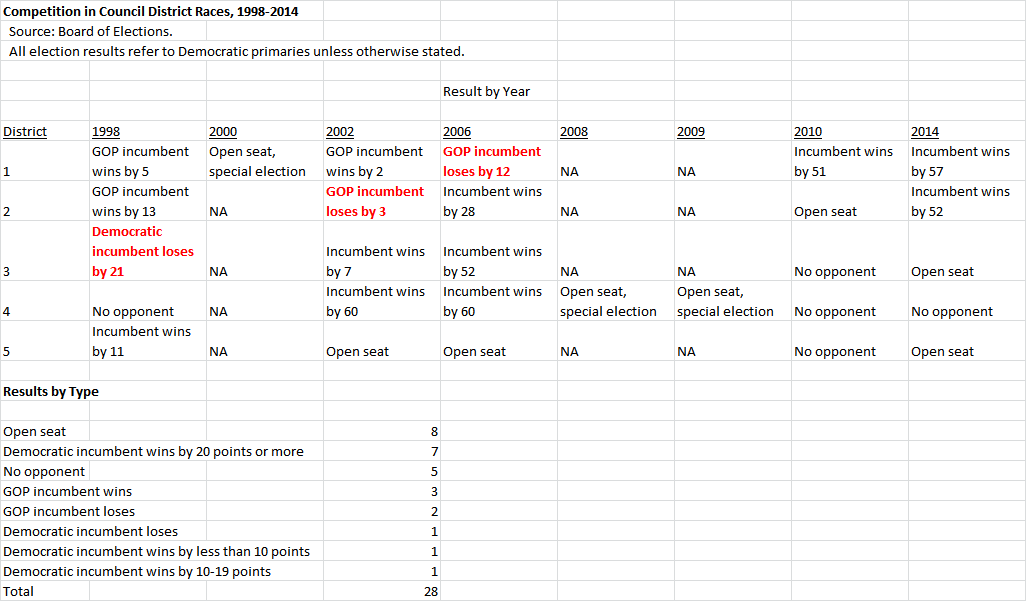
Why do we believe that will happen?  Consider recent elections.  Below is a chart showing the results of all district council elections since 1998.  Over that period, there have been 28 district council elections, 20 of which featured incumbents.  The incumbents won 17 of 20 races, an 85% win rate.  If the Republican incumbents are omitted, the remaining Democratic incumbents won 14 of 15 elections, a 93% win rate.

If that is not enough to prove the non-competitiveness of these elections, consider just two facts.  First, only one Democratic district incumbent has lost under our current structure, and that happened in 1998.  Second, of the last six contested district races, five saw the incumbent win by more than fifty points.

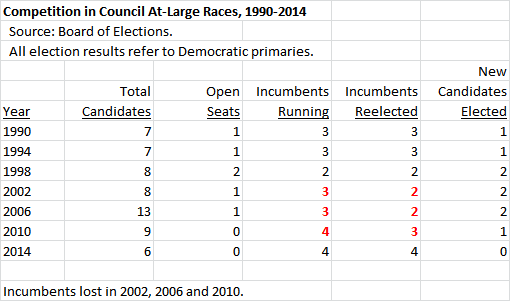
Meanwhile, the at-large races are much more competitive.  Since the current system was established in 1990, no group of at-large incumbents has ever run unopposed.  Three Democratic incumbents have lost – Blair Ewing (2002), Mike Subin (2006) and Duchy Trachtenberg (2010).  Even in the two elections in which all four incumbents ran for reelection (2010 and 2014), challengers still entered the race and one of them (Hans Riemer in 2010) knocked out an incumbent to win.

This year, those same trends continue unabated.  There are 25 at-large candidates (with more to come) running with three seats open.  Meanwhile, district incumbents Nancy Navarro (D-4) and Tom Hucker (D-5) have no opponents while Craig Rice (D-2) has token opposition in the primary.  Only Sidney Katz (D-3) has a serious challenger.  This disparity persists even in the presence of public financing, which was supposed to promote competition.

What explains this pattern?  After all, district races are theoretically cheaper than at-large races because they have fewer voters.  The reason is that one-seat races against incumbents are very different affairs than at-large contests.  A challenger running against an incumbent for one seat must show that the incumbent has committed a firing offense; otherwise, voters will support the candidate they know better.  These one-seat races can turn nasty as we have seen from recent MoCo Senate elections as well as the bitter fight between Council District 5 incumbent Derick Berlage and challenger Marc Elrich twenty years ago.  At-large races are seldom negative unless slates are formed to compete against each other.  (That hasn’t happened since 2002.)  At-large challenger Hans Riemer ran a model race in his 2010 win, promoting his policy agenda of progressivism and smart growth and never targeting any single incumbent for criticism.  Most candidates don’t have the stomach for negative elections when an open seat is available.  And in six of the last eight at-large races (including next year), at least one seat has been open.

Political competition is extremely valuable.  It should not be discarded lightly.  There may be good reasons to increase the number of districts, but if at-large members are completely eliminated, voters will pay the price with fewer choices and less accountability at election time.

Share

In Their Own Words, Part IV: George Leventhal

We continue with our County Executive questionnaires with Councilmember George Leventhal (D-At Large).

What was your most important achievement in your current or past office? How do you think it demonstrates your leadership ability?

My most important achievement is that I have consistently been a champion for those who most need a government on their side. My leadership in public office has been to utilize innovative methods of helping and serving those who, but for the involvement of government, could not achieve a high quality of life on their own.

  • I established the Montgomery Cares program, a network of community clinics that this year will provide 70,000 visits to patients without health insurance. The program includes medical check-ups; sick visits; medications; lab tests; X-Rays; flu shots; access to specialty care; access to behavioral health care; oral health care; and more.
  • In 2015, because of my leadership, Montgomery County housed every identified homeless veteran in the county. We are one of three states and 51 communities that have achieved functional zero for veteran homelessness.
  • In 2017, I provided funding to ensure the county can house every chronically homeless individual by the end of 2018, through the “Inside Not Outside” campaign.
  • I have been the champion every year since 2003 for supplementing the wages paid to caretakers for people with developmental differences.
  • I passed the Design for Living legislation, which provides property tax credits for investments that make housing accessible for elderly and disabled residents.
  • I created the county’s Interagency Commission on Homelessness.

I have consistently championed funding for the Maternity Partnership Program, to ensure prenatal care for expectant mothers without health insurance, and Care for Kids, to ensure health insurance for all Montgomery County children.

Share

In Their Own Words, Part III: Bill Frick

We continue with our County Executive questionnaires today with Del. Bill Frick (D-16).

What was your most important achievement in your current or past office? How do you think it demonstrates your leadership ability?

During my career in Annapolis there have been many legislative successes that I am proud of, and each highlight different approaches to leadership.  For many, I have been a negotiator and dealmaker. I was the lead legislator in creating a state-sponsored retirement plan to help low-income workers save for a secure retirement. When I started on this path, the bill was seen as a fringe liberal proposal, but I worked with colleagues in the House and Senate of both parties and carried the bill to a bipartisan success that has been held out by AARP as a national model.

There have also been times when I have served as an unapologetic warrior for our values.  I was the lead house sponsor on legislation to increase the state’s reliance on clean renewable energy, an issue that enjoys little Republican support.  For two years, I championed this legislation until it passed the House and Senate in 2016, only to have Larry Hogan veto the bill.  As a part of the leadership team, I led the override vote that finally allowed the Clean Energy Jobs Act to become law, despite the united objection of the Republicans.

Different circumstances call for different leadership styles, and I am proud that I’ve been able to adapt my role and style to promote and protect Maryland’s values.

Share

In Their Own Words, Part II: Marc Elrich

We continue with our County Executive questionnaires today with Councilmember Marc Elrich (D-At Large).

What was your most important achievement in your current or past office? How do you think it demonstrates your leadership ability?

My most important achievement has been increasing the minimum wage in Montgomery County, and helping to increase it in Prince George’s County and Washington, DC as well.  Opponents of minimum wage increases often try to pit neighboring cities and counties against each other, inaccurately arguing that raising wages in one area will cause employers to flee to surrounding lower-wage localities.  I helped convince lawmakers in these three jurisdictions that joining forces and pushing for higher minimum wages together would defeat this erroneous argument while delivering a real economic win for hundreds of thousands of people.

While I pushed hard for Montgomery County’s minimum wage to increase automatically with inflation, I ultimately accepted a bill without that provision, and with a slower phase-in than I had wanted, to secure the votes necessary for it to pass the Council.  I didn’t give up, however, and have continued to fight for a living wage for county residents, sponsoring a $15 minimum wage bill that earned the support of a majority of my colleagues last year.  Though that bill was vetoed, I am confident that we will soon succeed in passing a version of the legislation I reintroduced.

I believe this achievement demonstrates both my recognition that our residents’ needs demand urgent action and my ability to produce tangible changes through the political process.  I begin by listening to and working with affected communities.  Whether you’re a full-time worker living in poverty or a resident who loves your community and wants to be certain that, as we grow, the county provides the schools, transportation, and other infrastructure necessary to handle that growth without harming the environment, I am committed to getting results for you.  Master planning must include residents; transportation solutions must be affordable and appropriate; and protecting green spaces and water quality, preserving existing affordable housing, and encouraging the use of alternative energy must be priorities.

As County Executive, I know how to build the coalitions with our residents, businesses, and organizations to continue to help this county work for all of us.

Share

Stop Giving Robin Ficker More Ammo

By Adam Pagnucco.

Right about now, the happiest man in Montgomery County lives in Boyds.  He is 74, a huge sports fanatic, a long time attorney, a former state Delegate, a perpetual candidate and a tireless activist.  He loves the County Council because some of its members give him endless material for use in his never-ending demagogic campaign to weaken and ultimately paralyze county government.

Yes folks, we are talking about the notorious political heckler Robin Ficker.  And he must be jumping for joy at the news that some members of the council are considering a possible new soda tax.

Ficker has been running for office and placing charter amendments on the ballot, mostly intended to limit taxes, since the 1970s.  The huge majority of his amendments have failed, often because the political establishment labeled them “Ficker amendments” to exploit the national infamy of his heckling at Washington Bullets games.  One exception was the razor-tight passage of his 2008 charter amendment mandating that all nine Council Members vote in support of exceeding the charter limit on property taxes.  But Ficker has never had more ammo than in the last four years and he has used it to push his anti-government agenda.  Consider what has happened.

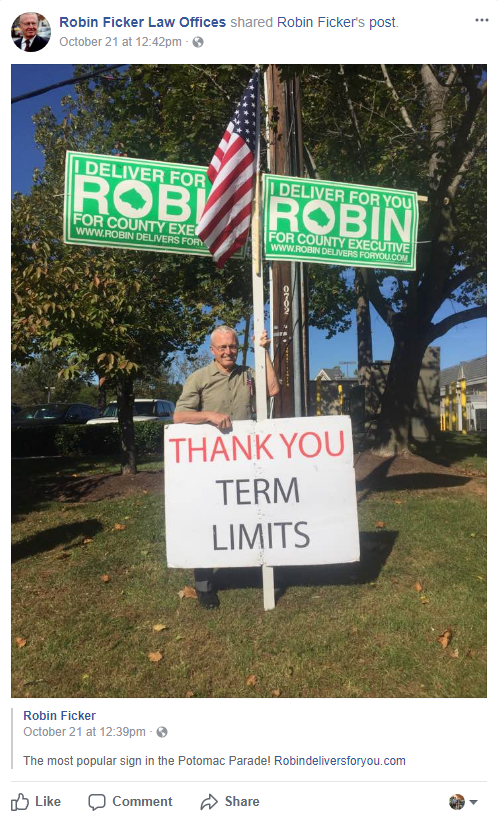
The council’s approval of a large salary increase for its members in 2013 and its passage of a 9% property tax hike in 2016 gave Ficker’s term limits charter amendment momentum.  Some Council Members then used their campaign funds to finance a lawsuit to keep term limits off the ballot, which failed.  Council Member Nancy Floreen’s “exasperated” and “defensive” performance in a television debate with Ficker and Council Member George Leventhal’s comparison of term limits supporters with Brexit voters didn’t help.  Ficker predicted term limits would pass by twenty points; instead, they passed by forty.

Robin Ficker thanks MoCo voters for giving him his biggest political win ever.

That’s not all.  Ficker has enrolled in the public financing system established by the council for his latest Executive run.  And he requested the county government’s email lists after another resident obtained them under the Public Information Act.  Any competent campaigner – maybe even Ficker – should be able to use those thousands of emails to raise enough money to qualify for public matching funds.

And now we have news of the soda tax, which prompted gleeful self-promotion by Ficker in Bethesda Magazine’s comment section.  Expect a Facebook ad soon.

Your author does not enjoy writing this column because we find merit in this particular tax.  Sugary drinks and soda are public health menaces, especially to children.  The intended use of the money for early childhood programs is a good idea.  And the current tight budget does not give any quick or easy options for funding undeniable, but expensive, priorities like early childhood education.  But the counter-argument from Ficker, who calls Council Members “tax increase specialists,” is obvious.  “They’re not listening to you,” Ficker will tell the voters.  “You told them no more tax hikes and they’re going to do it anyway.”  Even Leventhal, who has voted for numerous tax hikes and has done as much to promote public health as any Council Member ever, has come out against the new tax.

The danger here is not that Ficker will be elected.  Voters made that mistake once all the way back in 1978 and have never come close to repeating it since.  The real problem is the next charter amendment that Ficker will inevitably introduce after his latest election campaign fails.  Whatever else Ficker is, he is an astute student of Maryland county tax policies.  He is fully aware of the taxation and spending limits in the Prince George’s County charter, such as the requirements that the property tax rate may not exceed 96 cents per $100 of assessed value and that bond issues, new taxes, other tax increases and some fee increases be approved by voters.  He is also aware of provisions in the state constitution and several county charters that forbid legislative bodies from adding spending to executive budgets.  Indeed, some of his past charter amendments have been variants of such policies.

It’s one thing to raise taxes during terrible economic downturns as the county did in 2010.  That simply had to be done.  It’s a very different thing to discuss new discretionary tax hikes in times when voters are not convinced that they are absolutely needed.  If the council would like to have more money available for worthy programs, it should focus on growing the economy, stop adding ongoing miscellaneous spending financed by one-shot revenue sources, redirect cable fund money to purposes that actually benefit the public and restrain some parts of the budget to finance expansions of others.  Doing those things will free up tens of millions of dollars, and maybe more, over time.  But constant talk, and occasional passage, of discretionary tax hikes will only help Ficker place a Prince George’s-style anti-tax doomsday charter amendment on the ballot.  Should such a thing pass, no soda tax will save us.

Hence a warning.  If you give Robin Ficker enough ammo, even he will eventually hit the target.

Share

MoCo’s Mighty Seven Zip Codes

By Adam Pagnucco.

For a long time, Montgomery County has been thought of as a wealthy jurisdiction.  It has long appeared in lists of the nation’s richest counties (although it is about to drop out of the top twenty).  Politicians elsewhere in Maryland view it as a gold mine, with Senate President Mike Miller famously saying, “It’s like Never Neverland for other legislators of the state.”  The county is regularly shorted by state wealth formulas which disproportionately distribute state aid, especially for public schools, to other parts of Maryland.

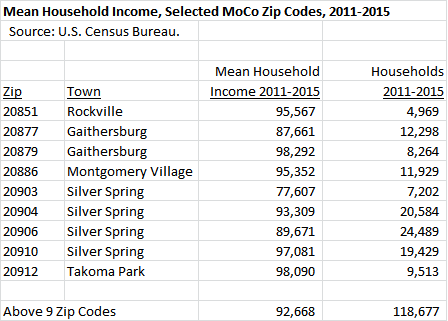
But most of Montgomery County is not particularly rich.  Its wealth is concentrated in seven zip codes which skew its mean household income upward and make the county as a whole appear richer than it really is.

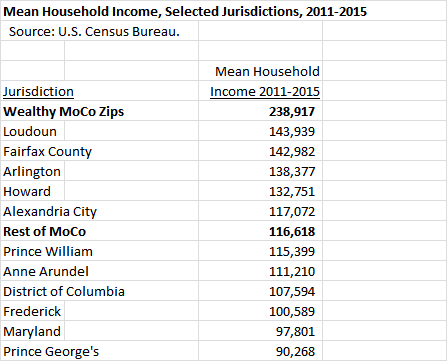
All residents of MoCo understand that there are huge differences between areas in the county even though many outsiders do not.  According to the U.S. Census Bureau, the county’s mean household income was $133,543 over the 2011-2015 period, just barely squeaking past Howard County ($132,751) for tops in the state.  But that conceals big variations.  MoCo has nine zip codes in which mean household incomes were under $100,000.  The combined mean household income of these areas ($92,668) is roughly equal to the mean household income of Prince George’s County ($90,268).

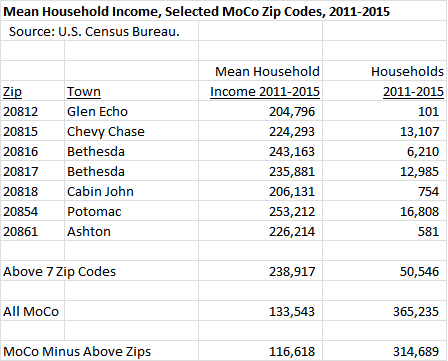
MoCo has seven zip codes in which mean household incomes were over $200,000 in the 2011-2015 period.  These zip codes, mostly located northwest of D.C., account for 14% of the county’s households and 25% of its household income.  If these zip codes were regarded as a separate jurisdiction, their combined mean household income would be $238,917.  The combined mean household income of the rest of Montgomery County is $116,618 – about half the income of the Mighty Seven.

How do the mean incomes of the Mighty Seven and the rest of the county compare to the rest of the region?  We show the mean household incomes of those two parts of the county along with the other large jurisdictions in the region below.  The Mighty Seven as a group are easily at the top although we suspect that extracts of the wealthiest parts of Loudoun, Fairfax, Howard and D.C. would also be in that range.  As for the rest of the county, its income is average compared to the rest of the region.

That’s right, folks – with the exception of its wealthiest zip codes, MoCo is a middle-income jurisdiction by the (admittedly high) standards of the Washington region.

This reality has interesting implications for policy makers and candidates.  The issue of equity between different parts of Montgomery County is getting traction as a political issue in the upcoming election.  But in terms of who pays the county government’s bills, there is no question that county revenues are hugely dependent on a limited number of wealthy neighborhoods, especially in the absence of robust economic growth.  If those residents decide that they can get a better deal by living somewhere else, that would be a huge threat to the county’s tax base.

As for the state level, there’s a tendency to look at differing incomes and wealth BETWEEN counties but not INSIDE counties.  That’s how state wealth formulas work – they compare counties to each other but not local areas to each other.  How many state policy makers have understood prior to reading this blog post that there is a large part of Montgomery County that is economically comparable to Prince George’s?  It’s time for a serious examination of how to direct state aid to local areas in need regardless of which county borders they happen to occupy.

Share

District 18 Senate Battle by the Numbers

By Adam Pagnucco.

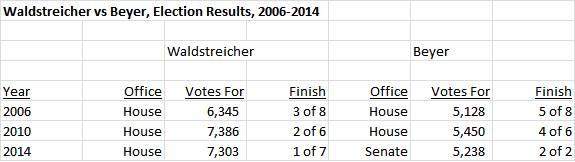
Last week, David Lublin broke the news that former District 18 candidate Dana Beyer is planning to run for Senate against Delegate Jeff Waldstreicher.  Both Beyer and Waldstreicher have run three times in the district.  Let’s see how their past performances stack up.

Electoral Results  

Beyer and Waldstreicher first ran for office in 2006 when both ran for the House.  Waldstreicher, aided greatly by the Apple Ballot, won a close contest with attorney Dan Farrington to claim the open seat vacated by Rich Madaleno.  Beyer ran a credible campaign but finished fifth of eight candidates.  Waldstreicher would never be seriously threatened in his two reelection contests while Beyer lost another House race in 2010 and a Senate challenge to Madaleno in 2014.  One fact apparent in the electoral data is that Waldstreicher’s performance has improved over the years while Beyer has consistently received between 5,000 and 5,500 votes.

Fundraising

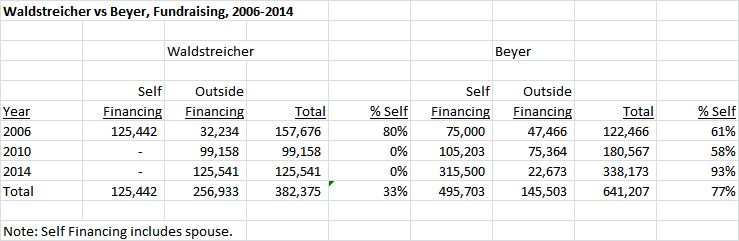
In 2006, both Waldstreicher and Beyer were primarily self-financed candidates.  Since then, Waldstreicher has successfully raised outside money while Beyer has continued to mostly self-fund.  Beyer’s loans to her 2014 campaign against Madaleno constituted one of the largest self-financing performances in the history of MoCo General Assembly elections.  Drawing on her own money, she is easily capable of matching Waldstreicher dollar for dollar.

Major Endorsements

Waldstreicher has been endorsed by virtually every major progressive group over the course of his career as well as by the Washington Post in 2014 and the Gazette in 2010 and 2014.  Beyer was endorsed by the Post, the Gazette and Equality Maryland in 2010 and by MCGEO in 2010 and 2014.

Beyer vs Madaleno for Senate

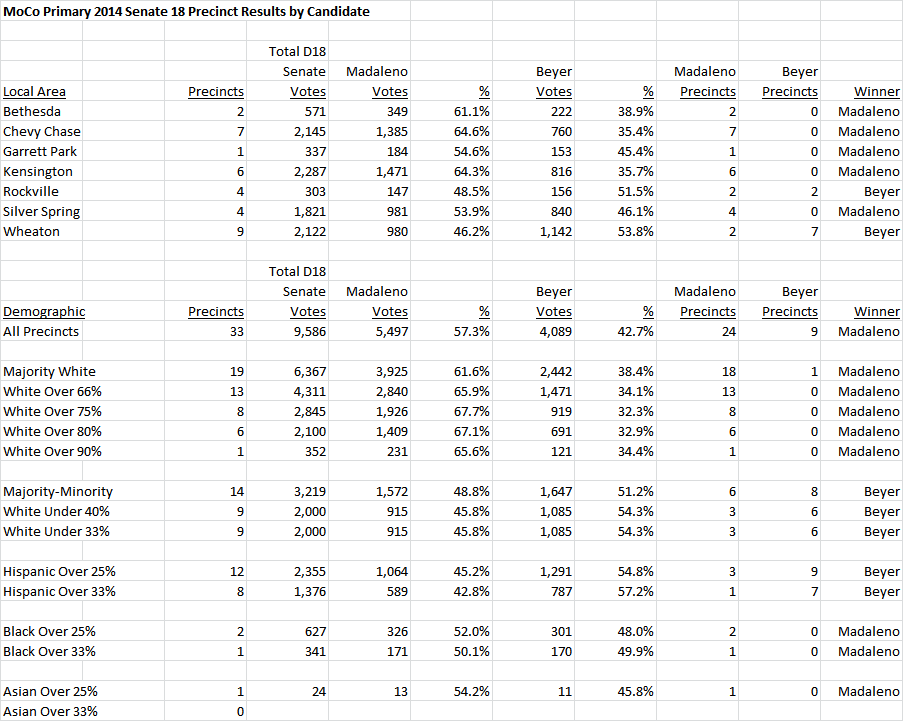
In 2014, Beyer ran against incumbent Rich Madaleno for Senate.  It was a steep uphill climb.  Madaleno is beloved by nearly all District 18 activists and is arguably the most prominent Senator in the district’s history other than the immortal Chris Van Hollen.  Despite all of that, Beyer lost by a 58-42% margin, coming closer to winning than many people believed she would.  She outraised the incumbent by more than 2-1 (if you count her epic self-financing), won the precincts in Rockville and Wheaton and was competitive in Silver Spring and Garrett Park.  Her loss was due to Madaleno running up margins of close to 30 points along Connecticut Avenue.  Still, this was a loss and not a disaster.

So what does all of this mean?  Your author agrees with David Lublin and sees Jeff Waldstreicher as the favorite in this race.  He owns most of the advantages that come with incumbency: fundraising capability in Annapolis (especially with those who have business before his powerful House Economic Matters committee), relationships in the district built through constituent service and relationships with many influential progressive groups who have endorsed him in the past.  He is also a hardworking, adept campaigner who has survived three straight competitive elections.

But Dana Beyer will present a real challenge.  She could wind up spending more than Waldstreicher due to her self-funding capacity.  She has shown some strength in the less wealthy parts of District 18.  And she is more than willing to get tough to win, burying Madaleno in waves of negative mail in 2014.  She is definitely going to bring it against Waldstreicher.

This is gonna be one hell of a race!

Share