All posts by Adam Pagnucco

It’s Time for Accountable, Engaged and Strong Leadership

By Hoan Dang, Candidate for Montgomery County Council (At-Large).

Life was not easy for me when I came to this country. I was only eight years old when I fled the Vietnam War with my family.  Our journey to America began with living in refugee camps, and then in a crammed two-bedroom apartment with 18 other family members.  But my parents worked hard to save up, and eventually settled in Bethesda.  At first, I thought anywhere was better than what I had previously experienced. But it soon became clear that Montgomery County was a special place.

What Montgomery County had to offer us was priceless. The county had families like the Kreckes and the Gustafsons, our neighbors who did not hesitate to welcome us and help us adapt to our new life in America. The county had a strong public education system because I had MCPS teachers who invested in my future even though English wasn’t my first language. The county also had unparalleled opportunities for me to volunteer in my community. In the spring of 1979, I joined the Boy Scouts of America, and eventually, I became an Eagle Scout, which was when I first felt empowered to give back to the community that had given so much to me and my family.  These experiences, which had a profound impact on my life, embody the progressive values of Montgomery County.

Since leading my first community service project, I have worked hard to uplift our county’s diverse communities for the past 35 years. My public service brought me to work with many others who had stories similar to mine.  As former President and Board Chair of the Association of Vietnamese Americans (AVA), I led efforts to resettle over 25,000 refugees and immigrants who needed to secure housing, obtain jobs, prepare for U.S. citizenship tests, and apply for services from government agencies. As a product of our great education system myself, I believe in the importance of investing in students, which is why I have served on the board of the George B. Thomas, Sr. Learning Academy for the past 16 years. During my tenure, the Academy’s flagship Saturday school program has academically uplifted over 3,000 students annually at 12 different locations across Montgomery County.

Now, I’m running at-large because I want to ensure that our county remains a safe and welcoming community, with better opportunities for all residents. Montgomery County is a great place to live and work, but we are also facing challenges that demand innovative solutions in local government. The county’s population has almost doubled in the past 40 years, leading to overcrowded schools, horrible traffic congestion, and higher taxes for our residents. With the real threat of shrinking resources from the federal government and a slow-growing economy right here at home, we need a leader on the County Council who has a vision for a better Montgomery County.

My vision for our county is a safe and welcoming community, with a booming economy, excellent schools and a fast transportation system, where residents are empowered to better their lives and the lives of others. To achieve this vision, as your next County Councilmember At-Large, I will focus on three main priorities: jobs, education and transportation – which I refer to as “J-E-T”.

Jobs

We must collaborate with small businesses to ensure they receive the critical services, information, and guidance needed to help them grow and create well-paying jobs here in Montgomery County. Job creation is stagnant in our county with projections of just 1% annual growth over the next decade. To stimulate growth, we must change how our county works with business owners to promote entrepreneurship and create well-paying jobs. We can start by changing how our county departments engage with businesses for inquiries, permits and regulatory compliance. Over 70 percent of Montgomery County businesses ranked their interaction with county government as either “average” or “poor” in a recent survey conducted by the County Executive’s Economic Advisory Group. Montgomery County should be a leader in improving interactions with business by making procedures less complex and easier to understand, so that businesses can grow and employ more people. I support many of the regulations the county has in place to protect the environment, workers and our communities, but we can also improve these regulations to better engage the business community.

We must also do a better job at promoting our county as an ideal place to do business. Here in Montgomery County, we enjoy a high quality of life, great public schools and excellent public amenities. We also have one of the educated and most diverse workforces with a high number of workers who hold college degrees, many of whom speak a second language. All of these attributes are attractive to prospective companies and crucial for our county to succeed in a 21st century economy. We have a great story to tell about Montgomery County, but we need to do a better job of telling it.

Education

Our children need to be prepared for the 21st century workforce. This starts by addressing the overcrowding in schools across the county, by leasing and re-purposing unused commercial space for schools, early childhood education programs, and distance learning.  Several jurisdictions across the country (not to mention the world) have already begun using this model, including Fairfax County in Virginia, which recently completed the conversion of a vacant office building into Bailey’s Upper Elementary School. With an office vacancy rate of over 14 percent in the County, I believe there is great potential for an adaptive reuse of these spaces.

Additionally, we need to make universal pre-k a reality in Montgomery County. Publicly funded pre-k is available to only 25 percent of all 4-year-old children who live in the County. Trends have shown pre-k education has enormous positive impacts on children, especially for those who come from multi-lingual households.

Finally, we need to bring more vocational programs to MCPS to give students more exposure to different career paths such as medical science, construction, and auto repair. Vocational careers are just as vital as careers that require a four-year college degree to our local economy and communities.

Transportation

We need to reduce traffic congestion and increase transportation options by taking a comprehensive and holistic approach to our transportation infrastructure. We need to invest in all transportation modes including trains, buses, roads, bike lanes, sidewalks and everything in-between, including promoting remote work options.

We must also support and invest in transportation models that fit the needs of the individual community. The transportation needs in Clarksburg are not the same as the needs in Bethesda, which is why we must consider all available options to reduce traffic congestion. Studies have shown that every dollar spent on infrastructure boosts the economy by two dollars because such investments encourage more businesses to invest and stimulate economic development.  One of the most basic responsibilities of government is to ensure people get from point A to point B quickly and safely. I will make it a priority to fulfill that responsibility to residents across the county.

For the past decades, Montgomery County has been served well by a progressive and forward-looking County Council. However, many residents still face intractable and difficult problems, which require new perspectives and approaches in local government to address those problems.  I am committed to bring strong, engaged, and accountable leadership to the County Council and work with our communities as an equal partner for change. That’s the kind of leadership I want to bring as your next Montgomery County Councilmember, At-Large, and why I respectfully ask for your support and your vote on June 26, 2018.

Share

Is MoCo’s Budget in Trouble?

By Adam Pagnucco.

Montgomery County’s $120 million budget shortfall has set off political fireworks this election season, including attacks from Delegate Bill Frick (D-16), who is running for Executive, and Republicans who question how taxes could be going up while revenues are going down.  County Council incumbents pooh-pooh it, insisting that the budget decline is unremarkable and the economy is strong.  County Executive spokesman Patrick Lacefield, who once predicted that any loss of the county’s $30 million in liquor profits would cause a big property tax hike, now says that the $120 million shortfall is “pretty small” at just 2.2 percent of the county’s budget.

What is going on here?  Is MoCo’s budget in trouble?

First, the incumbents are right to point out that mid-year corrections, including budget savings plans, are not uncommon.  Between FY08 and FY11, the County Council approved five mid-year cut packages ranging from $30 million to $70 million each due to the Great Recession.  In FY16, the council approved a $54 million savings plan associated with the U.S. Supreme Court’s Wynne decision and disappointing income tax receipts in the prior year.  While mid-year cuts happen occasionally, it’s important to note that their history indicates that they are often – but not always – produced by looming economic problems.

So what’s causing this one?  No one is totally sure yet, but there seems to be two phenomena at work.

Declining Income Tax Payments from the Wealthy

In Maryland, the state collects income taxes on behalf of local governments and remits them in periodic distributions.  Part of MoCo’s problem originated in its November income tax distribution from the state, which includes extension filers who tend to be disproportionately very wealthy.  It’s difficult to forecast income tax payments from wealthy people because their dependence on capital gains and business income can be volatile.  The chart below from the state’s Bureau of Revenue Estimates contrasts the annual change in average federal adjusted gross income between all MoCo taxpayers (pink bars) and the top 100 MoCo taxpayers (blue line).  Income change for all taxpayers usually varies by single digits each year while income for the super-wealthy almost always varies by double digits.  This creates serious forecasting challenges for the county government since the super-wealthy have a material impact on its budget.

One relevant fact is that the November distribution may be down by 29% in MoCo but, according to the state, it is also down by 30% in Howard County and 26% in Baltimore County.  One thing these three jurisdictions have in common is that they all have substantial concentrations of very wealthy people.  That suggests that some of MoCo’s problem is not specific to the county but rather to variations in the incomes of the super rich.

Why is this happening?  One explanation lies in capital gains income.  Council analyst Jacob Sesker writes:

To a large degree, that volatility is the result of the year-to-year variations in the capital gains income of a small number of County residents. Illustrating this point, part of the projected FY18 decline in income tax revenue can be traced to a sharp drop in the capital gains of the County’s top 50 taxpayers, who realized gains in tax year 2016 that were 50% of the gains realized in tax year 2015, resulting in $21 million less in County income tax revenue (Revenue Administration Division of the Maryland Comptroller). Staff’s review of tax return data published by the Comptroller indicates that roughly 1.8% of Montgomery County returns report income of $500,000 or greater. On average, these returns explain more than half of any year-to-year increases in income tax revenue, and explain more than 100% of any year-to-year declines in income tax revenue.

Another factor could be the tax bills being considered by Congress, which contain numerous large cuts for wealthy individuals and corporations.  The super wealthy could be deferring capital gains and business pass-through income to next year when they would be subject to significantly lower rates.  If true, that would mean less income tax revenue this year but perhaps more next year when the deferred income is reported.  That’s just a theory but it can’t be ruled out.

Broader Economic Weakness

There are other facts that can’t be explained by the tax planning of the super wealthy.  First, FY17 (the year of the 9% property tax hike) closed out with $25 million less than expected.  Second, the county is writing down $206 million over the next six years in property taxes, energy taxes, transfer taxes, recordation taxes, telephone taxes and hotel taxes in addition to a $212 million income tax writedown.  The energy tax revision alone is $100 million over six years.  The reason for that is unclear, but it’s worth remembering that since commercial energy users pay roughly double the tax rates of residential users, some assumptions regarding employer energy use may be operative here.  It seems unlikely that a “strong economy” would produce such broad, multi-tax writedowns of the kind just put forth by the county.

What’s the bottom line?  Over the years, we have learned that under most circumstances, economic trends usually matter more than singular events.  One good year should not cause irrational exuberance and one bad tax distribution should not cause panic.  Whether the recent shortfall turns out to be meaningful or not, MoCo’s serious budgetary challenges are long term in nature.  They relate to decade-plus trends of lagging growth in employment and income, repeated funding of ongoing spending with one-time revenue sources and the county’s recent passage of large tax hikes and expensive employment laws at the same time, a unique combination among Washington-area jurisdictions.  That is on top of any targeting of Maryland and general economic insanity by Congress.  The big question is not about one tax distribution from the state but whether a combination of all these long-term factors will catch up with MoCo in a really bad way in the next couple years.

That’s a question for the next Executive and County Council.

Share

Moon Country Club Bill Could Generate $10 Million for MoCo

By Adam Pagnucco.

A local bill introduced by Delegate David Moon (D-20) that would end property tax breaks for country clubs would eventually generate $10 million a year for Montgomery County Government according to General Assembly analysts.  That’s welcome news for the county, especially considering its current budgetary difficulties.

Under current state law, the State Department of Assessments and Taxation (SDAT) is allowed to strike agreements with country clubs having golf courses to cap the assessed value of their land.  To be eligible for such agreements, the clubs must have at least 100 members who pay dues averaging $50 or more annually for each member; restrict use of their facilities primarily to members, families, and guests; have at least 50 acres of land; and have a golf course with at least 9 holes and a clubhouse.  In practice, the agreements limit assessed land values to $1,000 an acre.  In return for the assessed rate, a club with an SDAT agreement must agree not to sell its land for subdivision and to not discriminate on race, color, creed, sex or national origin.  If a club with an agreement does sell its land for subdivision, it must pay back taxes equivalent to what it would have been paying without an agreement.

Not long ago, your author asked SDAT for all of its agreements with country clubs in Montgomery County.  SDAT sent us ten of them but we later learned that there are actually fifteen of them in the county.  One of them was signed in 1980 and three more were signed in 1981; all four of these are fifty year agreements.  Two more were transferred from prior owners.  One agreement, for the Lakewood Country Club in Rockville, was signed in 2017.  In tax year 2016, when the agreement was not effective, the club’s 175 acres had an assessed land value of $1.94 million.  Once the agreement takes effect, the club’s assessed land value will be $175,000 – a 91% reduction.

Moon’s local bill would abolish such agreements with country clubs in Montgomery County as of their expiration or June 30, 2029, whichever date is earlier.  Because Maryland’s state constitution requires uniform rules for the assessment of land, Moon’s bill takes the form of a constitutional amendment carving out MoCo country clubs and golf courses from that requirement.  The amendment would have to be approved by voters.  We understand that Moon may also introduce a statewide bill to deal with SDAT agreements everywhere.

The fiscal note on Moon’s bill indicates that MoCo country clubs with SDAT agreements have a combined 3,000 acres currently assessed at $3 million.  In the absence of the agreements, the fiscal note estimates that the club’s assessed land value would be $983.3 million.  So once the agreements are all gone by Fiscal Year 2030, the fiscal note estimates that the state would collect an additional $1 million a year in property taxes from the clubs and the county would get an additional $10 million annually.

That’s right, folks – if the country clubs simply pay property taxes at the same rate the rest of us do, the Montgomery County Government would get an extra $10 million a year.

Delegate Moon’s country club bill is the biggest no-brainer of all time.  There is no justification for the richest of the very rich to get a property tax break that no one else does.  And if they are required to pay the same as everybody else, the county government would get a nice revenue bump to help it deal with our significant and increasing needs.

We hope every single MoCo Senator and Delegate will join David Moon and support his bill.

Share

GOP Tax Bills Discriminate Against Maryland

By Adam Pagnucco.

Much has been written about the tax bills passed by the U.S. House and Senate in recent weeks.  Overall, both bills offer small tax cuts to the poor, modest ones to the middle class and large cuts to the wealthy and corporations.  But in order to partially offset the massive tax cuts going to those at the top, the bills do something else.

They discriminate against taxpayers in Maryland.

Why do they do that?  One key feature of both bills is that they abolish the ability of individuals to deduct state and local income taxes from their federal incomes.  (Property tax deductions would still be allowed up to $10,000.)  According to IRS data for Tax Year 2015, U.S. federal taxpayers deducted a total of $334 billion of state and local income taxes from their incomes, more than the amounts they deducted for mortgage interest ($278 billion), charitable contributions ($222 billion), real estate taxes ($187 billion) and state and local sales taxes ($17 billion).  Abolishing the state and local income tax deduction hits people who itemize their deductions and pay significant amounts of state and local income taxes.  Marylanders are targeted on both those measures.

Itemizing Deductions

According to the above IRS data, 46% of Marylanders itemized their deductions on their federal tax returns in 2015.  That’s the highest rate in the country, far surpassing the national rate of 30% and red states like Arkansas (22%), Mississippi (23%), Louisiana (23%), Texas (24%), Alabama (26%), South Carolina (27%) and Georgia (33%).

State and Local Income Tax Deductions

In terms of state and local income tax deductions per return (including non-itemized returns), Marylanders ranked fifth in the nation at $4,217 per return.  Maryland trailed New York, D.C., Connecticut and California.  Virginia ranked tenth, indicating that the abolition of this deduction will hit the Washington, D.C. metro area particularly hard.  The states least impacted are mostly red states and those with little or no income taxes.

Inside Maryland, the impact will be felt differently across the state.  That’s because residents of some jurisdictions pay much more in state and local income taxes than others.  According to 2015 income tax data from the Comptroller, MoCo and Howard County residents pay by far the most state and local income taxes in Maryland.  Residents of many parts of Western Maryland and the Eastern Shore pay the least.

Consider this.  If you itemize your deductions, are paying $5,000 in state and local income taxes – roughly the average in Maryland – and your effective federal income tax rate is 15%, you will owe $750 more to Uncle Sam because of the abolition of the state and local income tax deduction.

Does that mean you will owe more federal taxes overall?  That depends.  If you are wealthy, you could get huge offsetting cuts because of changes to the top income tax brackets and tax cuts on pass-through income from your businesses.  If you are poor or middle class, you could benefit from an increase in the standard deduction and an increase in the child credit, but that could be offset by an elimination of the personal exemption.  An analysis of the Senate bill two weeks ago by the Institute on Taxation and Economic Policy found almost all of the tax benefits from that bill going to the top quintile of Maryland taxpayers.  Changes prior to the Senate floor vote and in conference committee may tweak the details but not the overall impact.  And it could get worse: wealthy Republican donors are already complaining that their tax cuts are not big enough.

There are many evils in the GOP’s tax bills: redistribution to the one percent, big tax breaks for multi-nationals who ship jobs overseas, losses of insurance coverage under the Affordable Care Act and more.  But for Marylanders, the additional slap in the face is that the bills shift the federal tax burden away from states like Texas, South Dakota, Alaska and Mississippi and onto residents of the Free State.  All Marylanders, including Republicans, should oppose that.

Share

Ron George: “Leftist Democrats” Believe Businesses are “Slave Plantations”

By Adam Pagnucco.

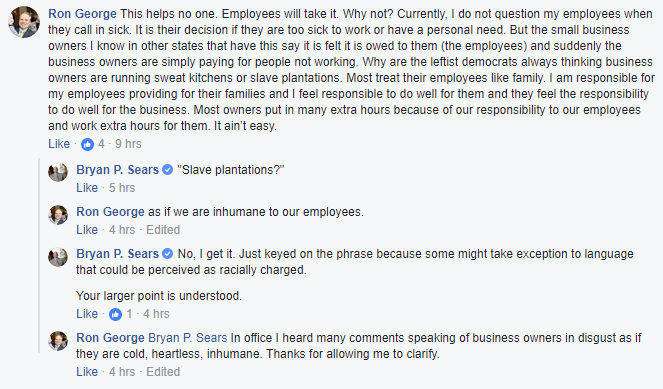
Former GOP Delegate and gubernatorial candidate Ron George, who is running for State Senate in District 30, said on Facebook that “leftist Democrats” think businesses are “running sweat kitchens or slave plantations.”  When challenged on his language by a reporter, he did not back down.

The Facebook exchange occurred on Daily Record reporter Bryan P. Sears’s page.  When Sears posted a video of Delegate Luke Clippinger weighing in on Governor Larry Hogan’s newest sick leave proposal, George wrote:

This helps no one. Employees will take it. Why not? Currently, I do not question my employees when they call in sick. It is their decision if they are too sick to work or have a personal need. But the small business owners I know in other states that have this say it is felt it is owed to them (the employees) and suddenly the business owners are simply paying for people not working. Why are the leftist democrats always thinking business owners are running sweat kitchens or slave plantations. Most treat their employees like family. I am responsible for my employees providing for their families and I feel responsible to do well for them and they feel the responsibility to do well for the business. Most owners put in many extra hours because of our responsibility to our employees and work extra hours for them. It ain’t easy.

George owns a jewelry store on Main Street in Annapolis.

When Sears raised the possibility that George’s reference to “slave plantations” might be viewed by some as “racially charged,” George replied, “In office I heard many comments speaking of business owners in disgust as if they are cold, heartless, inhumane.”  The full exchange appears below.

We get that as a business owner, George may not particularly enjoy the government setting his workplace practices.  But multiple polls find that huge majorities of Marylanders support paid sick leave.  Even Governor Hogan has introduced not one but two sick leave bills.  Are they all “leftist Democrats” who believe that business owners treat employees like slaves?  Or is Ron George as out of touch with Marylanders as he is inclined to the use of racially charged rhetoric?

Share

Susan Turnbull is Running for Office. Is it Lt. Gov. with Ben Jealous?

Former national DNC member and Maryland Democratic Party Chair Susan Turnbull established a state-level campaign committee on November 22.  Her committee filing does not list the office for which she is running.  Her campaign chair is former Montgomery County Democratic Central Committee Chair Karen Britto and her treasurer is federal lobbyist Matthew R. Schneider.

It may not be a coincidence that gubernatorial candidate Ben Jealous just sent out a blast email stating that he will announce his pick for Lieutenant Governor tomorrow. Indeed, private reports indicate that Turnbull has agreed to be Jealous’s running mate.

We have asked Turnbull about the office for which she is running.  When (if?) she replies, we will update this post.

If nominated, Jealous-Turnbull would be the first Democratic ticket with no white male on it. I imagine Jealous is hoping that Turnbull will help in Montgomery County, Turnbull’s home. She also has a lot of connections as a former state party chair that could prove useful in raising money and building support around the state.

At the same time, Turnbull’s status as a party insider cuts against Jealous’s effort to campaign as an outside challenger to the establishment. In that sense, opponents can easily cast Turnbull as the ultimate insider despite her lack of experience in public office.

Share

County Executive Candidates on the Liquor Monopoly

Question: The county’s liquor monopoly has come under heavy criticism–not least from Seventh State. If at all, how would you reform or change, or press the state legislature to change, the Department of Liquor Control?

Roger Berliner

At the county level, I have been the chief advocate for ending our unique – and counterproductive – liquor monopoly.  As someone who has fought monopolies most of my professional life, I know in my bones that monopolies are rarely, if ever, in the public interest.  Government monopolies are generally even less efficient.  And a government monopoly that tries to do a job that the private sector does in the rest of the country is almost always less efficient.  That is true in MoCo.  As a result, our residents vote with their feet.  Almost one-third of our purchases of liquor are made outside Montgomery County.  Our restaurants hate it.  Top flight restaurants have said that they would never come here. Bottom line: our monopoly needlessly perpetuates the reputation of our county being anti-business and anti-consumer and stunts our economy.

However, the state is a critical partner in this conversation.  It is state law that created our monopoly, and state law must be passed to change it.  The positive side of this dynamic is that the state would be the principal, direct beneficiary of increased liquor sales.  I would work with the Governor and our legislature to split the savings that the state would derive and hold the county harmless as it weans itself from this monopoly.  The dollars are not that significant given that our retail operations should continue to do well – assuming that they can compete!  And in the long run, our county will prosper more without the monopoly than with it.

Marc Elrich

Any discussion of the Department of Liquor Control (DLC) must acknowledge that the Montgomery County budget relies on over $30 million in liquor revenue per year.  That is no small amount of money, and it supports critical county services, including almost $11 million for bond payments.  Nobody who has proposed privatizing the county’s liquor supply has a workable plan to fill the budget hole privatization would create, likely because there is no way to do so that doesn’t create other problems for the state.

Privatization proposals thus should not be taken seriously; instead, we should continue to look for ways to make the DLC more efficient and effective than it has been in the past, and to increase sales so that we can increase the revenue that the DLC generates.

We’ve already changed the way the DLC is run by bringing in industry professionals, including the director and the warehouse manager, who have improved the operations of the liquor system and brought in a philosophy of continuous improvement.  I’ve also encouraged introducing lower markups for more expensive items, which they did, and I’ve supported and will continue to support efforts to help local breweries and wineries sell and distribute their goods.  Both the new director and I want to hear and consider other ideas for helping transition the DLC from something that the county has long taken for granted into a professionally run system.

In fact, if a private-sector business had a division that produced a substantial profit but was identified as having management problems and customer service issues that prevented it from being more profitable, its most likely course of action would be to change management, work to improve services, and strive for greater profits.  That is exactly what we have been doing with the DLC.

Bill Frick

I have been the state’s leader on fixing this abysmal broken system.  My “end the monopoly” effort, helped immensely by the Seventh State’s Adam Pagnucco, fell short in 2016 in large part because of vigorous opposition from the Council and County Executive.  We agreed to let the Executive lead a work group on the issue, but that work group served no real purpose other than to push the issue onto the desk of the next Executive.

This is a great opportunity.  The DLC has value, and I have proposed to ensure that the value stays with Montgomery County by selling off the DLC’s assets, such as its franchise rights to beer distribution, its stores and warehouse, to generate millions in capital dollars that can be spent on school construction.  Because the elimination of the DLC will generate millions in repatriated sales and excise tax dollars, I would work with my colleagues in the legislative leadership to help return some of those revenues to the County.  Finally, we all know that the work of alcohol distribution will not disappear with the end of the DLC, rather, those jobs will migrate to the private sector and will likely grow in the County as our consumers come home to buy their beer, wine and spirits here.  I will work with the private sector distributors and unions to find the best outcomes for current DLC employees as we get the County out of the liquor business.

George Leventhal

I am willing to entertain serious negotiations with parties who are willing to make a serious offer to purchase the right to distribute beer, wine and spirits in Montgomery County. In FY 2018, that enterprise generated more than $33 million in surplus revenue over expenses to the county’s general fund, of which $11 million was spent on debt service for approximately $100 million in Liquor Control Revenue Bonds, which were issued more than a decade ago to pay for transportation improvements, including the Montrose Parkway. I think we should commission an independent economic analysis of the present value of a guaranteed revenue stream of more than $30 million each year. My understanding is that it would come to hundreds of millions of dollars – more than enough to retire the bonds. I do not think the county should simply give away these valuable rights, which belong to the people of the county. However, serious offers from serious buyers should be considered. Simply giving the rights (and the associated revenues) away would require that the bonds be retired or refinanced through other means. If general obligation bonds were used to refinance the Liquor Control Revenue Bonds, it would reduce the county’s ability to construct new schools and other capital projects by $100 million.

In the absence of a serious offer to buy the rights to the entire enterprise, I continue to support the County Council’s 2015 proposal to privatize special order sales of beer and wine. Problems with delivery of special orders comprise the vast majority of complaints from restaurants, but the Montgomery County delegation to Annapolis declined to take up the County Council’s proposal in the 2016 session after County Executive Leggett asked for more time for study.

The Montgomery County delegation also declined to take up proposals for immediate privatization or for a voter referendum. Candidates for County Executive who have concerns about the Department of Liquor Control’s shortcomings should remember that liquor laws are made in Annapolis, not in Rockville. I would also support action by the state legislature to allow sales of beer and wine in grocery stores. Beer and wine stores will soon be able to sell spirits under legislation that passed in the 2017 session, which I supported.

Share

Should There Be Rent Control Near the Purple Line?

By Adam Pagnucco.

Council Member Marc Elrich, who recently equated potential gentrification near the Purple Line with “ethnic cleansing,” is taking flak for his remarks and is not backing down.  We will leave it to others to judge his choice of words.  But what interests us is the policy proposal he has made: specifically, Elrich would like to see rent control imposed near Purple Line stations.  That’s worth discussing.

Economists tend to disagree on many issues but a huge majority of them oppose rent control.  Liberal New York Times columnist Paul Krugman has written, “Almost every freshman-level textbook contains a case study on rent control, using its known adverse side effects to illustrate the principles of supply and demand.”  A massive review of economic research on rent control found evidence that it encourages conversions of rental units into condos and leads to higher rents in non-controlled units.  Rent control repeal in Cambridge, Massachusetts led to a surge in property values in both controlled and non-controlled units and a 20% increase in housing investment.  Even Communists denounce rent control.  In 1989, Vietnamese Foreign Minister Nguyen Co Thach told a news conference that rent control did more damage to his capital city than American bombs.  “The Americans couldn’t destroy Hanoi, but we have destroyed our city by very low rents. We realized it was stupid and that we must change policy.”

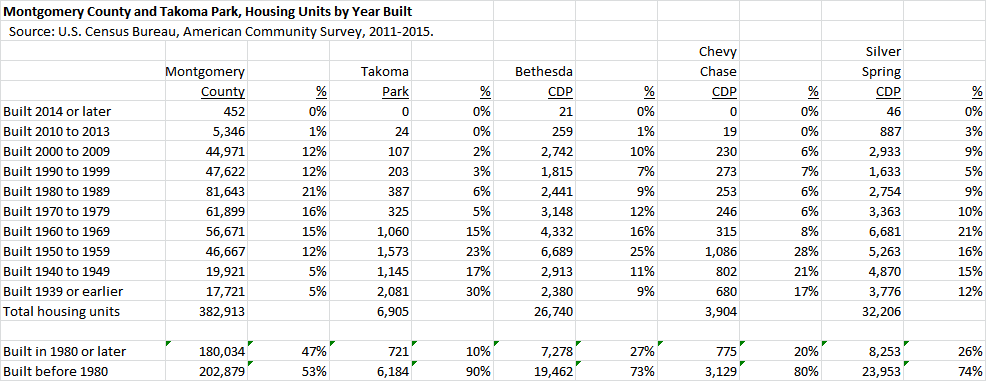
One need not go to a Communist nation to observe the effects of rent control.  MoCo has a good example of that policy right here at home: the City of Takoma Park, which passed a rent control law in 1981.  We examined U.S. Census data to analyze how the city’s housing stock compares to the county’s.  Below we show that just 10% of the city’s housing was built in 1980 or later, much lower than the county’s percentage of 47%.  That’s not a fair comparison since the city is much older than the vast majority of areas in the county.  However, other older areas inside the Beltway like Downtown Bethesda (27%), Chevy Chase (20%) and Downtown Silver Spring (26%) have much higher percentages of their housing built in 1980 or later than Takoma Park.

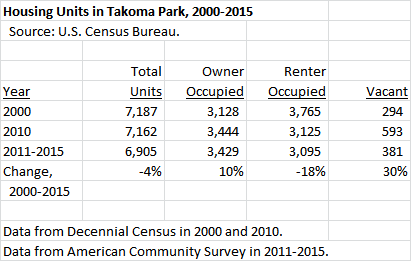
It gets worse.  Takoma Park has been losing rental housing units for years.  Below we show the city’s total, owner-occupied and renter-occupied housing units in 2000, 2010 and the five year period of 2011-2015.  During that time, the city’s total housing units fell by 4% and its renter-occupied units fell by 18%.  Owner-occupied units increased by 10% and vacancies rose by 30%.  No housing policy that produces double-digit losses in rental units can be described as good for renters.

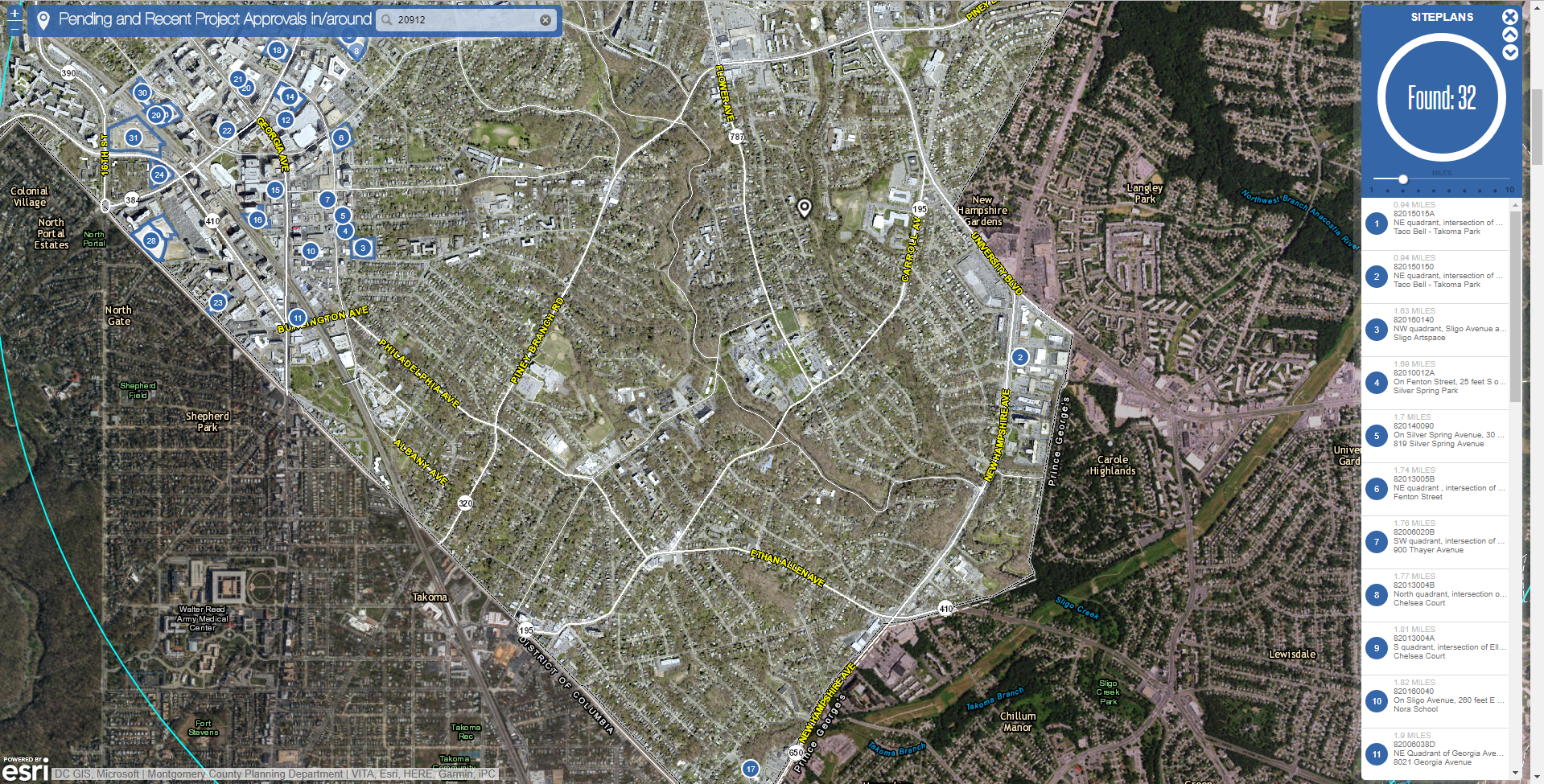
Takoma Park’s housing decline is not going to turn around soon.  According to the site plans, preliminary plans and sketch plans listed on the MoCo Planning Department’s development tracking map, only two housing projects with a combined seven units are pending in Takoma Park.  Those units are all single family, which are exempt from the city’s rent control law.

This extract from the Planning Department’s site plan map shows the huge contrast in development plans between Takoma Park and Downtown Silver Spring.

The implication of all this is clear: housing developers are steering clear of Takoma Park’s rent control law.  These folks are not going to be any more enthusiastic about rent control near Purple Line stations.  Why does that matter?  When it comes to building new housing, there are basically three options.  First, you can build it near transit.  Second, you can build it away from transit, thereby incurring the associated congestion and environmental costs.  Or third, you can try to block it from being built, and that’s one probable effect of rent control.  But that won’t stop population growth – instead, it will result in overcrowded housing, unsafe living conditions and code violations.  (Such phenomena are not unknown in some areas of the county.)  Rent control near the Purple Line just encourages options two and three.

Finally, the Purple Line is a huge investment, costing at least $2.65 billion to construct.  Only an insane society would pour billions of dollars into a transit project and then stop new housing from being built next to it.  Even Vietnamese Communists would agree.

Disclosure: Your author is a long-time supporter of the Purple Line and is a publicly listed supporter of Council Member Roger Berliner for Executive.

Share

Giving Thanks

By Adam Pagnucco.

Today is Thanksgiving, an occasion for celebrating with friends and family and giving thanks.  And we here at Seventh State have many thanks to give.

We are thankful for the reporters, bloggers, troublemakers, rascals, rogues and scalawags who keep our government honest.  And we are thankful to this nation’s founders who created the First Amendment to protect them.

We are thankful for Facebook, which gives us online tirades by politicians available for screen shots.

We are thankful for the liquor monopoly, which gives us a rare county service to complain about.  (Snow plowing season hasn’t started yet.)

We are thankful for public campaign financing, which has helped give us more candidates than can fit in RFK Stadium.

A recent day at the County Board of Elections’ candidate counter.

We are thankful to all the County Council candidates who will shortly be filling out our 72-question questionnaire.  (We are kidding – or so they hope.)

We are thankful to our guest bloggers.  After all, someone has to come up with good content for this site!

We are thankful to David Trone, who has promised to give Total Wine coupons to everyone who votes for him.  (OK, this hasn’t happened, but we are entitled to our fantasies!)

We are thankful to Comptroller Peter Franchot, who is doing everything in his power to help Maryland craft beer connoisseurs.  (His occasional entertaining spats with Senate President Mike Miller are a bonus.)

We are thankful to Council Member Hans Riemer for having the best pair of pants in county politics.  (Not to mention one of the best-looking families of all time!)

We are thankful to everyone who signed the petition to deport Justin Bieber and we hope there is another one.  Perhaps the current President will take action!

We are thankful for Roger Goodell, who might be the only person in pro football worse than Dan Snyder.

We are thankful for Baltimore City State Senator Nathaniel Oaks, who brought back fond memories of Senator Clay Davis.

We are thankful to our many off-the-record sources without whom it would be impossible to understand what the government is doing.  Keep it coming, folks!

We are thankful to the government employees who educate our kids, protect us from crime and provide us with professional, top-notch services every day.  And we are thankful to the private sector employees and business owners who pay for them.

We are thankful for our families and friends, who knock us down when we deserve it and pick us up when we need it.

And most of all, we are thankful to Seventh State readers, who tolerate our dreck and inexplicably come back for more.

Happy Thanksgiving!

Share

Bill Frick: Name One Program You Would Cut

Name one program in the county budget that is not working and can be cut.  Tell us how much in annual savings that would yield.

For too long, Council members have used the County budget as a piggy bank to fund their pet projects and ideas, often ones that could not survive a serious cost/benefit review.

As we reorient County government to be a constituent-consumer focused organization, we can find savings.  For example, the county employs nearly 40 personnel in its 311 call center, despite the dramatic shift in technology away from phone calls and towards electronic communications.  If Montgomery County complemented this with a constituent service app, as exists in neighboring jurisdictions, many constituent services would be routed directly to the relevant agencies instead of going first through bureaucratic call centers, and we could save taxpayer money.

Finally, the County should not be a leader in corporate welfare.  I would end our tax credits for investors, money that goes from everyday taxpayers straight to the pockets of wealthy investors, often to reward them for making investments they would have made regardless.  This is a fight I led at the state level as the architect of the Tax Credit Evaluation Act, legislation to spotlight and reform our runaway subsidies, and by going toe-to-toe with Hollywood to make sure our tax dollars were being spent productively.

Share