All posts by Adam Pagnucco

Solar Industry Blasts “De Facto Moratorium” on Solar in Ag Reserve

By Adam Pagnucco.

In the wake of the county council’s changes to a zoning text amendment that would allow solar panels in the agricultural reserve, the solar industry is now urging the council to defeat the legislation. The industry claims that two amendments adding soil restrictions and additional review requirements are tantamount to a “de facto moratorium” on solar in the reserve. One solar generator based in Kensington has already abandoned its projects in MoCo and industry representatives allege that others are also pulling out.

The letter to the council from the Coalition for Community Solar Access and the Chesapeake Solar and Storage Association is reprinted below.

*****

Montgomery County Council
100 Maryland Avenue, 6th Floor
Rockville, MD 20850
RE: ZTA 20-01

Dear President Hucker and Councilmembers,

The Coalition for Community Solar Access (CCSA) and Chesapeake Solar and Storage Association (CHESSA), formerly MDV-SEIA, thank the Montgomery County Council for its year-long consideration of the Zoning Text Amendment 20-01 (ZTA 20-01) and the opportunity to offer input on behalf of the solar energy industry. We appreciate the time and attention the Council has dedicated to this important issue and recognize that you sought to find balance in your approaches with the best of intentions. However, at this time and due to the amendments that were adopted by the Council on January 26, 2021, particularly related to restrictions on Class 2 soils and new conditional use requirements, CCSA and CHESSA regrettably submit this letter in strong opposition of the ZTA 20-01 as it will prevent reasonable solar development in Montgomery County.

The trade associations and our member companies presented information stating that either soil restrictions beyond Class 1 soils or conditional use would prevent reasonable development of community solar and AgNEM facilities in Montgomery County. As you know, the Maryland Community Solar Pilot Program seeks to provide clean, renewable energy to Maryland residents who do not otherwise have access to solar electricity, particularly with respect to low- and moderate-income families.

While we understand many on the Council believe that these two amendments were a “compromise,” seeking to find a “middle ground,” these two amendments unfortunately undermine the very purpose of the ZTA – which we believed was to allow solar development in a very limited portion of the AR Zone. Small scale solar energy development, such as Community Solar and AgNEM, is a complicated undertaking that entails many federal, state, and local hurdles. ZTA 20-01 as introduced was a relatively modest bill that included several safeguards and an aggregate cap. Over the course of the year-long process, we conceded to several additional amendments related to land conservation as well as other ancillary agricultural benefit requirements and safeguards. While most of the amendments prior to the January 26th decisions created additional cost and burdens on solar development, our members were willing to meet such challenges to promote renewable energy development in the County and work hand in hand with the agricultural industry.

However, the adoption of the class II soil restriction not only reduces the available acreage under the 2% cap by 70% but it eliminates development overall because it doesn’t take into account solar siting provisions required for construction. When these considerations are applied, as required by developers, the soil restriction in fact prevents ground-mounted solar development in the county. Furthermore, the extensive delays caused by the conditional use provisions and the inability to fast track the process will inevitably place community solar facilities in jeopardy of being fined for an extension and removal from the community solar pilot program. The increased costs associated with the court proceedings, duplicative planning board processes and subjectivity for approval, decrease the cost savings for community solar subscribers, defeating the intent of providing affordable clean energy to customers who have been unable to access it through other means. These are simply risks the industry cannot take.

Not only will the two amendments to ZTA 20-01 – Class 2 soil restrictions and conditional use – prevent Montgomery County from achieving its robust clean energy goals, these amendments, if the ZTA is enacted, will introduce considerable risk to the state’s community solar pilot program and reduce the customer benefits received by Maryland residents as a whole, including low- and moderate -income families. The recent actions taken by the Council place a de facto moratorium on solar development in the AR Zone and prevent Montgomery County from participating in the remaining three years of the Maryland Community Solar Pilot Program.

As a result of the votes taken on January 26th, several of our members have already started to cancel current land option leases with landowners and farmers in Montgomery County. Others have begun cancelling contracts with local vendors and consultants, including employment opportunities in the County. We have also heard from other subscriber organizations that have begun to cancel subscriber acquisition for Montgomery County residents to participate in community solar programs.

While we are always willing to find workable solutions to our climate challenges with the County, we respectfully but strongly urge that ZTA 20-01 be defeated in its current posture. Thank you for your work and we hope we can count on your support to vote no.

Sincerely,
Leslie Elder, Mid-Atlantic Director
Coalition for Community Solar Access

David Murray, Executive Director
Chesapeake Solar and Storage Association

CCSA is a national coalition of businesses and nonprofits working together to implement best practices for all community solar markets. Our mission is to empower all Maryland households and businesses that seek home grown energy sources through community solar. We work with customers, utilities, local stakeholders, allies and policymakers to develop and implement best practices that ensure community solar programs provide a win-win-win solution. The solution begins with the customer and the land owners. Our members are solar industry leaders and are engaged at every step of development, ensuring these best practices are not theoretical but are applied and practiced. We have members headquartered in Maryland, including some members headquartered in Montgomery County, and others who were interested in investing here.

The Chesapeake Solar & Storage Association (CHESSA), formerly MDV-SEIA, is a regional trade association representing over 10,000 solar installers, developers, manufacturers, and other solar workers in Maryland, Virginia and the District of Columbia. It is the recognized state affiliate of the Solar Energy Industries Association.

Share

Top Seventh State Stories, January 2021

By Adam Pagnucco.

These were the top stories on Seventh State in January ranked by page views.

1. Raskin Chief of Staff Writes About Attack on the Capitol
2. Are Maryland Vaccine Deliveries Fair?
3. State to Counties: Vaccinate Private School Staff or Else
4. What Happened to White Flint?
5. MoCo Solar Power Company Throws in the Towel
6. How Does MoCo’s Vaccination Rate Compare to the Rest of Maryland?
7. State Legislators Call on Harris to Resign
8. Political Awards 2020
9. MoCo’s Hero
10. Mizeur Threatens to Run Against Harris

This is a pretty concise list of what has been on the minds of MoCo’s political community: the attack on the Capitol, Jamie Raskin, vaccines and the movement to throw out Andy Harris. The story on the solar zoning text amendment reflects a split among environmentalists that is bound to resurface on future issues. As for White Flint, which was also the top story in December, that article demonstrates a major challenge that MoCo will face as it emerges from the pandemic: how to rebuild its economy and not lose any more ground to the rest of the region. Economic competitiveness was a big issue before COVID and it will return to that pedestal as the next election approaches.

Share

Can Andy Harris be Defeated?

By Adam Pagnucco.

With a majority of Democratic state legislators calling on him to resign and former Delegate Heather Mizeur, now an Eastern Shore resident, announcing a run against him, District 1 GOP Congressman Andy Harris has a target on his back. Democrats all over the state are offended by his alliance with Donald Trump, his inexcusable behavior on the House floor, his failure to condemn QAnon and various other misbehaviors over the years. Now he is seeking a seventh term after pledging to serve only six. Democrats want him out but here’s the big question:

Can Andy Harris actually be defeated?

The key to answering that question lies in examining Harris’s district. Maryland’s first congressional district has historically contained the Eastern Shore. Variations in its composition have depended on which other jurisdictions have been added. In the 1970s and 1980s, the district contained Harford County and the three southern Maryland counties (Calvert, Charles and St. Mary’s). In the 1990s, it contained a large piece of Anne Arundel County and a tiny piece of Baltimore City. In the early 2000s, it contained parts of Anne Arundel, Baltimore and Harford counties. Since 2011, it has contained parts of Baltimore, Carroll and Harford counties as it has been stretched out along the Pennsylvania border.

In the 2011 redistricting round, General Assembly Democrats had two goals: fortify their congressional incumbents and flip Western Maryland’s sixth district from red to blue. They accomplished both but the price of doing so was packing Republican precincts in the Baltimore suburbs into the first district. That greatly benefited Harris, who was first elected in 2010 when he defeated a one-term Democratic incumbent. Harris has not been seriously threatened since.

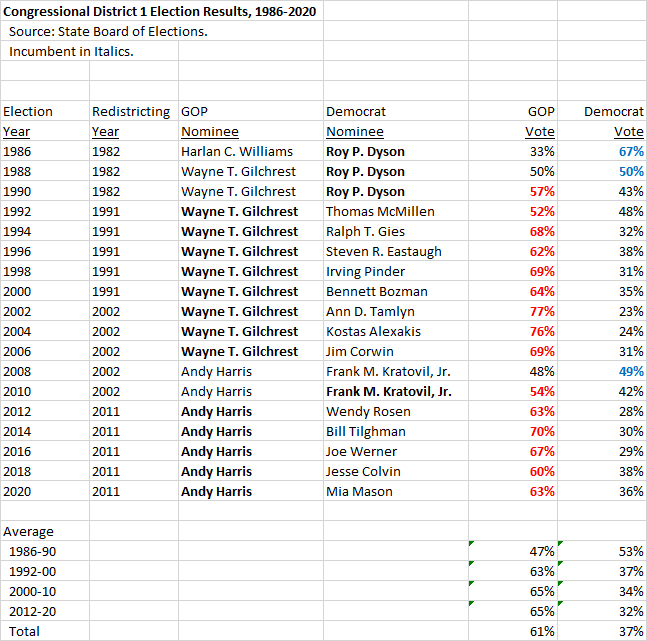
The table below shows the history of general elections in the first district since 1986.

Since Democratic incumbent Roy Dyson was defeated in 1990, the Democrats have gone an abysmal 1-15 in the district’s general elections. The sole exception was in 2008, when GOP incumbent Wayne Gilchrest was defeated by Harris in the primary and Queen Anne’s County prosecutor Frank Kratovil squeaked in during Barack Obama’s first election to the presidency. Harris defeated Kratovil two years later during the tea party revolt. It’s worth noting that in the last 30 years, only three incumbents have been defeated here: Dyson and Kratovil, both Democrats, and the Republican Gilchrest who was beaten in a primary by the more conservative Harris.

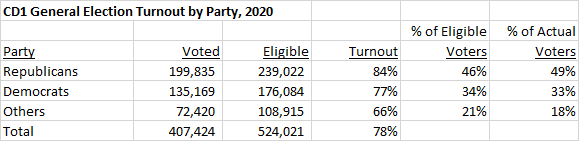
The first district is now the most heavily Republican congressional district in the state. The table below shows its turnout by party in the 2020 election. Republicans accounted for 46% of eligible voters and 49% of actual voters. Democrats accounted for 34% of eligible voters and 33% of actual voters and turned out at a lower rate than Republicans.

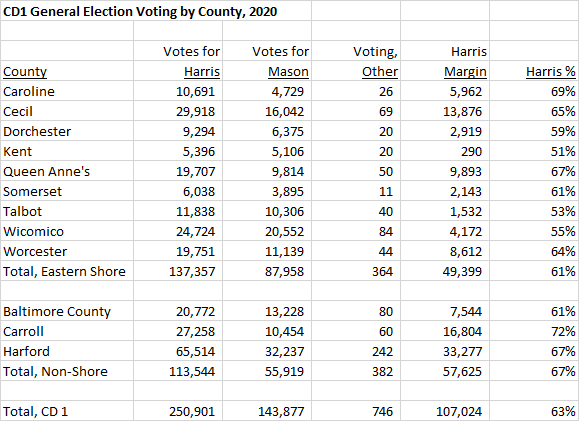
Harris won the 2020 general election with 63% of the vote, about average for his tenure as an incumbent. The table below shows the breakdown of his votes against challenger Mia Mason by county. Harris pulled a margin of nearly 50,000 votes from the Eastern Shore and almost 58,000 votes from the non-Shore counties, illustrating just how much GOP votes in the Baltimore suburbs are helping him win.

Put together the above two charts and a successful Democratic challenger would have to get votes from all the Democrats, almost all the unaffiliated voters and a smattering of Republicans. That is a LIFT.

How would the Democrats have made up the 107,000 vote margin that elected Harris last November? Getting a top-notch candidate would help; Harris had a cash on hand advantage over Mason in October of more than $1 million to roughly $2,500. Mizeur won’t have any problem raising money against Harris. She is an able politician who surprised people in the 2014 Democratic gubernatorial primary, but is the former Takoma Park progressive a good fit for the first district?

Mizeur doesn’t hold back when discussing Harris.

It’s hard to see a scenario in which the Democrats could defeat Harris without changing the district’s boundaries. Here’s where it gets difficult. Let’s suppose that the Eastern Shore remains at the heart of the district. The shore gave Harris a 50,000 vote margin last time. The Democrats would have to rearrange the rest of the district from a plus-58,000 vote margin for Harris, as it was in 2020, to a negative-51,000 vote margin. A great candidate could make up some of those votes, but this is still tough.

Where would the new precincts come from? The Democrats could draw a line across the bay bridge and up into Baltimore City. There’s a bit of precedent for that as the district contained a handful of city precincts in the 1990s. But the number of precincts would have to be far greater than a handful to overturn Harris’s advantage on the shore. And this would create a truly odd district, combining inner city Baltimore with some of the most rural areas in Maryland.

The Democrats could also add left-leaning precincts around Annapolis and in Howard County but would it be enough? If they added in Southern Maryland, as it was in the 1970s and 1980s, it’s not clear that the district would be much bluer.

Complicating the issue is the effect of altering the first district on other nearby districts. While Harris is protected by keeping Republicans in his district, Democratic incumbents in the second, third, seventh and eighth districts are protected by keeping Republicans out. What will they say if they are told to swap their blue precincts with Harris’s red precincts? I might speculate but this blog prohibits profanity!

Getting rid of Harris will require a historically great opponent, an investment of huge financial resources and redistricting changes that will generate resistance with no guarantee of success. Additionally, the Democrats could get lucky if a primary challenge from a credible candidate like Harford County Executive Barry Glassman drains some of Harris’s war chest. Nothing is impossible in politics. But this is a BIG mountain to climb. Let’s see just how badly the Democrats want Harris out of Congress.

Share

State to Counties: Vaccinate Private School Staff or Else

By Adam Pagnucco.

Phase 1B of the state’s COVID vaccination schedule includes “education staff, including K-12 teachers, support staff and daycare providers.” Some counties are now starting vaccinations of school staff. The state’s Department of Health has just issued a warning to all county health officers and other vaccine providers that they must include private school staff in their vaccination programs or risk having their vaccines reallocated to other vaccine providers who comply. The state’s warning follows Montgomery County Executive Marc Elrich’s announcement that his county is working with Johns Hopkins Medicine to vaccinate MCPS employees, a statement that makes no mention of private school staff.

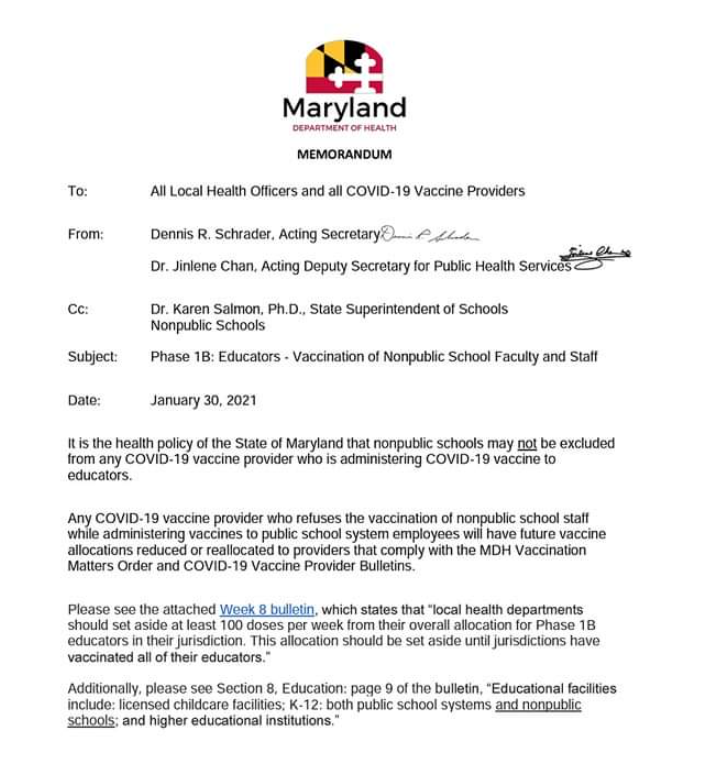
The memorandum from Acting Secretary of Health Dennis R. Schrader to vaccine providers is reprinted below.

*****

To: All Local Health Officers and all COVID-19 Vaccine Providers

From: Dennis R. Schrader, Acting Health Secretary
Dr. Jinlene Chan, Acting Deputy Secretary for Public Health Services

Cc: Dr. Karen Salmon, Ph.D., State Superintendent of Schools
Nonpublic Schools

Subject: Phase 1B: Educators – Vaccination of Nonpublic School Faculty and Staff

Date: January 30, 2021

It is the health policy of the State of Maryland that nonpublic schools may not be excluded from any COVID-19 vaccine provider who is administering COVID-19 vaccine to educators.

Any COVID-19 vaccine provider who refuses the vaccination of nonpublic school staff while administering vaccines to public school system employees will have future vaccine allocations reduced or reallocated to providers that comply with the MDH Vaccination Matters Order and COVID-19 Vaccine Provider Bulletins.

Please see the attached Week 8 bulletin, which states that “local health departments should set aside at least 100 doses per week from their overall location for Phase 1B educators in their jurisdiction. This allocation should be set aside until jurisdictions have vaccinated all of their educators.”

Additionally, please see Section 8, Education: page 9 of the bulletin, “Educational facilities include: licensed childcare facilities; K-12: both public school systems and nonpublic schools; and higher educational institutions.”

Share

MoCo Solar Power Company Throws in the Towel

By Adam Pagnucco.

Stefano Ratti, President of Chaberton Energy, has told the county council that his firm has given up its plans to proceed with solar energy projects in Montgomery County. Chaberton Energy is based in Kensington and operates throughout the mid-Atlantic region.

Ratti blasted two amendments made by the council on Tuesday to a pending zoning text amendment on solar projects in the agricultural reserve. Together, they would effectively ban solar panels in 99% of the reserve’s acreage and add potentially time-consuming review requirements on the remaining acres. Council Members Gabe Albornoz, Andrew Friedson, Sidney Katz, Nancy Navarro and Craig Rice voted for both amendments while Will Jawando voted only for the amendment on review requirements. Council Members Hans Riemer, Evan Glass and Tom Hucker voted against both.

Banning solar panels on Class I and Class II soils would effectively allow them on only 1,324 acres of the agricultural reserve’s 101,541 acres.

Ratti’s email to the council, sent yesterday, is reprinted below.

*****

From: Stefano Ratti
Date: Wednesday, January 27, 2021 at 11:25 AM
Subject: Solar Energy in the County

Councilmembers Friedson, Albornoz, Navarro, Rice, and Katz,

I am grateful for the work you do on the County Council, but, with yesterday’s vote on excluding Class II soils (and, to a lesser extent, changing the use to conditional), you have now killed the possibility of doing solar energy in any meaningful way in Montgomery County. In the middle of a pandemic you killed an opportunity to create local jobs, do a lot of good for the environment, bring revenue to the County (which could have been used for the benefit of the Ag Reserve), help local landowners, and save money on electricity bills for county residents (particularly low-income residents, under the state community solar program). You also voted against 70% of the residents of Montgomery County, who demand action on environmental issues. With one single vote.

Here is what the next few days look like for me and my Montgomery County solar team:

We are going to rescind the five land options we have with our Montgomery County landowners (they are, like everything else in the County, on Class II soil – we have canvassed the county for one year and we have been unable to find one single viable non-class II property)

We are going to meet with our landowners and explain that, unfortunately, no, the county doesn’t want you to have a solar farm

We are going to tell our investors that we didn’t clear the Montgomery County ZTA milestone; they will not release the development funds that were earmarked for Montgomery County projects

We also have to tell our investors that we lost 30% of our proposed projects and we will have to figure out how to keep our business viable, which our staff and their families rely on; yes, we are a Montgomery County business, but, no, we are de facto blocked from operating in our own county

We will call our headhunters and tell them to stop looking for staff

We are also going to terminate contracts with our local contractors; we are going to call them and say, that, unfortunately, no solar project is going to happen in our county (whether it’s us or other solar companies)

All that this vote achieves is to “preserve” a handful of acres of land that is currently producing feed for animal consumption, or sitting fallow. Along with a couple of farming jobs, which could have been easily re-purposed to establish and maintain agricultural activities on the solar installations, while we are missing out on the economic benefits for the farming community*. Running us out of the county appeases a vocal minority of NIMBY activists, who don’t mind keeping fossil fuel plants open, as long as they are not in their backyard, but rather in disadvantaged communities who don’t get to have their voices heard.

I am not proud to be a Montgomery County resident today.

Councilmembers Riemer and Hucker, a heartfelt thank you for all the effort you have put in sponsoring this bill; you are probably just as disappointed as we are, but know that your genuine efforts to do good for the environment and help the local economy are not going unappreciated; and doing the right thing always has a value on its own. Councilmember Glass and Jawando: thank you for your vote on Class II soil and recognizing that excluding Class II soil makes it impossible to do anything. And we urge you to vote against passing the ZTA version with the class II soil exclusion.

Stefano Ratti

* See for example report published just today from Rocky Mountain Institute: https://rmi.org/insight/seeds-of-opportunity/ “Seed of Opportunity – How Rural America Is Reaping Economic Development Benefits from the Growth of Renewables”

Share

Why is West Virginia Doing a Better Job on Vaccination Than Maryland?

By Adam Pagnucco.

William A. Galston, a Senior Fellow at the Brookings Institution, has written an eye-opening piece on vaccine distribution comparing West Virginia to Maryland. In it, Galston notes that West Virginia ranks high on poverty rate, low on education rate and low on median income among U.S. states while Maryland is on the other end on all those measures. Yet, West Virginia “ranks 2nd in the share of its population that has been inoculated and has turned 83% of the doses received from the federal government into actual inoculations” while Maryland “ranks 35th for its inoculation rate and has delivered only 46% of doses received into its people’s arms, well below the national average of 53%.”

What accounts for the disparity?

Galston identifies two factors. First, he credits West Virginia for relying on a network of independent pharmacies to vaccinate nursing home residents rather than using CVS and Walmart, which the rest of the nation has done. Galston believes local pharmacies have more penetration into rural areas and closer relationships with nursing homes than national chains, resulting in better vaccination performance. The second factor has to do with the governance structures used by West Virginia and Maryland. Galston writes:

The second apparent explanation for West Virginia’s superior performance: decisions have been made by the governor at the state level, eliminating confusion and competition among localities. Starting January 25, a state-wide online site will allow all residents to register for vaccinations and will direct them to facilities with doses available. A week later, on February 1st, the state will expand its network of community clinics to cover all 55 of its counties.

In Maryland, by contrast, most of these issues have been left to its counties, each of which has established its own priority lists and facilities for administering the vaccine. Maryland’s system of strong county governance works well in normal times but is impeding vaccine delivery during this pandemic. As Maryland residents know, this diversity has created confusion and has given residents with access to multiple information sources advantages over those with weaker networks and less Internet access. A bewildering maze of online sites—some from counties, others from hospitals–has sprung up. Prince George’s County has closed its vaccination facilities to Marylanders who live outside its borders.

Galston has a point. One cannot overstate the level of confusion in Maryland about how to get vaccinated. Take a look at the state’s vaccine website, which says that we are in Phase 1C, which includes adults age 65-74 and essential workers in lab services, agriculture, manufacturing and the postal service. Now take a look at Montgomery County’s vaccine website, which says we are in Priority Group 1B, which includes adults age 75 and older. Prince George’s County’s site aligns with the state while Anne Arundel County’s site says, “Currently, the Anne Arundel County Department of Health is NOT in Phase 1C. The Department is providing vaccine appointments ONLY to the Phase 1A group and Phase 1B’s county residents who are age 75+.” Frederick County’s site says it is vaccinating “1A and people 75 years and older who live or work in Frederick County.” Baltimore County’s site says it is in Phase 1C. Howard County’s site says that Phase 1C has not begun and vaccinations for adults age 65-74 will begin in February. And so on. Baltimore City’s site seems to resemble the state’s but says that phases are “as of Jan. 25th, 2021. Phases subject to change due to CDC, MDH or FDA updated guidance.” So what’s true now might not be true tomorrow. Add to this the assorted residency and work requirements being imposed by counties and the disarray gets worse.

Then there are the hospitals, who as of last week had received twice as many vaccines as county health departments. Hospitals are responsible for vaccinating their staff and associates but what happens if they have left-over vaccines? I was recently forwarded an email that originated with a doctor at one of MoCo’s hospitals stating that they had a surplus of vaccines and had 16 appointment slots. The email spread like wildfire and the slots promptly filled up. Who knows who signed up? Enthusiasm quickly dried up when the hospital sent notice to those who registered that they had to provide proof of health care employment and had to sign legal attestation of eligibility.

Confusion and multiple opportunities for registration and preregistration have tempted some to sign up at every outlet they can find, reasoning that if just one of them pays off it will be worth it. In a briefing with the media yesterday, Montgomery County officials tried to persuade the public to avoid this practice because it would overbook appointments and clog the system. But with different entities administering vaccines and apparently different criteria and rules in place among them, why wouldn’t folks sign up everywhere they could hoping to get lucky?

The biggest single problem afflicting all states and counties is the nationwide shortage of vaccines, which the Biden administration is trying to fix through buying 200 million more of them. It’s also understandable that Maryland is relying on its existing system of counties and health care providers rather than trying to reinvent it in the middle of a huge vaccination push, which would undoubtedly create a whole other category of problems. But the conflicting information coming out of the state, its 24 local jurisdictions and other vaccine-administering entities is problematic. If it continues, it will hinder the efficiency of vaccine distribution and prolong the pandemic.

Share

Ashwani Jain is Running for Governor

By Adam Pagnucco.

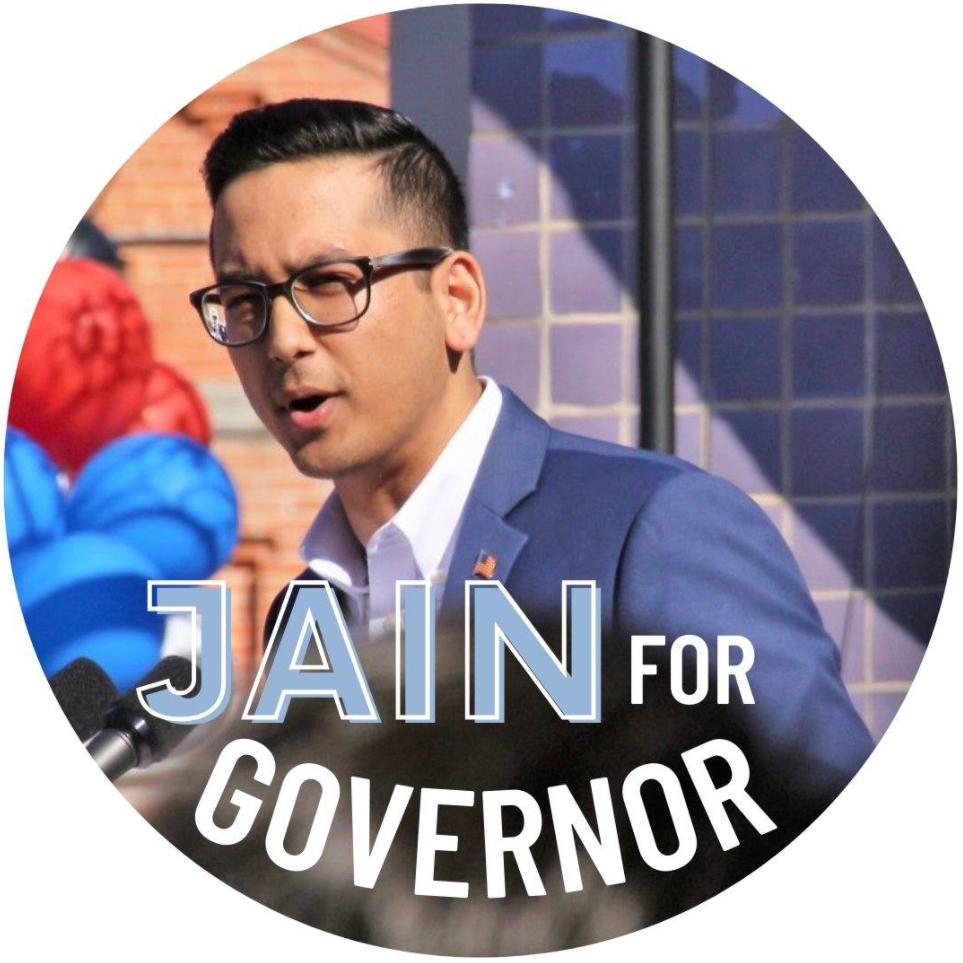
Former Obama administration official Ashwani Jain is running for governor. A resident of Potomac, Jain ran for Montgomery County Council At-Large in 2018 and finished eighth in a race for four seats. Jain just made an announcement and his press release is reprinted below.

*****

FOR IMMEDIATE RELEASE: January 28, 2021
Shairee Arora | PressForJain@gmail.com

Former Obama-Biden Appointee Ashwani Jain Announces Historic Candidacy for Maryland Governor

If elected, Jain would become the nation’s first millennial Governor and Maryland’s first Governor of color

Montgomery County, MD — Last night, Friends of Ashwani Jain announced that Maryland native Ashwani Jain is running for Governor of Maryland in a historic campaign. If elected, Jain would become the nation’s first millennial Governor and Maryland’s first Governor of color. To learn more, visit JainForGovernor.com. To watch the campaign’s kickoff video, click here.

“Maryland needs strong leadership — leadership that reflects the makeup and diversity of the state. That’s why I’ve decided to run for Governor,” said Ashwani Jain. “If elected next year, I would serve as the nation’s first millennial Governor and Maryland’s first Governor of color. While a voice like mine has never been in the Governor’s Office, in a state that is younger and more diverse than it’s ever been, voices like mine are growing and need to be represented. I’m honored to be running to be the next Governor of Maryland.

“Although I may be young, I have experience beyond my years and understand how the systems of government work. For two decades, I’ve fought to expand opportunities for Marylanders through advocating for public policy at all levels of government, including with then-President Barack Obama and then-Vice President Joe Biden. And on a personal level, as an 18-year survivor of childhood cancer, a son of immigrants and small business owners, a Maryland native and product of public schools and a diverse millennial, I understand the real impact of policies, including the inequities, because those policies and inequities have impacted me.

“I firmly believe I have the experience, perspective and empathy needed to serve as Maryland’s next Governor. It’s time for a new start and to change the narrative of who deserves a seat at the table.”

Jain (he/him pronouns) is a 31-year-old with a compelling personal and professional story. He beat cancer, attended a Title 1 Elementary School and later went on to earn two bachelor’s degrees and one master’s degree. He has worked in the public, private and non-profit sectors, and served in the Obama/Biden White House and two federal agencies — the Department of Housing and Urban Development and the Department of Health and Human Services. Jain also served as the Director of Outreach for now-President Biden’s Cancer Moonshot.

With what will be a completely vacant Governor’s seat for the first time in a decade, Jain has two main objectives. The first is to make Maryland’s state government more representative, transparent and accountable by focusing on Inclusion, Banning Corruption and ensuring Equal Access. The second is to take a comprehensive approach to solving Maryland’s issues by focusing on a “Relief, Recovery and Reform” agenda. To learn more, visit JainForGovernor.com.

#

Share

Don’t Mess With the Real Deal

By Adam Pagnucco.

In January 2014, District 1 County Council Member Roger Berliner posted a cash balance of $52,369 in his campaign finance report. Over the prior year, he had raised just $200. Berliner was a battle-tested politician as he had defeated an incumbent to get elected in 2006 and then beat a capable challenger in 2010. But he had clearly taken 2013 off, at least from a political perspective.

That caught the attention of former At-Large Council Member Duchy Trachtenberg, who had been ousted in 2010 and was looking for a way to get back into politics. Trachtenberg filed to run against Berliner hours before the filing deadline and was sitting on a cash balance of $122,575 from the last election. She looked like a threat as she was a former incumbent, had money and brought union support and some business support into the race.

Berliner went into overdrive, raising money hand over fist and locking down his district. He wound up thrashing Trachtenberg by 57 points. But if he had shown a large cash balance, Trachtenberg might not have run against him in the first place.

Berliner’s successor, Council Member Andrew “Real Deal” Friedson, is no doubt aware of this history.

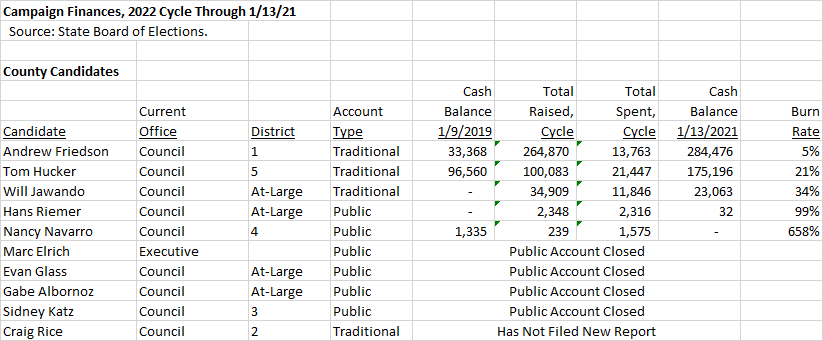
The table below shows campaign finance data for the incumbent county executive and county council members. My presentation differs from other sources in two ways. First, I show money raised and spent for the entire cycle, not just the last year. Second, I calculate burn rate, which is the percentage of money raised that has already been spent. Burn rate is important because candidates need to keep it low in the beginning to save up for large expenditures like mail at the end.

Friedson’s numbers are the obvious headline. He raised $264,870 for the cycle and has a cash balance of $284,476. His burn rate was a rock bottom 5%, meaning he spent very little compared to what he raised. We’ll get into just how astounding Friedson’s cash balance is below.

District 5 County Council Member Tom Hucker also did well, raising $100,083 and finishing with a cash balance of $175,196. Hucker was aided by the facts that he had marginal opposition in the last election and he has been raising money for a potential run for comptroller. If he runs for his current seat, his cash balance is excellent. But in a race for comptroller, he trails actual and potential candidates Delegate Brooke Lierman ($588,292 on hand), Senator Brian Feldman ($346,320), Bowie Mayor Tim Adams ($253,130) and Senator Jim Rosapepe ($207,181).

At-Large Council Member Will Jawando was the top fundraiser among county council candidates in public financing last time. But after entering traditional financing, he reported a cash balance of just $23,063. Jawando is a talented candidate and he has time to fix this, but at this moment, he doesn’t look as strong as he should.

Most of the other incumbents were in public financing last time and either have no money or have closed and not reopened public financing accounts. They don’t need to have an active public account right now as they are not eligible for county matching funds until a year before the next primary (which will be held on June 28, 2022). But they should open public accounts soon.

At-Large Council Member Hans Riemer, District 2 Council Member Craig Rice and District 4 Council Member Nancy Navarro are term limited. They can’t run for council in the next election but they could run for other offices.

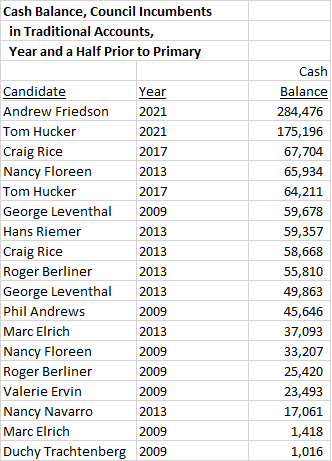
Let’s return to Friedson’s huge cash balance, which was posted a year and a half before the next primary. The table below shows cash balances reported by council incumbents in traditional financing a year and a half before the next primary over the last four cycles (2010, 2014, 2018 and 2022). There are a lot of good fundraisers in here, especially the at-large incumbents who often raised more than $250,000 for their reelections. Friedson’s number smokes them all and so does Hucker’s.

If Hucker runs for reelection to his current seat, it’s hard to see him having a problem. He has represented the core of his district since he was first elected as a District 20 Delegate in 2006 and his political roots there go back much farther than that. The recipe for running in that area is to go as far left as possible and it’s difficult to get to the left of Hucker.

Friedson is a different story. Some on the left dislike his alliance with the business community (which is reflected in his fundraising) and his fiscal conservatism (at least in highly relative MoCo terms). They note that he won his first primary with 28% of the vote in an 8-candidate race. Rumors of a primary challenge have circulated for months. Friedson’s opponents should be mindful of the district’s 30-year history of electing Republicans and Democrats with moderate tendencies as well as Friedson’s status as a hometown boy.

In any event, Friedson is sending a message to critics and potential opponents with his huge war chest. It goes something like this.

You can’t outraise me. You can’t outwork me. I am going to dominate every meaningful measure of political power in District 1. Save your time and your money and focus on other races because I am going to win.

That’s the message from the Real Deal. Will it be heard?

Share

MoCo’s Hero

By Adam Pagnucco.

We are living in historic times. After the sack of the U.S. Capitol, America approaches a day of reckoning with the only president to incite an insurrection against our democracy. At the center of this moment is Congressman Jamie Raskin, who has been named the lead impeachment manager in the trial of Donald Trump. It’s a huge moment. It’s Jamie’s moment, yes, but it’s also ours. All of the nation will be watching.

I have met a lot of politicians, many of them good ones, but there was always something special about Jamie. He first ran for office in 2006 against incumbent District 20 Senator Ida Ruben, who had been in office for more than 30 years and had gradually lost touch with many of her constituents. Jamie didn’t so much run a campaign as he established a grass-roots movement for progressive values and attentive representation. Ruben didn’t stand a chance.

MoCo is full of smart people. Most of them want you to know they’re smart sooooo badly. Jamie is as smart as anyone but he has no need to show off. He is charming, witty, quirky and sometimes even a little goofy. He is so full of eagerness when discussing something he cares about, like constitutional law. Who can make constitutional law interesting and cool? Jamie can because he gets so excited about it and he knows so much about it. He never talks down to you. He draws you in. He had that effect on people even outside his district, which is a big reason why he ascended to Congress.

Lots of people have a Jamie story. Here’s mine. About ten years ago, I had a potential legal problem that was keeping me up at night. It had a First Amendment dimension to it, and knowing Jamie is a national expert on that subject, I called him on the spur of the moment. I’m a District 18 resident so Jamie was not my State Senator. I didn’t know him well back then. Nevertheless, he invited me to his home at 10 at night, listened to me, educated me and supported me. Maybe it was no big deal for him but it was a huge deal for me. My problem turned out to be a non-issue but I never forgot how he helped me. I’m not the only one. I have heard countless stories of Jamie’s generosity and kindness over the years.

And now we come to the hard part. Perhaps the cruelest fate a human being can suffer is to lose a child. For parents, children are not just our favorite people – they are our contribution to the world. When they do well, we feel a sense of accomplishment because we feel that we are leaving something positive behind when we go. I have a son. If he were to pass away in my lifetime, I’m not sure I could find purpose and meaning in continuing to live. When that horrible tragedy happened to Jamie, what did he do? He went back to work. And for him, that meant leading a crusade to rid us of the most destructive political scourge in the last 160 years of U.S. history, the Emperor of Lies, Donald Trump. How much strength and sense of duty does that take? I am far from the only one who marveled at Jamie’s ability to rise from the depths of devastation to the heights of greatness.

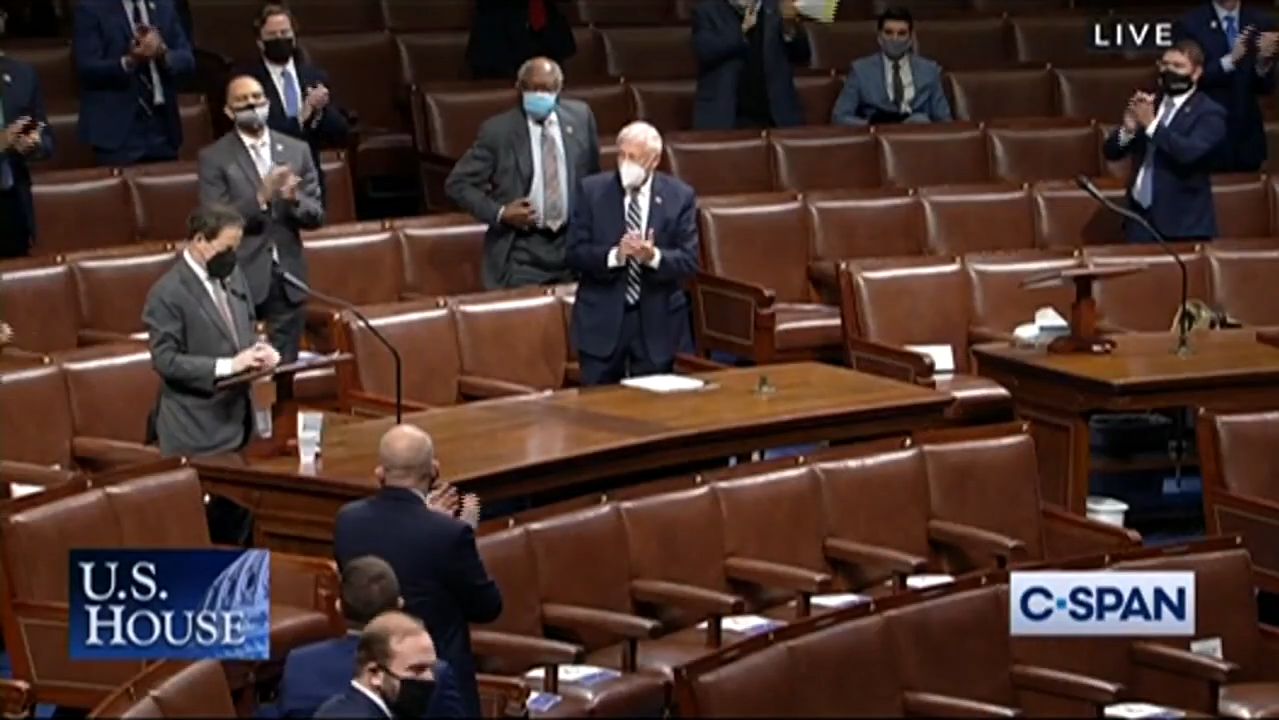
Members of Congress from both parties applaud Jamie after he thanks them for their support during his family tragedy.

In a war against evil – and make no mistake, evil is what rampaged through the U.S. Capitol weeks ago – people of good will need heroes. For folks around the country, Jamie has joined a pantheon of great leaders seeking to restore America’s highest aspirations. But here in MoCo, Jamie is more than that. He is one of us, a favored son in our civic and political family. He’s ours. He is MoCo’s hero. And whatever happens in years to come, we are never going to forget this moment.

Thanks, Jamie.

Share