All posts by Adam Pagnucco

Toward Cost-Effective Transportation

By Neil Harris.

Transit is much more expensive to build than highways. It’s politically correct to focus on transit. But is it the best use of our tax dollars? Let’s look at the numbers.

Transportation planners in our region look at many. At the most recent Transportation Planning Board (TPB) meeting, there was a presentation on the ways that transportation plans are measured and approved factors – social equity, air quality, and many more. But when I asked if there was a cost-benefit analysis, it became clear that this did not appear to be on anyone’s list of measures.

By cost-benefit, I mean this: when you build a new transportation project, how much money does it cost to move people?

Over the last few weeks, I went back through some presentations and found the two slides shown below that have the numbers to tell an important story. I spent a lunch hour on the phone with TPB staff to verify that what I was seeing was accurate, and what it might mean. Here is what I learned from TPB’s data:

The DMV region plans to spend $42 billion to expand transportation capacity over the next 25 years, split between $27 billion on highway expansion and $15 billion on transit. This will result in 2.7 million more daily trips by auto and 300 thousand more daily trips in transit. By simple arithmetic, this means that it costs just over $10,000 to add capacity for another auto trip, and more than $53,000 to add another transit trip. Building transit capacity currently costs more than 5 times as much as highway capacity!


If this was the only factor that was important, then decisions would be easy. Any CEO would immediately allocate more money into adding highway capacity. Of course, it’s not the only factor. Not everyone can afford to travel by auto – we want lower-income people to be able to get to their jobs, so we need transit. Transit trips are less polluting than autos, although TPB’s data shows a steady decrease in auto pollutants thanks to greater efficiency and the growing number of electric, zero-emission vehicles.

The other key is that, for parts of our region, building new roads or even expanding existing ones is terribly difficult. Where would you put a new thoroughfare in DC, or in the close-in suburbs?

The costs I focused on so far are the capital costs for new projects. The same TPB information can be used for operating costs – how much it costs for each trip. It turns out that we’re going to spend $130 billion over the next 25 years on transit operations and repairs, about $5.2 billion annually, with capacity growing to 1.5 million daily trips, for a per-trip cost of about $9.50. Each time someone takes a transit trip, the government subsidizes the trip by that amount. We’ll spend $72 billion to maintain roadways during the same period, about $2.9 billion annually, to move up to 16.6 million trips/day. That comes to just under 50 cents per trip.

The operating cost information is useful in a couple of ways. At the same TPB meeting, the Commuter Connections presentation unveiled a new program, piloted in Howard County MD, where auto commuters can receive a $10 stipend for taking a rider along with them. That number is almost exactly right – it is comparable to the cost of putting someone on transit instead, but we don’t need to build more transit lines.

That is the kind of thinking we need. When we look at a new project or a new idea, does it move people more effectively than how we’re doing it now? Is it better for some reason, is it faster, is it cheaper?

For example, the TPB recently recommended that we find ways to encourage employers to let more people work from home. What if the government provided an incentive to the employers? With these numbers, we can make informed judgments about how much of an incentive makes fiscal sense.

The amount of money we have to transport people is limited, so we need to think carefully about optimization strategies to move people cost-effectively as well as focusing on all the other factors.

Neil Harris is a member of the Gaithersburg City Council and the Metropolitan Washington Council of Governments Transportation Planning Board.

Share

Gaithersburg Electeds Endorse Balcombe

By Adam Pagnucco.

Council At-Large candidate Marilyn Balcombe has announced endorsements from three elected officials in Gaithersburg: Mayor Jud Ashman and City Council Members Mike Sesma and Neil Harris.  Balcombe is the long-time President and CEO of the Gaithersburg-Germantown Chamber of Commerce and lives in Germantown.  Gaithersburg, including both the incorporated and unincorporated areas, has more than 40,000 registered Democrats of whom roughly 3,500 have voted in each of the last three mid-term Democratic primaries.

Left to right: Sesma, Harris and Balcombe, Ashman.  Credit: Balcombe for Council Facebook page.

Share

Blair Goes on TV

By Adam Pagnucco.

Businessman David Blair is the first County Executive candidate to go on TV.  Below, we print page one of his contract with WUSA (CBS Channel 9) for the week of March 6-12.  Blair chose to run three spots on morning news show Great Day Washington and three spots on The Late Show with Stephen Colbert for a combined cost of $5,070.  We have seen no evidence from Federal Communications Commission filings that any other local candidates have gone on TV yet other than Congressional candidate David Trone, who has purchased time on radio, WDVM-TV in Hagerstown and Univision.

Share

Progressive Maryland Endorses for County Council

By Adam Pagnucco.

Progressive Maryland, an umbrella organization containing several influential progressive groups, has announced it is endorsing the following candidates for County Council.

At-Large: Brandy Brooks, Will Jawando, Danielle Meitiv and Chris Wilhelm

District 1: Ana Sol Gutierrez

District 3: Ben Shnider

District 4: Nancy Navarro

District 5: Tom Hucker

Progressive Maryland has previously endorsed Marc Elrich for County Executive and Ben Jealous for Governor.  Brooks is an employee of the organization.  Hucker founded the group’s predecessor, Progressive Montgomery.

Two things strike us as interesting here.  First, this is the first major institutional endorsement not received by at-large incumbent Hans Riemer.  (SEIU Local 500 has endorsed three non-incumbents in the at-large race but left a spot open for Riemer contingent on further events in Rockville.)  Second, Progressive Maryland’s affiliates include MCGEO, UFCW Local 400 (grocery store workers), the SEIU Maryland/D.C. council, NOW and ATU Local 689 (WMATA), all of whom play in MoCo elections.  Does Progressive Maryland’s decision provide insight on which candidates may be endorsed by these other groups?

Share

Where Are the Voters?

By Adam Pagnucco.

With six Democratic candidates for County Executive and over thirty Democrats running for Council At-Large, the hunt is on for MoCo primary voters.  Luckily for the candidates, we are here to point the way!

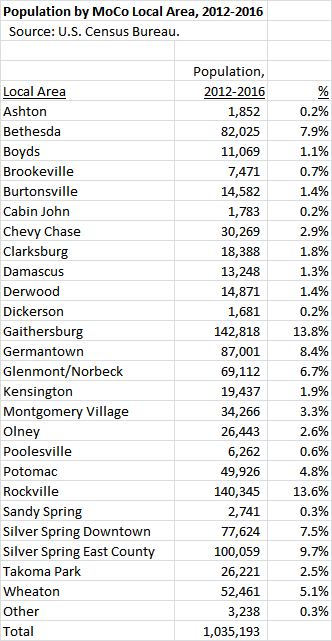
Let’s start by looking at population.  Residents are not distributed evenly across the county.  The neighborhoods closest to the D.C. border and close to urban centers are more dense than Upcounty areas.  Below we show population estimates by local area for the years 2012-2016 from the U.S. Census Bureau.  Local areas are grouped by zip codes.  For example, data for Rockville does not refer to the municipality itself, but to the four zip codes that comprise Rockville (20850, 20851, 20852 and 20853).  Because Silver Spring is such a large part of the county, we broke it into four pieces: Downtown (zip codes 20901 and 20910), Wheaton (20902), Glenmont/Norbeck (20906) and Silver Spring East County (20903, 20904 and 20905).

And so the population concentrations are where one might expect: Downcounty and near urban centers like Rockville and Gaithersburg.  But that’s not the end of the story.  Our elections are decided by closed Democratic primaries.  For state legislative and county offices, the general elections have not been relevant since 2006, when the last two Republican elected officials (County Council Member Howie Denis and Delegate Jean Cryor) were defeated.  And Democrats are distributed differently around the county than all residents.

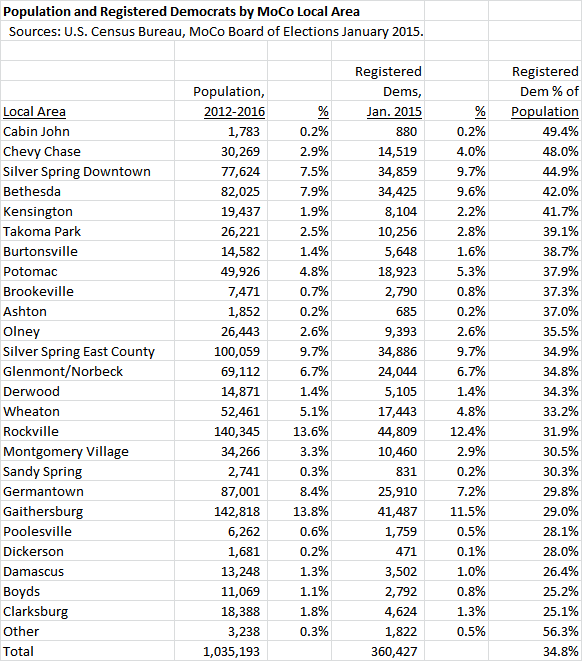
Right after the last cycle ended, we obtained a January 2015 version of the voter file from the county’s Board of Elections and spliced it with Census data to model local elections.  The number of registered Democrats in MoCo has risen by 5% in the last three years so, for the purpose of looking at geographic patterns, our existing voter model is not exact but is not too far off.  Below is a comparison of population by local area from 2012-2016 and the number of registered Democrats from January 2015.

There are large differences in Democratic density (the percentage of residents who are registered Democrats) between MoCo’s local areas.  In five local areas – Cabin John, Chevy Chase, Kensington, Bethesda and Silver Spring Downtown – more than 40% of residents are registered Democrats.  And in seven local areas – Dickerson, Poolesville, Damascus, Germantown, Gaithersburg, Boyds and Clarksburg – less than 30% of residents are registered Democrats.

Now let’s fine-tune this even further.  The chart below compares population by local area from 2012-2016 to the number of Super Democrats, whom we define as having voted in all three of the 2006, 2010 and 2014 primaries, in January 2015.  This Super Dem number has probably fallen slightly as a few folks who voted in those primaries have left the county or passed away, but the broad pattern will still hold.

Again, there are large differences in Super Democrat density (the percentage of residents who are Super Dems) between local areas.  In six areas – Cabin John, Chevy Chase, Kensington, Bethesda, Silver Spring Downtown and Takoma Park – at least 5% of residents are Super Dems.  In seven areas – Poolesville, Montgomery Village, Gaithersburg, Damascus, Germantown, Boyds and Clarksburg – less than 3% of residents are Super Dems.

Here’s the bottom line – countywide elections are decided in large part by voters in a Democratic Crescent stretching from Takoma Park in the east through Downtown Silver Spring, Kensington and Chevy Chase to Bethesda and Cabin John in the west.  These areas roughly trace the neighborhoods around the Beltway and between the Beltway and D.C.  They are the parts of the county that sent Jamie Raskin to Congress.  Together, the six areas in the Democratic Crescent have 23% of the county’s population, 29% of the registered Democrats and 37% of the Super Dems.  Every countywide candidate is going to want to play there.

Does that mean that a candidate whose chief appeal is outside the Democratic Crescent is doomed to fail?  Not necessarily.  Crescent voters have MANY suitors as most of the Executive and Council At-Large candidates come from those areas and will be aggressively pursuing votes there.  Council Member Nancy Floreen, who is a former Mayor and current resident of Garrett Park, won four straight at-large elections by combining women, moderates and Upcounty voters and her 2014 second-place finish was her best ever.  This model is no doubt being studied by County Executive candidate and former Mayor of Rockville Rose Krasnow and Council At-Large candidate and Germantown resident Marilyn Balcombe, both of whom Floreen has endorsed.

One more thing.  Some Upcounty activists have long complained of the influence of Downcounty on county government decision making.  Your author did not witness geographic parochialism on the part of any At-Large Council Members, all of whom come from Downcounty, during the time I was employed at the council.  But to the extent that Downcounty does exercise disproportionate influence, it’s because those residents turn out in Democratic primaries to a much greater extent than people who live Upcounty.  As long as primaries remain closed to party members, that will continue to be the case in any countywide elections regardless of structural changes in county government.  If you are an Upcounty resident and you don’t like that, the best remedy is to get your neighbors to vote in the primary.

Downcounty’s influence is only likely to grow because of one new factor in county politics: the implementation of public financing.  As we shall see, a large percentage of contributions to publicly financed candidates is coming from localities in the Democratic Crescent we described above.  That information will be published in the near future.  Stay tuned to Seventh State!

Share

Kim Propeack: Why Naming Names Isn’t So Simple

By Adam Pagnucco.

With the #Metoo movement continuing to impact society, the actions of the General Assembly to limit harassment and abuse are coming under scrutiny.  As a result, some are calling for harassment victims to start naming names.  Senator Cheryl Kagan (D-17) and House candidate Sara Love (D-16) did just that last week.  But there’s another side to this.  On Friday, Kim Propeack, CASA de Maryland’s long-time political and communications director, commented on why naming names isn’t so simple on Facebook.  With her permission, we reprint her remarks below.

*****

The raging debate about the testimony before the Womens Caucus on sexual harassment in the Maryland legislature has been fascinating. I am so proud of Nina Smith and so many others that came forward. But I have been absolutely perplexed by the comments from colleagues and on fb and other platforms expressing confusion about why people do not come out publicly. I want to share two stories from my own career that I think illustrates perfectly the thinking and or impact that challenging abuse in the legislature can have.

Many moons ago, my buddy Natali Faní-González testified against an anti-immigrant bill supported by then freshmen Delegates McDonough and Impallaria, both notorious anti-immigrants. As she and I left the committee room and stood in the hallway, we were accosted by the two delegates. Impallaria stood over Natali yelling at the top of his lungs that Natali must be an illegal. To underscore how racially targeted this was, Natali may have been literally the only Latina lobbyist or staffer in Annapolis at that time. McDonough was similarly standing over me screaming at me in the middle of the hallway. A male lobbyist who saw this going on ran over to physically block McDonough because he appeared close to striking me. McDonough then shoved that lobbyist and me to the ground. Natali and I filed ethics complaints against the two delegates. Finding of insufficient evidence despite the fact that this occurred in front of hundreds of people. But the male lobbyist who came to my aid let us know he really wanted the whole thing to go away. He said, “I have a professional career to think about.” He didn’t think he would be taken seriously in the future if he was embroiled in an ethics process.

Move ahead to my other example. In 2003, the late great Senator Gwen Britt was the lead Senate sponsor of the MD DREAM Act. And so her Chief of Staff decided that I should date him (I am not not naming that dude; I seriously don’t remember his name.) After weeks of uncomfortable conversations with him, I spent a particularly queasy hour on the phone with him dodging his repeated requests to go out on date while he poured over my looks what we would do, etc. I repeatedly went back to the stupid trope about how really it wasn’t him but I was involved with someone. I didn’t want to insult him because he was staffing my priority bill. So finally, I shut down the conversation with a definitive no. The following day, he starts actively undermining passage of the bill. He recruited people in the Senator’s district to attack her for having introduced the bill and recruited anti-immigrant voices to come down to Annapolis and testify against. Despite his efforts, the bill was voted out of the General Assembly. Then onto the Governor. This guy, the Chief of Staff to the lead sponsor of the bill, then recruited people to reach out to the Governor’s office to veto the bill.

I’m not laying Ehrlich’s decision at his feet. Bobby Ehrlich could be stupid on his own. But me as a relatively seasoned activist and certainly no wilting flower, got a serious lesson on how much more difficult your life gets when you don’t play game. And more importantly, how much the folks you are working for can be hurt. These are just two incidents among the various grab ass and more across the years. But I thought they were particularly relevant to respond to the Why Don’t We Just Name Names question.

Share

Kagan Names a Name

By Adam Pagnucco.

One of the things that has been missing so far in the #Metoo movement’s impact on Annapolis is the naming of actual perpetrators of sexual harassment.  Well, that ends now.  Senator Cheryl Kagan (D-17) has issued a statement on official letterhead accusing former District 16 Delegate and current lobbyist Gilbert J. Genn of touching her inappropriately.  (Genn was once a member of the House Judiciary Committee and Chair of the Subcommittee on Criminal Justice.)  Think on this, folks: if a lobbyist is behaving this way with a person of power – a State Senator! – what is happening to others?

We reprint Kagan’s statement below.

Share

Candidates Ask Supporters to Stuff Online Poll

By Adam Pagnucco.

Back in the days of Maryland Politics Watch, we would occasionally set up online polls for various races.  The polls had no validity, of course.  They could not screen for registered voters, much less those in a particular party or county, and even those that limited each IP address to one vote could be easily gamed through multiple devices and masking software.

But we did it anyway for two reasons.  First, we were greatly entertained by the thought of frenzied candidates snapping the whip over armies of interns and yelling, “Vote faster!  You’re not pushing the vote button fast enough!!”  And second, they got lots of eyeballs, or at least apparent eyeballs.  Your author once scrutinized the traffic coming into one of our better performing online polls and discovered that most of it was coming from a handful of IP addresses.

Eventually, we stopped.  The “polls” added no value to the readers’ understanding of the elections.  And they also turned into a huge waste of time for candidates.  After we posted yet another online poll in 2010, one candidate emailed and said, “I really hate these things.  I have to drop everything and start voting!”  We took that comment to heart.  From that point on, your author determined that it was only worth doing a poll if we could invest it with some kind of methodological validity.  That’s easier said than done with an online poll!

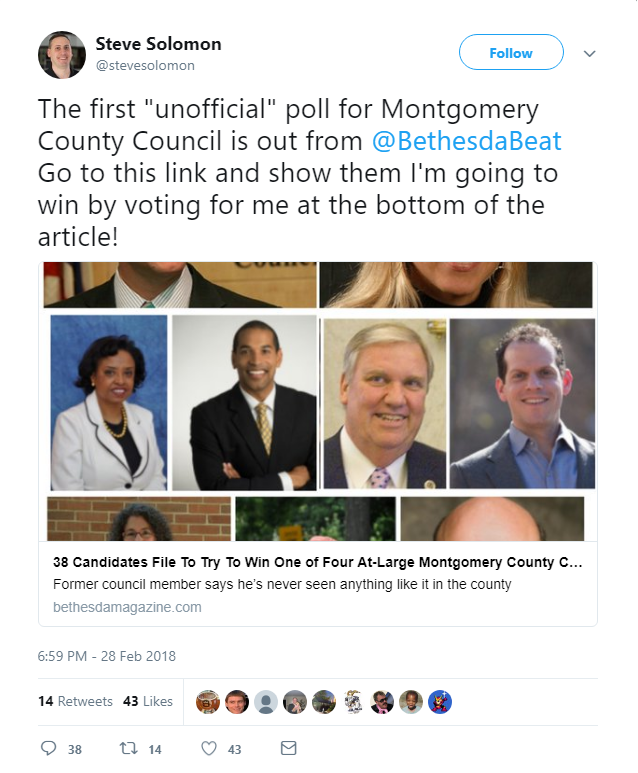
That has not stopped others.  On Wednesday, Bethesda Magazine did an online poll on the Council At-Large race, which it admitted was “not scientific,” with SurveyMaker.  The poll began making the rounds on Facebook and one political insider sent it to your author, breathlessly panting, “Unscientific, but very surprising!”  Then a complete unknown, Steve Solomon, took the lead spot and folks started to understand just how unscientific this poll was.

Solomon’s “win” was not an accident.  He is a sports radio host and he encouraged his listeners to vote for him on both radio and Twitter.

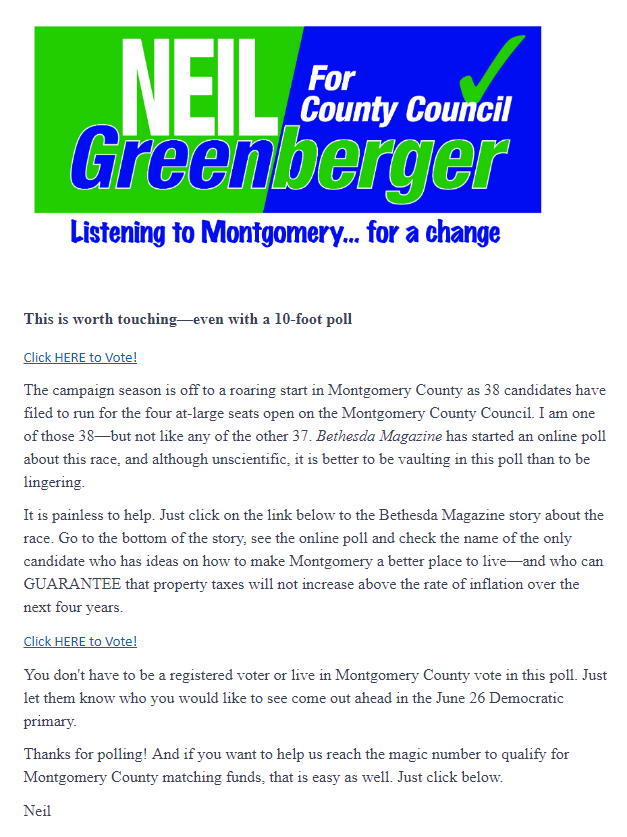
Solomon was not alone.  Neil Greenberger sent out a blast email asking his supporters to stuff the poll.  He told his list that while the poll was unscientific, “It is better to be vaulting in this poll than to be lingering.”  He even said, “You don’t have to be a registered voter or live in Montgomery County vote in this poll. Just let them know who you would like to see come out ahead in the June 26 Democratic primary.”

Now look.  We do not absolutely deplore all online polls.  They can be fun and buzzy, and if folks want to push buttons for kicks, that’s fine.  But it’s absolute cross-eyed tomfoolery to see them as containing any merit.  Candidates, listen up.  If you spend your time pumping worthless ca-ca like this instead of phone banking, door-knocking and raising money, your chances of winning will be about as high as the coyote’s chances of catching the road runner.  Now get back to work!

Share

Four More Years for Franchot

By Adam Pagnucco.

For many months, rumors have abounded about the Democratic establishment seeking to find a primary challenger to its hated nemesis, Comptroller Peter Franchot.  But at the close of candidate filing, it became clear that the effort to oust Franchot had failed.  The Comptroller has no Democratic opponent, and with only an unknown Republican running against him, Franchot is certain to get four more years in office.

Among the statehouse’s leadership, Governor Larry Hogan is regarded as a rival but not a bitter enemy.  That’s because since the Governor is a Republican, a certain amount of political competition is expected.  Franchot, on the other hand, is despised by the Annapolis Democratic ruling class.  As a Democrat and a former twenty-year Delegate, someone in Franchot’s position would normally be expected to be a loyal player on Team Dem.  Instead, the Comptroller is the leader of Team Franchot – a team with different interests and tactics than Team Dem – and the leaders revile him as an apostate.

Understanding Franchot requires breaking out of the conventional political box – something the Comptroller specializes in.  Here are four facts about Franchot that players in state politics should recognize.

He Has Built a Thirty-Year Career on Rebellion Against Authority

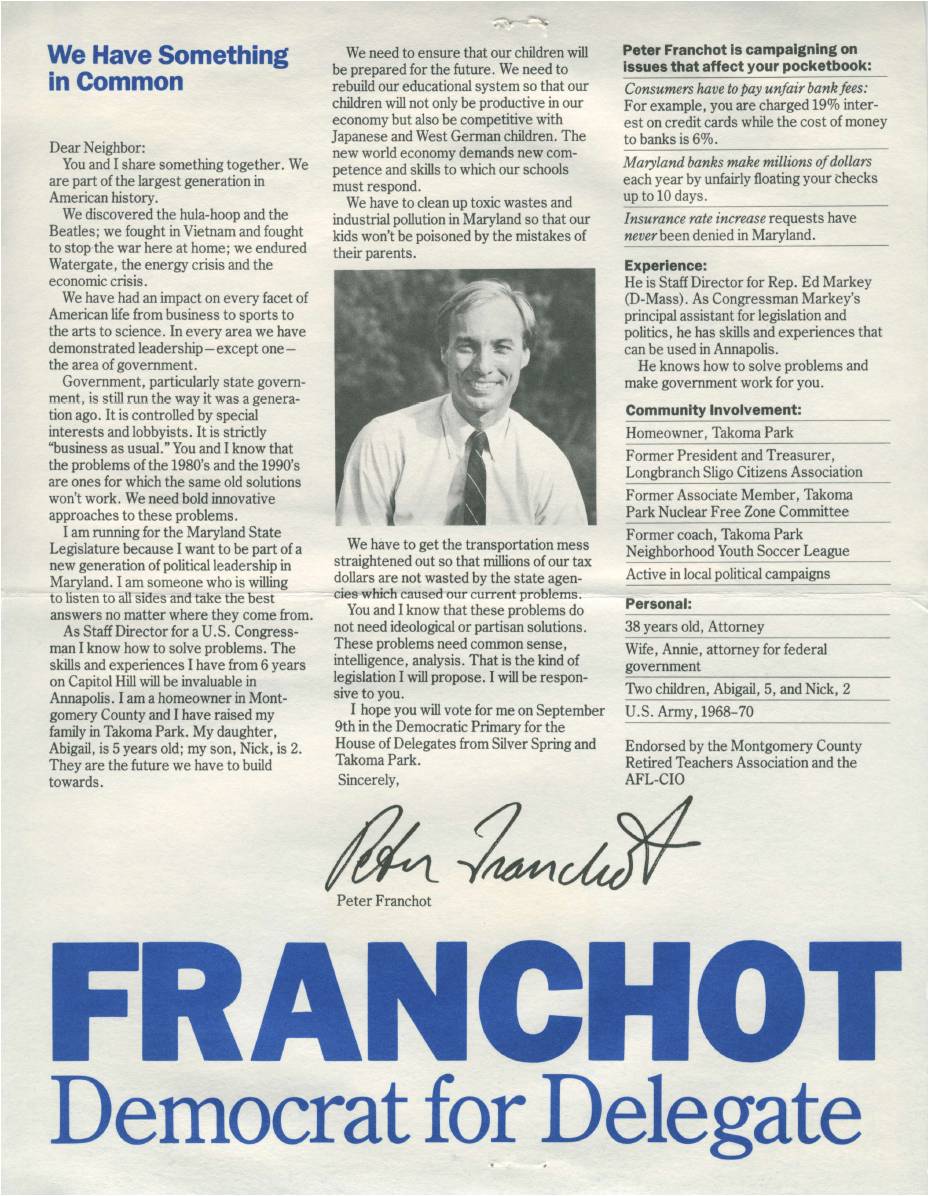
Let’s go back to 1986.  District 20 State Senator Stewart Bainum was leaving his seat to run for Congress.  Two Delegates, Ida Ruben and Diane Kirchenbauer, ran for the open Senate seat.  But Ruben was not content to go to the Senate – she wanted to control the entire district.  So Ruben put together a slate including incumbent Delegate Sheila Hixson, MoCo Democrat of the Year Robert Berger and former Takoma Park City Council Member Lou D’Ovidio.  Franchot, then a young aide to Massachusetts Congressman Ed Markey, was having none of it.  He launched an aggressive door-knocking campaign for Delegate running against lobbyists, greedy banks, insurance companies and “special interests” of all kinds.  Franchot finished first in the Delegate race, surpassing even Hixson, and learned an early lesson: revolting against the establishment, both political and economic, could be electorally rewarding.

Franchot targets special interests in a 1986 mailer.
That was just the beginning.  Two years later, Franchot ran a tough and occasionally negative race against the new darling of moderates in MoCo, Congresswoman Connie Morella.  (This is the only race Franchot would lose.)  In 1992, Franchot backed an ill-fated coup attempt against House Speaker Clay Mitchell.  Mitchell’s rival, Nancy Kopp, would go on to be rehabilitated, but Franchot was sent so far to the back of the bench that he could have been sitting in a Bay Bridge toll booth.  After the 2002 election, Franchot began running against Mister Maryland, Comptroller William Donald Schaefer, and even took out a $750,000 loan on his house to do it.  After winning an upset victory, Franchot then fought with Governor Martin O’Malley and the legislature’s presiding officers over slots and other issues all the way through Hogan’s election.  And the fight goes on over craft beer.

Here is a partial list of all the establishment figures Franchot has taken on in the last thirty years: two incumbent Delegates in his home district, a popular Congresswoman, multiple House Speakers and the Senate President, a sitting Democratic Governor and one of Maryland’s most influential all-time political figures in Schaefer.  No other politician has assembled such a list and survived.  And yet here is Franchot, more than thirty years later, with no primary opponent.

He Champions Non-Partisan Issues

Think of some of the issues Franchot has taken on in the last decade: opposition to slots, cracking down on fraudulent tax returns, getting air conditioning in Baltimore County schools, opposing MoCo’s liquor monopoly, moving the start of school until after Labor Day and liberalizing state laws on craft beer.  These issues seem like an eclectic set but they have two things in common.  First, none of them are partisan or ideological issues.  Folks in the left, right and middle can agree on many of them.  And second, the constituencies in opposition are attractive opponents to have: casino conglomerates, tax cheaters, corporate mega-beer producers and incompetent bureaucrats.  To quote former Illinois Governor Rod Blagojevich, from a political perspective this is [expletive deleted] golden.  Franchot has picked up allies and admirers in all these fights who range all over the political spectrum and will never desert him.  How many Maryland politicians can make that claim?

Moreover, despite the contempt that the establishment holds for Franchot, he has had his share of wins.  Pressure from Franchot and Hogan has helped accelerate Baltimore County’s school construction program.  Hogan’s executive order on school openings after Labor Day, a Franchot idea, has gone unchallenged.  Last year, Franchot got a major tax fraud bill passed through the General Assembly.  And the current efforts to put slots money in a lockbox for education is a big vindication for Franchot, who has argued for a decade that gambling money was not used for schools as promised but has instead been poured into the general fund.  We will see how his current craft beer crusade turns out.

He Lacks Ambition and Fear

Most politicians are driven by ambition and fear.  Ambition, typically manifesting as a drive for higher office, causes politicians to take risks, stand out and appeal to critical interest groups.  Fear can be healthy when it aids self-preservation, including fear of being disliked, embarrassed, ostracized or losing an election.  The behavior of most politicians involves a competition and balance between these two competing traits.  In a sense, Franchot has neither of them.

Franchot’s absence of fear is obvious.  The scathing denunciations of Franchot by O’Malley, the legislature’s presiding officers, the Baltimore Sun editorial page and various dukes and barons of Annapolis would scare the living daylights out of most politicians.  Not Franchot.  He not only doesn’t care; the confrontations actually energize him.  Your author has seen him grin and rub his hands together in glee at the prospect of taking on folks whom he would call “bullies and bosses.”  No other influential figure in state politics acts like this.

But here’s the thing: Franchot also lacks any ambition for higher office.  He figured out some time ago that Comptroller is a great job.  Franchot doesn’t have to vote on controversial bills, draft budgets, raise taxes or say no to constituents.  He gets to travel around the state, hand out awards to small businesses, get involved with issues of his choice and, as long as tax refunds go out quickly and efficiently, he can do all of the above as long as he likes.  So he isn’t going to run for Governor, Congress or anything else.  That frees up Franchot from having to compete for all of the Democratic interest group support he would need in a competitive primary with quality opponents.  That means he gets to set his own agenda in a way other politicians can’t.  And boy, that has been a major asset to him.

The Establishment Handles Him Terribly

If you’re a leader in the Democratic establishment, there are only two ways to deal with the occasional and inevitable Franchot eruptions.  You can ignore them.  You can co-opt them.  Sometimes you can do both.  But whatever you do, don’t take on Franchot directly.  Then he gets to fight “bullies and bosses,” and either gets his way or he gets to be martyred in front of legions of adoring supporters.  Either way, he wins.

The recent craft beer fight is a good example of mishandling Franchot.  Maryland’s alcohol laws are notoriously anti-competitive, although they have very slowly begun to liberalize.  Franchot rightly criticizes the state’s beer franchise laws, which essentially establish state-sanctioned distribution cartels, and he ridiculed a requirement in a bill passed last year that craft breweries send some of their beer to distributors and buy it back before serving it in their tap rooms.  Then he set up a task force to give his proposed beer law reforms legitimacy and had his army of craft beer supporters descend on Annapolis.  What to do?

The rational response would be to ignore and co-opt.  From a strictly political perspective, the establishment should have given Franchot’s bill a polite hearing but otherwise ignored it.  Then they should have extracted pieces from it that the distributors could live with, pass those in a separate bill sponsored by state legislators who could use a bump, and declare victory.  Franchot would declare partial victory too, but who cares?

But this is Franchot so rationality went out the window.  Instead, the leaders put forth two bills: one to retract the improvements the craft breweries won last year and another to form a task force to study whether the Comptroller’s alcohol regulatory authority should be taken away.  The establishment’s reward was an all-day hearing that degenerated into a searing circus featuring angry and sputtering Delegates, militant craft beer advocates, allegations of payoffs through booze industry political contributions and a starring role for Franchot who got to denounce “back room deals.”  They gave Franchot exactly what he wanted: a swarming sea of fans and HUGE press attention.  How exactly is this supposed to encourage him to behave differently in the future?

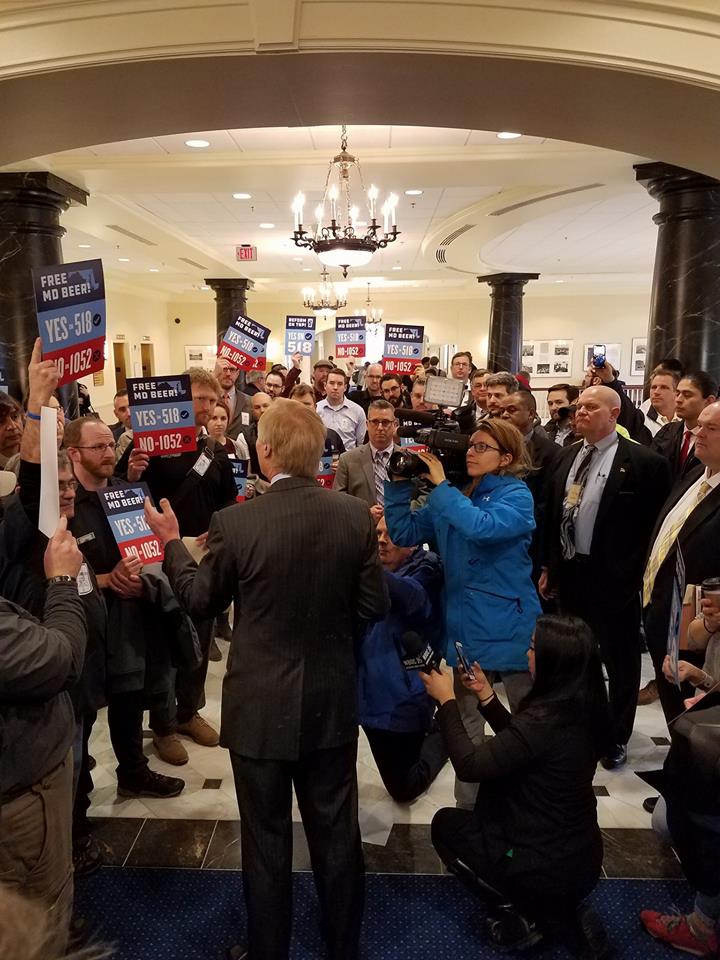
Franchot preens like a peacock before press and supporters outside the House hearing room where his craft beer bill was discussed.  Credit: Franchot’s Facebook page.
The Bottom Line

There are 188 members of the General Assembly.  The place needs hierarchy to operate.  There must be organization, leadership, direction and consequences for violators.  Otherwise, nothing would get done.  All of this means that if the establishment didn’t exist, we would have to create one.

That said, establishments decay and become obsolete when they go unchallenged.  There’s a valuable role for disrupters like Franchot: they keep the leadership on its toes and make sure issues that do not originate solely within favored interest groups get addressed.  This push and pull keeps the place vibrant and relevant and, over the long run, makes it better.

The leadership may not always like that.  But they’re going to have to deal with it, at least for another four years.

Disclosure: The author has done campaign work for Peter Franchot in the past but has not worked on his current campaign on craft beer.

Share