All posts by Adam Pagnucco

Placeholders Have No Place in the MCPS Capital Budget

By Laura Stewart.

Have you ever heard of the term “placeholder” in the county budget? I never had, until as a PTA President, I started to advocate for an elementary school that had 9 portables. The terminology surrounding placeholders was confusing.  At first it sounded like a planning tool that might be helpful.  But as I have looked at the scenarios in front of us in this budget cycle, I believe that real solutions need to take place instead of placeholders.  I will explain by using two real life scenarios below, followed by a review of the consequences of the current County Council’s SSP (Subdivision Staging Policy.)

Scenario 1:

An elementary school has just received an addition due to housing turnover, new development, and a boundary change that was intended to address split articulation patterns and crowding at other schools.  After the addition was completed, the school immediately became over-crowded again and now has four portables. More development is underway in the area, and it will cause even more crowding at the school.

Due to county policy, future development goes into moratorium when a school is forecast to be over 120% capacity at year 5 in the budget, unless there is a “solution.” That solution can be a “placeholder,” money put in the budget that covers the extra seats a development will create, based on the County’s “student generation rates.”  This money is not tied to a specific plan. It is only there to prevent the area from going into moratorium. The school system promises to develop an actual project in time for the seats to materialize in the next 5 years.  This school gets assigned a “placeholder” by the Council since a capacity project is not included in the Board of Education’s recommended FY19 budget.

Scenario 2:

A school has been over 120% capacity since 2011 and is at 151% today.  A plan to address the overcapacity is not included in the Board of Education (BOE) Recommended FY 19-24 budget.  Since there are no pending development projects in this part of the county, no “solution project” is proposed by the County Council, and the area officially goes into a housing moratorium.

Scenario 1 is in Bethesda, scenario 2 is in East Silver Spring.  Neither community is happy with place holders!

I will first explain why the areas with development aren’t happy.  The scenario 1 school, Bethesda ES, is in an area where housing development continues.  In fact, there are an additional 11 buildings submitting applications in the area under a recently approved master plan. Somerset Elementary School is in a similar situation and the Council has proposed a placeholder for that school as well. There is no actual plan for another addition at the Bethesda school (which may not even be possible, given the small site size,) or a plan for a new elementary school nearby. New schools, even at properties MCPS already owns, are much more expensive than additions. Additions also can cost more than the placeholder price tag that is included in the budget. Placeholders are supposed to guarantee seats in 5 years, but the past has shown that projects almost never get done in that time period.  Of the last five placeholders that had a due date before 2018, only one project finished by the due date. Another 4 placeholders added in FY15 were postponed the following year. Continuing development with a placeholder causes schools to go way over capacity, often much more than the initial 120% threshold, by the time there is a real solution.

Now let’s look at Scenario two.  East Silver Spring does not have pending development. The school that is the most overcrowded in the area is Burnt Mills ES, at 151% and over 200 children are in portables. In fact, this school has been over the 120% threshold since 2011, when the feasibility study was done. No project for this school is in the FY2019-2024 CIP. They will be considered in the new renovation and expansion program in a future CIP, but there are limited funds and there are many schools that will be considered. There are no guarantees for this school. So this area is now officially in moratorium, and has been for a while.  Relief at Burnt Mills seems elusive without any project on the books. Parents feel like they do not get the attention that other areas with lots of development get.  They are not wrong. Even though placeholders aren’t solutions, at least the conversation about a possible solution takes place at the County Council.

Seven areas are in housing moratorium in Montgomery County, but only three had placeholders proposed to be added in this budget cycle, two in Bethesda and one in Gaithersburg. I’ve spoken to parents in Bethesda that would rather have a building moratorium take place so the County could take time to come up with a real planned solution. The Gaithersburg school, Judith A. Resnik ES, had an addition project scheduled with a completion date. The enrollment there is trending down slightly, but is still projected to be at 122% capacity within 5 years.  To avoid a moratorium, the County removed an actual project (the scheduled addition), and added a placeholder.

Real money is taken out of the MCPS budget for placeholders, instead of actually using those funds for planned projects. In fact, several projects that were proposed in the BOE Recommended FY19 Budget are slated to be delayed due to lack of funds, including Col. E. Brooke Lee Middle School. It is considered a “sick” building by many teachers and parents. Mold and other issues come up regularly. They were elated to have a project that had a completion date of September 2021, only to be deeply disappointed when they were included in the delay list. Placeholder money – used to avoid putting development in moratorium- could be allocated NOW to schools with greater needs than the areas with pending development. Placeholders compete for scarce funds in the CIP.

There is another unintended consequence of giving placeholder money to areas of higher growth. These areas tend to be more affluent. So the optics continues to perpetuate the perceived and the real divide between East County and West County. For instance, there are huge disparities in wealth in our two scenarios. Bethesda ES has a 7.3% Free and Reduced Meals Rate (FARMS.) Burnt Mills ES has 67.1% FARMS.  The affluent area gets the attention of councilmembers and solution/placeholder projects – that may or may not actually come to fruition – while poorer areas are left out. This policy also divides the County North and South too, because rural areas do not have the growth that down county areas receive.

I am in no way blaming Councilmembers or insinuating that they mean to ignore certain areas of the County. I know that many fight for scarce resources, and fight to bring economic growth in underperforming areas of the County. I am blaming the processes and policies that perpetuate inequalities and perception of inequalities in our school system. I propose changing the system.  We can come together as a community and find a better way forward. Let’s get developers, Council Members, the Board of Education, the MCPS Division of Long Range Planning, and the Planning Department together and come up with REAL solutions so we can finally build real classrooms for kids, no matter in which zip code they live.

Laura Stewart is the CIP Chair for the Montgomery County Council of PTAs.

Share

Navarro Blasts Krasnow, Blair and Frick Over Racial Equity

By Adam Pagnucco.

County Council Member Nancy Navarro is blasting County Executive candidates Rose Krasnow, David Blair and Bill Frick over their comments on her racial equity resolution.  The council resolution would have the county measure racial equity impacts of budget items and legislation.  Its action language states:

The Council is committed to examining the data needed to develop an equity policy framework that would require the County to question how budget and policy decisions impact equity.

This effort must be a partnership between the County Council, County Executive, County Government, county agencies, institutions, and our community. The County Government
must challenge itself to bring new and different partners to the table. Partnering with other jurisdictions as members of the Government Alliance on Race and Equity (GARE) will also enhance the County’s effort and commitment to fostering equity.

Equity analyses should be part of capital and operating budget reviews, appropriation requests, and legislation. Program and process oversight should be undertaken viewing programs and processes through an equity lens. Equity targets and measures of progress must be put in place.

The Council will provide additional FY19 Operating Budget resources for the Office of Legislative Oversight to develop a baseline report describing current disparities in education, employment, housing, health, employment, land use, and other measures of opportunity by May 31, 2019. Following the transmittal of the baseline report, the Council will introduce legislation for the County to develop an equity policy framework to inform the delivery of all County services.

The entire council, including the three members running for Executive (Roger Berliner, Marc Elrich and George Leventhal), has co-sponsored the resolution.  But fellow Executive candidates Rose Krasnow, David Blair and Bill Frick criticized it in the Washington Post:

Democrat Rose Krasnow, the county’s deputy planning director and a former mayor of Rockville, said she worried the measure would lead to “paralysis by analysis.” She also questioned the timing of the resolution: “It seems like such a political statement in an election year.”

Del. C. William Frick (D-Montgomery) said growing “private-sector jobs” and wages is the best way to eliminate disparities. Businessman David Blair applauded the vote but the Democrat wrote in an email that “we shouldn’t confuse activity with progress. . . . Where’s the progress been the past 12 years?”

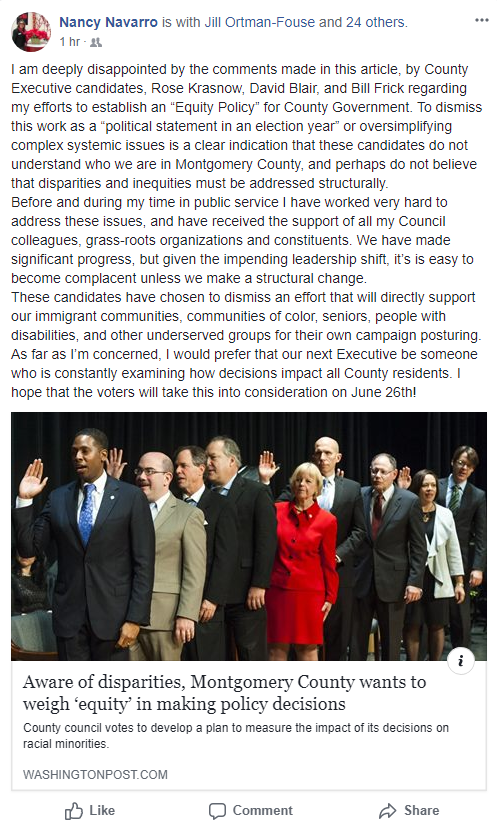
That drew Navarro’s wrath.  She denounced the three candidates on Facebook, writing:

I am deeply disappointed by the comments made in this article, by County Executive candidates, Rose Krasnow, David Blair, and Bill Frick regarding my efforts to establish an “Equity Policy” for County Government… These candidates have chosen to dismiss an effort that will directly support our immigrant communities, communities of color, seniors, people with disabilities, and other underserved groups for their own campaign posturing. As far as I’m concerned, I would prefer that our next Executive be someone who is constantly examining how decisions impact all County residents. I hope that the voters will take this into consideration on June 26th!

We see Navarro’s point.  Montgomery County, like the rest of the United States, is rife with inequities of all kinds.  Navarro’s resolution does not prescribe specific remedies; it only initiates the process of measuring inequities so that they can be considered in public policy decisions.  It’s hard to understand how any progressive candidates for office could oppose that.  Perhaps Krasnow, Frick and Blair would like to comment further before their existing remarks are set in stone.

Share

Are Republicans Trying to Help Aruna Miller?

By Adam Pagnucco.

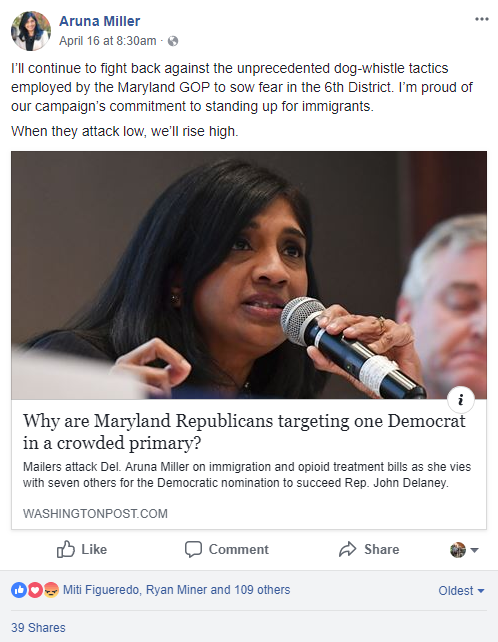
Much has been said about the Maryland Republican Party sending out racist mailers targeting Congressional District 6 candidate Aruna Miller.  The standard interpretation of this seems to be that the GOP sees Miller as a strong candidate and is trying to keep her out of the general election.  Indeed, the Washington Post editorial board made that argument.  But what if the Republicans are actually trying to help Miller instead?

The classic example of intervention in an opposing party’s primary is Missouri Senator Claire McCaskill’s promotion of conservative GOP Representative and eventual opponent Todd Akin.  McCaskill spent $1.7 million on ads accusing Akin of being “too conservative” during his GOP primary, helping boost him past the rest of the field.  And that’s not all – when Akin pulled a successful TV ad in favor of one that flopped, McCaskill schemed to have her pollster contact Akin’s campaign to persuade him to re-run the high-performing ad.  Once Akin won his primary, McCaskill exploited his weaknesses to finish him off and get reelected.

Two “anti-Akin” ads by McCaskill and the Democratic Senatorial Campaign Committee.

Why do we bring this up?  Some of the people who received the GOP mailers were female Democrats, including Miller herself.  A few took to Facebook and Twitter to complain about it.  And if they didn’t get them directly, they may have read about them in publications like the Washington Post, Bethesda Magazine and India West.  How do you think they are going to react when they see a female Democratic candidate getting bashed in racist mail sent by Republicans?  They are going to rally to Miller, of course, and that’s what happened on social media.  Maybe that’s the point.

Miller uses GOP racism to motivate her supporters.

Aruna Miller is doing really well in this campaign.  She is raising lots of money, doing well at forums, attracting great endorsements from the Sierra Club and the teachers and is the most prominent woman running in a primary electorate that is roughly 60% female.  But look at this race from the standpoint of the GOP.  They know David Trone won an absolute majority of the vote in rural Frederick and Carroll Counties in the CD8 primary – the kind of areas that Republicans need to dominate in the sixth district.  They know Trone could spend $10 million in a general election, something no other Democrat can do, and that would free up national Democratic money to go to other Congressional districts around the country.  Most of all, Trone looks more like incumbent Congressman John Delaney than any other candidate – a center-left businessman who says he has created thousands of jobs.  The GOP knows that kind of candidate can win in this district.  Why would they want another one like Delaney?  And if they don’t, why not help a rival win?

Maybe we’re reading too much into this but we don’t think the GOP is stupid.  This kind of tactic can work.  Just ask Claire McCaskill!

Share

We Get Phone Calls

By Adam Pagnucco.

Sometimes your author gets phone calls like this.

*****

Politician X:  Hey Pagnucco!  How’s the kid?  How’s business?

Me:  Well, I –

Politician X:  Great to hear it.  I got something you need to write about RIGHT NOW.

Politician X then tells a story about Politician Y.  On a scale of 1 to 10, with 10 equal to felonious behavior and/or rooting for the Dallas Cowboys and 1 equal to peeing in the shower, this is a 2.5.  Nothing illegal here, but there might be some questionable judgment IF it’s true.  As background, Y is not running against X, but Y has endorsed one of X’s opponents.  X also heard a rumor years ago that Y told someone X is a conniving politician.

Me:  OK.  Do you have any proof that Y did that?

Politician X:  No.  But you know it’s gotta be true!  Remember when Y did that other thing?

X retells another story about Y from a while back that was never verified.  That one might have been a 3.5 IF it ever happened.

Me:  Are there any documents?  Any links?  (The allegation does not involve anything easily verified like a vote on legislation, a campaign contribution or a screenshot.)

Politician X:  I don’t know.  Maybe you can find something.  Ask Politician Y.  Maybe he’ll be stupid enough to admit it!

Me:  Um, OK… Lemme think about whether this is provable, and if so, how.  In the meantime, if you believe it’s true and you can back it up, say it on Facebook.  Then maybe it will be covered.  At least it will be discussed, and if there’s anything there, it might come out.

Politician X:  I can’t do that!  I’m running for office.  If I say that, Y’s supporters will come after me.  That’s why we have blogs.  You guys will say anything!

Me: … … …

Politician X:  I’ll check back later to see how that story is coming along.

*****

Look folks.  We like investigating allegations, but there has to be something to them.  If you’re going to tell us something, be ready to 1. supply evidence or 2. go on the record.  We’re not gonna print unfounded speculation on your behalf just so you can get someone else to say something YOU want to say but won’t.  We’re not the New York Times, but there are such things as libel laws.  If you want to libel someone, do it yourself!

If you are thinking of making a call like the one made by Politician X above, don’t bother.  And Politician X, if you are reading this – and we know you will! – the next time you make a call like this we are gonna print your name.  Believe that!

Share

Joy Nurmi: Meitiv Flunks Science Test

By Joy Nurmi.

Danielle Meitiv frequently reminds us that she is a scientist. Then one should wonder why, when she accuses our County Executive of failing to endorse women candidates, she fails at one of science’s most basic tenets – sample size and probability of drawing a false‐positive conclusion when the sample is too small.

According to one of the country’s top science organizations – the National Institutes of Health (NIH) – sample size is important. In the NIH publication, “How sample size influences research outcomes,” NIH says: using a sample smaller than the ideal increases the chance of assuming as true a false premise.

So when Ms. Meitiv draws the conclusion that our County Executive is not interested in gender balance because of his endorsements in the Council at-large race, one might ask about how Mr. Leggett’s track record stacks up in a larger sample size. For example, when one looks at all the candidates he has endorsed in the current election, one sees that it includes four women: Aruna Miller, Lily Qi, Charlotte Crutchfield and Rebecca Smondrowski. Interestingly enough, that equals 50% of his total endorsements. And with his endorsement of Aruna Miller, he was out up front and early when many were hanging back.

Look carefully at Mr. Leggett’s endorsements. They are not only gender balanced, but they are rich in diversity as well. It is important to note that this County has never elected any Latino or Asian for an at-large seat. And, Mr. Leggett is the only African American ever elected to an at-large office.

Where has Ms. Meitiv been in furthering this goal of diversity, correcting these deficiencies? She criticizes Mr. Leggett only because it benefits her as a candidate. It gets her publicity.

Look also at the top tier of management in County government appointed by Mr. Leggett. Twenty-two of the 44 top managers/directors are women. Again, 50%.

He has been highly successful in advocating for gender balance and diversity on a number of fronts. He has advocated with our governors for a more diverse judiciary, including recommending many women for judgeships, who have since been appointed. He has endorsed many women for elected office in the past. The examples are too numerous to list. In fact, you will not find any leader anywhere who has such a track record of fostering diversity and gender balance in so many facets of public life to equal Mr. Leggett’s.

It is truly unfortunate that Ms. Meitiv lashed out without facts, and as a result, failed this science test.

Joy Nurmi is a Special Assistant to County Executive Ike Leggett and a former Chief of Staff at the County Council.

Share

Female Candidates Accuse Leggett of Sexism

By Adam Pagnucco.

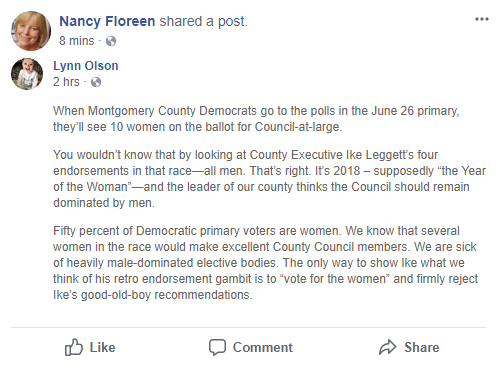
County Executive Ike Leggett’s decision to endorse four men in the Council At-Large race – incumbent Hans Riemer, Gabe Albornoz, Hoan Dang and Will Jawando – has provoked public accusations of sexism from two women who are running for office.

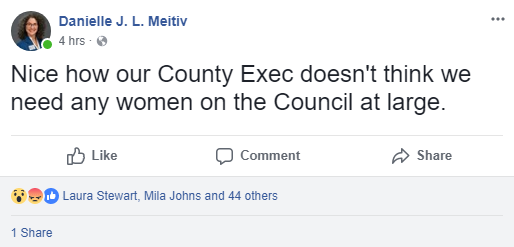
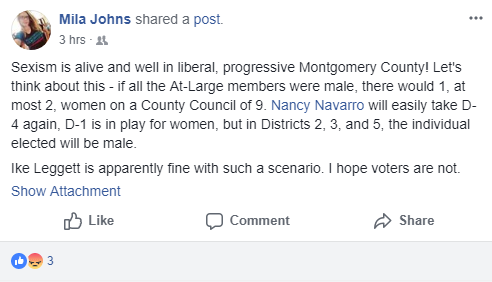
Council At-Large candidate Danielle Meitiv kicked things off on Facebook minutes after Leggett’s endorsement of Jawando was announced, writing, “Nice how our County Exec doesn’t think we need any women on the Council at large.”

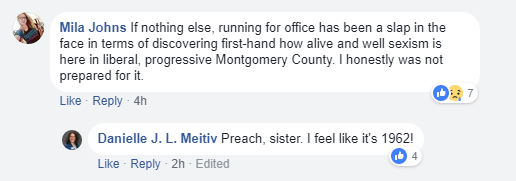
District 18 Delegate candidate Mila Johns followed up, directly accusing Leggett of “sexism, pure and simple,” and eventually shared Meitiv’s post on her own page.

Council Member Nancy Floreen also weighed in on this, although somewhat indirectly.

The sentiment expressed by Meitiv and Johns is shared by other women running for office.  Several of them blasted Leggett to your author in scathing terms but would not go on the record.  That makes sense – most politicians want to avoid public disputes with a sitting County Executive at election time.  One candidate who was willing to comment on the record was Brandy Brooks, who is running for Council At-Large and co-wrote an essay about gender parity in politics with Meitiv.  Brooks told us:

For many, 2018 could be the year for women, people of color, and working people, but not if we aren’t actively changing our political system both internally and externally. Maryland has one of the worst records in the country on gender parity: we rank 38th on the gender parity index with a score of 12.1 (down from 21.2 in 2014) with few women in federal, state, or local office. To be clear, the four men who have been endorsed by the county executive are qualified candidates — that is not the question. However, not endorsing a single woman running at-large sends the wrong message about how our political and elected leaders view gender parity. Some will argue that more of the women running should have sought the endorsement. Unfortunately, this view continues to fault women instead of asking why our leaders aren’t being intentional to seek women to endorse as well. It continues a pattern that leaves many on the margins. Thankfully, there are many strong women candidates running for office in 2018 to change this status quo, and I’m excited to be one of them.

If Leggett’s choices win, it’s possible that the council might have just one female member in its next term: District 4 incumbent Nancy Navarro.  Since its current structure was established in 1990, the nine-member council has never had fewer than two female members and has sometimes had three or more.  Additionally, the issue of how women are treated in politics has erupted in Annapolis as the General Assembly grappled about how to deal with harassment in its most recent session.  One at-large candidate (Delegate Charles Barkley) has even been accused of inappropriate behavior with women.

Riemer, Albornoz, Dang and Jawando are not unusual choices for Leggett.  The Executive has had a cordial relationship with Riemer during their time in office together.  Albornoz is widely regarded as one of his best department directors.  Dang and Jawando are solid candidates and both would bring assets to the council if elected.  But surely Leggett and his team should have expected pushback on this in the wake of his criticism of the District 39 state legislators for accepting Lesley Lopez on their slate, a dispute in which gender was raised as an issue.

In Leggett’s defense, he has filled his administration with strong and competent women, including but not limited to Department of Permitting Services Director Diane Schwartz-Jones, Office of Management and Budget Director Jennifer Hughes, Health and Human Services Director Uma Ahluwalia, Assistant Chief Administrative Officer Lily Qi, former libraries director Parker Hamilton and Special Assistant Joy Nurmi.  (Some of these ladies have left multiple boot prints on your author’s rear end!)  Leggett’s wife, Catherine, is an admired player in county politics who chairs the Executive’s Ball and raises money for the arts.  We are sure that Leggett’s MANY female supporters will step up in his defense should they deem this criticism worthy of response.

So who’s right?  That’s for you, the readers, to decide.

Share

Leggett Endorses Jawando

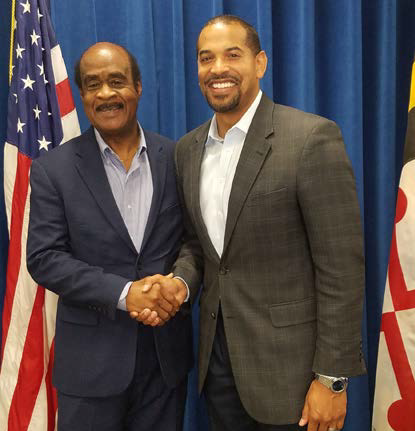
County Executive Ike Leggett has endorsed Council At-Large candidate Will Jawando.  The Executive has previously endorsed Gabe Albornoz (his Recreation Director), Hoan Dang and incumbent Hans Riemer in the race.  We reprint Jawando’s press release below.

*****

April 18, 2018

Inquiries: info@willjawando.com

County Executive Isiah “Ike” Leggett Endorses Jawando

ROCKVILLE, Md. – In a statement released today, Montgomery County Executive Isiah “Ike” Leggett endorsed Will Jawando in his race for County Council At-Large, noting Jawando’s record of public service and progressive leadership.

“I am honored to endorse Will Jawando for County Council At-Large. Will is an exceptional leader with a lifelong record of public service to Montgomery County and the nation. He worked as a public policy attorney on Capitol Hill and for President Obama in the White House. I was proud to appoint Will to serve on the Montgomery County Commission on Juvenile Justice, and worked with him to provide support for Summer R.I.S.E, a summer career internship program for high school students that he spearheaded,” Leggett said. “As an active, progressive community leader, Will understands the needs of Montgomery County and is committed to making our outstanding county even greater. I’m voting for Will, and respectfully urge you to join me in electing him to the County Council.”

If Jawando wins his contest, he will be only the second person of color to be elected to a county-wide office in Montgomery County. Leggett was the first, and only to date. Jawando recognized that when he welcomed Leggett’s endorsement.

“I’m privileged to earn Ike’s support, and I’m honored to have the opportunity to continue his legacy of public service in Montgomery County,” Jawando said. “We’ve worked together on closing the opportunity-and-achievement gap in our public schools, addressing issues of juvenile justice, and engaging our underrepresented communities in the civic process. I’m dedicated to addressing those issues that matter most to our families — our schools, fair and affordable housing, reliable transit and jobs. That’s the promise of Montgomery County.”

Aside from creating and managing the first year of Summer R.I.S.E., and his work on the Montgomery County Commission on Juvenile Justice, Jawando co-chairs the African-American Student Achievement Action Group, and created a community-based non-profit called Our Voices Matter, which works with underrepresented populations to increase civic engagement, voter registration and leadership training.

To learn more about the Montgomery County Promise, please visit www.willjawando.com.

Share

Ortman-Fouse Files for Matching Funds in Record Time

By Adam Pagnucco.

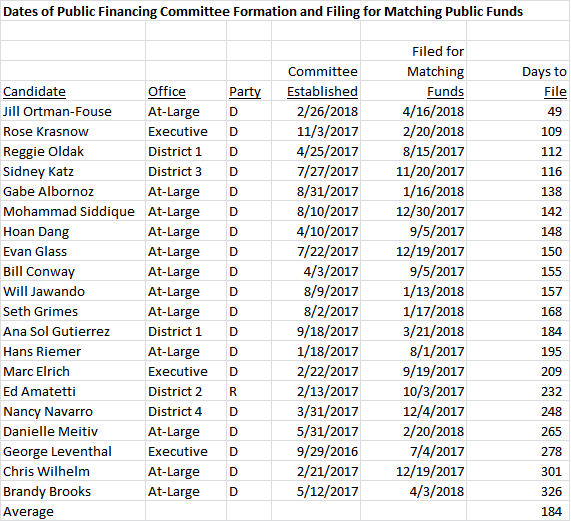
Board of Education member Jill Ortman-Fouse, who is running for Council At-Large, has filed for matching funds from the county’s public financing system.  Ortman-Fouse took 49 days from the date on which she established her campaign committee to apply for matching funds, a FAR shorter period of time than any other candidate.

Ortman-Fouse’s application, made on April 16, lists $23,466 in contributions from 368 county residents, exceeding the Council At-Large thresholds of $20,000 and 250 residents.  Below is the number of days between committee establishment and matching funds application for the twenty candidates in public financing who have applied for matching funds.  (Five other candidates submitted applications but were ruled ineligible by the State Board of Elections.)  Bear in mind as you read the stats below that the candidates have different qualification thresholds.  Executive candidates must collect $40,000 from 500 county residents.  District council candidates must collect $10,000 from 125 residents.

Ortman-Fouse totally smoked her competition in filing time, something that is going to turn heads among her competitors.  In just one term, she has become arguably the most popular school board member in the county since Blair Ewing, who left to run for County Council twenty years ago.  One reason for that status is her close attention to answering constituent questions and her constant social media interaction with them, something that is typical of the best elected officials in county and state governments but is unusual for school board members.  That has given her a network of supporters that approaches the level of incumbent County Council Members.  How far that penetrates into the rank-and-file voting public is unknown, however, as few voters can name their school board members.  And Ortman-Fouse has also been handicapped by her late start, missing out on the endorsement processes of many influential organizations.

That leaves us with a general observation.  It’s true that the top fundraisers in the Council At-Large race are men and that men have received most of the influential institutional endorsements (with some going to Brandy Brooks and Danielle Meitiv).  But the Democratic primary electorate is roughly 60% female and of the seven councils in the current structure since 1990, only one (the 1998-2002 council) lacked a female at-large member.  So don’t count out the women, dear readers – and especially not Jill Ortman-Fouse!

Share

Reznik Calls on Board of Public Works to Reject “Shadow Government” Highway Contract

By Adam Pagnucco.

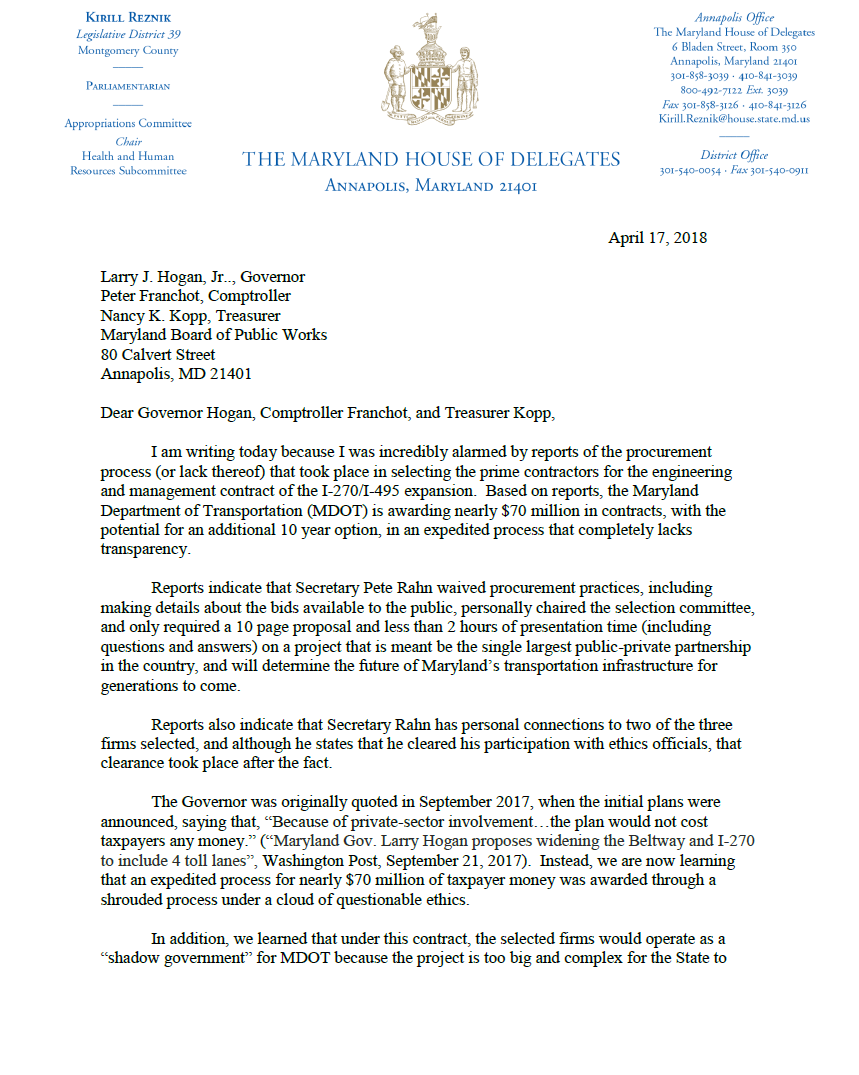
Delegate Kirill Reznik (D-39) has written to the Board of Public Works asking them to reject an engineering and management contract awarded by the Maryland Department of Transportation for its planned expansion of the Capital Beltway and I-270.  According to the Washington Post, the winning consortium included a former employer of the state’s Secretary of Transportation and was awarded the contract despite finishing second in its written proposal.  The Secretary did not vote directly on the contract, but he had dinner with a representative of his former employer and obtained an ethics clearance after the award was made.  Post reporter Michael Laris described the bidding process as “expedited and unusual” and wrote:

The winning firms, known collectively as the “general engineering consultant,” would act as something of a shadow government for the Maryland Department of Transportation, which says its plan to hire firms to build, finance and maintain toll lanes is too big and complex to govern itself.

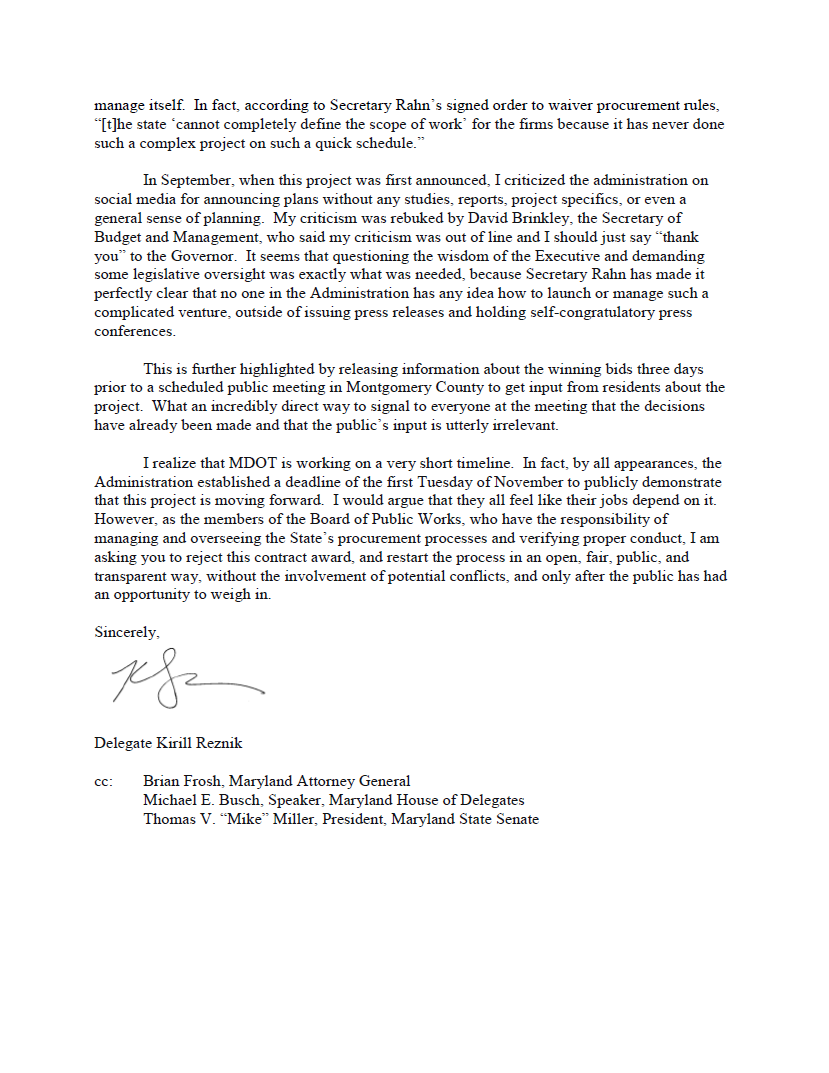
Referring to much of the above, Delegate Reznik said he was “incredibly alarmed” and asked the Board of Public Works to “restart the process in an open, fair, public, and transparent way, without the involvement of potential conflicts, and only after the public has had an opportunity to weigh in.”  We reprint his letter below.

Share

Council At-Large Undervoting, Part Two

By Adam Pagnucco.

In Part One, we learned that even though voters can vote for up to four Council At-Large candidates, they vote for only three on average.  Today we examine whether that statistic varies based on geography.

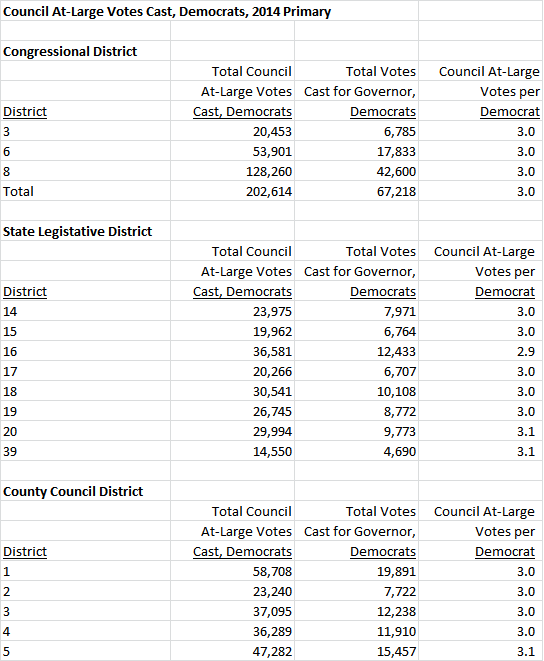
The chart below shows the total number of Council At-Large votes cast in the 2014 Democratic primary, the total number of Democratic votes for Governor and the ratio between the two from precinct votes on Election Day.  (Precinct-level turnout numbers from the state include early voters, absentee voters and provisional voters, distorting their use as a denominator, so we used votes for Governor as a proxy for Election Day voters by precinct.)  On average, each Democratic voter cast three votes for Council At-Large candidates.  That statistic varied very little between Congressional districts, state legislative districts and council districts.

Let’s take a deeper dive and look at local areas.  Again, there is minimal variation.  A mild outlier is Precinct 11-00 in Dickerson, home of at-large challenger Beth Daly.  Was there some undervoting there for Daly and her 2014 teammate, at-large incumbent Marc Elrich?  (The two finished first and second in that precinct and smoked everyone else.)  One note: the term Democratic Crescent refers to Cabin Branch, Bethesda, Chevy Chase, Kensington, Downtown Silver Spring and Takoma Park, areas which tend to exert disproportionate impact on Democratic primaries.

Over and over, we have seen that the average Democratic primary voter casts three votes for Council At-Large candidates.  That statistic has been stable over time and does not vary much by voting mode (early, election day, absentee or provisional), geography, presence of open seats or candidate count.  We see no reason why it would be significantly different in this election.  What does that mean?

One obvious implication relates to one of the hottest places to find votes in a MoCo primary: the Downcounty areas of Downtown Silver Spring, Takoma Park and nearby locations to the north and northeast.  Hans Riemer, Evan Glass, Will Jawando, Danielle Meitiv, Chris Wilhelm, Brandy Brooks, Seth Grimes, Cherri Branson, Jill Ortman-Fouse and Jarrett Smith are among the candidates who are from there and/or are running hard there.  If each voter is only voting for three at-large candidates, there simply are not enough votes to go around for all of the above candidates.  Who emerges from that scrum?

Riemer ought to finish first in that area.  He is not just the only incumbent in the race; he also finished second in Downtown Silver Spring, Takoma Park and Kensington to Marc Elrich in 2014, his best places of finish anywhere in the county.  The next tier might be Glass, Jawando, Ortman-Fouse and Grimes, all of whom have done well in prior races in that area.  How many votes are available there for anyone else?

One of the greatest challenges of running for Council At-Large is how to allocate scarce resources across a vast county-wide electorate in the face of lots of competition and other draws on voters’ attention.  Those candidates who successfully target the voters who align with their values, message, bio and (in some instances) demographic will have a leg up on their less strategic rivals.  With only three at-large votes per voter, the premium on strategic engagement is higher than ever.  It might just be decisive in an exciting and historic race.

Share