All posts by Adam Pagnucco

Taxpayer Flight from MoCo, Part One

By Adam Pagnucco.

We have been printing a ton of posts about the economy on Seventh State, including discussions of our employment and income growth, our rate of business formation, our increasing reliance on corporate welfare to attract and retain employers, the role of economic growth in creating the county’s $120 million budget shortfall and reactions from County Executive candidates and gubernatorial candidate Kevin Kamenetz. Let’s be clear: as we wrote eleven years ago, without economic growth, we will not be able to meet our needs without more tax hikes in the future.  And today, we begin presenting the following facts.

More taxpayers have been leaving Montgomery County than entering it for a long time.

The taxpayers who are coming in make less money than the ones who are leaving.

And while this has been going on for decades, it is now worse than it has ever been.

Our basis for these statements is a data series on tax migration maintained by the Internal Revenue Service (IRS).  As the IRS explains:

Migration data for the United States are based on year-to-year address changes reported on individual income tax returns filed with the IRS. They present migration patterns by State or by county for the entire United States and are available for inflows—the number of new residents who moved to a State or county and where they migrated from, and outflows—the number of residents leaving a State or county and where they went. The data are available for Filing Years 1991 through 2016 and include:

  • Number of returns filed, which approximates the number of households that migrated

  • Number of personal exemptions claimed, which approximates the number of individuals

  • Total adjusted gross income, starting with Filing Year 1995

  • Aggregate migration flows at the State level, by the size of adjusted gross income (AGI) and age of the primary taxpayer, starting with Filing Year 2011.

For every state and county in the U.S., the IRS tracks both inflow and outflow of returns, exemptions and adjusted gross income.  But that’s not all: the IRS reports the origin and destination jurisdictions of these flows.  So data users can see a situation in which County X has a net inflow overall but has a net inflow from County Y and a net outflow to County Z.  The directions of these flows, in an out, become apparent when the data is downloaded and crunched.

Over the next few days, we will publish the following statistics.

Montgomery County’s inflows and outflows of returns and adjusted gross income from 1993 (the first year in which comparable data is available) to 2016.

Inflow and outflow statistics for MoCo and its large neighbors – D.C., Frederick, Howard, Prince George’s, Alexandria, Arlington, Fairfax, Loudoun and Prince William – to provide perspective.

A listing of destination and origin jurisdictions of taxpayer migration between MoCo and its neighbors.  This will identify MoCo’s comparative advantages and disadvantages in taxpayer flow across the region.

Tomorrow, we will proceed.

Share

“Ever Feel Like Montgomery County Government Doesn’t Listen?”

By Adam Pagnucco.

That’s the title of the mailer sent out by Council District 1 candidate Meredith Wellington this week, which we reprint below.  The remainder of Wellington’s message is clearly directed at opponents of development, an ancient political tradition in MoCo.  But here is the thing: whether it’s fair or not – and we could make a case either way – pretty much everyone we talk to, regardless of their ideology, doesn’t believe the county adequately listens to them.  That message, distilled of ideological connotation, will travel far and wide.


Share

The View From 2007

By Adam Pagnucco.

A long time ago in a galaxy far, far away, a newish county blogger and professor named David Lublin reached out to a then-young civic activist who had just gotten involved in local politics to write about the county’s economy and budget.  The activist, who had only lived in the county for three and a half years and was already raising Cain about a new Metro entrance in Forest Glen, was still figuring out what was going on but – what the hell – he agreed.  This was the genesis of my second blog post ever, written in April 2007.  (The first was a piece on the Apple Ballot the year before.)

The county’s economic pressures, which have drawn substantial attention on Seventh State, were apparent more than a decade ago.  Then as now, the county was dealing with short-term budget issues.  But over the long term, I wrote that the end of the real estate boom – which would lead to the Great Recession – would result in three choices to balance the budget and preserve county services: large tax hikes, slowing the rate of budget growth or encouraging economic growth to fund the budget.  Many things happened over the ensuing decade: dramatic budget cuts, equally dramatic tax hikes, warfare with the school system and the state over education funding, breaking of union collective bargaining agreements and more.  But in the end, more a result of just muddling through rather than any strategy, the county picked options 1 and 2 – tax hikes and slower budget growth – and not option 3, which was encouragement of economic growth.  Indeed, because our economy has been so stagnant since the recession, we are now discussing pretty much the same things I wrote about eleven years ago.

Will the next decade be different from the last decade?  Folks, that is what this election is about.  It’s all up to you.

Here is the piece from 2007 reprinted.

*****

In Montgomery County local races, four issues regularly rise to the top: education, development, traffic congestion and the environment, in no particular order. In last year’s elections, all four issues were discussed by the candidates – especially development. But this spring a fifth issue has risen to surpass all of them: the county’s difficult choices on the budget. The budget is not only an unavoidable issue because it is central to the functioning of the government – it also affects the ability of county leaders to deal with each of the above four issues that are important to voters.

The county has a short-term problem and a long-term problem with its budget.

The short-term problem appeared in the first budget submitted by our new County Executive. While Ike Leggett’s proposal for $4.1 billion in county spending was 6.3% higher than last year’s budget, the increase was below the prior year’s rate of 9%. Leggett pronounced recent budget growth “unsustainable” and declared that no county agency, including the schools, would get its entire budget request. Despite an aggressive lobbying campaign by public sector unions – especially the Montgomery County Education Association – the County Council seems likely to uphold the broad outlines of the County Executive’s proposal.

Furthermore, Council President Marilyn Praisner has identified a $269 million budget deficit for the fiscal year starting in July 2008. The deficit margin is about 7% – which is close to the increase recommended for this year. The council may very well combine a small tax increase with careful maintenance of core spending to deal with this deficit. This may be enough to avoid modifying the county’s labor contracts with its employees as the Council President has recently discussed.

As serious as the short-term problem is, it does not compare to the county’s budget issues of 1991-92 when it suffered from an economic recession. At that time, 7,000 county employees were furloughed for four days. Public employees occupied the council chambers, teachers engaged in a work slowdown and some public school students walked out of classes to protest potential cuts. No one is predicting similar upheaval this time.

However, the long-term budget problem represents a significant challenge. Since 1990, the county’s population growth has averaged 1.4% per year while its budget has generally grown 5-10% per year. In recent years, the county has managed this by depending on big increases in property tax receipts driven by its real estate boom. That real estate boom has ended and property tax receipts will soon reflect that. The county faces three choices in the long run:

1. Large tax hikes to fund budget increases. The danger here is that those tax hikes may slow the county’s economic growth rate even further, worsening its fiscal problems in the future.

2. Slowing the rate of county budget growth to equal the rate of economic growth. This would mean county budget growth of 1-2% per year. This would be insufficient to meet the standards of service to which residents have become accustomed. School, fire, police and health care costs are all increasing at faster rates even if the size of the relevant county departments remains unchanged. This budget growth rate would also be insufficient to adequately compensate county employees, and that would gradually damage one of the nation’s best-educated, least-turnover-prone local government workforces.

3. Systematically encouraging enough economic growth to fund the county’s budget.

The third option reveals a naked truth that was not commonly discussed during the last campaign: budget policy and development policy are inter-related. Over the long run, limiting economic growth will limit the ability of local government to serve its residents. But as any resident of Phoenix or Las Vegas would observe, economic growth has consequences for quality of life. The question of the last campaign was, “Should we have development or not?” But the real question is, “How can we have enough economic growth to pay for government services we need without driving existing residents crazy?”

Economic growth comes from two sources: population growth and job creation. If one of these occurs without the other, or if they occur in different geographic locations, the result is traffic congestion. The two should occur together, at similar rates, and in nearby locations. This has direct implications for county development policy.

In general, the county has three kinds of developable areas: the agricultural reserve, the four downtowns (Bethesda, Rockville, Silver Spring and Wheaton), and the rest of the county. Most residents agree that the agricultural reserve should continue to be protected for cultural and environmental reasons. That leaves the other two areas for consideration.

The four downtowns are unique assets in the county because they each have residential density, concentrated office space and pedestrian-oriented retail space all within walking distance of each other. A resident of Bethesda’s central business district (CBD) who also works in the CBD does not have to use his or her car every day. That individual can walk to work and walk to the grocery store on the way home. The fact that all of the amenities of life are concentrated in a walkable radius cuts back on car use, which cuts down on energy usage, greenhouse gases and pollution. It also reduces the need for road maintenance.

But many residents may want to live in one CBD and work in another. This means that the CBDs should be connected, preferably through transit. Bethesda is connected to Rockville, and Silver Spring is connected to Wheaton through Metro’s Red Line. Bethesda could be connected to Silver Spring through the Purple Line. And a bus rapid transit route from Wheaton to Rockville is the county’s top transit study request of the state government. If both of those projects go through, the county will have four inter-connected downtowns.

How could the county encourage economic growth in downtowns rather than sprawl in non-transit-accessible suburbs? In the downtowns, the county could use zoning text amendments (or more ambitiously, coordinated and complementary updates to master plans) to encourage transit-oriented CBD growth. In non-CBD areas, project area transportation reviews and robust school capacity tests would limit development outside the downtowns. This combination of measures would channel economic growth to the CBDs while minimizing the consequences of traffic congestion and pollution. The side effect would be to encourage the creation of downtown entertainment districts, each customized to reflect the unique cultural identities of each CBD.

For those who are uneasy about growth in downtowns, keep in mind the other two budget options: large tax hikes or gradually deteriorating government services. No local area in this country – even Montgomery County – is immune to the negative long-run effects of either (or both).

Share

MCEA Endorses Council Incumbents

By Adam Pagnucco.

The Montgomery County Education Association (MCEA), which represents MCPS teachers, has endorsed four County Council Members running for reelection: Craig Rice (District 2), Nancy Navarro (District 4), Tom Hucker (District 5) and Hans Riemer (At-Large).  The only Council Member running for reelection this year who has not been endorsed by MCEA is Sidney Katz (District 3).  The union has previously endorsed Katz’s opponent, Ben Shnider.

Also, MCEA has not endorsed in the County Executive race and may ultimately not do so.  That would echo the 2006 Executive primary, when neither Ike Leggett nor Steve Silverman could reach the union’s 58% threshold for support in its Representative Assembly.

We reprint MCEA’s press release below.

*****

For Immediate Release:

May 3, 2018

Contact:  Nikki Woodward

Anzer.woodward@gmail.com

MONTGOMERY COUNTY EDUCATION ASSOCIATION ANNOUNCES NEW COUNTY ENDORSEMENTS

The Montgomery County Education Association (MCEA), which represents more than 14,000 classroom teachers, guidance counselors, speech pathologists, media specialists, and other non-supervisory certified educators in the Montgomery County Public Schools system, has endorsed several candidates for elected office in Montgomery County.  Endorsed candidates will appear on MCEA’s “Apple Ballot” for the 2018 primary and general elections.

COUNTY COUNCIL AT LARGE:

Hans Riemer (new), Brandy Brooks, Chris Wilhelm, Will Jawando

COUNTY COUNCIL (DISTRICT):

District 1: Ana Sol Gutierrez

District 2: Craig Rice (new)

District 3: Ben Shnider

District 4: Nancy Navarro (new)

District 5 Tom Hucker (new)

BOARD OF EDUCATION AT LARGE:

Karla Silvestre

BOARD OF EDUCATION (DISTRICT):

District 1:  Dr. Judith (Judy) Docca

District 2:  Patricia (Pat) O’Neill

District 5:  Brenda Wolf

MCEA has not yet endorsed a candidate for County Executive for the June primary.

-30-30-30-

Share

SEIU Local 32BJ Endorses in Maryland Races

By Adam Pagnucco.

SEIU Local 32BJ, a gigantic building services union stretching from New England to Florida, has announced endorsements in Maryland races.  The local is not to be confused with SEIU Local 500, which organizes MCPS support staff, adjunct faculty and child care workers, but the two locals share many progressive views and are both powerhouses.  We reprint 32BJ’s press release below.

FOR IMMEDIATE RELEASE:

Thursday May 3, 2018

FOR MORE INFORMATION:

Julie Karant: jkarant@seiu32bj.org

UNION REPRESENTING 18,000 WORKERS IN MARYLAND AND D.C. AREA ENDORSES MARYLAND STATE & COUNTY CANDIDATES

Silver Spring, MD – Commercial office cleaners and private security officers from the Service Employees International Union (SEIU) 32BJ today announced their endorsements in races for Maryland State Senate and Delegate as well as Prince George’s and Montgomery County Council. “These candidates are dedicated to improving life for Maryland’s immigrant and minority communities,” said 32BJ SEIU Vice President Jaime Contreras. “They also understand that low-wage workers need and deserve a $15 minimum wage to support their families.”

MD Statewide

Ben Jealous

Governor

Brian Frosh

Attorney General

MD Senate

Craig Zucker

MD State Senate District 14

Jeff Waldstreicher

MD State Senate District 18

Will Smith

MD State Senate District 20

Jim Rosapepe

MD State Senate District 21

Paul Pinsky

MD State Senate District 22

Joanne Benson

MD State Senate District 24

Angela Angel

MD State Senate District 25

Jamila Woods

MD State Senate District 26

Antonio Hayes

MD State Senate District 40

Alethia McCaskill

MD State Senate District 44

Mary Washington

MD State Senate District 43

Cory McCray

MD State Senate District 45

Bill Ferguson

MD State Senate District 46

MD House

Anne Kaiser

MD State Delegate District 14

Eric Luedtke

MD State Delegate District 14

Pamela Queen

MD State Delegate District 14

Ariana Kelly

MD State Delegate District 16

Emily Shetty

MD State Delegate District 18

Jared Solomon

MD State Delegate District 18

Bonnie Cullison

MD State Delegate District 19

Marlin Jenkins

MD State Delegate District 19

Marice Morales

MD State Delegate District 19

David Moon

MD State Delegate District 20

Jheanelle Wilkins

MD State Delegate District 20

Darian Unger

MD State Delegate District 20

Jocelyn Pena Melnick

MD State Delegate District 21

Matt Dernoga

MD State Delegate District 21

Mary Lehman

MD State Delegate District 21

Alonzo Washington

MD State Delegate District 22

Erek Barron

MD State Delegate District 24

Jazz Lewis

MD State Delegate District 24

Dereck Davis

MD State Delegate District 25

Wala Blegay

MD State Delegate District 25

David Sloan

MD State Delegate District 26

Veronica Turner

MD State Delegate District 26

Gabriel Acevero

MD State Delegate District 39

Terrell Boston Smith

MD State Delegate District 40

Melissa Wells

MD State Delegate District 40

Nick Mosby

MD State Delegate District 40

Maggie Mcintosh

MD State Delegate District 43

Cheryl Glenn

MD State Delegate District 45

Luke Clippinger

MD State Delegate District 46

Brooke Lierman

MD State Delegate District 46

Robbyn Lewis

MD State Delegate District 46

Wanika Fisher

MD State Delegate District 47B

Jimmy Tarlau

MD State Delegate District 47A

Julian Ivey

MD State Delegate District 47A

Montgomery County

Marc Elrich

County Executive

Craig Rice

County Council District 2

Ben Shnider

County Council District 3

Nancy Navarro

County Council District 4

Tom Hucker

County Council District 5

Hans Riemer

County Council At-Large

Will Jawando

County Council At-Large

Brandy Brooks

County Council At-Large

Gabe Albornoz

County Council At-Large

PG County

Donna Edwards

County Executive

Victor Ramirez

States Attorney

Tom Dernoga

County Council District 1

Deni Taveras

County Council District 2

Jolene Ivey

County Council District 5

Krystal Oriadha

County Council District 7

Gerron Levi

County Council At-Large

Karen Toles

County Council At-Large

With more than 163,000 members in 11 states, including 18,000 in the D.C. Metropolitan Area and throughout Maryland, 32BJ SEIU is the largest property service workers union in the country.

Share

Placeholders, Indeed, Do Have a Place in the MCPS Capital Budget

By Glenn Orlin.

In a recent piece in Seventh State it was argued that so-called “placeholder” projects have no place in the Montgomery County Public Schools capital program. But there are very good reasons why the County Council has done exactly that for the past eight years.

First, some background.  The Subdivision Staging Policy (SSP) Public School Adequacy Test compares enrollment five years in advance—at each cluster and level (HS, MS, or ES), and at each school—against the budgeted capacity at each cluster/level and school five school years hence.  If the future enrollment exceeds the future capacity in a cluster by more than 20% at any level, then the cluster goes into a housing moratorium; that is, no more housing subdivisions can be approved until the capacity standard is met.  (Relocatable classrooms are not counted towards “capacity” under the School Adequacy Test.) If the future enrollment exceeds the future capacity in a MS service area by more than 20% and 180 students, then that MS service area goes into a housing moratorium.  If the future enrollment exceeds the future capacity in an ES service area by more than 20% and 110 students, then that ES service area goes into a housing moratorium.  The five-year rule was selected many years ago because, on average, that is how long it takes for a housing subdivision approval to morph into occupied housing units, many of them having kids of school age.

At the start of this decade the Council began the practice of budgeting generic “Solution” (i.e., placeholder) CIP projects in certain circumstances.  The rationale is that while a cluster or school service area might have enrollment that exceeds the moratorium threshold, in many cases MCPS is concurrently planning for a new school or addition that would provide sufficient capacity in time to avoid such a moratorium.  The Council has approved Solution projects only when all the following conditions are met:

  1. A cluster or school service area is projected to exceed the moratorium threshold;
  2. MCPS is concurrently—or about to start—planning for a capital project that would address the potential moratorium; and
  3. MCPS’s normal schedule for planning, design, and construction would have the project’s added capacity opening by the start of the school year five years hence.

The most recent application of the School Test was approved by the Planning Board on June 22, 2017.  The Board placed seven ES service areas into moratorium: Burnt Mills, Highland View, Kemp Mill, Lake Seneca, Rosemont, Strawberry Knoll, and Summit Hall.  At that time, while all of them met Condition #1, none of them met Conditions #2 and #3.  Eight other clusters or school service areas were not placed into moratorium because Solution projects were justifiable and programmed: they met all three conditions.  In the FY19-24 CIP several of these Solution projects will be replaced by specific projects that the Board of Education (BOE) is now officially ready to recommend.  This new CIP will include only four Solution projects.

It is important to note that the decision to budget a Solution project for a school has nothing to do with whether there are new housing applications in that area awaiting the Planning Board’s approval.  Condition #1 occurs either when projected enrollment growth due to turnover, already approved new housing, or both, will be over the capacity threshold.  Whether there are impending housing development applications simply doesn’t matter in the decision to budget a Solution project or not.  Now let’s turn to the examples raised in the earlier Seventh State piece.

Bethesda ES and Somerset ES.  The service areas for both schools in the B-CC Cluster are projected to be well over capacity (+25% and +27%, respectively) in five years, that is, by the start of the 2023-24 school year.  MCPS is initiating an elementary school capacity study for the B-CC Cluster, which would examine a range of options.  The study will be conducted during the 2018-2019 school year.  The Board of Education (BOE) will then be in position to propose a specific project in its FY21-26 CIP request; if that project’s funding were to begin in FY21, then, following the normal schedule for planning, design, and construction it could open at the start of the 2023-24 school year.  Because all three conditions are met—a projected moratorium, planning about to begin, and a path to project completion in five years—the Council is poised to fund Solution projects for Bethesda ES and Somerset ES.  The total amount to be budgeted for these two Solution projects is about $6.4 million.  When a specific project is ready to be budgeted, this $6.4 million will be used to help fund it.

Judith A. Resnik ES.  The current CIP has a fully funded addition at this Magruder Cluster school (which would bring its capacity up to 740), but the BOE deleted the construction funding in its request for the FY19-24 CIP.  Enrollment is trending downward, although in five years it is still projected to exceed the moratorium standard if there is no addition.  The BOE is continuing planning for an addition, however.  So, since all three of the above conditions are met, the Council is planning to fund a $2.7 million Solution project for Resnik ES.

The fourth Solution project is about $6.3 million for Einstein HS, which the Council had already initiated, and the BOE itself has recommended continuing it. Therefore, the sum of the four Solution projects is about $15.4 million.  All but $3.7 million would be programmed in the last three years of the CIP (FYs22-24).

Burnt Mills ES.  This school is projected to be 47% over capacity in 2023-24, so certainly Condition #1 is met.  However, MCPS is requesting the Council to set aside in the CIP $120 million (talk about your placeholders!) while it undertakes a thorough review of the prior revitalization/expansion program “in order to develop a multi-variable approach to determine the priority order of large-scale renovations, possibly including programmatic and capacity considerations” (Superintendent’s FY19 CIP Request, page 1-2).  Therefore, the Burnt Mills situation meets neither Condition #2 nor #3.  Once the BOE has determined a strategy for this school, its improvement would either be partially funded as a Solution project or fully funded from the outset.

Ashburton ES.  If the argument is being made that Solution projects are budgeted to meet the desires of new development, then consider the case of Ashburton in the Walter Johnson Cluster.  It is projected to be more than 22% over capacity five years from now, meeting Condition #1.  Just last fall the Council approved the Rock Spring Master Plan which allows for at least 2,300 more housing units than exists or is already approved.  Almost all the Rock Spring area is within the Ashburton ES service area.  Nevertheless, since MCPS is not undertaking planning for additional capacity that would further relieve Ashburton, its service area will go into a housing moratorium in July.

E. Brooke Lee MS Addition. When the Council approves the CIP, it assures that there is enough money to pay for the projects it is budgeting in each of the CIP’s six years.  The Council is approving a tighter CIP this year than in the past, because it recognizes that debt service on borrowing has grown too high.  (Debt service is an obligation that must be paid before anything else in the budget, including salaries.)  Earlier this year the Council asked for the Superintendent to provide it with a list of “non-recommended” projects that would be the first choices to be reduced or deferred, should the Council need them to meet the spending limits.

One of the projects on his list was to delay the construction funding for Lee MS by one year, although not to delay the first-year (FY19) design funds, which would allow the opportunity for the project to be reaccelerated next year.  In its worksession on April 17, several members of the Council expressed the desire to delay neither the design nor the construction funds for the Lee MS project.  To accommodate this desire, there is a shortfall of $8 million in FY20 and $9.5 million in FY21 for which funds must be found.  We will do our best to do that, but deleting the Solution projects would contribute nearly nothing to this effort; there is only $169,000 in Solution project funds in FY20, and only $3.6 million in FY21; the remaining $11.7 million is in FY22 and later.

Do Solution projects almost never get done in five years, as the Seventh State article claims?  In fact, almost every project does get done within five years, or, the BOE later decides that the project isn’t needed after all.   In the article, it is stated that most of the Solution projects added in FY15 did not translate into actual projects within five years, which would have been the 2019-2020 school year.  For FY15 the Council added Solution projects for five Downcounty Consortium elementary schools: Brookhaven, Glen Haven, Highland, Kemp Mill, and Sargent Shriver.  Two years later, however, the BOE retracted its request for these projects, noting that the projected seat deficits were no longer high enough for it to request funds for additions there (see the FY17 Educational Facilities Master Plan, pages 4-37 through 4-41).

Is “real money” being taken out of the MCPS for Solution projects?  In a word, no.  The Council never budgets all the money it could in the CIP.  This is because the Council needs to reserve funds for: (1) when construction bids come in over estimates; (2) for when projects that are in the planning stage are ready for construction funding later in the CIP period; and (3) for unanticipated opportunities or emergencies that arise.  For these reasons, the Council this year will probably set aside a capital reserve of about 9% of the funds available for budgeting, as has been recommended by the County Executive.  But, after all, a Solution project is but a designated reserve, so the Council—as it has in the past—will likely set an undesignated capital reserve less than the Executive recommended by the $15.4 million in these Solution projects.  Therefore, the Solution projects do not compete with other projects in the MCPS CIP, nor with those in the County Government, Montgomery College, or Park & Planning CIPs.  If anything, the Solution projects provide a first claim on the capital reserve.

In summary, Solution projects in the CIP in no way compete with other projects, and they avoid housing moratoria in certain situations where they are not warranted.

Glenn Orlin is the Deputy Director of the Office of the County Council.  He has been the Council’s CIP Coordinator for the last 26 years.



Share

John Delaney Endorses Bill Conway

By Adam Pagnucco.

Congressman John Delaney has endorsed Council At-Large candidate Bill Conway.  We are not aware of Delaney endorsing other county-level candidates.  We reprint the Conway campaign’s press release below.

*****

FOR IMMEDIATE RELEASE: Monday April 30, 2018

Congressman John Delaney Endorses Bill Conway for County Council

Bill Conway, candidate for County Council At Large, announced today that he has been endorsed by Congressman John Delaney of Maryland’s Sixth Congressional District.

“I am proud to endorse Democrat Bill Conway for an At Large seat on the Montgomery County Council,” Congressman Delaney said. “Bill would bring policy and business experience to the County Council. He is a consensus builder who combines progressive values and a deep commitment to social justice with clear-eyed practicality and fiscal prudence. We need Bill’s leadership on the Council to grow our tax base with new jobs, control our choking traffic problems, and reduce the performance gap in our schools,” Delaney added.

“John Delaney is one of the most thoughtful and innovative leaders in Congress. He has served the people of the Sixth District with distinction and would lead our country wisely if elected to the Presidency. I am honored to receive his endorsement,” Conway said.

Share

The Executive Contest is a Two-Candidate Race

By Adam Pagnucco.

The Washington Post recently published an article declaring that the contest to succeed County Executive Ike Leggett was seen as “anybody’s race.”  Pshaw!  One of two candidates will win it.  One of them is Council Member Marc Elrich, who finished first in the last two Council At-Large primaries and is nearly sweeping progressive endorsements.  The other is…

We don’t know yet.  And we don’t know if we ever will.

During the 2016 Congressional District 8 race, your author called up one of the smartest people in state politics we know.  This fellow lives outside MoCo but he tracks all parts of the state and has sources everywhere.  When we asked him who was going to win, he said, “When I talk to the various campaigns, all of them say they’re gonna be the last one at the end along with Jamie Raskin.  When I hear that over and over, when I see that they all think that Jamie is the man to beat, that leads me to think Jamie will win.”  That dynamic is going on now in the Executive race.

Elrich’s long-time message combining opposition to development with far-left progressivism has earned him an overlapping base of land-use voters, liberals and Downcounty residents, especially in and near Takoma Park, where he served 19 years on the City Council.  In the 2014 Council At-Large race, Elrich finished first in every council district except 2 (where he finished second to Nancy Floreen) and first or second in every local area in the county except Damascus and Laytonsville.  He finished first in 138 of 251 precincts.  In the 2010 Council At-Large race, Elrich finished first in all five council districts and in every local area in the county except Cabin John, Damascus, Darnestown and Laytonsville.  He finished first in 166 of 243 precincts.  No other MoCo politician running for county office in this cycle has a base of this kind.

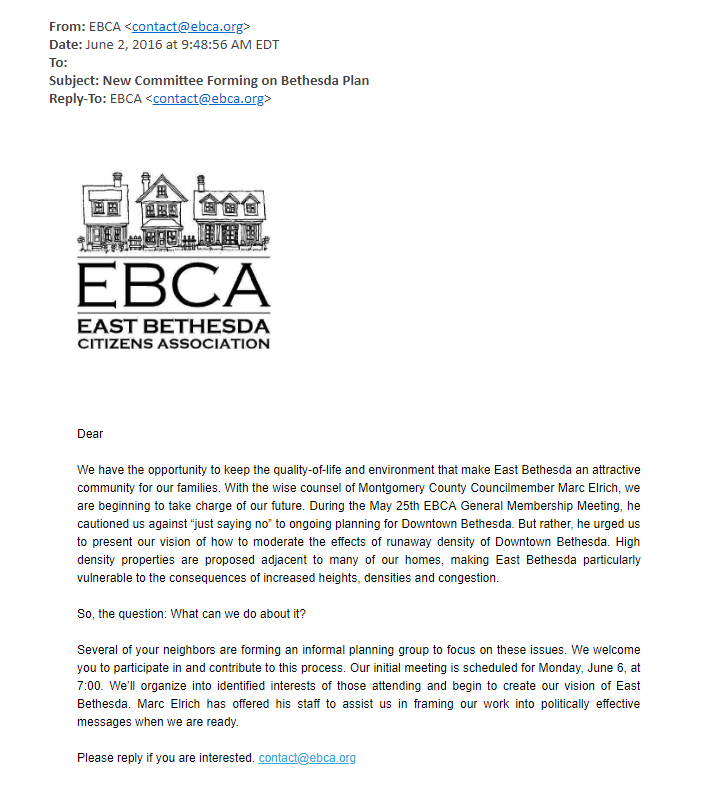
How did he assemble it?  For many years, Elrich has been assisting residents who oppose master plans all over the county.  And whether they won or lost, those development opponents came away from the fight with Elrich as their hero.  Here is an illustration: an email sent out by the East Bethesda Citizens Association on 6/2/16, on the eve of the council’s consideration of the Downtown Bethesda Master Plan, describing their meeting with Elrich and calling for action:

A year later, Elrich cast the lone vote against that master plan as he has with several other plans.  This plan’s opponents have now been incorporated into Elrich’s base – assuming they were not part of it already.

While other candidates struggle to attract volunteers, Elrich’s volunteer base is well established.  In 2014, the campaigns of Elrich and his ally, Beth Daly, posted poll coverage sign-ups on Signupgenius.com.  They were able to recruit coverage on 67 precincts, many on more than one shift, with particular strength in the voter-rich areas of Silver Spring, Takoma Park and Leisure World.  No one other than the Apple Ballot could touch this.  Now that he is running for the county’s highest office, how many precincts will Elrich be able to cover?

Among the influencers and highly informed activists, this election is rapidly becoming defined by whether you’re with Elrich or not.  If you don’t believe us, check out the Council District 1 candidates.  They’re an interesting group that collectively spans the differences of opinions in the county district containing the most Democrats.  Bethesda Magazine reporter Andrew Metcalf asked them during a recent debate for whom each was going to vote in the Executive election.  After significant prodding, here’s how the candidates responded:

Bill Cook – would vote for Marc Elrich

Pete Fosselman – undecided; wouldn’t vote for Elrich

Andrew Friedson – undecided; disinclined to vote for Elrich

Ana Sol Gutierrez – torn between Elrich and George Leventhal

Jim McGee – would probably vote for Elrich

Reggie Oldak – refused to say; would not vote for Elrich

Dalbin Osorio – would vote for Elrich

Meredith Wellington – undecided

All of the non-Elrich candidates have potential as well as challenges.  Council Members Roger Berliner and George Leventhal are running on their experience and qualifications.  (Disclosure: your author respects both but supports Berliner.)  Berliner is trying to get known outside his council district and Leventhal has been severely out-polled by Elrich in the last two elections.  Delegate Bill Frick, former Rockville Mayor Rose Krasnow and businessman David Blair are the fresh faces.  But they are little-known in most parts of the county and Blair started as a complete unknown.  All of these candidates have a long way to go and each of them is in the others’ way.

To contrast with Elrich effectively, a non-Elrich candidate needs to hit this sweet spot dead-on: “We live in a great county, but we can be even better.  Here are some ways we can improve.”  That involves a bit of threading the needle for the two council incumbents.  It’s understandable that they might react to critiques of the county’s economic performance as criticism of their records, but they should think of it like this: every Executive leaves unfinished business for the next Executive.  Ike Leggett inherited his share of problems from Doug Duncan, who in turn inherited some issues from Neal Potter.  This is entirely normal, so who is the best choice to lead in the future?  As for the non-incumbents, they aggressively point to the need to improve, but they tend not to have many specific proposals to get better because they don’t know the history and operations of county government as well as the two Council Members.  To be fair, how could they?  If no one hits this sweet spot, that leaves Elrich as the only candidate with a crystal-clear message that is distinct from the others.  Those who hear Elrich’s message and agree with it are less likely to peel off to someone else than tentative supporters of the other candidates who might change their preferences between them.

One more thing: we wouldn’t be surprised if most, if not all, of the non-Elrich candidates have polled.  If so, they all probably found similar results.  And so they could all tailor their messages in similar ways and maybe even say the exact same things.  That would blur the differences between them and make Elrich stand out even more.  This may already be happening as Berliner, Blair and Frick all repeatedly mentioned “innovation” at last Friday’s Executive forum.  Was that a coincidence?

If questioned privately, we bet all of the non-Elrich candidates would grudgingly admit that it’s a problem that five of them are in the race.  Each of them wants to be the person who gets to take on Elrich one-on-one.  So each of the five is looking at the others and saying, “If YOU all get out of the way, I can beat Elrich.”  But no one is dropping out because they all think they have a shot.  The big winner from this is – you guessed it – Marc Elrich.

One non-Elrich candidate needs to emerge from the pack and consolidate everyone that is not in Elrich’s camp.  If that happens, Elrich is beatable.  But if nothing changes and this election continues down the path it is on, Elrich will win with less than 40% of the vote.

Share

Executive Candidates React to Sage Consulting Report on MoCo Economy

By Adam Pagnucco.

Last Friday, the candidates for County Executive attended a forum to discuss a report by Sage Consulting listing numerous problems with the county’s economy.  Afterwards, most of the Executive candidates commented on the report and on the economy more generally via email and social media.  Their responses say a lot about which ones take the economy seriously, an issue that has drawn much attention from Seventh State.

Council Member Roger Berliner (whom your author supports) sent out this email over the weekend.

Our county has serious work to do to improve our business climate, diversify our economy, and increase the number of good jobs. It must be Priority #1 if we are going to be able to meet the needs of our school system, reduce congestion, invest in public safety, and protect our environment.

I have a record that I am proud of on improving our economy and a vision for our future that you can read about here. Some of my competitors have records too. Others have just words. It’s important to consider what we have done in pursuit of increasing prosperity, not just what we say we will do.

My record includes leading the successful effort to reduce our energy tax three years in a row; creating the small business navigator and a micro-loan program to help our local small businesses and entrepreneurs thrive; and playing a leading role in our Amazon bid. My vision is of a forward leaning county that embraces innovation, education geared towards the jobs of tomorrow, and vibrant urban centers served by state-of-the-art transit.

Yesterday, a consultant tasked with assessing our business climate and outlook, issued a scathing report. It highlighted one startling statistic: that “between 2011 and 2016, the number of [business] establishments in Montgomery County increased by 6, or roughly the population of businesses at a strip mall.” The report concludes that “Montgomery County therefore desperately needs to step up efforts to expand its commercial tax base.” You will get no debate from me on that point.

At the same time, the report declares:

This should not be mistaken for an assertion that Montgomery County is anything other than the finest possible location for Amazon HQ2. It will be difficult for Amazon to identify an area that is as open to new ideas, offers such abundant human capital, is as saturated with transportation options, supports such high quality public education, is as institutionally rich, and is as committed to shared prosperity as Montgomery County, MD.

So, while it is true that we have our challenges, challenges that must be met head-on, it is also true that we have extraordinary assets and a quality of life to match. I will build on our assets as your next County Executive, work diligently to improve our business climate, and am 100% committed to expanding a “shared prosperity.”

Life is good in Montgomery County, but we can make it better still. That’s my goal: a “more perfect” Montgomery County.

In service,

Roger Berliner

Delegate Bill Frick (D-16) sent out this email hours after the Executive forum ended.

Something doesn’t add up. How does a county with our talent, our people, our great public schools and our values lag behind the rest of our region in job growth and economic development? How is it that private sector employment has declined by 12,500 jobs from 2006 to 2016? How is it that, during that same time period, Montgomery County created on net just six new businesses?

The answer is clear. As I told the Montgomery County Business Roundtable earlier today, it is our political culture. My opponents have built a political culture in Montgomery County that doesn’t want to work with businesses to thrive and grow here in our County.  And if we elect someone to be County Executive who is part of that culture, things will not get better for business.

I am an outsider to Montgomery County Government and yet I have real governmental leadership experience as the Majority Leader of Maryland’s General Assembly. I have the relationships in Annapolis that can help our County. But since I am not a multi-millionaire, and unlike three of my opponents, I am not spending your taxpayer dollars to fund my campaign, I need your help to communicate with Montgomery County residents who deserve leadership that the current members of the County Council will not provide.

Montgomery County is an awesome place to live. It’s why I’m raising my two children here and sending them to our public schools. But we have a problem, and that is that we must reform in order to create new private sector jobs and increase our tax base. We have to focus on the core functions of county government – education, public safety, and transportation – and those need to be our priorities for our budget. Our County Government does not need to be in the liquor business, a failed venture that is hurting our food culture to the benefit of downtown DC restaurants. We have to have a culture of ‘yes’ in county government so that we are trying to find reasons to say yes to businesses rather than find reasons to say no.

Sincerely,

Bill

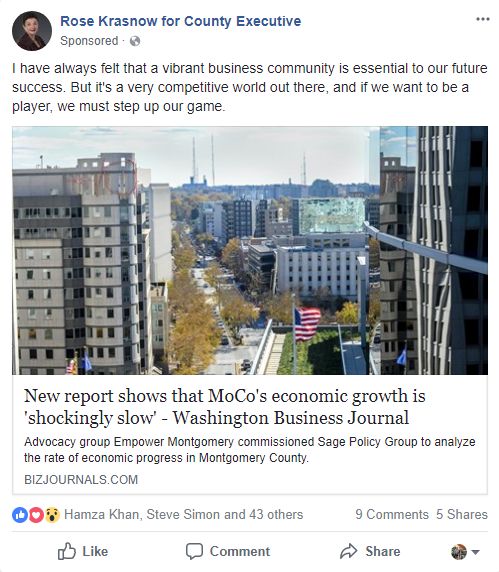
Former Rockville Mayor Rose Krasnow ran this Facebook ad.

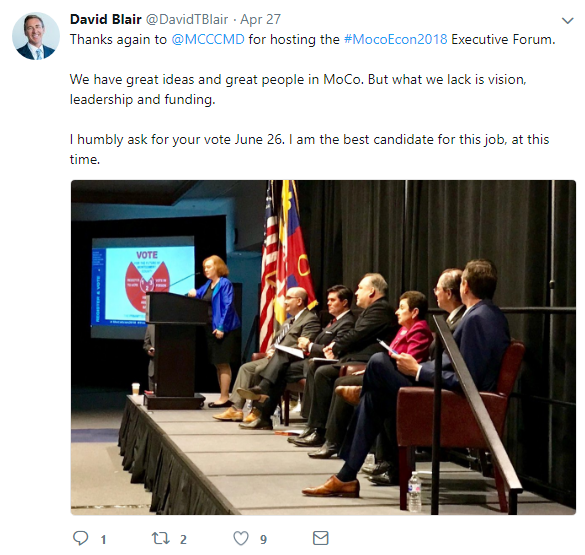
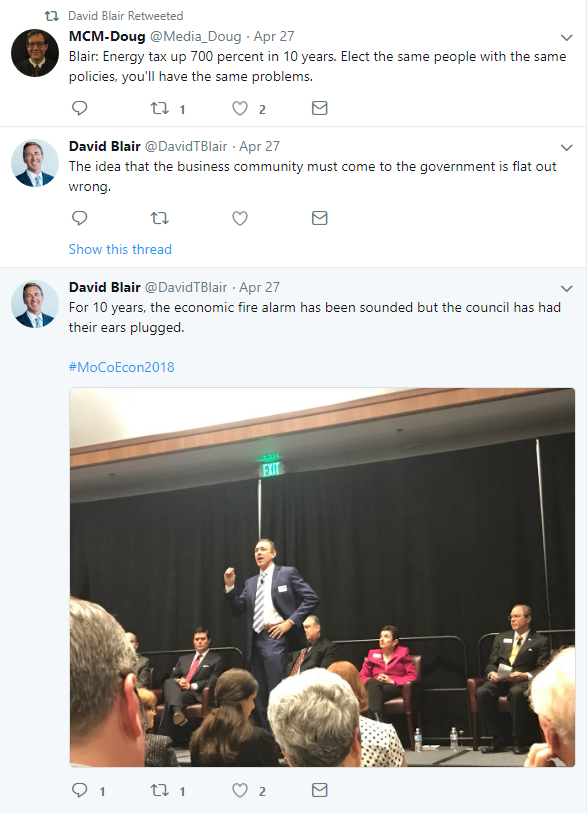
David Blair commented on Twitter.

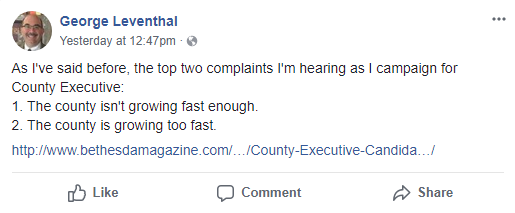
Council Member George Leventhal commented on Facebook.

We are not aware of Council Member Marc Elrich commenting via email, Facebook or Twitter.

Share