
The Washington Post has endorsed David Blair for Montgomery County Executive. Read their endorsement here.
All posts by Adam Pagnucco

Realtors Endorse Frick, Council Candidates
By Adam Pagnucco.
The Greater Capital Area Association of Realtors (GCAAR) has endorsed the following candidates in MoCo races:
Bill Frick – County Executive
Gabe Albornoz, Marilyn Balcombe, Hoan Dang, Evan Glass – Council At-Large
Craig Rice – Council District 2
Sidney Katz – Council District 3
Nancy Navarro – Council District 4
Tom Hucker – Council District 5
No endorsement was made in Council District 1.
The Realtors are the most influential endorsing organization in MoCo’s business community because of their volume of activity at election time. In 2014, they spent well into six figures on independent mail and PAC contributions. Despite every one of their county-level candidates winning except District 5’s Evan Glass (who came close), their reward was a recordation tax hike that they bitterly opposed two years later. Rarely has a group done so much and gotten so little in MoCo politics!
This time around, when they had a chance to oppose an incumbent who voted for the recordation tax hike, they did. Council Members Roger Berliner, Marc Elrich, George Leventhal and Hans Riemer, all of whom are in contested races, were left off their list. Rice, Navarro and Hucker have nominal opposition and are sure to be reelected. Sidney Katz’s opponent, Ben Shnider, is running to his left and was probably not a realistic option. The selection of Delegate Bill Frick for Executive, who is running scorching Facebook ads against the County Council, sends a message of discontent.
The big question now is how much the Realtors will do to support their candidates. We are a little more than a month away from early voting. Albornoz, Dang, Glass, Katz and Navarro are in public financing and cannot accept PAC checks. After getting burned last time, will the Realtors sink six figures into mail again? We will find out. Meanwhile, the Washington Post endorsement looms.
We reprint the Realtors’ email below.

Taxpayer Flight from MoCo, Part Five
By Adam Pagnucco.
Today, we conclude looking at jurisdictions with whom MoCo has had inflows and outflows of tax returns and adjusted gross incomes.
Loudoun County
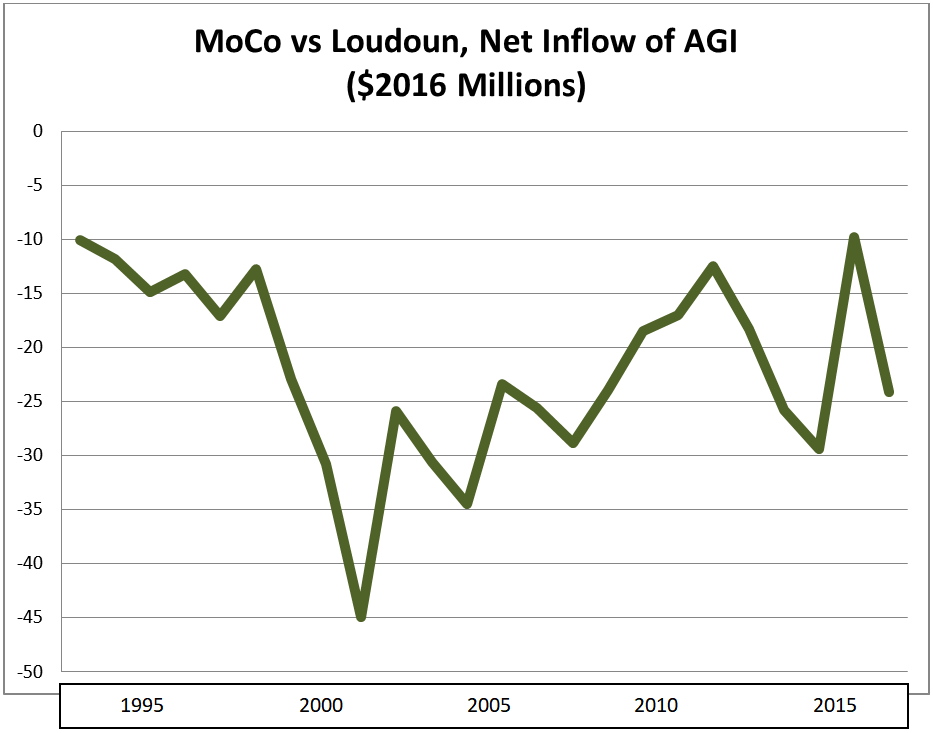
Net change in tax returns, 2006-2016: -1,507 (outflow)
Net change in adjusted gross income ($2016), 2006-2016: -$208 million (outflow)
Adjusted gross income of in-migrants ($2016), 2006-2016: $76,287
Adjusted gross income of out-migrants ($2016), 2006-2016: $100,587
Migrant income gap: Out-migrants earned 32% more than in-migrants
Loudoun has been the fastest-growing large jurisdiction in the Washington region for a long time and was once one of the fastest-growing places in the country. Much of its growth has come from people relocating from Fairfax but it has gained some folks from MoCo too. As the wealthiest county in the nation, it’s no surprise that its migrants from MoCo skew to high earners.
Howard County
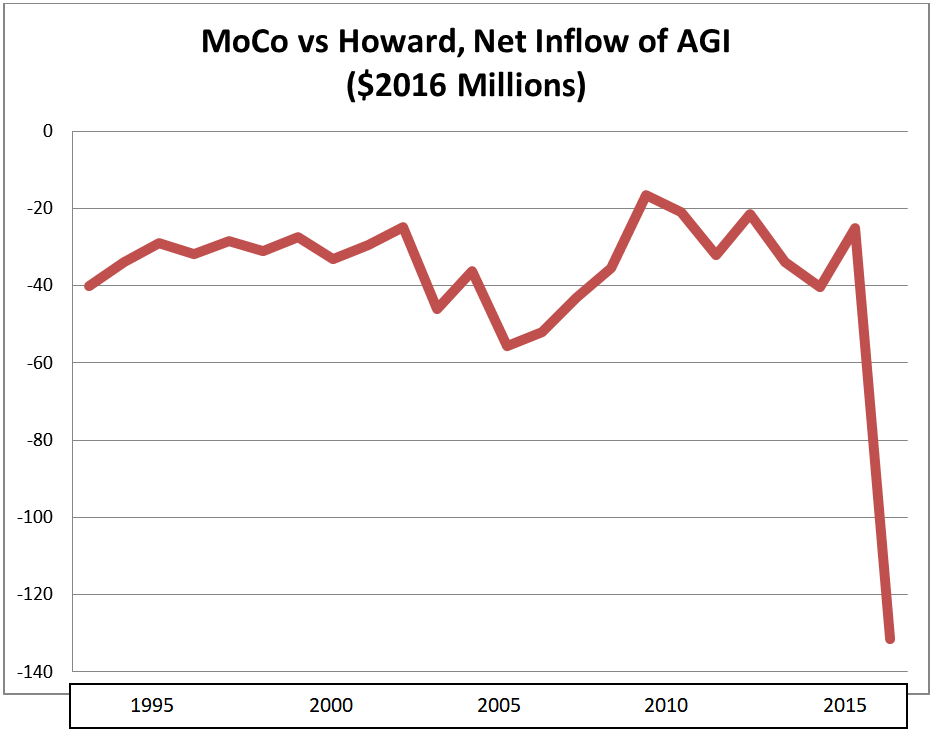
Net change in tax returns, 2006-2016: -2,859 (outflow)
Net change in adjusted gross income ($2016), 2006-2016: -$400 million (outflow)
Adjusted gross income of in-migrants ($2016), 2006-2016: $72,231
Adjusted gross income of out-migrants ($2016), 2006-2016: $90,724
Migrant income gap: Out-migrants earned 26% more than in-migrants
Howard is MoCo’s smaller and wealthier neighbor to the northeast. It gains relatively small amounts from MoCo every year but set a record in 2016, when $131 million of taxpayer income left MoCo for Howard. Howard’s schools and quality of life are comparable to MoCo but its significant distance from D.C. has limited its ability to compete for people who work downtown. Ironically, the joint bus rapid transit route on US-29 that MoCo is working on with Howard could help remedy that disadvantage.
Fairfax County
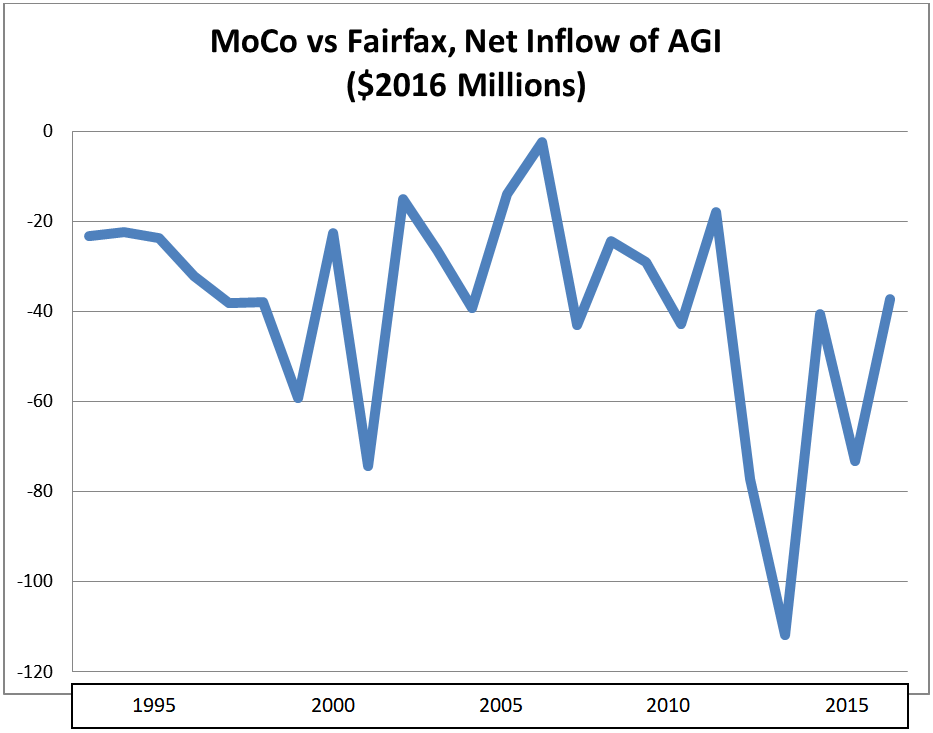
Net change in tax returns, 2006-2016: -2,382 (outflow)
Net change in adjusted gross income ($2016), 2006-2016: -$497 million (outflow)
Adjusted gross income of in-migrants ($2016), 2006-2016: $70,796
Adjusted gross income of out-migrants ($2016), 2006-2016: $93,521
Migrant income gap: Out-migrants earned 32% more than in-migrants
Fairfax has had more taxpayer flight than MoCo overall and is losing a ton of income to Loudoun ($2.5 billion over the last decade). But in head-to-head competition, Fairfax siphons millions in taxpayer income from MoCo every year, setting a record in 2013 with a net gain of $112 million. A big reason for Fairfax’s gains is that the people who move from MoCo to Fairfax made 32% more money than those who moved in the opposite direction over the last decade.
Frederick County

Net change in tax returns, 2006-2016: -7,170 (outflow)
Net change in adjusted gross income ($2016), 2006-2016: -$582 million (outflow)
Adjusted gross income of in-migrants ($2016), 2006-2016: $59,150
Adjusted gross income of out-migrants ($2016), 2006-2016: $69,017
Migrant income gap: Out-migrants earned 17% more than in-migrants
MoCo’s smaller neighbor to the north has been feeding off the county for years. Frederick’s biggest gains from MoCo occurred from 2002 through 2007 during the latter’s housing price boom. Frederick is not siphoning off anywhere near the amount of income that Loudoun is getting from Fairfax, but the inflow of people from MoCo has helped change its county seat’s downtown, its demographics and its politics.
Virginia
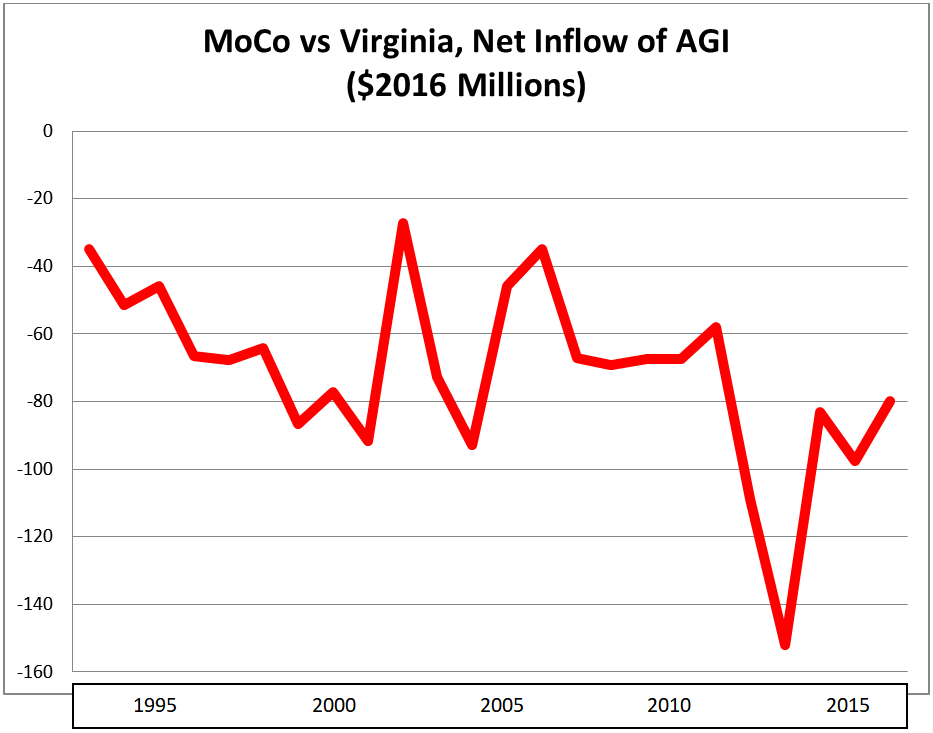
Net change in tax returns, 2006-2016: -5,638 (outflow)
Net change in adjusted gross income ($2016), 2006-2016: -$851 million (outflow)
Adjusted gross income of in-migrants ($2016), 2006-2016: $70,701
Adjusted gross income of out-migrants ($2016), 2006-2016: $83,010
Migrant income gap: Out-migrants earned 17% more than in-migrants
MoCo has lost significant amounts to Virginia over the years, with the biggest income losses occurring in 2013 ($152 million) and 2012 ($109 million). Fairfax is the biggest culprit, followed by Loudoun and the rest of Northern Virginia. The pace of income lost has picked up considerably since the early 1990s.
Florida
Net change in tax returns, 2006-2016: -2,769 (outflow)
Net change in adjusted gross income ($2016), 2006-2016: -$907 million (outflow)
Adjusted gross income of in-migrants ($2016), 2006-2016: $70,112
Adjusted gross income of out-migrants ($2016), 2006-2016: $132,459
Migrant income gap: Out-migrants earned 89% more than in-migrants
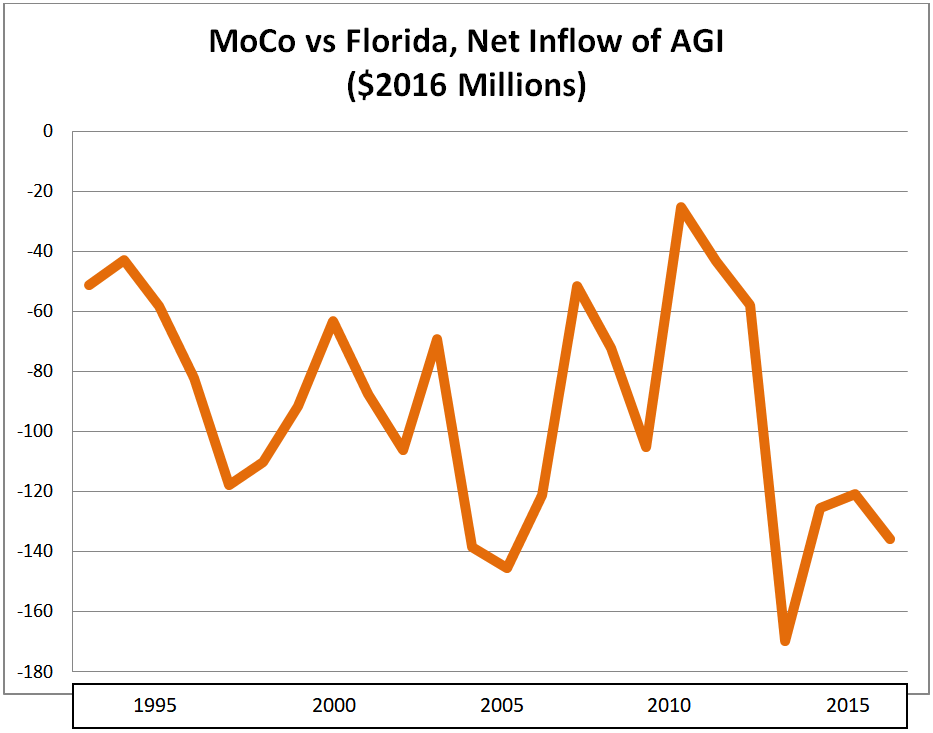
Everyone has heard the stories of rich people and/or retirees moving from MoCo to Florida. Well, those stories might be true: more MoCo income has been lost to Florida than to Virginia over the last decade. The number of people moving to Florida is less than those moving to Virginia. But the average income of those moving from MoCo to Florida – $132,459 – is large in both absolute terms and when compared to those moving in reverse ($70,112). One more thing: the last four years saw the biggest net loss of taxpayer income to Florida ($552 million) of any four-year period on record.
Washington Post Endorsements Should be Coming Out Soon
By Adam Pagnucco.
Most influential endorsements have been made in our state and local races but one big one still has to drop: the Washington Post. In contested races for Executive and County Council over the last three cycles, the Post has gone 18-7 – a 72% win rate. Its misses included Howie Denis (Council D1, 2006), Mike Subin and Bo Newsome (Council At-Large, 2006), Royce Hanson (Council District 2, 2010), Duchy Trachtenberg (Council At-Large, 2010), Tom Moore (Council District 3, 2014) and Evan Glass (Council District 5, 2014). Other than maybe Newsome, all of these were credible candidates and three (Denis, Subin and Trachtenberg) were incumbents. In 2014, the first mid-term year in which Maryland had a June primary, the Post endorsed for Executive on May 2, for County Council on May 26 and for General Assembly on May 30. Candidates are eager for the Post to endorse sooner rather than later because they would like to add the endorsement to their yard signs, mail and walk lit.
We know that the Post has been interviewing Executive and County Council candidates. We would not be surprised if their endorsement for Executive comes out in a matter of days.
Taxpayer Flight from MoCo, Part Four
By Adam Pagnucco.
In Part Three, we saw that MoCo’s problem of taxpayer flight is shared by most jurisdictions in the Washington region. But what happens when we look at MoCo’s taxpayer inflows and outflows to and from each of its large neighbors? From whom does MoCo gain income on net? And to whom does MoCo lose income on net?
We looked at net gains and losses between MoCo and nine other local jurisdictions plus two states. Let’s start with the two jurisdictions from which MoCo has net gains of taxpayer income: D.C. and Prince George’s.
District of Columbia
Net change in tax returns, 2006-2016: +1,070 (inflow)
Net change in adjusted gross income ($2016), 2006-2016: +$417 million (inflow)
Adjusted gross income of in-migrants ($2016), 2006-2016: $94,696
Adjusted gross income of out-migrants ($2016), 2006-2016: $83,038
Migrant income gap: In-migrants earned 12% more than out-migrants
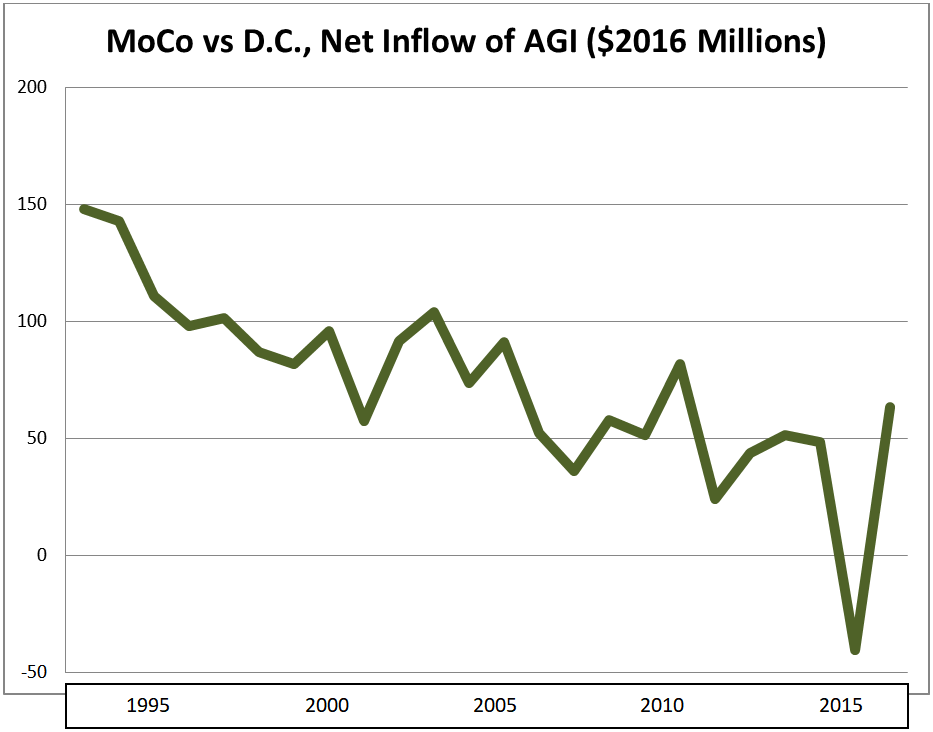
MoCo almost always drains tens of millions of dollars in taxpayer income each year from D.C. That’s because it gets more in-migrants from D.C. than out-migrants and the in-migrants make more. This fits a pattern of young people living in D.C. and then moving to the suburbs as their incomes grow and they are ready to have kids. However, as D.C.’s economy has improved since the 1990s, the District’s net income flow to MoCo has diminished over time. In 2015, D.C. even netted a gain of $40 million from MoCo, the first time the District ended up on the plus side of this ledger since this data series began in 1993.
Prince George’s County
Net change in tax returns, 2006-2016: +834 (inflow)
Net change in adjusted gross income ($2016), 2006-2016: +$39 million (inflow)
Adjusted gross income of in-migrants ($2016), 2006-2016: $42,894
Adjusted gross income of out-migrants ($2016), 2006-2016: $42,802
Migrant income gap: In-migrants earned about the same as out-migrants
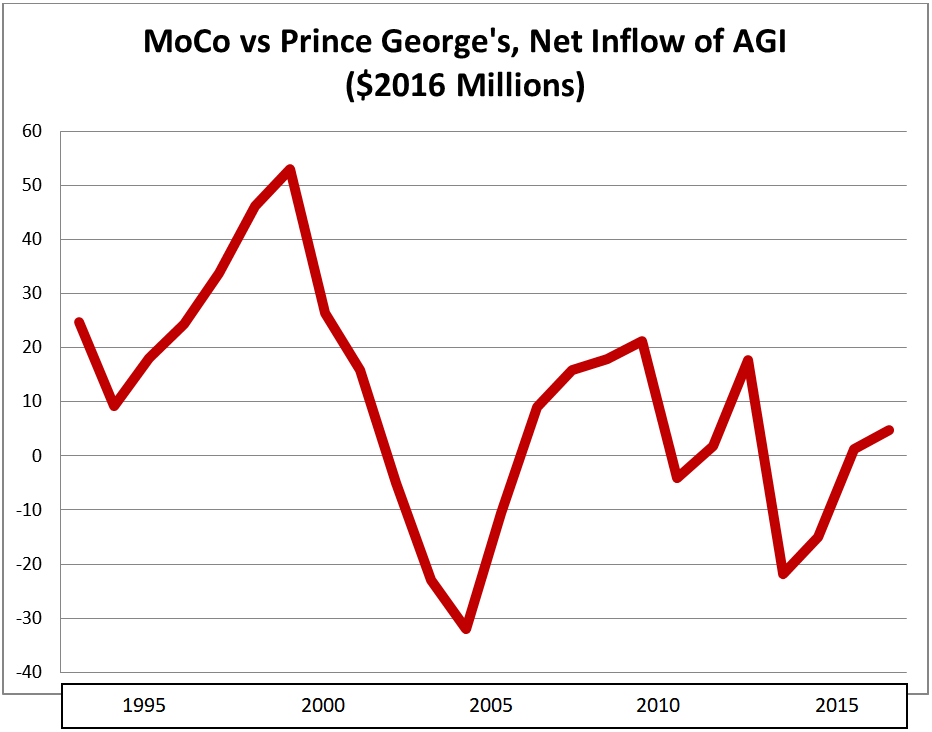
In the 1990s, MoCo consistently enjoyed positive income inflows from Prince George’s, but that began to change in the 2000s. In the last fifteen years, MoCo lost money to Prince George’s seven times. MoCo may still have a slight advantage but it’s very tenuous and could slip away.
Alexandria City
Net change in tax returns, 2006-2016: -346 (outflow)
Net change in adjusted gross income ($2016), 2006-2016: -$7 million (outflow)
Adjusted gross income of in-migrants ($2016), 2006-2016: $78,961
Adjusted gross income of out-migrants ($2016), 2006-2016: $73,304
Migrant income gap: In-migrants earned 7% more than out-migrants
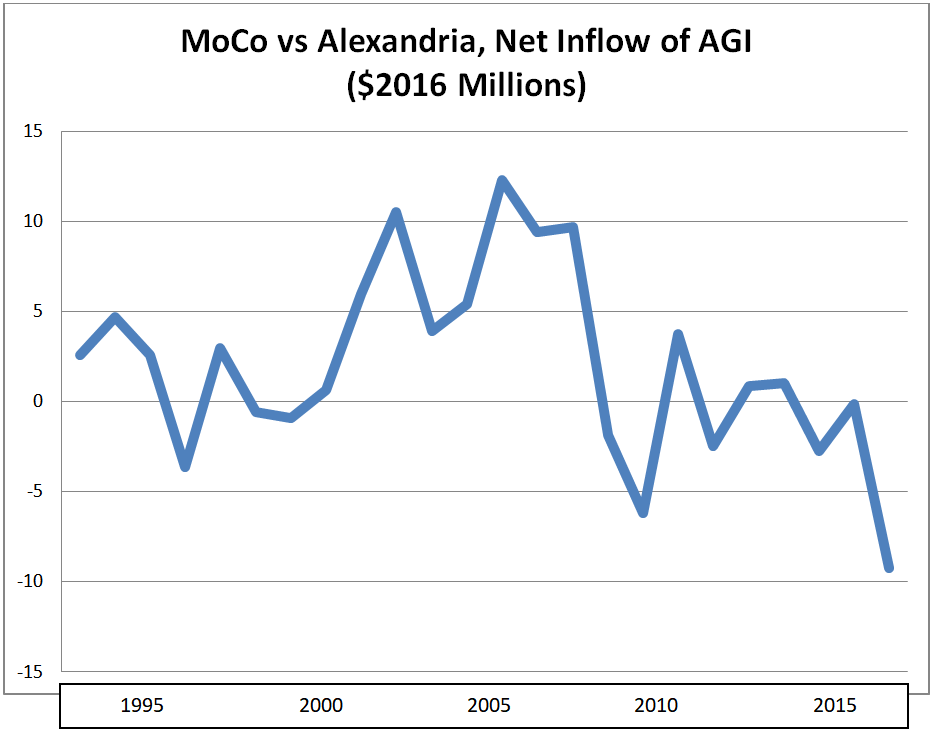
There’s not a ton of migration between MoCo and Alexandria and the two jurisdictions roughly break even, although MoCo’s balance has deteriorated a bit in recent years.
Arlington County
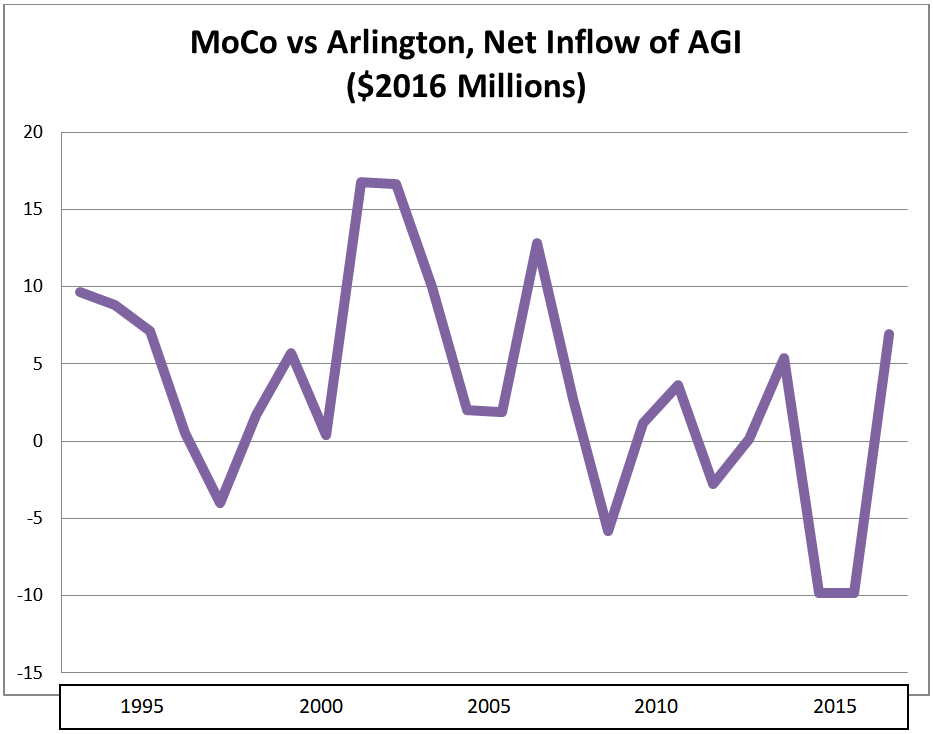
Net change in tax returns, 2006-2016: -1,103 (outflow)
Net change in adjusted gross income ($2016), 2006-2016: -$8 million (outflow)
Adjusted gross income of in-migrants ($2016), 2006-2016: $85,154
Adjusted gross income of out-migrants ($2016), 2006-2016: $72,852
Migrant income gap: Out-migrants earned 14% more than in-migrants
As with Alexandria, MoCo roughly breaks even with Arlington. Again, MoCo’s balance has gotten slightly worse in recent years.
Prince William County
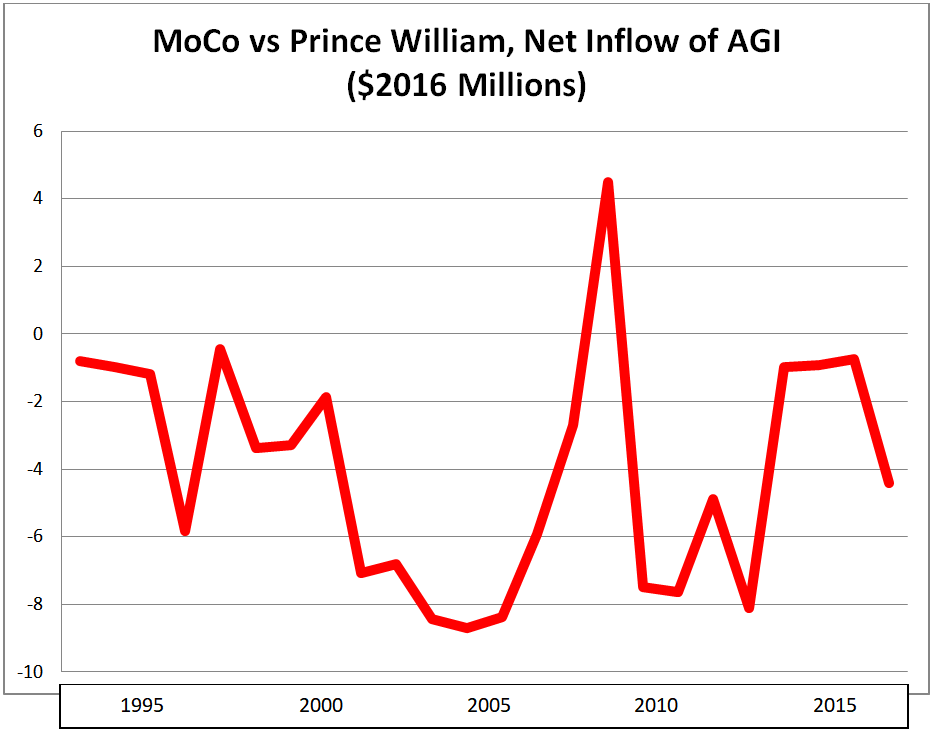
Net change in tax returns, 2006-2016: -289 (outflow)
Net change in adjusted gross income ($2016), 2006-2016: -$33 million (outflow)
Adjusted gross income of in-migrants ($2016), 2006-2016: $50,076
Adjusted gross income of out-migrants ($2016), 2006-2016: $57,436
Migrant income gap: Out-migrants earned 15% more than in-migrants
Prince William has received small inflows of income from MoCo that have diminished in recent years. Most people moving between the two counties fall in the lower end of the region’s income distribution.
We will conclude tomorrow.
Taxpayer Flight from MoCo, Part Three
By Adam Pagnucco.
In Part Two, we detailed how MoCo has experienced an exodus of taxpayer income since 1993. But MoCo is not alone: many large jurisdictions in the Washington region have suffered from taxpayer flight over the last decade.
Below is a chart showing the net change in tax returns for the ten largest jurisdictions in the region. We show net change for two time periods: the last five years (2011-2016), which include the recovery from the Great Recession, and the last ten years (2006-2016), which include the pre-recession peak, the recession itself and the recovery afterwards. MoCo ranks nine out of ten in both periods with only Fairfax faring worse. Loudoun is the only jurisdiction showing significant in-migration in the last five years while D.C. was comparable to Loudoun over the last ten years.
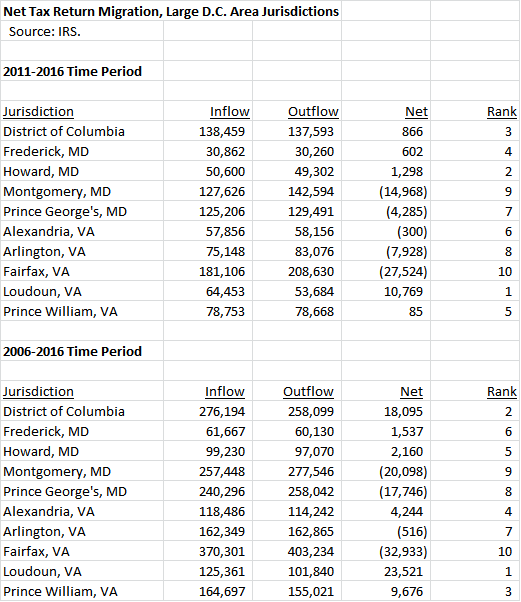
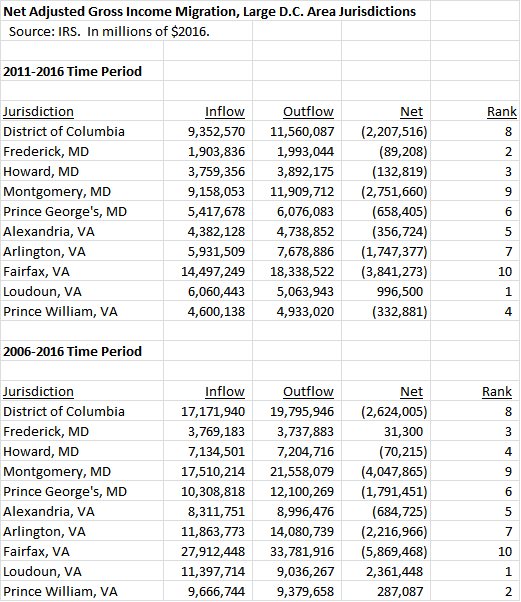
Next, we show the net change in adjusted gross income (AGI), measured in 2016 dollars, over the two periods. Once again, MoCo is the second-worst jurisdiction in the region with only Fairfax trailing. Notably, only Loudoun had a net inflow in the last five years and Loudoun, Prince William and Frederick had net inflows in the last ten years.
Finally, we show the average AGI of in-migrants vs the average AGI of out-migrants over the two periods. In every jurisdiction except Loudoun (during the 2006-2016 period), in-migrant AGI was lower than out-migrant AGI. MoCo’s gap was the third largest.
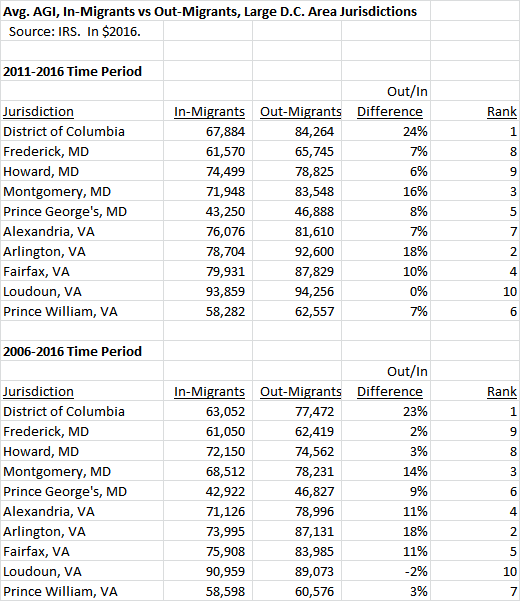
This is a bad picture for MoCo and not a very good one for the region as a whole. What is going on here?
First, as has been previously noted by George Mason Professor Stephen Fuller, the entire Washington region’s economy has slowed down since the Great Recession. That is reflected in the deterioration of the numbers above between the last five years and the last ten years. The “new normal” has not been kind to anyone in this area and that includes MoCo.
Second, Fairfax has been affected by taxpayer income losses even more than MoCo. Like MoCo, Fairfax is a huge county with huge bills to pay and nightmarish traffic congestion. But Fairfax also shares a long land border with Loudoun, which has grown dramatically in past decades and is currently the nation’s wealthiest county. Of the $5.9 billion that Fairfax lost to taxpayer flight in the last decade, $2.5 billion went to Loudoun.
Third, in addition to the number of taxpayers leaving on net, MoCo’s problem is the big gap in income between those coming in and those leaving. One would expect to see such a gap in places like D.C. and Arlington, the two jurisdictions with the biggest income gaps shown above. That’s because both places attract lots of young people who work in and near downtown D.C. and then move out when they earn more and have kids. That explanation does not work well for MoCo, which has a much lower percentage of young people in its population than D.C. or Arlington. And yet MoCo’s gap, which is third in the region, has been significantly bigger than the gaps in Fairfax and Howard, two jurisdictions of similar wealth, in the last five years.
We have seen how MoCo compares to its large neighbors in tax migration overall. But what about direct inflow and outflow relationships? To whom does MoCo lose income? And from whom does MoCo gain income? We will begin examining that in Part Four.
Frick Fries the Council
Taxpayer Flight from MoCo, Part Two
By Adam Pagnucco.
As we stated in Part One, the IRS tracks the inflow and outflow of returns, exemptions and adjusted gross income (AGI) for all states and counties. Comparable data starts in 1993 and continues through 2016. Here is what that data looks like for Montgomery County.
First, let’s look at the inflow and outflow of tax returns, which approximate the number of households.
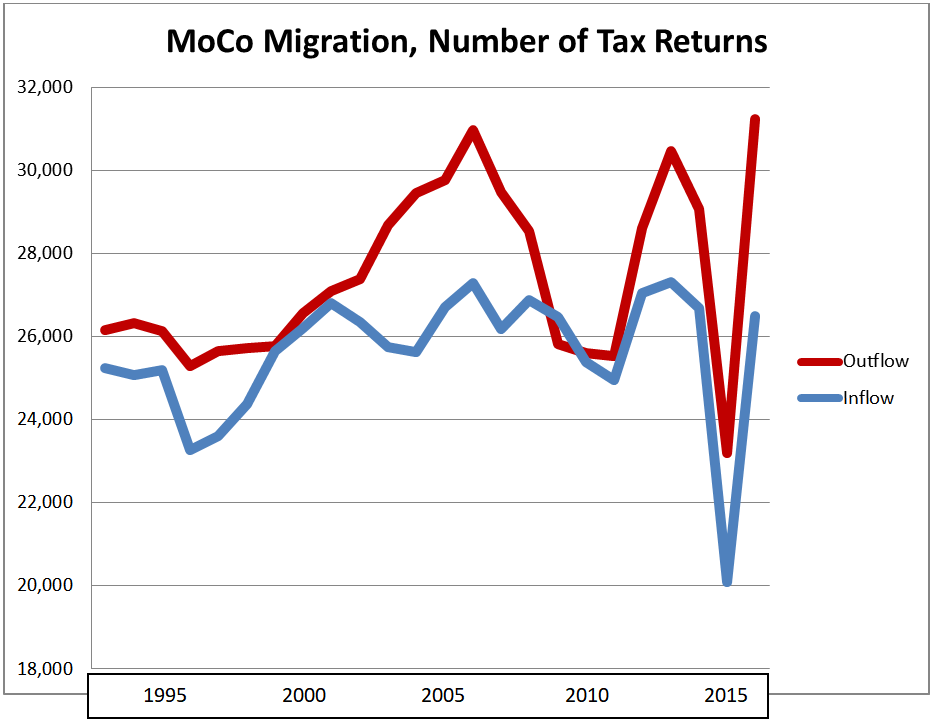
For most years, the number of tax returns leaving has exceeded the number of tax returns entering. The chief exceptions have occurred during economic downturns, especially in the aftermath of the Great Recession. We are skeptical of the data for 2015: there is no apparent explanation for the enormous drop in both inflow and outflow in that one year. We saw those drops in every local jurisdiction we examined and they did not seem to produce huge swings in net changes, as we will see.
Below is the net change of tax returns (inflow minus outflow).

The net migration of tax returns – inflow minus outflow – tends to shrink during recessions but it is almost always negative. Since 1993, there was only one year when inflow exceeded outflow – 2009, when tax return migration was +658. In 2016, outflow exceeded inflow by 4,748 returns – the worst year on record. The migration of exemptions, in and out, has followed similar patterns.
Now let’s look at the migration of adjusted gross income (AGI). The chart below shows the total AGI of taxpayers migrating into Montgomery County and out of Montgomery County, adjusted for inflation and measured in millions of 2016 dollars.
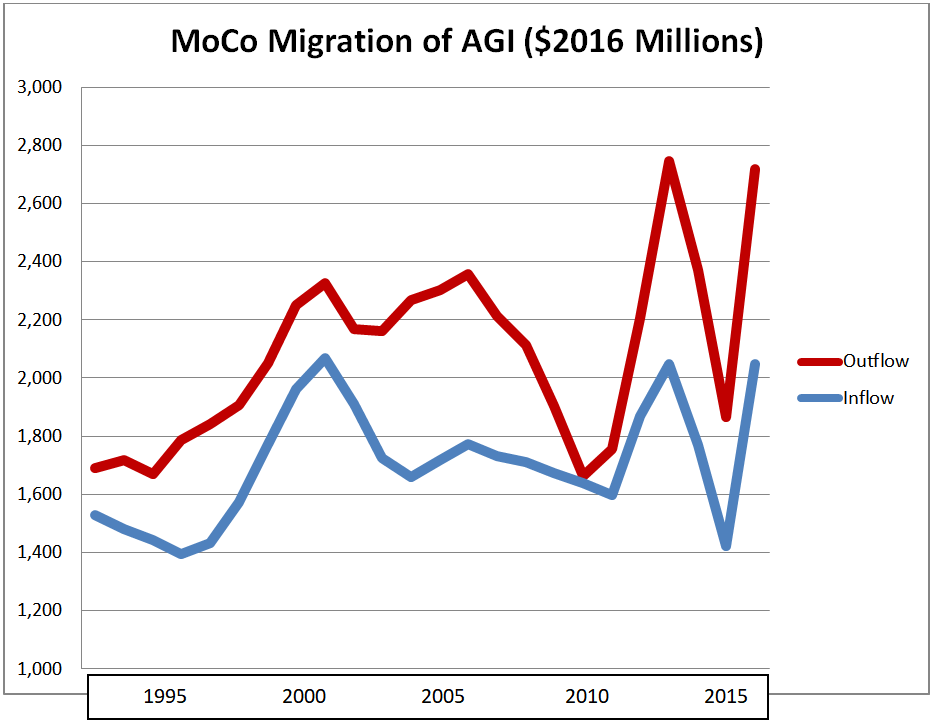
Outflow has exceeded inflow in every year. Note, once again, the fluky data for 2015. Below is the net change, adjusted for inflation, in millions of 2016 dollars.

Every year has seen a net loss of adjusted gross income. The year which came closest to a wash was 2010, when $24 million was lost. The worst losses on record were in 2004 ($608 million), 2013 ($697 million), 2014 ($601 million) and 2016 ($672 million). Over the five-year period of 2011 through 2016, $2.75 billion of taxpayer income left Montgomery County on net.
The IRS data tells one more story. Thousands of taxpayers enter MoCo and thousands leave MoCo every year. But on average, those who enter have lower adjusted gross incomes than those who leave. The chart below shows the average AGI of in-migrants and out-migrants in 2016 dollars.
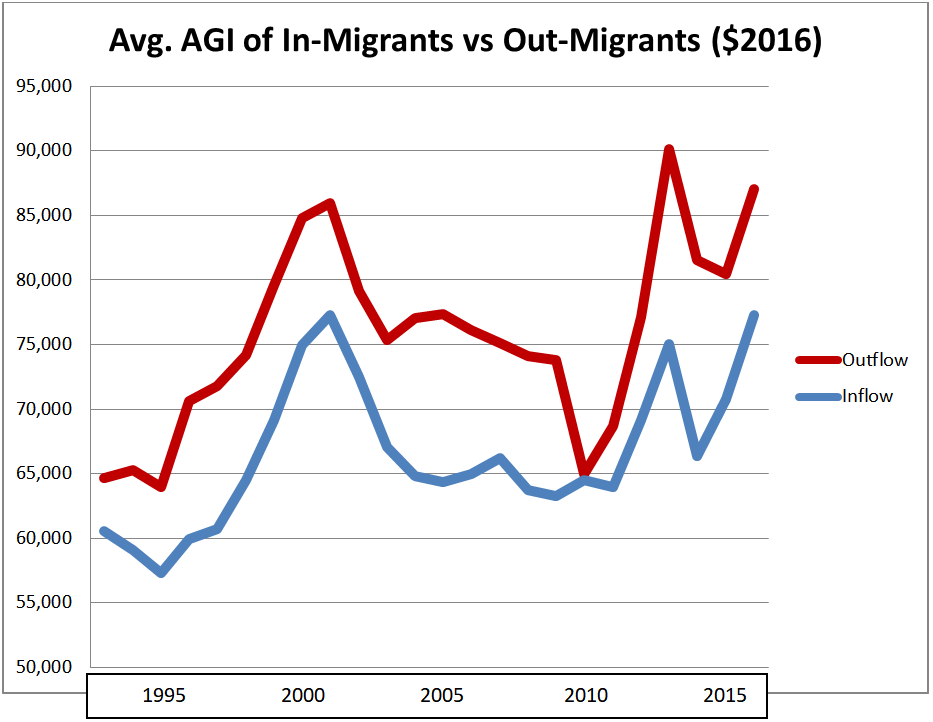
Since 1993, out-migrants have had greater adjusted gross incomes than in-migrants by an average of 14%. In the 2011 to 2016 period, the average AGI of in-migrants was $71,707 in 2016 dollars while the average AGI of out-migrants was $83,262 – a gap of 16%.
One can only imagine the impact on the county’s budget when hundreds of millions of dollars in taxpayer income leave every year.
Montgomery County is not the only jurisdiction in the region to see a net exodus of taxpayer income. We will examine how MoCo compares to its large neighbors in Part Three.
SEIU Local 500 Endorses “Take a Hike Mike” Candidates
By Adam Pagnucco.
As part of its campaign against Senate President Mike Miller, SEIU Local 500 has endorsed eleven State Senate candidates whom it believes will “change the leadership in the State Senate and, most importantly, change the way things are done in the legislature.” One of the candidates is Tommi Makila, Miller’s primary election opponent. The union has previously announced its support for some of these candidates, like Dana Beyer in District 18 and its own member, Aletheia McCaskill, in District 44. We reprint the union’s press release below.
*****
For Immediate Release
May 7, 2018
Contact: Christopher Honey
honeyc@seiu500.org,
SEIU Local 500 Endorses eleven “Take a Hike Mike” Candidates
Union is supporting candidates that support new leadership in Annapolis
(Gaithersburg, MD) Today, Service Employees International Union Local 500 announces it has selected its initial eleven candidates across the State of Maryland whom they believe will go to Annapolis and change the leadership in the State Senate and, most importantly, change the way things are done in the legislature.
“We need to elect people who will stand up against the status quo in the State Senate. That is why, today we are announcing our support for a team of Senate candidates who will do what it takes to get the people’s business done” said Merle Cuttitta, President of SEIU Local 500.
“We will be supporting this team of candidates with our trademark boots on the ground, digital, paid mail and earned media. We intend to send the message loud and clear that a vote for these candidates is a vote for progress in Annapolis,” added President Cuttitta.
The following candidates are being endorsed today:
District 10 (Baltimore County) – Rob Johnson
District 11 (Baltimore County) – Sheldon Laskin
District 18 (Montgomery County) – Dr. Dana Beyer
District 23 (Prince Georges County) – Tim Adams
District 25 (Prince Georges County) – Delegate Angela Angel
District 27 (Prince Georges, Calvert and Charles Counties) – Tommi Makila
District 40 (Baltimore City) – Delegate Antonio Hayes
District 41 (Baltimore CIty) Senator Jill Carter
District 43 (Baltimore City) Delegate Mary Washington
District 44 (Baltimore City and County) – Aletheia McCaskill
District 45 (Baltimore City) – Delegate Cory McCray
* * *
The Progressives’ Big Gamble
By Adam Pagnucco.
One of the more remarkable things occurring in MoCo this cycle is the snowballing of progressive groups around District 3 County Council challenger Ben Shnider. Just look at our latest endorsement chart. Shnider, who was virtually unknown a year ago, has collected about as many progressive endorsements as much better known politicians like Council Members Hans Riemer and Nancy Navarro, Delegate Ana Sol Gutierrez (running for Council District 1) and Council At-Large candidate Will Jawando. That’s a challenge for Shnider’s opponent, incumbent Council Member Sidney Katz, but it’s a challenge for the progressive groups too.
Sidney Katz is an odd target for progressives – and basically anyone else. Consider this: he has been an elected official at the municipal or county levels for forty years and no one dislikes him. Generations of Gaithersburg residents think of him as Dad, an uncle or Grandpa. No one would paint him as a conservative – for Heaven’s sake, he voted for a nine percent property tax hike along with the rest of the council two years ago. He has also voted for nearly every other progressive initiative passed by the council, including more school funding, more non-profit support, bills establishing sick leave and parental leave and almost everything else.
But there is one glaring exception: Katz was one of four Council Members who voted against the 2016 minimum wage bill which was then vetoed by County Executive Ike Leggett. That bill had incredible symbolic importance for many of MoCo’s liberal groups, who viewed it as a litmus test for determining which elected officials were true progressives. Katz’s efforts to forge a compromise and get a different version of the bill passed later did not mollify the left. For them, the damage was done. And someone’s head had to roll. But whose?
Four Council Members – Katz, Roger Berliner, Nancy Floreen and Craig Rice – voted against the first bill and Leggett vetoed it. Leggett and Floreen are term-limited and retiring. Rice has only token opposition in his Democratic primary. Berliner is running for Executive, an election in which progressive groups would be aligned with minimum wage lead-sponsor Marc Elrich regardless of the bill vote. That left Katz, the only opponent of the original bill against whom the left had a clear shot. And in Ben Shnider, the left has a challenger who is appealing, smart, hard-working, experienced in campaigns and an unquestioned progressive.
SEIU Local 500, a lead player in advocating for minimum wage hikes at the state and county levels, was the first major progressive group to endorse Shnider. Many more followed, including SEIU Locals 32BJ (janitors) and 1199 (health care), Progressive Maryland, the Laborers, Casa in Action, the teachers and more. The Sierra Club’s endorsement of Shnider was probably connected to another vote of Katz’s, this time against a bill banning pesticides. Katz is supported by the police and fire fighters unions, the volunteer fire fighters and the apartment and office building owners. MCGEO is the largest progressive group to not yet weigh in.
Shnider pressures Katz on the minimum wage bill.
Knocking off an incumbent is not easy. Indeed, only one Democratic district council incumbent has been defeated since the County Council’s current structure was established in 1990 and that happened twenty years ago. In the last six times that a Democratic district council incumbent was challenged, the incumbent won by 50 or more points five times.
Ben Shnider has nothing to lose by challenging Katz. He is running a tremendous campaign and has built great relationships with the left and the smart growth community. If he loses, he could very well come back to win another election as so many other MoCo politicians have. Win or lose, Shnider will be just fine.
But what about these progressive groups? The fact that so many of them have endorsed Shnider has MoCo’s political community watching this race – especially the county’s elected officials. The left will have many priorities in the next term and some will cost serious money and political capital. If these groups actually knock off Katz – or come close – then no one will want to run afoul of them in the future. But if they do nothing other than allow Shnider to use their logos and Katz wins big, they will look weak. Other elected officials will think, “They can’t hurt me so I can do what I want.” Let’s remember that for most politicians, the main thing on their minds is ALWAYS whether a group can help them or hurt them. If you can’t do either, you just don’t matter.
The progressives are making a big gamble by targeting Sidney Katz. For their sake, it better pay off.