All posts by Adam Pagnucco

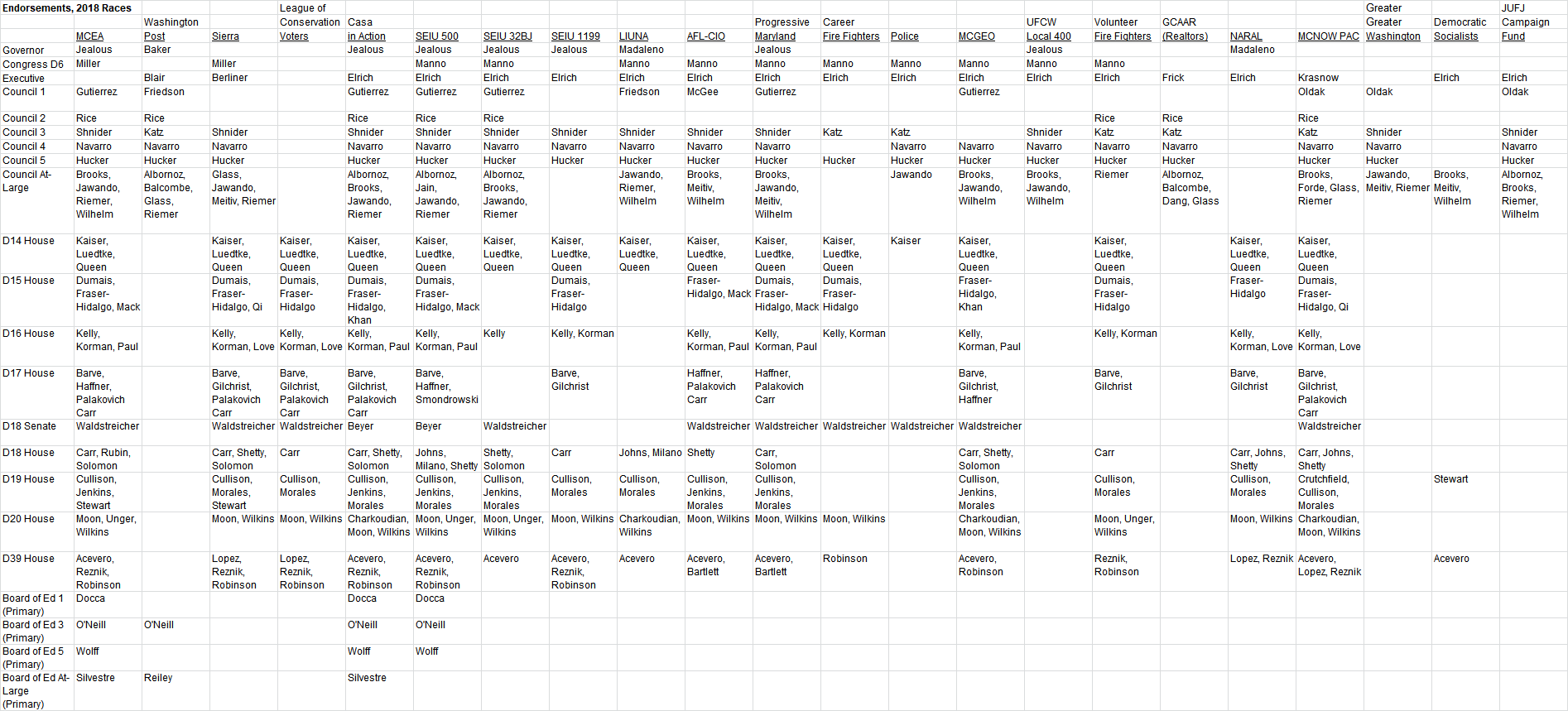
AFL-CIO Makes Endorsements in MoCo, Prince George’s Races

The Metro Washington AFL-CIO has announced endorsements in local races in Montgomery and Prince George’s Counties.  They have previously endorsed Marc Elrich for County Executive.  Following is their press release.

*****

FOR IMMEDIATE RELEASE
May 22, 2018
Contact: David Dzidzienyo, ddzidzienyo@dclabor.org

Metro Washington AFL-CIO Endorses in DC, Montgomery and Prince George’s Primaries

“With the Supreme Court ruling on Janus vs. AFSCME expected any day, political engagement by union voters is more important than ever,” said Metro Washington Council president Jackie Jeter in announcing endorsements in upcoming local primaries. “These candidates have proven their commitment to the issues that affect the working men and women of our communities and deserve the full support of the local labor movement.”

The Metro Council released endorsements in the following races: DC Mayor, Council and Attorney General; Montgomery County Council, Prince George’s County Council and Prince George’s County Board of Education.

The Metro Council also endorses Cynthia Collins (SEIU 400) for the PG Democratic Central Committee (At-Large) and Initiative 77 in the District.

District of Columbia
Mayor: Muriel Bowser
District of Columbia City Council – Chairman Candidate: Phil Mendelson
District of Columbia – Attorney General Candidate: Karl Racine
District of Columbia City Council – At-Large Candidate: Anita Bonds
District of Columbia City Council – Ward 1 Candidate: Brianne Nadeau
District of Columbia City Council – Ward 5 Candidate: Kenyon McDuffie
District of Columbia City Council – Ward 6 Candidate: Charles Allen

Prince George’s/Montgomery County
Montgomery County Council At-Large: No Recommendation
Montgomery County Council At-Large: Brandy Brooks
Montgomery County Council At-Large: Danielle Metiv
Montgomery County Council At-Large: Chris Wilhelm
Montgomery County District 001: Jim McGee
Montgomery County District 003: Ben Snyder
Montgomery County District 004: Nancy Navarro
Montgomery County District 005: Tom Hucker

Prince George’s County Council At-Large
Prince George’s County Council At-Large: Gerron Levi
Prince George’s County Council At-Large: Karen Toles
Prince George’s County District 001: Tom Dernoga
Prince George’s County District 002: Deni Tavaras
Prince George’s County District 005: No Recommendation
Prince George’s County District 006: No Recommendation
Prince George’s County District 007: No Recommendation
Prince George’s County District 008: Tony Knotts
Prince George’s County District 009: Sidney Harris

Prince George’s County Board of Education
Prince George’s County District 002: Joshua M. Thomas
Prince George’s County District 003: Juwan Blocker
Prince George’s County District 006: Pat Fletcher
Prince George’s County District 009: Arun Puracken

Share

This Has to Change

By Adam Pagnucco.

Going into this year’s budget deliberations, the County Council was told two important things.

First, county budget director Jennifer Hughes wrote the following on April 5.

The County Executive’s recommended budget, released on March 15, 2018, closed a $208 million budget gap, raising the cumulative amount of budgetary shortfalls resolved in County Executive Leggett’s proposed budgets to more than $3.7 billion. Due to many economic pressures, the shortfalls between projected budget demands and projected revenues will likely continue into the foreseeable future. Our income tax revenues are projected to grow only modestly and the economic recovery continues to be modest and fitful. Additionally, we have not yet adjusted our revenue projections to reflect the effects of H.R. 1, the Tax Cuts and Jobs Act of 2017 (TCJA). There will be an impact on our revenues due to TCJA although the magnitude of the impact is uncertain at this time.

Second, the council’s own senior legislative analysts wrote this on April 27.

FY18 tax revenue is now estimated to be $106.1 million below the FY18 approved budget, and $11.1 million below the estimate from December’s estimate. FY19 tax revenue projections are $76.8 million below the FY19 projections made less than one year ago.

So shortfalls “will likely continue into the foreseeable future” because the economic recovery is “modest and fitful.”  The GOP’s federal tax law could be a problem.  And next year is already projected to see a $76.8 million shortfall after this year’s shortfall, which was over $100 million.

Suppose you were an elected official reading that information.  What would you do?  Perhaps you might say, “Wow, things are kind of tight.  We need to cut back a little because if there is a downturn, we are going to have a problem.”

That’s not what happened.  Instead, the council tapped a total of $77.7 million in one-time fund transfers to finance ongoing spending both this year and next year.  Here are the one-shot revenue sources we know about:

$62.4 million in retiree health fund money (for FY18)

$4 million from the Public Election Fund (FY19)

$10.5 million from the Employee Health Benefit Self Insurance Fund (FY19)

$800,000 inter-fund from Park and Planning (FY19)

$77.7 million total

Believe it or not, there could have been more.  There were serious discussions of financing additional spending by tapping into retiree health money a second time.

The council was justified in taking money out of the Public Election Fund since its balance ($11 million) far exceeds the likely total cost of public financing this cycle.  But the $10.5 million transfer out of the county employees’ health insurance fund is problematic since it contains premiums paid by employees in addition to taxpayer money.  A group of employees has already sued to stop such transfers although both the Circuit Court for Montgomery County and the Court of Special Appeals have ruled against them.

This continues a pattern we have written about before: the council’s practice of using one-shot revenues to pay for ongoing spending on top of the Executive’s budget.  The council has used such methods to add many millions to the budget over the years, though it’s hard to tell exactly how much came from one-time sources because their financing methods are not posted along with the items that are added.  As a result, this is all rather opaque even for someone such as your author who used to participate in the council’s budget process.  (Yes, that makes me part of the problem!)

The council might reply by citing the fact that the county has enjoyed a triple-A bond rating for a long time.  That’s true.  There is much to recommend about the county’s financial practices, including its top-notch pension plan funding ratio (currently 92%) and its reserve ratio, now close to ten percent of revenues.  But the bond rating agencies care primarily about one thing: can bond issuers repay their debt?   Because the county contains a subset of very wealthy neighborhoods and has demonstrated a repeated willingness to raise taxes on them (along with the rest of us), we have a pretty low risk of default.  That probably allows us to get away with using band-aids a little more than some other triple-A jurisdictions that have less resources , like Prince George’s.

Ultimately, the bond ratings agencies’ interests are not identical to county residents.  The ratings agencies are perfectly happy to see more tax hikes that go to debt service.  They are less concerned with whether residents get better services to go along with higher taxes.  That’s our business.  And here is what is happening, folks.  The economy is not as great as our elected officials say it is.  Even Ike Leggett’s own budget director says, “the economic recovery continues to be modest and fitful.”  The county is resorting to band-aids, transfers and using money that is supposed to go to health insurance to add more ongoing spending.  Eventually, if it keeps doing such things, those options are going to dry up when the next recession comes.  And if the next downturn is bad enough, there will be three options on the table.

Raise taxes – again

Lay off county employees

Lose the bond rating

This has to change.  We need elected officials who can prioritize spending and exercise restraint now to head off problems later.  If you agree, remember that on Election Day.

Share

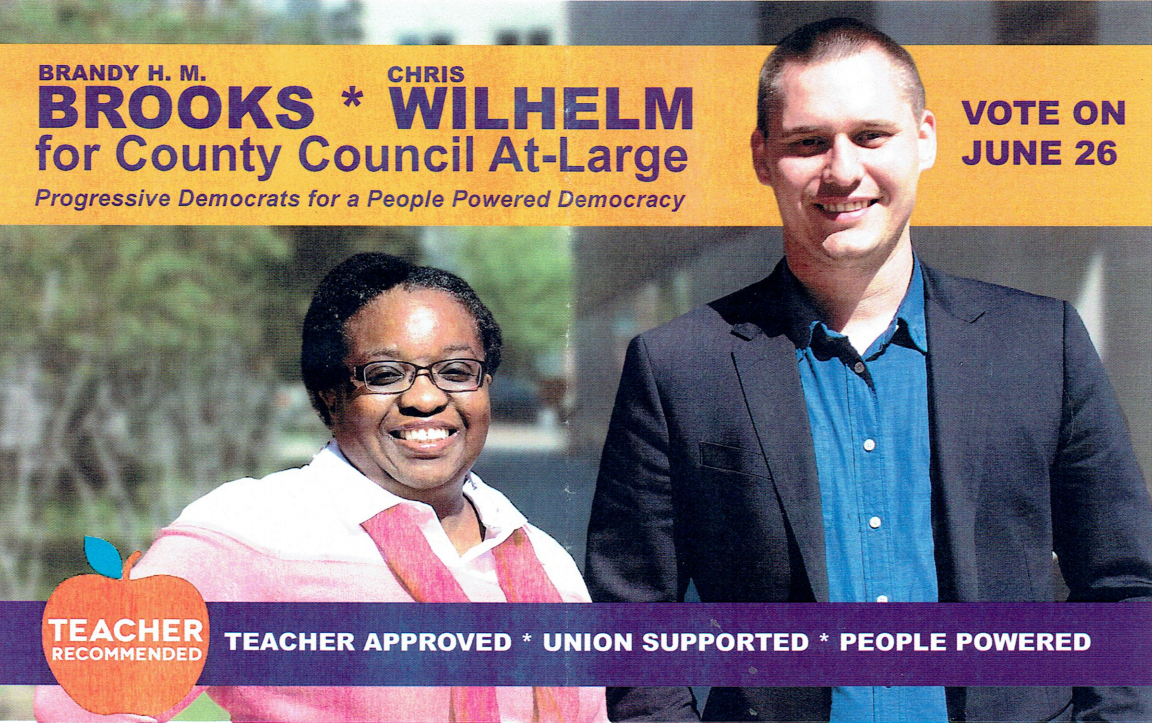
Brooks and Wilhelm Campaign as Team Progressive

By Adam Pagnucco.

Council At-Large candidates Brandy Brooks and Chris Wilhelm, both of whom have been endorsed by numerous progressive organizations, have produced a joint lit piece in which they call themselves #TeamProgressive.  Candidates in public financing, like Brooks and Wilhelm, cannot be members of slate committees.  But nothing in the public financing law prohibits them from producing joint lit with multiple authority lines, as this piece is.  This is the first joint lit piece we have seen in the council at-large race.

Share

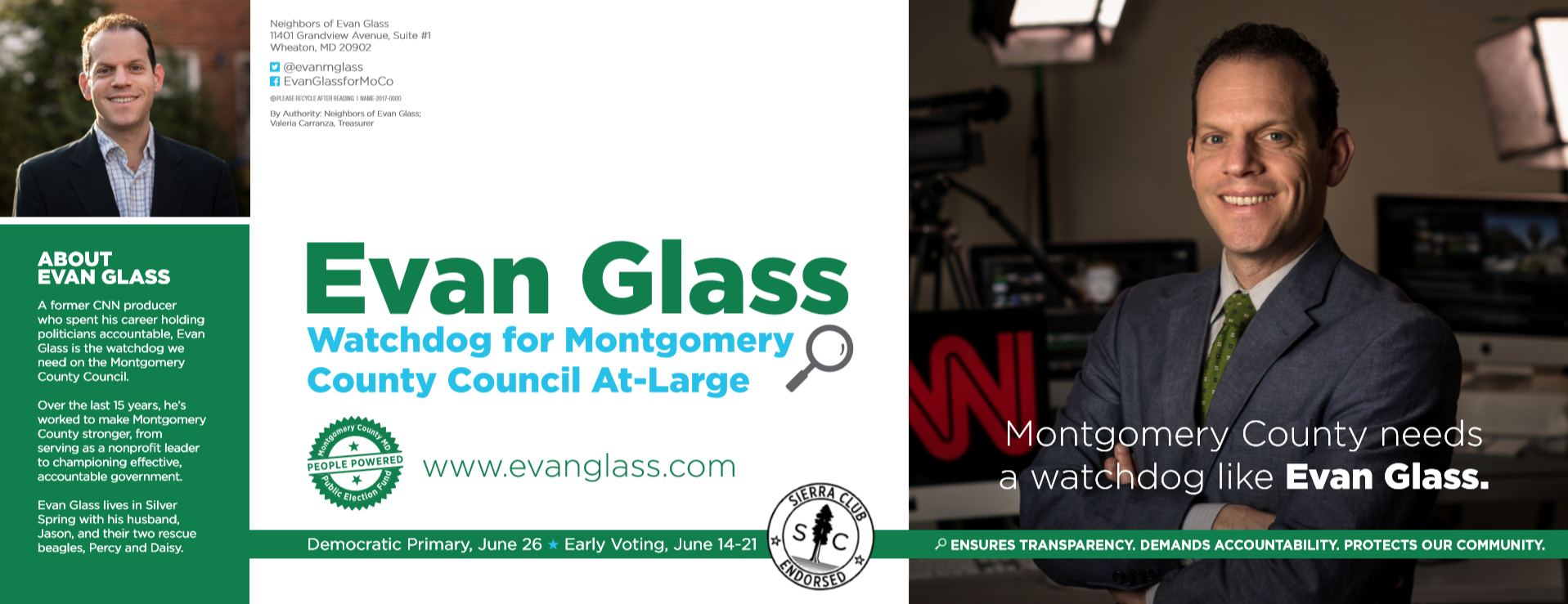
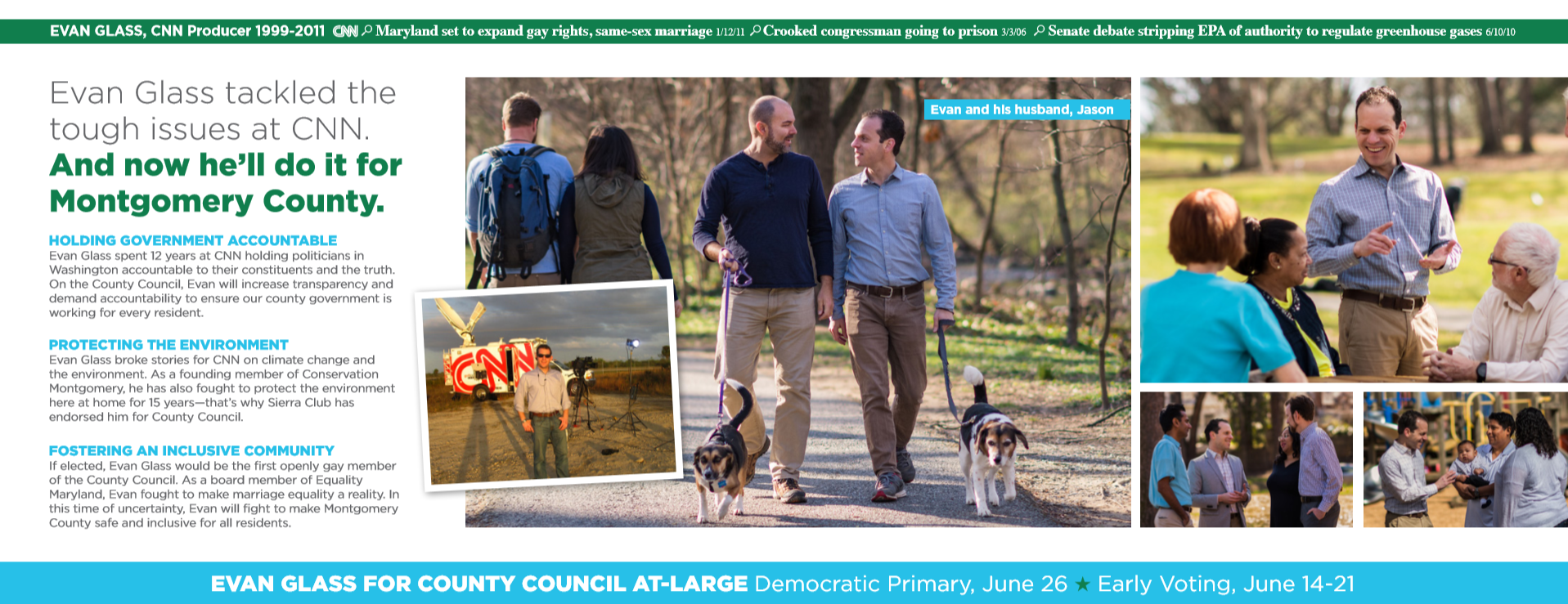
Evan Glass, Watchdog

By Adam Pagnucco.

Council At-Large candidate Evan Glass has sent out a mailer drawing on his journalistic background and saying he will be a watchdog if elected.  We could use a watchdog in the aftermath of the Silver Spring Transit Center fiasco!  We are particularly amused by Glass’s citation of a story on which he worked called “Crooked congressman going to prison.”  We think incoming Council President Nancy Navarro should establish a new council committee to investigate crooked congressmen and make Glass its chair.  It will be the busiest committee at the council by far!

Share

Ike Leggett’s Greatest Achievement

By Adam Pagnucco.

As the primary election approaches and the six Democratic candidates for County Executive make their case, it’s worth considering the incumbent they are seeking to succeed: Ike Leggett.  The county’s steady helmsman is approaching the end of a thirty-year career in politics and he deserves much respect for his knowledge, temperament and savvy.  But it is Leggett’s greatest achievement that sets an example for all who follow him and poses an important lesson for the next term.

Simply put, Ike Leggett saved the county from financial disaster.

When Leggett assumed office in December 2006, he was determined to cut back the rate of budget growth overseen by his predecessor, Doug Duncan.  In his first budget, Leggett proposed giving MCPS $19.7 million less than its request.  That was still a $117 million increase over MCPS’s prior-year budget, but it was a smaller increase than the schools wanted and the education community revolted.  The council worked it out.  The following year, Leggett proposed a big property tax hike which was mostly passed by the council.  These events may seem unrelated, but they weren’t: Leggett smelled trouble coming and he was battening down the hatches.

And boy, did trouble come.  In 2010, the Great Recession hit the county’s economy and budget with a fury that no one in government had seen before.  Leggett proposed what was then the ugliest budget of all time.  It included hundreds of millions in cuts and double-digit reductions in many departments.  750 work years were reduced through attrition and position abolitions.  A fire truck and an ambulance were to be taken out of service and four police sub-stations were proposed for closure.  Employee raises were eliminated and furloughs were instituted.  Healthcare for the uninsured was reduced.  And Leggett proposed increasing the energy tax by $50 million.

The Executive didn’t sugar-coat it.  In his press release, he said:

To those who object to these reductions, I have a simple message: I do not like these any more than you do… Hard choices must be made, and not just talked about, in this difficult economic and fiscal environment.

And then, unbelievably, things got even worse.  Revenues were written down twice while Leggett’s budget was under consideration by the council.  The county’s FY10 reserves were literally dwindling to zero.  Leggett was animated by two goals: save the county’s bond rating and save as many county employees’ jobs as possible.  To do that, he was going to have to battle every group that helped him get elected.  In the end, Leggett and the County Council worked together to pass the baddest budget ever, a $4.3 billion nuke bomb that had the biggest county spending cut since the current charter was passed in 1968.  And that wasn’t the end of it – two more years of not funding collective bargaining agreements and fighting with the school system were ahead.  But the bond rating was preserved and mass layoffs were avoided, laying the groundwork for recovery.

This was the county’s worst hour.  It was Ike Leggett’s finest hour.

Leggett didn’t do all this alone.  The council stayed with him and all ten of them jumped off the ledge together.  But as the Executive, Leggett’s role was absolutely critical.  He could have pointed fingers at Council Members who voted for earlier large budget increases, thereby blowing up the teamwork between the two branches that was critical to getting through the crisis.  He did not.  He could have papered over the problems with band-aids and said next year would be better.  That would have been very tempting for Council Members to go along with – let’s remember that 2010 was an election year.  He did not.  He simply told the truth and made the hard choices the voters paid him to make.  And in the end, it worked out.

Your author has had many policy differences with the administration over the years and the Executive is leaving significant unfinished business for his successor, as all Executives have done.  But let’s recognize a central truth.  Leaders are not remembered for doing twenty small things really well or maybe not so well.  They are remembered for how they deal with a crisis.

Ike Leggett passed that test.

And now we are charged with picking Leggett’s successor.  The economy is not healthy enough to pay our bills and the county is now resorting to quick fixes to balance the budget.  The entire Washington region is not as strong as it once was.  Most ominously, since the average business cycle lasts 5-6 years, we are due for a recession during the next term.  That doesn’t guarantee that the next one will be as bad as the earth-shattering Great Recession, but it won’t be fun.  The voters are about to make a judgment on which group of elected leaders will deal with our coming challenges.  Bearing in mind the example set by Leggett, who deserves your support?  There are important policy issues at hand, but on the personal traits of the candidates, here are a few ideas.

Vote for adults.  We will be well served by people who do their homework, take their responsibilities seriously and are willing to do the thankless chore of reading hundreds of pages of dreary, bureaucratic reports on everything the county does.  People who are not interested in that kind of drudgery will not be equipped to make tough but intelligent decisions.

Vote for civility.  This is one of Leggett’s greatest strengths.  Sure, he will push back on what he sees as inaccuracies or misrepresentations but he preserves his ability to work with everyone.  That paid off in a huge way during the Great Recession.  Elected officials who blow up at others won’t be able to assume a unifying role in an emergency.

Vote for honesty.  If someone tells one group one thing and then tells another group something completely different, be skeptical about that.  Trust the person who says no when necessary and not yes every single time.  And someone who tap dances all over the place on his or her record and positions is not going to be a reliable leader at crunch time.

Most of all, vote!  And do your best to make sure that the people you pick are ready to deal with the next crisis – just as ready as Ike Leggett.

Share

MoCo Deportation Defense Proposal in Danger of Falling Through

By Adam Pagnucco.

Montgomery County’s proposal for funding legal defense of people threatened by deportation appears to be in danger of falling through.  Below is a letter from the MoCo Deportation Defense Coalition outlining what has happened.

*****

Dear Supporters of Deportation Defense Funding,

We are sorry to tell you that the County Council has acquiesced to the demands of the State’s Attorney, John McCarthy. The Council amended its special appropriation and added an extensive list of criminal convictions that would render a person ineligible for representation by the CAIR Coalition. This list, based on past convictions for which a person has already completed his/her sentence, includes misdemeanors and nonviolent offenses, not just serious felonies. In addition, the Council has acceded to McCarthy’s demands that there be almost no exceptions made to these criminal exclusions. This means that the CAIR Coalition cannot use County funds to challenge the deportation of a refugee or of someone who may be tortured upon return to their country. The resulting program would be far more restrictive than others around the country.

As a result, the CAIR Coalition is withdrawing its request for the money. The MoCo Deportation Defense Coalition supports CAIR’s decision and opposes the resolution in its current state. Join us at a press conference hosted by CASA and supporters on Monday at 1:30 pm in front of the State’s Attorney’s Office and come to the formal vote on the functionally-defunct resolution on Tuesday at 1:30 pm. Please read on for more information about why we support CAIR’s withdrawal and what you can do to show your opposition to the Council’s decision.

Why the MoCo Deportation Defense Coalition supports the CAIR Coalition’s refusal to participate in the County’s hobbled deportation defense special appropriation:

CAIR estimates that the restrictions would reduce the number of people who could be represented by approximately 70 percent. The remaining 30 percent would not necessarily be the County residents most likely to receive relief under immigration law. The restrictions would leave many County residents who could obtain relief from deportation if they had a lawyer, without one;

The Council’s program reflects an ill-informed and unjust approach to deportation defense funding that we should not support. Our criminal justice system has been shown to treat people of color and immigrants unfairly. An extensive exclusions list furthers the toxic narrative perpetuated by our President of immigrants as bad, undesirable, and irredeemable people. Deportation defense funding is about due process for all, so all people who qualify for relief under our harsh immigration laws can have a fair shot at getting it, regardless of their ability to pay for a lawyer;

The process through which the resolution was amended reflects a dangerous and undemocratic approach to policy-making. The County’s lead prosecutor, an elected official who is not a member of the County Council and has no expertise in immigration law, declared by fiat his requirements. McCarthy accepted almost none of the CAIR Coalition’s multiple attempts to compromise. Our Council members deferred to McCarthy despite letters and testimony by immigration experts, including former immigration judges and attorneys, arguing against criminal exclusions;

The Council’s proposed program is far more restrictive than others around the country; Baltimore’s publicly funded program has no criminal restrictions at all and Prince George’s County’s exclusions list is smaller than the list that the CAIR Coalition originally agreed to.

What Can You Do? Join Us:

Monday, May 21, 1:30 pm Press Conference @ 50 Maryland Avenue, Rockville (the Office of the State’s Attorney). Speakers will explain what happened and why John McCarthy’s involvement was inappropriate and unjust.

Tuesday, May 22, 1:30 pm Council Session to vote on the special appropriation @ 100 Maryland Avenue, Rockville (3rd Floor). We will stand silently and hold up our signs during the vote.

Bring signs to both, suggestions include: Deportation Defense: Due Process For All; No MoCo McCarthyism; Immigrants are not political pawns; No sham votes; John McCarthy Is Not A Councilmember; Due Process For All, Not For Some

Share this email with other deportation defense supporters!

We promise to keep fighting for deportation defense funding in Montgomery County with the new County Council and with private funders. We hope you will continue to join us in this fight!

In Solidarity,

The MoCo Deportation Defense Coalition

Share

On the Town of Kensington Election

From a trusted correspondent in Kensington.

For the fourth time in six years, Kensington’s town elections will be uncontested.

The first-term mayor, Tracey Furman; a first-term Town Council member, Duane Rollins, and a newcomer to Kensington politics, Bridget Hill-Zayat, are on the June 4 ballot. All will be elected to two-year terms that begin July 1.

Kensington’s mayor and Council members are chosen in non-partisan elections. The four Council members serve staggered, two-year terms.

The Council’s most senior member, 10-year incumbent Sean McMullen, is not seeking reelection. He has told associates that five terms on the Council was enough. McMullen in recent years had taken the lead in developing the Town’s annual budget.

Furman, who served two terms on the Council before being elected mayor in an uncontested election two years ago, has sought to raise the Town’s profile by encouraging and supporting civic events and promoting local businesses. Kensington, which is home to about 2,400 people, has a small downtown and a number of businesses along or near Connecticut Avenue, the six-lane artery that bisects the town.

Furman’s predecessor as mayor, Peter Fosselman, is one of eight candidates seeking the Democratic nomination for Montgomery County’s First District council seat. Fosselman’s husband is Rollins, a former business owner in Kensington who was elected to the Town Council in 2016.

Fosselman stepped down as mayor that year, saying he had encouraged Furman to run to succeed him. Furman, who has lived in Kensington nearly 40 years, announced in March her plan to seek another term.

Hill-Zayat is a lawyer whose web site says her work has focused “on the energy and cannabis industries” and that she seeks to help clients develop “successful cannabis businesses.”

The only recent competitive local elections in Kensington were last year, when a first-term Council member, Tom H. Rodriguez, was ousted by newcomer Conor Crimmins, and in 2015 when Rodriguez and Darin Bartram won election in a three-way race. Crimmins and Bartram will be up for reelection next year.

The Town plans a meet-and-greet event for this year’s candidates on May 21. The election June 4 will be at Town Hall from 6-9 p.m.

Share