All posts by Adam Pagnucco

Samir Paul Raising Money for Recount

By Adam Pagnucco.

District 16 House candidate Samir Paul, who led for most of the ballot counting over Sara Love but now trails by nine votes, is raising money to finance a recount.  We reprint his blast email below.

*****

Folks,

Sorry for the long radio silence since the election on June 26. The count is finished, and we’re currently down by 9 votes out of 55,581 cast in the race. With such a razor-thin margin, we’ll file for a recount so we can be absolutely confident every vote was counted. Thanks for your support so far.  It’s going to cost more than $15,000 in legal fees, so please help if you can manage: samirpaul.com/recount

It’s normal, I think, for a result this close to sting. But as I wrote to my campaign team 11 days ago on an uncertain election night, we overcame some absolutely massive disadvantages to run a campaign that has surprised many of the political insiders who didn’t think a middle-class, immigrant-son teacher like me could compete in a race like this. Win or lose, we definitely won.

In a race this close, every single thing we did mattered. Every door you knocked when you were tired and sweaty, every stranger you greeted at the polls when they were just slightly out of your way, every phonecall you made or email you sent or dollar you gave or tweet you tweeted or postcard you hand-wrote. All of it made this quite remarkable outcome possible, and none of that happened by accident. It happened because of YOU.

So thanks for everything you’ve done so far. If you can kick in a little more for our homestretch recount fund, please stay in the fight with us. I’ll keep you posted as we learn more and — regardless of what happens — I’ll keep fighting for a more just, inclusive, and abundant world.

Samir

Share

What We Learned About Public Campaign Financing

By Adam Pagnucco.

This past primary saw the first use of public campaign financing in local elections in Maryland.  Many people both inside and outside Montgomery County have been watching the system’s performance.  For the benefit of both MoCo policy makers as well as those in other jurisdictions who are considering adoption of this system, here are the things we have learned about public financing.

Public financing was heavily used and helped attract a record number of candidates.

Thirty-three candidates enrolled in public financing.  Four of them ran for Executive, nineteen ran for Council At-Large and ten ran in Council Districts.  Of these candidates, twenty-three qualified for matching funds – all four Executive candidates, twelve Council At-Large candidates and seven District candidates.  That’s a 70% qualification rate.  MoCo has never had as many candidates for county office as it had this year – not even close! – and public financing was partially responsible for that.  Several candidates told your author that they would not have considered running if public financing had not been available.

Candidates in public financing can win.

Of ten county-level seats, six – Council District 3, Council District 4 and all four Council At-Large seats – were won by candidates in public financing.  Three of these winners were incumbents and three were not.  The County Executive seat may also be won by a publicly financed candidate pending absentee and provisional ballot counts.

But did public financing change the outcome?

The three incumbents who used public financing and won did not need the system to win.  Of the three non-incumbents who won while using it, we predicted that two – Council At-Large candidates Evan Glass and Will Jawando – would be strong contenders more than a year ago because they had run credible races before.  The third non-incumbent public financing winner, Council At-Large candidate Gabe Albornoz, would have at least been a viable candidate in the traditional system because of his endorsement by the Washington Post and his networks in the party, the community and among Ike Leggett supporters.  The leading Executive candidate in public financing, Marc Elrich, has long outperformed his fundraising and benefited from significant outside progressive support.  In no instance can we point to public financing as THE reason a candidate who was otherwise not viable became a winner.  In fact, if all candidates had used the traditional system, it’s possible that the exact same group of them would have won.

It was cheaper than expected.

The county set aside $11 million in its public election fund on the assumption that there would be many new candidates and that a lot of them would max out in public matching funds.  Yes, there were a lot of candidates, but only four – Council At-Large candidates Evan Glass and Will Jawando, Council District 1 candidate Reggie Oldak and Council District 3 incumbent Sidney Katz – maxed out.  Two more Council At-Large candidates – incumbent Hans Riemer and Bill Conway – came close and County Executive candidate Marc Elrich was not far off.  As a result, the county spent $4 million in matching funds distributions through the end of June – waaaaaay less than the $11 million in the public election fund.

Incumbents did well in the system.

In his 2014 race, Council At-Large incumbent Hans Riemer raised $271,817.  Four years later in public financing, Riemer raised $326,866 through June – a 20% improvement.  Council District 3 incumbent Sidney Katz raised $135,589 in 2014.  Four years later in public financing, Katz raised $176,265 through June – a 30% improvement.  Council incumbent Marc Elrich, who ran for Executive, raised $851,602 through June, a higher total than he had raised before and enough to let him compete with a multi-million-dollar self-funder.  Fellow council incumbent George Leventhal, who also ran for Executive, had decent fundraising with $628,426 but his campaign was hurt by front-loaded spending and few endorsements.

The system did not produce credible challenges to district incumbents.

Council District incumbents Craig Rice, Nancy Navarro and Tom Hucker blew out little-known challengers.  In the latter case, Hucker’s challenger actually qualified for matching funds and sent out two negative mail pieces but was still wiped out by 45 points in early and election day voting.  In the only competitive district race, District 3 incumbent Sidney Katz used public financing to defeat Ben Shnider, who ran in the traditional system.  The lack of competitiveness in district races is a long-standing trend that public financing has not changed.

Public financing was administratively challenging.

While no users of public financing told your author that they regretted participating in the system, all of them complained about its cumbersome administrative requirements – especially showing proof of residency to obtain matching funds and dealing with filing issues in the state’s software.  The State Board of Elections has every right to verify in-county residency before authorizing release of public funds, but the system’s ease of use should be reviewed by the next County Council.

Raising money in public financing takes a long time.

We wrote about this during the campaign.  Because the system relies on a large volume of small contributions, contacting those MANY small contributors takes a long time to pile up serious cash.  Late entrants into public financing like County Executive candidate Rose Krasnow and Council At-Large candidate Jill Ortman-Fouse were unable to match competitors in fundraising who also used public financing.  The lesson here is if you are going to use this system, start running early.

Self-funders did not overwhelm the system.

In the County Executive race, public financing candidate Marc Elrich fought self-funding David Blair, who gave his campaign at least $2.9 million, to a virtual draw.  In Council District 1, Meredith Wellington – who gave her campaign $78,000 – is on her way to finishing fourth behind public financing candidates Ana Sol Gutierrez and Reggie Oldak.  Self-funding was not a major factor in the Council At-Large race.

Public financing did not stop interest group participation in the election.

Interest groups may not have been able to contribute large individual, corporate and PAC checks to candidates but they still played.  They spent significant amounts on TV and mail in the Executive race and some progressive groups canvassed for their candidates.  Just as importantly, institutional endorsements mattered as much as ever.  Marc Elrich could not have come close in the Executive race without them.  District 1 candidate Ana Sol Gutierrez benefited from them to finish second even though she had lackluster fundraising.  District 3 candidate Ben Shnider had many and came closer to winning than most people initially believed.  And all four winning Council At-Large candidates (incumbent Hans Riemer, Will Jawando, Evan Glass and Gabe Albornoz) had lots of them.  Candidates who lacked interest group support, like Executive candidates Rose Krasnow and George Leventhal and Council At-Large candidates Hoan Dang, Bill Conway and Jill Ortman-Fouse did not come close to winning.  Savvy interest groups can exploit public financing by helping candidates of their choice raise money inside the system while using their own money to finance PAC and independent expenditure activity.  Here’s a prediction: all of the above will happen again.

Most women using public financing did not win.

Much has been said about the next County Council having just one female member.  District 4 incumbent Nancy Navarro used public financing to defeat a no-name challenger.  But no other woman in public financing came that close to winning.  In early and election day voting, Gutierrez trailed traditionally financed candidate Andrew Friedson in District 1 by seven points.  Krasnow finished third in the Executive race by fourteen points.  And the highest-performing woman in the Council At-Large race was Marilyn Balcombe, who used traditional financing to finish fifth.

There are numerous reasons to explain these finishes.  Gutierrez’s primary voter base was in Wheaton, which is outside District 1.  Krasnow and Council At-Large candidate Jill Ortman-Fouse raised money quickly but started too late to raise a lot of it.  Council At-Large candidates Brandy Brooks and Danielle Meitiv were unknown in county political circles before running so they could not tap into preexisting donor networks.  We believe that female candidates can succeed in the system, but we admit that this cycle presents little evidence of that.

Public financing amplified the influence of the Democratic Crescent.

We have written before about the Democratic Crescent, the region of the county stretching along the Beltway from Takoma Park in the east to Cabin John and Bethesda in the West.  This area has a disproportionate number of Democratic activists, voters and political contributors and sent Jamie Raskin to Congress two years ago.  Back in March, we found that the Crescent accounted for a majority of public financing contributions to Executive and Council At-Large candidates and waaaaay out-paced contributions from Upcounty.  If we were to repeat that exercise today, we have little reason to believe that the result would be significantly different.

The impact of Crescent participation was clearly seen in the Council At-Large results.  Riemer, Glass and Albornoz live in the Crescent.  Jawando lives outside it but much of his base in Legislative District 20 is inside it.  All four oppose M-83, the Upcounty highway demanded by many in Clarksburg.

There has only been one At-Large Council Member from Upcounty since the current council structure was created in 1990.  That person – Gaithersburg resident Mike Subin – has an asterisk since he was originally elected in District 2 in 1986 and shifted to an at-large seat when the new structure was put in place four years later.  And so the trend of not electing Upcounty residents to at-large seats was well established prior to this year but we wonder if public financing will lock it in.

We have spent $4 million on public financing so far.  Was it worth it?

We laid out the pluses and minuses above.  Readers, this question is for you to answer!

Share

Maryland’s Recount Procedure

By Adam Pagnucco.

As the elections for the Montgomery and Baltimore County Executives are very close, as are a few others like the District 16 House race, Maryland’s recount procedure is relevant.  It is contained in Md. Election Law Code Ann. § 12-101 through § 12-107.

“A candidate for public or party office who has been defeated based on the certified results of any election conducted under this article may petition for a recount of the votes cast for the office sought.”  The petition must be filed within three days after the results of the election have been certified and may request a recount in all precincts or just some precincts.  An opposing candidate may file a counter-petition if the results of the election are changed or if the original petition only addresses some precincts and the opposing candidate requests that all precincts be recounted.  On a ballot question, a registered voter eligible to vote on the question may file a petition for a recount.  A registered voter may file a counter-petition on that ballot question if the original petition did not specify all precincts or the result is changed.  Bonds are due from the petitioner and/or counter-petitioner to cover the cost of the recount.

Recounts are conducted by the appropriate local board(s) of election.  The State Board of Elections will monitor and support the work of the local board(s).

Petitioners are responsible to pay the cost of the recount with the following exceptions laid out in § 12-107(b)(2).

(i)  the outcome of the election is changed;

(ii)  the petitioner has gained a number of votes, for the petitioner’s candidacy or for or against the question that is the subject of the petition, equal to 2% or more of the total votes cast for the office or on the question, in all precincts being recounted; or

(iii)  1. the margin of difference in the number of votes received by an apparent winner and the losing candidate with the highest number of votes for an office is 0.1% or less of the total votes cast for those candidates;

2. in the case of a question, the margin of difference between the number of votes cast for and the number cast against the question is 0.1% or less.

If the petitioners are not responsible for paying the recount cost, the county must pay.

In the case of the Montgomery County Executive candidates, the recount payment threshold, which is “the margin of difference in the number of votes received by an apparent winner and the losing candidate with the highest number of votes for an office is 0.1% or less of the total votes cast for those candidates” is approximately 70 votes since Marc Elrich and David Blair together received roughly 70,000 votes.  Our hunch is that either campaign would be willing to bear the cost of a recount if necessary although how Elrich would finance a bond while in the fundraising constraints of public financing is an interesting question for lawyers to consider.

Share

Dear MoCo Democrats, It’s Time to Back the Nominees

By Delegate Kirill Reznik (D-39).

You may not know it, but there is a war raging.  It’s mostly among my 3,000 or so Facebook friends.  You see, apparently there is a civil war between the Clintonite, corporatist pseudo-fascists and the Sanderista, Marxist communists for the Presidency of…yeah, it’s the County Executive Primary.  By the way, these are not my descriptions, these are how you have described supporters of David Blair and Marc Elrich.  Don’t believe me?  I have screenshots.

It doesn’t matter that we all agree on literally 90% of all issues.  Yes, that’s right, we do.  But recently, it has become popular to discount any politician or elected official who doesn’t agree with you 100% of the time as the worst example of the other side.

Let’s be very, very clear.  Republicans don’t actually do this.  Yes, they fight in the Primary, and then they back their nominee.  Every. Single. Time.  And they will do it for Robin Ficker.  And they will come out to vote.

I did not support either Marc Elrich or David Blair in the Primary.  I did not support David Trone for Congress.  I did enthusiastically support Ben Jealous for Governor.   But I would have supported Rushern Baker or Rich Madaleno or anyone else, just like I plan to support the Democratic nominees for County Executive and Congress.  Why?  Because they are all 1,000 times better than the alternative.  David Blair is not going to sell the County to the highest bidder and Marc Elrich is not going to put us all into gulags.

I guarantee you that the Republicans will be out in force in November to back Larry Hogan, Amie Hoeber and Ficker, and they will pretend that they are all moderate to siphon votes from our side.  They are so afraid of an educated, healthy and reasonably compensated middle class workforce that they will vote for the Republican nominees no matter what.

They will portray Hogan as moderate.  The guy who nominated a gun nut who thinks that Democrats are responsible for mass shootings to the Handgun Permit Review Board.  The guy who nominated a woman who thinks doctors who perform legal abortions should lose their license to practice medicine to the Maryland Board of Physicians.  The guy who exploited an alleged rape in a high school to deny Montgomery County Public Schools a waiver to extend the school year for five days.  The guy who called teachers “thugs.”  They will portray him as a moderate and they will be out in force to elect him.

They will portray Amie Hoeber as a moderate.  The woman who thinks that separating children from their parents is a “complicated issue.”  The one who will vote for a right wing Speaker of the House dead set on rubber-stamping Donald Trump’s agenda.  They will be out in force for her too.

And if you doubt they will also vote for Robin Ficker, you are kidding yourself.  So go ahead, split the vote with an independent run, launch a write-in campaign, do it all. Cut up the Democratic vote so much that a camouflage shorts-wearing sociopath becomes County Executive.  Don’t think it could happen?  Take a look at the current occupant of 1600 Pennsylvania Avenue who received 93,000 votes in Montgomery County.

Share

MoCo Democrats are Badly Divided

By Adam Pagnucco.

This may not be the most polite thing to say in the wake of the MoCo Democrats’ Kiss and Make Up Party, but it’s the truth: MoCo Dems are badly divided.  Consider the following.

The photo finish in the Executive race between Marc Elrich and David Blair is exacerbated by the fact that many Democratic activists are part of Anybody But Elrich or Anybody But Blair factions.  No matter who wins, that person will have 29% of the primary vote, far lower than any prior MoCo Executive.

That’s not the only divide in the Executive race.  The three incumbent Council Members received a combined 52% of the vote.  The three outsiders received 48%.  That suggests an even split between those who want more of what they have seen from the council and those who want something different.

Gubernatorial candidate Ben Jealous won MoCo with roughly 36% of the vote, four points ahead of Rushern Baker and 22 points ahead of MoCo State Senator Rich Madaleno.  No one wants to talk about this publicly, but there are quite a few county Dems out there who will consider voting for Governor Larry Hogan.

Now Nancy Floreen has filed a declaration of intent to run for County Executive as an independent.  This is sure to attract the attention of some Dems who are upset that the nine-member County Council will include just one woman.  Floreen is one of the most prominent female Democrats in the county’s history.  No woman has been elected countywide more times than Floreen since charter government was established in 1970.  If she does indeed get on the ballot, a not-insignificant number of Dems – especially women – could vote for her.

All of this adds to county Democrats’ pre-existing divide about land use, the Upcounty vs Downcounty split, long-standing tensions between progressives and moderates and the Hillary vs Bernie disputes of two years ago (and the Hillary vs Obama disputes before that).  Throw that in with the fact that a majority of Democrats voted for term limits and there’s a lot of bubbling in the cauldron right now.

The county’s two most popular Democrats are U.S. Senator Chris Van Hollen and Congressman Jamie Raskin.  Neither is known for intervening in and settling local disputes.  County Executive Ike Leggett is widely respected but is leaving office.  The Governor is a Republican who is happy to see Dems fight Dems.

As for the Republicans, they must be kicking themselves that they couldn’t find anyone else to run for Executive other than Robin Ficker.

Share

Nancy Floreen Files Intent to Run for County Executive as an Independent

By Adam Pagnucco.

Bethesda Magazine just reported that Council Member Nancy Floreen has filed her intent to run for County Executive as an independent.  But getting on the ballot is not as simple as filing.

The magazine noted that Floreen is still a Democrat and that could present a legal difficulty.  But there is more.  According to § 5-703 of the state’s election law, Floreen has until the first Monday in August to submit petition signatures sufficient to place her on the ballot.  The law states:

A candidate who seeks nomination by petition may not have the candidate’s name placed on the general election ballot unless the candidate files with the appropriate board petitions signed by the lesser of 10,000 registered voters or 1% of the total number of registered voters who are eligible to vote for the office for which the nomination by petition is sought, except that the petitions shall be signed by at least 250 registered voters who are eligible to vote for the office…

The number of registered voters required to satisfy the requirements of paragraph (1) of this subsection shall be determined as of January 1 of the year of the primary election for which the nomination is sought.

The state’s voter registration report for January indicates that there were 644,179 registered voters in Montgomery County at that time.  So Floreen’s absolute minimum threshold would be 6,442 MoCo voters.  To be safe, she probably needs at least 10,000 signatures to account for inevitable disqualifications.

She has until August 6 to get them.

Following is Floreen’s statement.

Today I filed an Intent to Declare Candidacy with the Maryland Board of Elections to run for County Executive in the November general election.

Let me be clear: I would like to have waited for the final count of ballots in the County Executive race. However, State law sets July 2 as the deadline for declaring an independent candidacy.

I did not support either David Blair or Marc Elrich. Whichever candidate prevails in the count will do so with less than 30 percent of the third of Democrats who voted — a fraction of a fraction. That’s less than 40,000 votes in a County of more than a million.

I believe ALL Democrats, Republicans, and independents would benefit from a third, independent choice.

I will announce my final decision on candidacy once all the primary votes for County Executive have been tabulated and certified.

Share

A Pattern in the Absentee Ballots?

By Adam Pagnucco.

All eyes in political MoCo are on the County Executive race, which will be decided by absentee and provisional ballots.  After the first absentee canvass, Marc Elrich’s lead over David Blair has declined from 492 votes to 149 votes, guaranteeing an absolute squeaker of a finish.  Lots of folks are asking why.  A preliminary analysis of absentee voting data suggests one reason: for the most part, candidates endorsed by MCEA, of whom Elrich is one, are performing slightly less well in absentee voting than in early voting and election day voting.

The Montgomery County Education Association (MCEA), which represents MCPS teachers, has historically been the most powerful interest group in MoCo elections.  Its political program has combined mail and poll coverage where its mighty Apple Ballot is distributed.  This year, its mail program has been partially diverted to the Governor’s race (where the union helped pay for three mailers on behalf of Ben Jealous) and Congress District 6 (where the union sent three mailers for Aruna Miller).  Its remaining mailers were one for its State Legislative District 16 endorsees (one of whom was teacher Samir Paul), one for its Council At-Large endorsees (one of whom was teacher Chris Wilhelm) and one with the Apple Ballot itself.  The latter mailer was the only one to include Marc Elrich, who was endorsed late.  In past years in which races for Governor and Congress were not an issue, MCEA’s mail program was entirely focused on state legislative and county races.

Alterations to the mail program may explain variations in absentee ballot voting.  People who vote early, on election day and through provisional ballots may encounter Apple Ballot poll coverage.  And it’s not just MCEA who distributes it; candidates who are featured on it often distribute it too.  But absentee voters do not go to a polling place.  They must be contacted through other means.  As stated above, MCEA’s mailers were drawn into races for Congress and Governor and if the union has a robust digital program, we have not seen it.  All of this means that absentee voters in General Assembly and county-level races are less likely to be influenced by the Apple.

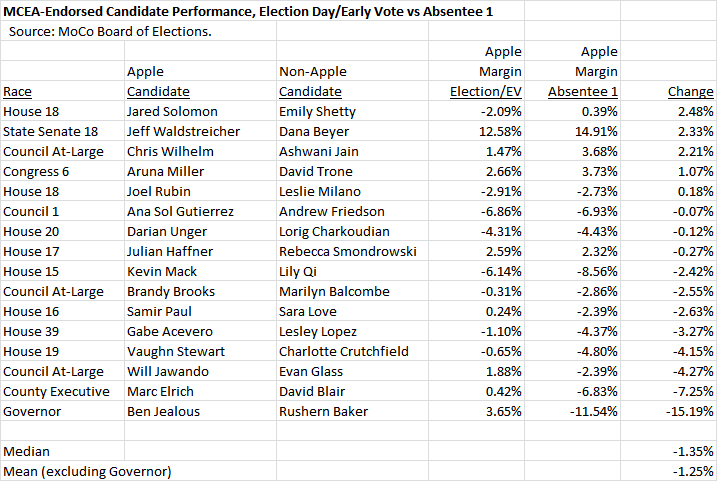
The table below shows sixteen close performances in county races between Apple-endorsed and non-Apple candidates.  (We excluded incumbents to remove any incumbent effect on absentee voting.)  In each race, the margin between the two in election and early voting results is shown alongside the margin in the first absentee canvass.  (Both sets of results are unofficial and there will be another absentee canvass.)  In eleven of these sixteen races, Apple-endorsed candidate performance declined in absentee voting.

Now some of these races have other things going on.  In Congress District 6, Aruna Miller benefited from MCEA’s three mailers and her performance actually rose a tiny bit among absentees.  In the gubernatorial race, a clear outlier, Rushern Baker may have benefited from the Washington Post’s strong endorsement.  (This year, the Post did not endorse in Congressional or state legislative races.)  David Blair got not one, but two Post endorsements.  Elrich’s late endorsement from MCEA handicapped his ability to publicize it, which may have impacted absentee voters.  And so on.

The Apple Ballot is arguably the best endorsement in the county.  Blair would already have won the Executive race if Elrich had not received it.  But the data above, however tentative it is, suggests a pattern: the Apple has been slightly less effective in absentee voting.  The median performance drop is 1.4 points.  The mean performance drop excluding the outlier race for Governor is 1.3 points.  So let’s round it in rough terms to a point-and-a-half decline.  That’s not enough to affect most races but it is having an impact on the razor-thin contests for County Executive and House 16.  MCEA should consider this in designing its future political programs.

Share

Does Blair Have a Chance?

By Adam Pagnucco.

With early votes and election day votes counted, Marc Elrich leads David Blair by 452 votes to win the Democratic County Executive nomination.  This would be a close margin in a House of Delegates race but it’s incredibly close for a county-wide race.  The final outcome will now be decided by absentee and provisional ballots.  Does Blair have a chance or will Elrich hold on to win?

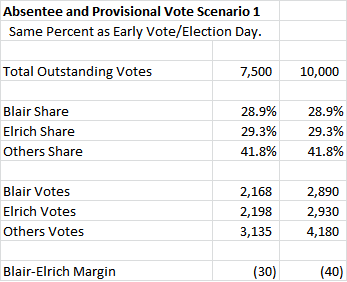
According to Bethesda Magazine, the county’s Board of Elections received 4,900 Democratic absentee ballots as of Monday.  In addition, 3,614 provisional ballots were cast but that total includes all parties.  For the sake of discussion, let’s assume that 2,500 of those provisional ballots came from Democrats.  If there are only 5,000 Democratic absentee ballots received, that is 7,500 outstanding votes.  A higher end assumption would be that 7,500 Democratic absentee ballots come in, resulting in 10,000 outstanding votes.

Let’s do a math exercise on the final outcome of the absentee and provisional votes.  In the first scenario, let’s assume that the percentages of three categories – Blair’s percentage, Elrich’s percentage and the percentage of all the other candidates – exactly match the shares recorded during early and election day voting.  In this scenario, Elrich picks up between 30 and 40 votes more than Blair and he would win.

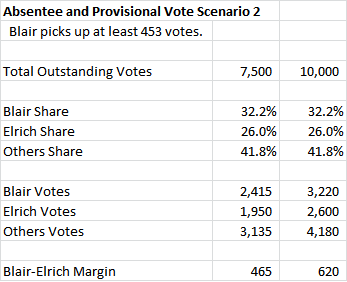
Now let’s do a scenario in which Blair wins.  Since Blair and Elrich are the top two and no one else is even close, it’s the margin between them that will determine the victor.  In this second scenario, we will hold the percentage of all the other candidates constant and merely adjust the totals for Blair and Elrich.  Adding 3.3 points to Blair and subtracting 3.3 points from Elrich produces a net gain for Blair of 465 votes in a 7,500 vote universe, enough to win.  That margin would go up to 620 votes in a 10,000 vote universe.  But note that this scenario requires Blair to lead Elrich by 6.2 points among these groups, a very different result than Elrich’s 0.4 point lead in early and election day votes.

We adjusted the percentage for the other candidates up and down and didn’t find much change in the margin Blair needs, which is more than six points over Elrich.  Again, this is a departure from the cumulative early vote and election day totals.

Will it happen?  Readers, you tell us!

Share

The Washington Post Ballots

By Adam Pagnucco.

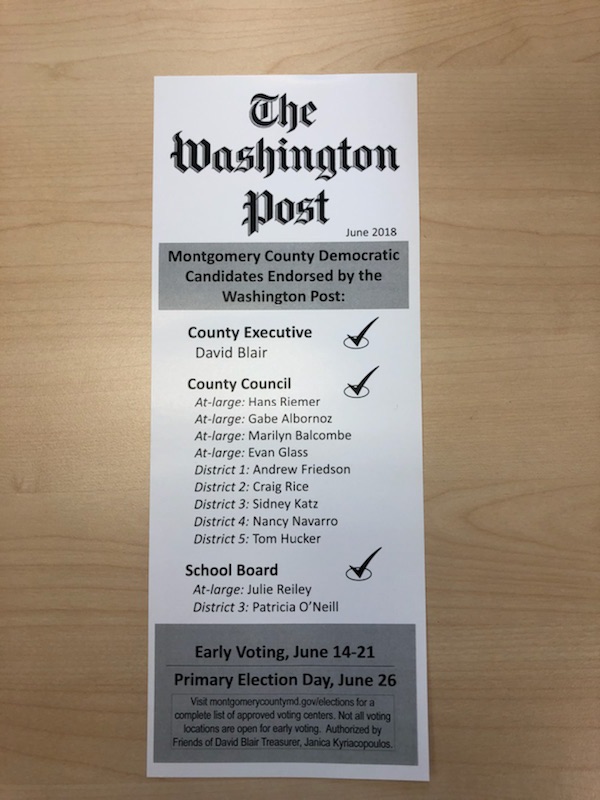
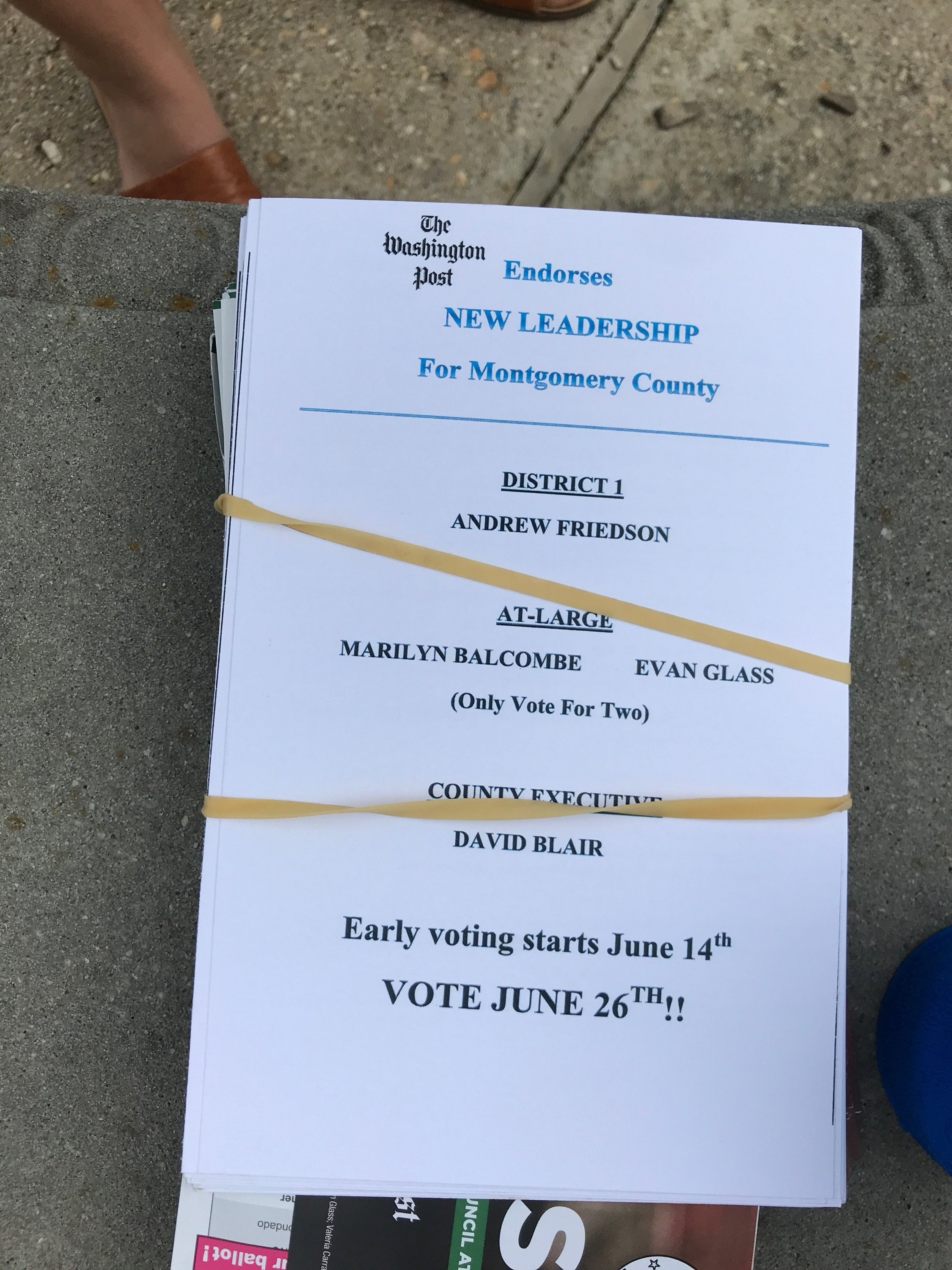
Two ballots were handed out today announcing county-level endorsements by the Washington Post.

The first one shows all of the Post’s endorsements for County Executive, County Council and Board of Education.  It has an authority line from David Blair’s campaign.  We hear that several other Post-endorsed campaigns distributed it in addition to Blair’s people.  The presence of an authority line makes it legal and the fact that it included all the county Post endorsements, not just some, is fair.

The second one shows just four of the Post’s endorsements: County Executive (Blair), Council At-Large (Evan Glass and Marilyn Balcombe) and Council District 1 (Andrew Friedson).  The other two Council At-Large Post endorsees (incumbent Hans Riemer and Gabe Albornoz) do not appear.  It has no visible authority line.  This particular one was distributed in Bethesda but we have no idea how many were handed out.  If it indeed lacks an authority line, this ballot violated state election law.  It was also misleading because it only partially lists the Council At-Large endorsements.  No campaign has admitted responsibility for this flyer.

We have not seen a “Washington Post Ballot” in the past.  But if it continues, and if campaigns can agree on funding it, it could conceivably be turned into an alternative to the Apple Ballot.

Share