Since 1990, the Montgomery County Council has had five district seats and four at-large seats. Every few years, proposals are made to get rid of the at-large seats and go to an all-district seat system. County voters rejected a ballot question doing so in 2004 by a 61-39% vote. The county is fortunate that they did because getting rid of the at-large seats is a terrible idea.
Why is that so?
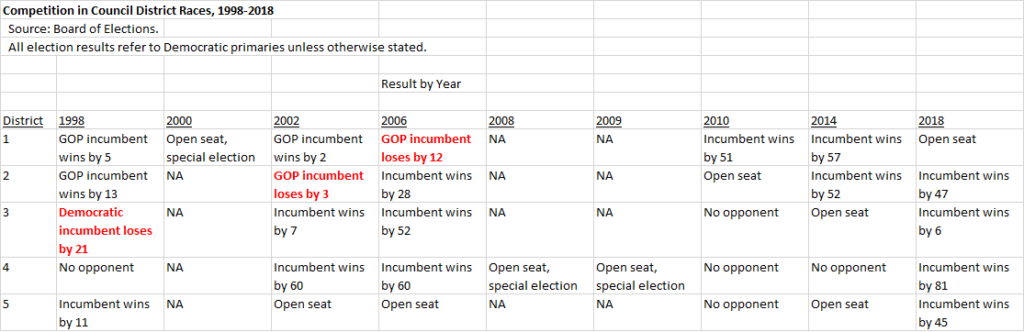
The table below shows the outcome of council district races over the last six cycles, plus open seat special elections in 2002, 2008 and 2009.
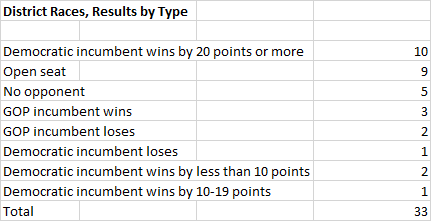
Here is the distribution of outcomes in these contests.
The huge majority of these races are non-competitive when Democratic incumbents are on the ballot. In fact, a Democratic district incumbent has not been defeated since 1998, when challenger Phil Andrews door-knocked his way to victory against District 3 incumbent Bill Hanna. Since then, a challenger to a district incumbent has come within 10 points only twice. Democratic district incumbents have an 18-1 win-loss record since 1998, which includes 5 races with no opponent. In the last 10 races with district incumbents, the incumbents have won by 40 points or more 8 times.
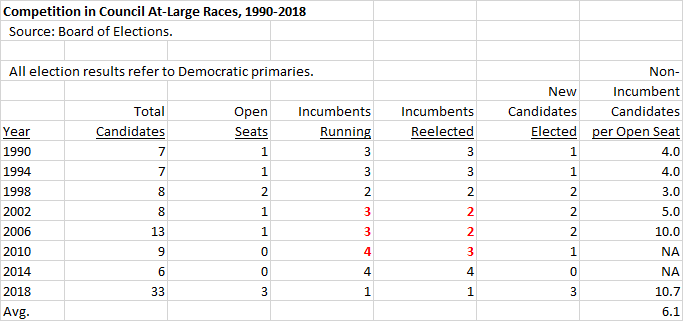
Now let’s look at at-large council races since 1990.
There are four at-large council seats. In every cycle since the current system was instituted, there has been more than four at-large candidates, meaning there has always been competition. That has been true even in cycles in which all four incumbents were running (2010 and 2014). In three cycles (2002, 2006 and 2010), an incumbent was defeated. In 2018, an incredible 33 Democrats ran at-large when 3 open seats were available.
Public financing no doubt played a role in encouraging so many candidates to run at-large. In contrast, district races with incumbents in 2018 were sleepy aside from District 3, in which the incumbent used public financing and the challenger stayed in the traditional system. (The incumbent won.)
All of the above illustrates a central fact: at-large races with incumbents usually have much more competition than district races with incumbents. One reason for that is the nature of such elections. An at-large race is a beauty contest with the four most popular candidates winning. Negative campaigning is uncommon except when slates are present (as in 2002). But in a district race with an incumbent, a challenger must make the case that the incumbent has committed a firing offense; otherwise, voters tend to go with the incumbent. Most candidates stay clear of heavy-lifting negative campaigns, especially when they are likely to lose, and with rare exceptions (like 2018 District 3 challenger Ben Shnider) the best ones prefer to run at-large.
Political competition is precious. Decades of evidence from our elections shows that abolishing at-large council seats would destroy most political competition in council elections. That is a really bad idea.
That said, supporters of adding districts are not wrong. More on that tomorrow.
Delegate Vaughn Stewart (D-19) has launched an online petition urging Governor Larry Hogan to cut checks to every applicant who has been waiting to receive unemployment benefits for longer than two weeks. Stewart cited the example of Vermont, which began sending $1,200 checks to applicants with unresolved claims back in April. Two Maryland Senate committees recently held a nearly nine-hour Zoom session hearing scores of complaints about problems with the state’s unemployment system. It’s a huge issue for state legislators and constituents alike.
Stewart’s petition can be found here. His statement on Facebook is reprinted below.
Today, I launched a petition drive seeking immediate relief for Marylanders still waiting for their unemployment benefits. According to the Maryland Department of Labor last week, nearly 35,000 Marylanders have requested but not yet received their benefits.
The pandemic has created a nationwide backlog of unemployment claims, but many states have handled it more deftly than Maryland. For example, in April, Republican Governor Phil Scott directed Vermont’s Department of Labor to send $1,200 checks to any resident whose unemployment claim had not been processed.
My petition urges Governor Hogan to follow Vermont’s lead by immediately mailing checks to every Marylander who has waited longer than two weeks to receive their full benefits. With so many Marylanders still waiting for the benefits they paid for, it’s time to put people over process. Governor Hogan should send relief now, and worry about bureaucratic box-checking later. You can sign here: https://actionnetwork.org/petitions/governor-hogan-cut-the-checks
I’ve collected dozens of stories from workers throughout the state who are still struggling to access their benefits. I solicited these tales on “Maryland DIY – REAL ANSWERS,” a popular Facebook group where residents help each other navigate the bureaucratic maze. Here are a few. (I’ve changed names to protect identities.)
Sabrina from Carroll County has waited a month and a half for benefits. She can’t pay her bills, her savings are gone, and she’s on the verge of bankruptcy.
Corinne from Frederick County is a single mom who has waited for her unemployment benefits since March. She can’t pay her rent, her car payment, or any other bills. This nightmare has sent her into a deep depression.
Kiana from Prince George’s County is a mother of three and a domestic violence survivor. She’s waited weeks to receive her benefits, and cannot afford to move her and her children out of a temporary safe house.
Governor Hogan–send checks to these women and the thousands of Marylanders waiting for benefits NOW.
Challenger Marylin Pierre, who is running against a slate of four sitting circuit court judges, will be appearing on the ballot in MoCo’s general election. If elected, she will preside over civil, family, juvenile and criminal cases for 15 years.
Circuit court judicial candidates usually don’t talk much about issues when they run like candidates for other offices do. That’s because most are vetted by judicial nominating commissions and appointed by the governor, after which they serve on the bench temporarily and must run in the next election to serve a full term. Incumbents who have gone through the vetting process claim that its thoroughness qualifies them as judges and therefore should be respected by voters. This language by MoCo’s incumbent slate is typical of how judicial incumbents make their case.
The four judges on the “Elect Sitting Judges Montgomery County Slate” – the incumbents in the upcoming election – have gone through the Judicial Nominating Commission process. The process started with a lengthy and comprehensive application covering all aspects of their education, breadth and depth of law practice, and personal background. Each judge’s application was submitted to no fewer than twelve diverse bar associations, each of which conducted its own investigation and interviews. In addition, the Bar Association of Montgomery County conducted a referendum wherein each applicant’s qualifications were subjected to a vote by every member of the bar association. The results of both the referendum and the specialty bar association interviews were provided to the Judicial Nominating Commission. The Commission then conducted its own independent investigation of all applicants and thoroughly vetted and interviewed each. A list of the most highly qualified candidates was sent by the Commission to the Governor, who interviewed and appointed the best of the best.
The Sitting Judge Principle ensures that Montgomery County has only the most qualified judges on the bench. The diverse organizations that participate in the vetting process have ensured the appointment of a bench that reflects our community. The Sitting Judges are experienced, vetted and approved.
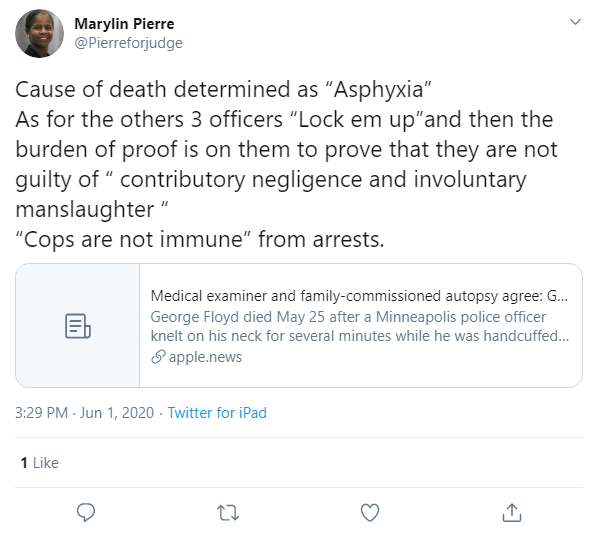
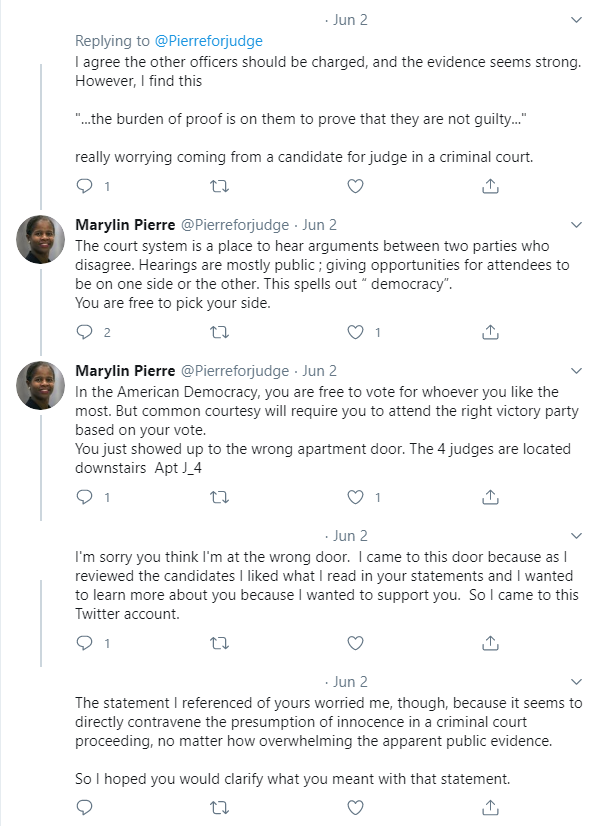
Deprived of such accreditation, challengers who fail to get through the vetting process must state their case persuasively enough to overcome that in the eyes of voters. That brings us to Pierre. In the wake of the death of Minnesota man George Floyd at the hands of police, Pierre tweeted this on June 1.
When challenged on this, Pierre had the following exchange with another person holding a different view. (I redacted the person’s identity.)
The notion that a criminal defendant bears the burden of proof at trial is inconsistent with the due process clauses of the U.S. Constitution. The U.S. Supreme Court has clarified exactly what due process means on at least two occasions. In Speiser v. Randall, 357 U. S. 513, 525-526 (1958), Justice William J. Brennan Jr. wrote for the court, “Due process commands that no man shall lose his liberty unless the Government has borne the burden of producing the evidence and convincing the factfinder of his guilt.” And in In re Winship, 397 U.S. 358, 364 (1970), Brennan wrote for the court, “Lest there remain any doubt about the constitutional stature of the reasonable-doubt standard, we explicitly hold that the Due Process Clause protects the accused against conviction except upon proof beyond a reasonable doubt of every fact necessary to constitute the crime with which he is charged.”
Pierre’s reference to “contributory negligence” is also strange. Contributory negligence is a doctrine primarily found in tort law, not criminal law, that prevents plaintiffs from recovering damages if they are at least partially at fault for their injuries even if the defendant is more at fault. Maryland is one of a handful of states that uses this doctrine but Minnesota abandoned it in 1969. What does this have to do with George Floyd’s death?
Pierre should know all about due process standards for criminal defendants. She is a graduate of Howard University Law School and the John Jay College of Criminal Justice. She has practiced law for 28 years and has a long list of professional and other qualifications. She even tweeted on May 30, “We are all presumed innocent until proven guilty.”
On June 18, 17 days after Pierre posted the “Lock em up” tweet, I emailed her asking for comment. I used an email address (MarylinForMaryland@gmail.com) to which she had replied three days before and appears on her website. I wrote:
Hello Ms. Pierre – Recently, I came across this tweet from you on the police officers who were charged with murdering George Floyd.
I am thinking about writing about this but first I’d like to hear your point of view. Specifically, can you comment on how this tweet conforms with the due process rights of criminal defendants?
Adam Pagnucco
As of this writing (June 22), she has not replied. But she did delete the “Lock em up” tweet at some point after I contacted her.
And now the question falls to you. If you are a MoCo voter, do you believe Marylin Pierre should be a circuit court judge?
Update: Pierre sent me the following email three hours after this post went up. I am reprinting the email below but I am deleting the phone number she provided to protect her privacy.
Mr. Pagnucco,
The Marylin Pierre For Judge campaign has read the article you wrote about the tweet from the @PierreForJudge account. Running a campaign is so time-consuming that some of the duties have to be delegated. The Marylin Pierre For Judge campaign established some guidelines and the person running the twitter account has been diligent in following those guidelines until the tweet that you wrote about. We think that this had to do with the traumatic incident and the volunteer’s reaction to it. We have discussed the tweet with the volunteer and we went over the guidelines again.
Sometimes we are able to answer questions very quickly and sometimes we are not. We regret that we did not get a chance to respond to your inquiry before you posted the article.
If you would like to contact us, things move so quickly that you may need to call and a text at [phone number deleted by Pagnucco] instead of just sending an e-mail. Thank you for your time and attention.
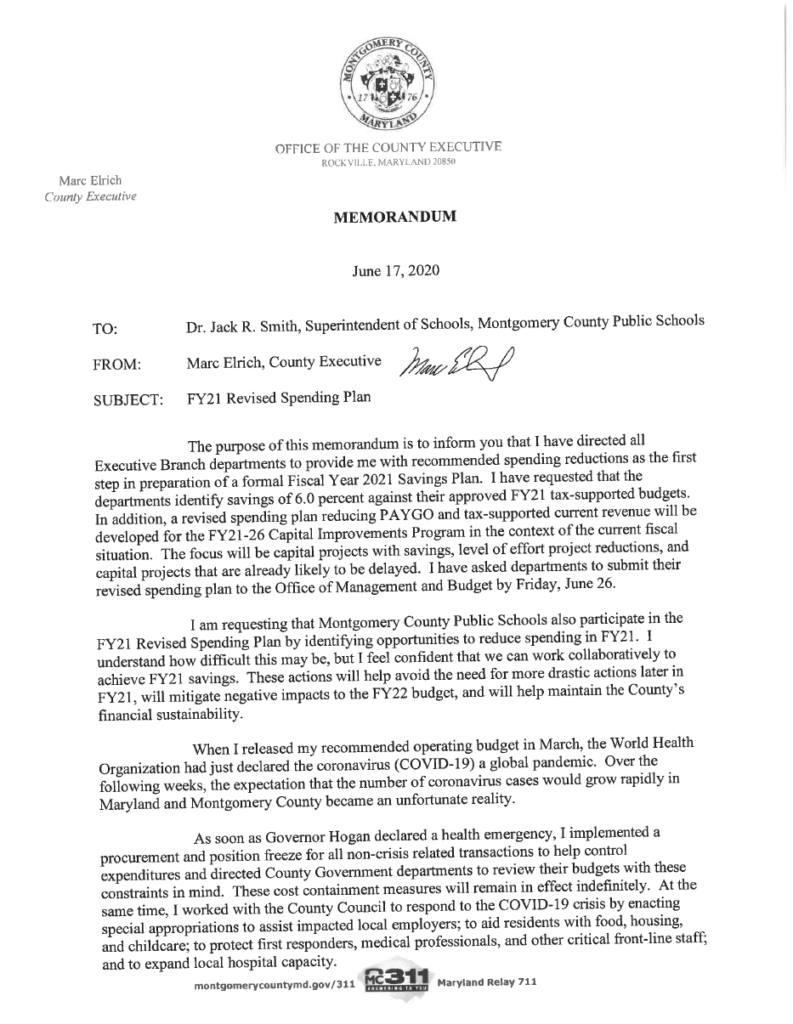
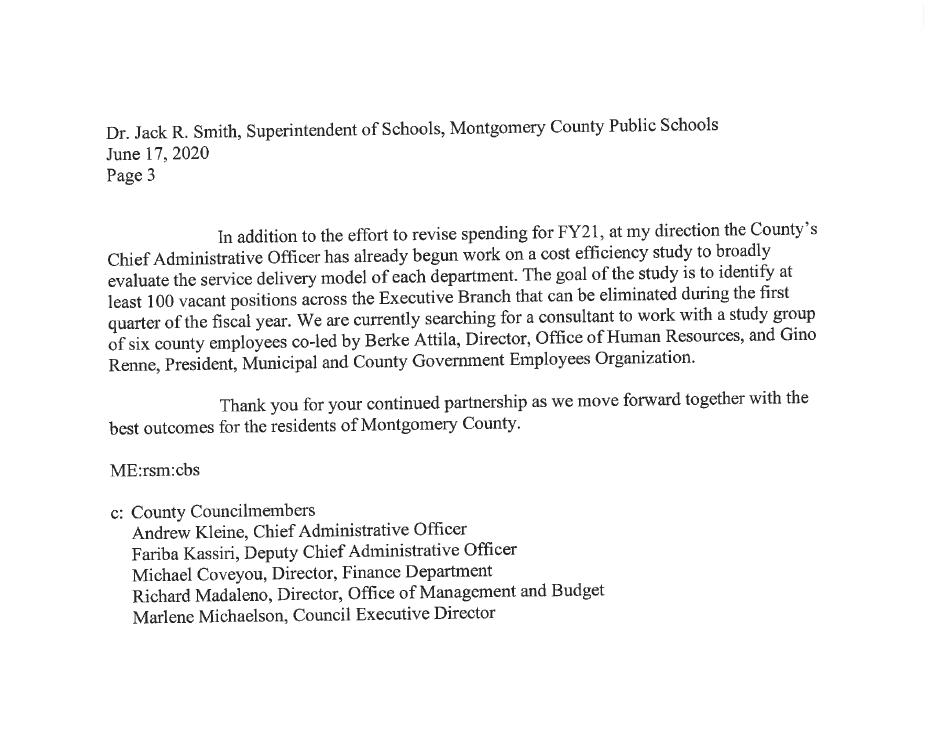
In a memo to Montgomery County Public Schools (MCPS) Superintendent Jack Smith, County Executive Marc Elrich is asking MCPS to make operating budget cuts along with the rest of county government. Elrich also makes clear that the capital budget will have to be reduced. Elrich is not asking for a specific cut number yet but indicates that the county will have a clearer picture of its tax base by late August.
What is unclear is how any spending cuts to MCPS conform with state law. The county council recently funded MCPS at maintenance of effort, which is the minimum amount of local dollars allowed by the state. If the county wants to reduce MCPS below maintenance of effort, relevant state law will need to be addressed.
In a June 4 op-ed in the Washington Post and comments reported by WTOP, County Executive Marc Elrich has promised to reform the Montgomery County Police Department (MCPD). According to WTOP, Elrich said MCPD has “an institutional problem” that “starts top down.” He said that he will be submitting a contract to the county council “for reevaluating everything” about MCPD.
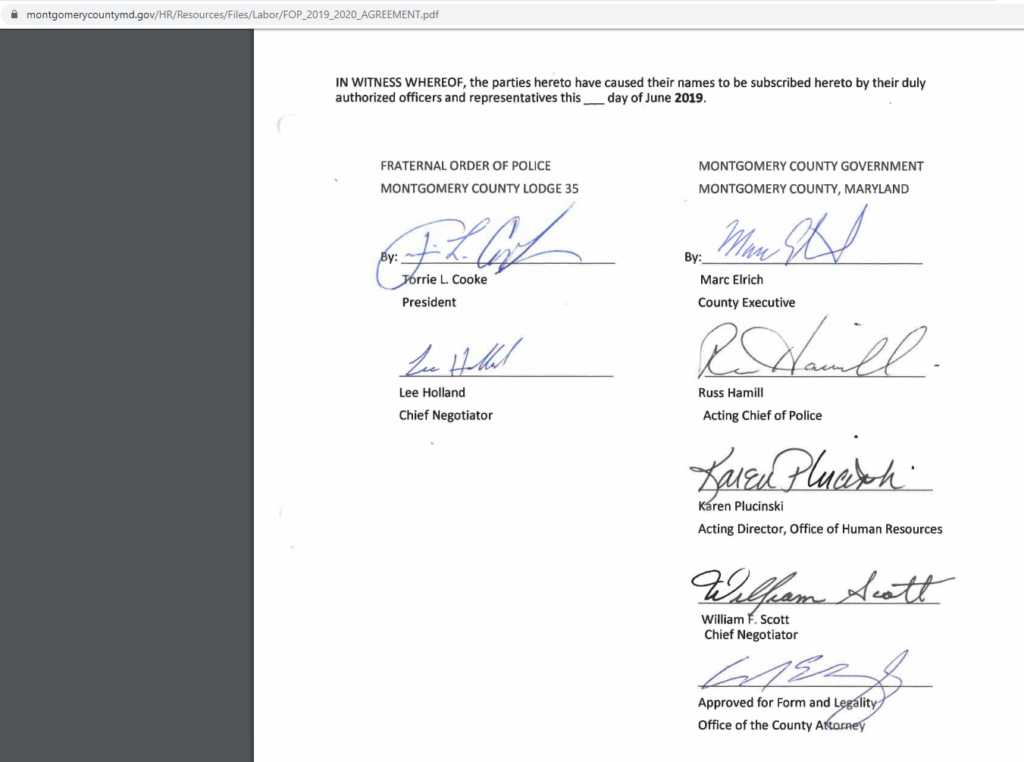
If Elrich does intend any serious reforms, he will have to deal with a powerful document that can be invoked in response to them: his own contract with the Fraternal Order of Police (FOP) Lodge 35. The FOP’s contract, which Elrich personally signed, gives the union and individual officers substantial authority to restrict the ability of the chief to run the department, keep employee information confidential, block access to personnel records and mandate the destruction of certain personnel and video records. The contract even obligates the county to help the FOP block answers to public information act requests for videos and data. Many of these kinds of provisions are not unique to Montgomery County. But as the executive who signs union contracts as well as a 12-year member and former chair of the county council’s Public Safety Committee, which oversees the police, Elrich is directly responsible for their implementation here.
Here are some of the provisions of Elrich’s 2019-20 contract with the FOP.
Under certain circumstances, the FOP can force the police chief to bargain over new or changed rules or directives.
Article 61 (Directives and Administrative Procedures) contains a set of procedures that constrain the police chief’s ability to implement new or changed rules or directives. When the chief seeks to implement a new rule or directive or change an existing one, he must notify the FOP. “The primary subject of any new, changed, or amended directives or rules covered by the article shall not include matters currently addressed in the collective bargaining agreement, or matters proposed by the County and rejected by the FOP at the most recent term negotiations, or matters, the primary subject of which, were taken to mediation by the FOP at the most recent term negotiations.”
The FOP may then demand to bargain the proposed rule or directive. If the chief does not agree, the matter goes to the county’s Permanent Umpire who decides if the rule or directive must be bargained. This provision limits the ability of the chief to run his department without the consent of an arbitrator. It could certainly be activated to counter any reform proposals opposed by the union.
If employees are arrested, they must disclose it to their supervisor. However, the disclosure “shall be considered confidential and shall only be shared on a need to know basis.”
Article 15 (Hours and Working Conditions) Section Y contains this language on what happens when an employee is arrested.
Employees shall immediately report, or as soon as practical, to their commander/director or bureau chief, any circumstance where the employee is arrested or becomes a defendant in any criminal proceeding that may result in incarceration, receives an incarcerable traffic citation as defined in the Maryland Transportation Article, has their driver’s license/privilege suspended, revoked, refused or canceled that affects their ability to operate a county vehicle, or is notified that they are the subject of a criminal investigation by any law enforcement agency. If the employee is served with a temporary protective order, temporary ex parte order, or other similar temporary order that impacts the employee’s ability to carry a weapon or to perform their assigned police duties or any permanent protective order, permanent ex parte order or other similar permanent order that impacts the employee’s ability to carry a weapon or to perform their assigned police duties, they shall report the matter (as outlined above) directly to their commander/director or bureau chief to be reviewed to determine if the matter impacts the employee’s ability to perform their assigned police duties. The employee shall provide the commander/director or bureau chief with the information (i.e. date/time/location of the alleged offense, case/docket/tracking number) required for the employer to obtain additional information. All information shall be considered confidential and shall only be shared on a need to know basis. It is recognized that all persons are presumed innocent until proven guilty.
In Maryland, criminal records are public documents accessible through the state’s judiciary website. This language prevents police supervisors from disclosing at least some information that is public record.
Management does not have an unfettered right to access personnel records.
Article 51 (Personnel Files) Section B gives an employee and their authorized representative access to the employee’s personnel file. Additionally, the following individuals can access the file only on a “need to know” basis: the employee’s supervisor, an appointing authority or designee, the county’s Human Resources Director or designee, the county attorney or designee, the Chief Administrative Officer or an Assistant Chief Administrative Officer, and members of a Recommendations Committee when an employee has applied for a position vacancy announcement.
“Need to know” is not further defined in the section other than for the county attorney, when it is defined as “when an employee is in litigation against the County, e.g., Merit System Protection Board, Worker’s Compensation, Disability, Retirement, etc.)” and members of a recommendations committee, when it is defined as “limited to performance evaluations, letters of commendation, awards and training documents for bargaining unit members assigned to Recommendations Committee.” Release of personnel records to anyone else is prohibited without the employee’s signed authorization.
Personnel files are destroyed five years after an employee leaves county employment.
Article 51 (Personnel Files) Section E states the following.
Except as provided below, all records including medical and internal affairs files, pertaining to separated employees shall be destroyed five (5) years after separation, unless the files are the subject of pending litigation. In which case, these files will be destroyed at the conclusion of the litigation.
The County may maintain records necessary to administer employee benefits programs, including health and retirement, a file containing the employee’s name, address, date of birth, social security number, dates of employment, job titles, union and merit status, salary and like information.
Except as required by law, no information may be released from any file without the express written permission of the separated employee.
Section H adds these restrictions.
To the extent not specifically preempted by State law, adverse information concerning an officer’s past performance shall not be admissible in any proceeding unless maintained in strict accordance with this article.
Except as provided in paragraph 1 of this section, only information properly maintained in personnel files as established by this Article may be used in any other process, proceeding, or action.
Elrich’s signature on the FOP’s 2019-20 contract.
Mobile Vehicle System (MVS) recordings may not be used for performance evaluations.
Article 66 (Mobile Vehicle Systems) Section C.7 states, “No recording may be used for the purpose of performance evaluations.” Section C.6 states, “All recordings will be destroyed after 210 days, unless the recording is, or may reasonably become, evidence in any proceeding. A recording will be retained if the FOP provides notice to the Department within 210 days of its potential use in a hearing.”
Management may use MVS recordings for disciplinary purposes under certain circumstances including external complaints, pursuit, collision, uses of force, injury or when management has “reasonable basis to suspect that a recording would show an officer engaged in criminal wrongdoing or serious allegations of misconduct in violation of Department rules and regulations applicable to bargaining unit members.”
Body camera recordings “shall not be routinely reviewed for the express purpose of discovering acts of misconduct or instances of poor performance without cause.”
Article 72 (Body Worn Camera System) Section D.2 states:
BWCS recordings shall not be routinely reviewed for the express purpose of discovering acts of misconduct or instances of poor performance without cause. An employee’s supervisor may use BWCS recordings to address performance when cause exists. Any recording used must be reviewed with the subject employee prior to any documentation of performance. Any documented review will be included in the employee’s supervisory file. The employee shall have the opportunity to respond in writing to the document. The response shall be attached to the supervisor’s document. The employee and the employee’s representative shall be provided access to the referenced recording if requested. Performance evaluation shall not be the sole reason for the employer retaining a recording beyond the agreed upon term.
Section F.1 states, “All BWCS recordings will be destroyed after 210 days, unless the Department deems it necessary to retain the recording for a longer period of time.” Section F.2 states, “An employee may elect to save BWCS recordings for longer than 210 days if the recording was used to support a performance evaluation which resulted in a single category being rated as below requirements.”
Police instructors are prohibited from having sex with trainees. However, they cannot be disciplined for it.
Article 15 (Hours and Working Conditions) Section L prohibits instructors and field training officers (FTOs) from having sex with trainees whom they are instructing. If that happens, the instructors and FTOs are separated from the trainee’s class. However, if the instructor or FTO discloses the relationship to management, “managers and supervisors must maintain the disclosure in confidence” and “no disciplinary action or retaliation must occur as a result of the disclosure.” If the relationship is not disclosed but is otherwise discovered, the more senior officer is involuntarily transferred but “violation of this rule will not result in discipline.” Nothing in the contract prohibits the instructor or FTO from proceeding to train other trainees.
The contract obligates the county to help the FOP block answers to certain public information act requests.
The Maryland Public Information Act (MPIA) is mentioned in three different articles of the contract.
Article 65 pertains to Automatic Vehicle Locators (AVLs) and Portable Radio Locators (PRLs), which are described as “systems that allow the Department to identify the location of police vehicles and portable radios that are equipped with GPS tracking capabilities.” Sections D and E address what happens when MPIA requests are made for AVL and PRL records.
Section D. MPIA. The County agrees that it will deny all Maryland Public Information Act (MPIA) requests for stored AVL/PRL data on the movements and location of vehicles assigned to unit members until and unless a point is reached where court decisions establish that AVL/PRL data is public information subject to release under the MPIA. The County will defend its denials of MPIA requests for stored AVL/PRL data in the trial courts, and will continue to defend these denials in trial courts until and unless court decisions establish that AVL/PRL data is not confidential information. The County may, where appropriate, seek appellate review of court decisions ordering the release of AVL/PRL data, but is not required to do so. If the county chooses not to appeal, the employee shall have the right, as allowed by the Court, to continue the appeal at the employee’s own expense.
Section E. Summonses. The County agrees that it will seek court protection from any subpoena or summons seeking stored AVL/PRL data on the movements and location of vehicles assigned to unit members, except for subpoenas issued by a grand jury, or a State or federal prosecutor. The County will seek protection from subpoenas and summonses in the trial courts, until and unless a point is reached where court decisions establish that AVL/PRL data is not confidential information. The County may, where appropriate, seek appellate review of court decisions ordering the release of AVL/PRL data, but the county is not required to do so. If the county chooses not to appeal, the employee shall have the right, as allowed by the court, to continue the appeal at the employee’s own expense.
And so the contract directs the county to block the public’s access to these records in court.
The second article mentioning the MPIA is Article 66, which pertains to Mobile Vehicle Systems (MVS). Section 3.13 states:
All external requests for copies of recordings, including subpoenas and summonses, will be reviewed by the County Attorney’s Office. The County will notify the FOP of all such requests for MVS recordings/data involving unit members and solicit its opinion before determining whether the request will be granted or denied. If the County determines that a request cannot be denied under the MPIA, it will give the FOP an opportunity to file a reverse MPIA action and will not grant the original request until and unless a court orders that the recording/data be disclosed.
The third article mentioning the MPIA is Article 72, which pertains to Body Worn Camera Systems (BWCS). Section E states:
Release of BWCS video in absence of a specific request: The County will provide written notice to the FOP prior to the release of any BWCS recording to the public. In the event of an emergency or a bona fide public safety need the County may provide written notice after the release. This does not include release of recordings in connection with litigation, In events where there is no exigency, an employee captured in the recording may object to the use of the recording, in writing, to the Chief of Police (or designee) within two calendar days of receiving the notice of intent to release the recording as to any reason(s) why he or she does not wish the recording to be released. The Chief of Police (or designee) will consider any reason submitted by the employee before proceeding with the release.
The release of recordings of an employee’s death or injury shall not occur absent compelling law enforcement related reasons to release the recording or in situations where the release of those recordings are required by law.
The County shall ensure that all external requests for copies of recordings, including subpoenas and summonses, will be reviewed for compliance with applicable standards, including those imposed by law or by provisions of this Agreement. The County will maintain a log of all MPIA requests for BWCS video that it receives. The County will make this log, the underlying MPIA request, and the requested recording, available to the FOP for inspection. If the FOP objects to the release of any portion of the recording, it must promptly notify the County of its objection(s) and its intent to file a “reverse MPIA” action if the County decides to release the requested recording. The County will promptly notify the FOP of any decision to release the requested recording and the date and time of that release, unless the FOP first serves the County with a “reverse MPIA” action it has filed in a court of competent jurisdiction. The parties will make all reasonable efforts to provide each other with expeditious notice under this section given the relatively short time limits in the MPIA and its overall policy of providing the public with prompt access to public records without unnecessary delay.
In summary, the FOP’s contract requires the county to block public access to automatic vehicle locator and portable radio locator data in court and also requires it to facilitate the FOP’s opposing release of motor vehicle and body camera video in court.
If Elrich is serious about reform, he needs to review his own police union contract to see if its provisions are compatible with change. If he doesn’t, the county council will have to step in.
On May 27, the Maryland State Department of Education (MSDE) released a summary of responses from local school districts to its survey on distance learning. However, MSDE did not initially list the responses by school district. After Delegate Eric Luedtke (D-14) submitted a Maryland Public Information Act request to get the responses by district, MSDE published that data. Delegate Luedtke shared the responses with Seventh State. Below are the questions by MSDE and the responses submitted by Montgomery County Public Schools (MCPS) in early May.
Question: Are distance learning packets a part of your school system’s Continuity of Learning Plan?
Answer: Yes.
Q: In the past week, what percentage of eligible students received at least one distance learning packet?
A: I have data about distance learning packets but cannot answer this question exactly as it is written.
Q: If you answered the previous question “I cannot answer this question exactly as it is written” or need to provide additional information about students receiving distance learning packets, please explain.
A: To date, MCPS has produced 405,583 instructional packets from the digital files provided by the Curriculum Office. These multi-page, two-sided, stapled booklets are grade-specific and course-specific.
Distributed to schools: March 13: 109,023
Distributed to meal distribution sites: Total of 296,550 April 8: 47,250 April 17: 77,950 April 22: 77,950 April 29: 46,705 May 6: 46,705
Q: Is your school system collecting data on student engagement with distance learning packets?
A: Yes.
Q: How does your school system define student engagement with distance learning packets? (What “counts” as engagement?)
A: The weekly packets are designed for students to use in collaboration with the digital learning platform or for students to use in replacement of the digital learning platform. Students using the packets are expected to complete the assignments and tasks in the packets. Students who use the weekly paper packet should take a picture of one assignment page that best represents their work for the week and submit it to the teacher via email. Teachers keep the submitted packet assignments and use it to inform engagement levels as well as to inform the learning that is taking place.
Q: In the past week, what percentage of your students who received a distance learning packet have engaged with a distance learning packet? (For example, if 600 students received a distance learning packet, what percent of those 600 students engaged with a distance learning packet?)
A: I have data about engagement with distance learning packets but cannot answer this question exactly as it is written.
Q: If you answered the previous question “I cannot answer this question exactly as it is written” or need to provide additional information about students engaging with distance learning packets, please explain.
A: MCPS has just over 100 students engaging in only paper-packet activities. These students are working with their individual teachers on completion of work. MCPS is collecting engagement data from teachers in order to account for all students during distance learning. Teachers not only provide feedback through the use of the gradebook, but they also provide anecdotal data on individual students who are/are not engaging in remote learning.
Q: To your knowledge, what percentage of your students have access to the Internet, either at home or at a location suitable for accessing online learning activities? (Please answer this question to the best of your knowledge, even if your school system is not using online distance learning as part of its Continuity of Learning Plan.)
A: 93.75%.
Q: Is online distance learning part of your school system’s Continuity of Learning Plan?
A: Yes.
Q: Is your school system collecting data on students who sign on to online distance learning?
A: Yes.
Q: How has your school system defined “signed on” to online distance learning? (What “counts” as being signed on?)
A: MCPS is using three core digital systems as part of the online learning experience: Canvas, Google Apps, and Zoom. We are able to track logins across each of these systems over time.
Q: In the past week, what percentage of eligible students signed on to online distance learning?
A: 95% signed on at least once between April 25 and May 1.
Q: Is your school system collecting data on student engagement with online distance learning?
A: Yes.
Q: How has your school system defined/measured student engagement with online distance learning?
A: Engagement includes digital footprint data (logging in), completion of assignments, engaging in live sessions, and having interaction with the teacher. MCPS uses the digital footprint data to create an initial profile of the student’s online activity. We set a guideline of three logins per week per student, but recognize that some students may complete work in fewer, longer sessions, and the majority of students will engage in far more than three sessions per week. This data serves as a baseline indicator. From there, teachers provide anecdotal data and layer in additional engagement data that we cannot capture with the digital footprint data – paper packets, emails, phone calls, parent outreach, and effort. Together, this data is used to determine engagement for students.
Q: In the past week, what percentage of your students engaged with online distance learning?
A: I have data about engagement with online distance learning but cannot answer this question exactly as it is written.
Q: If you answered the previous question “I cannot answer this question exactly as it is written” or need to provide additional information about students engaging with online distance learning, please explain.
A: During the week of April 25th, more than 90% of students logged in to our digital systems more than 3 times. Teachers are in the process of updating comments about students’ engagement to provide the complete picture of activity for the first three weeks of marking period 4.
Q: Since your school system implemented its Continuity of Learning Plan, what percentage of students and/or families in your school system have not once been contacted, and/or contact has been attempted but failed? Contact may occur with either the student or family, and with a teacher, school staff member, school system administrator, or other educator.
A: <1%.
Q: Since your school system implemented its Continuity of Learning Plan, what percentage of students in your school system have not participated in distance learning in any form, meaning they have not received a distance learning packet, have not logged on to online distance learning, etc.? These students may have been contacted for other reasons.
A: Between 3% and 10% depending on criteria used.
Q: This survey asked about student participation in distance learning for your school system as a whole. Do you have this information by grade span (elementary, middle, and high)?
A: Yes.
Q: Please provide any additional information or comments about student contact and/or participation in distance learning.
A: About 3% of students have not engaged in distance learning of any kind or have not responded to emails, phone calls, or other outreach efforts. Some of these students were waiting on technology (which we are still centrally distributing or delivering to homes as requests come in). A small subset have indicated that due to illness, enrolling in community college courses, applying for early graduation, or opting out of distance learning, they will not be engaged in marking period four learning activities. As part of the engagement framework for marking period four, MCPS has set the minimum expected level of weekly log-ins to core digital platforms to greater than or equal to 3. While the majority of students are well above this minimum criteria, about 10% of students are not meeting this threshold. School academic and well-being support teams are charged with following up with these students in order to help improve quality and quantity of engagement in distance learning. MCPS has developed a comprehensive outreach plan that includes coordinated communication between counselors, school administrators, parent community coordinators, PPWs, and local law enforcement to connect with 670 students who have not yet engaged in any form of distance learning or replied to phone calls, emails, or other outreach efforts.
Child care providers have been as hard hit as any other industry by the COVID-19 crisis and are struggling to survive. The county is considering a $10 million grant program to help providers make it through the crisis. Shaun Rose, President of Rock Spring Children’s Center in Bethesda, has a number of ideas for improving the county’s grant program so that it can have the maximum impact. Following is his testimony before the county council.
Dear Council President Katz,
I write to express my support for the ECEI Recovery Fund, but urge you to make several amendments to more efficiently use the funds to accomplish the goal of supporting child care programs that are attempting to reopen and/or stay open to provide care to the County’s families while facing severe challenges to economic viability.
For the past 15 years, I have been involved in child care and early childhood development as both a parent and then as the president of Rock Spring Children’s Center. Rock Spring is a nonprofit child care & preschool facility that attempts to meet the needs of the families and children in our community with spots for 176 infants through pre-k children. As a former representative of child care providers in both elected and appointed capacities, I have testified regularly about the critical need for more resources to better support parental needs for quality child care, to bolster & expand child care businesses, and to improve the wages of child care workers. As a former Chair of the County’s Commission on Child Care, I volunteered for over 6 years to advise the County on child care policy issues.
The situation is dire for child care programs in Montgomery County and across the nation. A recent survey by the Maryland Family Network found that, without significant governmental assistance, many child care programs in the State may close forever (https://www.marylandfamilynetwork.org/news/over-half-marylands-child-care-programs-mayclose-due-covid-19-pandemic). My center reopened on June 1 with an enrollment of less than 20% of normal. We are estimating we will lose an average of between $75,000 and $150,000 per month for the foreseeable future due to the low enrollment, increased costs, and possible future closures either because we have a suspected or confirmed COVID case or because of more general shut down restrictions. This only gives us a matter of only a few months to hang on with the hope that a combination of federal, state and county assistance before we will also have to close permanently.
While I strongly support the goal of the ECEI Recovery Fund, two changes could make it more impactful. First, the award amount for centers should be based on “licensed capacity” rather than number of “sites.” A single site program with a normal capacity to serve 200 children will likely be suffering twice the economic loss as a 5-site program with 20 kids at each site. The current formulation would grant only $75k to the 200 capacity child care program and $300k to the 100-capacity program with 5 sites. This seems inconsistent with the County’s public policy goals of trying to maintain as much child care capacity as possible.
Second, the current iteration of the ECEI Recovery Fund makes funds available to programs only for losses in April and May 2020, during the “Stay at Home Order.” Those programs that received some federal assistance through PPP or that laid off their staff had much lower losses over the past weeks than they will in the coming weeks as the County reopens and everyone needs to be back to work. The way it is currently structured, the ECEI Recovery Fund doesn’t help those programs that are currently trying to serve County families and doing so at considerable losses. Some programs may not even be able to attempt to reopen.
Therefore, the appropriation should be amended to include losses incurred in June, July, and August. Programs could be granted a maximum award amount after applying. The program would then submit evidence each month of their qualifying losses to be reimbursed up to the maximum of their award. This would cover those that are trying to continue to operate and give the fiscal support & incentive others may need to justify trying to reopen rather than giving up.
I thank you so much for your dedication to our County and to our families and for your consideration of my concerns. I hope that you will make the amendments I suggested and pass this appropriation.
Sincerely,
Shaun M. Rose President, Rock Spring Children’s Center Shaun@RockSpringCC.com
Montgomery County Executive Marc Elrich has announced that the county’s Phase 2 reopening will begin on Friday, June 19 at 5 PM. His press release appears below.
Montgomery County Executive Marc Elrich Announces Phase 2 Reopening Date For Immediate Release: Monday, June 15, 2020
Montgomery County Executive Marc Elrich and County Health Officer Dr. Travis Gayles today announced the County has achieved its benchmarks and will officially enter Phase 2 of reopening on Friday, June 19 at 5 p.m.
The County plans to continue with an incremental reopening, based on public health data. Phase 2 allows additional businesses and activities to start and/or increase modified operations under specified guidelines. The guidelines include:
Retail – curbside and limited in-store; one patron per 200 sq. ft. of sales space; Restaurants – outdoor/patio seating and limited indoor dining with requirements; up to 50 percent capacity maximum indoors if social distancing can be maintained; Childcare – childcare programs can reopen with a maximum of 15 individuals per classroom; Gyms – fitness centers, and other indoor physical activities; open with requirements; one patron per 200 sq. ft. of fitness space; Houses of Worship – virtual, drive-in, and limited indoor and outdoor services with requirements – one congregant/family unit per 200 sq. ft. of service space; Indoor and Outdoor Gatherings – limited to a maximum of 50 or one person/family unit per 200 sq. ft., whichever is lower Salons/Barbers/Nails – all personal services allowed by appointment only; one patron per 200 sq. ft. of service delivery space; Car Washes – open for internal and external cleaning with requirements; Office Spaces and Multi-tenant Commercial Buildings – limited use for nonessential personnel with requirements; telework strongly encouraged where applicable; Indoor and Outdoor pools (public and private) – open with capacity restrictions; Outdoor Day Camps – expanded opening with requirements; Outdoor Youth Sports – expanded for low-contact sports with requirements; Parks & Playgrounds – parks open for personal fitness and fitness classes with requirements; playgrounds open with requirements; only low-contact sports allowed; and Ride On Bus Service – expanded schedule; expanded routes. Certain outdoor recreation activities and facilities are already permitted: golf courses, archery, shooting ranges, marinas, campgrounds, horseback riding facilities and tennis courts.
The following businesses and services will remain closed in Phase 2:
Concerts and theaters; Senior centers; Libraries; and Recreation facilities. Protective measures such as maintaining physical distancing, careful cleaning and disinfecting, and face coverings being worn by employees and customers, are just some of the measures being required of businesses that are in this second phase of recovery.
Activities allowed in this phase of reopening are based on metrics the County established with progress overall in decreasing daily numbers of new cases, increasing testing capacity, implementing a large-scale contact tracing effort with the State, decreasing hospitalizations and use of the emergency room by patients with COVID-19 related symptoms, and positive trends in the death rate and test positivity. The COVID-19 Data Dashboard can be viewed on the County’s website.
Put the “count” in Montgomery County! Be sure to complete the Census online, by phone, or by mail. It’s safe, confidential, easy, and important. #2020Census #EveryoneCountsMCMD
For the most part, the leaders reflected the two big stories of the month: MoCo’s mud-splattered school board contest and the county’s low turnout in the primary. (It turns out that despite early data from the State Board of Elections, MoCo probably won’t be last in the state.) Also, the county deserves credit for posting a COVID-19 dashboard just two days after we called for one.
June promises to be another busy month. Thank you for reading Seventh State!
In the days leading up to the primary election, turnout reports from the State Board of Elections consistently showed MoCo as last in the state. Updated numbers released this morning now show MoCo is one of the lower turnout jurisdictions in Maryland but no longer last.
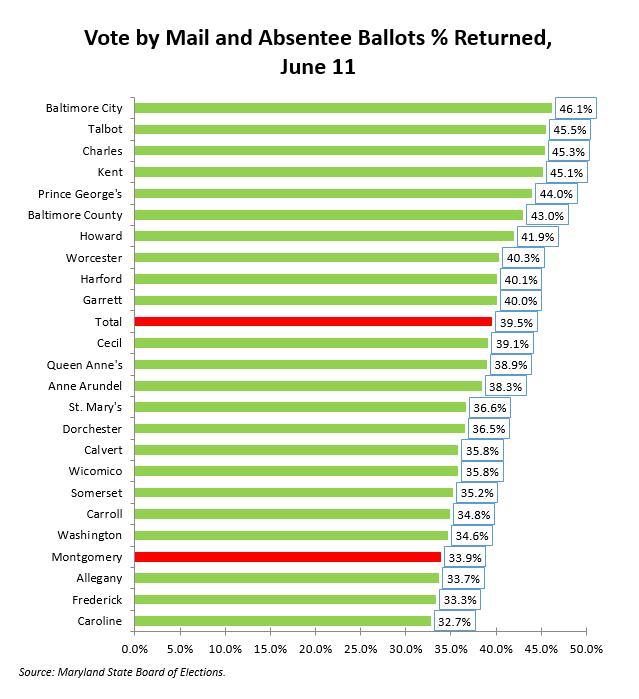
The chart below shows the combined return rate of vote by mail ballots and absentee ballots. (Vote by mail ballots dominate this statistic as 3,485,891 of those were sent to voters while 99,718 absentee ballots were sent to voters statewide.) The state has so far not released turnout counts for election day votes.
MoCo now ranks 21 of 24 jurisdictions in turnout in these two categories. Baltimore City, despite huge problems with late ballots and counting in City Council District 1, ranks first. That’s a testament to city voters who decided Baltimore’s future in this election.
In terms of party splits, MoCo ranked 13th of 24 in Democratic turnout, 23rd of 24 in Republican turnout and 5th in unaffiliated/third party turnout among the 13 jurisdictions that received ballots from those voters.
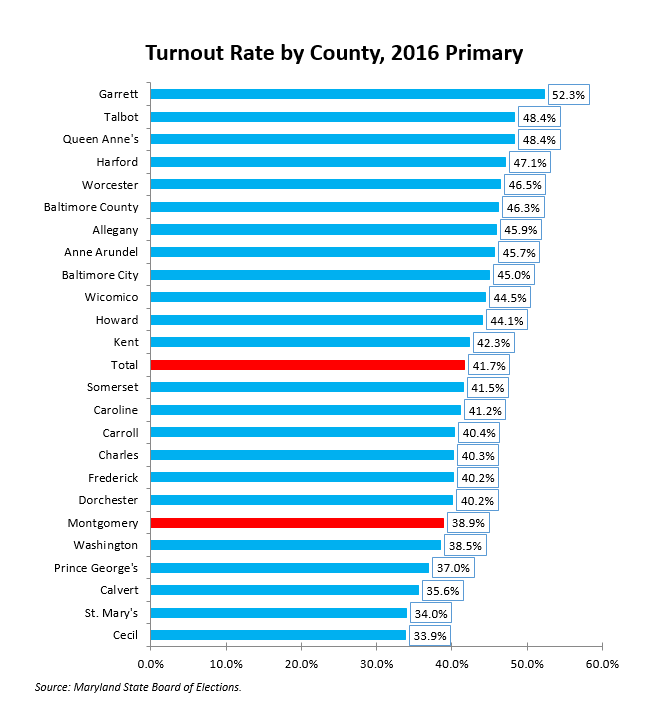
MoCo was also one of the lower turnout jurisdictions in the 2016 primary as shown in the chart below.
In addition to turnout, another issue is how long it is taking to count ballots. At the moment, the county has received 227,383 in combined vote by mail and absentee ballots along with an indeterminate number of election day ballots. At the moment, 137,060 ballots for president have been counted and 124,764 ballots for at-large school board have been counted. That means the county board of elections has a ways to go before all ballots are counted. The board has scheduled canvasses through June 20.