All posts by Adam Pagnucco

Kleine on the Line Again

By Adam Pagnucco.

Nearly a year ago, I wrote a column called “Kleine on the Line” about the county’s embattled Chief Administrative Officer (CAO), Andrew Kleine. Back then, I wrote:

Andrew Kleine is a smart guy with interesting ideas and a lot to offer. But we are now at a big moment. The chief administrative officer is the single most critical non-elected employee of county government. He or she must be beyond reproach and in total alignment with the county executive’s priorities.

The controversy over Kleine’s former business partner and his book sales, as well as the scathing letter from the unions, calls into question whether this is the case with Kleine. [County Executive Marc] Elrich must resolve these issues one way or another or his administration will pay the price.

A year later, Elrich has paid a price in the form of a searing report by the ethics commission and the inspector general detailing how Kleine steered county contracts to his business partners and converted county government into a book club. Now Kleine really is on the line as the county council is due to discuss his ethics problems in an open meeting tomorrow.

The ethics commission report by itself would generate harsh consequences in any other administration. But it is not the only issue with regard to the CAO’s record. Kleine described implementing Elrich’s campaign-era “90 Days Financial To-Do List” as one of his top priorities in November 2018, but numerous promises in that list have gone unfulfilled or under-fulfilled. The list included a ten-year financial plan (not done as of the FY21 budget), a “structural review of all departments in partnership with the county’s unions” (where is it?), an innovation fund (cut back from a $2 million request last year to one $71,545 software project) and a promise to “introduce or strengthen mechanisms that hold county leaders accountable to both other employees and to the public.” That last one reeks with irony.

There is more. Restructuring in cooperation with the unions was a major Elrich campaign promise, but since the unions have put their objections to Kleine in writing, whether this can be completed with Kleine having any part in it remains in doubt. The CAO’s office would normally have a role in approving department head nominees and the nominations of Vennard Wright (technology services) and Tonya Chapman (police department) were both train wrecks due to lack of vetting. The administration’s two-year budgeting initiative, with which Kleine was directly involved, was resisted by the county council and made no appearance in the FY21 budget. And it’s unclear whether Kleine was directly involved with the $10 million “magic asterisk,” the illegal negative appropriation in the executive’s recommended budget intended to account for phantom savings from “cost efficiencies.” But if he did have a role in it, add that to the above list.

The CAO preaches “outcome budgeting” in his book and elsewhere, but given the above record, what has been done that has yielded a positive, documented and significant financial benefit for the county?

Now let’s put all this into context. At the time of Kleine’s arrival in county government towards the end of 2018, two other events were occurring. First, Kleine’s predecessor – 12-year CAO Tim Firestine – was leaving. Unlike Kleine, who had never worked in MoCo government before, Firestine had been with the county for nearly 40 years. Before he was CAO, he was the county’s highly regarded finance director for 15 years. He was well known and well respected in both the executive and legislative branches. Firestine wasn’t warm and cuddly, but no one disputed that he was honest, competent and totally uninterested in self-promotion. He left very big shoes to fill.

The other huge event was the revelation that former economic development official Peter Bang had stolen $7 million from county government. The news was arguably the biggest scandal in county history and shocked people who had worked with Bang, who cultivated a reputation as a sharp dressing, no-nonsense professional. In the aftermath of Bang’s arrest, ethics became an even higher priority in a government that prided itself on avoiding the municipal corruption that so often plagues other jurisdictions in the region.

Into this arena descended Kleine, who immediately set out to direct county contracts to his private business partners and began promoting his book throughout county government and beyond. Bear in mind that 99% of county employees knew little or nothing of Kleine when he arrived. This was the first impression he was making on them. Say what you will about MoCo government, but it is full of professional, experienced and dedicated people – both managers and rank-and-file – who would never think of going anywhere near a conflict of interest. How did they see Kleine’s behavior? We don’t know how all of them saw it, but we do know from the ethics report that employees from two different county departments went to the ethics commission to complain. If these employees are still in county government, they are still working for Kleine even after he admitted to violating two sections of ethics law.

There has been no allegation of criminal activity by Kleine but he is guilty of extremely bad judgment that went on for months. How can he remain in his current role? He is the administrative head of county government. The next time he appears before the county council (in person or virtually), he has to know that all nine of them will be thinking about his ethics violations. The same goes for his own employees. Is there a senior manager anywhere in county government who has not read the ethics report? How can Kleine command the respect and good will any CAO needs to run the government?

The other question here is: where was Elrich? In the spring of 2019, rumors were everywhere about Kleine’s book promotion and his contractors. Was Elrich completely unaware of what was happening or was he aware and saw nothing wrong with it? Neither scenario is appealing. Kleine is the most senior non-elected person in the administration and reports to only one person – Elrich. If Kleine remains CAO after a slap on the wrist, it’s an open question as to whether Elrich is capable of firing anyone – or even disciplining them – for misconduct. What impact will that have on the culture of the executive branch?

That brings us to the county council, which is due to discuss Kleine at an open meeting tomorrow. The council can’t discipline Kleine directly – that is the prerogative of Elrich alone. But the council’s views on Kleine relate to a major theme of this term: the council’s lack of respect for the Elrich administration. The council has voted down Elrich’s labor agreements, rejected his approach to fixing the county’s balky public safety communications system, rejected his tax hike proposal (on the very day he offered it), rewritten his second budget, rejected his first nominee for police chief, passed its own set of health regulations in protest of his performance on COVID testing and regularly ignores his input on legislation. Then came Elrich’s hot mic joke that the council is allegedly “fact proof,” which drew harsh responses from Council Members Nancy Navarro and Gabe Albornoz. It’s hard to imagine the council having an even worse opinion of the administration, but if it comes to believe that Elrich tolerates unethical conduct, his influence will dwindle to zero. That’s obviously bad for Elrich. It’s also not so great for the daily function of county government.

Share

Wear Your Masks Correctly, People!

By Adam Pagnucco.

Earlier this month, the county asked residents about mask usage through Survey Monkey and found that a big majority of respondents reported seeing improper wearing of masks, especially failure to cover the nose. The county’s press release is reprinted below.

Results of Montgomery County Survey on Masks Show Improper and Ineffective Usage

For Immediate Release: Friday, July 24, 2020

More than 2,700 people responded to a recent flash survey on masks and while an overwhelming majority of respondents (91 percent) think wearing a mask is “very important to slow down the spread of COVID-19,” 78 percent of respondents also reported seeing many people wearing masks improperly, such as exposing the nose.

The short survey, conducted via Survey Monkey earlier this month, included five questions and was shared through the County’s Facebook and Twitter accounts, WhatsApp and Nextdoor.

More than half the respondents (61 percent) said they are seeing people wear masks inside buildings and outside where social distancing is not possible and they would like to see more people comply.

“We were pleased to see the response to our survey, while not scientific, indicates people care about keeping themselves and others safe,” said County Executive Marc Elrich. “Wearing a mask, maintaining physical distancing, washing hands and getting tested are the keys to our ability to slowing the spread of COVID-19.”

When asked to describe how people were wearing masks improperly, 66 percent of respondents said they have observed others wearing masks covering only their mouth and chin. Respondents said most mask violations were observed at local businesses (39 percent) and parks, trails and playgrounds (34 percent).

“It is important for everyone to comply with the health order—wearing a mask, and wearing it properly is one of the best tools we have to fighting COVID-19,” said County Health Officer Dr. Travis Gayles. “A mask should be fitted properly and cover the mouth and nose in order to protect others. Just covering one’s mouth doesn’t get the job done.”

For more information about face coverings, visit the County’s COVID-19 Information Portal.

For the latest COVID-19 updates, visit the County’s COVID-19 website and follow Montgomery County on Facebook @MontgomeryCountyInfo and Twitter @MontgomeryCoMD.

Put the “count” in Montgomery County! Be sure to complete the Census online, by phone, or by ail. It’s safe, confidential, easy, and important. #2020Census #EveryoneCountsMCMD

Share

MoCo is Praying for a Federal Bailout

By Adam Pagnucco.

The COVID cuts have begun. County Executive Marc Elrich has sent a mid-year savings plan to the county council, which has tweaked it and given it tentative approval through a straw vote. The ostensible cut numbers are $44 million from the operating budget and another $28 million from the capital budget. That compares to revenue writedowns of $48 million in FY20 and $192 million in FY21, meaning that the cuts are roughly a third of the revenue loss.

But let’s be clear. The county has not adopted a true fiscal strategy as it did ten years ago, at least not yet. Its real strategy – if you can call it that – is to pray for a bailout from Washington.

Let’s look at what exactly these cuts are.

The most common form of “cut” in the savings plan comes in the form of lapses. The county budget defines lapse as, “The reduction of budgeted gross personnel costs by an amount believed unnecessary because of turnover, vacancies, and normal delays in filling positions. The amount of lapse will differ among departments and from year to year.”

Lapses occur naturally because of churn in the workforce. Imagine an employee leaves a position that has a cost of $100,000 a year at the end of a fiscal year. Now imagine that the county takes six months to fill the position. That lapse has cut the county’s cost of filling that position to $50,000 in the current fiscal year. However, that cost will jump to $100,000 in the next fiscal year assuming that it remains occupied. These costs are common throughout published budgets. By keeping lapsed positions vacant for longer, county departments can produce “savings.” No one is getting laid off through such practices and they are equivalent to deferring planned future spending, not making actual cuts. Department managers may wish to fill these positions but extending lapses means they will have to wait longer.

Elrich’s savings plan included over 60 lapsed positions in the savings package. Many of them were lapsed for only part of the fiscal year. It’s hard to tell the exact number because not all individual positions were listed. Their total combined cost was $7.0 million, or about a fifth of the administration’s operating budget reductions. The council added another $3.5 million by converting Elrich’s proposed abolition of vacant positions in the police department into lapses. Even though no employees are actually getting cut through these lapses, the $10.5 million counts as a “cut” because it means the county will be spending $10.5 million less than it was planning to spend in FY21.

In Elrich’s plan, nine county offices and departments – the Community Engagement Cluster, Consumer Protection, the County Council, Environmental Protection, Finance, Housing and Community Affairs, Legislative Oversight, the Housing Opportunities Commission and Procurement – relied exclusively on lapses for their share of “cuts.” Seven more – the Circuit Court, County Attorney, Human Rights, Inspector General, Management and Budget, Public Information and Technology Services – used lapses for a majority of their “cuts.”

Another set of reductions relates to turnover, telework, shifting funding to state money and adjustments for service reductions already set in place (like transit and recreation facilities). Examples of these kinds of cuts are $4.2 million in previously reduced transit service, a $2.9 million reduction for Next Gen 911 “in anticipation of state aid,” $1.9 million in “utility savings due to continued telework” and $766,713 in savings from recreation facilities that have been closed for months. Much of this is booking savings the county was already going to receive. Little of this represents new actual service cuts.

Most of the impactful cuts are concentrated in health and human services, the police department, transportation and the parks department. Then there is Montgomery College, which has agreed to direct $4.4 million of county money to its fund balance rather than spend it this year. That money will be available for the next annual budget. MCPS has been spared – for now. There are also modest adjustments to the capital budget related to cost savings on certain projects, delays on the state’s Purple Line project (which is tied to three related county projects) and deferrals of Ride On bus purchases. These trims will pale in comparison to a likely bloody capital project adjustment season early next year.

The county government knows that plucking low hanging fruit is far from sufficient to survive the current budget crisis, so why is it not doing more? Elrich answered that question in his savings plan transmission memo to the council. Elrich wrote:

Across the country, states and local governments are struggling to deliver vital services to residents and help communities to recover, while adjusting to a significant decline in revenues. Unlike other recessions, however, it is unlikely we will be able to climb our way out of this fiscal crisis without additional Federal aid unless we decimate the services that are so desperately needed by County residents. Do not get me wrong, we are grateful for the aid that the Federal government has already provided to Maryland and Montgomery County to help us navigate these uncertain times, and I am greatly appreciative of our State’s Congressional delegation for their continued assistance and leadership. Simply put, however, without additional aid from the Federal government, deep and draconian spending reductions may well be needed in order for us to balance our budget. These reductions will have lasting impacts on County residents, businesses and employees.

There is enormous uncertainty on whether there will be substantial new amounts of federal aid coming from Washington. U.S. Senate Majority Leader Mitch McConnell has previously said that he would rather let states and local governments go bankrupt than engage in “revenue replacement.” While House Democrats have included nearly a trillion dollars for state and local governments in their COVID relief bill, Senate Republicans seem content to merely allow already-expended aid to be used for broader purposes. (Right now, it can’t be used to plug deficits.) The latter approach offers little to MoCo, which is rapidly spending the $183 million in federal aid it has already received on COVID-related programs. Federal aid may ultimately be used as a bargaining chip to resolve other issues like unemployment benefits, stimulus checks, COVID liability and school reopening aid, which is not a happy place for states and local governments to be.

The county would be in better shape if it had done what county executive candidate Marc Elrich said he was going to do two years ago: undertake a genuine restructuring program in cooperation with the county’s unions to save money starting in the first 90 days of the term. Instead, the executive has added positions through his recommended budgets – some of which were trimmed by the council and others now lapsed – and the county’s top manager has spent his time running a book club while getting blasted by labor. The county’s budget director has also said that the county is looking at eliminating at least 100 vacant positions. (How does that save actual cash?) Now the county is praying that Mitch McConnell – who wants us to go bankrupt! – will bail us out.

Prayer is a great thing for matters of faith. It is much less useful for matters of budget.

Share

MCPS to Go Virtual Only Through January

By Adam Pagnucco.

Montgomery County Public Schools (MCPS) has announced that it will offer virtual learning only through January 29, 2021. Their community update is reprinted below.

*****

MCPS To Provide Virtual-Only Learning for First Semester

Plan to be reassessed in November 2020 for Second Semester

Dear Parents, Guardians, Students and Staff:

I am writing to provide an important update on our Fall 2020 recovery plans. MCPS has been working closely with county and state health officials on the potential reopening of schools. Yesterday (July 20), we received additional guidance from Dr. Travis Gayles, county health officer, in which he shared that “based upon the current state of surveillance and epidemiological data, I would not recommend in-person instruction for students inside school buildings at this time. I recommend investing in a virtual instruction model until, at earliest, the completion of the first quarter in November, with consideration for virtual instruction through the first semester.” As I have shared previously, our plan has always envisioned starting in a virtual-only model. However, given this updated guidance, the safest choice for our district is to remain in a virtual-only instructional model through the first semester—January 29, 2021; or until state and local health officials determine conditions in our county allow for students to return safely after the first semester. This decision includes the cancellation of all fall and winter sports. Working with Dr. Gayles and county elected officials, we will reassess at the end of the first quarter (November 9, 2020) to determine if we are able to implement a phased blended model in the second semester (beginning February 1, 2021). We will continue to engage with our community as we continue to navigate this incredibly complex situation.

We anticipate that Governor Larry Hogan and Dr. Karen Salmon, state superintendent of schools, will also provide an update on the state’s recovery plan for schools this week. We will review their guidance and make all necessary adjustments to align our plans.

We continue to explore creative ways to support students receiving special services and families with significant challenges in accessing curriculum through a virtual model. We also know that this decision to extend virtual instruction will significantly impact the work schedules of many parents in our county. We are seeking the ability to allow buildings to remain open in a limited capacity for essential purposes, including meal service; to support access to technology and other materials; and for use by some child care providers.

On August 6, 2020, we will provide an updated plan to the Board of Education. This update will reflect adjustments stemming from changes in guidance from local health officials and the important feedback we’ve received from students, staff and the community. The Board of Education will vote on this plan at that time.

We are building on what we learned during the spring to provide a robust and dynamic virtual learning experience for our students. Our staff is being provided additional professional development to enhance their instructional abilities in a virtual model; we have put systems in place to ensure all students have access to digital devices and access to the internet when they are away from school buildings; and we are building in additional time for student support and learning opportunities. We are also streamlining digital tools and platforms to make it easier for our students, staff and families to engage in teaching and learning.

Our students are the heart of what we do and why we exist. There is no doubt in my mind that we all want what’s best for students. This decision is incredibly difficult as we know how much students need school for their academic success and social-emotional well-being. We take the immense responsibility of ensuring staff and student safety, educating our students and creating opportunities for all seriously. Thank you for your continued support and collaboration as we work together to meet the needs of our students, staff and families.

Sincerely,
Jack R. Smith, Ph.D.
Superintendent of Schools

Share

Nine Kings and Queens

By Adam Pagnucco.

Advocates of a nine-district county council in MoCo press on despite clear evidence that our at-large races have much more political competition than our district races. But there is no need to speculate about what a nine-district system would look like. For more than 30 years, a nine-district system was in use right next door to us in Prince George’s County. How did it work there?

Under Prince George’s County’s original charter in 1970, its county council had eleven members, all elected at-large. Five of them had to reside in one each of five districts while the other six could live anywhere in the county. The structure was quickly dominated by Democratic Party leaders who ran slates for state and county offices, but it began to disintegrate when non-slate members won races in 1978. In 1980, the county passed Question K, which replaced the old structure with 9 district-based council members who would be elected solely by voters in their districts. At the time, the Washington Post wrote:

With the council reduced from 11 to 9 members and its members elected from separate districts, there will be decidedly fewer countywide offices with which to form a slate. That was one goal that the amendment’s initiators — Republicans and Democrats who ran against the party slate in 1978 — intended. The supporters of K also said they designed the amendment to make the council more responsive to the electorate. Its opponents charged that the amendment will cause parochialism and an emphasis on district issues at the expense of the county.

Sound familiar?

The new structure was first used in 1982, which saw the defeat of numerous incumbents and power brokers. The system remained in place until 2016, when residents approved Question D to add 2 at-large members by a 67-33% vote. In 2018, a retiring district council member and a non-incumbent won the 2 new at-large seats, defeating seven other candidates including another retiring district council member and a former state delegate.

Another factor in Prince George’s elections are term limits, passed by voters in 1992. The county executive and county council members are limited to two consecutive four-year terms, though they can return after being out of office. Additionally, council members can serve two terms in district seats and then immediately run for two more terms in the at-large seats created in 2018. Prince George’s voters have rejected multiple attempts to repeal or extend term limits.

How well has the nine-district system promoted political competition in Prince George’s County?

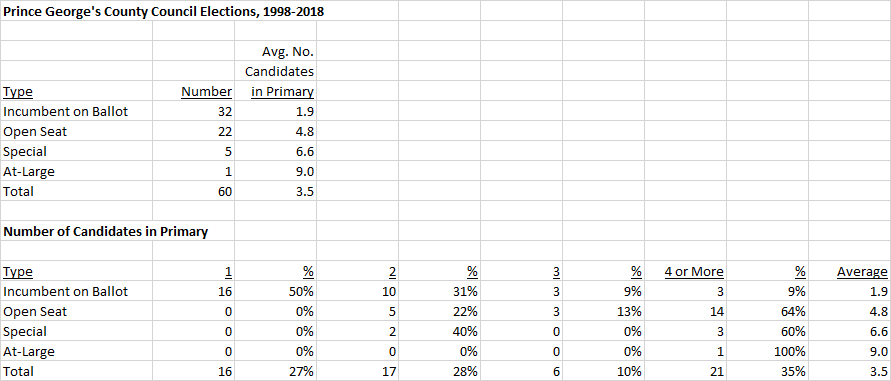
The table below shows the distribution of the 60 county council elections held in Prince George’s from 1998 through 2018. Of those 60 elections, 32 were district races with an incumbent on the ballot, 22 were for open district seats, 5 were special elections for open district seats and one was an at-large election in 2018.

The first thing one notices is that the average number of primary candidates is much lower in races with incumbents (1.9) than in open seat district races (4.8) and special elections (6.6). The 2018 at-large race had 9 candidates.

Now let’s look at how incumbents fare in Prince George’s district races.

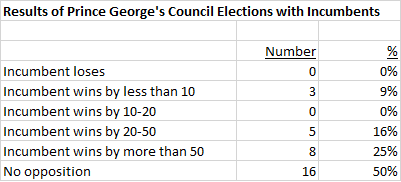
Fully half of the elections featuring an incumbent (16 of 32) had no opposition. Only 3 elections had an incumbent winning by less than 10 points. Ninety-one percent of the elections had an incumbent winning by 20 points or more or not having an opponent at all.

The combined record of incumbents running for reelection over the last two decades is 32-0.

Granted, elections work differently in Prince George’s and MoCo. Prince George’s politicians employ mixed slates of incumbent and non-incumbent state and county candidates who distribute sample ballots listing all of them. This gives incumbents, especially non-term limited state legislators, enormous influence in selecting and grooming new members of their political organizations. But the end result is not much different than in MoCo’s district council races since 1998, in which Democratic incumbents have an 18-1 record and regularly win blowouts.

The lesson from Prince George’s County is clear: in the context of all district seats, true competition usually only occurs when an incumbent does not run. Because Prince George’s limits incumbents to two consecutive four-year terms, that means true competition happens once every eight years for district seats (unless a vacancy occurs and a special election is held). In Montgomery County, which limits council members to three consecutive four-year terms, true competition would occur once every twelve years. That is a mammoth setback from MoCo’s at-large elections, which have at least some degree of competition in every primary and have sent three incumbents home.

The effect of electing nine candidates and then allowing them to face creampuff (or no) opposition for twelve years would be to create nine kings and queens. That is comparable to what happened in Prince George’s County except our monarchs would rule 50% longer. The NIMBYism and parochialism of the Prince George’s nine-district system even acquired a name – “council courtesy,” under which the other eight members nearly always accepted a member’s position on development in his or her district. With neither the county executive nor the planning board trumping the council on land use powers, the council members were unchallenged overlords inside their domains. Then-special election candidate (and future Council Member) Derrick Leon Davis explained how this works on Kojo Nnamdi’s show in 2011.

In politics, there are few things more dangerous than elected officials who face little or no competition. The risk of being hurled from office by pitchfork-wielding voters is one of the few safeguards protecting the people from politicians afflicted by greed, ego, malice, sloth or sheer incompetence. Nine-district advocates have legitimate grievances and the county could use more district council seats. But competition is a far better solution to our problems than the crowning of kings and queens.

Share

MCEA President Responds to MCPS Video

By Adam Pagnucco.

Montgomery County Education Association (MCEA) President Chris Lloyd has released the video below as a message to MCEA members in reaction to the MCPS video on the school system’s reopening plan. MCEA had previously said that the reopening plan was “wholly inadequate” to protect the health of students and employees.

Lloyd covers a lot of ground in this video, relating concerns of worried teachers and their family members, asking which metrics will be used to judge school safety and asking what will happen if (when) students and employees contract the virus at school and pass away. He says that school preparation can be funded with a share of the federal CARES Act money received by the county but notes that the school system has not requested it. He implores teachers not to leave their jobs. And he describes this feedback from MCEA members on MCPS’s video.

Some of you told me you felt the video on Friday from our employer was condescending. That it was gaslighting. That it made you feel small. And angry. That it was another example of our employer using tactics to try and divide us from our community. That it was an attempt to union bust. The union isn’t me and it isn’t you. It is all of us as a part of the largest labor union in the country with 3 million members.

On top of all of this, MCPS and MCEA have not finalized a new collective bargaining agreement as of this writing.

Share

Reopening Decisions by School District So Far

By Adam Pagnucco.

Editor’s note: this post has been updated to include Washington County, Maryland.

In the aftermath of discussion about MCPS’s reopening plans, let’s take a look at what other districts are planning. Bear in mind that jurisdictions in Maryland and Virginia are bound by state guidance and they have had different coronavirus infection rates. Below is a summary of the approaches taken by 18 school districts in the Washington-Baltimore region.

Opening with online only as first phase (7 districts)

Arlington County: Schools will begin on September 8 with full-time distance learning. Parents may choose a hybrid model combining distance learning and physical school, which will begin implementation in October.

Charles County: Schools will start with all virtual learning “with a goal of transitioning to Phase 2 as quickly as possible. Phase 2 would include in-person instruction for special populations of students.”

Harford County: Distance learning only for the first semester. A limited number of spaces in physical schools will be offered to students to help them access online instruction.

Howard County: Distance learning only through January 28.

Prince George’s County: Distance learning only for the first two quarters of the school year.

Prince William County: The school year will begin with distance learning only for the first quarter (September 8 through October 30). Afterwards, “the goal will be to transition to a 50% capacity model in the second quarter, with the option for students to remain virtual.”

Washington County: “Washington County Public Schools (WCPS) students will begin the 2020-2021 school year with all students in grades pre-k through 12 engaged in distance learning. The Board of Education unanimously agreed to adopt a model of full distance learning beginning August 31, 2020 and continuing until it is safe for students to physically return to school.”

Preliminary plan with online only as first phase (3 districts)

Calvert County: “On July 16th, the Board of Education of Calvert County Public Schools decided to continue the discussion of how to open the 2020-2021 school year. To ensure the safety of staff and students during the COVID-19 pandemic, the Board is in favor of starting the year online for all students. Board members recognize, however, that barriers exist for some students to learn online. The Board will continue to accept public comments about meeting the needs of students with limited or no internet connectivity or other challenges through July 22nd.”

Carroll County: Reopening will occur in three sequential phases: enhanced virtual/distance learning for all students, hybrid model combining distance learning and some in-person instruction and a traditional model. Parents may opt for online only for the entire fall semester.

Montgomery County: Schools will begin with distance learning and eventually phase in some in-person instruction. The teachers union and MCPS management have shared their perspectives on the plan.

Opening with choice model (1 district)

Fairfax County: Parents have been given a choice between full-time distance learning and a hybrid option with at least two days in physical schools.

Preliminary plan with hybrid or choice model (2 districts)

District of Columbia: According to a preliminary plan, parents may choose between all online learning or a hybrid of in-person and online. Mayor Muriel Bowser has said a final plan will be announced on July 31.

Frederick County: A draft plan suggests that most schools will open with a hybrid model in which students will be divided into two cohorts and alternate between two days in physical school and three days in virtual learning.

No plan yet (5 districts)

Alexandria City: The district is still in its planning process and does not yet have a draft plan.

Anne Arundel County: The district is still in its planning process and does not yet have a draft plan.

Baltimore City: The district is preparing a preliminary plan for consideration by the school board on July 28.

Baltimore County: No decision has been made.

Loudoun County: No plan has yet been released.

So far, no public school district in the region has said it will reopen with 100% traditional in-person instruction.

Share

MCPS Releases “Just the Facts” Video

By Adam Pagnucco.

MCPS has released the video below elaborating on its school reopening plan. The video was no doubt prompted by the Montgomery County Education Association’s statement that MCPS’s reopening was “wholly inadequate” in protecting students and staff.

Among the points made by MCPS Superintendent Jack Smith and some of his top staff are:

School will start on August 31 and be “all virtual.” Smith said, “When we phase it will depend on our health circumstances in our community and in our state.” Right now, the timing of when phases of in-school learning will begin is unknown.

Smith commented on the needs of students for physical school. He said, “We know that we have literally thousands and thousands of students who need to be in school if at all possible. We have students who are in poverty. We have students who have learning disabilities. We have students who are requiring English. We have students who really benefit from the structure, from their physical, social and psychological well-being. We have students who want the most rigorous experiences. In fact, every single student needs school. So we want to be ready to phase in when we’re able to come back in based on the health situation of our community. And when we are ready, we want to be able to start.”

The issue of discipline related to mask wearing came up. Deputy Superintendent Monifa McKnight gave this example: “We definitely are not going to discipline a six year old child who needs to take a break or struggles with adjusting to this new way of keeping themselves safe. But what we are going to do is teach them about it, teach them about the importance of it and how it contributes to their environment in a responsible way and help them and make note of things they struggle with wearing it so we can figure out ways to support them.” Nothing in the discussion contradicted MCEA’s statement that violating mask requirements would not result in discipline.

Communications Director Derek Turner said, “The next rumor I’ve heard is that only teachers and students are going to be cleaning classrooms.” (Note: MCEA said that “teachers and students will be primarily responsible for wiping down surfaces between classes” but did not say that they would be the only ones cleaning classrooms.) Associate Superintendent Essie McGuire said that building services workers would have more cleaning responsibilities than before but that teachers and students would have a role too. She said, “When we think about teachers and students, we’re really thinking about those personal spaces, the kind of in-the-moment, day-to-day cleaning that may just go with incidental use of your room or your personal space.”

McGuire said that MCPS has spent millions on personal protective equipment (PPE) and will continue to. When asked by Turner about whether just two masks would be provided for the entire year to teachers and students (as MCEA asserted), McGuire discussed how inventories of masks and other PPE would be available at schools but did not otherwise directly address the two-mask question.

McGuire said that different kinds of hand sanitizer dispensers would be available in different places inside schools. However, she did not directly contradict MCEA’s statement that “free-standing, hands-free sanitizer stations will not be available at school entrances because of their difficulty to obtain.”

McGuire said that there will not be a hard standard of 15 kids in a classroom. Classrooms will be evaluated based on their size and social distancing requirements to determine their appropriate student capacity. The actual number of students per classroom will vary.

On the degree of choice given to MCPS employees about whether they would be required to return to physical schools, Smith quoted a statement made by MCEA President Chris Lloyd in Bethesda Beat. Smith said:

I think this quote by Mr. Lloyd, the MCEA president, at the end of June, beginning of July in the Bethesda Beat really kind of sums up where we are. This is the quote. Lloyd said, “Many older teachers and those who are immune-compromised have told him they might not be comfortable returning to school buildings in the fall. But Lloyd said Superintendent Jack Smith has been clear with union leaders that teachers and students will have the flexibility to decide if they need to work remotely.” And so really that’s that issue of need and flexibility and choice, how all that works together. So we have to have a process for that. So we’re going to continue to work with individual employees and with individual families about what works for different families based on their needs and we have to be ready when we can phase in again to know who can and will work in schools, who will need to be in the virtual program and how that will continue to work together. So we’re going to continue this conversation in the next week, in the next month, in the next couple of months as we move forward and make plans for how to re-phase, reenter schools in a phased approach when we’re able to do so.

Smith ended the video with this statement.

This is a very, very tough situation. No one would have chosen this. Not one person would choose this. And we are all touched and affected by it. Every one of us, every person listening to me today has been touched in many ways by this. We must continue to work together on behalf of everyone to do the best job we can to make things work for our community, for our students, for our staff and the entire public education structure. It’s critically important for our future that we are able to continue forward with public education in the way that it serves our communities.

Amen to that, Dr. Smith.

Share

MCEA: MCPS Reopening Plan “Wholly Inadequate” to Protect Students and Staff

By Adam Pagnuccco.

Last night, the Montgomery County Education Association (MCEA) held a town hall with its members to share its recent discussions with MCPS on a range of issues, including MCPS’s plan to reopen schools. MCEA just put out the press release below summarizing its views on the reopening plan.

*****

MONTGOMERY COUNTY EDUCATORS CORRECT MISINFORMATION REGARDING PROPOSED SCHOOL REOPENINGS WITH SERIOUS CONCERNS OVER STUDENT AND COMMUNITY SAFETY

Summary of MCEA Position on Reopening

ROCKVILLE — The Montgomery County Public Schools (MCPS) plan to reopen schools is wholly inadequate to protect the health and safety of students and staff. Many questions about how to safely implement the plan remain unanswered and there are discrepancies between what MCPS leaders told the public during a July 15 virtual town hall, and what they are telling the teachers from the Montgomery County Education Association (MCEA) who are trying to work with MCPS to come up with a way to ensure student and staff safety.

Masking, social distancing, and enhanced cleaning are the three pillars on which the MCPS plan rests, and it fails in all three areas.

For example, MCPS is proposing supplying students and staff with two cloth masks for the entire school year. Disposable masks will be available if students or staff forget their mask or soil it, but only as long as supplies are available. The cloth masks must be cleaned after each use, but there is no way for teachers to determine whether a mask has been washed.

Mask wearing will be mandatory, but educators have no recourse beyond moral persuasion to enforce this requirement. MCPS says mask-wearing is a “wellness” issue and that teachers should stress to students that wearing a mask keeps everyone safer. If a child cannot be persuaded, MCPS suggests the teacher ask the school nurse or counselor for help, if one is available. MCPS has made clear this is not a “discipline” issue and that teachers should not send students to building administrators.

Students will eat lunch in their classrooms–unmasked. It is unclear who will monitor students during lunch, and teachers/students will be responsible for “sanitizing” the space after eating.

For social distancing, MCPS is requiring six feet between student desks in classrooms. MCPS has posted videos showing adults pretending to be students sitting in classrooms and lining up when they arrive at school, but MCEA representatives who have visited elementary schools to look at classroom set ups have yet to find one large enough to safely accommodate students, even if class sizes are halved, as MCPS proposes. Limited bus seating means schools will have to stagger arrival and departure times, further complicating social distancing. It is unclear how schools will safely conduct mandatory drills, including fire drills and those required for active shooter threats and inclement weather.

Enhanced cleaning and frequent hand washing also fall far short. Contrary to what MCPS has told the public, free-standing, hands-free sanitizer stations will not be available at school entrances because of their difficulty to obtain. Because no additional funds have been designated to beef up custodial staffing, teachers and students will be primarily responsible for wiping down surfaces between classes. This assumes adequate cleaning supplies will be available. Building services staff will clean “high contacts” areas, but given limited time, it is likely places like bathrooms will be cleaned just twice a day. A weekly “deep clean” on Wednesday does little to protect students and staff throughout the school day on Monday and Tuesday, or Thursday and Friday.

A plan replete with shortcomings cannot ensure the health and safety of students or staff. If MCPS leaders persist with this terribly flawed reopening, they will do so, leaving educators with an untenable choice: our jobs or our health and the health of the people we love.

#

Share

Distance Learning May be Plan C, but it is the Best Option Right Now

By Sunil Dasgupta, candidate for Montgomery County Board of Education, At-large.

Students, families, and school staff are waiting anxiously as MCPS debates what school will look like in the fall. Who will return to school buildings, and when? How will transportation work? Will students and staff be able to choose virtual learning and instruction? There are infinite questions and no great options.

Plan A for the fall was to bring all students back into classrooms. Under normal circumstances, this would of course be the optimal plan, and the American Academy of Pediatrics (AAP) argued for the physical presence of students in schools as necessary for child development. But CDC’s 6-feet social distancing guidance requires each student and teacher have 36 sq ft of exclusive space while in school. Even using Parks and Recreation facilities, tented outdoors classrooms, or small self-contained pods, MCPS cannot make full time in-person instruction possible for all students.

Plan B is the hybrid model—part in-person and part online with shift attendance—which is reflected in the draft plan that MCPS released this week. This plan attempts to bring students and staff back into buildings while meeting CDC guidelines, but it raises questions about safety, risk, and reward. One high school English teacher pointed out that, under the draft plan, he would meet with his students in-person only six times in the fall. The potential benefit of the hybrid model does not seem worth the risk, and with a substantial number of students and staff opting for online instruction, a great deal of the burden of carrying forward instruction would remain online.

That leaves us with Plan C: online, virtual, distance learning only, at least for the fall semester. The last few months have shown that it is very difficult to provide high-quality distance learning. Even in a large, wealthy jurisdiction like Montgomery County, we see noticeable gaps in access, engagement, and continuity of learning. While online learning has been more manageable and accessible for some, many families are reporting confusion over scheduling, technology problems, lack of student engagement, and absence of learning. When combined with serious equity and access issues, the results have been far from satisfactory.

None of the plans are perfect. But only one plan is safe: Plan C. MCPS should stick with distance learning for the fall semester, and the school system should make the announcement as soon as possible so we can create the best Plan C possible.

We can provide additional training for teachers, set higher expectations for students, and create more engaging curricula. We can make concrete plans for technology troubleshooting and meeting the needs of students with special learning needs and English Language Learners. And we can give families time to plan for how to manage life once classes resume.

But we can only begin preparing for more equitable, better organized, and ultimately more powerful online learning experiences for our young people once the school system makes the call to go with the imperfect, yet safe Plan C. Waiting longer risks losing the vital prep and training time needed to get this right.

Share