All posts by Adam Pagnucco

Council Drops Poison Pill on Nine Districts

By Adam Pagnucco.

In addition to placing at least one competing proposal on the ballot, the county council is about to adopt a tactic to defeat the proposed charter amendment for 9 districts that is sure to infuriate its supporters. The worst thing (or best thing, depending on your point of view) is that this tactic has a proven record of success.

Specifically, it relates to the exact language on 9 districts that will be placed on the ballot.

Maryland Election Law § 7-103 lays out the role of local governments in preparing ballot language. This morning, the county council will be considering this language for the ballot on the 9 districts amendment (providing that it has 10,000 valid signatures and actually qualifies).

Question D

Charter amendment by petition

County Council – Alter Council Composition to 9 Districts

Amend Sections 102 and 103 of the County Charter to:
— divide the County into 9, rather than the current 5, Council districts;
— elect all Councilmembers by district, rather than the current 5 by district and 4 at large; and
— reduce from 5 to 1 the number of Councilmembers each voter can vote for

FOR

AGAINST

Consider this. Every voter who looks at the ballot will be told that this charter amendment would reduce the number of council seats he or she may vote for from 5 to 1.

This is the exact same language that appeared on the ballot when a 9 district amendment was submitted to voters in 2004. That amendment was defeated on a 61-39% vote. Like 2020, 2004 was a presidential election year in which many – probably most – voters were interested in national politics and knew relatively little about the county.

I was one of those voters. I moved to the county in 2003 and 2004 was my first election here. At that point, I knew two things about MoCo. 1. It had a county executive named Doug Duncan who had appeared on TV during the hunt for the D.C. sniper. 2. There was a fight being waged over a big highway called the Intercounty Connector. (I checked to make sure its alignment was nowhere near my new house.) That was about it. So here I was in the voting booth trying to figure out what this 9 district question was. And I saw that it would reduce the number of council members I could vote for from 5 to 1. I thought that was a terrible idea. I like voting for elected officials so I voted NO. So did 61% of the electorate.

Supporters of 9 districts are going to cry foul but they have to acknowledge two things. 1. The language is indisputably accurate. 2. It has appeared on the ballot before so the council is following precedent.

Poison pills are hard to swallow. This pill could very well poison the electoral prospects of 9 districts.

Share

Nine Districts for MoCo Submits 16,448 Signatures

By Adam Pagnucco.

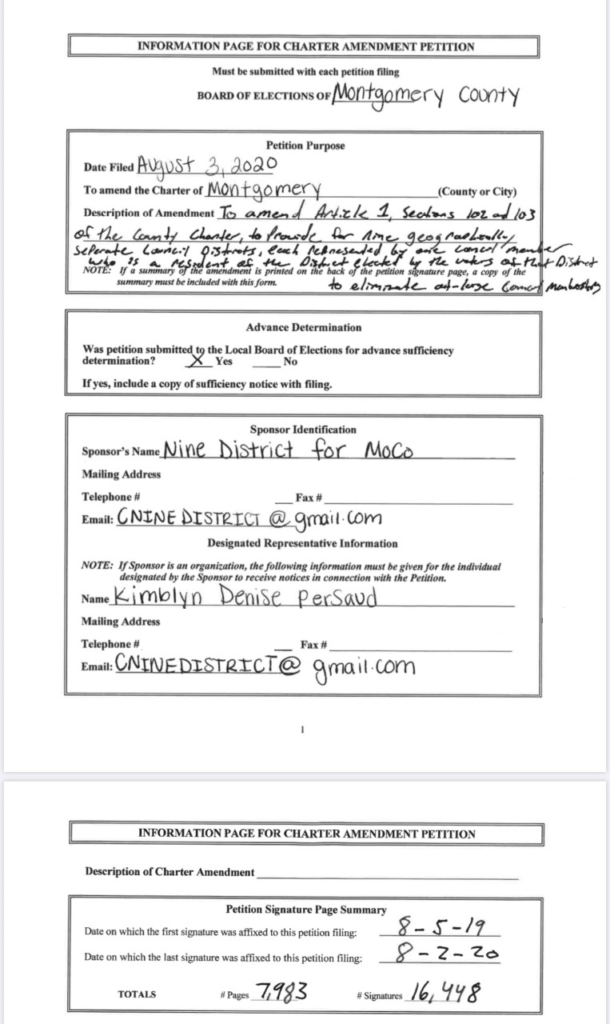
Nine Districts for MoCo, a group that seeks to replace the current county council structure of 5 districts seats and 4 at-large seats with 9 district seats, has submitted 16,448 signatures in support of their 9 district charter amendment. The county board of elections will now begin verifying signatures. The group needs 10,000 valid signatures to get its charter amendment on the ballot.

The group’s raw signature count is not that different from the raw counts submitted by Robin Ficker for his 2016 term limits amendment (more than 18,000) and his current anti-tax amendment (more than 16,000). Both of those amendments qualified for the ballot and the term limits amendment passed. Maryland’s petition signature requirements are tough and some petitions that might appear to qualify at first glance have been thrown out. (For example, Ficker’s term limits petition was blocked in 2010.)

Nine Districts’ petition cover sheet is reprinted below. The phone number and address of the group’s chair have been redacted to protect her privacy.

Share

Hogan Overturns MoCo Closure of Private Schools

By Adam Pagnucco.

Minutes ago, Governor Larry Hogan issued an amended executive order preventing political subdivisions from closing or modifying the operations of schools. The governor issued this statement:

The recovery plan for Maryland public schools stresses local flexibility within the parameters set by state officials. Over the last several weeks, school boards and superintendents made their own decisions about how and when to reopen public schools, after consultation with state and local health officials.

Private and parochial schools deserve the same opportunity and flexibility to make reopening decisions based on public health guidelines. The blanket closure mandate imposed by Montgomery County was overly broad and inconsistent with the powers intended to be delegated to the county health officer.

To be clear, Maryland’s recovery continues to be based on a flexible, community-based approach that follows science, not politics. As long as schools develop safe and detailed plans that follow CDC and state guidelines, they should be empowered to do what’s best for their community.

I want to thank all the parents, students, and school administrators who have spoken out in recent days about this important issue.

The language of the governor’s amended executive order states at I.(e):

If a political subdivision determines that doing so is necessary and reasonable to save lives or prevent exposure to COVID-19, the political subdivision is hereby authorized to issue Orders that are more restrictive than this Order (“Local Orders”):

i. requiring any businesses, organizations, establishments, or facilities (except schools) to close or modify their operations; and/or

ii. requiring individuals to remain indoors or to refrain from congregating.

Share

Friedson Asks for Answers on Private School Shutdown

By Adam Pagnucco.

District 1 County Council Member Andrew Friedson has sent the letter below to county health officer Travis Gayles asking a series of questions about the county’s shutdown of private schools for in-person instruction, which happened on Friday. Friedson’s district includes Bethesda, Cabin John, Chevy Chase, Garrett Park, Glen Echo, North Bethesda, Poolesville, Potomac and part of Kensington.

*****

August 3, 2020

Travis A. Gayles, M.D., Ph.D.
Health Officer, Montgomery County
401 Hungerford Drive, 5th Floor
Rockville, MD 20850

Dr. Gayles,

As I am sure you are aware, the health order you issued late Friday, July 31 prohibiting independent schools from reopening for in-person instruction has been met with a great deal of anger, frustration, and confusion among our residents. This order caught many independent school leaders and families by surprise, including many who have spent the last several months preparing to open based on CDC and state guidelines. Understandably, it has generated countless questions conveyed to me and my office over the weekend.

While I recognize that not everyone will agree with all of the difficult decisions you must make as our County’s Public Health Officer during this pandemic, our residents do deserve clear, logical, and consistent rationales for those decisions, along with timely and transparent answers to their questions. In that spirit, I am requesting that you answer the following questions for our residents in a thorough, fact-based, and timely manner, consistent with previous reopening decisions made to date:

1. What specific health metrics and epidemiological data were used to make the determination that independent schools cannot safely open until at least October 1? Are there specific, objective public health metrics that must be met before in-person instruction can take place?

2. Why are neighboring jurisdictions with similar transmission rates allowing independent schools to open? Are they basing their decisions on different data? Do they assess the risk differently?

3. Have you consulted with neighboring jurisdictions to determine why they’ve reached a different conclusion than our health department?

4. Have you consulted with the State Health Department to discuss this decision and the factors upon which it is based?

5. Are there specific, unique features of a school setting that carry significant additional risk of transmission compared to other businesses such as child care providers, restaurants, barbers, retailers and offices that are able to operate on a limited basis with health directives such as social distancing, use of facial masks and other PPE, and cleaning protocols?

6. Rather than a wholesale prohibition of in-class instruction, did you and your team consider whether independent and religiously affiliated schools should be provided a set of health and safety guidelines for reopening like other sectors in our community? Are there no health directives and safety measures that can be employed in order for schools to open as many businesses have been able to? If not, why?

7. Were independent schools directly involved in the decision-making process to determine how they had planned to follow the CDC and state guidelines and whether there were additional measures that could be employed to further mitigate transmission risk? Were schools afforded an opportunity to provide individualized reopening plans for your consideration?

8. I understand that some day-care centers will operate “kindergarten support” classes. Children who would otherwise be in public school kindergarten will go to these classes at a day-care center, and the day-care center will assist the children with the online kindergarten instruction, and also provide aftercare. If that can be done safely, is it possible for a private school to safely operate a kindergarten class, provided it has the same density of children and adults and uses the same safety standards as a day-care center operating a “kindergarten support” class?

Because these decisions are not easy and the available information regarding this disease is rapidly evolving, it is even more critical that public health directives be made as clearly, consistently, and transparently as possible. If we ask the community to follow the rules, we must ensure that they have faith in the process that determined the rules, as well as the policies themselves. Thank you in advance for your prompt response to these questions.

Sincerely,
Andrew Friedson
Councilmember, District 1

CC: Marc Elrich, County Executive
Dr. Earl Stoddard, Director, Office of Emergency Management and Homeland Security
Sidney Katz, President, County Council
Gabe Albornoz, Chair, Health and Human Services Committee, County Council

Share

What Will Happen to the County Council?

By Adam Pagnucco.

Conversations had been going on for a while, but when Nine Districts for MoCo announced that they had gathered 15,000 signatures for their charter amendment, things got real in a hurry. The county council faced a serious chance that they would get involuntarily restructured by angry voters at the ballot box.

Now they had to talk about alternatives.

A majority of the county council is content with the current council structure of five district seats and four at-large seats. They believe that a mix of district representation and countywide perspective serves residents best. It also does not escape them that a new structure of nine districts could complicate their plans for the next election. Of the six members who are not term limited, who would run for which seats in a nine district configuration?

Leaving a potential nine district charter amendment as the only council structure on the ballot would be a crapshoot. What if all the voters wanting change voted for it because it was the only change option on the ballot? So council members discussed placing an alternative charter amendment on the ballot that would be more palatable. What would it be? In devising their preferences, each council member had to consider three factors: what was best for the county (at least in their opinion), what could gather enough voter support to compete with nine districts and what was best for (or at least not injurious to) their own political futures. These being nine very different people at different points in their political careers, this was a very complicated conversation.

Two ideas rose to the top of discussion over the weekend.

Adding two council seats

Last year, At-Large Council Member Evan Glass told the county’s charter review commission (which studies charter amendments and makes recommendations to the council) that “more districts may be warranted.” Indeed, MoCo’s council districts have more than twice as many residents in them as the regional average. One topic of conversation centered on adding district seats with two being the most mentioned number. Another variant was adding one district seat and another at-large seat. Regardless of the nature of additions, this line of thought addressed the need for more seats (and districts) without disturbing the configuration of the existing council and its currently serving members.

Adding an elected council president

The Montgomery County Council does not have a four-year president elected to that position by voters. The District of Columbia, Baltimore City, and Fairfax, Loudoun and Prince William Counties have presidents or chairs who are elected at-large. In Anne Arundel, Arlington, Baltimore, Frederick, Howard and Prince George’s Counties, the council or board selects its own officers, which is the system MoCo currently uses.

With this option, two corollary questions were generated. First, would an at-large council president replace one of the current at-large seats or would it be a brand new additional seat? Second, would the term limit clock “reset” for council president? In other words, if a term-limited council member were to run for council president and win, would that person be entitled to a new set of three consecutive terms? In 2016, when Prince George’s County (which has council term limits of two terms) created two at-large seats to go with its existing nine district seats, the county’s charter language explicitly allowed district incumbents to serve two more consecutive terms if they won at-large seats. The question of how term limits would apply is not an academic one for the three term-limited council members currently in office – Nancy Navarro, Craig Rice and Hans Riemer.

The problem with the council president proposal is not so much on its merits but rather that it is unresponsive to the public discussion, which has focused on two questions: should there be more district seats and should the at-large seats be eliminated? To my knowledge, no mass constituency has come forward and said, “You know, our problems would be solved if we had a permanent council president.” How does this dissuade anyone from voting for nine districts?

As of this writing, it seems the most likely proposal from the council will be to add two more district seats with no elected council president. But the council will not make a decision until Tuesday and there could be more twists and turns on this than on a country road in a blizzard.

Finally, there is one more bizarre possibility: what if the Nine Districts proposal does not make it onto the ballot? The group claims to have 15,000 signatures but the county board of elections has until August 14 to certify them. The group needs to have 10,000 valid signatures for certification; otherwise, regardless of the group’s claims, their amendment will not qualify for the ballot. The county council, however, must decide what question(s) it will put on the ballot this week. And so it’s possible that a council proposal could make it onto the ballot while the Nine Districts proposal fails to qualify.

Regardless of how it all turns out, it seems there is a strong likelihood that change is coming to Rockville.

Share

MoCo Shuts Down Private Schools for In-Person Instruction

By Adam Pagnucco.

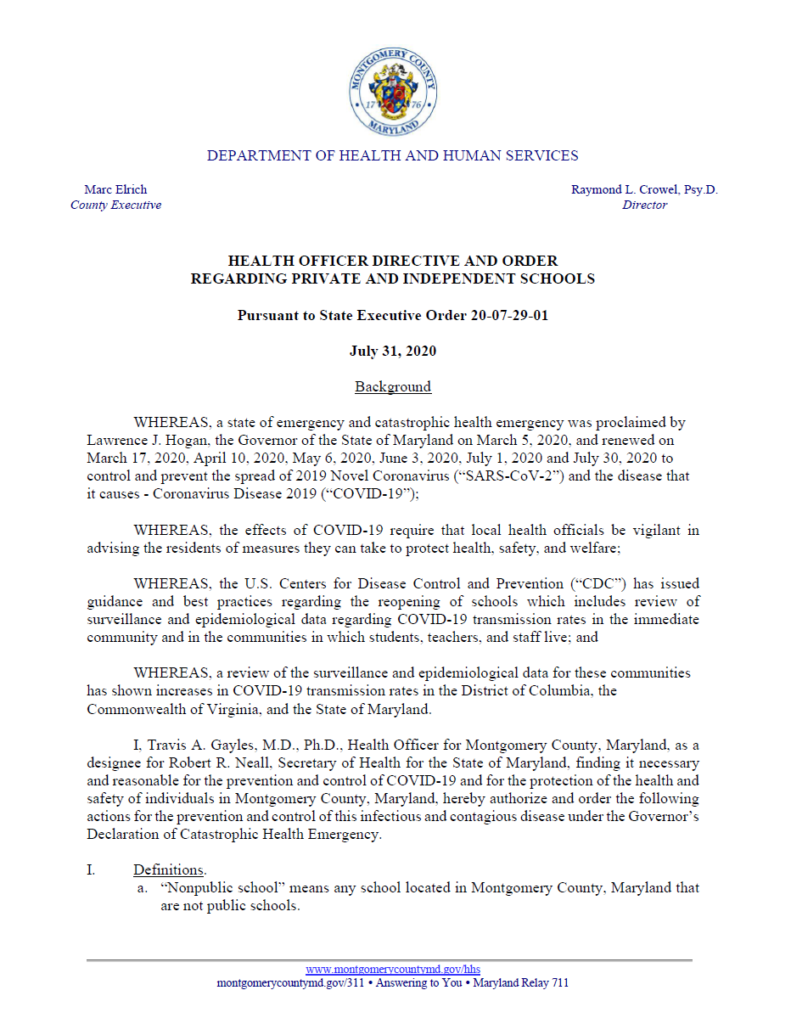
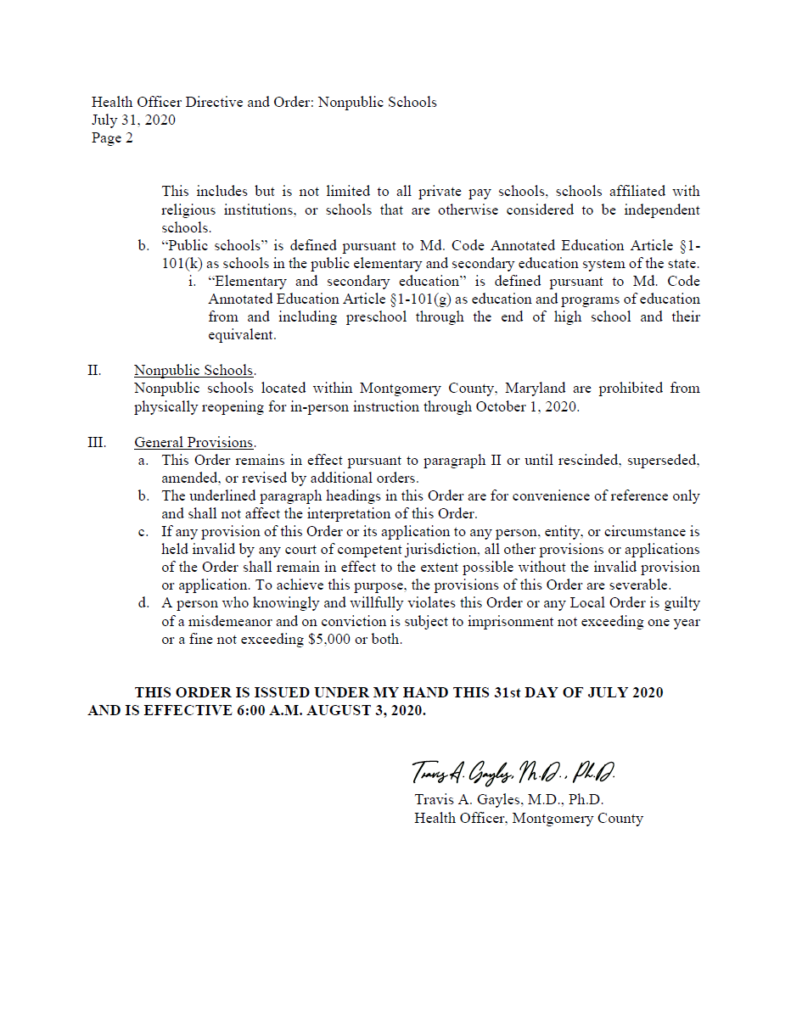
Montgomery County Health Officer Travis Gayles has issued an order shutting down private schools for in-person instruction. The order includes but is not limited to “all private pay schools, schools affiliated with religious institutions, or schools that are otherwise considered to be independent schools.” The order as currently drafted applies through October 1, 2020. Gayles cites State Executive Order 20-07-29-01 as giving him the authority to institute the shutdown. The order prohibits private schools from “physically reopening for in-person instruction” but is silent on virtual instruction.

The order from Gayles is reprinted below.

Share

Nine Districts for MoCo Claims 15,000 Signatures

By Adam Pagnucco.

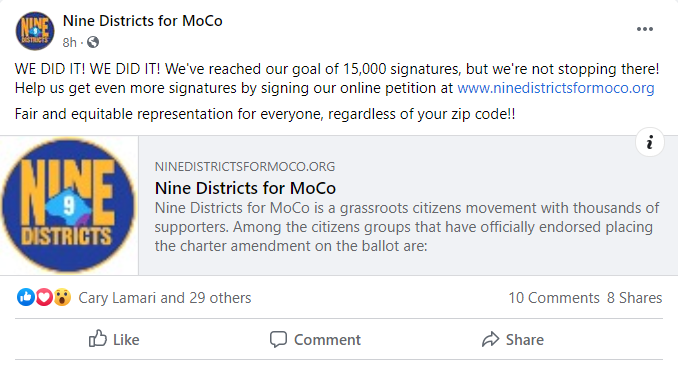
Nine Districts for MoCo, the group seeking to replace the current county council structure of 5 district seats and 4 at-large seats with 9 district seats, claimed earlier today that it has obtained 15,000 signatures for its proposed charter amendment. Under the state’s constitution, a charter amendment proposed by voters must receive valid signatures from not less than 20% of registered voters or at least 10,000 voters. The group’s Facebook post appears below.

The original deadline for receipt of petition signatures was Monday, July 27. However, the State Board of Elections extended the deadline by one week due to the COVID-19 crisis, meaning that the group may submit its signatures to the county on Monday, August 3. The county board of elections must then verify the signatures to ensure that the 9 district charter amendment qualifies for the ballot.

The group’s declaration was shared on Facebook by the Parents’ Coalition of Montgomery County, the Montgomery County Republican Club, the Republican District 16 Team, the Conservative Club of Maryland and former Montgomery County Republican Party Chairman Mark Uncapher.

Share

MoCo Finally Bans Tax Dollars for Kleine’s Book

By Adam Pagnucco.

Roughly a year after the Montgomery County Ethics Commission began receiving complaints about Chief Administrative Officer Andrew Kleine’s promotion of his book, the county has finally banned the use of tax dollars to purchase it.

The ethics commission’s report states that county employees began complaining about Kleine “during the summer of 2019.” The commission requested that the county’s inspector general begin investigating Kleine on September 4, 2019. The inspector general completed the investigation and sent a report to the ethics commission on December 12, 2019. At some point thereafter, Kleine offered a proposal to “cure” the issue which the ethics commission accepted and signed on July 1, 2020.

The ethics commission’s report states that the county bought 89 copies of Kleine’s book from October 1, 2018 through September 30, 2019 for a total of approximately $3,000. It contains no information about book purchases since then.

On July 20, 2020, Deputy Chief Administrative Officer Fariba Kassiri – who reports directly to Kleine – sent out the email below to county managers advising them that county funds cannot be used to purchase Kleine’s book so long as he remains a county employee. The amount of county money spent on the book between September 30, 2019 and July 20, 2020 has not yet been reported.

*****

From: Kassiri, Fariba Fariba.Kassiri@montgomerycountymd.gov
Sent: Monday, July 20, 2020
To: #MCG.Department & Office Directors MCG.DepartmentOfficeDirectors@montgomerycountymd.gov
Subject: Restricted Book Purchase

Department and Office Directors,

In accordance with the CAO’s Proposal to Cure certain violations of the Ethics Law and the Ethics Commission’s subsequent acceptance of the proposal on July 1, 2020, I am advising you that your Department/Office should not purchase any copies of City On The Line by Andrew Kleine, so long as Andrew remains County employee. This means no purchases can be paid for through the Oracle system, by P-Card or by reimbursing employees for the purchase of this book.

Please share this information with your appropriate staff and let me know if you have any questions or need additional information.

Thank you,

Fariba Kassiri
Deputy Chief Administrative Officer
Montgomery County, Maryland
Offices of the County Executive

Share

Volcano in Rockville

By Adam Pagnucco.

When the county council met yesterday to consider the case of admitted ethics violator and Chief Administrative Officer (CAO) Andrew Kleine, one word alone can describe what happened: Eruption. Rockville was covered by a black cloud of ash and lava sprayed through the streets as the council held very little back. Montgomery County Government has never seen anything quite like it.

The basics are simple: last year, executive branch county employees (all of whom work under Kleine) complained to the ethics commission about his book marketing and his relationship with contractors with whom he had done private business and then had gone on to help obtain county contracts. After an investigation by the county’s inspector general, Kleine proposed a “cure” which involved the payment of $5,000 and his abstention from outside employment. The ethics commission accepted the cure and the county executive has allowed Kleine to remain as CAO. Seventh State has previously published columns on the issue on July 2, July 7, July 9 and July 27.

Kleine was not present at the council’s meeting, leaving ethics commission chair Rahul Goel and ethics commission staff director Robert Cobb to brief the council on Kleine’s ethics case. Before elaborating on the situation with Kleine, Goel and Cobb suggested a need for mandatory ethics training for all county employees, including elected officials. No one disagreed with that. But the council did not buy that ethics training alone would have prevented Kleine’s actions. What followed was a remarkable and unprecedented display by the council members in which some walked right up to the line of calling for the CAO’s resignation without actually crossing it. Consider these quotes from the briefing.

*****

Council Member Nancy Navarro

Training is important but how would that have avoided this situation? And it’s one thing for an employee to have done something like this but when it’s the Chief Administrative Officer, that raises for me some concerns because the employees, the county government employees obviously are under the Chief Administrative Officer and it is very difficult with a straight face to say to our employees “you’re going to have to go to mandatory training” when the Chief Administrative Officer himself didn’t seem to understand the basics of ethics and conflicts of interest…

I personally still have some concerns regarding the ability of Mr. Kleine to be the Chief Administrative Officer of our county government when there was such a lapse in judgment regarding something like this.

Council Member Gabe Albornoz

I’m troubled that Mr. Kleine was not put on administrative leave during the course of the investigation and continued in his role as the head of procurement for our entire county through this investigation. I’m concerned that the county executive has not reached out to my colleagues and I to express how his administration has taken this matter extraordinarily seriously, how there has been, I believe, a statement from the county executive but not much more than that in terms of his comments on this particular matter.

Because the ripple effect of a situation like this is profound. What do we say to department heads who are also found guilty of similar violations? That you get one strike? You get a pass the first time around and yes, there is a cure, but the cure for the payment of $5,000 and the retainment of employment is significant in light of what we have seen. And I appreciate those recommendations and I also appreciate the recommendation of additional training.

But the broader question here is trust. And I worked in an executive branch for twelve years and know how important that trust is among colleagues. And I don’t believe enough has been done beyond this cure to repair the damage from the messaging that this sends to all the county government, that this sends to people that deal in their business with county government. And I don’t think quite frankly that this matter has been taken seriously enough by this administration. And that’s a concern.

Council Member Hans Riemer

This whole incident reinforces a concern that I have had about – and I think many people in the county government have had about the chief administrator’s work. The county executive has allowed him to really apply his personal business theory, his personal business practice, “turn the curve,” to his management of the county government. The county executive has required all of our departments to participate in something that really often feels like a demonstration project for a consulting practice. And it often feels like it substitutes jargon for real management initiatives. And that has been weighing on me for a lot of time. And I think that this report just raises some real questions about the continuing of the consulting business and really whether the intended – whether the chief administrator’s success is the county’s success. And I think that that is weighing on a lot of people and department heads and managers. And I think we do have an issue. We need to restore the confidence of this county government in the leadership of the executive branch.

Council Member Craig Rice

At the end of the day, this falls on the county executive. The county executive wants to continue to have the number two person in charge be a person who has committed serious ethics violations, that’s a choice he’s going to have to justify, that’s a choice that he’s going to have to stand up and say this is why he feels as though it’s comfortable to have this person still in charge in a leadership position.

Council Member Andrew Friedson

Public trust is the only currency that we have in public life. It’s all we have in terms of our ability to govern, and to me, this speaks directly to public trust. And it’s why I share many of the comments of colleagues of how disturbed and disappointed I am by the contents of the ethics report because that’s what this speaks to. And it’s not a member of the county government, it is not some county employee, it is the top county employee, the person who is in charge of running the government. And I speak similarly to comments that were made about – the comments about training. This is not a training issue. Let’s not obscure what happened here. This is specifically a clear violation of ethics and of public trust. That’s what it is. It is a massive, massive failure of judgment in the highest position in county government…

When we talk about this as being a cure, it’s kind of a euphemism. What this really is effectively is a plea agreement.

*****

Volcanic eruptions can be hard to survive due to their pollution of the atmosphere, the danger of lava flows and the potential for subsequent discharges. In this case, the repeat discharge potential is real with multiple council members asking whether Kleine received special treatment (a subject for another time!) and requesting more information. Lava, like water, can drip drip drip.

With the council’s eruption threatening to bury the executive branch in a blanket of burning ash, the big question now is: why has the county executive allowed Kleine to stay? And will that continue?

Share

Ficker vs Friedson vs Elrich on Property Taxes

By Adam Pagnucco.

In an open meeting tomorrow, the county council will consider placing two charter amendments limiting property taxes on the ballot along with an amendment by Robin Ficker, which has already qualified. Let’s compare the three proposals – Ficker’s, one by Council Member Andrew Friedson and his colleagues on the council’s Government Operations Committee and one by County Executive Marc Elrich – to current law.

What would be limited?

Current charter limit: An annual growth limit is applied to the total dollar volume of real property tax collections.

Ficker: Same as current charter limit.

Friedson: A limit would be applied to the weighted average tax rate on real property.

Elrich: A limit would be applied to the real property tax rate but there is a lack of clarity on which rate. It could apply to the general property tax rate, which all county residents pay. Or it could apply to the weighted average tax rate, which includes both the general tax and many other smaller property taxes that are specific to function and/or geography. This issue needs to be decided one way or the other if this proposal appears on the ballot.

How would the limit be applied?

Current charter limit: The annual growth in the total dollar volume of real property tax collections is limited to the growth rate in the Washington-Baltimore consumer price index in the previous year. A few categories of property are exempted from this limit (notably new construction during the fiscal year).

Ficker: Same as current charter limit.

Friedson: The weighted tax rate on real property would not be allowed to increase without a unanimous vote of current council members.

Elrich: The property tax rate (whichever option is picked) would not be allowed to increase without a vote of two-thirds (six) of the council members.

Is there a waiver?

Current charter limit: Yes. The limit may be exceeded if all current council members vote to do so.

Ficker: No. The limit on property taxes is absolute (subject to state law).

Friedson: Yes. The limit may be exceeded if all current council members vote to do so (as in current law).

Elrich: Yes. The limit may be exceeded if two-thirds (six) of the council members vote to do so.

Are there disproportionate impacts on different taxpayers?

Current charter limit: No.

Ficker: No.

Friedson: No.

Elrich: Yes. The taxable value of owner-occupied residential property would be allowed to increase at a maximum rate of 3% per year. Other types of property would not be subject to this limit.

Who wins and loses under each option?

That depends on who you are and what your interest in taxes is.

People who depend on county services (other than schools) lose the most under the Ficker amendment, which ties the growth in property tax receipts to the rate of inflation. Inflation is low and might even be negative this year. If the Ficker amendment passes, it will raise the possibility that property tax collections will screech to a halt with limited ways to deal with that.

Groups favoring tax increases gain the most from the Elrich amendment because it lowers the threshold of breaking the tax limit from all current council members to two-thirds (six) of the council members.

Homeowners might benefit from the Elrich amendment, which limits annual tax bill growth on their principal residences to 3%. However, council staff pointed out that the average annual growth in residential assessments exceeded 3% only twice in the nine-year period of FY11-19.

Owners of commercial property and renters of both residential and commercial property will be disadvantaged under the Elrich amendment because they won’t get the 3% growth limit that homeowners will. Over time, the tax burden will shift away from homeowners and onto commercial entities and renters – including residential renters. This is exacerbated by the fact that the Elrich amendment makes property tax increases easier as stated above.

For stakeholders in MCPS’s operating budget, the entire discussion is irrelevant. That’s because a change to state law in 2012 allowed counties to ignore charter limits for the purpose of dedicating funding to approved budgets of local school boards. Since state law trumps county charters, no charter amendment can stop the council from passing a dedicated tax for MCPS. The Elrich administration included such a dedicated tax in its recommended FY21 budget but the council opposed it.

Ficker’s amendment looks to be headed to the ballot because it received enough petition signatures to qualify. We shall see what, if anything, the council decides to put on the ballot along with it.

Share