All posts by Adam Pagnucco

MoCo Medical Society Praises Gayles

By Adam Pagnucco.

The Montgomery County Medical Society has released the statement below praising county health officer Travis Gayles.

*****

FOR IMMEDIATE RELEASE September 18, 2020

MONTGOMERY COUNTY MEDICAL SOCIETY RECOGNIZES TRAVIS GAYLES, M.D., MONTGOMERY COUNTY (MARYLAND) HEALTH OFFICER, FOR HIS LEADERSHIP DURING COVID-19 PANDEMIC

Statement from Annette Pham, MD, FACS, President, MCMS

On behalf of the Executive Board of Montgomery County Medical Society, a professional association representing more than 1,600 physicians practicing in and/or living in Montgomery County, we wish to thank Travis Gayles, M.D., Montgomery County Health Officer and Chief of Public Health Services, for his exemplary leadership during the COVID-19 pandemic.

We commend Dr. Gayles for putting science first. Given the nature of the novel virus, his insistence on the use of scientific public and population health guidelines has been critical to ensuring the safety of Montgomery County residents. The reason that COVID-19 cases in Montgomery County have not been greater is due, in large part, to the aggressive public affairs and collaborative public health initiatives under his direction.

Sometimes these decisions have been unpopular; however, we commend Dr. Gayles for being a physician first using his medical knowledge and experience, strategic leadership, and passion for and dedication to our community’s health to tackle the challenges associated with COVID-19. His efforts have been professional, fair, and tireless. He is committed to the best interests of ALL Montgomery County residents.

The medical society has appreciated his collaboration with our organization to ensure physicians in our community have been kept informed throughout this crisis. We look forward to continuing collaborative efforts to also advocate for our patients as we head towards the next phase of recovery.

We are fortunate to have Dr. Gayles lead Montgomery County’s public health efforts. He is a critical asset to our county.

Share

MCM Labor Dispute Heats Up

By Adam Pagnucco.

Back in April, I wrote that a union representing production employees at MCM (Montgomery Community Media) had filed an unfair labor practice charge against MCM alleging failure to negotiate a new collective bargaining agreement in good faith. MCM is a non-profit that receives most of its funding from the county government to act as its cable access channel. As of FY21, the county is due to provide MCM $2.8 million. MCM’s collective bargaining agreement with NABET-CWA Local 31, which represents some (but not all) of its employees, expired on 6/30/18. MCM and the union have had discussions about a new agreement off and on since then.

As of this writing, a new agreement has not been reached. The union sent the email below to its members updating them on the status of negotiations. When reading it, bear in mind that management likely has a different point of view.


To: MCT/MCM NABET-CWA Members:
Dear Brothers and Sisters,
September 17, 2020

We would like to thank you for all of your hard work and diligence of pursuit during these trying times. Mostly however, your Union extends a huge congratulations for the incredible awards and accolades you have received for your ongoing work at MCT/MCM. It is with great pride that your Union wants to acknowledge all of you!

The Union understands the value of your contribution to MCT/MCM’s success. That is what fuels our negotiating committee, as we fight to gain better wages, benefits and working conditions for you. During these negotiations, we have faced an employer that does not acknowledge your hard work and dedication. To recap, the Contract expired on June 30, 2018, and CEO Nanette Hobson refused to bargain during the following 6 months. Your Union insisted on talks to present ideas, discuss issues, and hopefully put us on track for a “quick” settlement of decent terms once the Company was ready to bargain in January 2019.

When the Company sat down at the bargaining table, it sought to eliminate many of the benefits that you enjoyed in the collective bargaining agreement. The Union has spent the past 18 months fighting either to preserve those benefits or negotiate new provisions to protect all of you. The Union has gotten MCT/MCM to agree to a 3% wage increase for all full-time employees retroactive to July 1, 2019. The Union has gotten MCT/MCM to agree to a 3% lump sum payment for all part-time employees. The Union has further negotiated increases to the rate codes for part-time employees ranging from 6% to 35% depending upon the work being performed.

Here we are in September 2020, and the Company has presented us with another “Last, Best and Final” offer. To be very clear, we have been kind in our rendering of some older clauses with the hopes that the Company would respond in-kind with some substantial offers that acknowledge its respect for your continued hard work. We were wrong on that assumption!

There are only three issues that separate the parties:

First, the Company wants either to limit part-time employees’ participation in the Flex Plan to those who are currently participating in it or reduce its contribution to the Flex Plan from $10.00 per 8 hours worked to $5.00 per 16 hours worked. The former proposal is unacceptable because it would leave those part-time employees who are not participating in the Flex Plan with no other option for fringe benefits. The latter proposal actually discourages participation by making it harder for part-time employees to obtain coverage and access meaningful benefits. Your negotiating committee has repeatedly explained these issues to the Company, but it has not relented. The Union’s proposal is to maintain the Flex Plan, work on encouraging participation in the plan, and, if employees do not want the plan, then the parties can negotiate alternative arrangements in the future. The Company has rejected this proposal too.

Second, the Company wants to take playback operators out of the unit. It proposes eliminating a Playback Operator from the minimum/maximum wage scales for full-time employees (while acknowledging a Playback Supervisor will remain). Playback duties are bargaining unit work. The Union’s proposal keeps that work in the bargaining unit, but it at the same time provides greater flexibility to the Company as to which bargaining unit employees would perform that work. The Company refused that proposal as well.

Third, the final issue that is preventing a new agreement is the Company’s bad faith bargaining. MCT/MCM initially exploited the coronavirus pandemic by refusing to meet at all and then refusing to negotiate over economic matters. When the Union was finally able to force MCT/MCM back to the table, it tried to short-circuit the negotiations with ill-advised “Last, Best and Final offers.” MCT/MCM further tried to short-circuit the negotiations when CEO Hobson sent e-mails to you, mischaracterizing the Company’s last, best and final offers and encouraging you to ask your Union for a vote on proposals that the Company had not made at the time.

Throughout these two years of negotiations, the Union simply wanted to negotiate a new agreement that was fair and reasonable to everyone. The Union wanted an agreement that embodies the respect you deserve, as award- winning contributors to local, independent media. The Union wants an agreement that is fair to MCT/MCM, so that it can provide you with the employment that allows for you to continue winning awards and improving the quality of the media in Montgomery County.

On the other hand, MCT/MCM has not considered your needs as valuable employees. It refused for a long time to pay you properly. Now, it wants to limit or eliminate part-time employees’ access to fringe benefits, and it is seeking to do so during difficult times.

This has been a very frustrating time for the NABET-CWA negotiating team. We need your help! Wear RED whenever possible. Tell the Company you need to be appreciated! Union employees were slapped in the face in 2019 when every other employee at MCT/MCM got a pay raise.

This Company has received funding from the County budget. They have received special appropriations during COVID. Under the County “Services Contract” MCT/MCM receives almost double the salaries paid to those employees! Where does all the money go? Ask yourselves, then respond! Discuss this with management, but better yet… call and write to the County Councilmembers! They need to hear from you! This has continued too long!

The County Councilmembers emails are:

President, Sidney Katz – councilmember.Katz@montgomerycountymd.gov
Vice President, Tom Hucker councilmember.Hucker@montgomerycountymd.gov
Gabe Albornoz – councilmember.Albornoz@montgomerycountymd.gov
Andrew Friedson – councilmember.Friedson@montgomerycountymd.gov
Evan Glass – councilmember.Glass@montgomerycountymd.gov
Will Jawando – councilmember.Jawando@montgomerycountymd.gov
Craig Rice – councilmember.Rice@montgomerycountymd.gov
Nancy Navarro – councilmember.Navarro@montgomerycountymd.gov
Hans Riemer – councilmember.Riemer@montgomerycountymd.gov

In Solidarity,
MCT/MCM Negotiating Committee
/mw opeiu153afl-cio

Share

Turnout by County: 2020 Primary, Part Three

By Adam Pagnucco.

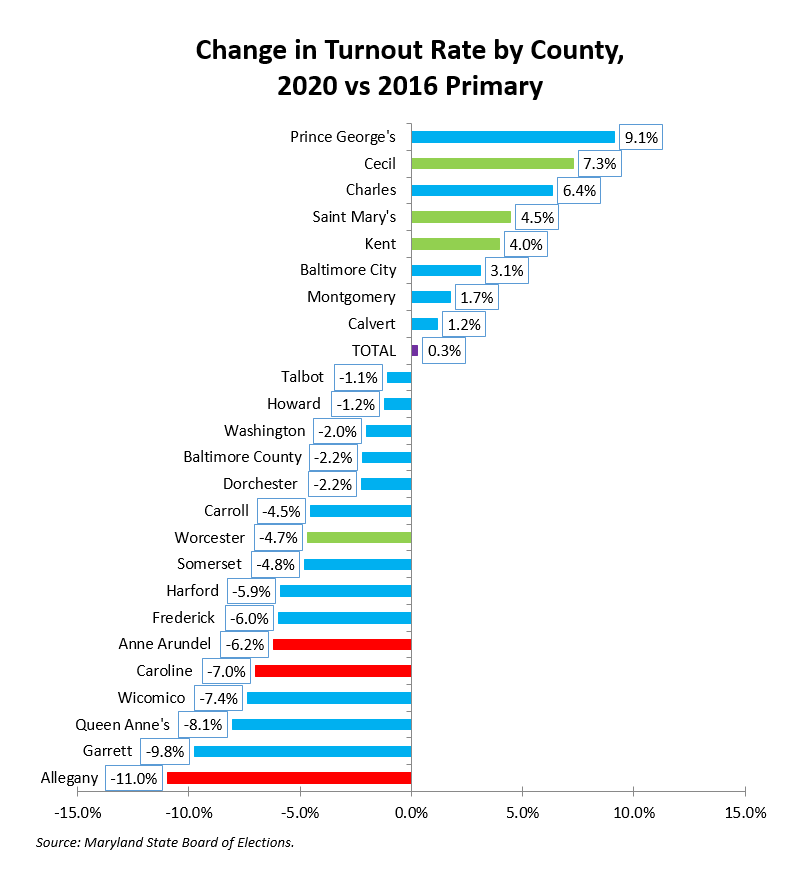
In Part One, we looked at overall turnout rate by county. In Part Two, we examined turnout rate by party. This post compares turnout between 2016 and 2020.

The chart below shows change in turnout rate between the 2016 and 2020 primaries. This one is a bit tricky. The counties in red (Allegany, Anne Arundel and Caroline) allowed unaffiliated voters to vote in 2020 but not in 2016. Therefore, since unaffiliated voters turn out at lower rates than party members, these counties’ turnout change is skewed downward. The counties in green (Cecil, Kent, Saint Mary’s and Worcester) allowed unaffiliated voters to vote in 2016 but not in 2020. Their turnout change is skewed upward.

Throw out the counties which allowed unaffiliated voters to vote in one year but not the other and this trend emerges: the four jurisdictions in which turnout went up the most – Prince George’s, Charles, Baltimore City and Montgomery – are all heavily Democratic and have large populations of color.

Overall, the two parties are headed in different directions.

Statewide Democratic turnout increased from 44.1% in the 2016 primary to 48.7% this year. Every county except Allegany, Frederick, Garrett, Howard and Washington saw increases in the Democratic turnout rate. One might have expected 2016 turnout to be higher among Democrats because Bernie Sanders had not yet dropped out by the time Maryland voted (on April 26). Nevertheless, 2020 primary turnout was higher despite Sanders suspending his campaign months before Maryland’s election day (June 2).

Statewide Republican turnout fell from 46.5% in the 2016 primary to 35.6% this year. Every county in the state saw a decline in Republican turnout. This was probably affected by the fact that the 2016 Republican primary was still semi-competitive when Maryland voted on April 26 whereas the 2020 Republican primary has not been competitive at all.

Overall, the picture of significant turnout increases in majority-black jurisdictions like Prince George’s and Charles counties along with falling Republican turnout across the board should not be encouraging to the GOP. Maryland looks poised to see tons of Democratic voters rushing to the polls (or more likely, the mailbox) to demonstrate their fury against the current occupant of the Oval Office. One wonders how this will affect the various ballot questions and charter amendments across the state, especially the ones in Montgomery County.

Share

MoCo Democrats Issue Statement on Ballot Questions

By Adam Pagnucco.

In the wake of their vote last night, the Montgomery County Democratic Party has issued the following statement on their position on this year’s ballot questions.

*****

Montgomery County Democratic Party Recommendations on 2020 Ballot Questions

For immediate release
September 17, 2020
Contact Linda Foley
chair@mcdcc.org

The Montgomery County Democratic Party has announced its voter recommendations on County and State Ballot Questions for the 2020 General Election. The recommendations were issued following a vote by more than 170 grassroots Democratic officials on September 16.

“The State and County questions on the 2020 ballot will have an enormous effect upon our ability to provide vital public services locally,” said Linda Foley, Chair of the Montgomery County Democratic Central Committee. “Democrats understand the value of public education, healthcare, transportation, public safety, libraries, and other vital services our State and County governments provide. That’s why we urge voters to vote FOR County Charter Questions A and C, vote FOR State Questions 1 and 2, and vote AGAINST County Charter Questions B and D.”

Here are the Montgomery County Democratic Party recommendations:

Vote FOR Question A: Council Property Tax Limit – Limit Tax Rate Increases
Question A establishes a cap on the property tax rate instead of the total revenue that the County can receive. This amendment would allow revenue to grow so County services can keep up with increased population and needs. Property tax rates will remain the same as this year. Any future increase would require an affirmative vote by all Councilmembers, as is currently required to raise the revenue limit.

Vote AGAINST Question B: Property Tax Limit – Prohibit Override
Question B is a bad way to fund public services. It prohibits the County Council from increasing the total revenue received from the property tax beyond the rate of inflation under any circumstances. This measure, proposed by Republican activist Robin Ficker, would cause a reduction in public services and threaten the County’s AAA bond rating, which enables the County to borrow at the lowest rate.

Vote FOR Question C: Increase to 11 Councilmembers
Question C expands the Council from 9 to 11 members. District Council seats would increase from 5 to 7. The number of At-Large seats would remain at 4. Each voter would continue to vote for 5 members of the Council. It reduces the number of residents represented by each District Councilmember, thus increasing representation.

Vote AGAINST Question D: Alter County Council Composition to 9 Districts
Question D eliminates the current Council composition of 4 At-Large and 5 single district seats. It establishes a Council of 9 members, each elected only by voters in their own district (eliminating At-Large seats). It would reduce from 5 to 1 the number of Councilmembers for whom each voter can vote.

Vote FOR Question 1: Balancing the State Budget
Question 1 allows the Maryland General Assembly to increase, decrease, or add items to the State budget provided such changes do not increase the total budget proposed by the Governor.

Vote FOR Question 2: Expansion of Commercial Gaming – Sports and Event
Question 2 would authorize the General Assembly to allow betting on sports and other competitive events to generate funding that must be used primarily for public education.

Vote YES to retain State Appellate Judges: Mary Ellen Barbera, E. Gregory Wells, and Steven B. Gould. The Party reviewed the records of the three State appellate judges on the ballot and supports their continuance in office.

By Authority: Montgomery County Democratic Central Committee, Dave Kunes, Treasurer.

Share

Turnout by County: 2020 Primary, Part Two

By Adam Pagnucco.

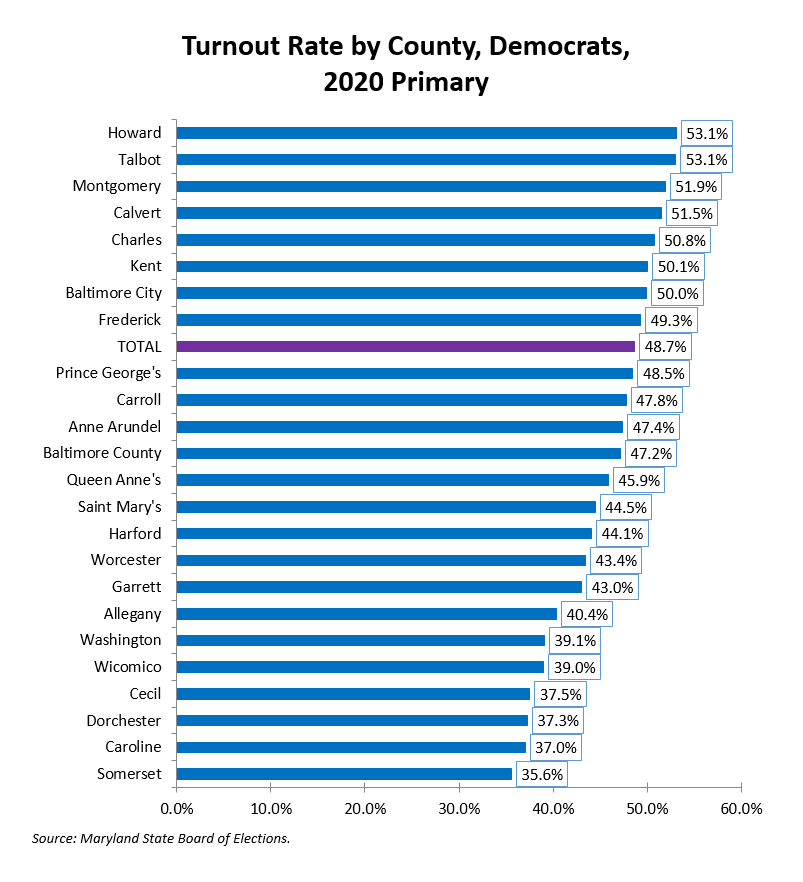
Part One showed the overall turnout rate by county in the 2020 primary but that statistic conceals numerous nuances. Today, we will look at turnout by party. Let’s start with the Democrats.

Every Maryland county had higher turnout among Democrats than among voters overall except Cecil, Dorchester and Somerset. Jurisdictions with the lowest Democratic turnout rates tend to be dominated by the GOP.

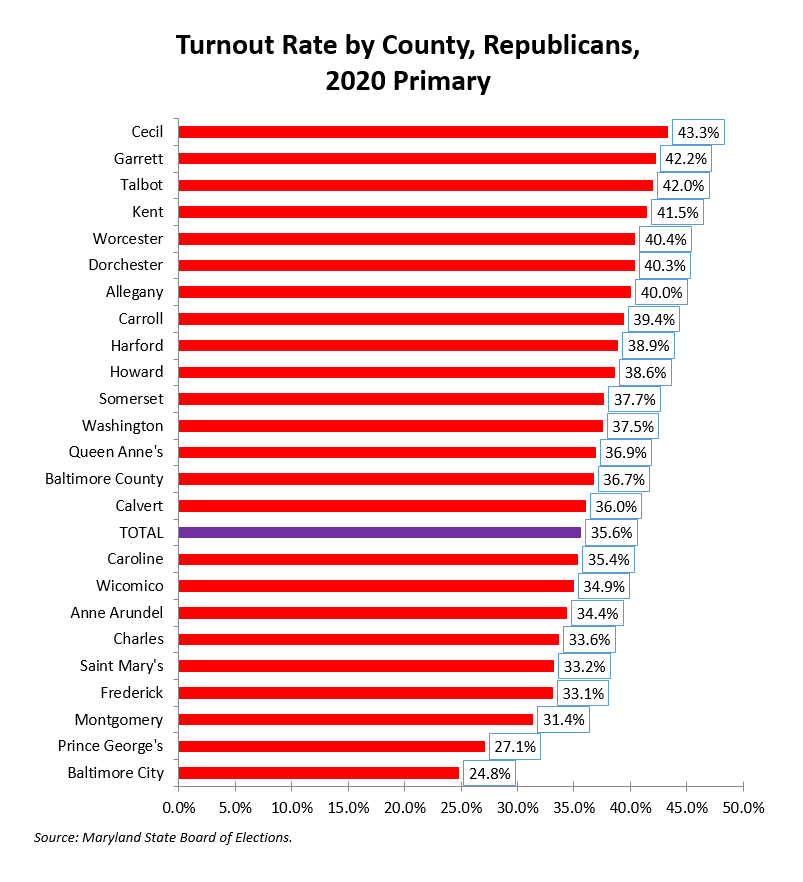
The chart below shows turnout rate among Republicans.

The most obvious fact here is that statewide turnout among Republicans (35.6%) was significantly lower than among Democrats (48.7%). In fact, in every county except Cecil, Dorchester and Somerset, the turnout rate among Democrats was higher than among Republicans. Granted, with the exception of a contested county executive primary in Cecil County, Republicans don’t have much to vote for because their incumbent president had little primary competition. But something similar could be said for Democrats outside Baltimore City.

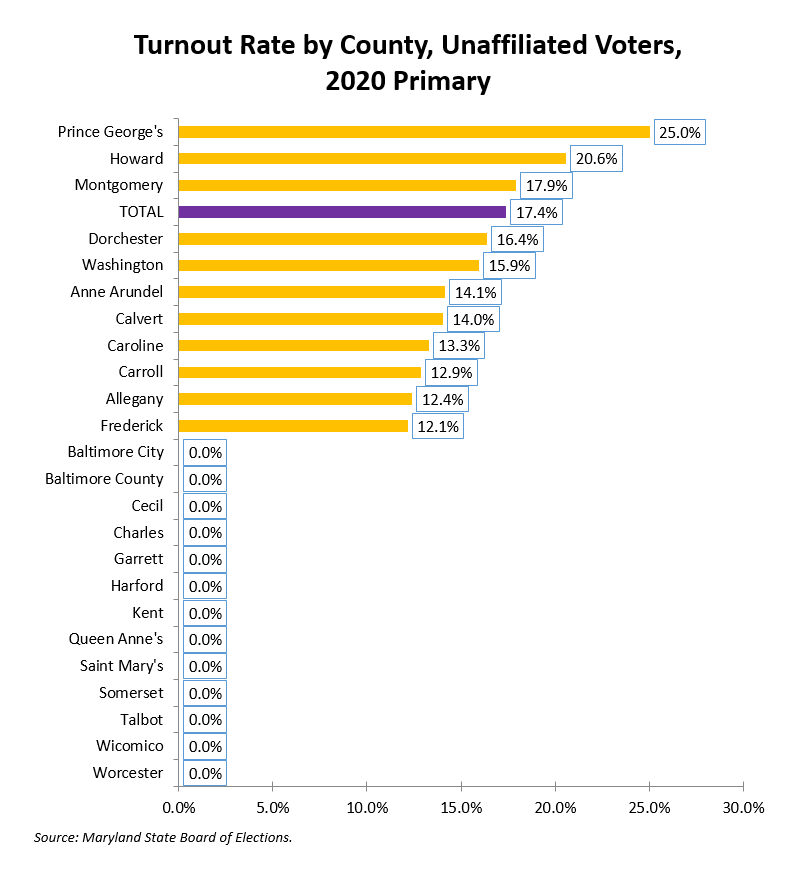
The chart below shows turnout rate among unaffiliated voters.

Only 11 counties allowed unaffiliated voters to vote in the 2020 primary. Since Maryland has closed primaries, unaffiliated voters cannot vote in party primaries but they can vote in primaries held for non-partisan offices. Among the counties allowing unaffiliated voters to vote this year, all had non-partisan school board races on the ballot except Washington County, which held non-partisan primaries for municipal offices in the City of Hagerstown.

In Part Three, we will examine change in turnout between 2016 and 2020.

Share

MoCo Democrats Take Position on Charter Amendments

By Adam Pagnucco.

As they do in every election year, officials of Montgomery County’s Democratic Party gathered tonight to take positions on charter amendments and ballot questions.

The standard format is for the party’s ballot question advisory committee, which studies such questions, to present information to the party’s precinct organization. The precinct organization, comprised of the party’s network of precinct officers, hears opinions, discusses the questions and takes votes. The party’s central committee takes the final votes establishing the party’s position, although they usually don’t go against the precinct organization’s stance unless the latter’s vote is close.

Tonight, County Executive Marc Elrich and a majority of the county council made their case to the precinct organization on the county charter amendments. The precinct organization voted in line with their recommendations and so did the party central committee. I don’t have exact vote tallies but my sources say they were all lopsided.

The ultimate vote by the MoCo Democrats was:

Yes to Question A, which was Council Member Andrew Friedson’s proposal to redo the county’s charter limit on property taxes.

No to Question B, which was Robin Ficker’s charter amendment to impose a hard cap on increases to property tax collections.

There was huuuuuge support for A and equally huuuuuge opposition to B (the Ficker amendment).

Yes to Question C, which was Council Member Evan Glass’s proposal to increase council district seats from five to seven and retain the current four at-large seats.

No to Question D, which is a charter amendment to convert the county council into nine district seats. No doubt the Democrats paid heed to the fact that Republicans support this proposal because they believe it might create a Republican council seat.

The party also voted to support state question 1 (which would grant more budgetary authority to the General Assembly over the governor’s budgets) and state question 2 (which would allow sports betting).

The exact language of all the questions and charter amendments can be seen on the official county ballot.

The party’s vote tonight is important because it will be expressed on its sample ballot, which is customarily mailed to hundreds of thousands of registered county Democrats. The vote is a particular blow to the Nine Districts for MoCo group, which has depicted its charter amendment as bipartisan but now has it supported by county Republicans and officially opposed by county Democrats.

Share

How Hard are County Employees Getting Hit by COVID?

By Adam Pagnucco.

One dimension of the current COVID crisis that has not been addressed so far is the impact on county employees. Many county employees, especially in public safety and transportation, are essential workers who have to interact face-to-face with the public. How are they doing in terms of their exposure to COVID-19?

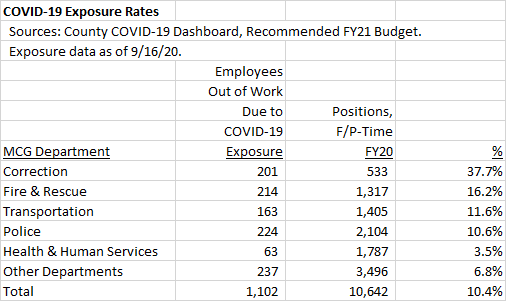
The county’s COVID dashboard contains some data on county employee exposure. As of this morning, the county reported that 1,102 of its employees had missed work due to “a COVID-19 related exposure.” Of those employees, 1,037 had returned to work, 72 were currently in quarantine and 3 had passed away. Exposures by department are shown in the table below.

Overall, 10% of county employees have missed work due to exposure. The four departments with the highest rates of missed work are correction (38% of positions), fire and rescue (16%), transportation (12%) and police (11%).

However, exposures do not equal actual cases of COVID-19. I asked county health officer Travis Gayles for actual COVID cases by department and the county’s Office of Human Resources supplied them. The table below shows cases by department and compares them to cases among county residents.

Countywide, COVID cases account for roughly 2% of the population. For the most part, the case rates among county employees are near that level or lower.

Overall, the data shows that the county is doing a decent job of protecting most of its employees from COVID. Some departments have experienced significant scheduling challenges due to quarantine procedures from exposures. But those same quarantines may have helped limit the spread of the virus in employee work sites. This data suggests that as an employer, the county has done its part to contain COVID-19.

Share

MoCo Republicans Attack Jawando Over Police Reform

By Adam Pagnucco.

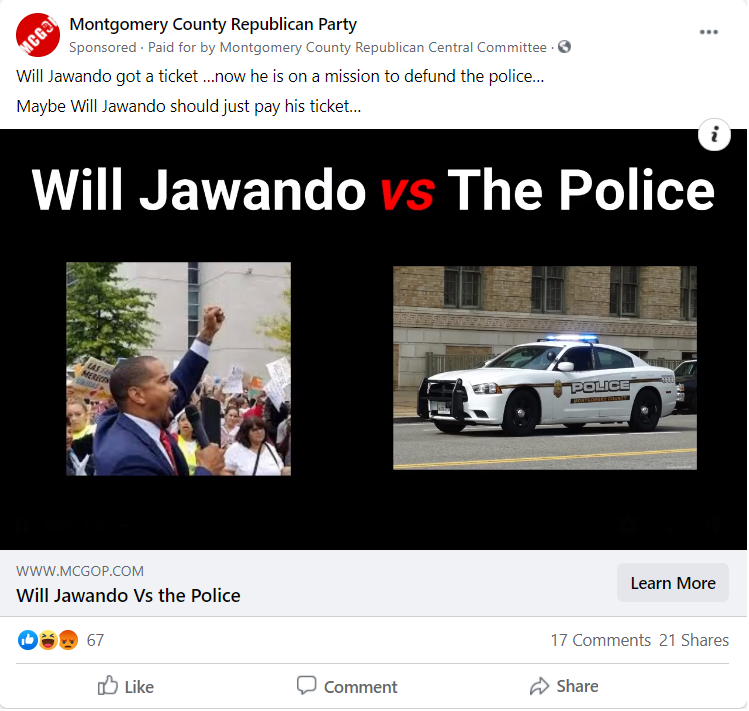
The Montgomery County Republican Party is now running this video attacking Council Member Will Jawando over his efforts to reform the police department.

The GOP is even running a Facebook ad to promote the video.

Not everyone is supportive of the county’s efforts to reform, reimagine and/or defund the police. Our post on the subject, “Free-For-All,” is on track to be the most-viewed post on Seventh State for this month. But getting attacked by Republicans is great for Jawando in building his prestige inside the county’s progressive Democratic base. Jawando should consider offering a subsidy to help the GOP run the ad in Takoma Park and the rest of the Democratic Crescent!

Share

Turnout by County: 2020 Primary, Part One

By Adam Pagnucco.

The 2020 primary is behind us and the ballots will go out soon for the general election. With few local races going on in the state but a historic presidential election coming, how did Maryland counties do on turnout?

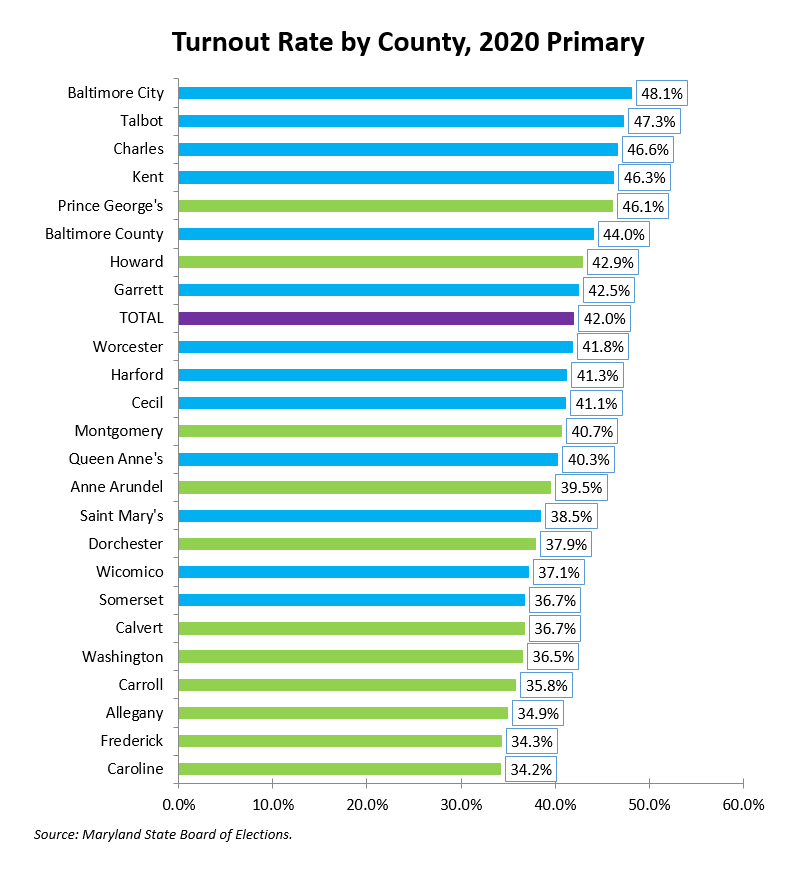
First, let’s look at the final turnout percentage by county in the 2020 presidential primary. Jurisdictions in green had races on the ballot for which unaffiliated people could vote while jurisdictions in blue did not.

It’s not a coincidence that the bottom six counties had non-partisan races on the ballot for which unaffiliated voters could vote. Unaffiliated voters turn out at lower rates than party members, so when they are included in a voting population, the overall turnout rate is skewed downward. Baltimore City’s status as number one is due to the fact that it elects its mayor, comptroller and city council members in presidential years, an unusual practice for local jurisdictions in Maryland.

In Part Two, we will look at turnout by party.

Share