All posts by Adam Pagnucco

Elrich’s First Veto: The Policy Debate

By Adam Pagnucco.

On Friday, County Executive Marc Elrich issued the first veto of his administration against a bill by the county council offering 15-year property tax breaks for high-rise developments at Metro stations.

Vetoes are uncommon events in MoCo politics. Elrich’s predecessor, Ike Leggett, vetoed three measures: a county property disposition bill in 2012 (which was overridden), a minimum wage bill in 2017 (which was subsequently replaced by a similar bill that he signed) and a 2018 line item in the capital budget covering stormwater contracting (which resulted in passage of a compromise). Vetoes are typically prevented by one of two things: deal-making between the executive and the council or passage of a measure by more than the six votes required to override. But there was no deal in this case: Elrich opposes the property tax bill and wrote his rationale in a lengthy veto message.

This post examines the policy debate around the bill, about which I wrote a three-part series. (Here are links to Part One, Part Two and Part Three.) Tomorrow, we will discuss the politics.

Bill 29-20, the target of Elrich’s veto, originated from three related events. First, Montgomery County, like the rest of the region, has a shortage of housing when compared to projections of population growth. This was chronicled in a report by the Metropolitan Washington Council of Governments (MWCOG), resulting in passage of a resolution by the county council to meet the county’s share of regional housing growth. (Elrich was notably skeptical of this.) Second, for at least the past fifteen years, the county has chosen to concentrate new density around Metro stations through its master plans for a combination of reasons related to transportation, environmental concerns, placemaking and preservation of the Agricultural Reserve. (Elrich voted against many of these master plans when he was on the council.) Third, Fivesquares Development, which was selected by WMATA as its ground lease development partner at the Grosvenor-Strathmore Metro Station, has proposed a housing development including high rises at the station. However, Fivesquares has since said that the economics of the site won’t allow anything more than low density development unless they obtain a subsidy.

These events gave rise to Bill 29-20, which offers developers at Metro stations 15-year property tax breaks if they build high rises. The bill’s supporters claim that without the tax breaks, the sites will either remain undeveloped or will contain low- or mid-rise projects that waste the stations’ potential for generating transit-oriented development. Elrich disagrees, offering several key reasons that I will evaluate.

Elrich: The bill “harms the budget.”

Elrich wrote:

At a time when the County is struggling to fund critical services, where the outlook for the next couple of years is uncertain at best, and where full economic recovery from this pandemic may take as much as ten years, it is certainly not prudent to reduce revenues coming into the County coffers.

The bill’s supporters argue that the tax break would only apply to projects that would otherwise not happen without the bill, thus not creating a real marginal cost to the county. They also say that without the bill, the Metro stations would remain undeveloped and therefore pay nothing to the county. However, according to Fivesquares, a low density project would be viable at Grosvenor-Strathmore without a subsidy and would therefore generate actual property taxes for the county. So even without the bill, it’s possible to get taxpaying low- or mid-rise development at Metro stations. The real question is not so much about the budget but whether the public benefit of high-rise housing infrastructure at Metro stations is worth an investment of public dollars. Elrich says no, the bill’s supporters say yes.

Elrich: The public benefit isn’t worth it.

Right now, developments at Metro stations are required to ensure that 12.5-15% of constructed units are moderately priced dwelling units affordable to moderate income people. Council Member Will Jawando amended the bill to require that 25% of a qualifying project’s units be moderately priced to get the tax break. Elrich says there should be a higher percentage of moderately priced units and he argues that they should be mandated rather than included in a tax incentive. (If he believes that, he should send over legislation to accomplish it.) Bill supporters argue that a higher percentage of affordable units would kill a project’s economics. The record of the bill does not conclusively prove either side right.

Elrich: Public funds should be used for affordable housing, not market rate housing.

Elrich argues that MoCo’s real housing shortage is in affordable units, not so much in market rate units, and that because the bill allows projects with 75% market rate units to get tax breaks, it contributes little to solving the county’s housing problems. He is right that MWCOG’s report recommends that “at least 75% of new housing should be affordable to low- and middle- income households.” But with all due respect to MWCOG, the difference between the county’s requirement that 12.5-15% of new units be moderately priced and the report’s recommendation that 75% of them be affordable is VAST. The county’s housing target is 10,000 units above forecasts. No one – not Elrich, not the council, not the planning board – has a credible financing plan for plowing (at least) hundreds of millions of dollars of public money into building 7,500 or more affordable units. Holding this bill or any other plan to that standard is unrealistic.

Elrich: The bill sets a difficult precedent.

Here, Elrich makes the same slippery slope argument that I made. If developers at Metro stations get these tax breaks, developers of properties next to Metro stations will want them too. The bill’s supporters argue that Metro sites have extra costs that require subsidies to offset. Those extra costs are probably responsible for the dearth of new high-rise projects at Metro stations all around the region. But the bill does change how the county does incentives. In the past, incentives have been granted on a case-by-case basis (including the Marriott headquarters development project). The bill establishes its subsidy in law, giving it to developers by right. The bill’s supporters don’t say this publicly, but they argue privately that legislation is necessary because Elrich can’t be trusted to constructively negotiate with developers. Even if that were true, Elrich won’t be executive forever, and case-by-case negotiations have advantages that a one-size-fits-all approach can’t replicate.

Elrich: Construction workers deserve prevailing wages.

Council Member Will Jawando offered an amendment to require that Metro station development projects should pay construction workers the same prevailing wage they receive on county construction projects to get tax breaks. The amendment failed on a 4-5 vote, with Jawando and Council Members Evan Glass, Tom Hucker and Sidney Katz voting in favor. Elrich cites the bill’s failure to require prevailing wage as a reason to veto it.

When I was employed by the carpenters union, I lobbied the council to pass what is now the county’s prevailing wage law. In doing so, I provided them with a mountain of evidence that prevailing wage laws do not inflate construction costs because higher wages tend to be offset by higher productivity. As Nooshin Mahalia of the Economic Policy Institute wrote just before the bill was passed:

An overwhelming preponderance of the literature shows that prevailing wage regulations have no effect one way or the other on the cost to government of contracted public works projects. And as studies of the question become more and more sophisticated, this finding becomes stronger, and is reinforced with evidence that prevailing wage laws also help to reduce occupational injuries and fatalities, increase the pool of skilled construction workers, and actually enhance state tax revenues.

Council Member Marc Elrich was a co-sponsor of the prevailing wage bill. No current council member was in office when it passed in 2008.

The county has a prevailing wage law for its construction projects. WMATA uses the federal prevailing wage law (the Davis-Bacon Act) for its construction projects. And yet a developer with a county subsidy building at a WMATA Metro station is not required to pay prevailing wage. That just does not make a lot of sense.

Those who voted against prevailing wage coverage argue (against the evidence linked above) that it would inflate project costs and offset the value of the 15-year property tax break. If they truly believe that prevailing wages increase costs, then to be intellectually honest, they should repeal the county’s prevailing wage law to save money for the capital budget. Unless they do that, the arguments against prevailing wage ring hollow. On this one, Elrich is right.

The best point that Elrich’s critics make against him is that if he opposes this bill, then what is his plan to build more affordable housing? The county’s current total of $62 million in operating and capital money for preserving and building affordable units is woefully inadequate when compared to the needs. Elrich has been discussing this issue while in elected office for 14 years. What is the Elrich Plan to Build Affordable Housing?

Tomorrow, we will get into the politics of the veto.

Share

Elrich Vetoes WMATA Property Tax Bill

By Adam Pagnucco.

County Executive Marc Elrich has vetoed Bill 29-20, which would grant high-rise developers on Metro station projects payments in lieu of taxes in return for 15-year exemptions from property taxes. I wrote a three-part series on this legislation quoting the bill’s supporters in Part One, evaluating their arguments in Part Two and raising concerns in Part Three. The bill passed the council with amendments on a 7-2 vote, with Council Members Tom Hucker and Will Jawando voting no. Under the charter, the council may override a veto with 6 votes.

The executive’s veto message is printed below.

*****

October 16, 2020

TO: Sidney Katz, Council President

FROM: Marc Elrich, County Executive

RE: Veto explanation of Bill 29-20, Taxation – Payment in Lieu of Taxes – WMATA Property – Established, Enacted with amendments

I share the Council’s desire to find ways to spur smart growth and to broaden our tax base. However, I strongly oppose the approach used by the Council in this legislation. It is too costly and does not achieve my goal of increased affordable housing. Therefore, I am vetoing Bill 29-20, Taxation – Payment in Lieu of Taxes – WMATA Property.

Below is a description of the bill and my explanation of the veto.

Description of Bill 29-20

Bill 29-20 requires 100% exemption of the real property tax for 15 years. This exemption is known as a Payment in Lieu of Taxes (PILOT). The requirement applies to development that is higher than 8 stories on property owned by WMATA at a Metro station. The development must include at least 50% residential rental housing, and one-quarter of the moderately priced dwelling units (MPDUs) must be affordable for residents at 50% of area median income (AMI). The PILOT would begin no later than the second year after the property tax is levied. The law would sunset in 2032, but any existing PILOT would continue until the end of its 15-year period. To be eligible for a PILOT, a developer would be required to use contractors and subcontractors who have no more than two final penalties of $5,000 or more in the three prior years for violations of applicable wage and hour laws. At least 25% of the workers constructing the project must be County residents. Special taxing district taxes are exempt from the PILOT.

This Bill harms the budget without providing a meaningful public benefit.

At a time when the County is struggling to fund critical services, where the outlook for the next couple of years is uncertain at best, and where full economic recovery from this pandemic may take as much as ten years, it is certainly not prudent to reduce revenues coming into the County coffers.

During the Council’s deliberations on the Bill, supporters could only cite one potential development as being eligible for this 15-year, 100% tax break – the proposed Strathmore Square at the Grosvenor/Strathmore Station. Under the provisions of this legislation, Strathmore Square’s owners would receive a tax break of more than $100 million. As a member of the County Council, I supported the zoning changes that made this proposed development possible, but I simply do not believe it is a responsible use of County resources to supplement a market-rate housing complex at this level of expense.

Should similar developments occur at the other potential WMATA sites across the County, lost revenue would likely exceed $400 million. To be clear, I want more housing constructed in our County, and I see the significant benefit of housing that makes transit usage extremely convenient. However, I do not believe providing developers with $400 million in incentives is worth the 8,000 new housing units. Put another way, this Bill would provide a developer with a $50,000 per unit subsidy regardless of cost of rent. We simply cannot afford this cost.

Public benefit

Generally, PILOTs are used to incentivize production of more affordable housing that we would not otherwise get. Under current law, new residential development must include between 12.5% and 15% MPDUs (the minimum percentage requirement depends on the location of the project). Enactment of an entirely new program with such a substantial subsidy must do more than require one quarter minimum required number of MPDUs be affordable to those earning 50% AMI. In fact, we need more of these deeply affordable units, and I would support turning that provision into a requirement, rather than simply using it as part of an incentive package. Again, the public benefit proposed by this Bill does not warrant the expenditure.

Authority already exists to provide PILOTs

As you know, the County already has the authority to offer PILOTs. It makes sense to continue to allow them on a project-by-project basis – not all projects need the same PILOT term or value. Flexibility should be maintained to enable negotiation of the best possible agreement in the public interest.

Additionally, if we want to provide tax incentives that support commercial development to bring new businesses here, those incentives should go to the occupant of the building, not to the developer of the building. This legislation gives public funds to help build buildings not to incentivize businesses that would be tenants in those buildings.

Use of limited public funds should be targeted for affordable housing production and meeting affordable housing goals, which is not the focus of this Bill

By the estimates developed by WMATA and some Councilmembers, about 8,600 units can be built on the properties covered by this Bill. Approximately 1,300 of those units would be the required MPDUs; approximately 7,300 would be market rate units. The recent regional housing study and the related housing goals were clear that our housing need was not simply about the total number of housing units. The report and the related goals specify income-based targets: three-quarters of the future projected 40,000 units need to be below 70-80% of area median income. Therefore, only one-quarter or 10,000 of the projected 40,000 units, are needed to be at market rate. If this legislation succeeded in producing the number of units estimated by WMATA, then about 7,000 (those on WMATA property) of the 10,000 market rate units needed would not produce property tax revenue for 15 years. The legislation would shift property taxes almost entirely onto below market rate units.

The remaining 3,000 market rate units are likely to be spread out at the 23 “activity centers” along with the more than 25,000 affordable housing units. It does not make sense to focus the market rate housing at Metro stations and push the other affordable housing elsewhere. As the recent Housing Preservation study points out, affordable housing units near transit are at greatest risk of being lost and are being lost.

Given the projected number of market units needed, there is no lack of zoning in the Metro Station areas in order to accommodate the needed units; while they may not be built on top of Metro property, they may be built nearby within easy walking distance of the Metro.

High rise housing is expensive to build and expensive to rent

Furthermore, a focus on high rise buildings ignores the fact that by its very nature, high rise development is the most expensive that can be built. Advocates want to maximize use of land but if density is used to build high rises, it will be unaffordable to most of the people identified as needing housing. Seventy-five percent of projected need is affordable housing – why would the focus be on subsidizing market rate housing? Zoning in central business districts for high rises far exceeds the zoning for types of housing that are generally affordable and more family friendly – including garden style and mid-rise apartments.

The Bill could increase the cost of WMATA land.

Under Federal law, WMATA must seek the highest and best price for their land. Land that is exempted from all property taxes for 15 years is more valuable because the calculation of its value includes the costs to acquire and develop, including taxes, weighed against market rents. If two properties are side by side, one exempt from taxes and the other not, and they were producing the same value of unit, the land value of the exempt property would be greater because its cost of development would be less than the cost to develop the tax-paying property. This would, in turn, likely raise the parcel’s appraised value. The Bill could potentially be counterproductive by raising the value of WMATA’s land.

The Bill sets a difficult precedent

It is not clear why there is a public need to specifically incentivize development on WMATA owned property. It is likely that other properties near Metro will ask for the same PILOT. Those properties offer similar value in providing transit proximate development – a residential walkshed is a radius of ½ mile from Metro; a walkshed is the area around a station that is reachable on foot for the average person – how far someone is willing to walk to their home or business from transit. Additionally, a commercial walkshed is ¼ mile from heavy transit, which would raise the question of whether commercial development should be favored closer to Metro. There does not seem to be a logic to the approach of this Bill.

The impetus for this Bill seems to be based on one project at one Metro site as evidenced by testimony and the Council packets. One project should not drive countywide policy.

The specific project was discussed during Council deliberations – at the Grosvenor Metro Station by FiveSquares Development which had been working with WMATA for about five years either directly or through their affiliate, Streetscape Partners.

The Bill is particularly focused on one project at the Grosvenor Metro. In December 2017, as a member of the County Council, I voted in favor of the Grosvenor-Strathmore Metro Area Minor Master Plan which allows for this development to proceed. WMATA documents that we reviewed show that the original assumption for their property was that about 500 units could be built. This Minor Master Plan up-zoned portions of the Plan Area to allow for greater density, particularly on the Metro site both to take advantage of the Metro location and to provide density to make the project feasible. This up zoning resulted in allowing more than 2,200 units to be built there, essentially quadrupling the density.

The documents show that FiveSquares was substituted for Streetscape as the developer and that the appraisal of the land would only be done after the completion of the rezoning process. So, the price was set based on the appraisal which, like all appraisals, took into account all of the costs and the market for units that would be needed to support those costs. One has to assume that FiveSquares fully understood what they were doing because had they thought the appraisal was wrong, they could have walked away from the project. FiveSquares agreed to the appraisal and signed a deal. The appraisal assumes that the property can be developed at the determined price and FiveSquares obviously concurred with that assessment. Having been personally involved as an Executive negotiating over the value of land, I know that it is common for buyers and sellers to differ in appraisals and then to reach agreements that attempt to accommodate the assumptions of both parties. One has to assume that FiveSquares knew what they were doing when they accepted the assumptions and the appraisals that went with it.

If FiveSquares had a problem with the price and appraisal, they had an opportunity to reject the appraisal and the deal. At no point during the Council’s consideration of the Minor Master Plan was there any indication that additional public subsidies would be required to get a high-rise project “shovel ready,” let alone a 15-year abatement of all property taxes.

I would also note that others have commented that FiveSquares will pay for amenities; those amenities attract residents and make the project feasible. They would also have been included in the appraisal and are key in marketing the property.

Fiscal impact of a PILOT and the FiveSquares project

According to the Bill’s Fiscal Impact Statement that compared Strathmore Square with existing nearby buildings, the development’s approximate annual property tax bill upon completion would be between $5.8 million to $7.1 million a year. Over 15 years, the approximate loss of property tax revenue would be between $87 million and $106.5 million for just this single project.

No evidence that this Bill is necessary to stimulate market-rate (non-affordable) housing and this approach is not done region-wide

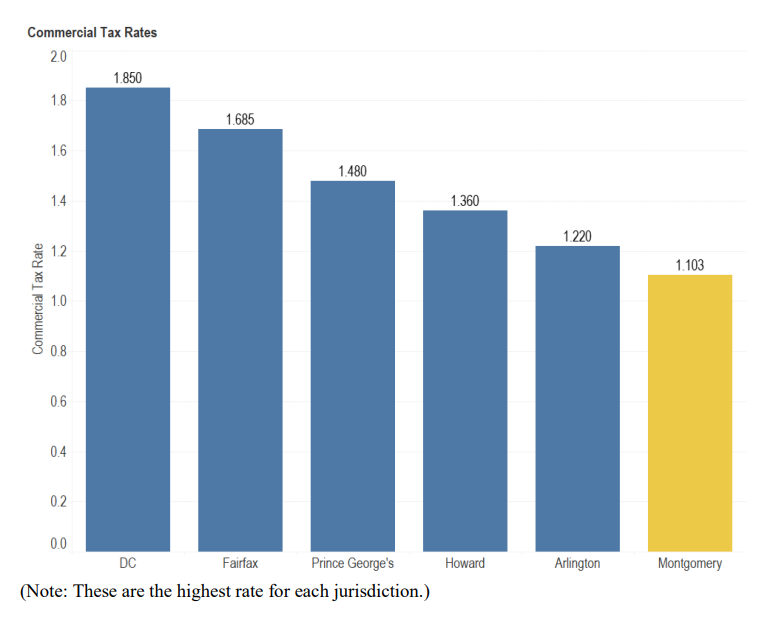
There is no evidence that this subsidy is required. In fact, if you look around the region, many of our neighboring jurisdictions have their highest taxes on property nearest Metro sites and the tax rates are substantially greater than in Montgomery County. If property taxes were the key to development, we would have won the development battle a long time ago because we are lower than most surrounding jurisdictions.

Furthermore, market housing is being built rapidly in Bethesda and is likely to spread to other densely zoned areas as Bethesda builds out. Rents in Bethesda are extraordinarily high, and it does not make sense to subsidize the construction of apartments that rent at prices far out of reach for most County residents. The Bill, coupled with a separate proposal from the Planning Board to reduce impact fees in most areas, will only deepen the obstacles to growing the tax base. While it is true that residents of these buildings will pay income taxes, the loss of property taxes is significant, and residents could live in other market rate housing where we collect both income taxes and property taxes. For the commercial sector, the only ongoing tax we receive to help provide infrastructure is the property tax.

This Bill was designed without a market analysis to establish whether this type of general legislation is needed. As noted above, the authority already exists to provide these PILOTS on an individual project basis, and a Countywide approach is not warranted.

Workers deserve prevailing wage

A majority of the Council voted against requiring the prevailing wage at these projects. The provision would have required that all contractors and subcontractors pay prevailing wages and be licensed, bonded, insured, and abide by wage and hour laws. Legislation that dedicates public funds to market-rate housing should, at least, also support the workers who build the housing. This provision was supported by the Baltimore-Washington Laborers’ District Council, an affiliate of LiUNA; United Association (UA), United Brotherhood of Carpenters, International Brotherhood of Electrical Workers (IBEW), CASA, Jews United for Justice, Progressive Maryland, Montgomery County Education Association (MCEA), SEIU 32BJ, SEIU Local 500, SEIU Local 1199, UFCW MCGEO Local 1994, and UNITE HERE Local 25. If WMATA was building a structure on the same property, current law would require them to abide by the prevailing wage. I believe the developments contemplated by this Bill should as well. The lack of such a provision to treat workers equitably and to share in the subsidy is another major deficiency in this legislation.

Using limited funds for market-rate (non-affordable) housing development means fewer funds for other services including affordable housing, recreation, and education, which has a racial equity/social justice impact

A Racial Equity and Social Justice (RESJ) impact analysis was not applied to this Bill, which was introduced before the RESJ requirement took effect. Because the Bill will have a significant budgetary impact, it deprives the County of tax dollars that could be used for other programs, including affordable housing that would benefit communities of color most. This Bill allows housing to be built for those who can afford it, not for lower income populations who are disproportionately Black and Latino.

Share

Chamber to Executive: Get the Money Out Now

By Adam Pagnucco.

The Montgomery County Chamber of Commerce has issued the following statement on the county’s pace of distributing federal COVID assistance.

*****

Montgomery County Chamber of Commerce Statement on Montgomery County Executive’s Failure to Distribute $45.6M in Federal Relief

Tuesday’s Council briefing on the Coronavirus Relief Fund was deeply concerning. It was revealed that the County Executive has yet to spend $45.6 million of Federal Relief that was intended for immediate distribution to help our residents and businesses. The need for this funding is both dire and urgent. These communities are struggling at unprecedented levels during this public health emergency.

The County Council has established several programs to administer this relief funding for rent assistance, local businesses, child care, and more. Over the past six months our Chamber has been a supportive partner to the County to help the Council and the Executive by hosting many briefings for county business owners to learn about these programs and how to apply for relief. But there is growing concern expressed by both residents and business owners that their applications have either not been approved or they have not received a response to know the status of their applications.

The County Executive’s failure to distribute in a timely manner the CARES Act funding the County has already received severely inhibits our Chamber’s continued advocacy at the Federal level for additional county and state funds. Further, there is growing concern that the consequence of not distributing these funds as intended by December 31 means that the funds must be returned to the Federal government.

The strategy of waiting for the federal government to take further actions to provide future relief funding does not take into account the urgency for those in dire need of this relief NOW. The County Executive needs to lead our County by implementing emergency relief programs desperately needed by our residents and businesses during this crisis.

Our citizens and businesses can no longer wait. And the clock is ticking with the threat of losing this funding. MCCC implores the County Executive to end this delay immediately and distribute the $45.6 million.

Share

Elrich is Surprised at the Council. Um, What?

By Adam Pagnucco.

In the wake of the county council’s nuclear annihilation of the county’s federal COVID grant management, MCM carried this quote from County Executive Marc Elrich:

Following the meeting, which Elrich did not attend, he told Montgomery Community Media he was surprised at the council’s reaction. “There is no way the money goes out the door the next day.” Elrich explained that applications for funds must be gone through to make sure they meet the requirements. “This is the whole thing about allocating money,” he said, adding, “We are not holding money back.”

Um, whaaaaat???

Anyone who was surprised by the council’s response to the administration’s COVID grant challenges is not paying attention to them. This is only the latest episode in a loooooong line of council complaints about the executive branch. If I were to type them all out, my keyboard would break. There is nothing new here. And there is absolutely nothing surprising.

If one word can be used to describe the council’s sentiment towards Elrich, it is frustration. They are frustrated at the communication problems which have plagued the relationship for the entire term. They are frustrated at what they believe to be disorganization and a lack of an agenda (other than reacting to COVID) on the part of the administration. They are frustrated at Elrich’s management of the budget, including but not limited to his union contracts, a raid on retiree health care money last year, a hidden tax increase built into his budget this year, his failure to make any progress on restructuring government to save money and now his runaway COVID pay liability. But most of all they’re frustrated because they don’t think they have a willing or competent partner in the executive branch. For all their substantial powers over budget, legislation and land use, the council members have no authority to actually run the government themselves. And at this point, all of them think the government could be run better.

Many people look at the executive-council relationship through the prism of Elrich vs Council Member Hans Riemer. It’s true that Riemer (my former employer) is Elrich’s harshest and most frequent critic. But Riemer is something of an anomaly. His fifteen-year personal enmity with Elrich is not shared by any other sitting Council Member. Instead, look at Council Member Nancy Navarro, a cautious politician who is not given to public hysterics. She was at a loss for words at the tumultuous meeting about the grants on Tuesday. Look at Council Member Tom Hucker, who shares much of Elrich’s political base and is usually with him on progressive issues. None of that stopped Hucker from calling out Elrich. “Do you know where the county executive is?” Hucker asked Chief Administrative Officer Rich Madaleno on Tuesday. Look at Council Member Will Jawando, another progressive who called the administration’s slowness on getting out federal assistance to renters and vulnerable residents “totally unacceptable.”

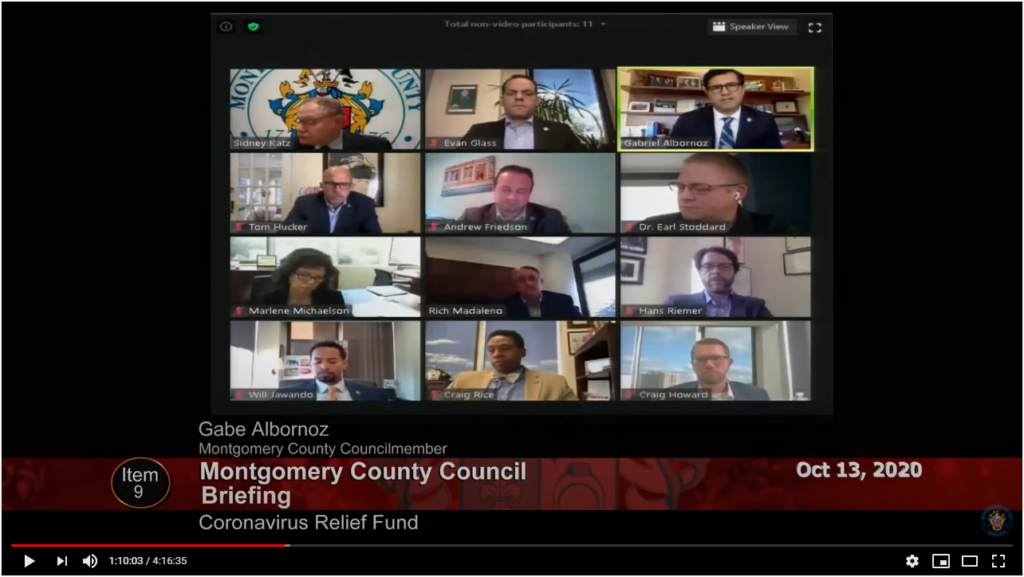
The body and facial language says it all.

But most of all, look at Council Member Gabe Albornoz. Nicknamed Mr. Rogers by his colleagues, Albornoz – like his mentor, Ike Leggett – is one of the most courteous and civil politicians I have ever met. Unlike his flashier freshman colleagues who have been quick to establish their political identities, Albornoz has set the same kind of slow, steady and workmanlike path to higher office that Leggett employed decades ago. But Albornoz has become increasingly vocal over his unhappiness with the administration in recent months. When Elrich joked that the council was “fact proof” on a hot mic, Albornoz said:

I did not find the County Executive’s comments on this video funny or amusing. In fact, I found them deeply troubling and the reaction of his senior officials disappointing. It’s also disappointing that the County Executive does not have a better understanding or command of this situation.

And with regards to the administration’s grant problems, Albornoz said:

I’m not confident at all that a month from now, when we have another update, that things will be significantly improved from where we are right now. And we’re setting everybody up for failure right now. And it’s not fair. It’s not fair to the county employees who are working diligently and around the clock to address these issues. We need stronger strategic leadership to be able to provide them with the support that they need to be able to get their jobs done. And I’m not seeing that and I’m not hearing that right now.

When Mr. Rogers grabs a shotgun, you know that all is not well in the neighborhood!

There have been seven MoCo executives since the office was established in 1970. None of Elrich’s predecessors have been so isolated and so regularly attacked by the council as Elrich has – and let’s remember that one of them (Jim Gleason) was a Republican. Politics is a team sport. No politician – not the president, not a governor, not a mayor, not a county executive – can totally go it alone and succeed from either a policy perspective or a political perspective. As amiable and astute as Rich Madaleno is, he can’t fix the relationship with the council all by himself. No one else can fix it. Only Elrich can.

And if he doesn’t, the “surprises” are going to keep coming.

Share

Council Nukes Elrich Over COVID Grants

By Adam Pagnucco.

Here are two things that almost everyone inside and outside of county government will agree on.

  1. The needs of residents and businesses for financial assistance to deal with the COVID crisis are immense.
  2. The $183 million in CARES Act grant money the county has been allocated by the federal government is helpful but is far from adequate to cover all the above needs.

With those two things said, representatives of the executive branch told the county council yesterday that they have not spent all the federal money appropriated by the council yet. And facing an end-of-year deadline to get the money out the door, there is now doubt as to whether the county will spend all of the federal money or forfeit some of it.

The council’s response to this was nothing short of nuclear.

The fissile material was prepared by council staff, whose memo to the council listed major appropriations of federal assistance and its actual expenditure by the executive branch. Six federal money appropriations mentioned in the memo and passed by the council months ago include:

Resolution 19-439: Emergency Assistance Relief Payment (EARP) Program
Adopted by council: 4/30/20
Funds appropriated by council: $5,000,000
Funds spent by executive branch: $0

Resolution 19-499: 3R Program (Reopen, Relaunch, Reimagine) – Economic Development
Adopted by council: 6/16/20
Funds appropriated by council: $500,000
Funds spent: $142,500 (Note: the county’s economic development corporation is responsible for spending this money.)

Resolution 19-506: Food Assistance/Security
Adopted by council: 6/23/20
Funds appropriated by council: $10,300,000
Funds spent by executive branch: $5,052,209

Resolution 19-523: Reopen Montgomery Initiative
Adopted by council: 7/7/20
Funds appropriated by council: $14,000,000
Funds spent by executive branch: $1,431,538

Resolution 19-535: Business Assistance for Medical and Dental Clinics
Adopted by council: 7/21/20
Funds appropriated by council: $3,000,000
Funds spent by executive branch: $0

Resolution 19-557: Rental Assistance and Eviction/Homelessness Prevention
Adopted by council: 7/28/20
Funds appropriated by council: $20,000,000
Funds spent by executive branch: $607,508

The above six appropriations total $52.8 million, of which the largest chunk ($20 million) is assistance to renters. Of that amount, the executive branch has spent $7,233,755. If the executive branch does not spend the remaining $45.6 million of federal money by December 31, it risks forfeiting the money.

That’s not all. Eight additional appropriations of federal money passed more recently by the council total $12.1 million, of which the executive branch has so far spent just $30,492. The two largest portions of this money are assistance to school age child care providers ($7.7 million) and assistance to distressed, affordable common ownership communities ($2 million). If this money is not spent by December 31, it might also be forfeited.

What’s the problem? First, the county just can’t spray checks around; it has to design the assistance programs, publicize them to potential recipients, process the applications and distribute the funds. Those things take staff and time. Second and more seriously, the county has had problems complying with FEMA paperwork requirements to get reimbursed. The process is nightmarish and time-consuming with FEMA changing the rules at least once (so far). County homeland security director Earl Stoddard told the council that the county had obtained just $20,000(!) in reimbursement from FEMA so far and that took more than two weeks and dozens of staff hours to process. Stoddard and Chief Administrative Officer Rich Madaleno made no defense of the feds and were clearly frustrated.

None of this mollified the council, who proceeded to nuke the executive branch from orbit. Here are just four quotes from MANY angry statements by council members.

Council Member Andrew Friedson
This is a really frustrating conversation and clearly there are a lot more questions than answers. Some of that is understandable when in the midst of a crisis and there are a lot more questions. We don’t know what the future will hold, we don’t know what this virus will do, we don’t know what the impact on our community will be, we can’t control what the federal government… and how they will respond. But the idea that our residents and our businesses are struggling more than they ever have and are more vulnerable than they’ve ever been, when the needs are as challenging as they currently are, with an economic crisis and a public health emergency, that our issue right now is not whether or not we will run out of money too quickly, but whether or not the clock will run out before these programs will have been able to help the businesses, help the residents, help the vulnerable members of our community who desperately need it. And I can’t tell you how frustrating that is for me. I believe it’s frustrating similarly for colleagues and I can’t imagine how frustrating that is for the 1.1 million residents who are desperately trying to get through the most challenging time in our lifetimes.

Council Member Nancy Navarro
For that list of special appropriations that we started, some of them, all the way back in April, the amount of money that has not been spent translates into residents not receiving that assistance. Residents who we interact with on a daily basis that I know I have said, “Oh no, we have this program, we have that program,” we all did, all these different places and interviews and social media, pushing all this out and I keep getting feedback that, “Well no, we have not really been able to access this and we have not received that,” thinking OK, we’ll keep working on it. So number one, I’m just super disappointed that so many of these amounts, these special appropriations, these funds that are specifically to address the needs of some of the most vulnerable people in the county, and when I see how little has been spent, I just don’t even know what to say…

There is no excuse for the fact that so much of this money has not been out there.

Council Member Gabe Albornoz
I’m not confident at all that a month from now, when we have another update, that things will be significantly improved from where we are right now. And we’re setting everybody up for failure right now. And it’s not fair. It’s not fair to the county employees who are working diligently and around the clock to address these issues. We need stronger strategic leadership to be able to provide them with the support that they need to be able to get their jobs done. And I’m not seeing that and I’m not hearing that right now.

Council Member Will Jawando
The thing that is totally unacceptable to me is that we can’t get money out of the door that we’ve appropriated for rent and for food and for emergency assistance. So we just have to do better on that.

Council Members also called out County Executive Marc Elrich directly.

Navarro
I apologize to you, Dr. Stoddard, because this is not directed at you, because you’re not the executive. And I will say, the executive should be here talking to us about what is happening because this is really, really critical.

Council Member Tom Hucker
[To Madaleno] Do you know where the county executive is? I would just expect the county executive to be coming in and making this presentation. This is not one, this is like five or six of the most important issues facing the county. It’s hard enough to tell our constituents, “We don’t have money to keep your business open, we don’t have money to keep you in your apartment,” but it’s heartbreaking to tell them, “We have the money, we appropriated it, and it’s in a bank account, we just haven’t given it to you yet. And we may not be able to.” And I would just think, if there would be one thing he’d be on top of, it’s this. I don’t want to be unfair to him, I’m happy to tell him that himself, but I’m a little shocked that he’s not here to make this presentation and that it also wasn’t made months ago.

Council Member Craig Rice
This lies firmly in the county executive’s lap. And look, I have been incredibly complimentary to the county executive in terms of how I think we’ve responded to the pandemic, and so now, I can also equally be critical of the fact that we failed. We dropped the ball. And it does rest in his court. That’s just the reality…

We cannot work as a county if we have a disconnect between the county executive and the county council on something that is so important as keeping people in their homes, putting food on their tables and making sure that they can continue to be employed. I mean, these are basics. And if it’s not happening, then there’s a serious problem ahead…

[To Stoddard] I just want to say I appreciate you falling on your sword, but sir, it’s not your sword to fall on.

Friedson
With all due respect, I heard earlier about the county executive and his frustration. We don’t need frustration from the county executive, we need leadership. And thus far on these issues, we have not seen it, and we need to.

On top of all that, Stoddard made this grim observation.

The FEMA reimbursement process is going to be incredibly difficult, not just for us, but also for FEMA. And as I think I have alluded to before, my experience with FEMA is generally that if they can find a reason not to reimburse you for something, they’re going to find it. And they’re going to utilize that as a rationale to not reimburse.

The county was counting on FEMA to reimburse it for tens of millions of dollars in extra pay County Executive Marc Elrich granted to the county employee unions. If the county doesn’t get federal money to finance that extra pay, it will blow a massive hole in its budget. In that case, the next nuke could be launched at Rockville from Wall Street with the county’s bond rating at ground zero.

Share

Friedson Floors Ficker on Taxes

By Adam Pagnucco.

Friends of White Flint made a huge score last week when they landed the heavyweight battle of the year, at least for MoCo tax geeks: a debate between Council Member Andrew “Real Deal” Friedson and long-time anti-tax activist Robin Ficker. Friedson and Ficker are the authors of Questions A and B, dueling tax limit charter amendments on the ballot this year. No quarter was asked and no quarter was given!

First, a reminder of what these tax questions would do. Question A (the Friedson amendment) would freeze the property tax rate and allow it to be increased only by a unanimous vote of the county council. Question B (the newest of many Ficker amendments) would allow property tax collections to rise at the rate of inflation and remove the current ability of a unanimous council to override it. Both questions impose limits on property taxes that the vast majority of Maryland counties don’t possess, although Question A would raise more money than Question B over time.

Friends of White Flint invited Friedson and Ficker to discuss their charter amendments on a Zoom meeting and they did not disappoint. Stiff jabs, hooks and uppercuts were thrown (virtually of course) as the high school linebacker and Muhammad Ali’s running partner put on a show. But Friedson threw the winning punch with this statement:

What Robin Ficker will not say, what he is not telling you, is when he repeatedly talks about that 8.7% property tax increase [in 2016] based on this ridiculous tax policy that we currently have, his property taxes, not just his tax rates, his property taxes, the literal dollars that Mr. Ficker pays today, are lower than what they were when property taxes were raised.

This is a true statement as can be verified from county records. Ficker was charged $4,920 in county property taxes on his Boyds home in 2016 and has been charged $4,723 this year, a 4% drop in his taxes. This is despite a slight increase in his property’s assessed value. Ficker’s experience demonstrates a quirk of the current property tax charter limit that his charter amendment would convert into a hard cap: because the charter limit ties revenue growth to inflation and not growth in the assessable base (which is usually higher), it can actually result in cuts to property tax rates and reductions in collections from some specific properties, including Ficker’s. Friedson argues that this deprives the county of the full tax benefits it could otherwise derive from growth and serves as a disincentive for economic development.

Ficker had no response on the issue of his county property taxes.

The full video is below.

Share

Time to Get Control of the Budget

By Adam Pagnucco.

Back in July, I wrote a post about the county budget titled “Crash!” The post discussed the county’s revenue writedown of $522 million for Fiscal Years 20-22, with more shortfalls to come later. That post was soon followed by another titled “MoCo is Praying for a Federal Bailout,” which described the county’s cream-puff savings plan and desperate desire for more federal money (which so far has not arrived). Three months later, an eye-opening memo from county council staff contains more details of what is becoming one of the most serious budget crises in recent county history.

Consider the following.

CARES Act Funding

The county has received $183 million in federal aid under the Coronavirus Aid, Relief, and Economic Security (CARES) Act. Of that amount, $100.6 million has been used for special appropriations, $82.2 million has been allocated for county operations (some as placeholders) and $10 million has been allocated for municipal and outside agency reimbursements. If the placeholders (totaling $85.9 million) are included, the county will have overspent its CARES Act money by $9.4 million.

COVID Pay

I have previously written that County Executive Marc Elrich agreed to distribute COVID pay of up to $10 per hour at a cost of $3.2 million per pay period indefinitely. According to the council staff, the initial cost estimate was low. The cost is now roughly $4 million per pay period. Through 9/26/20, $49.2 million has been paid out, far in excess of any savings the council achieved through canceling collectively bargained raises. The total cost of the extra pay is projected to total $72 million through the end of the calendar year and approximately $100 million if paid for an entire year.

The executive branch expects to get FEMA reimbursements for most of this pay but that is not assured. Council staff wrote:

Previously, the Executive Branch had indicated that the pay differential would likely be eligible for FEMA reimbursement – meaning that the County might only be required to cover 25% of the total cost. However, the County has yet to apply for or receive FEMA reimbursement for these costs. In preparation for this briefing, the Executive Branch provided the following update on the status of FEMA reimbursement for the pay differential: “These remain pending. There were changes in the FEMA reimbursement guidelines on September 15 and other reimbursement rulings that created significant questions about some personnel cost eligibility. We met with FEMA representatives on Monday, October 5 to clarify some of these questions and are proceeding with data collection for reimbursement. We have added a large number of staff to this effort to address the increasing data collection burden.” Based on the updated guidance from FEMA, even in the best-case scenario, it is likely that the County will need to cover much more than 25% of the total cost of the pay differential.

In other words, who knows whether the feds will come through, leaving the county stuck with tens of millions of dollars in liabilities.

Council staff also compared the extra pay negotiated by Elrich to other jurisdictions. Maximum payouts per pay period are $140 in D.C., $200 in Baltimore City, Baltimore County and Frederick, $250 in Anne Arundel and $350 in Prince George’s. Howard County paid one-time bonuses of $600 to $1,500 and Fairfax County does not have COVID pay at all. MoCo’s maximum payout is $800 per pay period, by far the highest in the region.

Spending from Reserve

This fact is not contained in the council staff memo but is nonetheless relevant to the county’s budget issues. Since the start of the calendar year, the council has appropriated amounts totaling $28 million from general fund reserves. This does not include another $28 million taken from reserves that were reimbursed with federal CARES Act money.

These appropriations might be understandable if the county had undertaken a deliberate strategy of dipping into its reserves to fight the recession. But no such strategy has been announced. The county has not officially diverged from its policy of setting aside 10% of its revenues into reserves, a policy originally devised ten years ago. What happens if we have a bad winter and the county must dip into reserves some more to pay snow removal costs, a common practice of the past?

During the Great Recession, County Executive Ike Leggett and the council of that era adopted very tough measures combining brutal spending cuts, an energy tax hike and a 10% reserve policy to save the county from financial disaster. Both the county employee unions and the business community were outraged at these tactics but they worked. When Leggett retired, he bequeathed a large reserve, a 96% pension funding ratio and a gold-plated AAA bond rating to his successor.

So far, the actions taken during the current recession bear no resemblance to the prudence of Leggett and the council during the Great Recession. We have seen a nothing-burger savings plan full of lapses, projected overspending of federal money, a new unending liability of COVID pay with no assurance of federal reimbursement, a drawdown of reserves and even hints of another raid on retiree health care money, a practice that has drawn a baleful eye from Wall Street.

The county’s elected officials are united in opposing Question B, the tax cap charter amendment from Robin Ficker that they say would endanger the county’s AAA bond rating. They’re right to oppose Question B. But the actions described above, occurring in the context of a huge revenue writedown, might be at least as big a threat to the bond rating as anything Ficker’s proposal would do. The council must heed the warnings of its staff and get control of the budget.

Share

Who is Spending Money on the Ballot Questions?

By Adam Pagnucco.

The six committees formed to advocate for and against MoCo’s ballot questions have filed campaign finance reports through October 4. Let’s see who is paying for all of this – so far.

First, a quick summary of the ballot questions.

Question A: Would freeze the property tax rate but allow a unanimous vote of the council to increase it. Authored by Council Member Andrew Friedson.
See Why Progressives Should Support the Friedson Amendment.

Question B: Would remove the ability of the county council to break the current charter limit on property taxes, thereby capping property tax revenue growth at the rate of inflation. Authored by Robin Ficker.

Question C: Would add 2 district seats to the county council, thereby establishing 7 district seats and 4 at-large seats. Authored by Council Member Evan Glass.
See MoCo Could Use More County Council Districts.

Question D: Would convert the current council’s 5 district seats and 4 at-large seats to 9 district seats. Authored by Nine District for MoCo.
See Don’t Abolish the At-Large County Council Seats, Nine Kings and Queens.

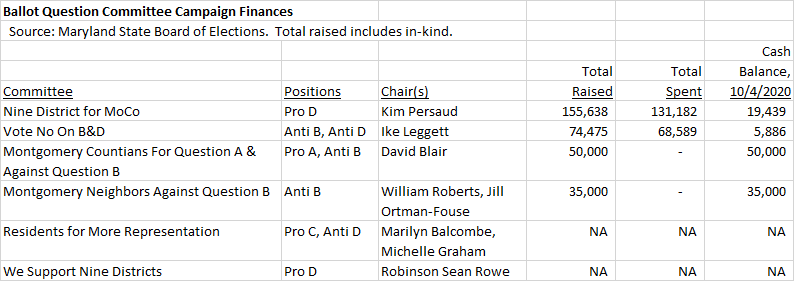
Here is a summary of committee finances for the entire cycle.

Nine District for MoCo, by far the oldest committee, has raised and spent the most money. It has had far more individual contributions (252) than Ike Leggett’s Vote No on B and D (30) with no other committee reporting any. Real estate interests have accounted for 83% of Nine District’s cash contributions. Interestingly, while Washington Property Company president Charlie Nulsen and the three county employee unions were major Nine District contributors in prior reports, they have not contributed any more since July. Nine District has collected contributions from leaders of the county’s Republican Party, which has raised money for the group on its website. The group has spent money on fees for Baltimore consultant Rowland Strategies, legal fees, robocalls and advertising (especially on Facebook).

Vote No on B & D, Leggett’s committee, spent $9,610 on graphic design for printing and campaign materials and $58,437 on direct mailing. So far, this is the only expenditure by any committee on mail. (Where’s my mailer, Ike?) Two other committees have collected money but not spent it and two more have collected less than $1,000.

Here are the biggest contributors to these committees and their positions on the ballot questions.

David Blair – $100,000
Supports Question A, Opposes Questions B and D
The former county executive candidate has given $50,000 each to Leggett’s group opposing Questions B and D and his own group supporting Question A and opposing Question B.

Charlie Nulsen – $50,000
Supports Question D
The president of Washington Property Company made one $50,000 contribution to Nine District for MoCo on 6/4/20. This was a critical boost for the group as it was in the home stretch of gathering signatures to appear on the ballot.

Monte Gingery – $40,000
Supports Question D
The head of Gingery Development Group has made three contributions totaling $40,000 to Nine District for MoCo.

MCGEO – $30,000
Opposes Question B, Supports Question D
The largest county government employee union gave $20,000 to Montgomery Neighbors Against Question B and made a $10,000 in-kind contribution to Nine District for MoCo. MCGEO President Gino Renne is the treasurer of Empower PAC, which gave another $5,000 to Montgomery Neighbors Against Question B.

Willco – $15,000
Supports Question D
The Potomac developer gave an in-kind contribution of $15,000 to Nine District for MoCo which was used to pay Rowland Strategies.

UFCW Local 400 – $10,000
Opposes Question B
This grocery store union which shares a parent union with MCGEO gave $10,000 to Montgomery Neighbors Against Question B.

Share

New Ad Supports Question A

By Adam Pagnucco.

Montgomery Countians for Question A & Against Question B, a ballot issue committee headed by David Blair, has announced its first ad. The ad and accompanying press release appear below.

FOR IMMEDIATE RELEASE

October 7, 2020

Scott Goldberg
Montgomery Countians for Question A & Against Question B
Scott@AistheAnswer.com

PRO QUESTION A & ANTI QUESTION B EFFORT LAUNCHES

Group Headed by David Blair Announces First Round of Ads Supporting Fiscal Responsibility

Montgomery Countians For Question A & Against Question B is spearheading a significant campaign to pass Question A and oppose Question B on citizens’ ballots this fall. A broad spectrum of growing groups and individuals share this policy position including the Greater Capital Area Association of REALTORS® (GCAAR), Montgomery County Council of Parent-Teachers Association, Montgomery County Chamber of Commerce, Montgomery County Education Association, the Montgomery County Democratic Party, Jews United for Justice, the Sierra Club, SEIU Local 500, all 8 State Senators and 32 Delegates representing Montgomery County, State Treasurer Nancy Kopp, and former Republican Councilmember Howie Denis.

Enacting Question A is a fix to our broken property tax system. “I strongly support Question A. This common-sense measure will set a consistent property tax rate so we can adequately plan to fund our schools, parks, and libraries,” according to David Blair, Chair of the Council for Advocacy and Policy Solutions and the ballot issue committee. State Treasurer Nancy Kopp has this to say: “Montgomery County is the gold standard in this country when it comes to public finances because our leaders make thoughtful, reasoned decisions. Question A continues allows county officials to balance budget stability, fiscal responsibility, and financial flexibility in a crisis. Question B would endanger Montgomery County’s financial well-being, threatening our triple AAA bond rating and creating instability for future budgets.” GCAAR has been working in close collaboration and their 2020 President, Danai Mattison Sky, says “Question A would modernize the property tax charter limit allowing for proper, measured growth in the county. Question B would threaten the financial stability of our county and endanger our AAA bond rating. GCAAR is proud to stand For Question A and Against Question B.”

In the coming days, the Committee will release digital ads, a social media plan including Facebook (@QAistheAnswer), Twitter (@AistheAnswer), and Instagram (@QAistheAnswer), direct mail and launch a website which can be found at www.AistheAnswer.com.

#

Share

State Audit: Thousands of MoCo Homeowners Overcharged on Property Taxes

By Adam Pagnucco.

The state’s Office of Legislative Audits (OLA), which is part of the General Assembly’s Department of Legislative Services, is one of the most useful offices in all of state government. Its many audits of state agencies are often must-reads for those who care about the proper functioning of government. And this week, OLA dropped a bombshell:

Because of mistakes made by the state in calculating homeowner tax credits, thousands of MoCo homeowners have been overcharged on their property taxes.

In most states, local governments assess property values, send property tax bills and handle appeals. Maryland uses a hybrid system in which the State Department of Assessments and Taxation (DAT) calculates assessments and tax credit values which the local governments use when they send tax bills. The state handles appeals.

OLA audits agencies all over state government. On October 5, OLA released an audit of DAT that contained many troubling findings. Of most significance is its finding that a mistake in calculating homeowner tax credits resulted in thousands of MoCo homeowners being “improperly” – yes, that’s the word OLA used – overcharged on taxes.

OLA’s Finding 5 starts with this statement.

DAT did not ensure HTCs [homeowner tax credits] were properly calculated. As a result, HTCs awarded to thousands of homeowners in certain jurisdictions were improperly reduced by at least $4.4 million in fiscal year 2019. Most HTCs are calculated automatically by DAT’s automated system based on applicant income data entered in the system by DAT employees. Certain HTCs are calculated manually by DAT employees when a homeowner does not receive an individual real property tax bill (such as in the case of a housing cooperative) or for new home purchases where the tax credit must be prorated for less than a year.

The improper HTC calculations that we address in this finding were the result of DAT’s incorrect treatment of certain additional tax credits offered by certain local jurisdictions. Because each local jurisdiction may or may not provide its residents with other tax credits, which are in addition to the HTC provided for in State law and are paid for by the State, each jurisdiction could be impacted differently or not at all by this finding.

Let’s recall that Montgomery County offers MANY property tax credits and exemptions.

OLA continues:

DAT did not periodically review the programming of its automated system to verify that it was calculating HTCs in an accurate manner and in accordance with the law. As a result, DAT was not aware that it had incorrectly programmed the system and that HTCs for residents of at least one jurisdiction (Montgomery County) were not being calculated consistent with the law as further described below…

DAT’s automated system improperly deducted the income tax offset credit (ITOC) administered by Montgomery County from homeowners’ State and County real property tax liabilities, resulting in the HTCs awarded to homeowners in Montgomery County being improperly reduced. Specifically, individual homeowners under the age of 65 had their State and County HTCs improperly reduced by amounts up to a total of $692, and homeowners at least 65 years old had their HTCs reduced by amounts up to a total of $1,038. Based on our analysis of HTC applications processed in DAT’s automated system for Montgomery County residents in fiscal year 2019, the improper reduction of homeowners’ tax liabilities resulted in reduced HTCs awarded to 5,388 applicants totaling $4.4 million. We determined that, based on the automated system’s programming for Montgomery County, DAT improperly calculated HTCs dating back to at least 2005 in the same manner. We could not readily determine the amount by which HTCs were improperly reduced for years prior to fiscal year 2019…

DAT received advice from its legal counsel on January 23, 2019 that confirmed our determination that DAT’s HTC methodology commented upon above was incorrect.

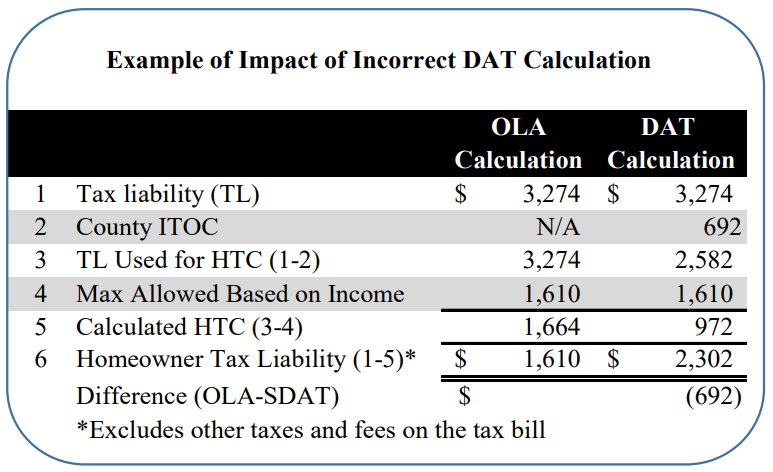
OLA offers this example of DAT’s miscalculation of the homeowner tax credit.

As the above example shows, the state’s miscalculation of the homeowner tax credit increases the homeowner’s tax liability, resulting in an overcharge on property tax bills. One of OLA’s recommendations was that DAT “consult with legal counsel on how to proceed regarding any refunds resulting from the HTC miscalculations including the $4.4 million noted above.”

DAT (which refers to itself as SDAT) was not having any talk of refunds. DAT responded:

SDAT disagrees with the sentiment of impropriety in the statement “HTCs awarded to thousands of homeowners in certain jurisdictions were improperly reduced by at least $4.4 million.” Before OLA began their audit, SDAT made a policy determination that increased the amount of tax credits received by certain jurisdictions in future years. Subsequent conversations with SDAT’s Assistant Attorney General confirmed that this is the appropriate course of action moving forward, but the Department does not feel as though prior year calculations were inaccurate as they were consistent with the Department’s practice at the time and implicitly upheld by PTAAB and Maryland Tax Court decisions.

OLA shot back:

DAT’s statement that the PTAAB and the Maryland Tax Court “implicitly upheld” the specific calculation method we addressed in our report is not consistent with its position during our audit fieldwork or subsequent to the audit when we discussed the finding with DAT management. Furthermore, the statement is questionable since the specific calculation method we addressed was demonstrably improper, and our assessment that the calculation method was improper was consistent with advice DAT received from its legal counsel in January 2019 as noted in our report.

So the two agencies are deadlocked. OLA can’t force DAT to give anyone any refunds. But the General Assembly can and OLA is an arm of the legislature.

MoCo’s 8 state senators and 24 delegates need to get all over this like white on rice. Government bureaucrats don’t get to screw up, get caught and then say, “Sorry, we’re keeping the money.” If OLA’s findings hold up, our delegation must ensure that any MoCo homeowners who were overcharged must be identified and paid refunds.

Share