Governor Larry Hogan is hopping mad about Question 1, a statewide constitutional amendment on the ballot that would curtail some of his massive budget powers. That’s understandable – any politician (and most of the rest of us) would be upset about having any of our powers taken away. But Hogan’s critique of Question 1 has careened into the territory of outright lies and he deserves to be exposed.
Question 1 has its roots in a state budget crisis way back in 1915. In those days, the state government was considerably less professional than it is now. In Fiscal Year 1915, the state ran up a general fund deficit of $1.4 million. That was pretty bad considering that the state recorded revenues of just $12.1 million.
The crisis resulted in the incorporation of an executive budget system into the state’s constitution, which gives the governor enormous powers to set the operating budget. The General Assembly is prevented from adding to or rearranging the governor’s proposed operating budget under most circumstances. The legislature can cut certain items from the governor’s budget and also fence off money, designating it for use only under certain circumstances. The governor can release the money for those purposes or save it. Over the years, the General Assembly got around the restrictions by mandating future funding for some items through statute (especially education). But in an operating budget for an upcoming fiscal year, the governor – any governor – has awesome power which dwarfs the ability of the legislature to check it.
No other state gives such budgetary authority to its governor.
In the past, the governor and the General Assembly lived with each other by negotiating (to an extent) what would appear in the governor’s budget. But Hogan and the current General Assembly tend not to negotiate with each other all that nicely. Last spring, General Assembly Democrats got fed up and passed SB 1028, a constitutional amendment that would junk the executive budget system and balance budgetary power between the governor and the General Assembly. That is now Question 1 on this year’s ballot. Here is the exact language of Question 1.
Question 01
Constitutional Amendment (Ch. 645 of the 2020 Legislative Session) State Budget Process
The proposed amendment authorizes the General Assembly, in enacting a balanced budget bill for fiscal year 2024 and each fiscal year thereafter, to increase, diminish, or add items, provided that the General Assembly may not exceed the total proposed budget as submitted by the Governor.
(Amending Article II Section 17 and Article III Sections 14 and 52 of the Maryland Constitution)
Additionally, the bill creating Question 1 grants the governor authority to veto any line items added by the General Assembly to executive departments. Furthermore, the bill makes clear that the changes will take effect in Fiscal Year 2024, after Hogan has left office.
Hogan despises this constitutional amendment and set up a website to oppose it. The website says, “Question 1 would upend the Maryland constitution to give career politicians in the legislature unchecked power over the budget, denying governors the chance to hold them accountable and to protect taxpayers.”
Hogan also made this video in which he claimed that Question 1 would lead to higher taxes.
Here’s the lie: Question 1 does not give the General Assembly “unchecked power over the budget.” The very language of the amendment makes clear that the legislature “may not exceed the total proposed budget as submitted by the Governor.” That means the governor still gets to set a budget ceiling that the legislature cannot exceed. Furthermore, the bill gives the governor line item veto authority over appropriations for state departments. What the bill actually does is establish a balance of power between the governor and the General Assembly that resembles the arrangement in most other states.
If Hogan wants to make an honest argument against Question 1, he can claim that the current system has worked well enough over the past century and has prevented a recurrence of the kind of budget crisis that it was designed to stop. But it’s a lie to say that it will result in higher taxes when the governor still gets to set a budget ceiling.
Readers, please take this into account when voting on Question 1.
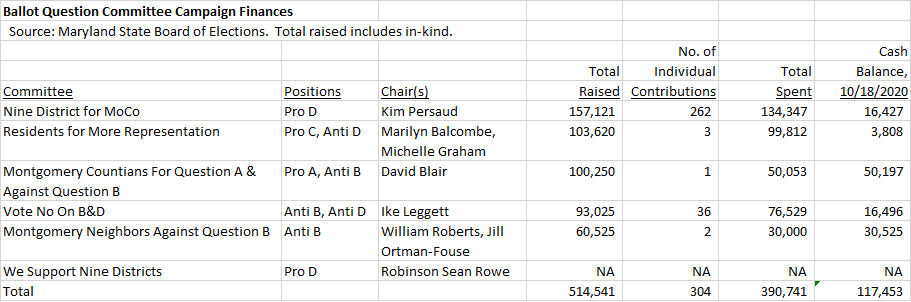
The six committees formed to advocate for and against MoCo’s ballot questions have filed their final campaign finance reports before the general election, covering the period through October 18. Let’s see where the money is coming from.
Question B: Would remove the ability of the county council to break the current charter limit on property taxes, thereby capping property tax revenue growth at the rate of inflation. Authored by Robin Ficker.
Question C: Would add 2 district seats to the county council, thereby establishing 7 district seats and 4 at-large seats. Authored by Council Member Evan Glass. See MoCo Could Use More County Council Districts.
Here is a summary of finances for the committees for the entire cycle through October 18.
To understand why these flows of money are occurring, it’s useful to recall the genesis of these questions. This year’s ballot question fight was joined when two questions were placed on the ballot by petition: Robin Ficker’s anti-tax Question B and Nine Districts for MoCo’s Question D, which would eliminate council at-large seats and remake the council into 9 district seats. In response to those ballot questions, the county council put two of its own questions on the ballot to compete with them: Question A (a different tax limitation measure) and Question C (which would keep the at-large seats and add two district seats). It is believed by some that if two directly conflicting ballot questions pass, they will both get thrown out, though that is not 100% certain.
Once it became clear that both Ficker’s anti-tax question and the nine districts question were going to appear on the ballot, no fewer than four new ballot issue committees were created to stop one or both of them and/or to promote the council’s alternatives. In short order, many of the county’s power players took sides in an uncommon off-year ballot question war. The players’ positions are at least as interesting as the committees’ activities themselves.
Nine Districts for MoCo, the oldest of the committees, has by far the most individual contributors but 82% of its cash funding has come from the real estate industry. In its most recent report, MoCo GOP Central Committee Member Ann Hingston made 6 more in-kind contributions totaling $993, thereby providing more evidence of the links between Nine Districts and the county Republican Party. Nine Districts’ fundraising pace has slowed as they have collected just $154 since October 4.
The competing committees have rapidly closed the gap. Three groups have paid for mail: former County Executive Ike Leggett’s group opposing Questions B and D, former executive candidate David Blair’s group supporting Question A and opposing Question B and Residents for More Representation, a group supporting Question C and opposing Question D. These groups are also paying for websites and online advertising. But they got off to a late start while Nine Districts has been campaigning for more than a year.
Below are all the major players who have contributed at least $10,000 to one or a combination of these ballot issue committees.
David Blair – $165,000 Supports Questions A and C, opposes Questions B and D Businessman and former executive candidate David Blair is the number one spender on ballot questions. He has contributed $65,000 to Legget’s group opposing Questions B and D, $50,000 to his own group supporting Question A and opposing Question B, and $50,000 to Residents for More Representation, which supports Question C and opposes Question D. Blair’s positions mirror the positions taken by the county Democratic Party. (Disclosure: I have done work for Blair’s non-profit but I am not involved in his ballot question activities.)
Charlie Nulsen – $123,500 Supports Questions A, C and D, opposes Question B Nulsen is the president of Washington Property Company. On June 4, he contributed $50,000 to Nine Districts to help get Question D on the ballot. On October 13, he contributed $23,500 to Residents for More Representation to defeat Question D. Nulsen could have saved more than $70,000 and achieved the same outcome by simply doing nothing. He also contributed $50,000 to Blair’s group supporting Question A and opposing Question B.
Monte Gingery – $40,000 Supports Question D The head of Gingery Development Group has made three contributions totaling $40,000 to Nine Districts.
Willco – $40,000 Supports Questions C and D On August 5, this Potomac developer gave an in-kind contribution of $15,000 to Nine Districts which was used to pay Rowland Strategies (their campaign firm). On October 9, Willco gave $25,000 to Residents for More Representation, which is seeking to pass Question C and defeat Nine Districts. Folks, you can’t make it up.
MCGEO – $30,000 Supports Question A, Opposes Question B, Gave Contribution to Question D The Municipal and County Government Employees Organization (MCGEO) has made a $20,000 contribution to Montgomery Neighbors Against Question B and a $10,000 in-kind contribution to Nine Districts. MCGEO President Gino Renne is the treasurer of Empower PAC, which gave another $5,000 to Montgomery Neighbors Against Question B.
MCEA – $20,000 Opposes Question B The Montgomery County Education Association (MCEA) has contributed $20,000 to Montgomery Neighbors Against Question B.
UFCW Local 400 – $10,000 Opposes Question B This grocery store union which shares a parent union with MCGEO gave $10,000 to Montgomery Neighbors Against Question B.
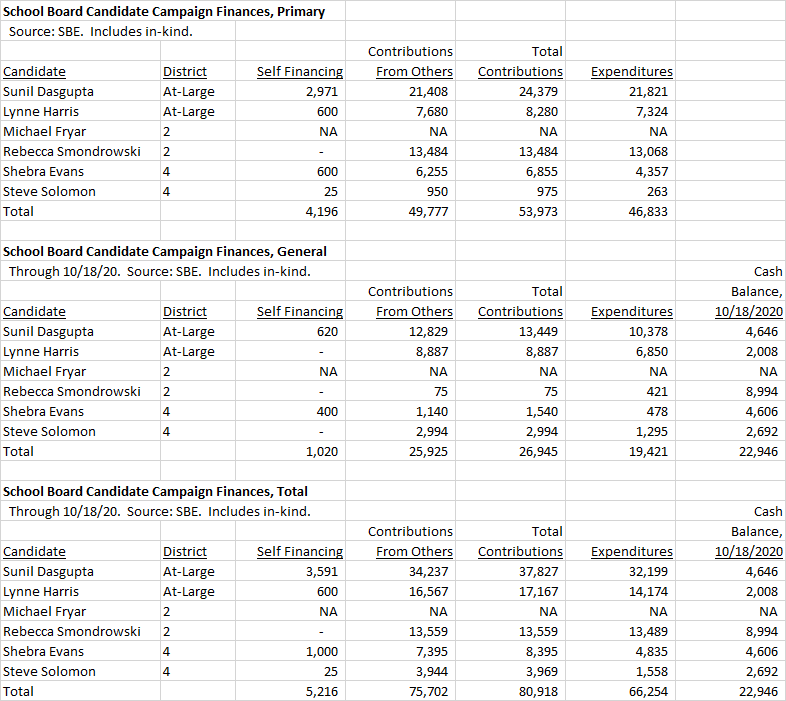
The school board candidates’ last campaign finance reports prior to the general election were submitted to the state on Friday. The table below shows money raised and spent for both the primary and the general.
There are a number of things I could point to here, such as Sunil Dasgupta’s financial edge over Lynne Harris (although that has declined in the general) and the fact that incumbents Rebecca Smondrowski and Shebra Evans don’t seem to be taking their challengers very seriously. (Smondrowski’s opponent, Michael Fryar, has raised no money but was still endorsed by the Washington Post. MCEA has not endorsed in that race.)
But the big story is what I wrote the last time I looked at these reports: these candidates are basically all broke. And that is particularly striking given the fact that at least a half-million people are probably going to vote in the general election this year. It’s impossible to reach that many people on a $20,000 budget (or less).
To MoCo’s state delegation: school board candidates desperately need public financing. Please introduce legislation enabling that to happen.
Guest column by Lynne Harris, Candidate for Montgomery County Board of Education At-Large.
Reopening schools – safely – is critical. As an MCPS teacher, parent, a nurse and a public health expert, I have been closely following public health guidance, evolving science around COVID, and the work of school systems all around the world that have opened during the pandemic. I’m disappointed that MCPS lags so far behind almost every school district in Maryland. Twenty of our state’s 24 school districts have begun bringing some students back. To prevent irreversible learning and opportunity loss, we need a public health compliant, student-focused plan to start providing some level of in-person instruction to students.
It’s critically important to have a CDC-compliant plan now to bring small groups of students into our schools, periodically. Those most in need of in-person instruction include students vulnerable to learning loss, struggling students, young learners, students with special needs, and students in hands-on CTE programs like mine. That plan needs to ensure that MCPS and the County Health Department are in continuous collaboration, and have a well-thought out and well-communicated plan to move back and forth between fully virtual and hybrid instruction as Montgomery County’s COVID numbers change. Some say that’s hard, but school systems all over are doing that now.
SCHOOLS ARE ALREADY OPEN!
Planning to reopen doesn’t’ require re-inventing the wheel. We can look at how school systems around the nation and the world are educating the next generation face-to-face during a global pandemic. Six of the nation’s ten largest school systems – some with hundreds of thousands more students than MCPS – have reopened. It’s not that MCPS can’t devise a safe plan, it’s that MCPS hasn’t yet created one.
To see how this can work safely, look no further than our own schools. They’re already in use. MCPS for-profit learning pods and low-cost equity hubs are currently operating in more than 60 schools. Private schools in Montgomery County are open too – here’s an interesting piece from Education Week written by a MoCo middle school teacher teaching at one of them.
REOPENING SAFELY
Almost every school system that has reopened devised a hybrid plan, with a mix of in-person and virtual learning. Planning starts by sharing information with communities and providing a firm date for staff and families to opt in or out of in-person instruction. That data is essential for planning – once a school system knows which staff and students will participate only virtually, then it can make school-specific plans for hybrid instruction.
Most school systems have started by bringing in the most vulnerable learners and early learners (mentioned above) first. They are at highest risk for irreversible learning loss. And pragmatically, it’s easier to devise a plan for pre-K and elementary schools, where most students are together in a single classroom – than for middle and high schools where students typically change classes four to eight times daily.
In school districts where partial reopening is working:
Masks are mandatory.
Students and staff can opt for virtual only instruction.
Health screenings are routine, with firm guidelines. Some are completed online daily before students and staff enter the building. Anyone with a COVID-19 exposure must notify the school and self-quarantine. Contact-tracing is handled quickly with health officials. Anyone who feels unwell stays home.
Common spaces are marked for social distancing and equipped with supplies for hand hygiene.
Arrival and dismissal procedures minimize crowding, utilizing as many entrance/exits as feasible so students and staff enter and leave from the exit nearest their classroom.
Groups of students remain together (cohort) throughout the school day – eating lunch together, taking handwashing breaks together, going outside together.
Enhanced hygiene and cleaning protocols include restrictions on multiple use items in classrooms, socially distanced classroom arrangements, and frequent cleaning of high-touch surfaces.
One day per week, usually Wednesday, is virtual for everyone, allowing for deeper cleaning of spaces mid-week.
Staff, students and families know the plan for pivoting back and forth between hybrid and virtual instruction as community COVID numbers change, and understand how they will receive information about community COVID status and school operations.
MCPS’s work with our County Health Department should yield guidelines for safe operations and allow each of our 208 schools to create its own plan for space utilization. Every one of our schools is unique – in enrollment size, building size and layout, and the presence (or not) of special programs. All of those things matter in figuring out how to safely bring some students and staff back into classrooms, and how to safely and efficiently use school space and maintain social distancing.
FACTS VS. FEAR
I hear some people talk about MCPS reopening from a place of fear. That’s understandable – we’re living through a global pandemic. We need to temper fear and rhetoric with reality, knowledge and fact. Zero risk is impossible. Wherever people gather there is always the possibility for illness to spread. Think about it: have you traveled since March? Gone to a gathering of people that you don’t live with? Gone to the grocery store? Gone to a Farmers Market? If so, were conditions tightly controlled and health protocols rigidly observed? There’s always risk.
We have to look at creating a reopening plan through the lens of our purpose as a public school system. Our purpose is to educate students and support students and families. That means we have to look at what’s best for students, and the data is clear – virtual learning is NOT best for the majority of students. Some will suffer irreversible lifetime consequences if we can’t resume some level of in-person instruction.
MCPS is behind schools and learning hubs in our district, most of the systems in our state, and many across our nation and the world. Planning for reopening requires robust collaboration – and it needs to begin now. If none of us are seeing, hearing or learning about that planning, then MCPS is falling even further behind.
In the wake of his veto message, County Executive Marc Elrich has once again blasted a bill passed by the county council granting developers at Metro stations 15-year property tax breaks. The council is set to override Elrich’s veto on Tuesday. Elrich’s mass email, which reiterates his reasons for vetoing the bill, is reprinted below.
*****
Dear Friends:
Last week I issued my first veto of legislation, Bill 29-20 Taxation – Payment in Lieu of Taxes – WMATA Property. I sent a memorandum with the veto explaining in detail the reasons for the veto; you can read the entire memo here, but I wanted to explain some of the reasons in my letter.
Like the Council, I am focused on expanding transit and transit-oriented development, broadening our tax base and preserving and increasing the supply of affordable housing. Unfortunately, Bill 29-20 does not achieve any important goals, is too costly and does not produce sufficient public benefit to justify the cost.
This legislation would require 100 percent exemption of the real property tax for 15 years. This exemption is known as a Payment in Lieu of Taxes, or PILOT [see NOTE 1]. A few requirements are included in the bill. However, it would not increase the number of affordable housing units than otherwise would have been provided. While it was amended to make some of the units more affordable, we could have negotiated that with the developer at a fraction of the cost to the County.
[NOTE 1: The requirement applies to development that is higher than eight stories on property owned by WMATA at a Metro station. The development must include at least 50 percent residential rental housing, and one-quarter of the moderately priced dwelling units (MPDUs) must be affordable for residents at 50 percent of area median income (AMI). The PILOT would begin no later than the second year after the property tax is levied. The law would sunset in 2032, but any existing PILOT would continue until the end of its 15-year period. To be eligible for a PILOT, a developer would be required to use contractors and subcontractors who have no more than two final penalties of $5,000 or more in the three prior years for violations of applicable wage and hour laws. At least 25 percent of the workers constructing the project must be County residents. Special taxing district taxes are exempt from the PILOT.]
It is an expensive, and unnecessary, approach, particularly at this moment when the County is struggling to fund critical services (the need for which is increasing and will likely continue to increase for a while), where the outlook for revenues over the next couple of years is not good and where full economic recovery from this pandemic may take as much as 10 years. It is certainly not prudent to reduce revenues coming into the County coffers at this time.
During the Council’s deliberations on the bill, supporters could only cite one potential development as being eligible for this 15-year, 100 percent tax break – the proposed Strathmore Square at the Grosvenor/Strathmore Station. Under the provisions of this legislation, Strathmore Square’s owners would receive a tax break of approximately $100 million. As a member of the County Council, I supported the zoning changes that made this proposed development possible, but I simply do not believe it is a responsible use of County resources to supplement a market-rate housing complex at this level of expense.
The developer of that project saw an increase in the allowed units that went from a little over 500 to more than 2,200—density that was based on being atop a Metro station. Now, the developer is arguing that it is too expensive to develop on the Metro, yet WMATA records show that the price the developer paid was based on an appraisal that was done AFTER the property was rezoned. The developer accepted the appraisal and agreed to proceed. If the developer thought the price was unreasonable and would make development unprofitable, it could have rejected the appraisal and the deal. Instead, it came to the County three years later and asked that all its taxes be forgiven because the deal does not work for it.
Should similar developments occur at the other potential WMATA sites across the County, lost revenue would likely exceed $400 million. To be clear, I want more housing constructed in our County, and I see the significant benefit of housing that makes transit usage extremely convenient. However, I do not believe providing developers with as much as $400 million in incentives is necessary to get 8,000 new housing units that are projected to come here anyway. Put another way, this bill would provide a developer with a $50,000 per unit gift regardless of cost of rent, without producing additional affordable housing units beyond the amount required for all developments. This is not a good use of public funds.
Nor do we need this law—the authority already exists for the County to negotiate individual agreements.
It makes sense to continue to allow them on a project-by-project basis—not all projects need the same PILOT term or value. Flexibility should be maintained to enable negotiation of the best possible agreement that is in the public interest.
Additionally, it does not make sense to focus the market rate housing (along with the public subsidy) at Metro stations, which pushes affordable housing elsewhere. As the recent Housing Preservation study points out, affordable housing units near transit are at greatest risk of being lost and are being lost. Seventy-five percent of projected need for housing over the next decade is for affordable housing—why would the focus of a housing bill be on subsidizing market rate housing? Furthermore, given the projected number of market units needed over the next 20 years, there is sufficient zoning near Metro Stations to accommodate the needed units. While they might not be built on top of Metro property, they may be built nearby within easy walking distance of the Metro.
In White Flint, there are properties adjacent to, and across the street from, the Metro entrance where housing could be built that would actually be closer to the Metro entrance than some buildings on WMATA property. In other words, the housing does not have to be built directly on WMATA property; it can be nearby. And this bill creates a difficult precedent. It is likely that other properties near Metro will ask for the same PILOT. Those properties offer similar value in providing transit proximate development. It is simply not good policy to have a general approach to subsidize market rate housing.
Ironically, this bill may be counterproductive by raising the value of WMATA’s land. Under Federal law, WMATA must seek the highest and best price for its land. Land that is exempted from all property taxes for 15 years is more valuable because the calculation of its value includes the costs to acquire and develop, including taxes, weighed against market rents. If two properties are side by side, one exempt from taxes and the other not, and they were producing the same value of unit, the land value of the exempt property would be greater because its cost of development would be less than the cost to develop the tax-paying property. This would, in turn, likely raise the parcel’s appraised value. Supporters of the bill have said they are trying to reduce the cost to developers, but if the value of the land increases, the bill has had the opposite effect.
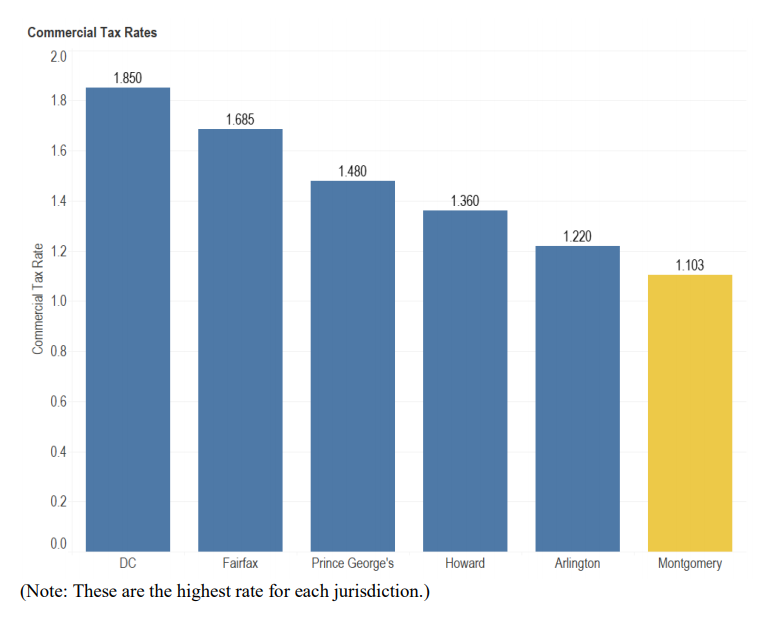
Furthermore, there is no evidence that this is needed. In fact, if you look around the region, many of our neighboring jurisdictions have their highest taxes on property nearest Metro sites and the tax rates are substantially greater than in Montgomery County. If property taxes were the key to development, we would have won the development battle a long time ago because we are lower than most surrounding jurisdictions. (See chart below)
And I would note that if one of the goals of this bill is to provide tax incentives to attract new businesses, those incentives should go to the occupant of the building, not to the developer of the building. This legislation gives public funds to help build buildings, not to incentivize businesses to become tenants in those buildings.
And workers deserve a prevailing wage. A majority of the Council voted against requiring the prevailing wage at these projects. The provision would have required that all contractors and subcontractors pay prevailing wages and be licensed, bonded, insured and abide by wage and hour laws. Legislation that dedicates public funds to market-rate housing should, at least, also support the workers who build the housing. If WMATA was building a structure on the same property, current law would require it to abide by the prevailing wage. I believe the developments contemplated by this bill should as well. The lack of such a provision to treat workers equitably and to share in the subsidy is another major deficiency in this legislation.
Finally, to risk of stating the obvious, using our limited funds for market-rate (non-affordable) housing development means fewer funds for other services including affordable housing, recreation and education, which has a racial equity/social justice impact. This bill allows housing to be built for those who can afford it, not for lower-income populations who are disproportionately Black and Latino.
I hope this gives you a better understanding why I could not support this bill.
Less than a month after leaving county government, former MoCo Chief Administrative Officer (CAO) Andrew Kleine has written an essay for Engaging Local Government Leaders, a public manager association, about his experiences in dealing with the COVID-19 crisis. The essay has set tongues wagging about whether Kleine has more to say about his time as CAO.
Kleine’s essay is fairly innocuous. He discusses teleworking, newsletters, masks and his personal exercise routine. He does not discuss his resignation. Notably, the essay makes him look good. The other thing one takes away from it is that Kleine is a superior writer. His writing style is concise, engaging, occasionally humorous and even a little zippy. It’s hard to write about government with zip, but Kleine can pull it off as he did in his book about Baltimore, City on the Line.
From a political perspective, the thing to notice about City on the Line is that Kleine names names. He recounts events and assigns quotes to city managers and politicians. Among other things, he reported this quote from then-Mayor Sheila Dixon: “The budget is like a $3 billion black box to me… The decisions brought to me are at the margins, which means that, as far as I know, 99 percent of the budget is basically on autopilot.” I bet Kleine is right. Very few politicians in my experience know much of anything about the budgets they are supposed to oversee. But what politician wants to see a quote like that in print?
As CAO, Kleine was THE top manager in MoCo government. He would have been present for all the big decisions. He knows who said what, who did what and how everything turned out. Heaven knows what documentation he has. Heaven knows how much he would be willing to say, but in his book on Baltimore, he said a LOT. (Kleine’s funniest story relates to a city manager who accused him of wanting to write a book about Baltimore after he leaves the city.)
If I were a senior official in the executive branch, I would dread the prospect of Kleine writing a book about his experiences in MoCo. He has nothing to lose and everything to gain. Let’s remember that Kleine never wanted to resign. The county council forced County Executive Marc Elrich to push him out. How would you feel if something like that happened to you?
One more thing: Kleine has plenty of time to publish another book before the next election.
Dear Adam, thanks for covering the “Nine Districts” matter. Rest assured, there is at least one dyed-in-the-wool Democrat who believes that County Council has for years betrayed the voters and residents on planning issues … and welcomes trying a new approach that might bring to end the years of County Council’s betrayal of voters and residents … so passing the “Nine Districts” ballot measure might not be a silver bullet, but it sends a strong signal — like passing the “term limits” ballot measure — that County Council’s betrayal of voters and residents has not gone unnoticed and that, to the extent possible, County Council will be held accountable by the voters they have betrayed.
This reader has an interesting point in bringing up term limits. The coalition for Nine Districts bears a more-than-passing resemblance to the coalition supporting term limits in 2016. Both groups contained Republicans, business folks, unhappy developers, moderate Democrats and everyone else who opposed the status quo. Some upcounty residents see a lot of appeal in Nine Districts. Four years ago, Clarksburg, Damascus, Derwood, Laytonsville, North Potomac and Poolesville voted in support of term limits by 80% or more.
Now let’s consider what Nine Districts supporters had to say about why they favored that initiative. There are themes of being ignored, losing out to downcounty and/or “Takoma Park” progressives, dissatisfaction with planning issues and more. Those very same grievances were cited by term limits supporters four years ago. And term limits were sold as the magic elixir that was supposed to fix it. All of it.
One thing that the term limits vote accomplished is that it spawned enormous, although probably temporary, aversion to tax hikes at the county council. Five council members who voted for the 8.7% property tax hike in 2016 that preceded the 70% vote for term limits are still on the council. Most of them along with at least half of the freshmen have opposed tax hikes at nearly every turn over the past year. When the county executive proposed a tax hike to fund more money for schools, eight of the nine council members immediately rejected it out of hand. When members of the General Assembly offered more taxing power to the council, a majority of them rejected that too even though it was merely enabling authority. They also rejected a hidden tax hike that was buried in the county executive’s budget. Council Member Evan Glass’s bill to tax teardowns is in limbo. And though they don’t favor Robin Ficker’s draconian charter amendment banning property tax increases, the council proposed an alternative containing a unanimous vote requirement for breaking the charter limit. Let’s remember that the latter requirement originated with a charter amendment passed by Ficker in 2008.
Yes, it’s true: so far, the county council of 2020 has had the same position on breaking the charter limit on property taxes that Robin Ficker had in 2008. No one seems to have noticed.
Someday, the anti-tax sentiment on the council will fade. Term limits, after all, create lame ducks who are by their nature immune from political accountability in the event that their careers in office are over. Throw in the county’s humungous multi-year revenue crash and we have not seen the last of tax hikes.
Whatever becomes of taxes, none of the other things that term limits were supposed to “fix” have been “fixed.” Four years later, supporters of Nine Districts are still complaining about those very same things. Here’s a prediction, folks – if Nine Districts passes, the new county council will be seen as just as bad as the current one by a faction of angry residents who will then spawn a new charter amendment – for the same reasons. And on and on it will go.
Instead of endlessly rejiggering the charter, how about we organize people to vote for adults? And then if the politicians act like bottle-throwing babies, vote them out. A few election cycles of that will send a message to the politicians that they won’t forget, even more so than term limits or nine districts.
The Montgomery County Economic Development Corporation (MCEDC) is the county’s economic development authority. It is a 501(c)(3) whose board members are nominated by the county executive and confirmed by the county council. Its operating budget comes mainly from county government. In June, MCEDC launched a business assistance initiative called 3R (Reopen Relaunch and Reimagine), which is funded by a combination of public and private money. One component of 3R is a new grant program for restaurants and retailers to prepare for the winter months. All companies in those sectors are encouraged to apply, but there’s a catch:
Getting the money depends in part on where in the county they are located.
As part of the public-private 3R (Reopen, Relaunch and Reimagine) Initiative, the Montgomery County Economic Development Corporation (MCEDC) is now accepting grant applications from local restaurants and retailers for up to $5,000 to prepare for the upcoming holiday season and winter months. Eligible businesses can submit applications through November 5.
More information on the 3R Initiative Restaurant & Retail grant program and the application can be found here. The grant is an important component of MCEDC’s comprehensive year-long 3R Initiative designed to address the devastating impacts of the pandemic on the Montgomery County restaurant and retail industries.
Although any locally-owned restauranteur or retailer with fewer than 100 employees can apply for the grant, ten Montgomery County target corridors will be given priority for funding: Burtonsville/Briggs Chaney, Wheaton/Glenmont, White Oak, Aspen Hill, Germantown, Damascus, Takoma-Langley, Four Corners, Montgomery Hills, and Twinbrook/White Flint. These ten target corridors were selected with community input.
I asked MCEDC CEO Ben Wu to explain the organization’s rationale for geographic prioritization. He wrote the following to me:
Hi Adam, thanks for your message and your interest in the 3R Initiative.
As you know, the 3R Initiative supports our Montgomery County restaurant and retail sectors during this pandemic crisis. This $1 Million public-private partnership is designed as a year-long initiative, of which the grants are an important element, especially now with the start of the winter and holiday seasons. Future elements include a retail recovery guide, a countywide e-commerce marketplace and additional targeted investments in selected commercial corridors.
While the 3R Initiative has county-wide components such as the recovery guide and the e-commerce marketplace, it is also an economic development pilot project that seeks to bring together community stakeholders in hard-hit target corridors that might not have significant resources to search for collective solutions. These community stakeholders could include landlords, tenants, chambers of commerce, neighborhood associations, local support organizations, and the County Regional Service Centers. The 3R Initiative will work with the target corridors to help their restaurants and retail establishments develop strategies and access funding (through the 3R and/or Reopen Montgomery grants). At the program’s conclusion, depending on the pandemic, we would discuss the future of bringing the successes of this community-based model in the target corridors to potentially be recreated in other areas of the county.
Although any locally-owned restauranteur or retailer with fewer than 100 employees can apply for the grant, ten Montgomery County target corridors will be given priority for funding. These ten target corridors were selected with recommendations and input from the five County Regional Service Centers and the community. They were selected to be geographically and demographically diverse. Each of the Regional Service Center jurisdictions have at least one target corridor, many with more than one.
If you should have any further questions, let me know.
Best, Ben
Now let’s stipulate a few things up front. First, MoCo is an incredibly diverse jurisdiction in all kinds of ways. One can make a case that non-identical communities should not be treated identically. Second, MoCo holds events in locations all over the county that are not the same in kind or timing. There are county seminars, recreation programs, park programs, community events and all sorts of things that rotate across geography. Third, the county has different tax, fee and regulatory requirements depending on area, including parking fees, impact taxes, enterprise zones and of course master plans. We are too large and diverse to enact perfectly homogenous standards for everything the county does.
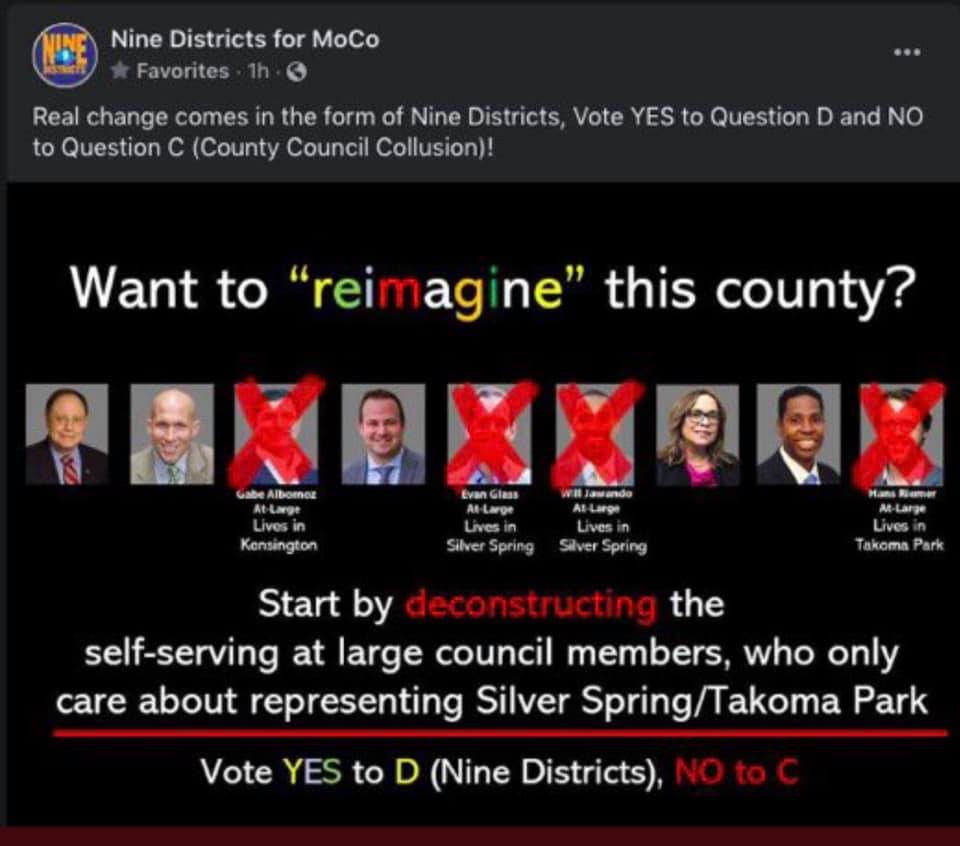
I don’t think MCEDC intends this, but their decision to steer money to some areas and away from others feeds one of the more toxic trends in MoCo politics: the suspicion that some parts of the county are treated better than others. There are tensions of east vs west (especially in issues connected to the schools). There is upcounty vs downcounty. (Folks ask why the Purple Line is being built but M-83, the upcounty highway, is not.) There is wealth vs less wealth. There are issues of racial equity which play out differently across MoCo. The current movement for nine council districts sprang from these tensions. The biggest single argument made by Nine Districts for MoCo is that the county council’s structure, especially its use of at-large members, steers resources away from some communities and towards others. MCEDC’s program is an unwitting but actual demonstration of this sort of thing.
So now two things will happen. First, conspiracy theorists residing in one of the non-prioritized areas will say, “Aha, we were right! The county really is trying to screw us!” Second, businesses in the largest non-prioritized areas will complain and say, “What about us?” The fact that the county’s largest business districts – Downtown Silver Spring, Downtown Bethesda, Downtown Rockville and Gaithersburg – are non-prioritized means that some serious clout could be brought to bear on this issue.
I think MCEDC is well intentioned. But I also think that this could turn into yet another headache that county leaders don’t need.
County Executive Marc Elrich has a soft and raspy voice. Close your eyes and imagine that voice saying:
I just think that developers should pay their fair share.
Last week was a terrible one for Elrich. His chief administrative officer and emergency management director were blown to smithereens by the county council over the pace of the executive branch’s distribution of federal assistance funds. The story dominated the local press for days. Elrich responded to the council with this saucy comeback: “I used to be a legislator, and it’s the best job in the world because you can just say, ‘I want to spend this money,’ and tell someone to go spend it. And you don’t actually figure out how to do it.” There is more than a bit of truth to this, but the observation won’t improve Elrich’s relations with an irate council.
I just think that developers should pay their fair share.
Supporters of the vetoed bill argue that it was necessary to enable development of high rises at the pending Grosvenor-Strathmore Metro station project. They feared that failure to act would doom or shrink the project. That urgency prevented them from examining other, more time-consuming, paths to a deal including an appropriation from the economic development fund (in which Elrich would get to play) or providing financing through the county’s economic development corporation or the Housing Opportunities Commission. But unlike those mechanisms, legislation is a highly public thing. By giving Elrich an opportunity to veto the bill, his critics on the council gave him an opportunity to go on offense.
But wait a minute, you say. The bill passed on a 7-2 vote, one more than necessary to override a veto. When the council overrides Elrich, doesn’t that make him a loser?
Those who think that do not understand how Elrich got elected executive. During his twelve years on the county council, Elrich was the sole no vote on a host of master plans, all increasing density. Yes, he “lost” those votes again and again. But he also picked up support in those communities from skeptics of the plans who came to see Elrich as their only champion. Those folks became a critical and expanding part of Elrich’s base. Few if any politicians in the county have ever won more from “losing” than Marc Elrich.
Elrich’s opposition to many new development policies have prompted his critics to brand him as a NIMBY. But there is more to his political success than pure NIMBYism. When you listen to him discuss development closely, he is making an equity argument as much as a land use argument. Here is what he said about development in 2002:
Our beleaguered middle-class is told that the County can no longer afford to provide the quality of life that made this place so attractive at the same time it throws millions in subsidies into the pockets of millionaires. We make great claims about ending welfare, but we’re really only changing the beneficiaries. What we’ve done is to recast developers as the new poster children of the Nineties. This blind devotion to growth is great – if you’re a developer or a tumor – but it doesn’t work so well for the rest of us who are better served by priorities that strengthen our communities and our schools.
In other words, throwing public money at developers reduces the money available for schools, public safety, health and human services, libraries, parks and more. Here is a more refined version of this argument from his 2018 campaign kickoff.
Elrich’s quarrels with developers resonated more when the economy was better, such as in 2006, when he was first elected to the council. As executive, such arguments come up less often, first because his office does not often deal directly with land use and second because the economy is in such wretched shape. MoCo has much bigger problems at the moment than “predatory” developers. But in a dark blue county in which Democratic primaries are the real elections for office, Elrich’s equity argument still has purchase when occasion calls for it.
Supporters of the bill that Elrich vetoed have good arguments on their behalf. It’s true that Metro sites have extra development costs. It’s true that, for the most part, high-rises are not being built on these sites. It’s true that transit-oriented development is superior to sprawl or no growth. So it’s not a crazy position that public investment should be used to make these projects happen.
But the bill’s supporters have two problems. First, they are making complicated arguments and Elrich is making a simple one. In politics, simple arguments usually beat complicated ones. Second, the supporters are making economic arguments while Elrich is making a value judgment. Most MoCo Democratic primary voters are not accountants or economists, but they do have progressive values. Broadly speaking, they agree with the notion that everyone with means – not just developers – should pay towards the cost of funding government.
On top of all that, consider the times we are in. The county’s unemployment rate is the highest it has been in anyone’s memory. Small businesses are shutting down left and right. Tenants are missing rent and will be, eventually, at risk of eviction. So what are we doing? Giving developers 15 year tax breaks. That’s how Team Elrich is going to frame this.
I just think that developers should pay their fair share.
Unless something strange happens, the council will override the executive’s veto. The bill’s supporters will get the policy win. But the political win? Overall, that belongs to Marc Elrich.