All posts by Adam Pagnucco

Early Results on MoCo Races

By Adam Pagnucco.

The first batch of votes on MoCo races has been reported. This is VERY early and VERY incomplete. So far, the reports include only early votes and less than half the mail ballots requested by MoCo voters with no election day votes tabulated. All of that means these races are FAR from decided, folks!

All of that said, here are the earliest results. Bear in mind that the final percentages are going to be different, but how different they will be cannot yet be said.

School Board At-Large: Lynne Harris 53%, Sunil Dasgupta 46%

School Board District 2: Rebecca Smondrowski 60%, Michael Fryar 39%

School Board District 4: Shebra Evans 67%, Steve Solomon 33%

Question A (Authored by Council Member Andrew Friedson, freezes property tax rate with unanimous council vote required to exceed): For 63%, Against 37%

Question B (Authored by Robin Ficker, would limit property tax receipt growth to rate of inflation and remove council’s ability to exceed): For 41%, Against 59%

Question C (Authored by Council Member Evan Glass, changes county council structure to 4 at-large seats and 7 district seats): For 62%, Against 38%

Question D (Authored by Nine Districts for MoCo, changes county council structure to 9 district seats): For 41%, Against 59%

It is probably not a coincidence that these results mirror the recommendations of the county’s Democratic Party, but the results are far from final.

At some point tonight, the election day votes should be added in. You can refresh them here for school board races and here for ballot questions.

Share

Top Seventh State Stories, October 2020

By Adam Pagnucco.

These were the top stories on Seventh State in October ranked by page views.

1. MoCo Democrats Issue Statement on Ballot Questions
2. Sitting Judges Get Temporary Restraining Order Against Pierre
3. Harris Blasts MCEA Over School Reopening
4. Progressive-Backed Judge Candidate Courted, Donated to Republicans
5. Teachers Respond to Lynne Harris
6. Elrich Vetoes WMATA Property Tax Bill
7. State Audit: Thousands of MoCo Homeowners Overcharged on Property Taxes
8. Reopening Plans – MCPS is Behind
9. Why Montgomery County Ballot Questions B and D Are Truly Bad Ideas You Should Vote Against
10. Ballot Question Committee Scorecard

The number one post by far was MoCo Democrats Issue Statement on Ballot Questions. In fact, that post was one of the most well-read in the history of Seventh State. Most folks who saw it probably found it through Google – and that’s a meaningful piece of intelligence. If people are googling terms like Montgomery Democrats and ballot questions, then not only are they finding content here, they may find similar content at Bethesda Beat, the Democratic Central Committee’s website, the various ballot issue websites and elsewhere. This means that MoCo voters want to know what the county Democrats think about the ballot questions. That’s good news for supporters of Questions A and C and not such good news for supporters of Questions B and D.

The two posts about circuit court judge candidate Marylin Pierre and her opponents, the sitting judges, are being aggressively circulated on social media. This is the fiercest MoCo judicial race in a loooooong time. Can Pierre break through?

One story that was big with readers and off the radar of politicians was State Audit: Thousands of MoCo Homeowners Overcharged on Property Taxes. It’s a massive scandal that state math errors resulted in overcharging of property taxes for thousands of MoCo homeowners and that the state is refusing to offer refunds. In addition to Seventh State, Fox 5 and WMAR (ABC) Baltimore covered it. As far as I know, no state or county politician has made a public statement about this. Maybe I will ask them!

Share

Once Again, MoCo’s Two Electorates

By Adam Pagnucco.

In November 2016, I wrote a three-part series called MoCo’s Two Electorates. (Here are the links to Part One, Part Two and Part Three.) I also wrote a piece titled “MoCo Revolts” in the wake of the term limits vote.

The combined thesis of those pieces are the following.

1. MoCo has two electorates: people who regularly vote in Democratic primaries and people who vote in general elections. Both electorates are important. Democratic primaries choose the county’s elected officials while general elections decide ballot questions and charter amendments.

2. There are roughly 40,000 Super Democrats in MoCo who vote in every primary. Relative to general election voters, they tend to be slightly more female, older, slightly higher income, slightly more likely to live in a single family home and more concentrated in downcounty. They are also slightly LESS diverse than general election voters.

3. Democrats comprise roughly 60% of general election voters with some variation by year. Republicans have outnumbered unaffiliated voters among the rest of actual voters though not by a lot. That means Republicans and unaffiliated voters can team up with a minority of Democrats to pass ballot questions.

4. On four straight meaningful local ballot questions since 2008, the general electorate took arguably the less progressive position in their votes. They voted in favor of Robin Ficker’s anti-tax charter amendment in 2008, against Ike Leggett’s ambulance fee in 2010, in favor of repealing some collective bargaining rights for police in 2012 and for term limits in 2016. This trend among the general electorate should not be comforting to the left. Term limits passed with a whopping 70% of the vote and only four precincts in the entire county voted against them.

Accordingly, these are the prophecies I made back then.

November 7, 2016: “Term limits is the issue of the day and will be decided soon enough. But a broader question looms. Given the differences between MoCo’s Two Electorates, what happens when elected officials cater to one of them at the heavy expense of the other? The recent large property tax hike, which was spread all across county government, was aimed at the priorities of liberal Democratic voters. It also became the core of the push for term limits which is aimed at the general electorate. This suggests a need for balance and restraint by those running the government. Because if one of the two electorates feels unheeded, either one has the tools to strike back – either by unseating incumbents or by shackling them with more ballot questions and charter amendments.”

November 11, 2016: “Opponents of term limits may be right about one thing – they may change the names of elected officials, but not the type of them. Democrats, often very liberal ones, will continue to be elected because of our closed primary system. But the combined message of the last four ballot questions imposes a hard choice on the elected officials of today and tomorrow. They can try to balance the interests of various constituencies across the political spectrum at the possible cost of losing the progressive support that influences Democratic primaries. Or they can stay the course and watch more moderate general election voters pass even more restrictive ballot questions, including perhaps the ultimate bane of progressivism – a hard tax cap.”

What has happened since then? First, let’s consider these two facts from the 2018 elections.

Geography: In the 2018 Democratic primary, the Democratic Crescent (a term I coined for the areas in and near the Beltway stretching from Takoma Park to Kensington and Bethesda) accounted for 34% of voter turnout while Upcounty accounted for 25%. In the 2018 general election, the Democratic Crescent accounted for 27% of voter turnout while Upcounty accounted for 31%. (The rest of the county accounted for 42% in each case.)

Diversity: Precincts that were majority white cast 60% of the votes in the 2018 Democratic primary and 58% of the votes in the 2018 general election. Precincts that were at least three-quarters white cast 22% of the votes in the Dem primary and 20% of the votes in the general. Precincts that were less than 40% white cast 24% of the votes in the Dem primary and 26% of the votes in the general. All of this suggests that the general electorate is slightly more diverse than MoCo’s Democratic primary electorate, which I also found in the 2014 data I examined years ago.

In other words, despite the substantial growth in voting in 2018, the differences between MoCo’s two electorates continued.

Two years later, ballot questions are THE local issue now. The county’s elected officials are up in arms about Ficker’s newest anti-tax charter amendment (which I predicted four years ago) and the nine districts charter amendment. Groups like Nine Districts for MoCo and former school board candidate Stephen Austin’s Facebook group did not exist in 2016, but they are playing in county politics now. Austin’s group has 8,500 members, bigger than any other online group devoted to MCPS. Nine Districts gathered more than 16,000 petition signatures for their charter amendment, of which 11,522 were found to be valid. Both groups direct their influence at the general electorate rather than just Democratic primary voters. Neither depends on the blessings of the Democratic Party but rather employs a combination of social media, press interest and (in Nine Districts’ case) developer money to get their points across. As for the Republican Party, it has found new life in promoting ballot questions like Ficker’s Question B and Nine Districts’ Question D.

Guess what? These kinds of things are here to stay. Regardless of what happens this year, don’t be surprised if more charter amendments appear on the ballot in 2022 and 2024 that arouse the ire of those in power. Tough beans for them because they are powerless to prevent it.

Have today’s county elected officials heeded the prophecies of 2016? For the most part, their agenda reflects the wishes of the progressive left – defunding the police, pursuing racial equity, cracking down on rent increases, resisting ICE and emphasizing transit over road construction. The one exception is that the county council (unlike the executive) has been resistant to tax hikes. Progressives sometimes complain that the county government doesn’t go far enough, but it does go in their direction. The problem is that other groups in the general electorate – Republicans, unaffiliated people and moderate to conservative Democrats – either don’t rank these priorities as highly as do progressives or in some cases might even oppose them. Mix that in with the county’s perceived anti-business reputation and geographically specific issues like school boundary lines and M-83 and many in the general electorate are not in the same place as the Super Democrats.

MoCo still has two electorates. One has the power to pick elected officials. The other can decide ballot questions that fundamentally change the structure of county government. We shall soon discover the depth of differences between them as well as their relative balance of power in controlling the county’s destiny.

Share

Who Has the Edge in the At-Large School Board Race?

By Adam Pagnucco.

This year saw one of the most contentious school board primaries in recent county history. With incumbent at-large school board member Jeanette Dixon announcing her retirement, a 13-member field filled social media and press accounts in their quest to succeed her. Perhaps the foremost issue was MCPS’s boundary study, which was both supported and opposed by numerous candidates. The primary’s survivors are former PTA president and MCPS teacher Lynne Harris and Universities at Shady Grove professor Sunil Dasgupta, both boundary study supporters. Now they are facing off in a general election that will reach its conclusion next week.

Who is going to win, Harris or Dasgupta?

Here is what we know. Harris has been endorsed by the Washington Post and is supported by a large number of PTA activists, including her campaign manager, Laura Stewart. Dasgupta has been endorsed by MCEA, wielder of the mighty Apple Ballot, as well as SEIU Local 500, Casa in Action and Progressive Maryland. His campaign manager is MCPS teacher Chris Wilhelm, who ran a strong campaign for county council at-large two years ago. (Wilhelm and Stewart, besides being the campaign managers, are both well-qualified to be school board candidates themselves!) Dasgupta has outraised Harris but neither has the money to effectively reach a general electorate which will probably have a half million voters. The campaign seems devoid of the rancor that characterized the primary although some teachers were upset with Harris’s remarks criticizing MCEA over the issue of school reopening.

Both candidates have written guest blogs on Seventh State. Dasgupta wrote Distance Learning May be Plan C, but it is the Best Option Right Now on July 17 and Changing the Reopening Timeline: a Recipe for Confusion and Anxiety on September 28. Harris wrote Reopening Plans – MCPS is Behind on October 25. All three posts attracted significant numbers of readers.

At first glance, both Harris and Dasgupta seem to have plausible chances to win. But this is Seventh State, so let’s not stop there. On to the spreadsheet!

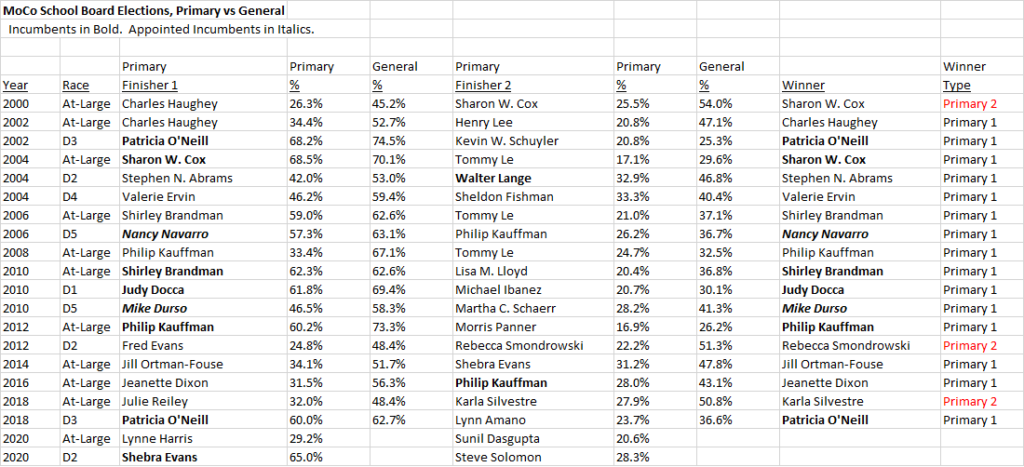
Let’s look back at the last twenty years of school board races. The table below examines the frequency with which candidates who finish first in a primary go on to win the general election. (Races in which there are two or fewer candidates don’t have primaries but rather advance directly to a general election.) Incumbents appear in bold, with appointed incumbents also appearing in italics.

In the last 18 school board races with both primaries and generals, the top finisher in the primary went on to win the general 15 times. That’s good news for Harris, who finished first in the primary this year. But let’s not declare the race over yet. The three cases in which the top primary finisher did not win have four things in common.

The election had an open seat.
That’s the case this year as Harris and Dasgupta are vying to replace a retiring incumbent.

The top finisher in the primary received a low percentage of the total vote.
In the 2000 at-large race, Charles Haughey finished first in the primary with 26% of the vote. In the 2012 district 2 race, Fred Evans finished first in the primary with 25% of the vote. In the 2018 at-large race, Julie Reiley finished first in the primary with 32% of the vote. All three would go on to lose the general. Harris’s percentage in the primary, 29%, is in the same ballpark as these other candidates.

The second finisher in the primary had either the Post or the Apple Ballot.
In the 2000 at-large race, Sharon Cox was endorsed by the Post. In the 2012 district 2 race, Rebecca Smondrowski was endorsed by the Post. In the 2018 at-large race, Karla Silvestre had the Apple Ballot. All three came back from second-place finishes in the primary to win the general. As noted above, Dasgupta has the Apple.

The difference between the top and second finishers in the primary was five points or less.
In 2000, Cox trailed Haughey by 1.8 points in the primary. In 2012, Smondrowski trailed Evans by 2.6 points. In 2018, Silvestre trailed Reiley by 4.1 points. All three came back to win the general. Harris led Dasgupta in this year’s primary by 8.6 points. That’s a bigger margin than the other three races discussed here.

And so, Dasgupta meets three of the four conditions under which second place primary finishers won school board general elections over the last 20 years. Only the margin by which Harris finished first in the primary augurs against him.

So what do you think, readers? Does Harris have the edge because she won the primary by almost 9 points? Or can Dasgupta come back to win?

Share

Crapshoot

By Adam Pagnucco.

At the national level, the big questions are who will control the presidency and the Congress. At the county level, the big question is which (if any) of four consequential charter amendments on the ballot will pass. This is an all-consuming question for most of the county’s power players.

What is going to happen?

First, a quick summary of this year’s ballot questions.

Question A: Would freeze the property tax rate but allow a unanimous vote of the council to increase it. Authored by Council Member Andrew Friedson.
See Why Progressives Should Support the Friedson Amendment.

Question B: Would remove the ability of the county council to break the current charter limit on property taxes, thereby capping property tax revenue growth at the rate of inflation. Authored by Robin Ficker.

Question C: Would add 2 district seats to the county council, thereby establishing 7 district seats and 4 at-large seats. Authored by Council Member Evan Glass.
See MoCo Could Use More County Council Districts.

Question D: Would convert the current council’s 5 district seats and 4 at-large seats to 9 district seats. Authored by Nine District for MoCo.
See Don’t Abolish the At-Large County Council Seats, Nine Kings and Queens.

Now to some history. The last time the county was embroiled in a ballot question battle this sweeping was in 2004. In that year, three charter amendments were petitioned to the ballot:

Question A: An anti-tax charter amendment by Robin Ficker removing the ability of the council to exceed the charter limit on property taxes. This amendment was similar to this year’s Question B.

Question B: A term limits amendment by Ficker that was similar to the amendment passed by voters in 2016.

Question C: An amendment to create nine council districts that was identical to this year’s Question D.

At that time, a coalition of business, labor, progressives and elected officials assembled to oppose all of the questions. The group had a simple name: the Vote No Coalition. The Post editorial board also urged a no vote on all three. In the end, the tax cap amendment failed by 59-41%, term limits failed by 52-48% and nine districts failed by 61-39%.

This year, the message isn’t simple because – unlike 2004 – the council placed competing amendments on the ballot. The message from most of the council and many of their supporters is vote for A and C, vote against B and D. The message from many opponents is vote for B and D, vote against A and C.

How many ordinary voters are going to keep track of the alphabet soup? At least the Post has stayed consistent with its message of 16 years ago, urging a no vote on everything.

Another difference between today and 2004 is that the groups are more fractured now. In 2004, labor was a powerful force in the Vote No Coalition. This year, three unions – MCGEO, the fire fighters and the police – gave thousands of dollars of in-kind contributions to Nine Districts for MoCo. (MCGEO now insists that they don’t support nine districts.) Developers, a major source of campaign funds in MoCo, are all over the place. The only real commonality with 2004 is that virtually every category of player is united against Robin Ficker’s anti-tax Question B, which has no ballot issue committee advocating on its behalf. Otherwise, the proliferation of competing committees and genuine differences of opinion, especially on council structure, make this year much more complicated than 2004.

In analyzing the questions’ chances of success, let’s first consider the electorate. It’s a presidential general election so the electorate is going to be huge. Four years ago, 483,429 MoCo residents voted in the general. This year, that number will probably be more than 500,000. A huge majority of them are voting primarily for president. A huge majority of them know little or nothing about county tax policy or the structure of the county council. No group has the resources to communicate with all of them.

It’s a crapshoot, folks.

Aggravating all of this is the complicated nature of the questions themselves. Question A, for example, is 148 words long and reads like it was drafted by a lawyer or a tax accountant. Do most voters have strong opinions on whether capping a tax rate or an increase in total receipts is an inherently better approach? As for the council questions, do most voters have strong opinions on which legislative structures are better? Politicians and advocates have strong opinions on all of the above but they won’t be deciding the outcome. A half million voters who know little or nothing about any of this will.

Despite all of the activities by the ballot issue committees, the two things most likely to be seen by voters are the ballot language itself and the recommendations of the county Democratic Party, which were mailed to all households with at least one Democrat in them. Question D’s ballot language, which tells voters it will reduce the number of council members they can vote for from five to one, is a huge problem for nine districts supporters and may have played a part in killing nine districts in 2004. As for the Democrats’ recommendations (supporting A and C, opposing B and D), it’s natural for Democrats – who historically comprise a big majority of MoCo general election voters – to seek guidance from their party on questions with which they aren’t familiar. Here on Seventh State, this post on the Democrats’ position was the runaway most-read post in October. Then again, the Democratic Party opposed term limits four years ago and it was passed with 70% of the vote anyway.

Finally, what happens if conflicting questions pass? That outcome can’t be dismissed, especially if voters have problems even understanding the questions. Since 2002, MoCo voters have approved 81% of all county questions that have appeared on the ballot. A state attorney general opinion from 2002 speculates that courts will reject directly conflicting questions passed by voters, although the opinion states, “The Courts in Maryland have not addressed the issue of which of two conflicting charter amendments would prevail if both received a majority vote in an election.” It’s not clear that the courts have resolved this question since then. So what happens if both A and B pass, or if both C and D pass? Will the courts reject both or impose whichever of them gets more votes?

Again, it’s a crapshoot.

Regardless of what passes and what doesn’t, we all have to ask ourselves this.

Is a crapshoot any way to run a government?

Share

Pierre Responds to Sitting Judges

By Adam Pagnucco.

Yesterday, the sitting judges slate filed for and were granted a temporary restraining order against the campaign of their opponent, Marylin Pierre, after they alleged that one of her volunteers inaccurately told voters that she was a judge. Pierre sent us the following response.

*****

Mr. Pagnucco,

Thank you for the opportunity to respond to the allegation.

Let me be clear, I have never referred to myself as an incumbent judge at any time during this campaign or during my previous campaign. I am proudly a candidate for Circuit Court judge in Montgomery County and have endeavored to conduct this campaign with the highest standards of professionalism and civility appropriate to the office.

Instead of engaging voters on the issues that I have raised during this campaign, my opponents have resorted to uncivil personal attacks and frivolous legal intimidation tactics to try and win the race. This allegation and their social media and television ads seek to damage my reputation and call into question my professional experience and service to the bar and our community.

The other candidates made a choice. They could have reached out to my campaign to let us know a volunteer misspoke. Instead, they are using litigation to harass & intimidate while wasting taxpayer money.

Montgomery County deserves judges who will do what is best for our community, use the taxpayer’s resources wisely, and show dignity and respect for all.

While my opponents continually attempt to smear me and my 30 years of experience, I know who I am. I am a dedicated lawyer, a former military police officer in the United States Army, a former chair of the Montgomery County Criminal Justice Coordinating Commission, a winner of the Leadership in Law Award, a three-time winner of Maryland’s Top100 Women Award, and a winner of numerous other community service and pro bono awards.

I am the only candidate endorsed by Progressive Maryland, Progressive Neighbors, Progressive Legacy, NARAL Pro-Choice Maryland PAC, the Association of Black Democrats of Montgomery County, Our Revolution Maryland, Our Revolution MoCo, MoCo Students for Change, the Montgomery County Green Party (MD), and Mayor Jeffrey Slavin.

I am a progressive and compassionate candidate for judge.

Share

The County is Not Taking its Budget Crisis Seriously

By Adam Pagnucco.

As I have previously written, MoCo government is in the throes of a dire budget crisis that rivals the near-death experience it suffered during the Great Recession. The county is looking at an estimated revenue shortfall of $522 million from FY20 through FY22. In response, the county executive announced back in March that he had “already instituted a hiring and procurement freeze for all programs not engaged in direct response to COVID-19.” The idea was to clamp down on all but the most necessary types of spending to weather the county’s pandemic-fueled budget downturn.

Nothing has improved since then. However, it’s apparent that the hiring freeze is over.

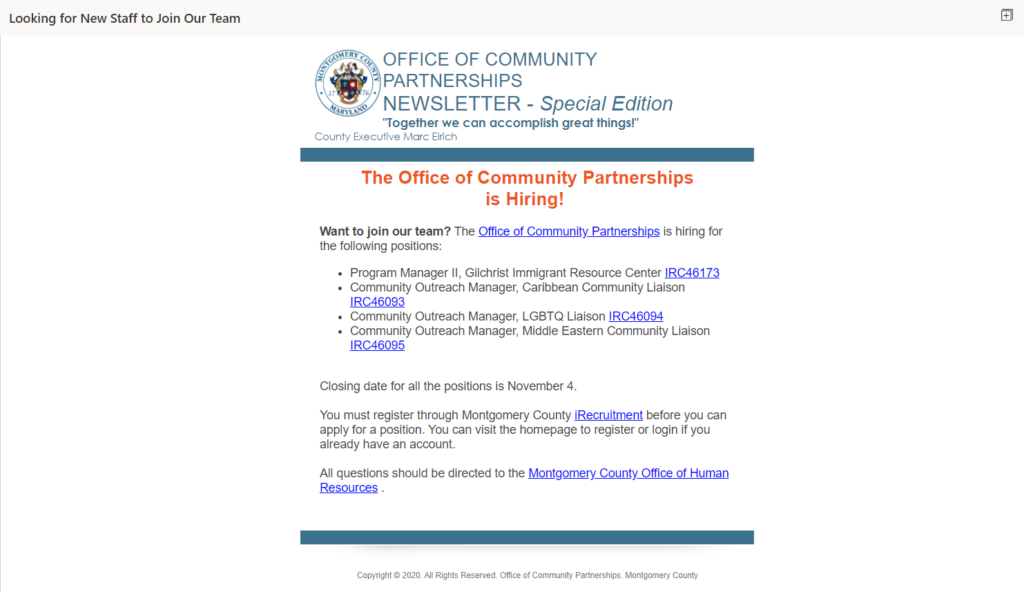
Today, I received this notice from the county’s Office of Community Partnerships that they are hiring for three community outreach positions and a program manager position.

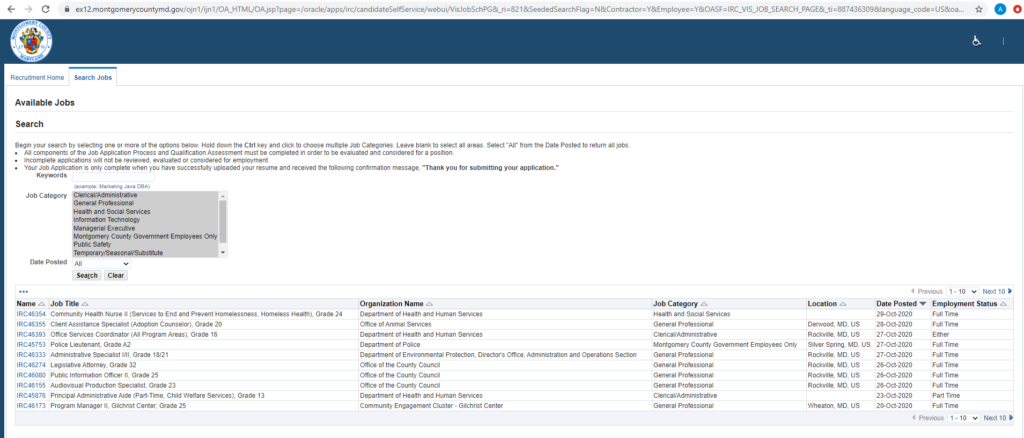
That’s not all. The county’s online hiring system shows 43 open positions for which the county is soliciting applications, of which 22 were posted this month and 9 were posted in the last week. These positions include an adoption counselor in the Office of Animal Services, an administrative specialist in the environmental protection director’s office, a manager in the retirement plan office, a policy analyst in the budget office, a warehouse position at the liquor monopoly and three positions at the county council. It’s hard to argue that any of these positions are “engaged in direct response to COVID-19.”

So let’s add this all up. The county is facing hundreds of millions of dollars in revenue losses. Nevertheless, it has committed to open-ended COVID pay that could total $100 million over the course of the year, is spending freely from reserves and passed a cream puff savings plan full of paper “savings” from lapsed positions. The county can’t stick to its previously announced hiring freeze and is even hinting at another raid on retiree health care money. The county’s fiscal strategy, such as it is, is to pray for a federal bailout.

Maybe the county will get a bailout after all. If the feds don’t do it, will taxpayers be asked to do it next spring?

Share

Sitting Judges Get Temporary Restraining Order Against Pierre

By Adam Pagnucco.

Here’s something you don’t see every day in MoCo: a group of candidates obtaining a temporary restraining order against an opponent. As strange as that might be, the details are even stranger.

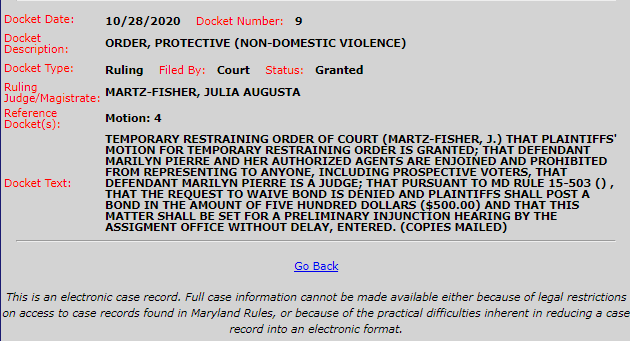
The incident that gave rise to the temporary restraining order occurred on Monday, October 26. According to a complaint filed in circuit court, sitting judge and candidate Bibi Berry and one of her volunteers encountered a volunteer for Marylin Pierre, who is running against the sitting judge slate, at the Silver Spring Civic Building. The civic building is an early voting location and Monday was the first day of early voting. Berry and her volunteer allegedly heard Pierre’s volunteer tell voters that Pierre was “the only progressive judge on the ballot.” Berry then claims to have corrected Pierre’s volunteer, telling voters (accurately) that Pierre is not a judge. According to the complaint, Pierre’s volunteer “continued to repeat the same phrase to prospective voters, ‘Ms. Pierre is the only progressive judge on the ballot’ louder and with greater conviction.” The sitting judges then filed for a temporary restraining order against Pierre’s campaign prohibiting her and her surrogates from referring to her as a judge. Judge Julia Augusta Martz-Fisher granted the temporary restraining order today.

This is the third strange incident involving Pierre that has been reported on Seventh State. The first occurred when Pierre tweeted that the defendants accused of killing George Floyd in Minnesota should be locked up with the burden of proof placed on them to show their innocence, a clear departure from basic criminal law. Pierre blamed the tweet on a volunteer. The second incident occurred when the former chair of the county Republican Party alleged that Pierre told GOP leaders in 2018 “she would be a ‘law and order’ judge who would be tough on bail.” Pierre is running as a progressive this year. Pierre admitted to attending GOP events and to contributing to the GOP but did not specifically address the allegations about what she said to party leaders.

Appearing below are the excerpt from the sitting judges’ online case file (accessible here) showing the issuance of the temporary restraining order as well as both the motion for temporary restraining order and the complaint filed by the sitting judges.

Share

Undervoting on School Board Races and Ballot Questions

By Adam Pagnucco.

This year has four hotly contested county ballot questions and at least one legitimately contested school board election. But here is something folks tend to forget: not everyone votes on these so-called “down ballot” races. And the question of who is not voting is almost as important as the question of who is.

In a presidential year, almost everyone who votes casts a vote for president. There are lots of other races at stake. This year, MoCo voters can also vote for Congress, judges, school board, two state ballot questions and four county ballot questions. However, there will inevitably be undervoting in many of these races. For the purpose of this post, the definition of “undervoting” is the percentage of people who cast a ballot but don’t vote in a particular contest. There is a lot of undervoting.

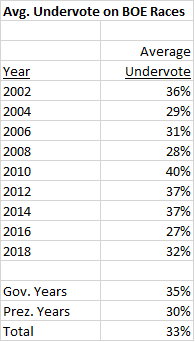
The table below shows undervoting in MoCo school board races since 2002. On average, one-third of people casting votes do not vote for school board.

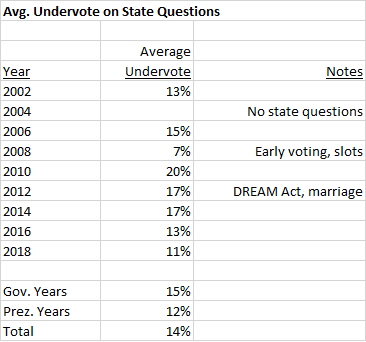
The table below shows undervoting in MoCo for state ballot questions since 2002. On average, one in seven people casting votes do not vote on state ballot questions.

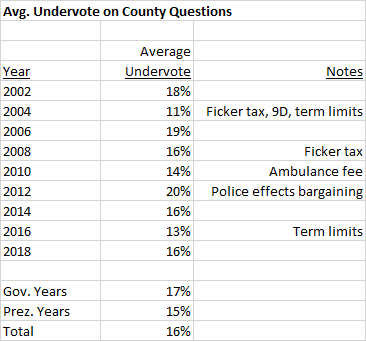
The table below shows undervoting in MoCo for county ballot questions since 2002. On average, one in six people casting votes do not vote on county ballot questions.

What determines undervoting? As shown in the tables above, undervoting seems to be a little less prevalent in presidential years, though not by much. Undervoting is much higher for school board races than ballot questions. That makes sense since – at least in some cases – voters can figure out how they feel about ballot questions from their language whereas school board candidates don’t have enough money to communicate directly with voters.

There is a little bit of evidence that clear and consequential ballot questions lead to less undervoting. County ballot question undervoting was lower than average in 2004 (when nine council districts and Ficker amendments on taxes and term limits were on the ballot) and in 2016 (when Ficker’s term limits amendment passed). State ballot question undervoting was about half the normal rate in 2008, when early voting and slots were on the ballot.

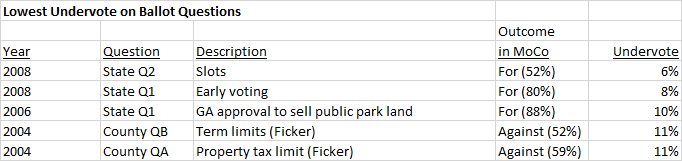
The table below shows the ballot questions with the lowest undervotes since 2002.

Four out of these five – slots, early voting, taxes and term limits – were big-deal questions. They were also relatively easy to understand for voters.

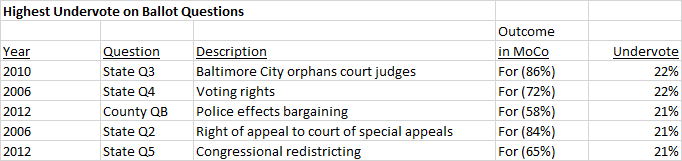
The table below shows the ballot questions with the highest undervotes since 2002.

There isn’t much of a pattern here. The police effects bargaining question in 2012 was the only question that was strongly contested.

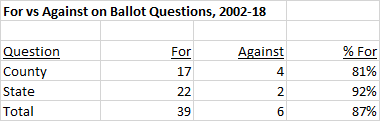
One more thing that will be of interest to all the groups promoting or advocating against specific ballot questions this year: most ballot questions pass. Since 2002, MoCo voters have voted in favor of 81% of county ballot questions and 92% of state ballot questions.

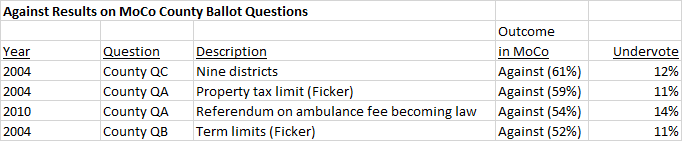
Here are the results for the four county ballot questions that have failed since 2002.

All four – term limits (2004), nine council districts (2004), property tax limits (2004) and the ambulance fee (2010) – were the targets of vigorous campaigns dedicated to killing them. All four saw lower than average undervoting.

There will certainly be undervoting this year and the stakes for the county, especially from the county ballot questions, are especially high. How will that affect the outcome?

Share

Non-Profits Come Out Against Question B

By Adam Pagnucco.

Non-profits have joined an expanding alliance against Robin Ficker’s anti-tax Question B that includes progressives, unions, business groups and all of MoCo’s county-level elected officials. The press release from Montgomery Neighbors Against Question B appears below.

*****

FOR IMMEDIATE RELEASE

Contact: Daniel Koroma
info@mocoagainstb.org

AREA’S TOP NONPROFIT ORGANIZATIONS JOIN OPPOSITION TO QUESTION B

From leading business groups to anti-hunger activists and local Democratic clubs, Montgomery County’s community leaders agree on one thing: Ficker’s Question B is a dangerous idea.

MONTGOMERY COUNTY, October 26, 2020 — The cross-county coalition that burst onto the Montgomery County political scene earlier this fall with a scathing ad aimed at Robin Ficker’s latest folly, Ballot Question B, now has a wide range of allies. The County’s diverse nonprofit community has joined the call to oppose Question B and released a public statement with over 25 nonprofit signons. Their message is one of strong public services, a strong local economy, and fiscal responsibility.

For Manna Food Center, a non-profit working to end hunger in Montgomery County, “Question B represents a real threat to our ability to provide expanded services effectively to a growing population of residents who find themselves vulnerable to hunger. Now is not the time to self-impose measures that would stunt the county’s ability to fund itself and Manna’s ability to provide services to communities when they need us most.”

Opposition to Question B is widespread across the Montgomery County non-profit community, with business groups uniting with labor, charitable organizations, and religious groups. “Nonprofits do their work in close partnership with County government.” said Lesley MacDonald, Executive Director of Nonprofit Montgomery. “Question B would severely restrict the County’s ability to support critical services. It would be harmful to the community, to nonprofits, and to those most in need.”

“The nonprofit organizations that help to tie Montgomery County’s social fabric together and provide vital services for an increasing number of our residents understand that supporting Question B would be a bad decision” said Hope Gleicher of Identity, a local non-profit that creates opportunities for Latino and other historically underserved youth. “B undermines the county’s future and unnecessarily risks our fiscal health while we try to battle a global pandemic. The organizations on the front lines of that battle understand what’s at stake and we’re proud to stand with them.”

The addition of such a wide range of area organizations to the effort against Ficker’ proposal strengthens the opposition message: whether for public services, COVID recovery, the local economy or the County’s coveted AAA bond rating, Question B is the worst possible idea for Montgomery County.

#

To see the full list of Nonprofits that have signed onto the letter against B, click here. You can also see the validator image of all organizations Against Question B here. For additional information, please contact Daniel Koroma at info@mocoagainstb.org.

Share