All posts by Adam Pagnucco

Jawando Calls for a Tax Hike

By Adam Pagnucco.

This morning, the county council and representatives of the executive branch discussed the county’s abysmal new fiscal plan, which raises the prospect of cuts to county government (excluding MCPS and Montgomery College) of up to 12% next year. That attracted many comments from the council as one might imagine. Council Member Will Jawando was the only one to call for a tax hike to prevent draconian cuts. His comments (which can be seen on county video) are transcribed below.

*****

Thank you, Mr. President and thank you to Mr. Madaleno [the county’s chief administrative officer] and Mr. Coveyou [the county’s finance director] and acting director [Jennifer] Bryant [the county’s acting budget director]. Excited to confirm that shortly. And to all the staff.

A couple things I just wanted to note. I think Council Member [Evan] Glass said something that’s really important I want to underscore and I agree with, that our focus needs to be on maintaining services for those who need it the most, and Director Bryant, you said this as well, and I think everyone agrees with that. But I also want to make sure that we are also looking at how we’re going to come out of this crisis. And we are in the unenviable position of having to both manage our fiscal situation, deal with the multiple pandemics – health, social, economic – and try to make sure that we don’t exacerbate inequality and we plan for the recovery at the same time.

And that’s not easy, right? We’re dealing with that, as is the nation, as is the world. But I think we are in a better position than most to try to make those plans. And I want to urge us to do a couple of things as we’re thinking about that, so as Mr. Madaleno, as you’re coming back in January with your team. We have reserves for a reason. So we should use them. If we’re not going to use them now, I don’t know when you would use them. I’ve said this since the beginning. And we have been using them on special appropriations and we have been seeking reimbursement.

Jawando speaks in open session today.

But I think to – as we’re looking at, there’s been a lot of talk of savings plans. We cannot cut critical services to those in need that are going to exacerbate income inequality. And if those decisions are being made or are on the chopping block, we have to use reserves.

The other thing is we have to consider how we’re going to raise additional revenues. This has been one of the most unequal pandemics and recessions that we’ve ever seen. There was a report out in October that billionaires increased their net worth by $637 billion through October during the pandemic. And obviously those numbers are smaller for millionaires. But equal growth. While at the same time, you see more than 40 million Americans applying for unemployment insurance. My office has helped hundreds, I know other colleagues have. So this recovery, this pandemic has not been equal. And Montgomery County is a perfect example of that. We have – we are in the wealthiest county in the wealthiest state with the most millionaires per capita in the country. And so as a state and as a county, some who have done well, and I’m happy that that’s the case – we’re going to do have to do more for our residents. So before we discuss any cuts to services that are in need that are going to exacerbate inequality, we’re going to need to look at these types of options.

I’m glad that we included in the statement we sent to Annapolis asking for the authority to levy a progressive tax bracket on the income tax. We need to do that. I’ve said it before. If we were to increase the top bracket from 3.2 to 3.5 percent on just millionaires in the county, you’d bring in over $90 million in revenue a year. I’m not saying that’s the specific proposal we need to do, but we certainly need to be talking about those things in the context of this larger picture. And I just want to say that because it hasn’t been said. So I look forward to reviewing the details. I appreciate the sobering picture and look forward to working through this with you and our colleagues.

Thank you, Mr. President.

Share

The Day of Reckoning is Near

By Adam Pagnucco.

I worked at the county council during part of the Great Recession. Those were terrible years. Under County Executive Ike Leggett’s leadership, the county slaughtered every sacred cow to stave off fiscal disaster. It busted collective bargaining agreements, cut employee benefits, instituted furloughs, doubled the energy tax and cut positions by roughly 1,000 people. The county did those things for the sake of fiscal survival.

Never did we dream of cutting county government by 12% in one year. But that is the all-out disaster projected by the executive branch in its new fiscal plan, which was sent to the county council last night.

At first, the new fiscal plan doesn’t seem that bad. It projects lower shortfalls during the current fiscal year than the previous plan from July does. But it confirms what sage budget observers have been predicting for a while: Fiscal Year 21 is tough but Fiscal Year 22 will be much worse. The difference between them is reminiscent of the gap between a paper cut and decapitation.

To understand just how bad the projection for next year is, let’s go over the moving parts of the operating budget. Each fiscal year starts with a beginning reserve, targeted by the county as 10% of adjusted governmental revenues. (The 10% level was initiated by Leggett to stave off a bond rating cut ten years ago.) Next, the county projects its revenues, of which the biggest are property taxes, income taxes, other taxes and state aid (which mostly goes to MCPS and Montgomery College). After adjusting for net transfers, debt service, cash for the capital budget and a few other items, what’s left is allocated to the county’s agencies. Of those, there are four big ones: MCPS, Montgomery College, Park and Planning and Montgomery County Government (MCG), the latter of which is governed directly by the county executive. State-mandated minimums apply to local dollars going to MCPS and the college but not to MCG or Park and Planning. At the end, the fiscal year’s ending reserve is supposed to be set at 10% of adjusted revenues and carries over to the next fiscal year.

It sounds smooth and some years it is, but sometimes things go wrong. The current fiscal plan shows a LOT going wrong, including:

1. A drop in the projected reserve percentage in FY21 from 10.2% to 7.6%, a decline of nearly $140 million. That matters because it means less money will be available for FY22 than previously believed.

2. Declines in estimated FY21 receipts of income taxes ($58 million), transfer and recordation taxes ($19 million) and other taxes ($25 million) that are offset by assumed receipts of federal money, particularly FEMA reimbursements. The federal money is not assumed in FY22 but much of the tax revenue declines remain.

3. An increase in FY21 agency spending of $108 million, some of which is due to the executive’s COVID emergency pay program.

And so lower reserves, less tax revenues and higher spending in FY21 bleeds over to FY22, when the red ink really begins to gush. According to projections, getting reserves back to a 10% level in FY22 will require an extra $127 million. That has to come from somewhere, and since revenues won’t be growing, it will have to come out of allocations to the agencies. But remember – as we said above, MCPS and Montgomery College are subject to state-mandated spending minimums. The fiscal plan projects just 0.5% cuts to both of those agencies. That leaves Park and Planning and Montgomery County Government (MCG) to bear the brunt of the cuts.

Do the math and the fiscal plan projects cuts to Park and Planning and MCG of 12% in FY22. If you include one-time COVID-related spending in FY21, the cut to MCG appears even higher at 17%.

That’s right, folks: a 12% cut to the agencies that pay for police, fire service, parks, libraries, health and human services, transportation, environmental protection, courts, corrections, housing, recreation and most functions of government other than education.

Montgomery County has never seen anything like that before.

The Leggett administration used to send us ominous fiscal plans in December to warn the council against exuberant spending increases only to reveal rosier projections in March. It’s tempting to believe there may be a bit of that here except that the pandemic’s economic effects are truly unprecedented. If this projection is anywhere close to the truth, it would be a planet-shattering cataclysm for all stakeholders in county government – employees, residents and businesses alike. Layoffs would be inevitable. Benefit cuts for employees and vulnerable residents might be unavoidable. Terminated Ride On routes, less street maintenance, cuts to fire service, deferred police recruiting, cuts to child care and social assistance, extractions of cash from capital projects – you name it, it’s all on the table. It makes the Great Recession look like a rain drop on a sunny day.

Assuming the revenue projections hold, there are only three ways to avoid an evisceration of county government. The county can get a federal bailout (as it has been futilely praying for since last summer). The county can raid its reserves and retiree health funds, going significantly below its reserve target of 10% and risking its bond rating. Or it can raise taxes. It could also use some combination of the above in concert with cuts to spread the pain.

Given the ferocity of the pandemic, some degree of budget unrest was certain. The county could have prepared for this better by instituting a real FY21 savings plan rather than the nothing burger it passed in July, sticking to its hiring freeze rather than ending it, not spending freely from its reserves and behaving responsibly on emergency pay rather than creating a new $100 million a year liability. But it’s too late.

The day of reckoning is near.

Share

Top Seventh State Stories, November 2020

By Adam Pagnucco.

These were the top stories on Seventh State in November ranked by page views.

1. Will MCPS Reopen?
2. MoCo Democrats Issue Statement on Ballot Questions
3. MCPS Reopening Looks More Unlikely
4. Who Has the Edge in the At-Large School Board Race?
5. Elrich Extends Response Deadline for Public Information Act Requests
6. Council Drops the Other Purple Penny
7. Sitting Judges Get Temporary Restraining Order Against Pierre
8. Does Downcounty Pick the At-Large Council Members?
9. Scandal: County Employees Got COVID Pay They Were Not Entitled to Get
10. Winners and Losers of the Ballot Question War

Three of these stories were leftovers from the election and dominated the first week. Of the rest, two of the top three relate to whether and how MCPS will reopen – a huge issue that has yet to be resolved. Parents may disagree on exactly what MCPS should do, but all of us (I’m one of them!) are intensely interested in the outcome.

Share

Elrich Vetoes Impact Tax Cut

By Adam Pagnucco.

County Executive Marc Elrich has vetoed a bill passed by the council that would effectively cut impact tax collections. While the bill passed the council on a 9-0 vote, making it unlikely that Elrich’s veto will be upheld, the policy debate lays out stark differences between the executive and the council.

Impact taxes are charged to development projects in order to pay for the additional demands for infrastructure that they create. MoCo levies two: a school impact tax and a transportation impact tax. Both are used to finance the capital budget and are dedicated to schools and transportation projects respectively. The county council periodically adjusts impact tax rates, credits and discounts, and various structural aspects of how they are administered.

This year, the planning board proposed as part of a new subdivision staging policy (which sets the county’s policies on infrastructure) a package of tax changes. Bill 38-20 instituted a range of changes to impact tax collections that would effectively reduce the county’s receipts. Among the planning board’s proposals were to cut the school impact tax rate to 100% of the cost of a student seat from the current 120% of the cost of a student seat and to apply discounts to single-family detached and multifamily units in desired growth areas to incentivize growth, both of which would cut receipts. These cuts would be partially reduced by a new utilization premium payment applied to development projects in areas with crowded schools.

To offset the impact tax losses in Bill 38-20, the planning board proposed Bill 39-20E, which would raise recordation taxes. Currently, recordation tax receipts are split between the operating budget’s general fund, the capital budget (especially schools) and rental assistance programs. And so the planning board’s vision was to cut impact taxes and raise recordation taxes to spread the cost of financing infrastructure across both new and existing development.

Lots of changes were made to the planning board’s proposals but the bottom line is that the council passed Bill 38-20, which cut impact tax receipts, and has not yet passed Bill 39-20E, which would raise recordation tax receipts to help pay for lower impact taxes. (The latter had significant opposition from the real estate community.) The recordation tax increase is not dead, however; the council will return to that issue eventually if for no either reason than to examine the capital budget next year.

That leaves the county executive, who repeatedly expressed concerns about the changes to impact taxes and other growth policies throughout the fall. Elrich believes that Bill 38-20 will cost the county $12.5-20 million a year in lost impact tax revenues, all of which go to paying for school construction and transportation projects. (That number is subject to dispute.) Elrich also never bought in to the trade of lower impact taxes for higher recordation taxes. He would rather use higher recordation taxes to cover operating budget shortfalls or more school expenditures than to offset lower revenues from impact taxes. Accordingly, Elrich vetoed the cut in impact taxes even though it passed the council on a 9-0 vote. The council will win the policy debate for now, but the politics (and the budget maneuvers) will go on.

Elrich’s veto message is printed below.


MEMORANDUM

November 30, 2020

TO: Sidney Katz, President, County Council

FROM: Marc Elrich, County Executive

RE: Veto explanation: Bill 38-20 Taxation – Development Impact Taxes for Transportation and Public-School Improvements – Amendments

With new development comes increased infrastructure needs; the newly renamed “Growth and Infrastructure Policy” (Growth Policy) reduces the funding available to provide the necessary infrastructure while the need to provide infrastructure is more critical to our success than ever. While I have long been concerned with how impact taxes work and I believe that there are alternatives that should be implemented, I cannot support simply reducing the necessary revenues without an appropriate replacement. Therefore, I am vetoing Bill 38-20.

The primary purpose of the Growth Policy is to put forth policies for adequate infrastructure – schools, transportation and more – that accompany new development. While I have other concerns about the bill, my primary concern is the projected revenue loss, which is estimated to be between $12.5 million and $20 million per year based on an analysis of projects in the development pipeline.

These reduced revenues are occurring at a time when we know we don’t have enough funding to address current needs or other infrastructure investments needed to grow our economy and maintain our status as a desirable place to live. For example, legislation to increase state aid for school construction will require the county to provide local matching funds; traditional state aid costs the County $3 for every $1 from the State or an average of $200 million annually. It is important to ensure the County will be able to continue to match traditional state aid for school construction as well as the approximately $400 million in additional state aid expected from the Built to Learn Act. (This Act will take effect immediately upon the legislature’s expected override of the Governor’s veto of the “Kirwan” bill.) School overcrowding and a $1.5 billion-dollar backlog in new construction, renovation and modernization needs burden our school system – one of our prime assets.

In addition, regional business leaders have said that improved transportation is central to economic development, pointing out the importance of efforts like Bus Rapid Transit.

Yet at a time when we know that (post-Covid19) we need improved transportation and relief for overcrowded schools and delayed modernizations, this Growth Policy reduces our ability to finance those needs.

These and other increased needs are coming while we are lowering our General Obligation bond borrowing to slow the growth of debt service costs, which lowers the amount of infrastructure we can fund with bonds. Less bonding and fewer impact tax revenues will not allow us to address our education and transportation needs. Even as the Growth Policy reduces revenues, the need for the infrastructure will not disappear. Either the funds will have to come from somewhere else, largely from county residents, or we will have to forgo important infrastructure improvements which will make righting our economic ship even more difficult.

I laid out my concerns in a letter I sent to the Council on September 10 (attached) and I highlighted my concerns again in another letter on November 10 (attached). My staff also raised several issues throughout the process. While I appreciate some of the improvements to the Growth Policy, including the improved annual school test and the clarification for agricultural storage facilities, I cannot sign this bill as it is currently written.

The Council has stated that it will consider an increase in the recordation tax to fill the gap from the reduced revenue, but that discussion is not currently scheduled. Furthermore, using an increase in the recordation tax shifts the costs from the developers of the projects to people refinancing or buying homes as well as to purchasers of commercial properties. Additionally, in these uncertain budgetary times, any potential revenue source may have to be reserved for other needs.

If competitiveness is the issue vis-a-vis our neighbors, then we should consider how our neighbors raised the money to meet their infrastructure needs. I think we will find that their focus was not on ways to reduce the revenues coming from development – rather, the opposite – they looked for ways to ensure the resources needed to provide the infrastructure for a growing community.

I regret that in the middle of this pandemic we have not had the opportunity for a more fundamental discussion of other methods to achieve adequate public facilities under the Growth Policy. While I recognize that one of the driving forces behind the recommended changes is to generate more housing, we know this will generate more residents in need of services, more students in our schools, and more people traveling to their jobs. This strongly suggests the need to increase revenue sources, not reduce them. I would welcome an opportunity to work with the Council to identify fair, alternative methods to fund the necessary infrastructure. For example, our office is working on how we could structure development districts, which have been successfully implemented in Northern Virginia and which were recently recommended by the Economic Advisory Group. Without such a replacement, I cannot support a loss of revenue. That’s not providing adequate public facilities by any measure. We can do better.

Share

Why on Earth Do We Elect Judges?

By Adam Pagnucco.

In the wake of the nastiest MoCo circuit court judge election in recent memory, one question lingers.

Why on Earth do we elect judges in Maryland?

In considering that question, let’s note that Maryland is totally inconsistent in how judges are selected. Appellate court judges are nominated by the governor, confirmed by the state senate and subject to retention elections. Circuit court judges are appointed by the governor and run for election after a year. Their elections have partisan primaries and non-partisan generals. Orphan’s court judges run in partisan elections. District court judges are nominated by the governor, confirmed by the state senate and do not run in elections. Nominating commissions make recommendations to the governor on appellate, circuit court and district court judges.

Circuit court elections are normally sleepy affairs in which sitting judges, who go through a vetting process and are appointed by the governor, are confirmed by voters. But not this year, when circuit court challengers were able to break through to the general election in both Montgomery and Prince George’s Counties. Suddenly, non-elections turned into real elections. And in MoCo, it wasn’t pretty.

The campaign pitting challenger Marylin Pierre against the four appointed sitting judges had all the nastiness of MoCo’s most negative political campaigns. Charges of racism, lying, dirty tricks and more were hurled back and forth with little regard for the dignity of the bench. Let’s remember that these are supposed to be JUDGES, not politicians. These are the people who decide civil cases, who decide child custody, who rule on domestic violence and who sentence us to fines, jail or both. In many ways, judges are more important to our daily life than elected officials. They should be expected to adhere to a higher standard than the mud splattering practices of politics. But how much incentive do they have to do so when their jobs depend on elections?

Both sides had legitimate issues with the electoral process we just witnessed. The sitting judges emphasize the rigor of their vetting process and want voters to respect it. Here is how the sitting judges slate described it:

The process started with a lengthy and comprehensive application covering all aspects of their education, breadth and depth of law practice, and personal background. Each judge’s application was submitted to no fewer than twelve diverse bar associations, each of which conducted its own investigation and interviews. In addition, the Bar Association of Montgomery County conducted a referendum wherein each applicant’s qualifications were subjected to a vote by every member of the bar association. The results of both the referendum and the specialty bar association interviews were provided to the Judicial Nominating Commission. The Commission then conducted its own independent investigation of all applicants and thoroughly vetted and interviewed each. A list of the most highly qualified candidates was sent by the Commission to the Governor, who interviewed and appointed the best of the best.

Folks, readers of this blog do their homework in figuring out which candidates to support. But individual voters don’t have the tools to replicate this painstaking process. Instead, we are left to assess judicial candidates as we do politicians when in fact their work is fundamentally different.

That leads us to another problem: state law does not give judicial candidates the same latitude for making public statements that other candidates enjoy. MD Judges, Rule 18-104.4 states that judicial candidates “with respect to a case, controversy, or issue that is likely to come before the court, shall not make a commitment, pledge, or promise that is inconsistent with the impartial performance of the adjudicative duties of the office” and “shall not make any statement that would reasonably be expected to affect the outcome or impair the fairness of a matter pending or impending in any court.” Assuming candidates respect these rules, how are voters supposed to divine their positions?

That’s not all. Pierre’s supporters will be quick to point out how tilted the playing field was against her, especially in fundraising. In 2019 and 2020, Pierre raised a grand total of $18,849. In those same two years, the sitting judges’ slate account raised $445,113. In fact, the slate account dates back to 2001 and is periodically updated to include whichever sitting judges are on the ballot. Its contributions read like a who’s-who list of the MoCo legal industry – the very people who will be litigating cases in front of the judges to whom they are donating. Some may be inclined to defend this system as a meritocracy, but once the political contributions start flowing, it bears more than a passing resemblance to an oligarchy.

Oligarchies have drawbacks, but what happens when they lose? A cautionary tale comes from Anne Arundel County in 2004, when Republican lawyer Paul Goetzke was one of two challengers to knock out sitting judges, producing an all-white bench for the first time in a decade. Goetzke blasted the incumbents because they were appointed by Democratic Governor Parris Glendening, ran on a tough-on-crime platform and said he wanted “criminals rehabilitated in jail, not in their neighborhoods.” Within a year, lawyers around the state supported censuring Goetze for “unconscionable” and “intimidating” actions against defense lawyers. In 2017, a state investigator “found Goetzke violated judicial standards on impartiality and fairness, bias, prejudice and harassment and decorum, demeanor and communications with jurors, among others.” Goetzke retired for medical reasons six months later.

Goetzke is no anomaly. Judicial elections often attract strange characters. Retired Circuit Court Judge Steven I. Platt, who was a judge in Maryland for almost 30 years, had many stories to share in his 2014 essay calling for an end to judicial elections. Judge Platt wrote:

During the years from 1970 to 2014 while I have participated in and observed contested judicial campaigns, I have never seen any of the qualities which are desirable in a judge discussed as an issue in any contested campaign by a challenger. Instead I have witnessed the following issues being raised in campaigns for “Orphans Court” (Probate Court)—(1) “Whether a Licensed Practical Nurse (LPN) could do more for orphans than those lawyers.” (2) “Whether orphans who commit crimes should go to jail.” (3) “The skyrocketing rates of intestacy” (4) “The Orphans Court Judges positions on abortion and (5) Whether as a candidate for reelection to the Orphans Court I would take an orphan away from a “parent” who spanked the orphan and/or do I spank my own children?

As a candidate for a 15 year term on the Circuit Court I was asked many questions. My favorite came from a lady who identified herself as a “concerned citizen”. She wanted to know “whether the Sitting Judges favored ‘condoms in the schools’ and/or ‘prayer’ in the schools.” The answer I wanted to give was “We favor one or the other but not both”. I did however resist that temptation.

My point is very simple. It is that even though the history and examples cited are anecdotal, they illustrate that at best judicial contested elections distract and at worst they destroy the effort to secure a diverse and qualified judiciary.

The above evidence indicates that circuit court judge elections are vulnerable to low or no voter information, domination by oligarchy, negative politics, muzzling of candidates and unpredictable consequences depending on who wins. (Let’s bear in mind that circuit court judges serve 15-year terms, far longer than most politicians). Compared to elections befouled by these sorts of flaws, the vetting process is a better option. Let judicial nominees be vetted by their peers, nominated by the governor and confirmed by state senators, who can reject any who are truly out of bounds. If necessary, judicial terms may be shortened and retention elections can be used to weed out judges who go rogue after appointment. Whatever is done, the current election system is broken and must be terminated for this reason:

If we treat judges like politicians, don’t be surprised if they act like them.

Share

Guest Blog: Representation Matters in Every Corner of the County

Guest blog by Delegate Eric Luedtke (District 14).

It should not be controversial to say that governments have a responsibility to address the needs of all of their constituents. I appreciate Adam’s thoughts and writing, and how much he relishes the role of provocateur, though I take issue with his characterization of my recent op-ed in Bethesda Beat as blasting county government. I think it’s more along the lines of constructive criticism among friends.

While the analysis of recent electoral outcomes in Montgomery County’s upcounty and downcounty regions are interesting to those of us who follow county politics closely, the average resident of the county is much more interested in having problems in their communities addressed. I believe that much of the support for Question D was driven by a feeling that upcounty does not get its fair share of attention from county government. I should add, by the way, that a similar feeling is prevalent in east county as well.

Of course, there are those in county government who take issue with that suggestion. I recall, for example, a pair of conversations I had with one former member of the County Council. In one conversation, I was told that the commercial blight at the Burtonsville Crossing shopping center was happening because, and I quote, “Burtonsville is not Bethesda,” and that the county shouldn’t waste money trying to help Burtonsville address the profound problem of a decaying town center. In another conversation with the same person, I was upbraided for suggesting that the county didn’t pay enough attention to Burtonsville. The irony was astounding.

I’ve had folks in county government suggest that this perspective is wrong, that residents of every community in the county feel that problems in their particular community are under-addressed. Perhaps. But, again, as just an example, I’ve been working on the Burtonsville crossing issue for more than a decade now, since before I was elected, and with the notable exception of Councilman Hucker, I’ve never seen county government writ large act on it with any kind of urgency. It’s been an afterthought, if that.

If folks in county government want to demonstrate that my critique is off base, they can do so relatively easily.

If the county can create significant incentives for new development around downcounty metro stations, why can’t they do so to incent redevelopment at Burtonsville crossing? Or, alternatively, after a decade of blight, why can’t the county find a way to fine the property owner for failing to maintain the property as a viable commercial site? Or use eminent domain to put the property to a use that will actually benefit Burtonsville residents?

If complaints that the county doesn’t pay enough attention to agriculture are wrong, will the next county budget include the miniscule amount of money necessary to reopen the venison donation facility in Laytonsville? Will it include a commitment of $1 million a year from the general fund for agricultural land preservation?

If concerns that upcounty transportation isn’t enough of a priority are misplaced, will the 97/28 interchange have a higher priority in the next county transportation priorities letter? Will the county commit to funding more bicycle and pedestrian improvements around upcounty schools, such as a better sidewalk network in Damascus so kids can get to Damascus High School and Baker Middle School more easily?

Most residents of the county don’t follow the precinct results of elections. They just want the potholes filled, the congestion addressed, the schools funded, and they want to feel like they have a chance to be heard. The feeling that their communities weren’t being heard drove a lot of well meaning people to support Question D. Those of us in elected office can choose to recognize that concern, and do something about it. Or, we can simply ignore it, pretend like the vote for Question C solved the problem, and move on. But if the latter is the reaction, then we will almost certainly see more Question D’s in the future. I should amend my earlier op-ed. Representation matters, in every corner of the county. And when it’s not provided, residents will demand it, one way or the other.

Delegate Eric Luedtke is the House Majority Leader and has represented District 14 since 2011.

Share

Does Downcounty Pick the At-Large Council Members?

By Adam Pagnucco.

It’s not every day that you see a senior member of MoCo’s state delegation blast the county government, but Delegate Eric Luedtke (D-14) recently did so. In an essay published in Bethesda Beat, Luedtke opined, “The lesson of Question D is that representation matters” and repeatedly criticized county leaders for ignoring his district, which hugs the Howard County border.

Luedtke wrote, “Bluntly, due to the political geography of the county, countywide elected officials in particular don’t need to spend much time in the upper reaches of the county to get re-elected. The vast majority of the votes in the Democratic primary are downcounty votes.”

Is that true?

Former county council candidate (and co-chair of the ballot issue committee that opposed nine districts) Marilyn Balcombe has written about low upcounty turnout in the 2018 primary on Seventh State. Her conclusion was, “The Upcounty doesn’t vote and nobody cares.” Let’s reexamine that premise and also ask another question: did upcounty vote differently than downcounty in the council at-large race?

First, let’s set our definitions. For the sake of this analysis, I am defining downcounty as the “Democratic Crescent,” a term I coined for precincts located in Takoma Park, Silver Spring (inside the Beltway), Chevy Chase, Kensington, Bethesda and Cabin John. This area was responsible for sending Jamie Raskin to Congress in the fiercely contested 2016 primary. I am defining upcounty as precincts located in Brookeville, Clarksburg, Damascus, Dickerson, Gaithersburg, Germantown, Laytonsville, Montgomery Village, Olney, Poolesville, Sandy Spring and Washington Grove, which also include less populated areas nearby (like Ashton, Barnesville, Boyds and Spencerville). The rest of the county is here referred to – artfully – as “everywhere else.”

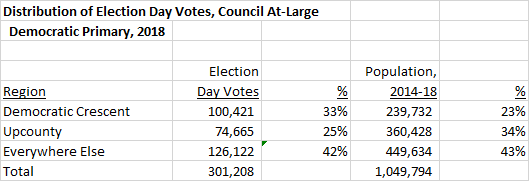
Precinct results are reported by the State Board of Elections for election day voting. (Precinct data excludes other voting modes.) In the 2018 Democratic primary, 301,208 votes were cast on election day in the council at-large race. Each voter can vote for up to four candidates since there are four at-large seats. Here is the distribution of council at-large votes by broad region along with U.S. Census Bureau population estimates for 2014-2018.

Roughly speaking, the crescent accounted for a quarter of the county’s population but cast a third of the votes in the council at-large Democratic primary. The upcounty was the reverse – it accounted for a third of the county’s population but cast a quarter of the votes. So downcounty didn’t account for a majority of the votes as Luedtke said, but it accounted for a disproportionate number of them for two reasons: a higher than average share of its voters are Democrats, and downcounty Democrats turned out at a higher than average rate as Balcombe wrote.

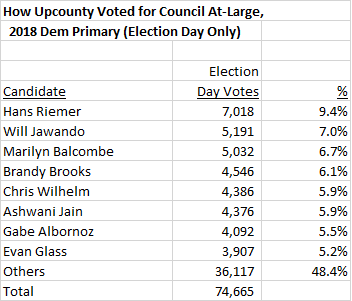
This might not matter much except for one thing: do downcounty Democrats vote for different candidates than upcounty Democrats? Here is where it gets interesting. The table below shows the rank order of finish for council at-large candidates among upcounty Democrats only.

Hans Riemer (the only incumbent) and Will Jawando finished first and second in the overall vote. But if the decision was made by upcounty, Marilyn Balcombe (who finished fifth overall) and Brandy Brooks (who finished seventh) would also have been elected. The result for Balcombe, who lives in Germantown, is unsurprising. However, Brooks is a Democratic Socialist who lived in Wheaton at the time. That shows how progressive upcounty Democrats, who also elected DSA member Gabe Acevero to the House of Delegates, can be. Gabe Albornoz and Evan Glass, who were both elected, finished seventh and eighth in upcounty respectively.

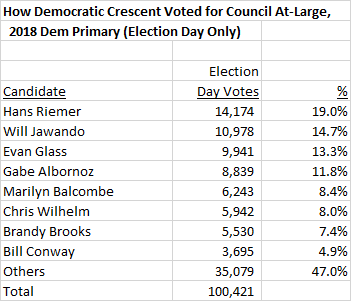
The table below shows how the Democratic Crescent voted.

Not only did the crescent pick all four at-large winners, it picked them in their overall order of finish. The crescent also voted for Balcombe, Brooks and Chris Wilhelm in their overall order of finish. At least in the 2018 election, the pattern established by downcounty voters applied very closely to the total result.

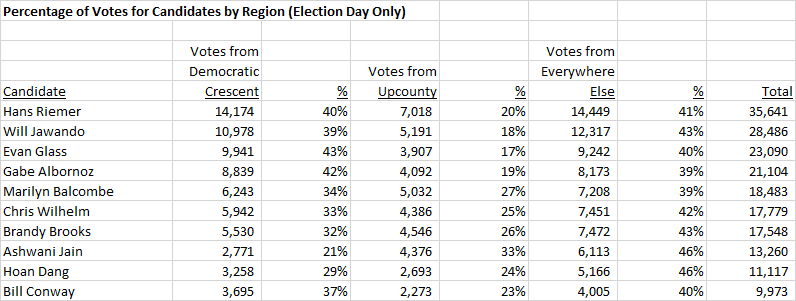
Now let’s look at where each of the top ten at-large candidates drew their votes from.

The four candidates with the highest percentage of their votes coming from the crescent – Riemer, Jawando, Glass and Albornoz – were the ones who got elected. In fact, each of these four received at least twice as many votes from the crescent as they did from upcounty. Candidates who received a quarter or more of their votes from upcounty (Balcombe, Wilhelm, Brooks and Ashwani Jain) did not win.

Just as in 2004, MoCo voters chose to reject the abolition of the at-large council seats this year. Given the fact that these seats will remain on the ballot, and given the election results above, upcounty voters must increase their turnout to get any respect from county government. If they don’t, the issues described by Delegate Luedtke in his column will continue.

Share

MCPS Reopening Looks More Unlikely (Updated)

By Adam Pagnucco.

One week ago, I asked “Will MCPS Reopen?” At that time, a number of factors poured cold water on MCPS’s plan to resume in-person instruction in January, including rising COVID case rates, potential costs with few options to pay for them and the experience of other districts in reopening and then promptly shutting down again. Events since then have made it even more unlikely that MCPS will reopen on schedule.

Consider the following.

1. In my post a week ago, I noted that schools in Allegany, Dorchester, Harford and Somerset counties all reopened and then closed again due to COVID spikes. Since then, Baltimore City, Baltimore County, Carroll County and Fairfax County have paused, suspended or delayed reopening and New York City has shut down its schools. Most ominously, Howard County’s school board voted against a reopening plan submitted by their superintendent and opted to keep schools virtual through at least April. This no doubt caught the attention of MCPS management. Having a school board publicly reject a crucial policy decision is a nightmare scenario for any superintendent and one that MCPS Superintendent Jack Smith will be keen to avoid.

2. County health officer Travis Gayles is urging private schools to use virtual learning only. Gayles tried to shut down private schools last summer but was stopped by the state. Nevertheless, he continues to believe that in-person learning is unsafe in the context of rising case rates, a message he has no doubt shared with MCPS.

3. Governor Larry Hogan imposed a set of new restrictions on bars, restaurants, retailers, gyms and religious institutions last week as COVID cases surged across the state. County Executive Marc Elrich plans to impose more restrictions too. The Smithsonian has closed the National Zoo and all of its museums in response to the surge. In his bluntest remarks to date, Hogan told Marylanders, “Just wear the damn mask.”

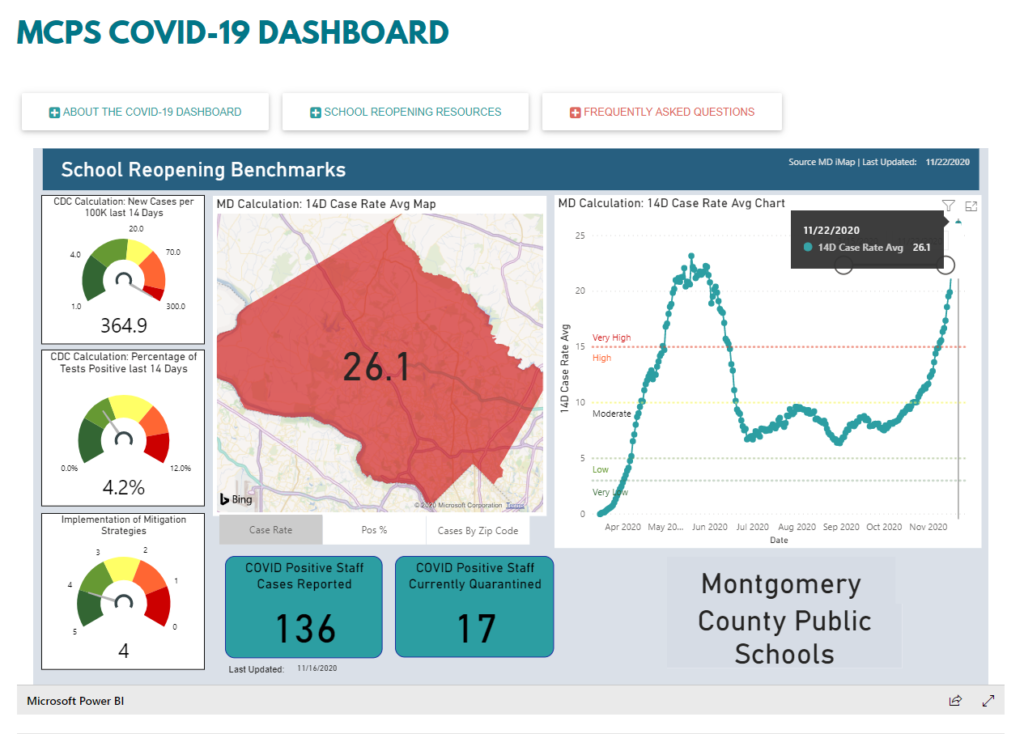
4. Looming over all of this is an unprecedented skyrocketing of COVID case rates. MCPS’s COVID dashboard uses a 14-day average case rate. A week ago, the rate was 19.5 cases per 100,000 residents. As of yesterday, the rate was 26.1, far above the level of 15.0 at which any students would be considered for in-person learning. The county’s 7-day average case rate jumped from 22.4 to 29.7 over the same period. Both the 7-day and 14-day averages are above previous peaks seen in May, when schools were shut down and economic restrictions were more severe.

MCPS’s COVID dashboard as it appeared yesterday.

5. Yesterday, the Post summarized the consensus of health officials in the region this way: “Public health experts and hospital administrators say the abrupt rise in new cases is unlikely to abate in the next few weeks and could foreshadow a more difficult December, followed by an even rougher January and a darker February.” In other words, it’s going to get worse before it gets better.

Despite all of this, MCPS is proceeding with a survey of parents asking whether they prefer hybrid (in-person and virtual) or virtual-only learning in the second semester. The survey says in bold that the system “will begin a phased-in return to in-person instruction on January 12, 2021.” Notice use of the word “will.” As of a week ago, 56% of responding parents preferred the hybrid option.

If schools were to reopen today, no students would be eligible for in-person learning according to MCPS’s own health metrics and the public health community believes that case rates have not yet peaked. However, MCPS is still telling parents that schools “will” resume in-person learning in January. At this point, MCPS management is on a collision course with some parents who want in-person instruction but likely won’t get it any time soon as well as with its own employees, many of whom fear for their health if called back to MCPS buildings.

It’s a very tough situation. And the longer MCPS management waits to adjust its course, the tougher it’s going to get.

Update: MCPS Chief of Engagement, Innovation and Operations Derek Turner points out that MCPS’s Family Guide to Help Determine Learning Preferences states the following:

Montgomery County Public Schools (MCPS) will offer both virtual and in-person learning experiences as health metrics allow. MCPS will begin a phased-in return to in-person instruction beginning January 12, 2021, with a focus on specific special education programs and certain Career and Technology Education (CTE) programs. If health metrics continue to be met, larger groups of students will begin phasing in on February 1, 2021.

Turner said, “By not including this important context, and in fact emphasizing the word ‘will’, readers may believe that MCPS is pushing forward with no concern for the health and safety of students and staff, which is far from the truth. I am asking that you update your piece to reflect the important context regarding health metric being met before a return to in-person can occur.”

Share

Elrich Extends Response Deadline for Public Information Act Requests

By Adam Pagnucco.

In a little-noticed executive order, County Executive Marc Elrich has indefinitely prolonged the time taken by the county government to respond to Maryland Public Information Act (MPIA) requests. Under the order, MPIA requestors may have to wait until after the pandemic emergency is over before the county will answer their requests.

The MPIA is a state law that is a counterpart to the federal Freedom of Information Act. Under the MPIA, individuals may request records in the custody of state and local governments subject to a number of exceptions. The time taken by governments to respond to requests is described by the state’s MPIA manual:

Under GP § 4-203(b)(1), if a custodian determines that a record is responsive to a request and open to inspection, the custodian must produce the record “immediately” after receipt of the written request. An additional reasonable period “not to exceed 30 days” is available only where the additional period of time is required to retrieve the records and assess their status under the PIA. A custodian should not, however, wait the full 30 days to allow or deny access to a record if that amount of time is not needed to respond.

That may not be the case anymore in Montgomery County for the foreseeable future.

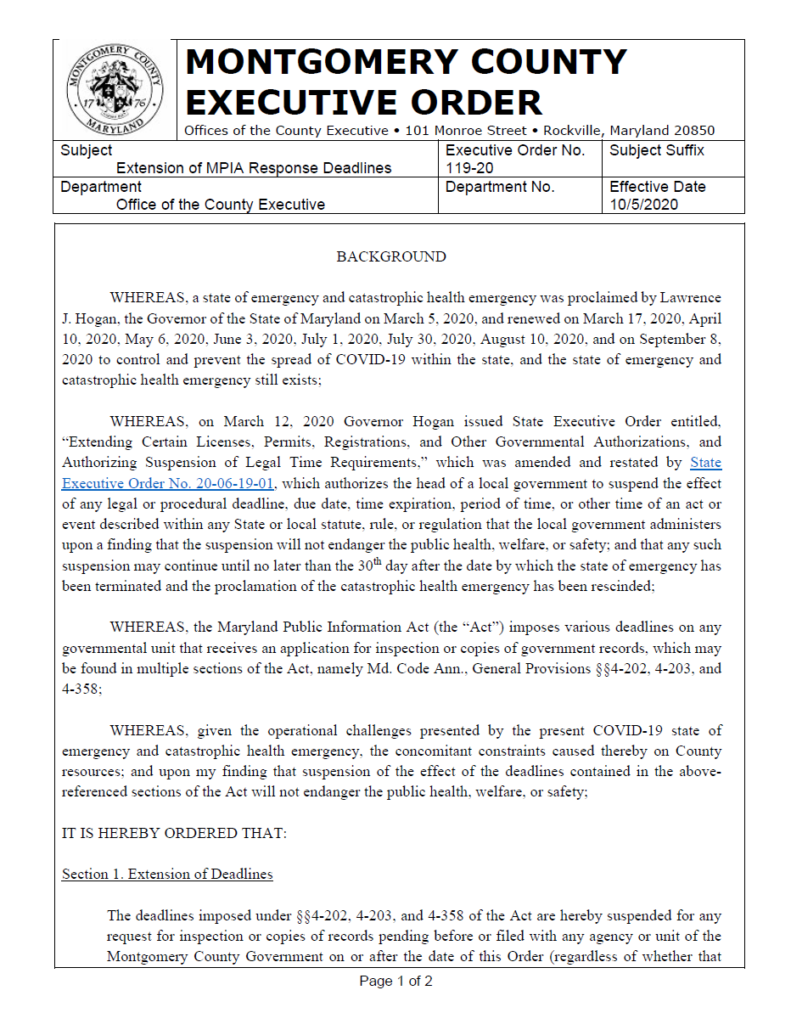
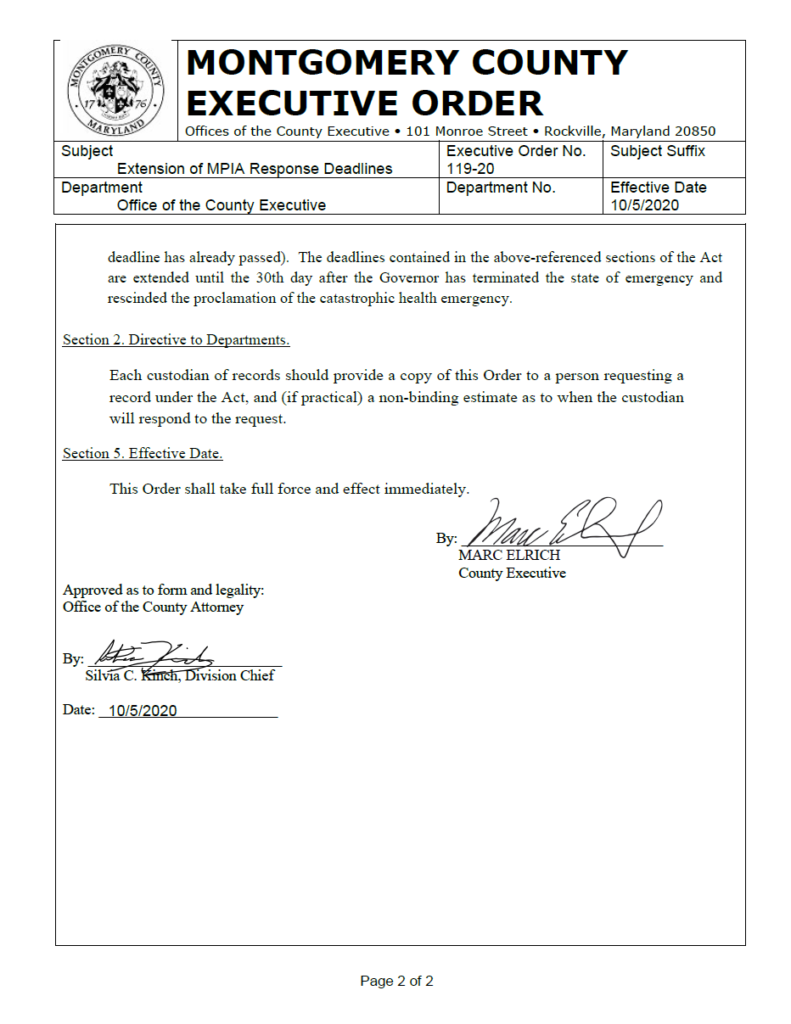
On October 5, County Executive Marc Elrich issued Executive Order 119-20 on the subject of “Extension of MPIA Response Deadlines.” The order’s text states:

Section 1. Extension of Deadlines

The deadlines imposed under §§4-202, 4-203, and 4-358 of the Act are hereby suspended for any request for inspection or copies of records pending before or filed with any agency or unit of the Montgomery County Government on or after the date of this Order (regardless of whether that deadline has already passed). The deadlines contained in the above-referenced sections of the Act are extended until the 30th day after the Governor has terminated the state of emergency and rescinded the proclamation of the catastrophic health emergency.

Section 2. Directive to Departments.

Each custodian of records should provide a copy of this Order to a person requesting a record under the Act, and (if practical) a non-binding estimate as to when the custodian will respond to the request.

Section 5. Effective Date.

This Order shall take full force and effect immediately.

No one knows when the state of emergency will end. This executive order could conceivably postpone MPIA responses by a year or more. This is an unprecedented act by Montgomery County Government. Additionally, the reference to “any agency or unit” of the county government raises the question of whether it applies to MCPS, Park and Planning, Montgomery College and other affiliated entities.

County governments normally do not have the option of overturning state law, but Elrich cites an executive order by Governor Larry Hogan as his source of authority. That executive order says in part:

The head of each unit of State or local government may, upon a finding that the suspension will not endanger the public health, welfare, or safety, and after notification to the Governor, suspend the effect of any legal or procedural deadline, due date, time of default, time expiration, period of time, or other time of an act or event described within any State or local statute, rule, or regulation that it administers. The unit head shall provide reasonable public notice of any such suspension.

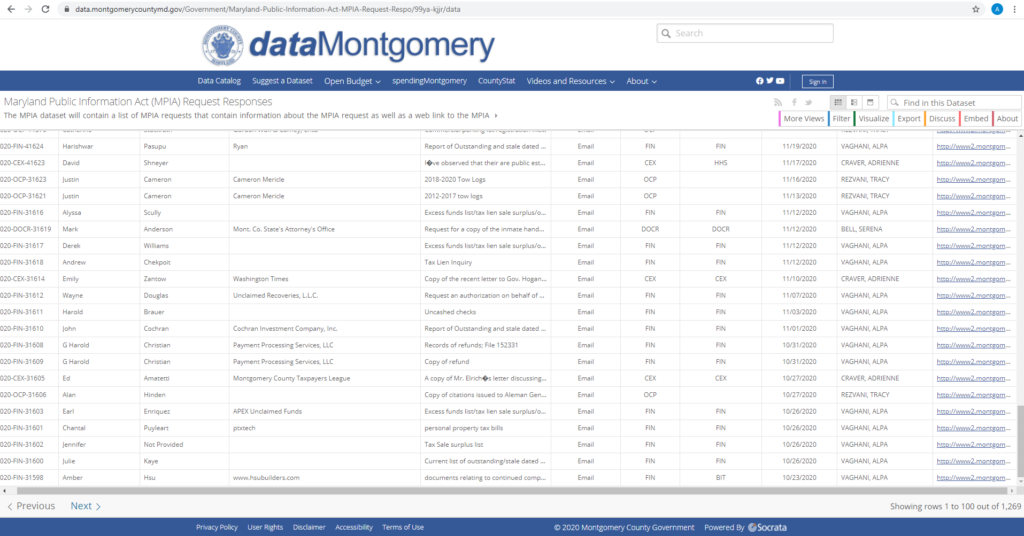
Elrich issued his executive order on October 5, when it took “full force and effect immediately.” Now here is an odd thing. According to the county’s MPIA response database, the county has answered 36 MPIA requests since October 5 as of this writing. This raises a number of questions. Do some county departments know of the executive order but not others? Or is there an interpretation of Elrich’s executive order that permits departments to decide whether to answer a request immediately or postpone it? Any disparate treatment of MPIA requests depending on their nature would be deeply troubling.

This screenshot of the county’s MPIA response database shows that it has continued to answer at least some requests since October 5.

Folks, I have been writing about state and county politics since 2006. I have used the MPIA countless times to obtain information of public interest, including information that would normally not be released by the authorities. The MPIA is among the most important tools available to residents to hold their government accountable. Indefinitely postponing answers to MPIA requests accomplishes nothing other than to allow county officials to behave as they will in the dead of night.

I respectfully ask the county council to summon representatives of the executive branch to justify this executive order in a public session.

Share

MoCo Hits New COVID Peak

By Adam Pagnucco.

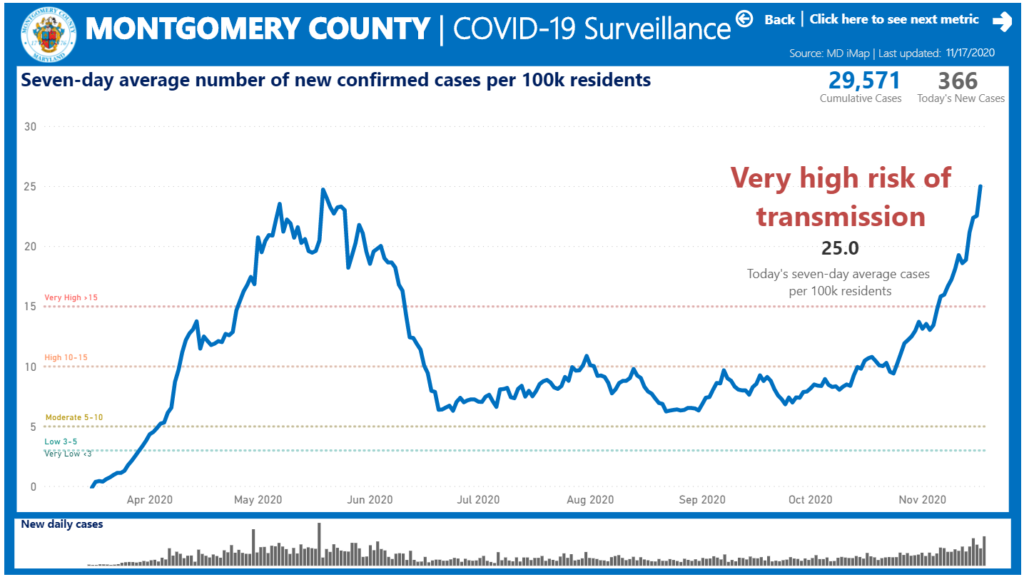
Yesterday, MoCo hit a new peak in its 7-day average of new COVID cases, a key statistic guiding the county’s pandemic response. On November 17, the county hit a 7-day average of 25.0 cases per 100,000 residents. That was higher than the previous peak of 24.7 on May 19, when the county’s lockdown measures were more severe than they are today. The graph below appeared on MoCo’s COVID dashboard yesterday.

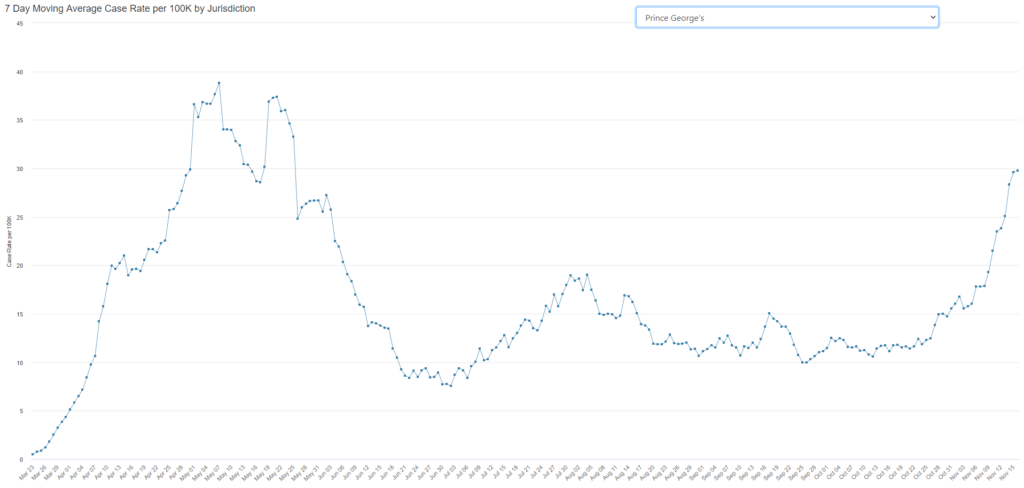
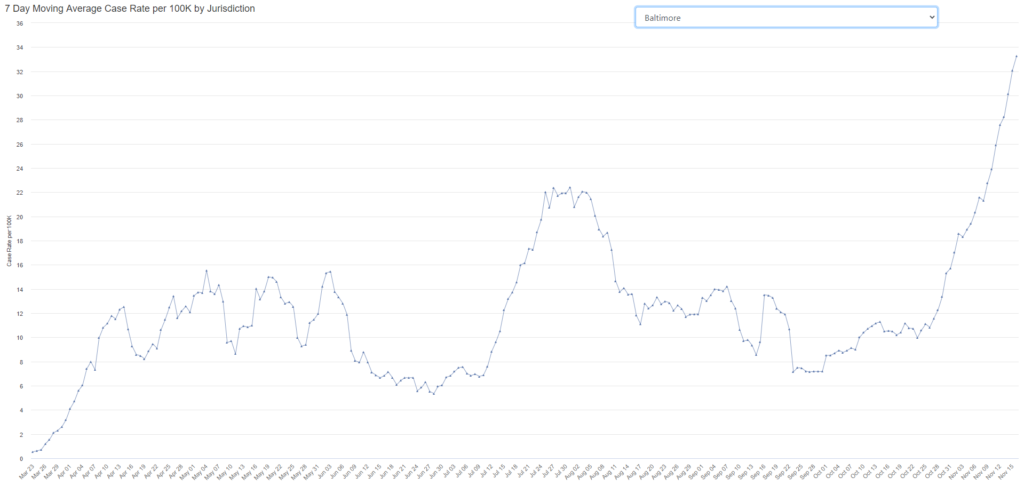
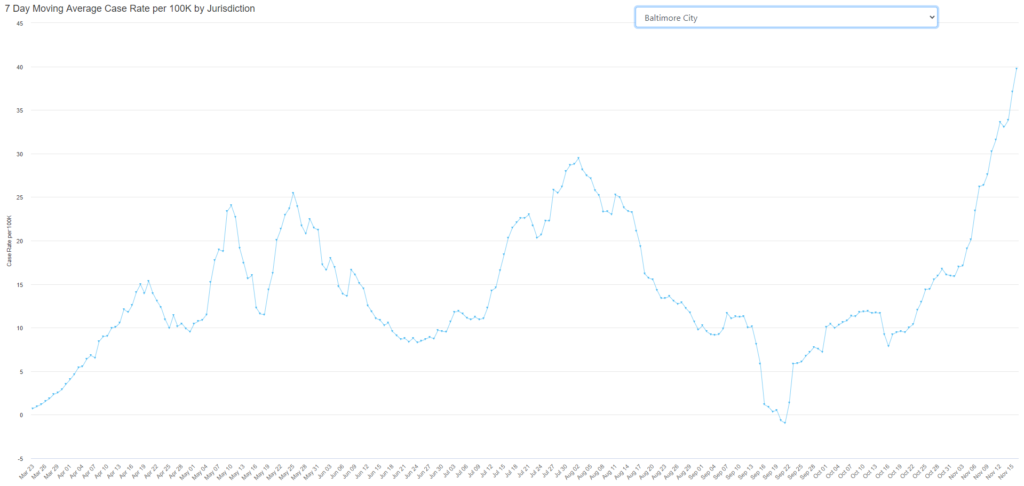
MoCo is not alone. Most major jurisdictions in the state have recently hit new peaks for COVID cases. The charts below from the state’s COVID dashboard show 7-day averages of case rates for each of the other Maryland jurisdictions with more than 250,000 residents.

Prince George’s: On November 16, Prince George’s County’s 7-day case rate was 29.8, lower than the previous peak of 38.85 on May 7.

Baltimore County: On November 16, Baltimore County’s 7-day case rate was 33.26, higher than the previous peak of 22.41 on July 31.

Baltimore City: On November 16, Baltimore City’s 7-day case rate was 39.76, higher than the previous peak of 29.46 on August 2.

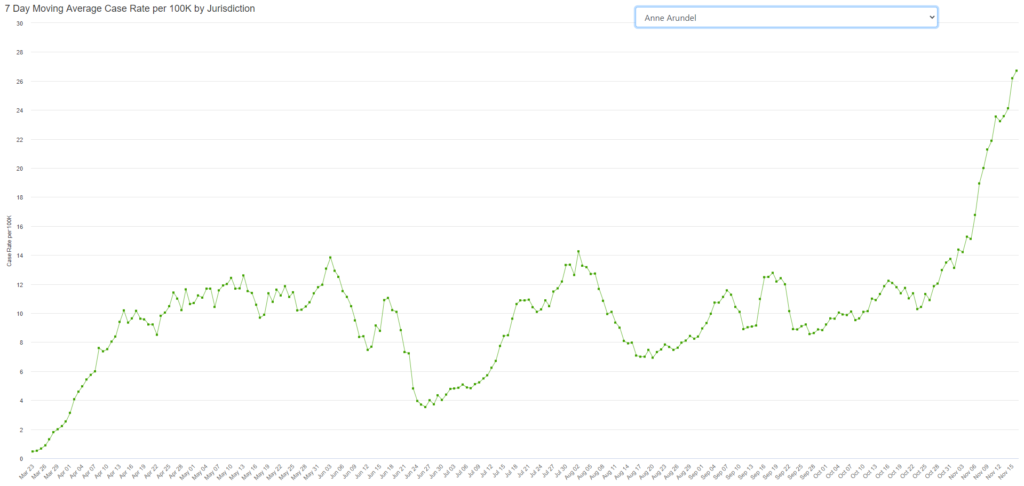
Anne Arundel: On November 16, Anne Arundel County’s 7-day case rate was 26.71, higher than the previous peak of 14.26 on August 2.

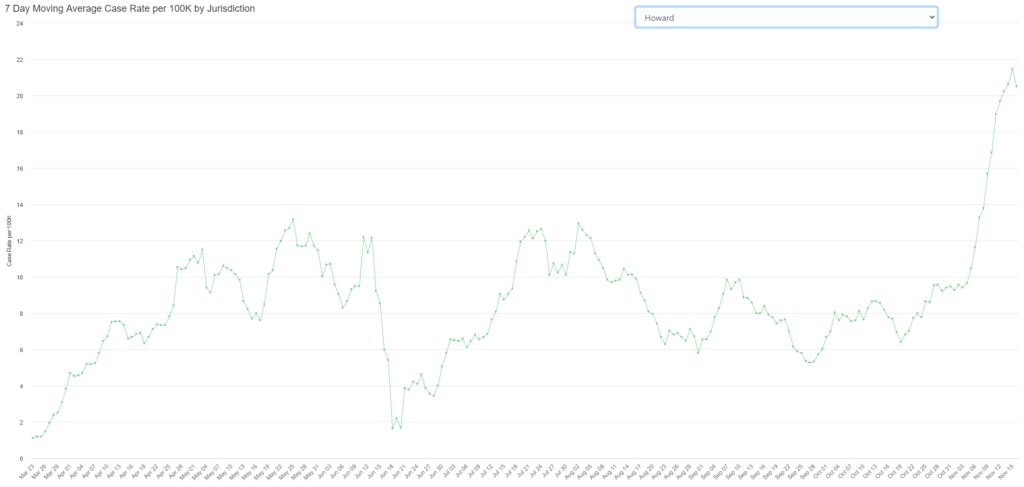
Howard: On November 16, Howard County’s 7-day case rate was 20.48, higher than the previous peak of 13.16 on May 25.

Frederick: On November 16, Frederick County’s 7-day case rate was 22.29, higher than the previous peak of 15.96 on April 14.

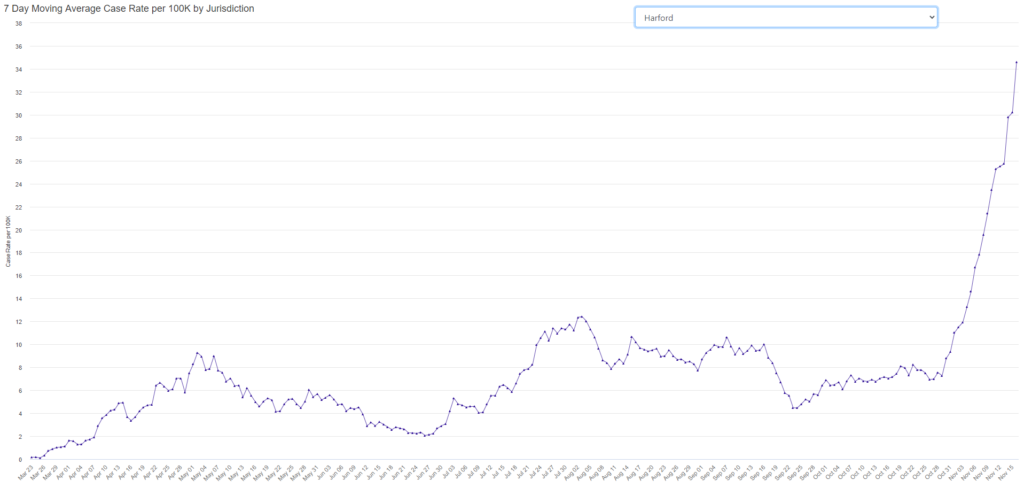
Harford: On November 16, Harford County’s 7-day case rate was 34.62, higher than the previous peak of 12.42 on August 3.

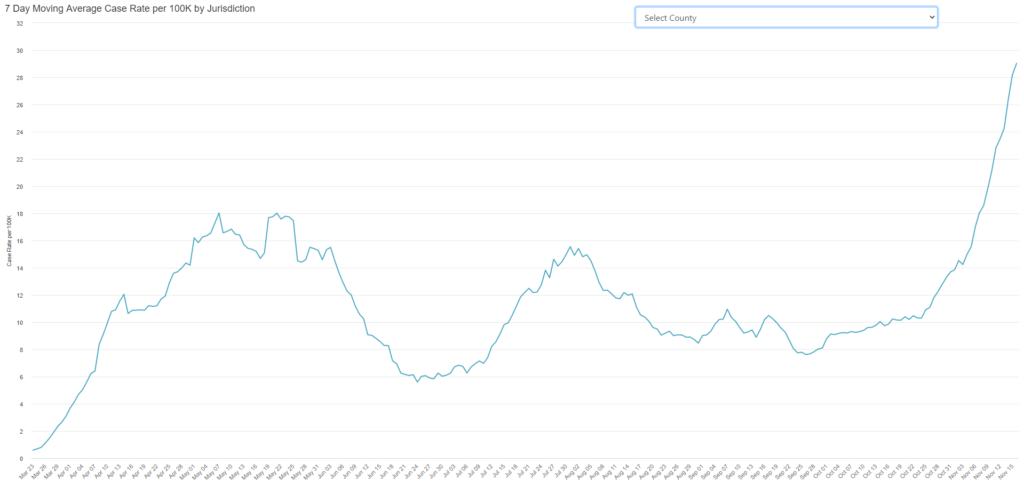
Finally, the chart below shows the statewide COVID case rate in Maryland. On November 16, the state’s 7-day case rate was 29.03, higher than the previous peak of 18.03 on May 7.

On November 16, the highest 7-day case rates per 100,000 residents in the state were in Allegany County (110.57), Garrett County (60.56) and Washington County (41.42).

These trends are alarming health officers, county leaders and health care providers all over Maryland. Expect swift and draconian measures from state and local governments to bring these soaring case rates under control.

Share