All posts by David Lublin

CD4 Target Demographics

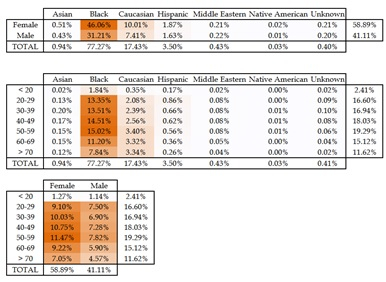
Today, 7S looks at the likely demographic composition of the electorate in the Fourth Congressional District. Many thanks to my anonymous reader who has so helpfully shared these statistics with me. The first table shows the share registered Democrats in CD 4 broken down by (1) race and gender, (2) race and age cohort, and (3) gender and age cohort.
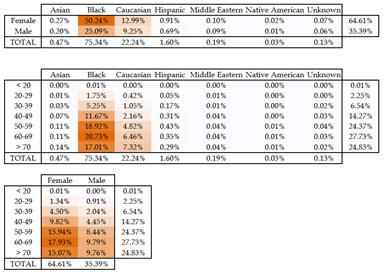
CD4 race age genderThe second table presents the same three demographic breakdowns but for voters who participated in two of the last four Democratic primaries. Close examination of the data reveals key differences between the makeup of the potential electorate of registered Democrats and likely voters, defined here as those who have voted in two of the last four primaries.
CD4 race age gender 2 of 4

Race and Ethnicity

First, African Americans will form an overwhelming share of the electorate as they comprise 77.3% of registered Democrats and 75.3% of likely voters.

Latino form 3.5% of registered Democrats but this growing demographic punches below its weight, as Latinos composed just 1.6% of likely voters. However, Latino voter turnout has been steadily increasing, so the turnout over the past four primaries may well underestimate the share of Latinos who will vote in the 2016 Democratic primary.

In contrast, Whites, listed in the table as Caucasians, vote a high rates. They form 17.4% of registered Democrats but 22.2% of likely Democratic primary voters. So far, all of the candidates who are still in the mix for the race are African American. An ability to attract white voters will aid a candidate’s campaign greatly.

Voters would do well to remember that Rep. Al Wynn won this seat originally through his biracial appeal. He came in second in both Prince George’s and Montgomery but defeated a black candidate with support centered in Prince George’s and a white candidate with support primarily in Montgomery.

Similarly, support from whites and Latinos in Montgomery played a critical role in Rep. Donna Edwards’ successful primary challenge to Rep. Al Wynn. In short, candidates who can combine significant black and white support tend to be formidable.

Gender

Women are an impressive 58.9% of registered Democrats but an astounding 64.6% of primary voters. At nearly two-thirds of likely voters, expect candidates to spend a lot of time at events that attract especially high numbers of women.

Candidates will also work hard to identify concerns that can attract a disproportionate share of their votes. No group or gender is monolithic in its voting behavior but some issues resonate with greater effect with women than men.

Race, Gender, and Age

Older voters participate at much higher rates than younger voters in Democratic primaries. Consider than 26.7% of registered Democrats but 52.6% of likely voters are over age 60. If voters wonder why they hear candidates talk a lot more about social security and health care than education, now they know.

African Americans over 60 form 37.7% of the electorate. African Americans over 50 are 56.7% of the electorate. Black women compose the bulk of these voters because (1) women register disproportionately as Democrats, and (2) the gender breakdown of population skews more female among older people.

In the overall population aged 20 to 60, there are roughly 1.03 women for every man among the civilian non-institutionalized population. Those numbers rise dramatically for older people. There are 1.22 women for each man in the over 60 population. That ratio rises to 1.26 for the over 65s and 1.35 for the over 70s.

Older people, especially older women, will play a disproportionate role among white voters too. Likely voters aged 60 and older form 62.0% of white voters. Again, expect these voters to be disproportionately female.

Key Demographics

Likely voters tend to be Black, older, and female. While every individual voter counts and matters, older Black women will be the central force in the Democratic primary for CD 4.

Whites, particularly older White women, can potentially play a pivotal role, as they form over one-fifth of likely voters. Expect all candidates to court this group. Black voters often play a similar role in Democratic primaries in white majority areas.

Share

Equal IVF Treatment for Same-Sex Couples Passes Senate

Sponsored in the Senate by Sen. Cheryl Kagan (D-17), SB 416 requires insurers to give equal coverage for in-vitro fertilization and artificial insemination to lesbian couples. The bill passed third reading in the Senate by 37-10.

While 36%, or 5 of 14 Republicans, voted for the bill, it won support of 97%, or 32 of 33 Democrats. The Republican split on the bill shows how far support for same-sex rights has progressed even since the 2012 referendum on marriage equality. Republicans may be beginning to realize that they win more when they focus on economic issues.

A corresponding bill, HB 838, has been sponsored in the House by Del. Terri Hill. Here is the vote on the bill in the Senate (Republicans are in italics):

Voting YEA (32D, 5R)
Miller
Astle
Benson
Brochin
Conway
Currie
Edwards
Feldman
Ferguson
Gladden
Guzzone
Hershey
Jennings
Kagan
Kasemeyer
Kelley
King
Klausmeier
Lee
Madaleno
Manno
Mathias
McFadden
Middleton
Montgomery
Muse
Nathan-Pulliam
Peters
Pinsky
Pugh
Ramirez
Raskin
Rosapepe
Serafini
Waugh
Young
Zirkin

Voting NAY (1D, 9R)
Bates
Casilly
DeGrange
Eckardt
Hough
Norman
Ready
Reilly
Sailling
Simonaire

Share

Yes on Restricting Cosmetic Pesticide Use

The following is a guest post from Julie Taddeo of Safe Grow Montgomery

It is mid-March, and already yellow warning signs are appearing on lawns all over the county. Millions of pounds of pesticides will be used in the state of Maryland as they are every year to help achieve a “perfect” look that puts our health (and that of our environment) at risk. Common sense tells us we should be concerned with this amount of chemicals being spread around where we live, where our kids play, and where our pets tread.

The fact that these substances are harmful to human health is not disputed; studies have linked lawn pesticides to a host of serious diseases like human and animal cancers, ADHD, Parkinson’s, and endocrine disruption, among other disorders. The EPA states that pesticides (including herbicides, fungicides, and insecticides) “can cause harm to humans, animals, or the environment because they are designed to kill or otherwise adversely affect living organisms.”

The only question is what their effects are in the small quantities likely to be absorbed by humans. It is very difficult to ascertain the harm (or safety) of small quantities of chemicals over long periods of time and large populations. But the harm is no less real: even a small risk per individual means a near certainty when multiplied by the population of the county.

In situations like this, when science by itself cannot at this time give a definitive answer, the sensible thing to do is to weigh the risks against the benefits or use precaution.  Bill 52-14, proposed by Montgomery County Councilmember George Leventhal, does exactly this by restricting lawn pesticides used solely for ornamental, or “cosmetic” purposes.

Other, more beneficial uses of pesticides (e.g., agriculture, control of invasive species, indoor pest control, tree care) are left untouched. As Councilmember Leventhal stated on talk radio, it’s a “gentle bill,” a rational way for our county to diminish the potential health risks at a small cost.

There is precedent for this bill.  Ontario, Canada banned cosmetic lawn pesticides (with exemptions similar to those in Bill 52-14) in 2008; Ogunquit, Maine banned lawn pesticides in 2014; Connecticut and New York enacted Child Safe Playing Fields acts in 2005 and 2010 respectively; Washington, D.C. passed the Pesticide Education and Control Amendment Act in 2012, and Takoma Park followed a year later with its own Safe Grow Act.

More towns and counties in the United States are not able to restrict lawn pesticides because they have been pre-empted from doing so by their states. Maryland is now just 1 of 7 states whose right is intact to pass stricter laws at the local level regarding pesticides. It is a right constantly under threat from the pesticide industry and its lobbying groups in Annapolis.

Should we leave to individual home owners the decision to use or not use cosmetic lawn pesticides? No, because lawn pesticides do not stay where they are put. Pesticides drift and also run off into our drinking water sources, so your neighbor’s choice becomes your choice. Parents have no control over pesticide use on playing fields and schools where our children play, and our parks are routinely treated with pesticides.

For those who reside in HOAs (1/3 of county residents) or in apartments, the right to choose how your lawn and common green spaces are managed doesn’t even belong to you. Should we leave it up to the EPA to be the sole regulator of harmful substances? The EPA is under budgetary and political pressures and its review system is fundamentally flawed, hampered by the very industry from which it should be protecting us.

There is nothing unusual about placing limits on individual rights for the greater good of the public’s health and our environment; our county has rules about recycling, litter, noise, trees, and in-door smoking, for example. And we have proof these laws work: the CDC recently reported that Americans’ exposure to second-hand smoke has declined by half since smoking bans have been instituted.

Montgomery County was a leader on this issue and it should be a leader in protecting its residents from second-hand pesticide exposure, too.

Share

CD4: Where are the Voters?

CD4

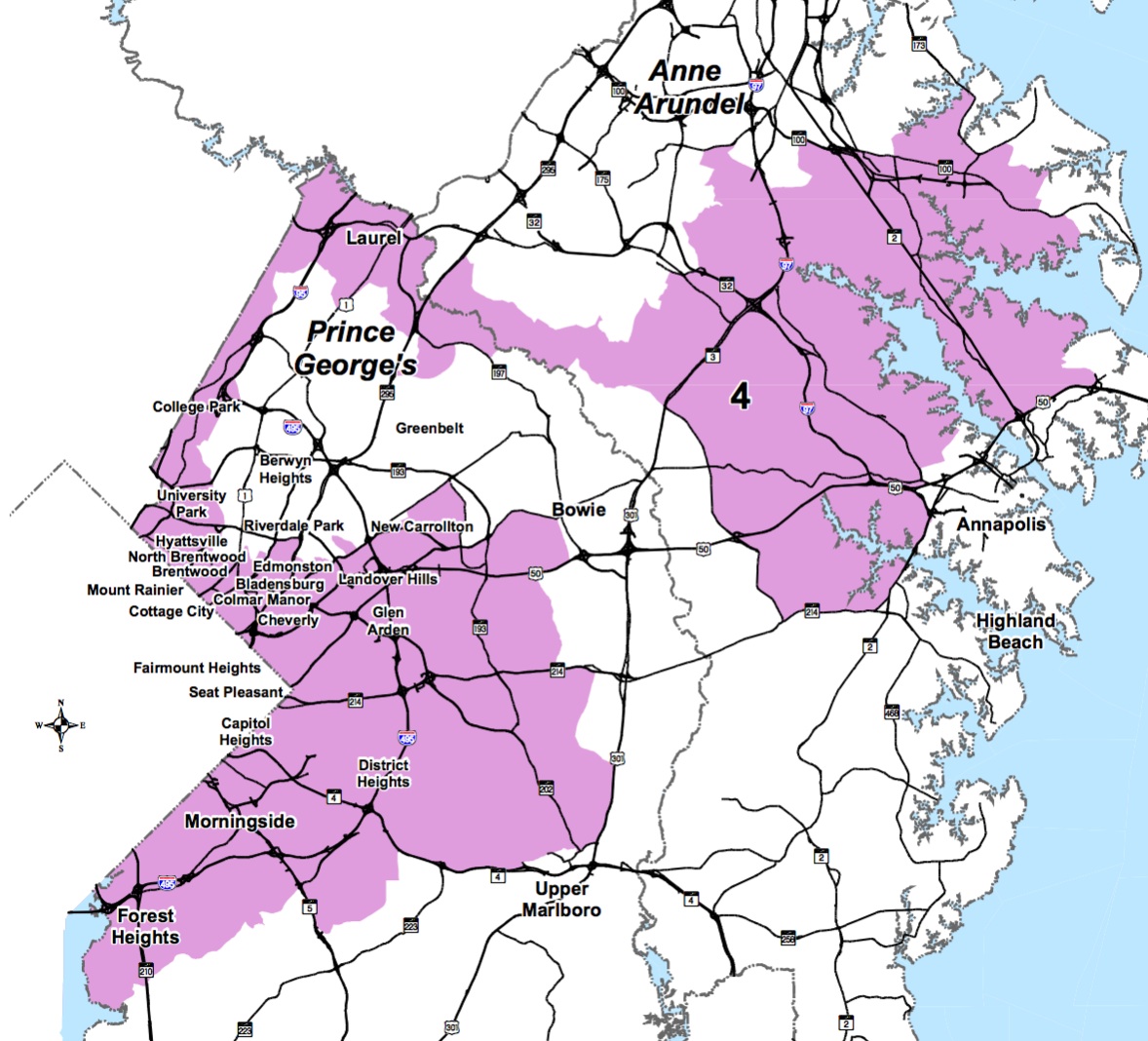
The overwhelmingly Democratic Fourth Congressional District will be open in 2016 since incumbent Rep. Donna Edwards is making a bid for the U.S. Senate rather than seeking reelection. So where do the Democrats who will vote in the primary live?

Registered Democrats by Legislative District

The Fourth CD is split between Anne Arundel and Prince George’s but 86% of registered Democrats live in Prince George’s. Former Prince George’s State’s Attorney Glenn Ivey was on the ballot repeatedly, though he has not been on the ballots since 2006.

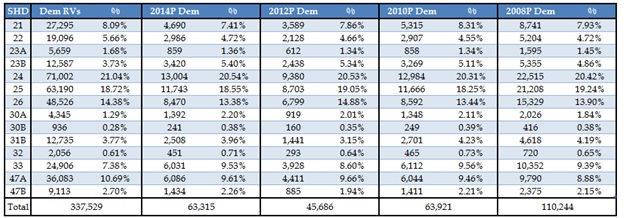
The following table shows the number of registered Democrats as well as the number who voted in each of the four past Democratic primaries within the portion of each state legislative district included in the Fourth Congressional District.

cd4 vr1

Newly elected Del. Erek Barron (D-24) is rumored to be interested in running for the Fourth. At 21.0%, D24 has the highest share of registered voters. Though Democratic primary turnout is slightly sub par, voters in this legislative district nonetheless consistently provided over one-fifth of all voters.

District 25 does not lag far behind District 24’s voting power with 18.7% of the CD 4’s registered Democrats. This is Lt. Gov. Anthony Brown’s former legislative district. Talented Del. Dereck Davis (D-25), the powerful Chair of the Economic Matters Committee, is also said to be musing about running for the seat.

Del. Jay Walker (D-26) is openly exploring a bid. Sen. Anthony Muse (D-26) from the same district is also rumored to be thinking about it. D26 has the third highest share of registered Democrats but lags notably behind either D24 or D25 with 14.4% of CD 4’s Democrats. Moreover, turnout is often mediocre–it fell as low as 13.4% of the Fourth’s total though it reached 14.9% on the one occasion in which the share of voters exceeded registrants.

Former Del. Jolene Ivey represented District 47 under different boundaries before redistricting. The current version of D47 holds 13.4% of CD 4’s registered Democrats but turnout consistently lags. In the past four Democratic primaries, voters from D47 never comprised more than 11.9% of the voters in CD 4.

Nevertheless, Jolene Ivey, a successful and highly talented politician in her own right who ran for Lt. Governor last year, will undoubtedly be an asset to her husband Glenn Ivey’s campaign. When she last ran for the House in 2010, she came in first by a mile in a crowded primary with eight candidates.

Del. Joseline Peña-Melnyk (D-21) is planning a run. Currently, she represents just 8.1% of registered Democratic in CD 4. A small base on which to build.

Registered Democrats by Legislative and County Council Districts

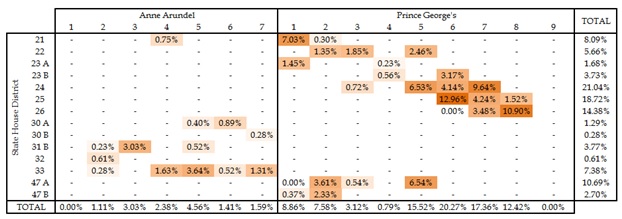
The second table shows the share of registered Democrats broken down by state legislative and county council district. None of the Anne Arundel Councilmembers represent more than 5% of registered Democrats in CD 4.

cd4 vr2

Prince George’s Council Vice Chair Derrick Davis (D-6)–not to be confused with the state legislator with the very similar name–represents 20.3% of registered Democrats but 64% also live in Legislative District 25. As this is declared candidate Anthony Brown’s former district and Del. Dereck Davis’s current district, competition for these voters could be fierce.

Councilwoman Karen Toles (D-7) represents 17.4% of CD 4’s registered Democrats. This district has significant overlap with Del. Erek Barron’s legislative district, as well as those of Brown/Davis and Walker/Muse. 15.5% of CD 4’s registered Dems also live in  Council District 5, held by Andrea Harrison. This district has a lot of overlap with D24 (Barron) and D47A (Jolene Ivey).

Former Council Chair Ingrid Turner has expressed interest in running for the Fourth. But she represented Council District 4. In its current incarnation, it falls almost entirely into CD 5. Just 0.8% of CD 4’s registered Dems live in District 4.

Likely Voters by State Legislative and County Council Districts

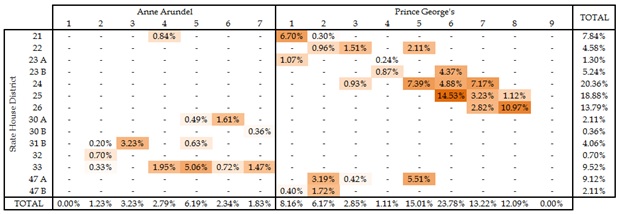
The final table breaks down the share of Democrats who voted in at least two of the past four primaries by state legislative district and county council district:

cd4 to2

This table indicates even more cleanly that Council District 6 is the heartland of CD 4’s Democratic voters. While it has less than a 3% advantage over Council District 7 in registered Dems, it has a 10.6% lead over the same district in two-time primary voters–23.8% versus 13.2%. No wonder Dereck Davis is thinking about running. (Notice also that Council District 5 leapfrogs ahead of Council District 7 in this table.)

Among state legislative districts, the biggest drop is in D47, which has 2.2% fewer two-time primary voters than registered Dems. Legislative Districts 24 and 25 have a slightly higher share of two-time primary voters than registered Democrats. But the statistics change less dramatic; the increase is 0.7% for D24 and 0.2% for D25. In contrast, the share of two-time primary voters is lower the registered Dems by 0.6% in D26.

Based on this table, the most desirable pieces of real estate to have represented before in terms of Democratic primary turnout are:

1. Maryland (Brown)
2. Prince George’s County (Ivey)
3. Prince George’s County Council District 6 (Derrick Davis)
4. State Legislative District 24 (Barron)
5. State Legislative District 25 (Dereck Davis/Brown)
6. Anne Arundel County
7. Prince George’s County Council District 5
8. State Legislative District 26 (Walker/Muse)
9. Prince George’s County Council District 7
10. Prince George’s County Council District 8
11. State Senate District 47
12. State Legislative District 33
13. State House District 47A
14. Prince George’s County Council District 1
15. State Legislative District 21 (Peña-Melnyk)

Share

Former M-NCPCC Chair Warns about MoCo’s Future

The following is a letter that former M-NCPPC Chair sent to the County Executive, County Council, and Planning Board.

Dear Mr. County Executive, Council Members, and Planning Board Members:

I hate sounding like a broken record, but everything I warned about last year and in 2009 is inexorably unfolding. Just check out the latest cover story in the March 6 “Washington Business Journal” by two knowledgeable reporters titled “MoCo’s Marriott Problem”—Bechtel is gone and Marriott is going. And this is by no means the end of it. Also notice, just as I warned, the sidebar piece on all the many alternative locations where Marriott is most likely to land—every single one is in DC (which has one-tenth the land area Montgomery County has) and Virginia. Every. Single. One.

Montgomery County has got to grasp, finally and fully, how it is truly viewed by the business and economic worlds out there. The County must do something dramatic, and soon, to change that image decades in the making. Our very economic viability is at stake right now, today, at this very moment.

Let’s be candid enough to look at our systemic faults:

1) We have not one but two transportation tests for new development; no other jurisdiction does that. And the tests are so complex and mind-boggling that no one but the three people who invented them can understand them, meaning they pose not only a double hurdle but a dangerous one. Imagine how a company located here and looking to expand somewhere in the region eyes that peculiar, unique hurdle.

2) We effectively have two County planning/permitting agencies, two environmental agencies, two transportation agencies, all too often grappling with each other. Guess who invariably gets ensnared in the middle of all that time-consuming, highly risky bureaucratic grappling? Imagine how a business person from, say, Seattle looking to land in the DC region views this arthritic process when stepping into the shoes of a potential land use applicant.

3) We don’t have a County economic development corp. run by people who, in their bones, get economic development, in which achievement metrics are required in order to be suitably compensated, but, rather, an economic development department run by well paid, well meaning people more experienced in the ways of politics. Imagine how a corporation from overseas being wooed by DC-area jurisdictions interacts with these two competing ways of dealing and communicating.

4) We have an entrenched bureaucracy in the County and MNCPPC that is rewarded more easily for saying “no” than for saying “yes.” Imagine how a local firm used to this day-to-day culture is liberated when it decides to inquire about maybe moving to a neighboring jurisdiction.

Taken together, these systemic faults are a cumulative anchor weighing upon our mutual necks that every jurisdiction in the region knows well and quietly appreciates.

So what is the solution? Given our history and reputation (whether earned or not as to any particular point is irrelevant because the overarching perception of being a general pain in the neck is real and therefore grave), we can no longer just do the usual pointless tinkering while the ship of state remains on its unwavering course to the ultimate withering of the tax base and thus our social order.

Accordingly, we must have the vision and gumption to scrap the two transportation tests for one, and make the one understandable. To bring the functions of MNCPPC under the County government and its 10 elected representatives. To create an economic development corp. and dissolve the department of economic development. To reward employees and management for saying “yes” when a proposal meets the laws and regulations or offers another creative way of advancing community building and economic viability.

We either dither or change. There is no other option if we wish to remain what we once clearly were—creative and quick, competitive and wise, always looking out for the big picture and the long view. In short, on top and for good reasons.

Respectfully,

Gus

Gus Bauman
Silver Spring

Share

EMILY’s List in for Edwards

EMILYsList-1EMILY’s List announced its support in the upcoming senatorial race for Rep. Donna Edwards. Great news for her campaign as she’ll need all the money that they can raise and more. Beyond the fundraising, it also gives her the imprimatur of a major endorser. An important day for the Edwards campaign.

Bad news for other women who had been musing about the race, specifically Baltimore Mayor Stephanie Rawlings-Blake and former Del. Heather Mizeur. Rawlings-Blake already has a challenging day job and it is unclear how serious she is about running for Senate.

This is now the second time that EMILY’s List has taken a pass on Mizeur who has been promoting her candidacy with donors as well as through her expansive social network. Of course, Mizeur could turn to an open congressional race where she could be a very competitive candidate–and might gain EMILY’s List support.

Share

CD8: Where are the Voters?

Building on Adam Pagnucco’s analysis from yesterday, I thought it would be great to delve into voter turnout in past Democratic primaries within the Eighth Congressional District. My gratitude to the reader who provided me with this extremely interesting registration and turnout data.

Registered Democrats by State Legislative District

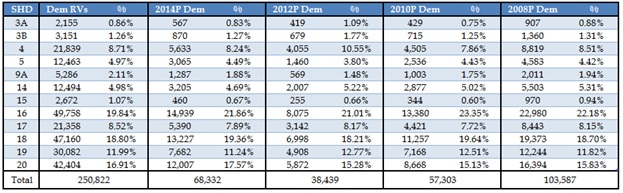
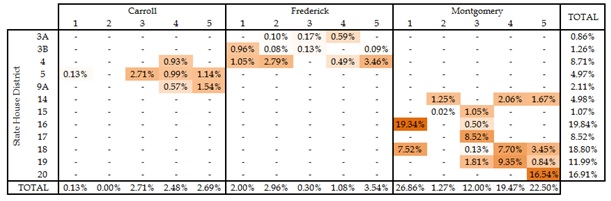
So where do registered Democrats live and which ones are more likely to vote? The first table shows the current number of registered Democrats along with past primary turnout broken down by state legislative district. Note that the data include only the portion of state legislative districts within CD 8.

TO1 Past VH x SHD

D16 holds 19.8% of registered Democrats and an even higher share of actual voters. In Democratic primaries from 2008 through 2014, D16 residents formed at least 21.0% and as much as 22.2% of voters. D16 is the most highly educated district in Maryland–and quite possibly the country–and studies show that education is more strongly related to voter turnout than any other factor. These numbers should encourage Del. Ariana Kelly.

In contrast, these numbers are less favorable to Sen. Jamie Raskin (D-20). Though D20 is chock-a-block with registered Democrats, not all of D20 is in CD8. As a result, D20 is home to just 16.9% of registered Democrats in the Eighth, probably less than many expect though still high.

Moreover, turnout within the D20 portions of CD8 is erratic. In 2014, D20 Democrats voted at a relatively high rate in the primary and constituted 17.6% of CD 8 Democratic primary voters. But their share in the district never exceeded 15.8% in the Democratic party primaries held from 2008 through 2012.

The second biggest stronghold of potential Democratic primary voters in CD 8 is D18, as it is home to 18.8% of all of registered Democrats. Turnout effects are smaller than in D16 or D20 with the share of D18 Democrats among all of the Eighth’s primary voters ranging from just 18.2% to 19.6%.

Del. Kumar Barve (D-17) suffers not only from the split in his district between the Sixth and Eighth Congressional Districts but the relative paucity of Democrats. Barve currently represents just 8.5% of the Eighth’s registered Democrats. They also tend to under perform on primary day, as their share of CD 8 voters ranged from 7.7% to 8.2% in the past four Democratic primaries.

Finally, it is worth noting that 17.9% of registered Democrats living in the Eighth don’t live in Montgomery County, so candidates will want to spend time and advertise in these areas. Fortunately for candidates, only around 8% of registered Democrats live in Carroll County, located in the Baltimore media market.

The rest live in the very expensive Washington media market where the vast majority of viewers are not registered Democrats living in the Eighth District. Less pricey social media will be extremely popular this year. But candidates cannot forget traditional media, as the primary electorate skews very old.

Registered Democrats by State Legislative and County Council Districts

The second table breaks down the share of registered Democrats by state legislative district and county council district:

TO2 Dem RV x SHD x County Council

Montgomery Councilmember Roger Berliner (D-1) represents 26.9% of CD 8’s Democrats but he has declined to enter the race. However, Montgomery County District 5 holds 22.5% of registered Democrats in the Eighth–a higher share than any state legislative district. Rumored congressional candidate and former Councilmember Valerie Ervin represented a slightly differently configured version of District 5.

At-Large Montgomery Councilmember Nancy Floreen has publicly mused about a run for Congress. She represents 81.8% of registered Democrats in CD 8, an overlap that any other of the rumored candidates would envy. But, as Adam pointed out, she has only run in the multimember at-large district, so the congressional race would be a different. Nevertheless, Floreen likely starts with higher name recognition than other candidates.

Likely Voters by State Legislative and County Council Districts

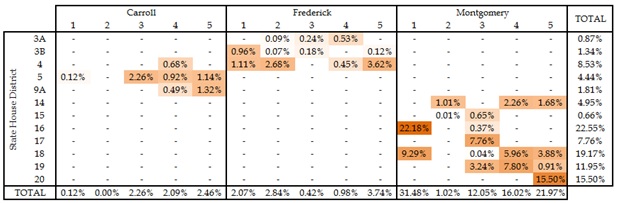
The final table breaks down the share of Democrats who voted in at least two of the past four primaries by state legislative district and county council district:

TO3 Dem 2 of 4 x SHD x County Council

Interestingly, this table reveals that D16 holds more people who are likely to vote in the primary than Council District 5. The high rates of turnout among D16 residents would bring Del. Kelly to parity with former Councilmember Ervin in terms of likely voters previously represented even though Ervin represented far more people.

Turnout only accentuates the Montgomery tilt of CD 8, as it is home to 82.5% of people who voted in at least one-half of the past four primaries. Among the remainder, 10.1% live in Frederick County as compared to 7.4% in Carroll County.

Based on this table, the most desirable pieces of real estate to have represented before in terms of Democratic primary turnout are:

1. Montgomery County (Floreen)
2. Montgomery County Council District 1
3. State Legislative District 16 (Kelly)
4. Montgomery County Council District 5 (Ervin)
5. State Legislative District 18
6. Montgomery County Council District 4
7. State Legislative District 20 (Raskin)
8. Montgomery County Council District 3
9. State Legislative District 19
10. Frederick County
11. State Legislative District 4
12. State Legislative District 17 (Barve)

Still, as Adam points out, all candidates have a lot of work to do to get known to most voters. Floreen and Kelly, who represent the most voters, have run only in multi-candidate contests. Other candidates have good bases but have run only in lower visibility races and in a portion of CD 8.

The keys to a good campaign remain the same: message, money, volunteers, and organization. Candidates need to have a message to sell to voters. They need money to pay for media to get it across and volunteers to spread the word and help canvass. But none of it matters if the candidate cannot run a a good strategic campaign.

Share

Update: Why is Hate, I mean Help, Save Maryland a Tax-Deductible Charity?

Your contributions to Help Save Maryland are tax deductable. This group busies itself perpetuating hate of blacks and gays, but its main joy in life is to spew vitriol about undocumented immigrants and CASA de Maryland.

Many organizations have two counterparts–a (c)(3) that conducts in educational and other tax deductible non-political activities and a (c)(4) that engages in politics. Donations to the latter are not tax deductible, and the two types of organizations have to be kept carefully separate.

Help Save Maryland thus describes its focus on “awareness and education” in an effort to fit the (c)(3) mold but lets the mask slip when it states that it “provides an effective voice for citizens frustrated by our out-of-touch Maryland politicians.” Its tag line on the top right of its web page says “Working to Make Our Elected Officials Accountable to The Citizens of Maryland.” That sure sounds like non-tax deductible lobbying to me.

Haters are gonna hate, as Rep. Aaron Schock recently reminded us at the beginning of the unfolding scandals that led to his resignation announcement yesterday. But that doesn’t mean we have to give them a tax deduction to lobby for it.

Share

Help Save Maryland

In 2015, bigotry can sometimes get defined down. But sometimes, the genuine unquestionable article stares you in the face. Help Save Maryland, an organization dedicated to fighting “the negative effects of illegal aliens,” provides examples.

Consider this segment from their St. Patrick’s Day Newsletter:

New Home in Rockville For CASA’s Illegal Day Labors

Montgomery County Executive Ike Leggett has always been a slippery operator.  Had the County Taxpayers pick up his legal tab some years ago when he was accused of sexually harassing a Blonde Haired White Female Staffer while he held an earlier county elected position.

Apropos of nothing, they dredge up an old charge from 1992 in order to perpetuate the oldest racist trope in the book of black men as sexual predators. And just to make sure you got the message, it was clearly important that they mention that she was “Blonde,”  “White,” and “Female.” Would it have been okay by HSM if the accuser had been a brown-skinned illegal alien male?

And, while I’ll plead guilty to many a typo due to lack of time and a proofreader, who capitalizes “blond” or “female” when they are not at the beginning of a sentence? HSM did not want you miss these key points.

Neverhtless, Help Save Maryland also wants you to know that racism is so over–almost as much as they want you to know they hate gays:

One of the strangest things [Loretta Lynch] said in reference to Dr. Martin Luther King, Jr’s “dream.” She said, “People tell us that dreams are not realized because dreams never are and he knew we had to continue working. I’d be remiss if I didn’t tell you that under this president and under this attorney general, the Department of Justice is committed to following through with those dreams.”

So, the dream won’t be realized, but you’re going to continue pursuing it. Do I have that right? What dream is Ms. Lynch after? Blacks and other minorities have equality in America. They can work. They can own a home. They can marry. They have all the same rights that whites have, so what is the dream Ms. Lynch is pursuing? It’s the same dream the sodomite community is pursuing: special rights.

Why aren’t black people more grateful? I mean, we allow them to work, even to own their own homes. Gosh, they can even get married. So demanding, these people.

It’s almost impressive that someone can manage to sound so churlish about African Americans having access to very basic rights and feels it necessary to place Dr. Martin Luther King Jr.’s “dream” in pejorative quotes. Only HSM thinks that Loretta Lynch’s desire to follow through on it makes her some sort of radical.

“Sodomite community” has a nice ring but it lacks the certain quaintness of “open homosexual,” a term used in the article they cite as evidence that LGBT people want “special” rights. They’re almost as demanding as those uppity black and brown people.

Share

CD8 is Wide Open

Today, I am pleased to present a guest post from Adam Pagnucco:

Long-time District 8 Congressman Chris Van Hollen is now running for the U.S. Senate. Who will succeed him? No one knows because this race is wide open. That’s right, wide open.

Announced or potential candidates include At-Large Councilmembers Nancy Floreen and Hans Riemer, District 20 State Senator Jamie Raskin, District 17 Delegate Kumar Barve, District 16 Delegate Ariana Kelly, former District 5 County Council Member Valerie Ervin, former District 20 Delegate candidate Will Jawando and former WJLA anchor and current Marriott executive Kathleen Matthews. All except Matthews have campaign records. None have run campaigns that approach anything close to the scale of a congressional race.

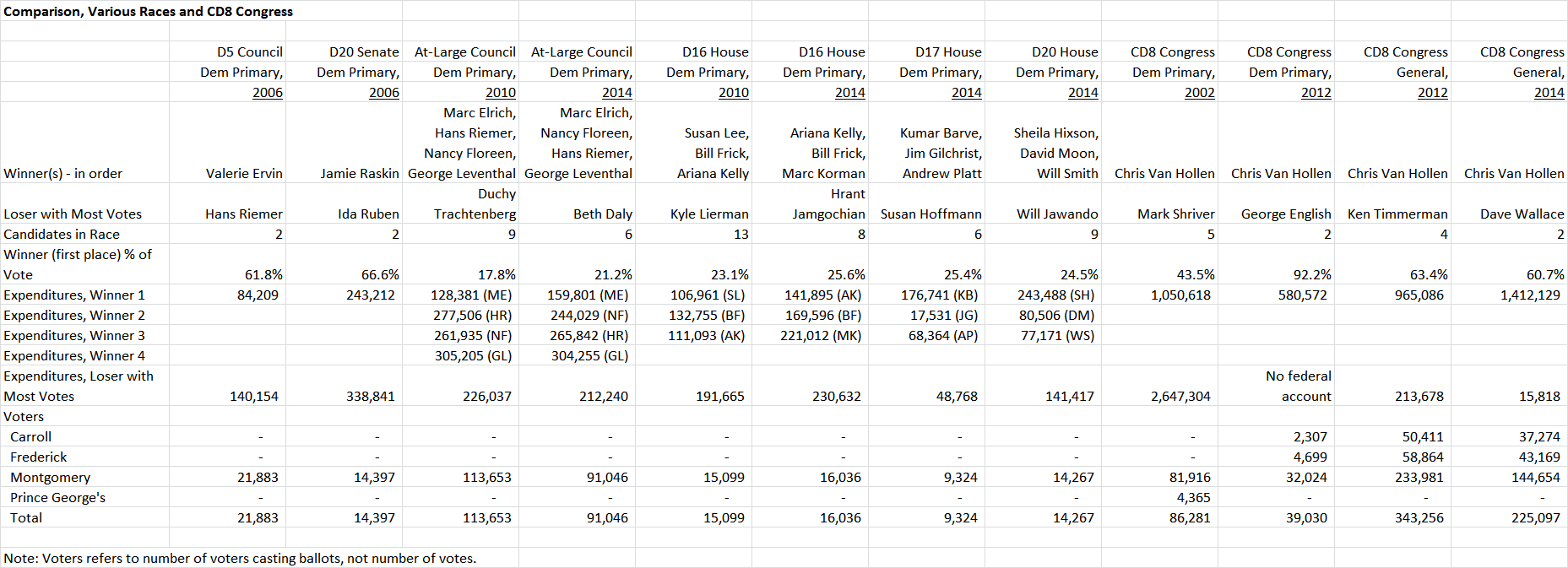
Consider the following data.

CD8 Comparison

Campaign Spending

In the CD8 2002 primary, Chris Van Hollen spent $1.1 million and won. Mark Shriver spent $2.6 million and lost. None of the prospective candidates in the current CD8 have demonstrated that kind of monetary capacity. Raskin, Riemer and Floreen spent between 200k and 300k on their competitive races. Barve came close to that level in 2014. Ervin has never spent more than 100k in a campaign. All of these candidates would need to dramatically increase their fundraising activity and it’s hard to see that any one has a significant advantage over the others. Matthews, who may be able to draw on self-financing, national Dem money and corporate money, may be an exception.

Size of Electorate

It’s tricky to forecast the size of the CD8 Dem primary electorate because the district was changed radically in 2012 and it does not have a recent experience of primary competition. Van Hollen faced no-names in both the 2012 and 2014 primary and general elections. In the 2002 primary, when the district was almost entirely in MoCo, 86,000 Dems voted. That was a high turnout year for Dems in terms of gubernatorial elections, but 2016 is a presidential year and many more Dems could turn out. In 2012, a presidential year, just 39,000 Dems voted in the primary, as Van Hollen clobbered an opponent without a federal account and there was no meaningful competition in the Presidential and U.S. Senate races. A combination of competition in the U.S. Senate and CD8 races, plus support for Hillary Clinton, could drive turnout in the 2016 CD8 Dem primary north of 100,000.

Among the possible candidates in the CD8 primary, only Nancy Floreen and Hans Riemer have experience running in an electorate that large. State legislative races tend to draw out 7,000-16,000 Democratic primary voters. But Floreen and Riemer don’t necessarily have an advantage because their races are fundamentally different from congressional contests (more below).

Multiple-Vote vs One-Vote Races

A congressional race has one similarity to a State Senate race: voters only get to vote for one candidate. In House of Delegates races (at least in MoCo), voters can vote for up to three candidates. In Council At-Large races, they can vote for up to four. These are very different dynamics.

In a multiple-vote race, a candidate can be no one’s first choice, but can be the second or third choice of a lot of people and still win. Such a candidate would do poorly in a one-vote race like Congress. Even though Floreen and Riemer have won countywide, many of their voters are not voting for them. In 2010, 113,653 MoCo Democrats voted in the primary. Riemer received 40,493 votes (36%) and Floreen received 39,500 (35%). In 2014, 91,046 MoCo Democrats voted in the primary, which was notably less competitive than it was in 2010. Riemer received 49,932 votes (55%) and Floreen received 52,924 votes (58%). The number of voters who would rate either Riemer or Floreen as their first choice would be FAR fewer and would be closer to the total of one of the State Senators.

For what it’s worth, Floreen finished first in 32 of the 138 CD8 precincts located in Montgomery County in 2014. Riemer finished first in 11. At-Large Council Member Marc Elrich, who finished first in 90 CD8 precincts, has shown no interest in a Congressional race.

Delegates have similar problems. Barve and Kelly finished first in their respective House races, but the number of their voters who would have picked them as a first choice is unknowable short of a contemporaneous poll.

District Overlap

State legislators do not enter this race on equal footing. District boundaries and voting patterns give some an advantage over others. Delegate Ariana Kelly benefits from the fact that her district has more actual primary voters in CD8 than any other MoCo state legislative district. In terms of cards cast on 2014 primary election day by residents of CD8, Kelly’s District 16 led with 14,114, followed by District 18 (12, 072), District 20, home of Senator Jamie Raskin and Will Jawando (9,331), District 19 (6,948), District 17, home of Delegate Kumar Barve (4,929), District 14 (3,302) and District 15 (442). Barve is handicapped by the fact that 42% of voters in his district reside in CD6, not CD8.

Women

Fifty-nine percent of MoCo Democrats are women. That figure applies to registered Dems, voting Dems and “super-Dems,” or Dems who always vote. This is not necessarily a prohibitive advantage for female candidates. But if one or two strong women face off against a male-dominated field, it’s possible that this factor could act as something like a tiebreaker. A savvy female candidate might point out that with U.S. Senator Barbara Mikulski’s retirement and Rep. Donna Edwards’ entry into the Senate race, the state could be facing the very real prospect of an all-male congressional delegation.

Presidential Year vs. Gubernatorial Year Turnout

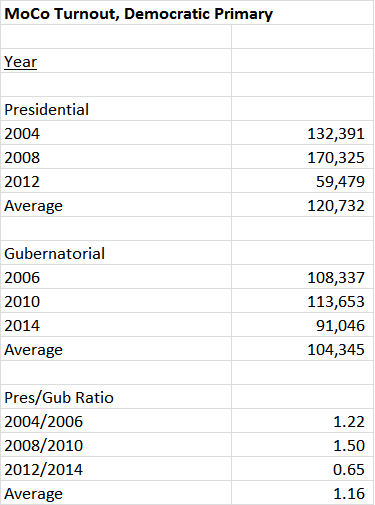
Presidential year Democratic primaries tend to attract higher turnout than gubernatorial year Dem primaries. Below are stats on how many MoCo Dems voted in the primary over the last six elections (both presidential and gubernatorial). With the glaring exception of 2012, when there was little or no competition in the presidential, U.S. Senate and CD8 races, presidential year turnouts tend to be higher. That means in a presidential year CD8 race, there will be tens of thousands of Democratic voters who have not voted in gubernatorial races and do not know their state senators, delegates or councilmembers. Communicating with these people will be a significant challenge for any candidate. Also, anywhere from a sixth to a fifth of the CD8 primary electorate will be residents of Carroll and Frederick Counties.

MoCo Turnout Dem Primary

Bottom Line

There are no favorites in this field. No candidate has proven that he or she can raise the money for a congressional campaign. The at-large County Council candidates run across a big geography but not in one-vote races. State legislators have small districts (at least compared to CD8) and delegates run in multiple-vote elections. Tens of thousands of non-gubernatorial and non-MoCo voters will have no idea who any of the candidates are and they will need some attention.

Wide open, folks. This contest is wide open.

Share