All posts by David Lublin

Baker and Leggett on Race and Endorsements

Prince George’s County Executive Rushern Baker got asked essentially why he, as an African-American leader, endorsed a white man over a black woman for U.S. Senate. Baker responded well and then Montgomery County Executive Ike Leggett jumped in to give an exceptionally eloquent statement:

Regardless of whether you prefer Van Hollen, Edwards, or someone else, their answers as to why they support Chris Van Hollen speak to the content of both of these gentlemen’s character.

Share

Hogan Threatens Legislative Leaders

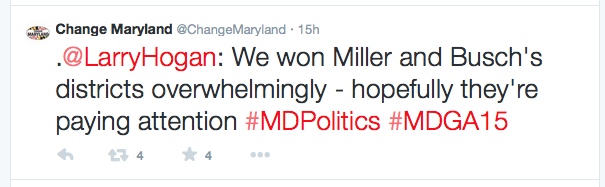
Gov. Larry Hogan tweeted this out yesterday via his campaign organization, Change Maryland:

HoganTweetThreat

This is one of those wonderful threats that is clearly meant one way–if you don’t bend, I’ll make electoral trouble for you at home–but Hogan’s press people will try to spin as we’re hoping that they’re listening to their constituents.

Somehow, I doubt they’re intimidated.

It’s also an argument that only goes so far. Democrats won so many seats in the General Assembly that Gov. Hogan cannot sustain a veto without Democratic support. Legislators have mandates too.

Share

Bad Day for Donna Edwards

Bakerendorsement

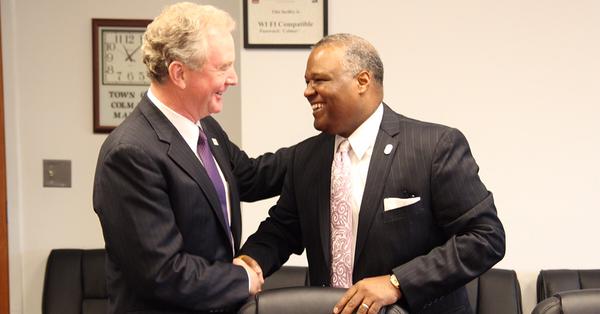
Rushern Baker Endorses Chris Van Hollen

Prince George’s County Executive Rushern Baker’s endorsement of Rep. Chris Van Hollen over Rep. Donna Edwards for U.S. Senate shows the tough road ahead for Edwards as the primary contest progresses. Not all endorsements matter. This one does.

While Van Hollen has the united support of the Montgomery County Executive and County Council, Edwards just lost the most prominent local official in her home base. Van Hollen has easily consolidated political support in his home base. In contrast, Edwards has now been served notice that she will have to fight hard to get Prince George’s to swing behind her.

It reinforces the existing media narrative that Edwards doesn’t work well with others either in Maryland or Congress. Moreover, it serves as a powerful signal to other African-American officials that it’s OK to endorse Van Hollen over Edwards. A further subtext is that Baker thinks Van Hollen will win so you should support early.

Edwards will try and counter as the authentic progressive candidate running against a corrupt establishment as when she challenged successfully Al Wynn. Except that she’s now a Member of Congress and part of the establishment so people want to see effectiveness as well as an ability to speak truth to power.

Moreover, neither Van Hollen nor Baker are Wynn. Both have strong reputations of wanting to clean up politics. Van Hollen, for example, has been a champion of campaign finance reform. The insufficiently liberal narrative won’t work on Van Hollen either and may just end up reinforcing that Edwards is less electable.

If Elijah Cummings enters the race, this can’t hurt him either, as it makes it easier for him to reach out to Prince George’s. In short, Cummings looks to have an easier time making inroads into Edwards’s base than vice-versa.

Share

Are Transit “Advocates” Their Own Worst Enemy?

Greater Greater Washington’s David Alpert’s went off on Maryland Transportation Secretary Pete Rahn in a recent blog post, accusing him of wanting to “slash and burn” WMATA:

Meanwhile, Pete Rahn, the new Maryland transportation secretary who insists he’s not a “highway guy,” wants to cut costs much more deeply. He wants WMATA to completely shelve any talk about expanding the system or even increasing the number of eight-car trains.

Only in the Greater Greater Washington bubble is failing to build new lines or stations for Metro a “slash and burn” approach or cutting costs. Alpert continues:

Rahn told Hauslohner and McCartney that “Discussions of expansion have to be deferred for maintenance, and it means saying ‘no’ to some popular things until [Metro] has addressed throughout its system the issues of performance and safety.”

While maintenance is extremely important, it’s also dangerous to completely ignore anything else. While Metrorail ridership has declined slightly, the overall trend is toward hitting capacity ceilings—not to mention the Blue Line, which is suffering right now.

People who ride Metro with any frequency are going to view Rahn’s  focus on getting the system working again as just plain common sense. Yesterday’s shutdown of the Bethesda Metro Station due to a lack of working escalators only emphasized the point if endless single tracking hadn’t already.

Alpert wants to call the stagnation in Metro ridership a blip but it has been going down since 2009. I bet that would change if the system worked better. At that point, I’d be glad to push for more eight-car trains–and so would the public and maybe Rahn.

Alpert tops it off with an out-of-touch analogy:

Rahn would certainly not say that Maryland should cancel any plans for even the smallest local road capacity increase project until every road and bridge is in tip-top shape and nobody ever dies on the roads, period.

Forehead hits keyboard.

Metro is not falling just short of “tip-top shape.” It’s seen as failing to do its job. For public transit to attract riders and provide the economic and transportation benefits, it has to be dependable. And Metro just isn’t anymore.

Indeed, Rahn’s notion that the financial and operational mismanagement must end before expanding the system will strike many as the arrival of rational voice. As the Washington Post pointed out, Metro didn’t even manage to spend its capital budget last year:

Rahn complained that Metro hasn’t been spending all of the money it has available to buy or modernize equipment while saying it needs more money.

Last year, Metro failed to spend $207 million, or 21 percent, of its 2014 capital budget that was meant to go toward maintenance, program management and vehicles, among other projects. According to the transit authority’s latest figures, Metro had only spent about 26 percent of this year’s capital budget by the time it was midway through the fiscal year.

Moreover, even when they manage to spend it, there are no often no real improvements. For example, little progress has been made on the escalator front with many breaking down soon after being rebuilt.

Echoing Alpert’s critique of Rahn for wanting to get a handle on costs and fix the system we have seems an excellent way to assure that approval ratings for Rahn’s boss, Gov. Larry Hogan, go up and he wins reelection in 2018.

Share

Reporters v. Data: Millennials Edition

On March 29, the Washington Post published yet another of many stories on how millennials love the city and hate the suburbs:

Transit-centric millennials . . . who were born between 1980 and the early 2000s, are causing angst in traditionally car-dominant suburbs such as Montgomery County. Suburbs nationwide have long lured companies — and the high-skilled workers they seek to attract — with good schools, relatively low crime and spacious corporate campuses surrounded by vast parking lots near major highways.

A realization is growing among those communities’ business and civic leaders that the traditional suburban brand needs an overhaul.

The story had several anecdotes but had no actual data to support its conclusion that people are no longer moving to the suburbs. One reason for that omission is that it isn’t true, as reported on FiveThirtyEight:

According to U.S. Census Bureau data released this week, 529,000 Americans ages 25 to 29 moved from cities out to the suburbs in 2014; only 426,000 moved in the other direction. Among younger millennials, those in their early 20s, the trend was even starker: 721,000 moved out of the city, compared with 554,000 who moved in.1 Somewhat more people in both age groups currently live in the suburbs than in the city.

Indeed, for all the talk of the rebirth of American cities, the draw of the suburbs remains powerful. Across all ages, races, incomes and education groups, more Americans are still moving out of cities than in. (Urban populations are still growing, but because of births and immigration, not internal migration.)

There have been some important changes but they’re about delaying moves to the suburbs

The common narrative isn’t entirely wrong about the long-term trend lines. Millennials are moving to the suburbs at a much lower rate than past generations did at the same age. In the mid-1990s, people ages 25 to 29 were twice as likely to move from the city to the suburbs as vice versa. Today, they’re only about a quarter more likely. But even that slowdown appears to be mostly about people delaying their move to the suburbs, not forgoing it entirely. Today’s 30- to 44-year-olds are actually heading for the suburbs at a significantly faster rate than in the 1990s.

And the move to the suburbs isn’t being driven by moves to new urban areas like Bethesda and Silver Spring. The home with a yard for the kids to play remains popular. Indeed, the exurbs are still the fastest growing areas:

But a survey released earlier this year found that most millennials still want a traditional suburban experience, complete with big single-family homes. The American Community Survey, which provides a more granular look than the data released this week, tells much the same story, said Jed Kolko, chief economist of the real estate site Trulia.

“The fastest population growth right now is in the lowest-density neighborhoods, the suburb-iest suburbs,” Kolko said.

FiveThirtyEight hypothesizes why this story has gained traction even though it’s not true:

So why has the “city-loving millennials” story gained so much traction? Kolko has a theory: As American cities have become safer and more expensive, they have become increasingly dominated by the affluent and well-educated — exactly the people who drive the media narrative.

Share

Hogan Approves Purple Line

In a surprise move, Gov. Larry Hogan announced that he is ready to move full-speed ahead on the light-rail Purple Line that will travel from Bethesda to New Carrollton in suburban Washington. The Baltimore Sun reported:

“Working closely with Transportation Secretary Pete Rahn, we have discovered the means to reduce costs substantially,” said Gov. Hogan at an early morning press conference. “If we eliminate frills, I am now confident that it can be built in a cost-effective manner that will bring business to Maryland.”

Hogan explained that a major barrier has always been the price of the light-rail cars, which are expensive and have to be imported from Ostrava in the Czech Republic:

We have cut unnecessary extras. Seats provide no benefit to the taxpayer, so they have been eliminated from the redesigned trains. Indeed, we have now also done away with walls and the ceiling to go with a sleek, modern flatbed design.

Purple Line Project Manager Mike Madden applauded the move:

I appreciate the governor’s support and leadership on the project. Eliminating not just doors but walls will make it easier to board and to exit the train, thus reducing time spent at stations and increasing speed, resulting in an estimated increase in ridership of 31.7%.

When asked for the documentation on the increased ridership, Madden described the information as “proprietary” but also reassured the public on their accuracy: “They were calculated by the same high-quality experts who designed the Silver Spring Transit Center that will open later this year.”

Hogan’s decision to simplify cars was hailed by former Action Committee for Transit President Ben Ross:

This new design is in touch with the simplified lifestyle preferred by Millennials. Let’s face it: seats are emblematic of the bourgeois Lexus lifestyle. I’m glad that Maryland and Montgomery County have said “yes” to our smart growth future by embracing open plan light-rail.

Similarly, Montgomery Council President George Leventhal congratulated Hogan on WAMU for “finally following his lead” and said “The open plan is an excellent forward-thinking idea. I think of it as a moving Capital Crescent Trail. It will be a first-class system.”

Not all of Leventhal’s colleagues were so sanguine. Council Vice Chair Nancy Floreen said to the Washington Post:

Heck, I never thought the Governor would invest so much money in areas that will never vote for him. Now, I’ll have to come up with all the money that Montgomery County promised when I’m Council President next year. I don’t see why I shouldn’t just run for Congress instead.

But Robert Thomson, better known as Dr. Gridlock, reassured the public in an online Post discussion: “I have every confidence that the Purple Line will light a fire under small business in Langley Park just as the DC Streetcar has sparked long quiet H Street.”

Former Carroll County Commissioner Republican Robin Frazier denounced the move. Appearing at a “Help Save Maryland” rally, she said that it would only help “homosexuals and illegal aliens get around so that they can use bathrooms in more places.”


Share

MoCo Young Republicans Attack Madaleno Letter

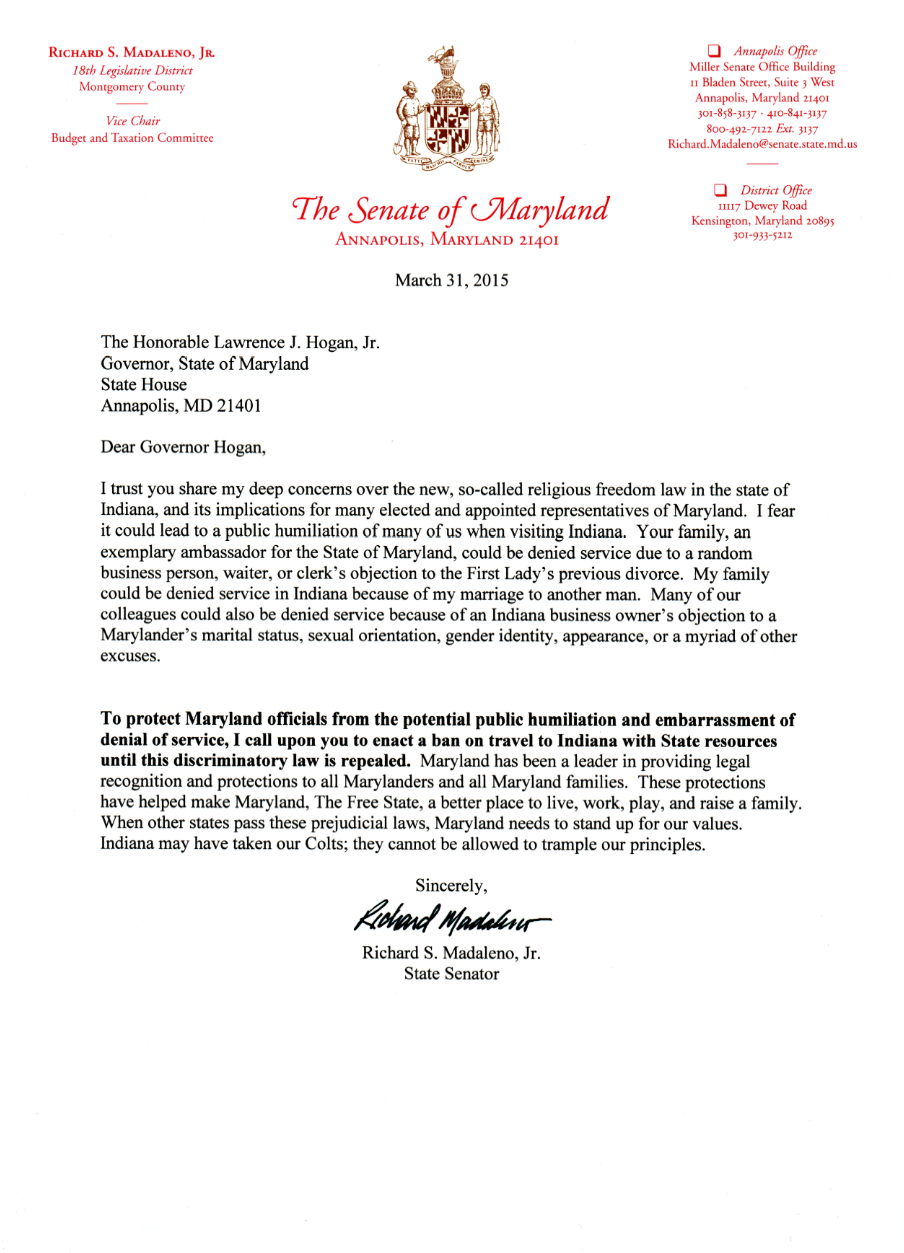
“Indiana may have taken our Colts; they cannot be allowed to trample our principles.”

Indiana Letter

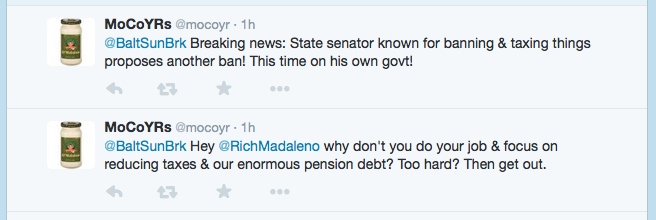
The Montgomery County Young Republicans have attacked Sen. Madaleno for his letter:

mocoyr

Interesting that the Young Rs view the letter as somehow an attack that needs response. I wonder how in tune they are with their members, as surveys routinely show that younger Republicans heavily favor LGBT rights.

These tweets seem particularly ill-timed since the budget just passed the Senate with bipartisan enthusiasm. If you’re unhappy about taxes and debt, Republicans now own it as much as the Democrats.

Share

Congressional Black Caucus Doesn’t Heart Donna Edwards

edwards cbcIt’s Not All Smiles Behind the Scenes

It’s poorly kept secret that Rep. Donna Edwards does not have particularly good relationships with much of the Maryland political establishment either in the State or in the House. But the National Journal recently also revealed the depth of her bad relationships with many other members of the Congressional Black Caucus (CBC):

Some current and former CBC members and aides, none of whom were willing to speak on the record, described Edwards as ambitious and aloof, saying she’s rubbed many in the caucus the wrong way. Others noted her public stances in opposition to other Maryland Democrats—an outlier in an otherwise collegial delegation.

One former staffer said that she essentially dropped out of the CBC for six months after a conflict with a colleague:

“I don’t think the CBC’s been a real priority for Donna. I don’t think she has particularly great relationships inside of the caucus,” said a former staffer for a CBC member. “I don’t think she’s going to win any popularity contests inside the CBC.”

In one particularly explosive episode, Edwards walked out of a CBC meeting last year after a dispute with Rep. Cedric Richmond. “He told her to get out, and she didn’t come back for six months,” said another former aide with CBC ties. “She didn’t come back until a month before she announced her candidacy for Senate. It struck a very disingenuous tone.”

Rep. Elijah Cummings could be the major beneficiary of Edwards’ problems with other members of the CBC:

Some CBC members were open in their desire to see Cummings enter the race. “I can only speak to the positive nature of the desire to get Elijah Cummings to run,” said Rep. Emanuel Cleaver. “There is a lot of interest in his candidacy from CBC members. … I would be stunned if the majority of the members aren’t supporting him.”

That preference could say as much about Edwards’ standing within the CBC as it does about Cummings’.

Even if Rep. Donna Edwards is the only African-American candidate, many CBC members might still sit this one out. Or even worse for her, they might support Rep. Chris Van Hollen:

“Donna Edwards has always been an outsider to the caucus,” said the former staffer with CBC ties. “The CBC overwhelmingly doesn’t think that Donna Edwards has managed her relationships well or even developed one. … I have heard members say that they will go and campaign for Van Hollen before they will support Donna Edwards.”

Share

Leaping Forward with Public Transit

leapThe Washington Post has a fascinating article on how technology is ripe to disrupt public transport just like it did for taxis with the arrival of Uber and Lyft:

The new venture-backed private transportation service Leap began offering rides in San Francisco last week in a swanky shuttle meant to feel “more like a living room than a bus.” A ride with the service, which costs $6 one-way or $5 in bulk, comes with WiFi, USB ports, a laptop bar and locally made pressed juices (for sale on board, that is).

Public transit is ripe for disruption — that’s why investors are backing these ideas. If you were to look around any city and try to identify a problem in need of lucrative new solutions that emerging technology might provide, the dreaded commute is an obvious one. Public transit can be inefficient, unpredictable, slow, crowded, or on its worse days downright broken. Transit needs a shakeup.

The fear is that new service would be only for the wealthy. From Anacostia, current Metro peak fares to Farragut West are $2.50, and $5.00 per day, probably cheaper than Leap. On the other hand, peak fare from Shady Grove to Metro Center is already $5.90 each way during peak hours. If you need to park, the daily cost rises to $16.90. So the difference in price in our area is cloudy, especially if competition enters into the game.

Government heavily subsidizes government-provided public transit and could subsidize rides for shuttles. Except that these subsidies could be targeted directly a lower income riders rather than to everyone regardless of income. Considering the cost of the DC Streetcar, Purple Line, and Baltimore Red Line, it would a lot cheaper.

Share

CD8 Target Demographics

Today, 7S continues to look at the demographic composition of the electorates in open congressional districts with the Eighth District. The first table shows the share registered Democrats in CD 8 broken down by (1) race and gender, (2) race and age cohort, and (3) gender and age cohort:

CD8 race age genderThe second table presents the same three demographic breakdowns but for voters who participated in two of the last four Democratic primaries. Close examination of the data reveals substantial differences between the makeup of the potential electorate of registered Democrats and likely voters, defined here as those who have voted in two of the last four primaries.

CD8 race age gender 2 of 4Race and Ethnicity

While whites compose 66.1% of registered Democrats, they form 77.4% of two-time primary voters. In contrast, African Americans are 18.3 of registered voters but only 14.3% of two-time primary voters. The drop off in Latino turnout is even higher–from 8.2% registered to 4.6% two-time participants. The share of Middle Eastern voters also falls from 2.0% to 1.0%.

Gender and Age

Women comprise 58.7% of registered Democrats but 59.6% of Democrats who voted in two of the last four primaries. Expect candidates to focus especially on messages that hold greater appeal among this key Democratic demographic.

There are vast differences in participation by age cohort. People who are 60 and older are just 32.8% of registered Democrats but 55.9% of likely voters. On the other hand, voters who are 40 and younger are 32.5% of the registered Democrats in CD 8 but only 7.9% of likely voters.

Put the two together and it becomes crystal clear that older women are a central demographic. They may form just 30.5% of registered Democrats but are 47.0% of likely voters. The age distribution of Black and Latino voters skews young, so this key group of older women will be disproportionately white.

Jewish Voters

The data I possess here do not give religious affiliation, though data bases exist that can estimate the Jewish share of the electorate based on surnames as well buying lists that indicate religious background (e.g. subscribers to Washington Jewish Week).

One 2003 survey estimated that 113,000 Jews lived in Montgomery County with 78% living in lower Montgomery County, which is almost entirely within the Eighth. The number of people living in Jewish households (i.e. including non-Jewish members) was higher at 133,000 with 77% in the lower County.

The total population of Montgomery at that time was around 915,000, so Jews formed around 12% of the population with people living in Jewish households composing close to 15% of the population. Of course, different surveys with alternative methodologies could well produce other results.

The Jewish population is heavily Democratic. Moreover, Jews skew older than other groups, and are more likely to both be registered and turn out to vote. But they will not necessarily support Jewish candidates. While Ben Cardin did very well again Kweisi Mfume in 2006, Ike Leggett carried many of the most heavily Jewish areas of the County when running against Steve Silverman that same year.

Share