All posts by David Lublin

Adam Replies to Gino on Liquor Control, Part II

Guest Blogger Adam Pagnucco replies to MCGEO’s Gino Renne

My reply to MCGEO President Gino Renne’s response to my post on the county’s Department of Liquor Control (DLC) continues.

  1. The union claims that state monopolies on alcohol sales enhance public safety.

MCGEO: “Dr. Roland Zullo, a research scientist at the University of Michigan, examined the impact of state ownership of retail alcohol distribution on 23 different crimes grouped in six categories. Dr. Zullo finds that state control of retail alcohol distribution is associated with statistically significant reductions in crimes that have been linked to alcohol consumption, including domestic abuse, assault, and fraud. Control states also had lower rates for vehicle theft and vandalism (using a slightly lower threshold for statistical significance, the 10% rather than the 5% level).”

Guess what? This “research” was financed in part by DLC. That’s right, the study MCGEO is citing is an unpublished, non-peer-reviewed working paper paid for by the National Alcohol Beverage Control Association (NABCA), a trade group of government alcohol merchants. George Griffin, DLC’s Executive Director, is a former President of NABCA and a current member of its board. The organization’s budget is partially financed by dues payments from its members, one of whom is DLC. NABCA is fighting efforts to end government alcohol monopolies and was greatly dismayed when Washington state voters got rid of their state monopoly in 2011. So NABCA paid for the working paper cited by MCGEO and it was completed a year and a half later.

For what it’s worth, the study found no statistically significant relationship between state control of alcohol sales and crime for 20 of the 23 measures it examined. Maybe NABCA needs to pay for a better study!

  1. The union opposes blogging(!)

Maybe this is beside the point, but it is too hilarious for me to resist.

MCGEO: “This [County Council DLC] resolution came after months of hearings, testimony and input from stakeholders. If you don’t like the way the process was playing out, Mr. Pagnucco, why didn’t you participate in it? Why are you using your friend’s blog to post your opinion without allowing for public input or participating in the public forum?”

So MCGEO regards blogging as an illegitimate way to participate in public discussions. Who knew? I have a long history of writing in favor of MCGEO’s positions and they have never before uttered a peep of protest. To the contrary; they republished two of my blogs on their website and used another on a handout. Their former Executive Director once asked me to write a piece supporting legislation the union wanted that would have allowed library workers to unionize, and since I favored the bill, I did. But in the one instance when I have publicly disagreed with them, I am told to cease my annoying prattling!

Do you think that MCGEO will resume its recognition of the value of blogging once I start agreeing with them again?

I will finish up tomorrow.

Share

Mikulski and Cardin 12th and 17th Most Liberal Senators

Sen114_Ideal_Point_PlotBThe graph shows the latest scores to be released by Voteview. Unlike conventional interest group ratings, they take into account all votes in the Senate (except those in which less than 5% of the Senate dissented from the majority).

The points show the estimates on the scale with most positive being more conservative. The lines around the points are 95% confidence intervals (i.e. the actual ideology of the senator has a 19 in 20 probability of falling on the line).

Presidential Candidates

Bernie Sanders is the most liberal member of the Senate. Rand Paul and Ted Cruz are literally off the charts as the two most conservative senators. Fellow Candidate Marco Rubio is the seventh most Republican while Lindsey Graham is the fifth most liberal.

Share

Adam’s Reply to Gino on Liquor Control, Part I

Guest Blogger Adam Pagnucco replies to MCGEO’s Gino Renne

Last week, MCGEO President Gino Renne, leader of the local union that represents most Montgomery County employees, responded to my post on the county’s Department of Liquor Control (DLC). President Renne has led MCGEO for more than twenty years and is an aggressive advocate for his members. I appreciate his taking the time to talk about DLC on Seventh State.

A few of his statements deserve examination. Let’s start with the one that is arguably most important to county consumers.

  1. The union claims DLC, an extra middle-man with an extra mark-up, actually has lower prices than our neighbors.

MCGEO: “Across all categories except special order beer, costs are 2-10 percent cheaper than neighboring jurisdictions.”

David Lublin put this argument to shame through his price comparison of DLC and Total Wine, which refuses to open a store in MoCo. Now let’s be fair: Total Wine not only blows away DLC, they beat almost everyone on price. How do they do it? The company explains:

We are committed to having the best wine selection with an emphasis on fine wines. This differentiates us from many retailers in the United States who specialize in one geographic area or price category. Our typical store carries more than 8,000 different wines from every wine-producing region in the world.

In addition to a world-class selection of fine wines, the typical Total Wine & More also carries more than 2,500 beers, from America‘s most popular beers to hard-to-find microbrews and imports, and more than 3,000 different spirits from every price range and category.

Total Wine & More is committed to having the lowest prices on wine, spirits and beer every day. Our tremendous buying power and special relationships with producers, importers, and wholesalers offers us considerable savings, which we pass on to our customers.

This business model is very difficult to implement with an extra middle-man interfering with the supply chain, especially one like DLC that is notorious for botching orders of specialty beer and wine. And so Total Wine will not open a store here even though its headquarters is in MoCo and its founders live here. MoCo customers are forced to drive long distances to access the company’s selection and low prices, and they do. Total Wine estimates that MoCo residents account for more than 20% of sales at its McLean, Virginia store and almost 25% of sales at its Laurel store.

But let’s set aside Total Wine for a moment and examine MCGEO’s assertion further. If DLC offers lower prices as they contend, that would be great news. Non-residents would be flocking into MoCo to get deals. We might even expect a proliferation of MoCo stores close to the county’s borders ready to lure non-residents in.

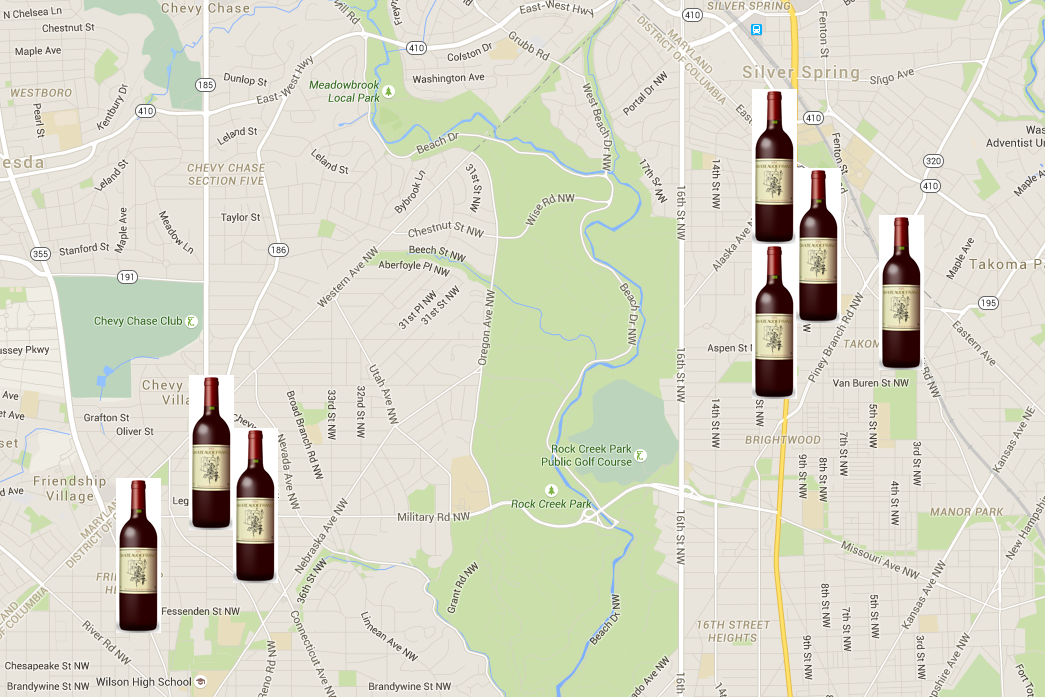
In fact, the opposite is true. There at least seven D.C. liquor stores within four blocks of the MoCo border. See the map below. The one DLC store near the border is in Friendship Heights and it is the only DLC store that is losing money. How is it possible for DLC to lose hundreds of thousands of dollars a year by selling alcohol to rich people? Perhaps one reason is that the District’s Paul’s Wine and Spirits is just three blocks away.

DC liquor stores

Alcohol sales data collected by the Maryland Comptroller’s office suggests substantial flight of customers away from MoCo. Both the U.S. Department of Health and Human Services and Gallup find positive correlations between alcohol consumption and education level, while Gallup finds an additional correlation with high incomes. Since MoCo is one of the highest-income and most-educated counties in the state, it should be a mecca for alcohol sales. But that is far from the truth. In terms of per capita sales deliveries to retail licensees inside each county, MoCo ranks 13th of 24 jurisdictions in wine, tied for 23rd in spirits and dead last (by far) in beer. Among the counties out-ranking MoCo in per capita wine sales are Calvert, Carroll, Cecil, Garrett, Harford and Kent, all mostly rural jurisdictions with far less disposable income than MoCo. Comptroller Peter Franchot, the principal enforcer of state alcohol laws and himself a MoCo resident, says of DLC, “Most people in Montgomery County go to Prince George’s, the District or Virginia to buy their alcohol because it’s such a disgrace.”

I will have more tomorrow.


Share

Franchot: DLC is “a Mecca of Anti-Consumerism”

Comptroller Peter Franchot on Montgomery County’s monopoly over retail and wholesale sales of alcohol in the Country:

Montgomery County is the last bastion of a medieval state system.

This is a system that is incredibly slanted against the consumer and the ordinary citizen.

Most people in Montgomery County go to Prince George’s County, or the District or to Virginia to buy their alcohol because it’s such a disgrace.

And these are some of the nicer things he has to say.

Share

On Julian Bond


I met Julian Bond for the first time like so many did: as the narrator of Eyes on the Prize, the wonderful televised series about the Civil Rights Movement. My African-American Politics professor required us to come in the evenings to watch the videos about events that were much more recent when he showed them in the late 1980s.

I didn’t realize at the time that one day I’d be showing an episode from the same series regularly in my class on Politics in the U.S. I would have been even more surprised if you told me that Julian Bond would be my colleague at American University where he was a Distinguished Lecturer for over two decades.

When another assistant professor and I first saw him down the hall in the late 1990s, neither of us had the nerve to go up and say hello and introduce ourselves. As my colleague put it, “that’s Julian Bond!”

His course on the Civil Rights Movement was much beloved not just because he served as a living bridge between the Movement and now who could communicate it to students. Or because he had a speaking voice and ability anyone would envy.

He took the time to respond thoughtfully and seriously to many, many students who came by his office hours. Though he was a fearless advocate with strong opinions who famously stood up to the powerful, he also somehow managed to be a consistently kind and gentle man.

Of course, I’ll always remember him for saying yes immediately to a request to speak out in favor of marriage equality during the referendum fight in Maryland. His clear and eloquent message of civil rights for all people unquestionably helped put us over the top.

His continued willingness to work for the basic dignity for all people until shortly before his death was typical. Long after he led the Student Nonviolent Coordinating Committee (SNCC) and fought successfully to be seated in the Georgia legislature, he spent many years restoring the NAACP to health and to respectability after it fell into crisis.

I’ll miss being able to refer students to his course–what an amazing opportunity it was for so many to learn from him. America will sorely miss a man who fought hard for justice with style and grace–and taught others to do the same.

Share

Tom Moore Will Not Seek Reelection in Rockville

Here is the statement he posted on Facebook:

After much soul-searching, I have decided not to run for re-election to the Rockville City Council this fall. I have cherished the privilege of serving the people of Rockville on their Council. But my family has paid a high price while I have campaigned and governed virtually nonstop over the past six years, and it is time for me to turn my attentions homeward.

Though I am keenly disappointed that my elected service must draw to a close for the time being, I take great satisfaction in what I have helped accomplish in office:

• We ended our downtown’s disastrous decade-long building moratorium;

• We saved an entire affordable neighborhood from developers who would have priced hundreds of working families out of their homes;

• We adopted a tough City ethics law; and

• We protected Rockville residents’ privacy by placing sharp limits on the data the government keeps on our movements.

My hard-won victories on these and other issues leave the City in a much better place than when I joined the Council. We can better protect our existing neighborhoods and better create great new ones. We can better compete with neighboring jurisdictions for residents and businesses and investment. The tough decisions I made on budgets and utility rates will maintain our infrastructure and strong City services for years to come.

I am surpassingly grateful for the efforts of Rockville’s superb City staff, whose round-the-clock efforts have made my job significantly easier every moment I have served in office.

You should know that I am very excited about some good folks who are preparing to run for office in Rockville this year. You will be hearing much more from them in the coming weeks. Keeping Rockville such a wonderful place to live, work, and enjoy life requires dynamic, experienced, and forward-looking leadership. We will have the chance for just that this fall. Stay tuned!

Finally, I am deeply grateful to the hundreds of friends and neighbors who have worked so hard over the years to send me to office so I could help fulfill our shared vision for a progressive, efficient, fair, safe, and neighborly Rockville. Thank you for giving me the opportunity to make our great City even better.

With warmest regards,

Tom

I can understand him calling it a day after six years–the same amount of time before I made the same decision. Tom was most recently in the news on this blog regarding Rockville’s debate over the removal of a statue of a Confederate soldier.

Share

MCGEO’s Ridiculous Claim that the Department of Liquor Control Saves Consumers Money

Yesterday, I published a reply by MCGEO’s Gino Renne to Adam Pagnucco’s guest blog on Montgomery’s Liquor Control Regime. In his reply, Renne attacks Pagnucco’s claim that the Department of Liquor Control (DLC) raises prices:

In his first false claim, Mr. Pagnucco claims that DLC’s operations increase costs for the consumer. Across all categories except special order beer, costs are 2-10 percent cheaper than neighboring jurisdictions.

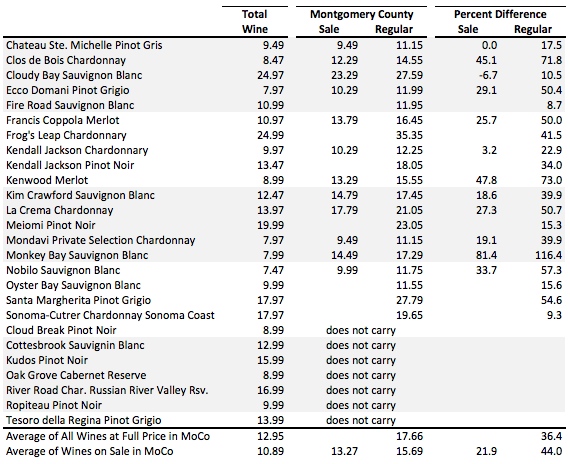
This claim struck me as incredible, so I decided to do a sampling of wine prices at a Montgomery County Liquor Store and Total Wine in McLean, Virginia. I focused on comparatively affordable wines and picked out some first at the DLC store and others from Total Wine, and did not know the price of the wine at the other store when I selected it (i.e. no cherry picking).

The results are presented in the following table:

wine

Among the 26 wines, DLC doesn’t carry seven–I checked with the cashier who searched the computer. Only one wine was cheaper at the DLC store and another at the same price, and these two bottles were on sale.

Looking only at the 12 wines currently offered at a discount at Montgomery DLC stores revealed that even their sales tend to be lousy deals. The discounted prices on these wines were an average of 21.9% higher than at Total Wine. When this same set of wines is not on sale, the difference rises to 44.0%.

Examining the larger basket of 19 wines available at both stores shows that regular prices in DLC stores average 36.4% higher that at Total Wine across the river. Put another way, it would cost you an extra $89.04 (plus tax) to buy them in Maryland.

If Gino Renne begins his argument for maintaining the status quo with an obvious, easily disproved falsehood, why should anyone believe anything else he or MCGEO has to say on the subject?

Here is the real capper: Total Wine has its headquarters in Montgomery County but it cannot open one of its (nicer than DLC) stores and offer the same prices here. If you want to know why, look no further than MCGEO and the County Council.

Share

MCGEO Responds to Pagnucco on Montgomery’s Liquor Control Regime

Gino Renne, President of UFCW Local 1994 MCGEO, Responds to Seventh State’s Guest Blogger Adam Pagnucco on Privatization of Montgomery County’s Department of Liquor Control:

Mr. Pagnucco opens his blog by stating that, “Few issues in county government have received more attention over the past two years than the operations of its Department of Liquor Control (DLC).” What a distraction! There are a lot of issues in Montgomery County’s Government that have received attention over the past two years, only one of which, the privatization of the DLC, seems to be receiving a lot of attention from the privileged elite in the County. Most of the County’s residents see far more pressing issues – the funding of the Purple Line, improving other parts of the County’s transportation infrastructure, increasing affordability of housing, and generally serving the needs of our county’s less-than-privileged with better wages, better economic opportunities and better public services. But since Mr. Pagnucco seems to think that we need to privatize DLC and claims that there are a bunch of “myths” surrounding DLC privatization, and he is using a one-sided platform to promote privatization rather than attend the Ad Hoc committees numerous public hearings and meetings, we’ll bite.

In his first false claim, Mr. Pagnucco claims that DLC’s operations increase costs for the consumer. Across all categories except special order beer, costs are 2-10 percent cheaper than neighboring jurisdictions. Many of the smaller retailers are against privatization primarily for the reason that DLC levels the playing field and keeps costs even.

Myth 1: Mr. Pagnucco claims that the County does not need DLC’s net income to function.

Actually, it does. Montgomery County, MD will owe $165,534,675 from 2015-2034 in debt service of revenue bonds that are currently paid through the revenues generated by the Montgomery County DLC. Additionally, the OLO report states that DLC has generated an average of $25.7 mill per year over past decade. That figure is nearly the entire Recreation Department or Library budget. Not chump change. The OLO report acknowledges potential lost revenue that will need to be made up through various fees, auctioning of licenses or a dedicated sales tax. However, the OLO report factors in no additional costs that would occur under a transition from county control to private enterprise. There would be leases to be paid, buyouts for early retirement, increased costs for enforcement and public health issues, etc.

While it’s easy to agree that the County will find a way to adjust, why should it? It has a guaranteed source of revenue that you propose the County throw away to make it easier for consumers to buy when there’s also no guarantee that consumption would increase. In Washington State, after privatization, sales only increased by 6% in its first year, while the next year data shows no increase. In addition, with increased prices, many consumers near the Oregon border are visiting liquor stores there to bypass the price increases. If privatization here were to follow the trends in Washington State, we’d definitely lose revenue to our neighboring jurisdictions.

Pennsylvania’s public liquor stores, which just beat back efforts to privatize, have reported a record boost in sales that are said to be due to improvements and modernization. A liquor board member said that people living in a border area are returning to shop in Pennsylvania stores because of the improvements.

A better solution is to keep the current public model in place with its fair prices and guaranteed revenue while expanding DLC stores. The resolution passed by the Council last week allows for this solution.

In Myth 2, Mr. Pagnucco claims that DLC monopoly isn’t needed for public safety, quoting decreased DUI and drunk driving arrests in newly privatized Washington State as evidence.

An official with an ALEC-connected think tank in Washington notes that this claim doesn’t really hold water. “Privatization didn’t improve the numbers necessarily but it didn’t make it any worse either.” A Washington state police spokesman adds, “I don’t think you can draw a correlation that because of private sales now we have fewer alcohol related arrests. The number of arrests is much more directly connected to the number of police officers out there actually patrolling.” The state police official notes that there are 80 fewer state troopers than previously, which has led to the decline in arrests. Couple that with legalization of marijuana in that same time period, one can draw the conclusion that arrests could have just as easily declined due to substitution of one drug of choice for another.

Tori Cooke, president of the Montgomery County FOP, testified that privatization would create public health and safety issues that are not easily addressed. And he and his fellow officers are against any efforts to privatize.

Dr. Roland Zullo, a research scientist at the University of Michigan, examined the impact of state ownership of retail alcohol distribution on 23 different crimes grouped in six categories. Dr. Zullo finds that state control of retail alcohol distribution is associated with statistically significant reductions in crimes that have been linked to alcohol consumption, including domestic abuse, assault, and fraud. Control states also had lower rates for vehicle theft and vandalism (using a slightly lower threshold for statistical significance, the 10% rather than the 5% level).

In Myth 3, Mr. Pagnucco claims that privatization would not result in the loss of high paying union jobs.

This is his most egregious of claims, especially for a former union employee. Where’s the evidence that “many private wholesalers” are represented by IBT? Or even evidence that union membership will not suffer a net loss? Mr. Pagnucco needs to explain himself on this one. I don’t know how he sees that transition occurring.

These are our members; it’s our job to protect them and to protect unions in general. It’s a public policy issue. There are societal costs. How much is it going to cost to put these people on the streets? Where are the high paying jobs that are family supporting and middle class sustaining going to come from for these 400 employees? I doubt we’ll see them at the mom and pop shops that could pop up if privatization were to occur. It’s extremely difficult to organize a union in your workplace these days. Although the NLRB is trying to speed up the process, the length of time from a certification election to a first contract can still take years. Union busters find many successful ways to stop a union campaign, as Mr. Pagnucco well knows.

DLC is able to provide good jobs with benefits while generating tens of millions to county coffers. Meanwhile, privatization will create minimum wage liquor clerk, warehouse and delivery jobs with little-to-no benefits that will exacerbate our economic inequality in this county. Sure, privatization could create union organizing opportunities, but no way it would create net gains in union membership.

In Myth 4, Mr. Pagnucco claims that the DLC is not getting better.

First and foremost, the fraud, waste and abuse in the private liquor industry is as rampant as it is in the public sector, if not more. But, because it’s private industry, it isn’t enforced or prosecuted very often or as publicly. In 2006, eight wholesalers in New York were ordered to pay $1.6 million in fines and costs for a “pay to play” scheme that favored larger retailers and provided discounts and inducements to those willing to pay. Meanwhile, smaller licensees were forced to cope. Under DLC’s structure, small licensees are given the same treatment as larger purchasers. With oversight, the DLC is forced to answer for its practices and it does. Private industry will not be given the same oversight.

Secondly, the DLC was hamstrung by technology purchases that were inappropriate for its needs and a hiring freeze, forcing customer service to suffer. Both of these were county mandates, not DLC-specific. It’s now been given the go ahead to hire and has made significant strides on that front. The ordering system is getting its revamp as well.

Yes, we agree that the system needs to be more nimble – it shouldn’t be forced to follow county-imposed hiring freezes and should be allowed to buy technology that specifically fits its needs, especially since it is a self-funded department.

In Myth 5, Mr. Pagnucco claims that the resolution to allow private wholesalers to fulfill sales of special order items is not “historic reform.”

We agree, it’s not “historic.” That’s hyperbole used for political purposes but it is a significant change for the department. Part of the change should make the DLC more nimble and part of the change should allow for expansion of the DLC’s store base. The “fee” Mr. Pagnucco complains about is paid by the distributor to allow for its participation in the Montgomery County market. Its structure has not yet been determined, just that there will be a fee.

Comparing the County DLC to the USSR’s failed perestroika? Really? I hope all readers realized that this is an absolutely absurd comparison. This resolution came after months of hearings, testimony and input from stakeholders. If you don’t like the way the process was playing out, Mr. Pagnucco, why didn’t you participate in it? Why are you using your friend’s blog to post your opinion without allowing for public input or participating in the public forum?

Again, I will emphasize there are much larger issues facing Montgomery County residents than from whom they can buy their liquor or wine. You need to respect the process and move on from this DLC issue and tackle our real problems.

Share

Explaining Leadership Loyalty Among U.S. House Democrats v. Republicans

As long as I’m focusing on U.S. politics today. . .

Charlie Cook has a set of very interesting analyses of loyalty to leadership among Democrats and Republicans. While Democrats who live in safe districts are more likely to vote with Pelosi than Democrats from marginal districts, the opposite is true among Republicans. Marginal district Republicans are much more likely to vote with Boehner than Republicans from safe districts.

This pattern is likely explained by primaries and the unusual disjuncture between the hardcore Republican base and the House leadership. Members from safe districts in both parties have a huge incentive to pay more attention to their primary rather than general election electorate. While moderation is rewarded in the general election, it’s all about the base in a party primary.

As a result, Democrats from safe districts have no problem casting solid left votes. Notice that the major Democratic defection from President Obama was on trade, where he lost Pelosi’s support and was at odds with the Democratic union and left-wing base.

The Republican conservative base is hostile to efforts by Boehner and McConnell to concede ideological points in order to govern. Ted Cruz’s attack on Mitch McConnell was an applause line at last night’s debate! So Republicans from safe districts are more likely to rebel against their party’s leadership. In contrast, marginal district Republicans want their party to look reasonable and able to make the government function so they vote with Boehner.

Share

Republican Debate Wrap Up

So I am currently in an undisclosed location with no television, which still did not leave me safe from political debates. Nevertheless, thanks to the inability of the FOX news stream to work, I had to listen to it on the radio feed while watching a picture about 10 seconds off from the talk on the home page.

Right Wing and Angry

I was struck once again how right wing the Republican Party has become. Jeb Bush, probably the most conservative governor of his (now past?) day, was one of the “moderates.” Projecting strength was the order of the day with Paul’s efforts to hearken back to a day when conservatives believed doing less was more falling flat.

Angry too. President Barack Obama isn’t just wrong. He’s a traitor who has perpetrated countless unconstitutional acts, weakened our military, and ruined America. Not many rays of sunny optimism save for the Horatio Alger competition at the end of the debate that would not have been out of place in a Democratic debate.

Good Questions, Some Bias

The three questioners from the right-wing media establishment asked good, tough questions. Their major negative moment was Chris Wallace’s decision to turn “illegals” into a noun, which I guess was shorter than “those brown people.”

The Republicans may be having a bromance with Trump but FOX wants to break them up. The three moderators were gunning for the Donald who repeatedly received questions that one would call “gotcha questions” except they were totally legit.

On the other hand, Marco Rubio received the easy softball about what he’d do to improve small business. Gave him the opportunity to hit the usual Republican erogenous zones. FOX man crush?

El Trumpo

Contempt. This guy has it for everyone. One even had the sense that he had it for the people who let him on the stage. A one man walking self-admiration society. With Trump, the answers may devolve into word salad but it’s all about the attitude.

Bush Part III

Felt like he was serving reheated pablum from the previous Bush administrations only that he’s too bright to believe it, which tended to weaken the delivery. You never quite feel you know where he stands–a problem in an election where “authenticity” (even if from a fake reality TV star!) seems the order of the day. He tried to dog whistle the right at the end with a Terri Schiavo allusion but it didn’t seem like a night for subtlety.

Though he nonetheless came across as one of the adults in the room, Bush’s unavoidable ability to remind us of his brother and complete hogwash of an answer on how he would create 4% economic growth through magical thinking made him look less like a general election winner than before the debate.

Marco Rubio

Has somehow managed to make Republicans forget that he was one of the major sponsors of the much reviled immigration reform bill. Rubio had the most telegenic delivery in the debate. His youth combined with not being Bush made him seem a more likely candidate if the goal is to get the Republicans to nominate someone credible who can get voters to turn the page.

If he does become the nominee, expect Democrats to play the clip unceasingly on his opposition to banning abortion in cases of rape and incest in response to a question from Megyn Kelly. Many Americans are uncomfortable with abortion but this provides a clear distinction that any Democrat would be glad to draw.

Ted Cruz and Rand Paul

Fascinating to see how the Republicans are no longer just that into the two guys who enchanted so much after the 2014 elections. Paul was an object lesson on what not to say to appeal to Republican voters.

Cruz continues to try to win the game of who is the most conservative of them all. But somehow pressing that button isn’t working for him anymore–at least not yet. Completely uncompromising and a good example of how our dysfunctional government could become more so.

And the Rest. . .

Huckabee is extremely comfortable on television. Sorta like an infomercial that leaves me deeply uneasy. Republican commentators thought he did well and he certainly wasn’t gunning for my vote.

Ben Carson’s soft-spoken delivery left me utterly confused as to why he is a Republican phenom. Unless his job is to explain why it’s OK never to talk about race–his big applause line.

Chris Christie’s ongoing problem is that he is the Lucy Ricardo of the Republican candidates–he always has some ‘splainin to do and never sounds altogether convincing doing it. Couldn’t answer why his state’s bond rating has plummeted even though he’s done such a bang up job balancing the books. Loves the blame game–it’s always someone else’s fault. Doesn’t look like Gov. Hogan’s endorsement will pay off for Maryland in future.

John Kasich sounded like a reasonable guy with experience. This leads me to believe he is unelectable in a Republican primary, despite the clear affection from the hometown crowd. But it’s hard to imagine how any nominee would not give serious thought to putting this popular swing-state governor on the ticket.

Scott Walker made no memorable impression on me. No gaffes and nothing off from the Republican script.

Final Note

As @PeterBeinart tweeted, “how on earth does Saturday Night Live parody this?”

Share