All posts by David Lublin

The State of Play Before Primary Night II: CD8

The Democratic primary in the Eighth Congressional District is fierce. And no wonder. Whoever wins is virtually assured of becoming a new Member of Congress in this safely Democratic territory.

Adam Pagnucco has done a good job outlining the strength and weakness of the three leading candidates (Matthews, Raskin and Trone), so I thought I’d look at how the other candidates may impact the race even if they don’t win.

Del. Ana Sol Gutierrez has run a somewhat quixotic campaign that has mainly been about advancing her progressive point of view in debates. Her campaign lacks to money to be competitive even though she has loaned it money from personal funds.

Despite the lack of funds, I heard from one voter that saw a television ad. Unfortunately for Gutierrez, advertisements have to play a lot in order to have an impact and her budget is simply not large enough to buy that hefty an ad buy.

She has sent out one bilingual piece of mail in the form of a newspaper. Voters may pick it up and take a peek because it’s original. But it has a lot of small print and many photos of the candidate in the style of the North Korean Central News Agency‘s coverage of Kim Jong Un.

Despite these limits, Gutierrez may have an impact. She had volunteers at the Lawton Center early voting center in Chevy Chase. Moreover, she has been in public office for 25 years as a candidate for the School Board and then the House of Delegates.

Gutierrez’s final political move has been to endorse Bernie Sanders. This seems more likely to do her more good than Bernie, as she links her campaign to a popular progressive and appeared on stage to endorse him at a rally in Baltimore.

As the first Latina elected in Montgomery County and a known  name, I expect Gutierrez to pick up a good chunk of the Latino vote. Indeed, it seems likely to propel her into fourth place even if she loses much of her past non-Latino support to Jamie Raskin.

Raskin seems most likely to be hurt by Gutierrez’s presence in the race. He represents a large Latino community in District 20 and has advocated strongly on a variety of issues from immigration to social justice that Gutierrez also emphasizes. It would certainly be ironic if Gutierrez, who ran to advance progressive issues, ended up costing the leading progressive candidate the nomination.

Del. Kumar Barve is a former majority leader of the House of Delegates who represents Rockville and Gaithersberg. Smart and quick, he’s one of the funniest members of the House of Delegates. Like the other state legislators in the race, he has ended up heavily on the liberal side of most issues.

Barve has more money than any candidate outside of the top three but remains out of their financial league. He has attempted to gain notice through strong criticisms of Raskin’s ads but my assessment is that these efforts have gained very limited traction.

At the risk of making Barve sound far older than he is, Barve was the first Asian American elected in Montgomery County and, indeed, is often highlighted in descriptions of pioneering elected officials. This would seemingly be an advantage in a county with a large and growing Asian American population.

Unfortunately for Barve, most Asian Americans identify less as Asians and more by their national origin. As Barve likes to note somewhat ruefully, he has the Hindu vote nailed down with the implication being that just won’t get him far.

Barve is one of those candidates who I could well have imagined breaking through but it hasn’t happened for him for a variety of reasons, including Trone’s money attracting so much attention. It would be nice for Barve if he finished well in the portions of the district he represents in the House of Delegates.

Will Jawando ran a good but losing campaign for the House of Delegates in District 20, home to Jamie Raskin. Two years later, he has jumped into the congressional race. Jawando is young attorney with a family who is also running on progressive platform and is easy to imagine winning public office in Montgomery County.

Jawando’s decision to enter this race surprised many. The safer bet would have been to help Raskin win election and then angle to win appointment to the state legislative vacancy. Jawando would have been a very strong candidate due to his own abilities, respectable finish last time, and links to the congressional winner.

While Rep. Elijah Cummings has stayed out of the U.S. Senate race, he has endorsed Jawando for the Eighth District. As the only African American in the race with support from a prominent African-American Democrat, albeit not from around the area, Jawando has the potential to attract some votes.

As with Gutierrez, this could hurt Raskin. However, Jawando is less well-known that the long-established Del. Gutierrez, so it’s unclear how big a splash he will manage to make in the race.

Joel Rubin is a friend and neighbor. He’s a nice, personable guy who, like many in Montgomery County, has been active in federal politics but at the local or state level until now. Rubin has raised a nice sum of money and run a good campaign even though he just lacks the funds or previous support base to be competitive.

Even though this is his first race, he’s shown some good clever, campaign abilities, including producing these excellent YouTube videos on Trone and and his own family story:

Like Will Jawando, I would not be surprised to hear more from Joel Rubin in the future.

Finally, I know little about Dan Bolling and David Anderson. Bolling is running as the anti-partisan candidate and Anderson appears to be a well-meaning progressive. I do not expect either to have a major impact on the outcome of the race. Click on the links to learn more about them.


Share

The State of Play Before Primary Night I

The Presidential

Maryland was made for Hillary Clinton. She has done very well among African-American voters, who form 30% of the State’s population and will comprise a higher share of Democratic primary voters. The exit polls from 2008 indicated that women composed a staggering 62% of the primary vote, another good demographic for Clinton this year.

Finally, Bernie Sanders is running as an anti-establishment candidate in a State where many primary voters literally live inside the Beltway. While the Obama campaign swept many of these same areas in 2008, there is no remotely parallel wave for Bernie Sanders.

On the Republican side, I suspect Trump will have a good night. Class dynamics are unusually inverted in Maryland with many upper class Democrats and working class Republicans, who have provided the backbone for Trump’s support elsewhere.  Will Gov. Larry Hogan end up having to explain whether he’ll support Trump to the same Republican coalition that elected him?

The U.S. Senate

In Maryland, the presidential primary has ceded marquee status to the hard fought battle between Donna Edwards and Chris Van Hollen. It has become a battle between the uncompromising progressive and the person who gets progressive results.

EMILY’s List upped the octane in this race by dumping millions on the side of Edwards, providing the bulk of her campaign funding. No doubt this has been a unpleasant surprise for Van Hollen, who likely expected to dominate due to his fundraising prowess and has enjoyed strong support from women’s groups in the past.

Lately, however, these advertisements have become a mixed blessing, as bizarre attempts to characterize Van Hollen as opposed to gun control or campaign finance provoked a backlash from the White House and critics. See Jonathan Shurberg’s excellent summary.

Edwards has been hoping that her compelling personal story, ability to bring some diversity to the Senate, and strong progressive credentials will help her unite progressive white and African-American voters into a winning coalition.

However, after months of a tight race, polls indicate that Van Hollen is pulling ahead but the voters will have the ultimate say tonight. If he does become the Democratic senatorial nominee, commenters will likely point to several factors.

First, I don’t think Edwards has convinced voters that she is more progressive than Van Hollen in any meaningful way. Van Hollen has also managed to sell the argument that he is not just progressive but accomplishes progressive goals more compellingly than Hillary Clinton in the presidential race.

Next, Edwards has not obtained support from key African-American officials, like County Executives Rushern Baker and Isiah Leggett. The silences from Rep. Elijah Cummings’ office and the Congressional Black Caucus are also deafening. Edwards has nonetheless done an impressive job uniting black support across the State, particularly in light of these gaps in her support base.

As she goes into the final stretch, Edwards has hammered home her personal story and that she would be only the second black woman in the Senate. No one could seriously argue against the desirability for more diversity in the Senate.

But the dominance of this argument risks reducing her campaign to only identity politics. It needs leavening with other elements to sustain substantial cross-racial appeal even though the Black Lives Matter movement gives it a natural energy that could still make this a close race tonight.

I know too little about the Republican race to comment.

Share

Delegates for Corporate Welfare

The General Assembly managed to pass a tax subsidy worth $37.5 million for Northrup Grumman but not to enact the increase in the Earned Income Tax Credit (EIRC) that both houses favor. Laudably, the House  did not tie the EITC increase to a tax cut for the wealthy like the Senate but instead adopted a broad based tax cut.

Nonetheless, the corporate welfare for Northrup Grumman easily passed the House of Delegates 76-57. Twenty-eight House Democrats supported this giveaway, including several who identify themselves as progressive leaders in the House:

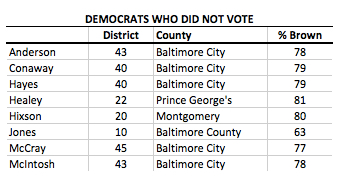
NG Dem DelEight Democrats didn’t vote on the issue, including a few members of the House leadership team:

NG Dem NV

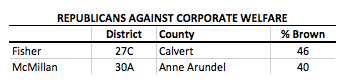
Two Republicans stood for conservative principles and did not give away your tax dollars to a corporation that already does quite well at the federal trough.

NG GOP

Share

On the Trone Campaign

Once this election is over, Democrats all over the Eighth Congressional District are going to feel jilted as the never ending stream of direct mail from David Trone comes to a sudden halt. So I’m playing this one in advance of primary day.

Seriously though, David Trone is running an excellent campaign. Many wealthy people decide to run for office but are completely oblivious to their lack of political expertise and spend their money badly. David Trone has hired experts, and he has hired good ones.

Trone’s direct mail is not only plentiful, it’s attractive and well-designed. It comes in a variety of formats. If you don’t read the postcard, maybe you open the letter. It’s also targeted; I received at least two pieces based on my ethnicity.

His television ads are similarly well done based on the few I’ve seen. Thanks to the blessings of Tivo, I see fewer political ads than many. (Some friends are impressed that I manage to watch TV not see most of Trone’s ads.) Increasingly, I suspect, viewers of commercials on television skew older. But that’s not bad in a primary because so do the voters.

Younger viewers may have been forced to watch when they viewed shows online, as most do nowadays. I imagine I might’ve seen more videos for Trone if I clicked on the many net ads, though I wonder greatly if they are effective.

Trone also has a large staff of paid canvassers. They’re way better than paid people that I’ve seen in most state legislative campaigns, who usually can’t wait to dump the literature and get home. Nonetheless, Trone’s people remain less passionate and knowledgeable than volunteers. Scratch the surface of his pleasant crew, though I am not sure many do, and they don’t know much about their guy.

The canvassers are also well targeted. Anyone who requested an absentee ballot soon had a Trone canvasser at their door. And Trone has very heavily promoted absentee ballot requests from people who have not voted in primaries previously.

If Trone loses, it won’t be because he spent his money badly.

The real question remains why Trone wants to be a freshman member of Congress. It doesn’t seem to be any particular issue passion. A clear campaign weakness is that his stances on public policy are cookie cutter and undeveloped.

Beyond wanting this to acquire this particular political success and to highlight his considerable business acumen, one wonders why he doesn’t run for an office where he could really shake things up. A Trone campaign for County Executive would sure unsettle the plans of most of the County Council.

Share

Senators for Corporate Welfare

The General Assembly couldn’t manage to pass an increase in the Earned Income Tax Credit (EITC) even though both houses supported it. In contrast, the bill giving Northrup Grumman a $37.5 million tax credit sailed to passage.

Who in the Maryland Senate supported this fine example of corporate welfare?

One Republican Against Corporate Welfare

Just about every Republican voted for the bill. Sen. Michael Hough (R-4) was the sole Republican who voted no, possibly because he is a conservative who (1) wants a simple tax code, (2) doesn’t think government should interfere in the free market by helping out only favored businesses, and (3) wonders why his tax paying constituents shouldn’t get the break instead of Northrup Grumman.

Democrats for Corporate Welfare

Nineteen Democrats joined the twelve Republicans who voted for the bill. The following chart lists them in decreasing order of support for Democrat Anthony Brown in the last election:

DforNGThough seven represent legislative districts that voted for Hogan, the rest hail from districts won by Brown. Nine of the 19 represent extremely safe Democratic districts. In these nine, Brown won by 59% or more, and all won election in 2014 by 62% or more.

Four more represent districts carried only narrowly by Brown (i.e. 50-52%). But even these senators do not face serious general election danger. Obama fared much better in the same territory, and Democrats won them by 57% or more in 2014 despite the terrible electoral fortunes faced by Democrats around the country.

Sen. Craig Zucker (D-14), recently appointed to replace retired Sen. Karen Montgomery, is tacking to the right of his predecessor. Besides voting in favor of giving money to Northrup Grumman, he also supported the tax cut for the wealthy. An interesting strategy as incumbent Sen. Rona Kramer lost to then-Del. Montgomery the primary after being attacked as too pro-business.

Dumb Politics

The politics of the legislation make little sense. It’s not even a question of alienating liberals. It’s hard to see how Democrats win more votes here from anyone. Are moderates, let alone liberals, really going to vote Democratic because Northrup Grumman received a tax giveaway?

The icing on the cake is that the Senate simultaneously killed off an increase in the EITC by standing firm in favor of a tax cut for the wealthy instead of for the middle class.

Share

EITC Increase Dies But Northrup Grumman Gets Corporate Welfare

One of the big battles of the General Assembly’s now ended legislative session centered around proposals to increase the Earned Income Tax Credit (EITC) and to cut taxes. Both the Senate and the House proposed an increase in the EITC. But while the Senate tied it to a cut in marginal rates for the top 11.1%, the House passed a broad based tax cut.

No EITC or Middle Class Tax Cuts

Conference negotiations resulted in stalemate, as the Senate held out for its tax cut on the wealthy. As a result, no tax cuts and no increase in the EITC. The political sense in the Senate’s position was lost on me. The Democratic-controlled Senate held the EITC hostage to a tax cut for the wealthy for which the Governor would inevitably claim all the credit. Bad policy and bad politics.

Don’t Worry, We Have Northrup Grumman’s Back

Meanwhile, the General Assembly passed a $37.5 million tax credit for Northrup Grumman. The Senate even voted down an amendment that proposed to make it nonrefundable. While the legislature made progress on other fronts, the General Assembly bombed the fundamentals on tax policy.

Heck, Republicans should have opposed this turkey too. If you really believe in the free market, then you should also believe that government should not pick winners and losers or give some businesses special treatment.

Sen. Rich Madaleno, who opposed the tax cut for the wealthy and the corporate welfare for Northrup Grumman, summed up the situation well in a tweet: “Sadly only Northrup Grumman gets expanded EITC.”

How Did They Vote?

That’s for tomorrow’s post.


Share

House of Delegates Tax Bill Vastly Superior

The Maryland Senate has passed a tax cut that is directed at the top 11.1% of taxpayers. It would reduce marginal tax rates for individual taxpayers who make more than $100,000 and joint taxpayers who make more than $150,000, while the people who earn less than this receive no cut in their rates and get peanuts – or more specifically, money enough to buy a meal at Chipotle.

In contrast, the House of Delegates has passed far superior tax legislation. Instead of focusing the benefits on wealthy Marylanders, the House bill would lower the marginal rates on income earned between $3001 and $100,000 (and up to $150,000 for joint taxpayers). The wealthy would still get a break but this bill, appropriately, directs far more of the benefit to the much-squeezed working and middle classes. Like the Senate bill, the House bill also expands the Earned Income Tax Credit (EITC).

Politically, it should be a no brainer to junk the Senate bill and adopt the House legislation, particularly for Democrats. While maintaining the EITC changes much needed by the working poor, the House bill distributes the tax cut far more widely and equitably. Let’s hope that the House and the Speaker stand firm.

Share

The GOP Bench, Part IV

The following is a guest post by Adam Pagnucco:

Most attention concerning the next round of state and local elections centers on the Governor’s office. Can the Democrats find a nominee to knock off Larry Hogan or can the Governor earn a second term? But the playing field is much larger than that. In truth, we are about to find out whether Maryland is on its way to becoming a genuine two-party state.

For most of the last few decades, the Maryland Republican Party has been almost irrelevant. Their sole Governor from the seventies through the early 2000s, Bob Ehrlich, was ejected after one term. Their presence in the General Assembly was negligible. Most of the large local governments were controlled by Democrats most of the time. The great debates of the day were driven by discussions within the Democratic Party and were not affected very much by those on the outside. But there is a real question now as to whether that sort of Democratic dominance will continue.

Regardless of whether Governor Hogan is reelected, the GOP enjoys a stronger position for future elections than anyone can recall in recent times. In 2022, the County Executives of Anne Arundel, Harford and Howard could very well be running for the GOP gubernatorial nomination whether Hogan wins a second term or not. If and when they do, Republican council members and/or state legislators will run to fill those Executive seats and become the next generation of local leaders. Competition for local council seats will be fierce in swing jurisdictions like Frederick, Howard and Baltimore County. Term-limited local officials will run for the General Assembly. In other words, in the absence of an earth-shattering event (like a Donald Trump presidency) or a mass revival of the Maryland Democratic Party, the Republicans’ recent gains could become self-sustaining.

The GOP will probably never be the majority party in Maryland in our lifetimes, but they don’t have to be. All they have to do is become competitive. That will enable them to become a factor in public policy debates both through their ability to win and hold elected office and through the threat of their doing so. We may already be seeing the effects of this as a bill to steer public funding to private schools has passed the Maryland Senate. Of the 25 Senators who voted in favor it, 14 were Republicans and some of the Democrats came from competitive areas like Anne Arundel, Southern Maryland and the Eastern Shore. The House did not pass the Senate’s proposal, but did agree to use public money to fund private school scholarships for the first time in the budget. Rising right-wing influence may also be a factor in the Senate’s passage of tax cuts for the rich. This is a reversal from the Senate’s approval of tax hikes for “half millionaires” (those making $500,000 or more) in 2012 and the General Assembly’s approval of a temporary millionaire tax in 2008.

Another consequence of the GOP’s ascent could be the empowerment of its extremist elements. Governor Hogan presents a moderate face to the public. But a recent Baltimore Sun poll found that 34% of Republican primary voters supported Donald Trump for President and another 25% supported Ted Cruz. That is sure to capture the attention of Republican elected officials and influence their behavior. Republicans like race-baiting Delegate Pat McDonough (labeled by the Sun as “the Trump of Baltimore County”); neo-Confederate Anne Arundel Council Member Michael Peroutka; Delegate Neil Parrott, who wants to require HIV victims to get tattoos to obtain medicine; Hogan-appointed anti-LGBT and anti-immigrant Baltimore County school board member Ann Miller; and Frederick County Council Member Kirby Delauter are all part of the GOP bench. Imagine what they would do with real power.

The challenge facing Maryland Democrats is not just Governor Hogan – it’s also the growth of the GOP in areas other than the two Beltways and the portion of I-95 connecting them. Will the Democrats respond with a sweeping statewide effort to regain their past dominance? Or will Republican gains at the local level be entrenched? That may be an even bigger question than the identity of the next Governor and it could set the political table for many years to come.

Share

Broadcast TV Spending in CD8

The following is a guest post by Adam Pagnucco:

Unlike most state and local races below the level of Governor, the contest in Congressional District 8 has seen a lot of television ads.  These ads are trackable, although not easily.  Today we present a first cut on who is advertising where, and for how much.

The Federal Communications Commission (FCC) requires TV and radio stations to report on political ad purchases.  In 2012, the FCC required broadcast TV stations to post political ad purchases on the agency’s website, but with a large caveat: the files are in pdf format.  They are not accessible through spreadsheet or database software, and are therefore not readily crunchable.  They are also not searchable.  A researcher has to go through every relevant station, one at a time, review all pertinent folders and manually enter the data to prep it for analysis.  This is a challenging and time consuming task!

The data is also incomplete.  Cable and satellite TV stations and radio stations are not currently required to report their political ads to the website, although they will be starting in the next cycle.  Furthermore, the reports do not include production costs.  They only include amounts paid to the TV stations, both gross and net of commissions.  So the information reflects only a portion of candidate spending on TV.  That said, broadcast TV is an important part of large-scale federal elections and data on it is worth looking at.

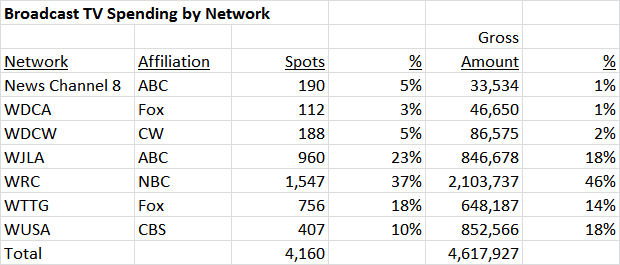
We assembled political ad data for all CD8 candidates in the year 2016 for all of the Washington area’s broadcast TV stations.  Contracts often cover a week or more into the future, so the most recent ones we obtained are active through April 16 – ten days before primary election day.  The broadcasters reported a combined total of 127 contracts through noon, April 4.  Here is the number of spots and gross amount for each broadcaster reporting.

Broadcast TV Spending by Network

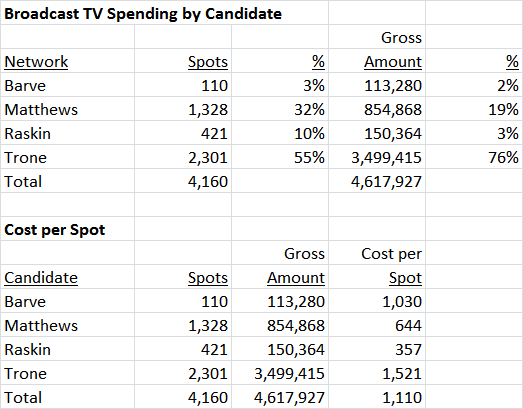
Unsurprisingly, the big four networks dominate.  Also not surprising is that WRC-TV, long the top-rated local network, is a runaway leader in ad spending.

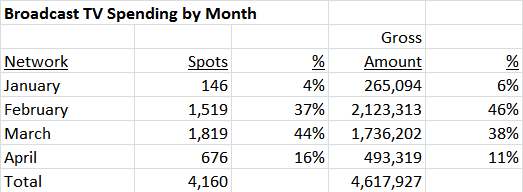
Broadcast TV Spending by Month

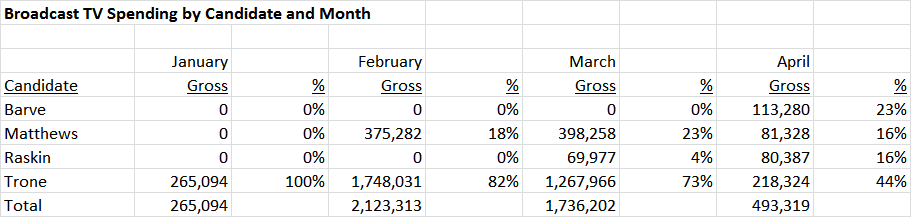
David Trone kicked off the 2016 ad season on January 26, when he began advertising on every network in our dataset.  On February 7, he paid for five spots worth $200,000 on WUSA on Super Bowl Sunday.  (That amount is more than what most candidates for State Senator and Delegate spend in their entire campaigns.)  Kathleen Matthews began advertising on February 8.  Jamie Raskin joined in on March 24 and Kumar Barve followed on April 6.  The drop in total spending between February and March was caused by a decline in Trone’s spending, part of which is due to the fact that there was no Super Bowl in March.  April spending is down because the contracts have not all been reported yet.

Candidate and Cost per Spot

Trone dominates this category of spending, accounting for the majority of spots and roughly three quarters of gross amounts paid to broadcasters.  There are big differences in the costs paid by the candidates, and that reflects their strategies.  All four candidates advertise during news programs and those shows tend to charge the highest rates.  Matthews mixes in cheaper daytime television like The Meredith Viera Show, Days of Our Lives, Who Wants to be a Millionaire, CBS Soaps and The Insider.  Raskin is keeping his costs down by running 15-second spots, half the length of his competitors.

Candidate and Month

Trone’s edge in TV has been eroding over time.  He had January all to himself.  But his CD8 TV market share dropped to 82% in February, 73% in March and 44% in April (so far) as other candidates have gone live.  (That April number could change a lot!)  Late TV commercials may mean more than early ones because many voters, especially casual ones, make up their minds late.

A few other things are worth mentioning.

  1. Trone’s real dominance may not be on TV or in mail, but in his digital advertising program. His ads are everywhere on the Washington Post and Bethesda Magazine websites.  There is no known source of reporting on those ads outside of the candidates’ campaign finance reports, and even they may be a bit murky.  In any case, Trone is making a big bet on digital and his opponents are not.
  1. Matthews reported an end-of-year cash balance of $1.1 million, but this data shows that she has spent over $800,000 on broadcast TV alone. Matthews has a formidable campaign operation, with staff, field, mail, office expenses and more.  This suggests that she has had a strong fundraising quarter, or is self-financing, or perhaps both.
  1. Raskin is emphasizing mail over TV. He has the second-most extensive mail program in the race behind Trone.  This is a deliberate calculation.  Mail is much easier to target than broadcast TV.  Mail can be sent to regular Democratic primary voters – the people who tend to pay closer attention to elections than others – while TV ads are sprayed into the ether to be viewed by regular voters, casual voters, non-voters, members of other parties and residents outside the district.  Raskin believes that regular voters will support him if they know that he is a) very liberal, b) very experienced in passing liberal bills and c) has a better chance to win than the other liberal elected officials running against him.  (That message has offended Barve, who has been in office for sixteen years more than Raskin and is a high-ranking member of House leadership.)  All three publicly disclosed polls in the race show Raskin at close to 30% of the vote.  If he can hold on to his supporters and his mail strategy gets him another five points, could that be enough to win?

How much does TV spending matter?  John Delaney won his seat in Congress in part through TV ads, and David Trone has so far spent at least double his total.  Kathleen Matthews trails, but she has spent enough to be heard.  The other candidates have not made a major commitment to TV.  Will they pay a price for that?

We will have an update on this data shortly before the primary.

Share