All posts by David Lublin

Transit-Oriented Development? LOL.

The first Purple Line associated development project is going up and –surprise–is about development rather than transit-oriented development. At Chevy Chase Lake, EYA is building  “62 stately” “luxury elevator townhomes” that start at $1.5 million. All will have two car garages.

Why the two car garages if everyone is going to be riding the Purple Line? Unless you think elevators count, that sure doesn’t sound like transit-oriented development, and surely places into question claims that ridership of people who live near Purple Line stations will be unusually high.

Despite the claims that the Purple Line would increase affordable housing in Chevy Chase, even as quite a few existing affordable housing units get knocked down, this development is not about that goal either. I suppose one can make the trickle-down development argument that increasing supply will lower the price–not one usually associated with progressives who support the project. But we could have done that without billions on the Purple Line.

What is this really about? Thanks to our public subsidy, the owners and developers of the land can build more and make a tidy profit on the roughly $100 million for which they intend to sell the units, which will be valued for their close-in location to DC, proximity to Bethesda and Silver Spring and good school district more than the pricey Purple Line. Accompanied by some shops, I imagine it will be a very nice place to live.

Attracting more wealthy taxpayers and raising the value of the land will also increase the County tax base–good for the County and its economic health. The irony, of course, is that in the future many of the same people who supported the Purple Line as a “social justice” measure will use undoubtedly use this development as an example of the growing economic divide in the County even though the policies they supported made this happen.

Share

Nothing to See Here

On the election front, the Free State promises to be virtually news free between now and November.

Maryland elects all state and county officials during the midterm election. True, Baltimore City is holding its mayoral and city council elections but I can’t say that the suspense is exactly killing me in this all Democratic town. All quiet on the local front.

At the federal level, we have an open U.S. Senate seat where all the drama was in the primary. It is the only open seat rated as “solid Democratic” by the Cook Political Report. No one is waiting with baited breath to see if state Sen. Kathy Szeliga, a Trump supporter, beats out Rep. Chris Van Hollen in a state that FiveThirtyEight says in the second most likely in the nation to vote for Hillary Clinton (polls-only forecast).

Maryland will also elect its eight federal representatives. Again, the excitement was in the primary for two open seats. The Fourth Congressional District saw former Lt. Gov. Anthony Brown make his political comeback. In the Eighth, state Sen. Jamie Raskin beat out a record-setting self-funded candidate.

But the general election should be a yawner.  Charlie Cook rates six districts as “Solid Democratic” and one as “Solid Republican.” Rep. Delaney’s Sixth District gains marginal attention as “Likely Democratic.” It seems unlikely that Delaney will be caught napping twice or that he’ll lose in 2016 — the Sixth lists Democratic in presidential elections —  when he didn’t in the Republican banner year of 2014.

If contested Virginia did not share the DC media market,. Maryland could be almost free of TV ads in the presidential campaign. Garrett is in the Pittsburgh media market, so it can also expect to share in Pennsylvania’s inundation.

Even the General Assembly is out of session and Gov. Larry Hogan is doing his expedient best to do his disappearing act during the presidential campaign.

Move along, nothing to see here.

UPDATE: The Cecil Times informs me that Cecil County has a race for county executive this year. Two commissioner seats are also up but unopposed since the Democrats didn’t put up candidates.

Share

Former GOP Delegate Candidate Jumps to the Democrats

Edptychange

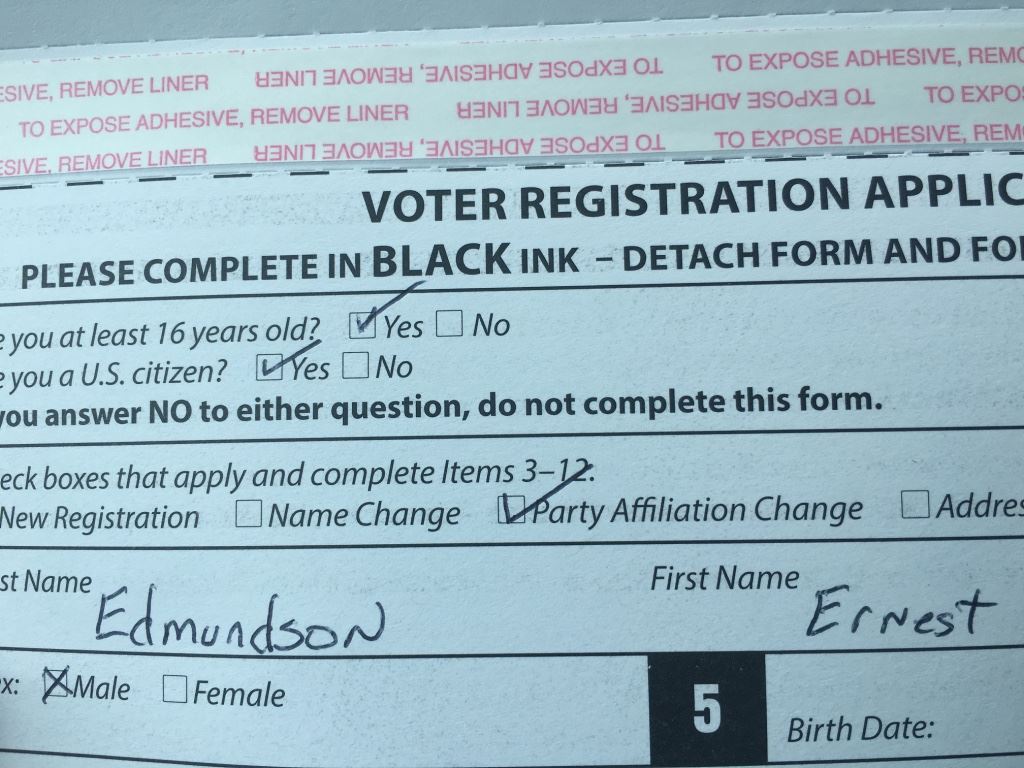
Former District 15 Republican Delegate Candidate Ed Edmundson announced his switch from R to D on Facebook yesterday, stating: “Done and Done. Bye-Bye GOP. I will not be part of a Party that picks a racist bigot to head the top of the ticket.” A real loss for the Montgomery GOP because they “desperately need people like him,” as I commented in this space two years ago.

In other news, Gov. Larry Hogan continues his silence on “racist bigot” Donald Trump becoming the nominee of his party.

Share

County Council Hopping Mad Over DLC Price Hike on Special Order Wines

Montgomery County Councimembers Tom Hucker and George Leventhal have objected vehemently to the Department of Liquor Control’s 10% price hike on special order wines.  Both have been staunch defenders of the County’s liquor monopoly and amazed that the DLC is taking exactly the opposite approach advocated by the County earlier this year.

Here is George Leventhal’s email to DLC Acting Director Fariba Kassiri:

Dear Fariba,

Last year, the County Council unanimously recommended that special order beer and wine sales should be handled by the private sector. County Executive Leggett initially agreed to this recommendation, but then changed his mind and our state legislative delegation deferred to his wishes, so no change occurred to beer and wine sales in Montgomery County. Now, according to your message below, the county has decided that because special order beer and wine sales cost DLC substantially more to process, DLC will impose a substantial price hike on licensees for these products. This decision was made without informing the County Council ahead of time and without the benefit of any advice from a Task Force on Liquor Sales, which Mr. Leggett promised to appoint but has yet to appoint.
Once again, DLC is acting in a manner that is adverse to the interests of the county’s restaurants and retail sector. I am disappointed in this decision and even more disappointed by the failure of the executive branch to take this issue seriously. The County Council’s Ad Hoc Committee on Liquor Control delved into the issue and came up with a compromise last year that would have preserved significant revenue to the county while freeing restaurants and retailers from the most onerous challenges of working with the county-controlled system. I am done apologizing for the failure of the executive branch to handle liquor sales responsively and efficiently. The responsibility for this failure rests squarely with Mr. Leggett.
With great concern,
George Leventhal
Montgomery County Councilmember

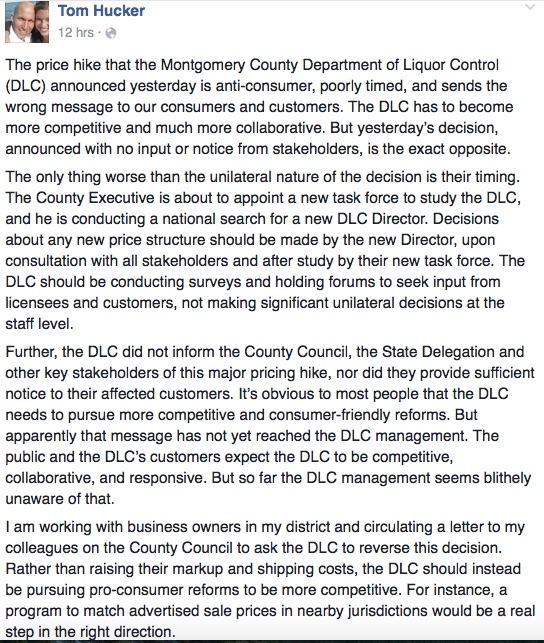
Councilmember Tom Hucker issued a press release and also posted this on his Facebook page:

huckerliquor

Share

DLC 10% Price Hike on Special Order Wines

The General Assembly session is over and the Montgomery County Department of Liquor Control (DLC) is safe from competition for another year. As the DLC no longer has to make the case that its prices are competitive, it has decided to celebrate by raising prices by 10% on special order wines over $18 per bottle.

Essentially, this is a tax increase. The County is using its monopoly power to increase the price on these wines by 10%. Businesses have a choice of either eating the cost or passing it on to the consumer. In any case, the change flies in the face of Councilmember Hans Riemer’s much vaunted reform proposal to free up special orders. MoCo is moving in the other direction.

Justin McInerny of Capital Beer and Wine sent out the following notice in response yesterday:

risingprices1

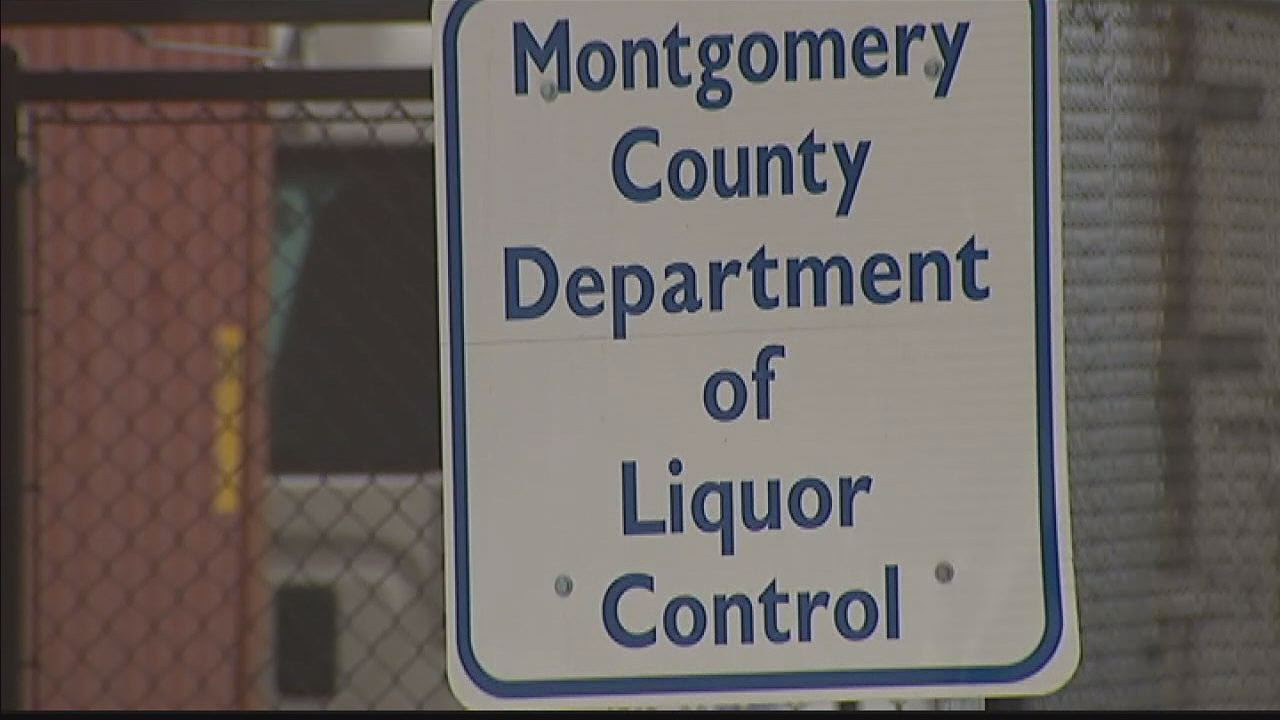
risingprices2

DLC INCREASES SPECIAL ORDER WINE WHOLESALE PRICES EFFECTIVE JUNE 1, 2016

Hi Everyone,

DLC has announced effective June 1, 2016 wholesale prices for all wines will be 25% over DLC’s cost. This is a huge, costly and burdensome increase for those of us who focus on small production, family owned and operated vineyards. Currently, the mark ups are as follows on wine:

  • 25% on special order wines whose cost to the DLC is under $18 per bottle,
  • 35% over cost for stock wines and
  • 15% for special order wines which wholesale for $18 per bottle.

Note that the percentage based markup is capricious and arbitrary to begin with. Shipping charges should not be based on how much an item costs. Shipping charges should be based on what it costs to ship the product. The DLC has no wholesale sales staff and originates no wholesale business. The DLC, like FedEx, is a delivery service which fulfils wholesale orders taken by third parties. A wine that wholesales for $10 per bottle costs the same to ship as a wine which wholesales for $12 per bottle.

HERE IS WHAT YOU CAN DO

I have made it easy for you to do something about this. Contact County Executive Leggett and the County Council members below and protest this decision.  

You can also call County Executive Leggett directly 240-777-0311, the DLC runs under his supervision.

You can also call the Councilmembers directly or e-mail them directly through the County Council website here.

Thank you for your help.

Share

Franchot’s Staff Troll Ferguson on Facebook

Hogan and Franchot Get Ready for the Cameras

Governor Larry Hogan and Comptroller Peter Franchot have been grandstanding in fine fashion lately. They are both outraged that Baltimore County and City are not installing air conditioning fast enough throughout the school system.

Hogan has more control over the budget than any other governor in the nation. He could have easily included the money for A/C in the budget without an iota of opposition but chose not to do so. Instead, he has set up a grandstanding moment with Franchot to deny the City and County monies needed for other school projects until they agree to install A/C in one year.

They kindly dumped the decision of what other projects the City and County should forego for the A/C on the Maryland School Construction Committee (IAC). Normally, this Committee reviews local projects to make sure they are ready to go and comply with other complex state requirements. Local governments determine which projects are needed in line with the Republican principle of local control – something that has gone out the window here.

Former Sen. and IAC Member Barbara Hoffman is shrewd and nobody’s patsy. She said correctly that this wasn’t the Committee’s job and moved to pass the job back to Hogan and Franchot on the Board of Public Works, who are eager to take credit for A/C but don’t want to explain why they are nixing taking care of problems like unsafe drinking water, fire safety and collapsing roofs. Even Hogan’s representatives on the Board voted for Hoffman’s motion.

Baltimore County Executive Kevin Kamenetz has gone one better and agreed to speed up the A/C but on the condition that the State reimburse the County for its share. Will Hogan and Franchot put their money with their mouths and agree to Kamenetz’s plan? Or will they demand that the County install A/C but not fix other very serious problems important to student safety?

Franchot’s Facebooking Staff

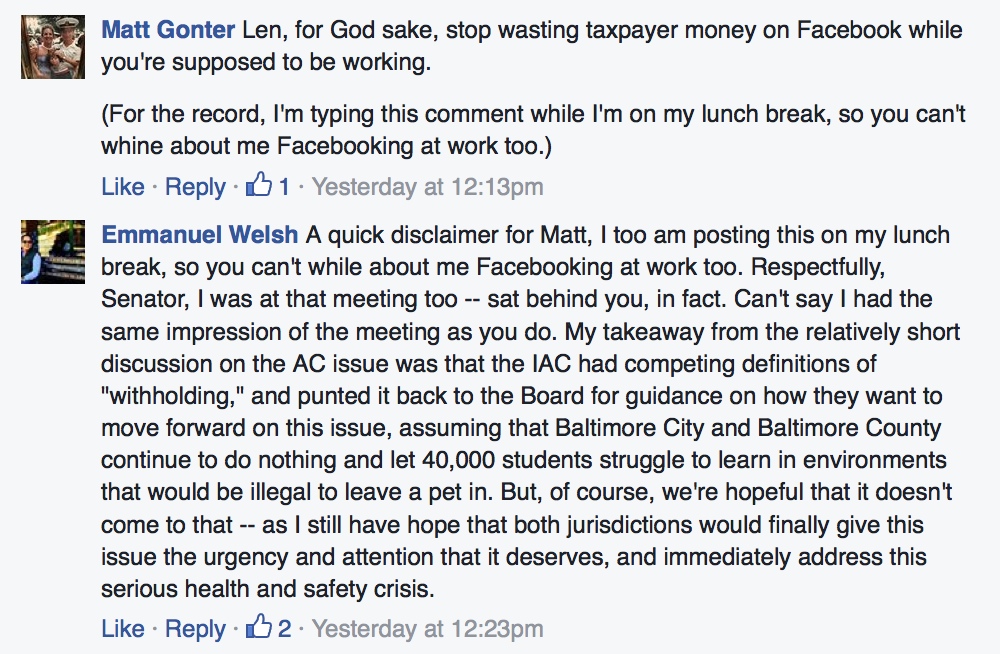
Meanwhile, Franchot’s staff seems to have little else to do but harry Sen. Bill Ferguson (D-Baltimore City) on Facebook for standing up for his jurisdiction’s priorities. Montgomery’s state legislative delegation doesn’t try to reorder our County’s priorities either.

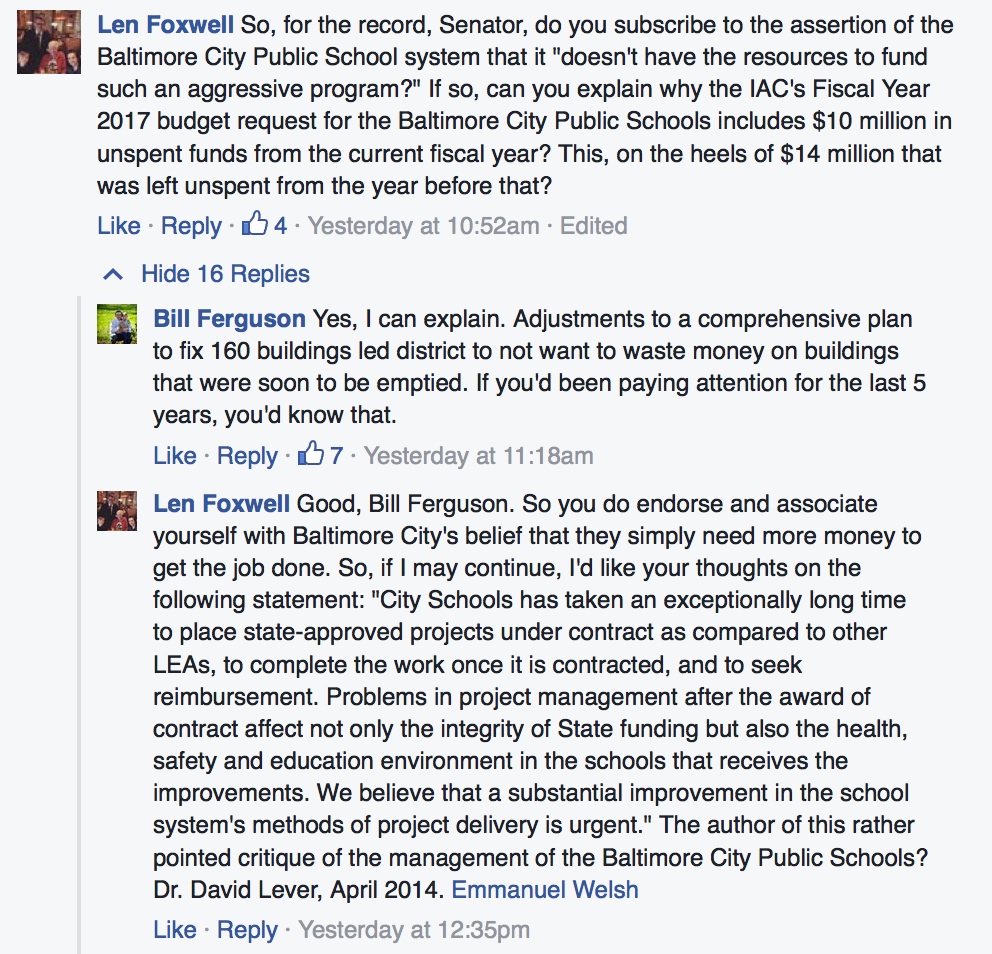
Here is Len Foxwell, Franchot’s Chief of Staff, interrogating Sen. Ferguson during normal business hours:

Ferguson-Foxwell1

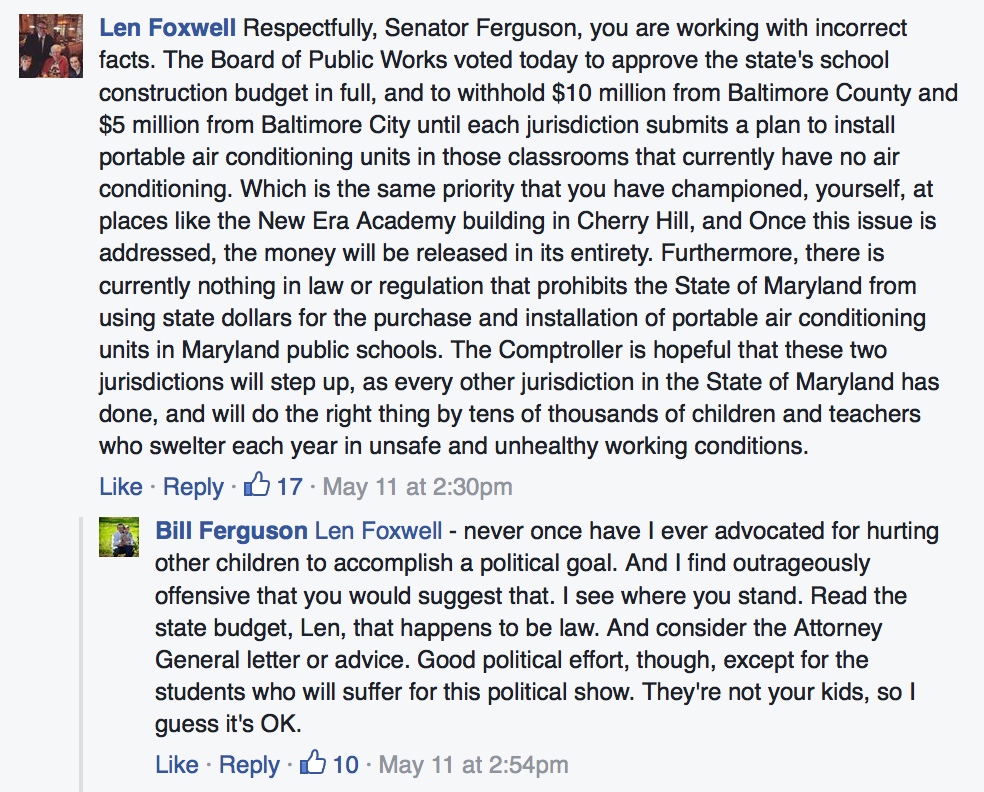
Apparently, Deputy Chief of Staff Emmanuel Welsh also has time to attack Ferguson on his Facebook page:

Ferguson-Walsh1Ferguson-Welsh2

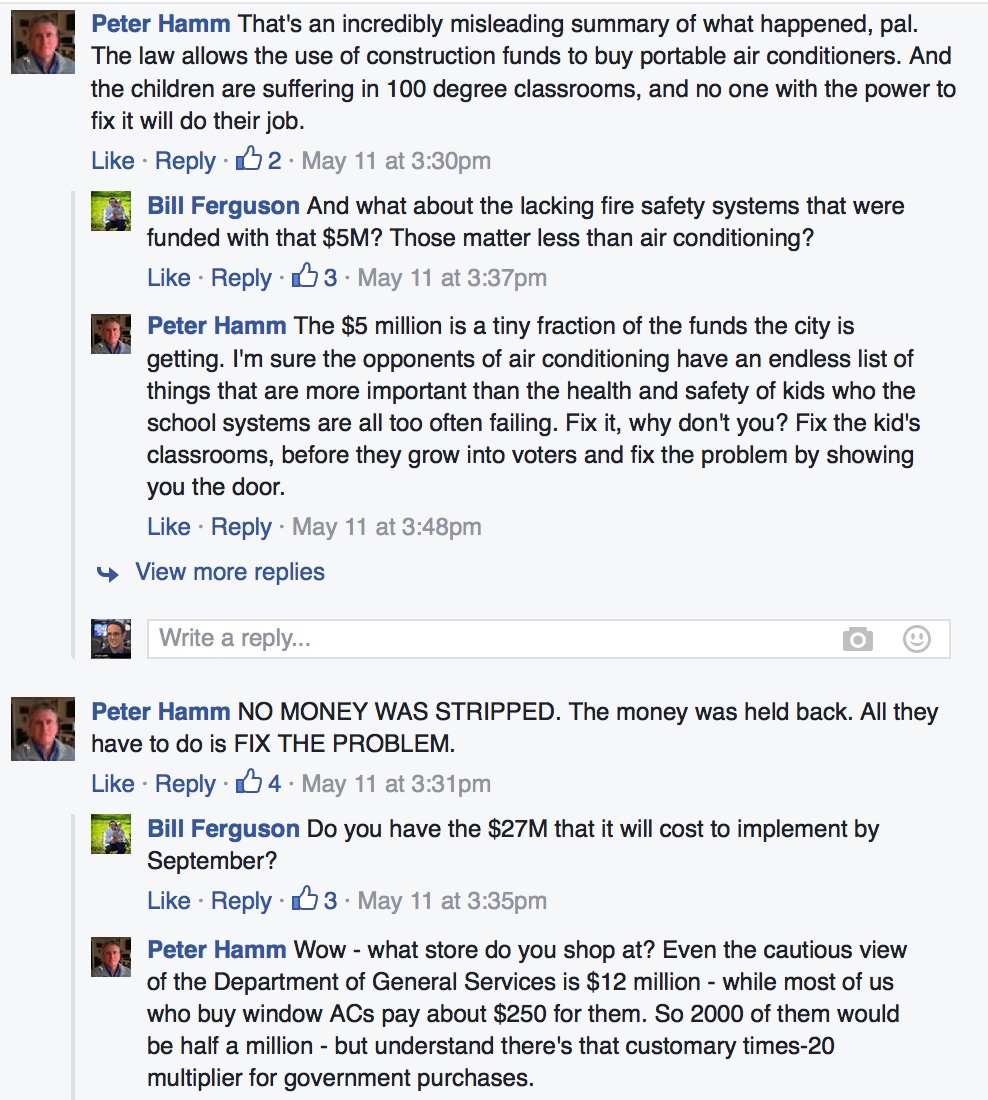
I suppose Communications Director Peter Hamm is arguably doing his job by spending time on Facebook taking potshots at Sen. Ferguson:

Ferguson-Hamm1

And here is more of Chief of Staff Foxwell:

Ferguson-Foxwell2

Communications Director Peter Hamm condescendingly calls Sen. Ferguson “pal” on Facebook. Proof, once again, that you may grow up but adolescence is forever.

Ferguson-Hamm2

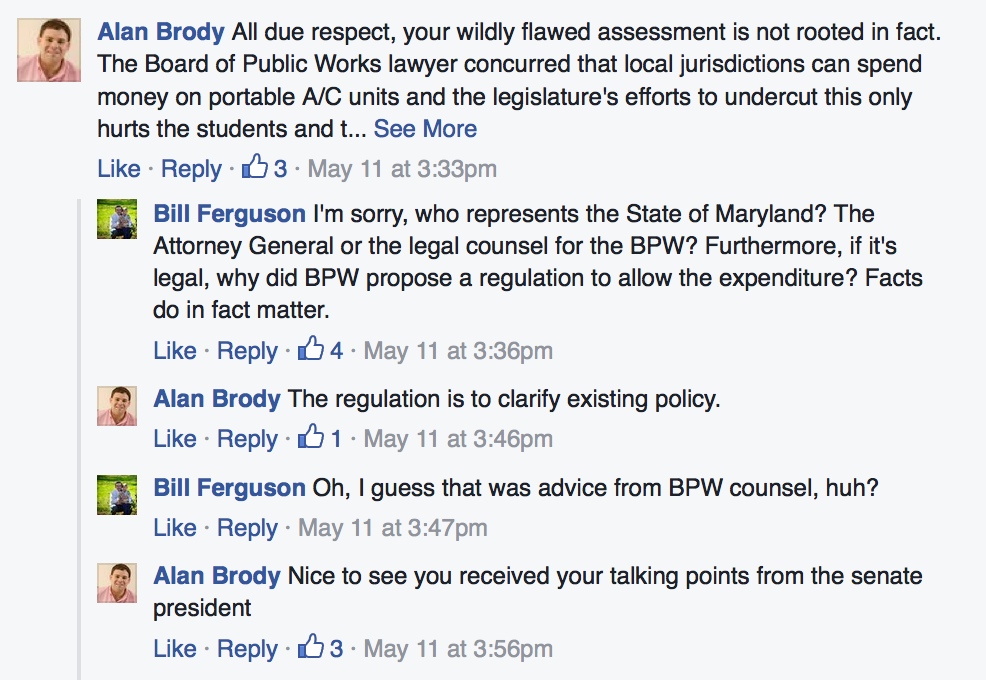
Press Secretary Alan Brody is also getting in on the fun:

Ferguson-Brody1

I never understand why politicians, let alone their staff, go after other politicians on Facebook pages besides their own. It rarely looks good.

Share

Council Provides Crucial Funds for Public Campaign Finance

The following is a press release from Fair Elections Maryland:

Montgomery County Increases Investment in Groundbreaking Fair Elections Program

(Rockville) – Today the Montgomery County Council made a critical investment in democracy by adding $5 million to its public election fund in its FY2017 budget. While this amount is only a fraction of a fraction of a fraction of the County’s overall budget, it represents a real commitment to amplifying the voices of small donors in county politics and diluting the influence of wealthy special interests. With adequate funding, the program will be up and running for the next county elections, encouraging more voters to participate in county elections and providing opportunities for a wider range of candidates to run for office.

A citizens’ task force suggested $10 million is needed for the program to succeed and recommended a $4 million installment for FY17, but County Executive Ike Leggett only included $1 million in his FY17 budget. The $4 million, added to the Executive’s $1 million and the existing $1 million from FY16, puts the Public Campaign Fund on track to be fully funded and successful.

“Montgomery County made history by creating the first program in Maryland for small-donor fair elections,” said Jennifer Bevan-Dangel, executive director of Common Cause Maryland. “We praise the action Council took today. They showed strong support for this critical program, and backed up their words with strong action.”

“In our democracy, the depth of your pocket should not dictate the volume of your voice,” said Maryland PIRG Director Emily Scarr. “We’re thrilled that the Montgomery County Council increased their commitment to getting big money out of local elections by making strong investment in their small donor matching program.”

“There is no doubt that national eyes are on this program in Maryland. By putting small donor incentives into action in Montgomery County, the public will get to see the effectiveness of the program, building the support and track record we need to pass state and federal reforms,” said Larry Stafford, Director of Progressive Maryland.

Concerned citizens had testified at the budget hearings and made hundreds of emails and calls into Council office asking the County Council to put $4 million into the budget to fund the fair elections program.

In a small donor fair elections system, candidates for County Council or County Executive who turn down large contributions and contributions from special interests can receive limited matching funds for small contributions from their county. Candidates must qualify to participate in the program by showing strong support from citizens in their district.

# # #

 Fair Elections Maryland includes Common Cause Maryland, Progressive Maryland, League of Conservation Voters, Every Voice, Maryland PIRG and many more state and local organizations who support good government. 

Share

LCV Supports Funding for Public Financing of MoCo Elections

Today, I am pleased to present a guest post from Karla Raettig, the Executive Director of the Maryland League of Conservation Voters.

A clean environment depends on clean elections. That’s why the Maryland League of Conservation Voters is urging the Montgomery County Council to allocate enough funds to ensure that the County’s publicly funded elections program succeeds. Two years ago, the Council unanimously established this voluntary system by which eligible candidates for County Executive and County Council can receive matching public dollars for their campaigns. To prove eligibility, candidates must first meet a reasonable threshold of low-dollar donations from individuals in their district, and agree not to accept contributions from corporations, PACs, or labor unions. All donations are capped at $150—as a result, the voices of small donors are empowered, and the playing field is leveled with wealthy special interests.

In jurisdictions from Hawaii to Maine, similar programs have proven effective in diluting the influence of wealthy special interests; refocusing legislators’ attention away from outside, moneyed interests and onto their constituents; improving democratic participation; and promoting greater diversity of candidates, including helping to elect women, minorities, and individuals from less affluent backgrounds.

In order for the program to succeed, however, it must be fully funded for the upcoming County elections. According to the recommendation of an independent task force of Montgomery County citizens, the Council needs to allocate $10 million over a four-year cycle—a fraction of the overall budget. Unfortunately, only $1 million has been set aside so far. Next week, the full Council will discuss whether to accept the recommendation by the Government Operations Committee to allocate $4 million in the FY ’17 budget for the program.

Maryland LCV strongly urges the full Council to accept the recommendation of Councilmembers Katz, Navarro, and Riemer.

Whether it’s federal, statewide, or county races, money is dominating the election process. Self-funded candidates are breaking records. Real estate, developer interests, and lobbyists are giving millions. And yes, even groups like Maryland LCV are in the campaign donation game. But our organization supports a system of public finance over the status quo that favors wealthy special interests over the voice of the voters. We know that voters care about climate change, about the safety of their drinking water and the quality of the air they breathe. It’s precisely these voters whose voices we’d like to see elevated in the electoral process.

According to New York University School of Law’s Brennan Center for Justice, “campaigns funded principally or entirely by private contributions distort democracy and pull elected officials away from the interests of ordinary, often unorganized citizens.”

It’s time to reduce wealthy special interest influence on our electoral process and equalize the playing field, and Montgomery County is the right place to start. Two years ago, the Montgomery County Council showed they are true leaders in working towards fair elections. Now, they must stay the course and ensure the program is fully funded for success.

Share