All posts by David Lublin

Judge Tepid on Term Limits Foes’ Arguments; Ficker Still Ficker

Attorney Jonathan Shurberg made the argument for No on B–the group fighting term limits–but the judge wasn’t inclined to buy because (1) he doesn’t think he’ll rule that the Board of Elections improperly validated the signatures, and (2) they didn’t have enough evidence to support their case.

No on B has over the weekend to continue to hone their argument and put together their evidence. But I’d expect council term limits to go to the voters. Meanwhile, Bethesda Beat reports that Attorney Robin Ficker is still Robin Ficker:

Ficker, who fought for and won the right to be a defendant in the case Wednesday, arrived nearly two hours after the hearing started. He told Greenberg he needed to leave at 3 p.m. to be at CNN studios in Washington where he was taping “Nancy Grace.”

This is after Ficker fought to become a co-defendant in the case. He’s laser focused on press attention. Not so much on the case.

Share

Term Limits Goes to Court

Today, at 9:30am, the Circuit Court will hear arguments as to whether No on B’s case against the referendum on term limits can go forward. The argument is purely about whether the proposal has met the legal requirements to be placed on the ballot–not the constitutionality of the referendum.

No on B’s argument rests on two points: (1) Robin Ficker marked up the petition pages and made changes before their submission to the Board of Elections in violation of the law, and (2) the petition lacks sufficient number of legal signatures. Having checked 28% of the pages so far, they have found 63% of the number of flaws required to knock the referendum off the ballot.

Weighing heavily on the pro-referendum side will be that the Board of Elections–the main defendant in this case–has certified the petition has a sufficient number of valid signatures. The judge could well regard the Board as more neutral party, as their job here is to carry out a bureaucratic process, not to advocate. At the same time, neutral does not immunize them against legal errors–and they may not have known of Ficker’s changes.

Robin Ficker, the petition’s proponent, has received permission from the Court to be an additional defendant. Whether Ficker’s brand of obnoxious vocal advocacy aids the case remains to be seen. While bringing strong support for the referendum, his presence could undermine any view of the Board as a more neutral party.

There is also the little underlying problem that Ficker is a walking advertisement against his own proposal. After all, the voters managed to unseat the Republican after his one and only term in the House of Delegates. While irrelevant to the case, it isn’t the sort of background that aids the pro-term limits side.

Democrat Jonathan Shurberg, a former candidate for delegate in District 20 who now blogs and has remained active in County politics, will serve as the attorney for No on B. While No on B aspires to pay him, they have not raised the funds so far.

Share

The Next Senator from District 20

The battle to replace Jamie Raskin in the State Senate is currently the object of much speculation but the logical and likely appointment by the Montgomery County Democratic Central Committee (MCDCC) seems obvious: Del. Will Smith.

All three sitting Montgomery senators who gained that office via appointment were already delegates: Craig Zucker in District 14, Brian Feldman in District 15, Nancy King in District 39. Each had served at least one full term in the House before moving to the Senate.

Beyond experience, selection of a delegate also make sense because the exact same constituency has already elected them to the General Assembly. The three delegates are not just the most obvious but most democratic choices.

Among the three delegates, Del. Sheila Hixson could have it if she wanted it but doesn’t. That leaves Del. David Moon and Del. Will Smith. Both are former campaign managers for Sen. Jamie Raskin’s past campaigns and won election in 2014.

Prior to their election, highly diverse District 20 had an all white state legislative delegation. The election of Korean American Moon and African American Smith changed that. Beyond personal ties, Sen. Raskin and Del. Hixon’s desire to diversify the delegation no doubt played a role in their joint endorsements of Moon and Smith.

The Montgomery County Democratic Party remains interested in promoting greater racial diversity in the delegation. MCDCC will be under enormous pressure to take this into account during its deliberations.

This factor weighs heavily against David Moon. No African American has ever won election or appointment to the Senate from Montgomery County. According to the Census, African Americans now form roughly 19% of the County’s population.

In contrast, there is currently one Asian American Senator–District 16 Sen. Susan Lee. She forms one of eight, or 12.5%, of the Montgomery County Senate delegation–not far off the estimated 15% of the County’s population that is Asian American.

There are currently three African Americans (Dels. Al Carr, Pam Queen and Will Smith) and four Asian Americans (Dels. Kumar Barve, Aruna Miller and David Moon along with Sen. Susan Lee) in the entire Montgomery state legislative delegation, so African Americans have less overall representation in terms of absolute numbers and percentages.

David Moon has advocated for increased minority representation in the General Assembly. He has promoted minority candidates and helped to pass along his considerable campaign skills. Nonetheless, the logic of these very ideas will work against him in a jurisdiction and party attuned to racial balance, especially since District 20 has the highest share of African Americans in the County.

Other African Americans have thrown their hat into the ring, notably former County Councilmember Valerie Ervin and Will Jawando. Both are well qualified but have political strikes against them that mitigate against an appointment over Smith.

Ervin has touted that her appointment would be a double win, as her appointment would bring the share of women in the Senate delegation to parity. However, she abandoned her seat on the County Council before the end of her term to take up another job, which annoyed many activists.

Additionally, Ervin supported Edwards for Senate–not the popular position in Montgomery. While this is not nearly as problematic as her resignation, Ervin’s quotes in the media expressing ambivalence about endorsing Van Hollen in the immediate aftermath of the election are much more damaging.

Jawando faces an uphill climb for different reasons. Smith beat him for a delegate seat in 2014. Why should MCDCC second guess the choice of the voters? Second, after losing that race, he made a quixotic bid for the congressional seat against Raskin.

If Jawando had supported Raskin, he would have been very well positioned for the delegate seat. Opposing Raskin, who has long had very strong support among this same constituency, has made winning that seat far more difficult, especially since he received even fewer votes in his congressional bid than his delegate race.

Share

WaPo Didn’t Just Bury the Lede, It Interred It

Read Adam Pagnucco’s critique of the Democratic response to the Hogan/Franchot proposed post-Labor Day school start posted this morning.

The Washington Post played monkey-see, monkey-do this morning in its coverage of last night’s debate. On page A1 (yes, I still get the print edition) and on its homepage, the Washington Post covered Matt Lauer’s questions about Clinton’s email that dominated the forum supposedly about national security.

It buried on A6 and left off the homepage the story that Clinton was absolutely right about Colin Powell’s advice regarding the use of her cell phone. As The Hill reported in a story titled “Powell told Clinton how to bypass State security measures:”

Powell says that he used a private phone line to keep his communications out of the State Department servers.

“What I did do was have a personal computer that was hooked up to a private phone line (sounds ancient.),” Powell wrote. “So I could communicate with a wide range of friends directly without it going through the State Department servers.”

“I even used it to do business with some foreign leaders and some of the senior folks in the Department on their personal email accounts. I did the same thing on the road in hotels,” he said.

Powell was responding to a question from Clinton about the restrictions on using a BlackBerry while in office. 

[Rep. Elijah] Cummings added that Republicans’ pursuit of Clinton over her server was politically motivated, otherwise they “would be attempting to recover Secretary Powell’s emails from AOL.”

Powell also told Clinton that he would frequently take his cell phone into Sensitive Compartmented Information Facilities (SCIF) — secure rooms where classified information was processed and mobile devices were prohibited.

In the print version, the WaPo truncated the story that appeared online, leaving out key paragraphs at the end about Powell taking devices into secure rooms with classified material. And the Republicans howl that the press is biased to the Democrats?

Share

Self-Deported Dan Bongino Melts Down

After losing a close race for the Sixth Congressional District, Dan Bongino self-deported to Florida, where this self-proclaimed non-politician has decided to run for Congress again.

It’s not going well.

Showing the cool calm when under fire for which former members of Secret Service are known, Bongino lashed out when a reporter accused him of being a carpetbagger. Apparently, he asked the reporter repeatedly “to carry out a sexual act that is not physically possible” as well as using much other ungentlemanly vocabulary that doesn’t exactly read grace under pressure.

Share

Montgomery Republicans Now Muslim Baiting

If you’re hoping that Donald Trump falls into the category of “this too shall pass,” you need look no further than the Montgomery County Republican Party to see that Trumpism isn’t an aberration but is the Republican Party.

The Montgomery County Republican Party and 7S have been having a lively debate on Twitter (140 characters being so amenable to thoughtful discussion) about the relative importance of Clinton’s emails versus Trump’s willingness to give Crimea to Putin and his hiring of a campaign manager illegally.

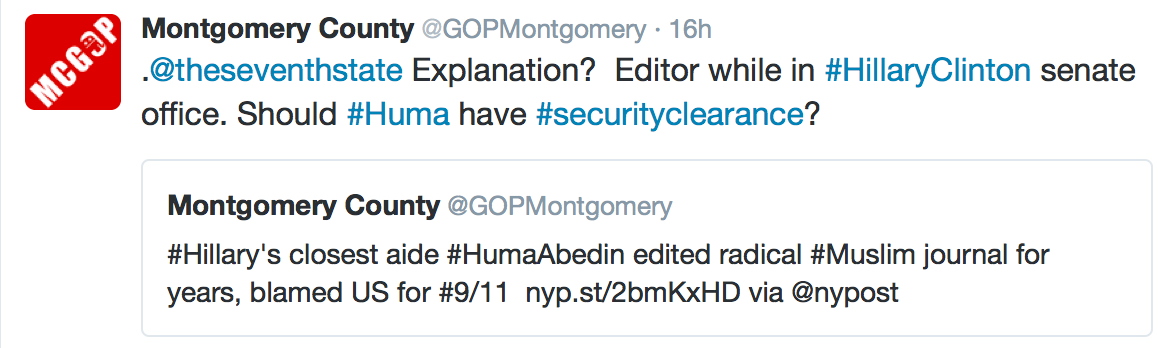
In its desperation to change the subject, the Montgomery GOP resorted to Muslim baiting about longtime Hillary Clinton aide Huma Abedin:

Huma1

They doubled down on this line of attack later:

huma2

In case you’re wondering if these recycled accusations have any merit, here is what Sen. John McCain has to say in response to Rep. Michelle Bachmann’s efforts to scaremonger:

These sinister accusations rest solely on a few unspecified and unsubstantiated associations of members of Huma’s family, none of which have been shown to harm or threaten the United States in any way. These attacks on Huma have no logic, no basis, and no merit. And they need to stop now.

Ultimately, what is at stake in this matter is larger even than the reputation of one person. This is about who we are as a nation, and who we still aspire to be. What makes America exceptional among the countries of the world is that we are bound together as citizens not by blood or class, not by sect or ethnicity, but by a set of enduring, universal, and equal rights that are the foundation of our constitution, our laws, our citizenry, and our identity. When anyone, not least a member of Congress, launches specious and degrading attacks against fellow Americans on the basis of nothing more than fear of who they are and ignorance of what they stand for, it defames the spirit of our nation, and we all grow poorer because of it.

Our reputations, our character, are the only things we leave behind when we depart this earth, and unjust attacks that malign the good name of a decent and honorable person is not only wrong; it is contrary to everything we hold dear as Americans.

Yet the Montgomery County Republicans continue to promote this scurrilous agitprop.

My twitter response to the Montgomery Republicans:huma3

Share

Maryland Republican Party Ashamed of Trump

The relationship between Donald Trump and the Maryland Republican Party is the love that dare not speak its name. Donald Trump is all but an unperson on the Maryland Republican Party twitter account, @mdreps.

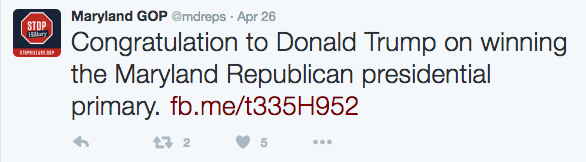
The Maryland GOP would rather pretend their presidential nominee doesn’t exist. @mdreps hasn’t mentioned Donald Trump since the Republican Convention. Indeed, “Trump” has appeared a mere five times @mdreps since the Maryland Republican Primary, including the following tweet on primary night:

MDGOP3

Next up, from the Republican salad days:

MDGOP5

Video received from a Trump voter in honor of this tweet:

The following is the only tweet in which the Maryland Republican Party expresses direct approval of Trump:

MDGOP4

Though Trump gets mentioned in the next tweet only in the cited article description, it’s worth a mention if only because the Maryland Republican Party’s own words, “It’s about ideas, not race,” are as Orwellian as they come.

MDGOP2

The next day they retweeted an innocuous shout out to the Republican delegation in Cleveland that copied Trump.

In short, you’d never guess that the a thumping majority of Maryland Republicans support Donald Trump.  There is not one picture. No tweets proudly touting his latest utterance.

I imagine some Republicans will claim they’re just too focused on state issues to mention Trump. Except that you may’ve noticed that their logo is a “Stop Hillary” sign. Maryland Republicans also have no problem using @mdreps to attack Democratic Nominee Hillary Clinton and President Barack Obama.

The lack of Trump mentions is really a good sign. Shame is the right emotion if Donald Trump is your party’s nominee. Let’s hope the second stage of grief for the party entails repudiation.


Share

Where the Purple Line Goes from Here

In the wake of District Court Judge’s Richard Leon’s decision that the Purple Line Final Environmental Impact Study (FEIS) violated the National Environmental Policy Act (NEPA) by failing to take into account ongoing Metro problems in their ridership estimates, the defendants have several different options.

First, defendants can produce the Supplemental Environmental Impact Study (SEIS) required by the District Court. According to the Maryland Transit Administration (MTA), this would set the project back by six months and could unravel the public-private partnership. I suspect that this is hyperbole and that MTA would manage to do it more quickly, though the study would need to be substantial enough to satisfy Judge Leon.

Alternatively, the defendants can appeal. Maryland Secretary of Transportation Pete Rahn has said that Maryland will appeal the ruling. Except that the decision about any appeal rests with the Federal Transit Administration (FTA) and the Justice Department, as the federal government is the defendant in the lawsuit.

As a first step towards any appeal, the federal government would need to seek a stay of Judge Leon’s ruling. The decision on any request for a stay would be a critical moment. If appellants win their request, the Purple Line could continue to proceed even as the appeal moves forward.

In order to receive a stay, the federal government would like have to show substantial, irreparable harm from a delay and the appellate court would have to deem them likely to win their appeal. In my view, the first condition would not be hard to demonstrate. The second point also strikes me as winnable, if only because NEPA suits tend to fail. But I’m not a lawyer–I don’t even play one on TV–and the Judge’s decision increases uncertainty.

Whether they are granted a stay or not, MTA and FTA would most likely wisely start to produce an SEIS so that they are prepared regardless of the outcome of the appeal. If FTA wins an appeal, they won’t need it but the money is small beans in comparison to the overall cost of the project. The appeals process could well take longer to conclude than an SEIS.

Regardless of the outcome, Judge Leon’s decision has highlighted MTA’s flat unwillingness to produce information on how it calculated Purple Line ridership. In effect, this biased and politicized agency is saying “trust me” to the public on this enormously expensive project–eerily reminiscent of Donald Trump’s “believe me.” Even the ardently pro-PL Washington Post acknowledged this fundamental issue in its editorial decrying the decision:

Granted, Maryland transit officials have not been sufficiently transparent about how they arrived at ridership numbers. And if their estimates for the Purple Line fall short of forecasts, it could prompt the state to raid other revenue sources to pay off the project’s construction debt.

Additionally, Purple Line advocates are in the uncomfortable position of explaining (1) their utter faith that Metro ridership will rise even though it has declined for several years despite strong regional growth, (2) why we should believe that the trend toward telecommuting and biking, which they use to explain the decline, will cease, and (3) why Metro’s deep problems will be solved anytime soon, despite the recent derailment of the brand new Silver Line.

Share

Morella Endorses Clinton

Unlike Trump enablers Senate Candidate Kathy Szeliga or Rep. Andy Harris (R-1), former Rep. Connie Morella (R-8) prefers to support the presidential candidate who isn’t a raging racist narcissist willing to say anything to attract higher ratings. In short, Connie Morella (R-08) has endorsed Hillary Clinton:

Hillary Clinton has the knowledge, the experience, and the commitment to lead our country as president and Commander in Chief.  She will reach out to every segment of our society to move our country forward.  I have seen her work across the aisle to get things done and I know her lifelong commitment to families and children. Unlike her opponent, she will not divide, bully, or dismiss us.  She is the right choice in this election and I wholeheartedly support her – and urge my fellow Republicans to look at the choice before them and do the same.

Share