
All posts by David Lublin

MoCo Board of Elections Responds to 7S Report on Early Voting Problems
The following was sent to 7S by Marjorie M. Roher, Public Information Officer of the Montgomery County Board of Elections:
Regarding “A Critical Error in Early Voting”
The Montgomery County Board of Elections would like to take this opportunity to address the concern raised in “A Critical Error in Early Voting.” Mr. Pagnucco’s description of the process that occurs in an early voting center is correct, and the Board appreciates his acknowledgement that the mistakes were honest.
Board staff learned of similar occurrences sporadically in several of the Early Voting Centers. In each case brought to our attention, the voter received the correct ballot prior to scanning and was able to cast his or her vote in the appropriate congressional race. The Election Director immediately contacted each Early Voting Center Manager to reinforce the need for accuracy in ballot distribution, instructed that Check-in Judges be reminded to circle the ballot style number on the Voter Authority Card (VAC) to make it easier to see, and Ballot Judges be reminded to double check the ballot style number on the VAC and ensure that they were issuing the correct ballot to each voter. The design of the ballot issuance tables at each Early Voting Center was reviewed to ensure that the possibility of co-mingling ballot styles was eliminated. Finally, a copy of The Seventh State blog was sent to each Early Voting Election Judge so that they might better understand the perception of the public when these types of errors occur.
All of these measures will assist in keeping errors to a minimum, but we urge voters also to pay attention to the ballot they are issued and, if they think they have the wrong ballot or if they have any other concerns regarding the voting process, speak to an election judge immediately so corrective action may be taken prior to scanning the ballot. This will assist the election judges, who are voters who volunteer to work at election time to assist their neighbors with the voting process.
When the State Board of Elections selected the voting system to be used in 2016, it intended to utilize Ballot Marking Devices (BMD) at all Early Voting Centers. This system would have allowed the Check-in Judge to hand each voter a ballot activation card with a bar code on the top, which would contain the voter’s ballot style and, when inserted in the BMD, cause the correct ballot style to appear on the screen. This would eliminate the need for an election judge to select the correct paper ballot for each voter. Unfortunately, problems with how the BMD screen displayed contests with many names could cause voters to not see all candidates before voting. For that reason, the State Board of Elections determined that the BMDs would only be used in 2016 by those individuals who requested them.
The State Board of Elections has requested the manufacturer of the BMD to modify the device so that all names in a contest would appear on the same screen. We believe that this will be accomplished by 2018 so that all voters choosing to vote during Early Voting would be able to utilize this method, thereby eliminating the need for multiple styles of paper ballots at each location and the possibility of human errors.
The Montgomery County Board of Elections strives to ensure that each voter has a pleasant, efficient, and accurate voting process and we encourage voters to contact us with comments or suggestions for improvement, so that we all can work together to make a good voting experience even better.
Marjorie M. Roher
Public Information Officer
Montgomery County Board of Elections
Early Voting Turnout Heavy Among Older and African-American Voters
Yesterday, I looked at the partisanship of early voters. Today, I take a peek of the age and racial demographics of early voters based on data graciously provided by a reader.
The estimates of the racial composition of the electorate are based on estimates of the race of voters with the caveat of the potential for errors. Not everyone named Morales is Latino just as not everyone called Goldberg is Jewish. Nonetheless, the information provide a useful first cut at who is participating in early voting.
Let’s start with the percentage of the electorate in each age group broken down by party:
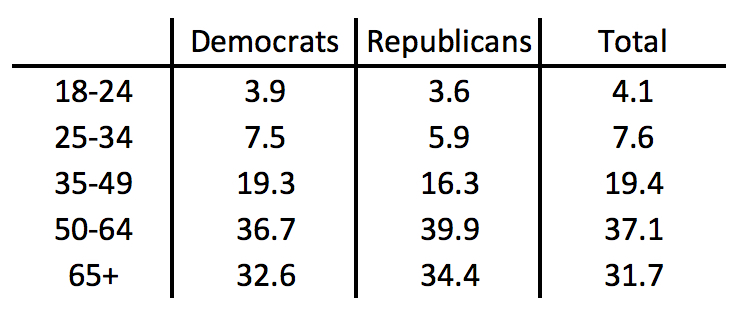 Early voters skew heavily towards older voters, especially among Republicans. At 74.4%, nearly three-quarters of GOP voters are over age 50. The Democratic share older than 50 is around 5% lower at 69.3%. Among all early voters, which includes unaffiliated and third-party registrants, the share is 68.9%, slightly lower than for Democrats. The low figure reflects much less skew towards older voters among non-major party voters.
In contrast, people 35 and under make up a low share of early voters–11.7% among all voters and just 11.4% among Democrats and 9.5% among Republicans. The latter figure reflects the heavy skew away from Republicans among millennials.
The next table shows the racial composition of each county’s electorate. Percentages add up to less than 100% because the race or ethnicity of many voters is unknown and cannot be reasonably gauged to any extent by proxies. As a result, the percentages presented here are invariably low end estimates.
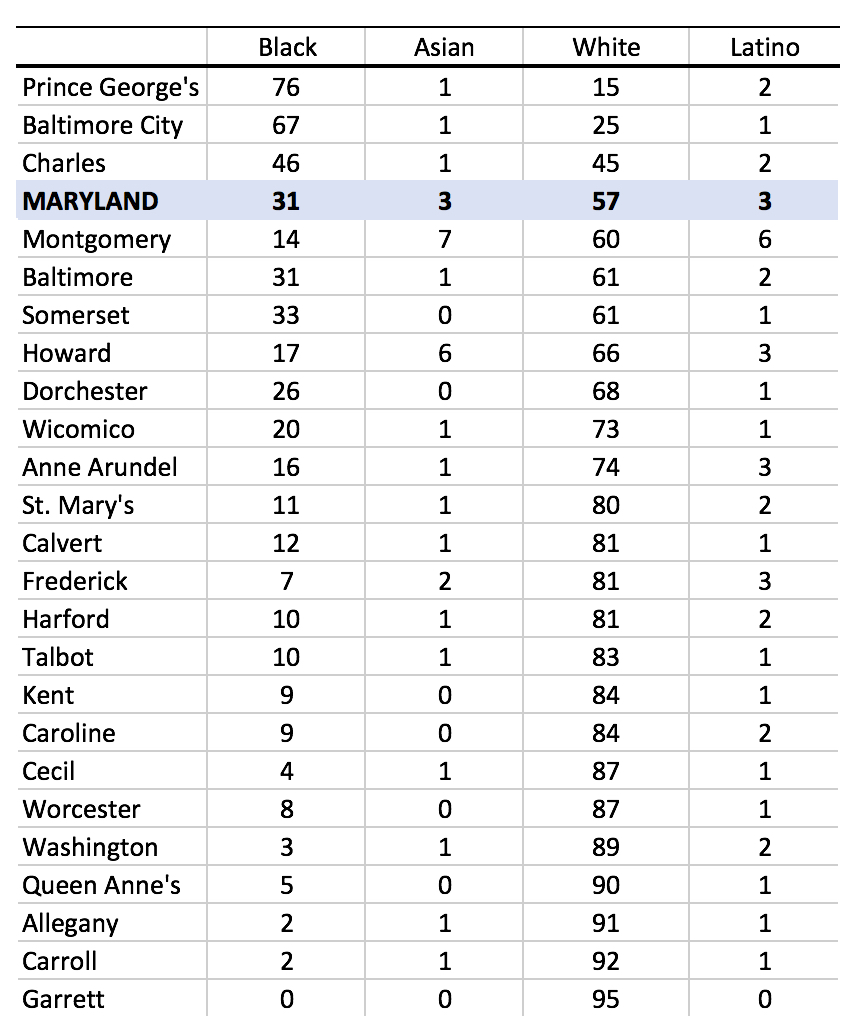 Among early voters, African Americans are high participants (31%), exceeding their share of the voting-age population. Unsurprisingly, black participants overwhelmingly outnumber other groups in Prince George’s and Baltimore City. In Charles, African-American early voters barely edge out whites–a sign of the continuing evolution of racial demographics in that county.
The encouraging rates of black participation help explain why Democrats are consistently outperforming Republicans in early voting. Not only does Maryland have vastly more Democrats, they are voting at a higher rate than Republicans.
In contrast, Latinos (3%) and Asians (3%) appear to be casting early votes at low rates, reflecting lower rates of citizenship and turnout. Asians compose the highest share of early voters in Montgomery (7%) and Howard (6%). Latinos comprise 6% of early voters in Montgomery, and 3% in Anne Arundel, Frederick and Howard.
In Maryland as a whole, approximately 57% of early voters are white. Again, as the percentages are calculated out of total voters and many could not be placed in any category, the estimates for all racial groups are low.
Early Voting Day 4 Stats
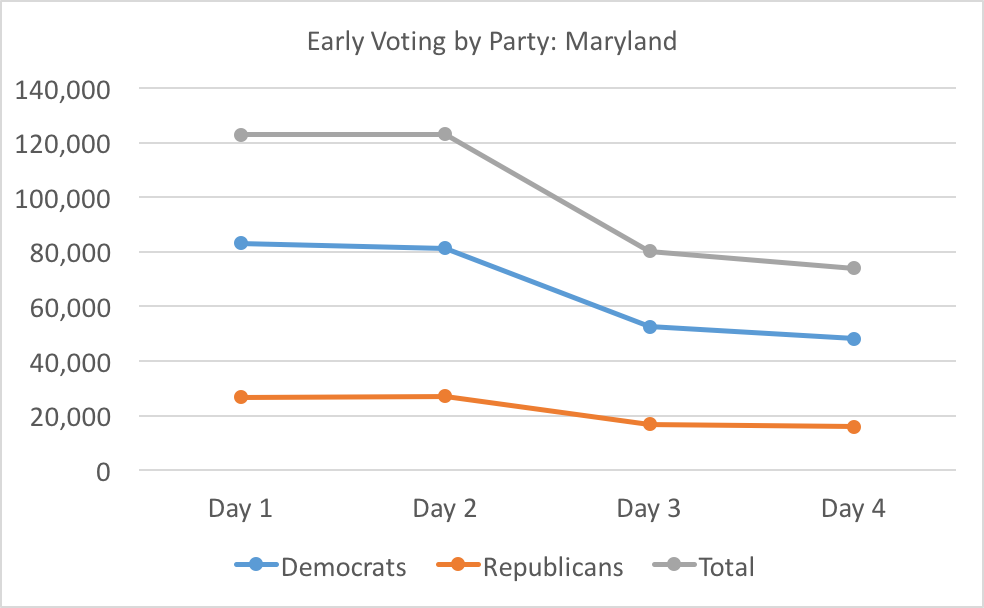 Early voting continues apace in Maryland. As in 2014, early voting dropped off precipitously over the weekend–an argument against switching Election Day to a weekend. So far, 400,235 Marylanders have voted early. This is already 93% of the people who voted early four years ago, so we will likely surpass the 2012 total today.
The increase is unsurprising due to the substantial increase in the number of early voting centers. Additionally, Governor O’Malley suspended early voting for two days in 2012 due to Hurricane Sandy and then extended it for two more days to make up the time.
While 10.3% of eligible voters have already cast their ballots, the rates differ greatly by party. 12.3% of registered Democrats have voted early compared to only 8.5% of registered Republicans.
The early vote is even more impressive when presented as a share of the number who voted in 2012. The 2016 early vote equals 14.6% of the 2012 total turnout. The number of Democrats who have voted early in 2016 is 17.0% of the total number of Democratic voters in 2012. In contrast, the number of Republican early voters is just 9.0% of the total 2012 Republican vote.
Despite the large gap between the parties, Republicans have improved very slightly relative to 2012, as the number of Republicans who have voted early this year is 97% of the 2012 total compared to 92% for the Democrats.
Note that all of these figures exclude absentee ballots. When I checked, the Board of Elections has not updated these figures since October 28th. As of that date, 78,299 Marylanders had cast absentee ballots. No doubt many more have arrived at the Board of Elections over the past few days.
The following graph shows that Montgomery County, the State’s largest jurisdiction largely reflects the State pattern.
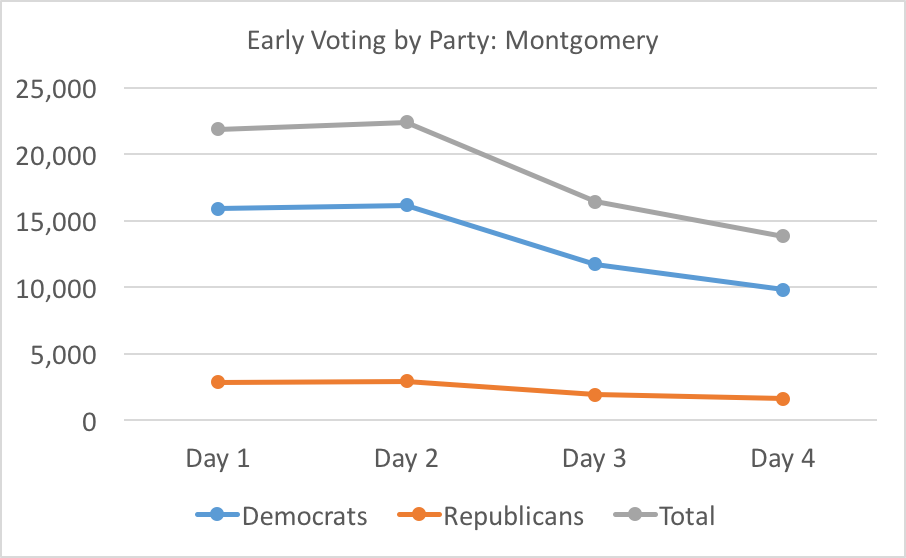 In Montgomery, 74,525 voters participated in the first four days of early voting. This equals 96% of the people who voted early four years ago, so Montgomery is performing slightly better than four years ago relative to the rest of the State (93%).
However, Montgomery still lags behind Maryland, as just 11.3% of eligible voters have voted early in the county. This includes 13.9% of registered Democrats but just 7.6% of registered Republicans. The 2016 early vote equals 12.1% of the 2012 total turnout.
Again, this masks a large partisan gap. The number of Democrats who have voted early in 2016 equals 17.0% of the total number of 2012 Democratic voters. In contrast, the number of Republican early voters is just 9.0% of the total 2012 Republican vote.
Anti-Term Limits Flyer

Early Voting Stats Day 1
Democracy rules! On the first day of early voting, my polling place was packed with people waiting to cast their ballot. Either people can’t wait to be done with this election or they feel strongly about their candidates, or both.
On their Twitter feed, the Maryland State Board of Elections reports that a record 125,914 people voted on the first day of early voting. That compares to just 78,409 people who voted on the first day of early voting four years ago–an increase of 60.6%. Statistics for this year are not yet available by county.
As of today, 68,377 have returned absentee ballots out of a total of 196,450 that have been sent out, so 65.2% of absentee ballots are still outstanding. The total number of people who have already voted in Maryland is 194,291.
How does this compare with 2012? There were 153,100 absentee votes four years ago, so we are currently at 44.7% of 2012’s total with Election Day 12 days away. Maryland looks set to blow way past early voting totals from 2012 as we have already reached 28.8% of the 437,600 early votes cast that year. Right now, the total votes cast as a share of the 2012 total of 3,693,600 is just 5.3%, so the vast majority of votes are still to come.
On Term Limits
This year’s term limits vote is the hot local topic of debate in Montgomery County. Or it would be, if either the pro or anti-term limits campaigns had any money to broadcast their message. Voters will largely have to decide for themselves whether they want term limits for the County Executive and County Council.
Political scientists tend to oppose term limits as anti-democratic. The exception is that presidential term limits often seen as preventing an unhealthy concentration of power. In emerging democracies, presidential term limits are increasingly seen as a good means to promote the rotation of power.
So why are so many Montgomery County voters ready to approve term limits that anti-democratically limit their own rights to reelect people to public office?
The Selectorate
A key reason is that many people don’t feel that they have much say over their government. This isn’t just hot air. Unless you vote in the critical Democratic primary that effectively decides elections for all partisan offices, you don’t.
Consider that the Census estimated Montgomery’s voting-age population at 788,043. (Note: this figure includes non-citizens, so it is an inflated estimate of the potential voters.) Among the eligible population, 630,355 were registered voters including 354,078 registered Democrats at the time of the 2014 primary elections.
Only 88,007 people participated in the hotly contested Democratic primary for County Executive. That’s just 11% of the voting-age population, 14% of registered votes, and 25% of registered Democrats. It’s also just 33% of 2014 general election voters, and 19% of 2012 general election voters.
Moreover, the Democratic primary selectorate is skewed heavily toward the more Democratic areas of the County. It’s no accident that so many councilmembers live very close together in the southeastern corner of the County–and most people never cast a vote in the key election to choose them.
Beyond the overwhelming strength of the Democrats, Republicans offer very weak alternatives. As a result, the general election, held in the lower turnout midterm election, feels more like a kabuki ritual even if the outcome accurately ratifies the preference of the voters for Democratic over Republican nominees.
The Fantasy
The great advantage of term limits compared to the status quo is that every voter can imagine that the new Council will be more responsive to whatever their political bent–even though some of the major dreams advocated are contradictory.
Robin Ficker touts lower taxes as County unions envision a Council willing to raise their pay higher. Civic associations imagine a Council less in thrall to developers while Chamber dreams of a more business friendly Council.
These claims cannot all be true but that doesn’t prevent voters from comparing their fantasy government to the much less glamorous reality. As the same people will choose new councilmembers by the same process, change may be more elusive than imagined.
Political Scientists Predict the Outcome
PollyVote surveyed 673 political scientists over the past four days and asked them to predict the outcome of the election in their state. These forecasts suggest that Clinton will win with 358 electoral votes with just 180 going to Trump:

Here are the predictions for the swingier states. The second column is the number of political scientists who responded to the survey. The third column is the predicted chance that Clinton will carry the state and the final column is the share of the two-party vote.
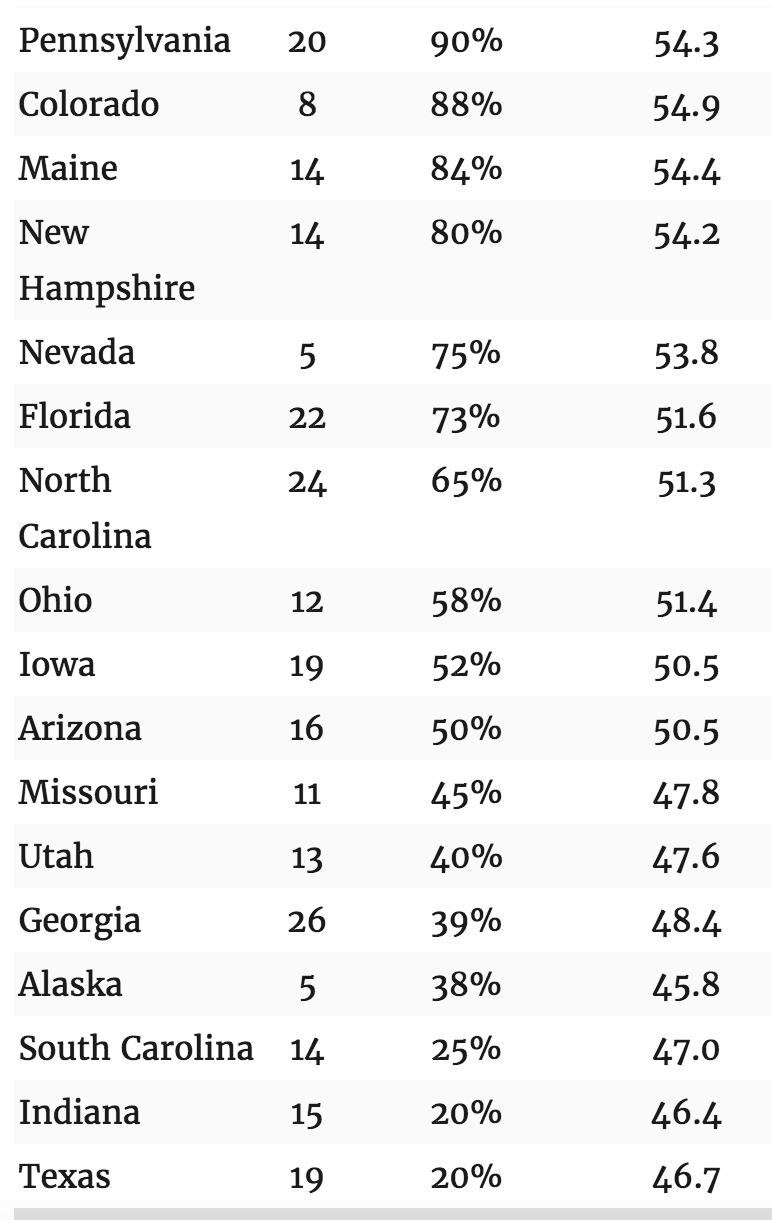
Needless to say, Maryland is not a swing state with the 26 respondents gauging the likelihood of Clinton winning at 100% and guessing her share of the two-party vote at 67.0%.
Australian MPs Pass Motion: Trump is a “Revolting Slug”
The BBC reports that Parliament of New South Wales, the largest state by far in our close ally Australia, has passed a motion condemning Donald Trump and calling him a “revolting slug:”
The parliament of New South Wales, Australia has passed a motion calling US presidential candidate Donald Trump a “revolting slug” unfit for office.
It condemned “the misogynist, hateful comments” it said had been made by Mr Trump about women and minorities. . . .
It said: “This house… agrees with those who have described Mr Trump as a ‘revolting slug’.”
“It’s clear that all reasonable and decent people find Donald Trump’s behaviour obnoxious and that the world is hoping American voters reject his politics of hate,” Mr Buckingham said in a statement.
This was as mean as they could get without having the words struck down for being inappropriate in Parliament but somehow seems just right–a marvelous and apt description of the Republican nominee.
Needless to say, motions like these are highly irregular. While foreigners often have strong preferences about who we elect, it is unheard of for foreign parliaments to pass motions all but begging the American people not to elect someone.
Trump supporters, who are remarkably quiet about Vladimir Putin and Russia’s interference in our election, may nonetheless resent this resolution by representatives in a free and friendly democracy. But many of his supporters simultaneously also believe that Trump will win and the election is rigged, so maybe they’ll manage.
But, of course, Australians might feel less of a need to weigh in if more Republicans took responsibility for helping make sure that Trump gets nowhere near the White House. Here in Maryland, almost all Republicans remain for the revolting slug.
More Banana Republicans
Two more Republican delegates continue to hug Trump tightly. Let’s start with Neil Parrott:

Del. Parrott is best known for his hysterical advocacy of the “bathroom bill” because he really thought that men dressing up as women to enter the women’s bathroom would become a thing once we passed transgender equality legislation.
These concerns do not extend to candidates that Parrott supports. He remains enthusiastically behind Donald Trump–the candidate who the Washington Post reported today has entered rooms with naked underage girls in it during the Miss Teen USA Pageant who were then forced to fawn all over him while nude:
To have the owner come waltzing in, when we’re naked, or half naked, in a very physically vulnerable position and then to have the pressure of the people that worked for him telling us to go fawn all over him, go walk up to him, talk to him, get his attention.
So the same man who wanted to use fear of a small vulnerable minority to criminalize their use of bathrooms over a nonexistent problem has no issue when the presidential candidate of his own party preys on underage girls.
Moving on to Del. Warren Miller. He rationalized his support for Trump by claiming that “her campaign hates Christians” in a tweeted reply to Dylan Goldberg, who formerly worked for Sen. Guy Guzzone:
 Miller clearly lives in the right-wing delusional alternative universe in which American Christians are persecuted and there is a “War on Christmas.” It would seem that the only Christian being persecuted here is Hillary Clinton.
One might add the weirdness of sending this particular tweet to Dylan Goldberg during Yom Kippur. While Miller’s belief about Clinton supporting Christian persecution is a work of fiction, Trump’s invocation of anti-Semitic tropes is on tape and he admitted to similar statements over the past 25 years.
As is well known, Trump retweets material, including the infamous anti-Semitic “sheriff’s star” attack, from right-wing white nationalist websites. His supporters have no problem attacking Trump critics, such as Anne Applebaum, for being Jewish.
In short, no one has done more to reawaken anti-Semitism in the U.S. in decades than Donald Trump. And this hardly compares to his routine demonization of Latinos, Muslims, and Blacks. Apparently, Miller is also fine with Trump’s anti-democratic threat to jail his opponent, undermining of NATO, and cozying up to Putin.
Folks, this is the norm in today’s Maryland Republican Party.