
Metro is still falling apart but the cookies were all ready at the National Press Club event to celebrate General Manager Paul Wiedefeld’s first anniversary on the job.
Photo credit: Delegate Marc Korman (D-16).

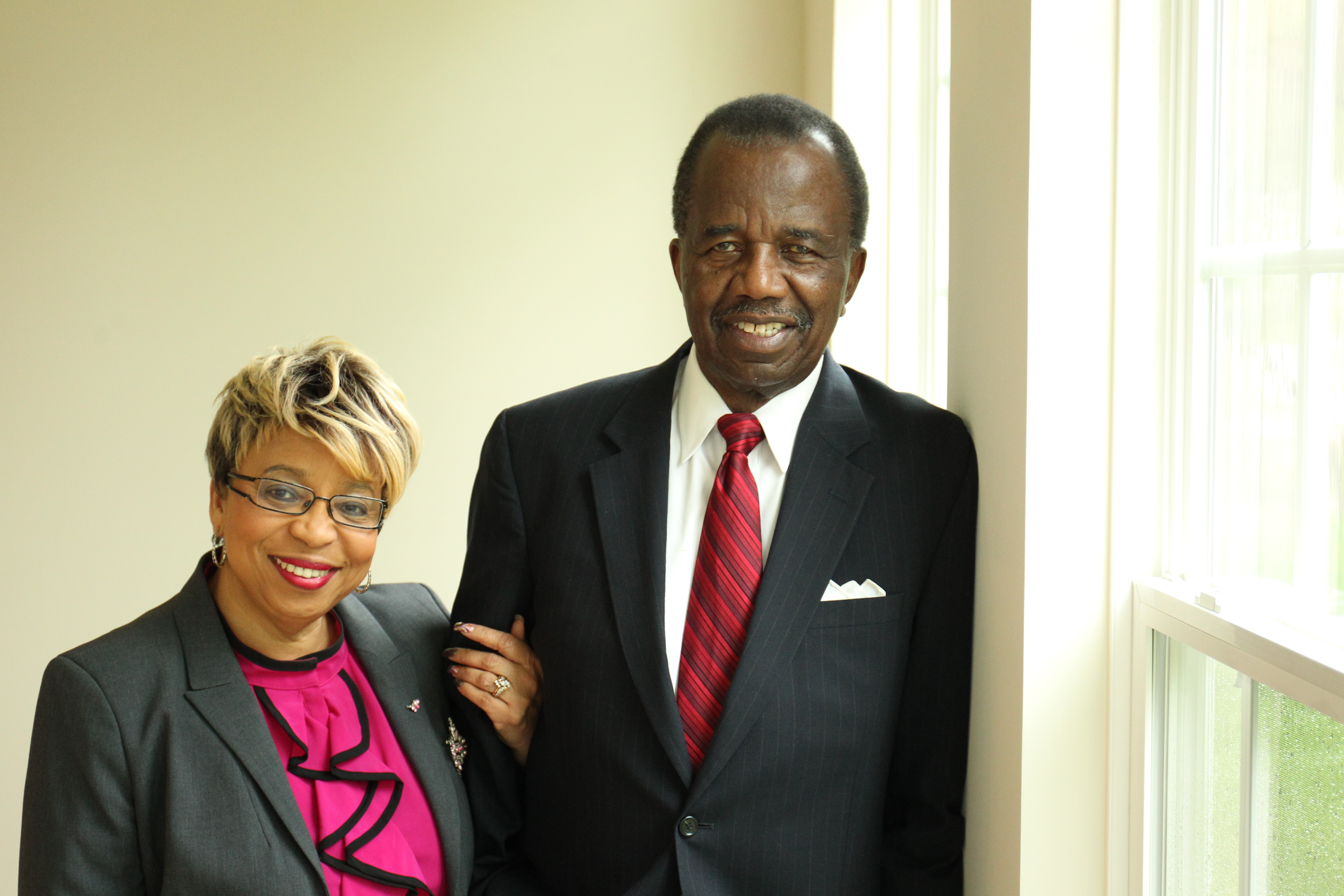 Sen. Ulysses Currie and Rev. Shirley Gravely-Currie
On November 4, Sen. Uly Currie (D-Prince George’s) sent his resignation effective December 1 to Senate President Mike Miller:
It is my deep love for my constituents and the Maryland Senate, combined with a recognition that I can no longer serve with the strength and energy you all deserve, that I have decided the time has come to turn the mantle over to a successor. . .
Now, he has decided to rescind his resignation, as the Central Committee is unwilling to appoint his wife to his seat:
I was proud and supportive when Rev. Shirley Gravely-Currie courageously put herself forward to fulfill this role as no other person came forward without the intention of using the appointment to gain an election advantage over others.
Since my announcement, it has been nothing but petty political jockeying and deal making, with only the 2018 election in mind.
Claiming to be shocked at the role that politics plays in politics and at the loss of civility his departure from the Senate would mean, Currie made a political move. As his resignation was not yet effective, I imagine he will make it stick.
While Currie certainly is a courtly individual, the Senate voted to strip him of his leadership position as Chair of the Budget and Taxation Committee in 2010 for ethics violations. Even Currie voted for the motion, which took place in the wake of his being found not guilty on bribery charges.
Having announced his departure, Currie should go. His behavior makes him easily characterized as a member of a crony driven pay-to-play Annapolis elite. Reversing his resignation for health reasons because his wife couldn’t win the appointment only serves to increase political cynicism.
I know little of his potential replacements but it would be good for the Democrats and for Prince George’s for someone new to be given a chance to represent the district.
My guess is that Trump is merely trolling Mitt Romney and Nikki Haley by meeting with them in the wake of the election. He enjoys the spectacle of them coming to kiss his ring but is way too narcissistic to appoint anyone who has been critical of him.
Having said that, Mitt Romney would be a fine choice for Secretary of State. I support Romney not in spite of his being a conservative but because he is one.
Romney views NATO as a critical part of American defense and articulated ideas for revitalizing it during the 2012 campaign. Contrast Romney’s viewpoint with that of Trumpkin Newt Gingrich who said that Estonia is in the “suburbs of St. Petersburg” and not worth defending–a statement more than a little reminiscent of Neville Chamberlain’s infamous reference to Nazi aggression against Czechoslovakia as a “a quarrel in a faraway country between people of whom we know nothing.”
Romney labelled Russia as a “geopolitical foe” — a regretfully accurate description in the wake of Russian aggression in Ukraine and Syria. Romney has been willing to take on Trump over his coziness with Putin. This will be needed in light of Trump’s willingness to let Russia dictate American foreign policy (e.g. we can’t support the rebels in Syria because Russia wouldn’t like it) and his naming of Michael Flynn–an abrasive man with close business ties to the Russians–as National Security Advisor.
Romney favors free trade:
The economic rise of China and other countries across Asia poses a different type of challenge. China and the rest of Asia are on the move economically and technologically. They are a family-oriented, educated, hardworking, and mercantile people. Trade and commerce with these huge new economies can further strengthen our economy and propel our growth. If America fails to act, we will be eclipsed. We have to keep our markets open or we go the way of Russia and the Soviet Union, which is a collapse. And I recognize there are some people who will argue for protectionism because the short-term benefits sound pretty good, but long term you kill your economy, you kill the future.
This doesn’t mean that Romney supports unfair trading practices on the parts of our partners. But it does mean that he recognizes that trade is critical to American economic success and an important part of our future–a welcome approach in an era when this has gone out of style in both major parties.
In short, Romney’s basic approach resembles that far more of Hillary Clinton than Donald Trump. He would be a welcome sign of calm as the election results have created deep concern among our key allies and partners around the world.
From Martin O’Malley:
Fellow Democrat –
On November 8, the Democratic party and our country suffered a major setback. Now more than ever, we need to listen to one another and work to repair what has been torn apart.
While I’m grateful to the supportive friends who have urged me to consider running for DNC Chair, I will not be seeking our Party’s Chairmanship. The DNC needs a Chair who can do the job fully and with total impartiality. The national interest must come first.
In the days ahead, my family and I will continue to do everything in our power to fight for the Democratic Party, and for the more compassionate and inclusive country that we carry in our hearts.
“We are one, our cause is one, and we must help each other if we are to succeed.”
-Martin
The election of Donald Trump has upended much of Gov. Larry Hogan’s reelection plan for 2018. Midterms are usually hard on the president’s party, which would have been great news for Larry Hogan except that Hillary Clinton didn’t win the election.
Midterm Elections Hard for Party with Unified Control
An examination of periods of unified party control of Congress and the Presidency since 1990 does not augur well for the Republicans. After Bill Clinton’s 1992 victory, Republicans swept in and took control of both the House and the Senate in 1994.
In the wake of 9/11, George W. Bush proved an exception, as the Republicans held up well in 2002. However, Democrats swept back into control in 2006, taking both the House and the Senate despite the structural barriers faced by Democrats in both cases.
Republicans also well remember that they eliminated the sizable Democratic majority in the House in 2010, just two years after Barack Obama gained election and ushered in unified Democratic control. While Republicans didn’t take the Senate, they made major gains, and the GOP took control of that body in the next set of midterms in 2014.
Democrats face enormous barriers to Senate gains in 2018 because they already hold so many of the seats up for election. However, the Republicans will likely face much less favorable trends than this year and this structural advantage won’t aid Larry Hogan.
Gubernatorial Elections Too
Indeed, a close examination of gubernatorial elections during midterms held under unified federal control by one party should not give Larry Hogan much comfort.
Republicans made stunning gains in 1994, as they picked up a walloping 10 governor’s mansions. They held the chief executive spot in 30 of the 50 states after this banner year election.
The post-9/11 2002 elections were less of an exception to the rule in gubernatorial than federal elections. The Republicans lost seats, though Bob Ehrlich did pick up the governor’s mansion in Maryland to become the first Republican since Spiro Agnew in the 1960s to hold that office.
The 2006 midterms were a great year for the out party–the party that did not hold the presidency–as Democrats went from a minority of 22 state houses to 28 after the elections. Gov. Ehrlich lost reelection in Maryland.
As the out party in 2010, Republicans reversed that trend. They went from having a minority of 23 governorships prior to the election to 29 afterwards. Yet Ehrlich, trying for a comeback, lost by an even greater margin to Gov. O’Malley. In 2014, despite already holding 29 governors, the GOP managed to pick up two more for a total of 31.
Declining Split-Ticket Voting
Something new happened in the U.S. Senate elections in 2016. Not one state elected a senator different from the party of the presidential candidate that won that state. This caps a long downward trend in the number of congressional districts that split their ticket.
Put another way, partisanship has grown much stronger and it is harder to win. Impressively, Hogan managed it with a strong prevailing wind behind him in 2014. But can he repeat the feat in 2016 when the Republicans appear likely to be facing a backlash based on historical trends? More discussion in Part III.
Governor Larry Hogan’s action since his election point to one major goal: avoiding the fate of Bob Ehrlich by winning reelection in 2018. His strategy on these points seems relatively clear. However, the 2016 election results may upend his strategy. Today, I look at the path he has pursued so far.
Poll-Tested Popular Gestures
Hogan has become the master of making popular moves that, in the end, are nice gestures but do little to reshape state government in a meaningful way. His new mandate that schools begin after Labor Day is a perfect example of this approach.
No Meaningful Cuts in Taxes or Spending
If you look at the state budget as a whole, the difference between what Maryland has done under Gov. Hogan and would have done if Anthony Brown had been elected is small and focused on popular but very small cuts.
The reduction in tolls is a perfect example. People love it and see it but it’s practically a rounding error in the state budget. Hogan has much derided the “rain tax” but it’s a federal mandate and sending it back to the counties doesn’t make it disappear, so the impact on Marylanders is less than appears.
Taking Credit for O’Malley’s Hard Decisions
Gov. Martin O’Malley had the misfortune to govern during the horrendous Bush recession. While the budget will always need further work, he and the General Assembly made the tough deep cuts and righted the ship on pensions.
Most interestingly, O’Malley took the unpopular decision to raise the gas tax. So far, despite Hogan’s vehement attacks on it during the campaign, it’s still with us, and Hogan seems very happy to go around the state taking credit for roads and other projects it funds.
His Cancer Fight
I am sure that Gov. Hogan and his family wish deeply that he had never been diagnosed with non-Hodgkin’s lymphoma. I am grateful, as are Marylanders, that he is making a great recovery. Indeed, he has been a fine example of the fight against a major illness. The publicity surrounding his brave fight has naturally engendered a great deal of sympathy.
One Downside: Touchy Persona
While Hogan generally presents a determined and happy face to the world, he doesn’t deal well with criticism. He can get petty and surprisingly touchy in response to it, lashing out negatively in response to even mild disagreements.
Conclusion
In short, Larry Hogan has presented a pleasing persona happy to do small things in the wake of the frenetic O’Malley years and enjoy the benefits of previous hard decisions. This approach has resulted in high approval ratings. But will Trump’s election upend Hogan?
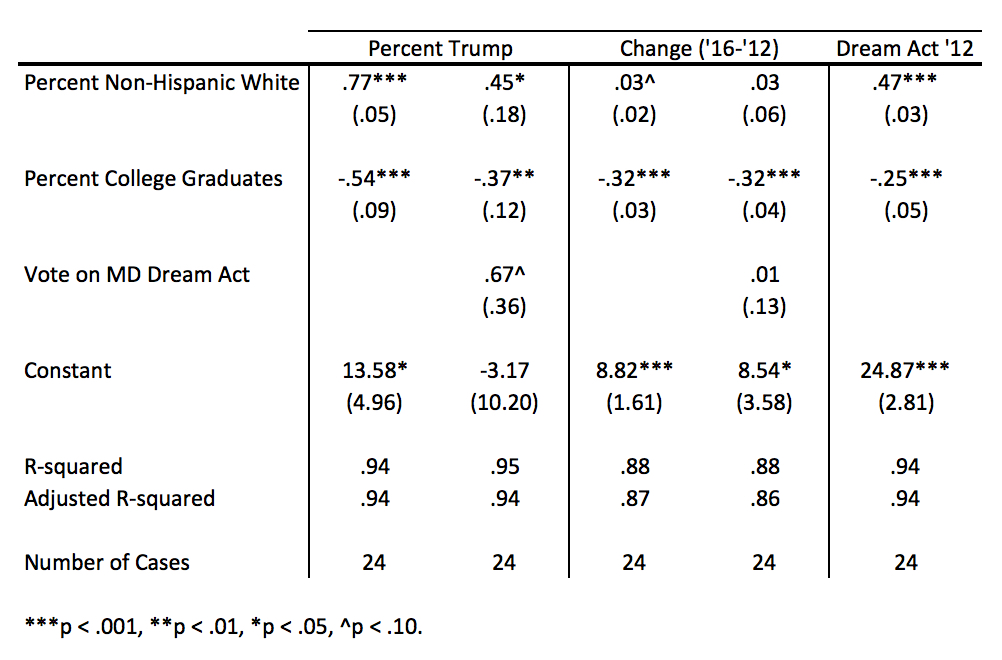 Top Line: The Republican coalition in Maryland took a sharp turn toward less educated voters and remains heavily white.
The above is a quickly done ordinary least squares (OLS) regression analysis of aggregate support for Trump and the change in the vote from 2012 to 2016 by county. The numbers in parentheses are standard errors around the coefficients shown above them.
The coefficients are easy to interpret. For example, the coefficient of .77 on Percent Non-Hispanic White in the model of Percent Trump indicates that 1% increase in the non-Hispanic white population resulted in a .77% increase in the Trump vote. Similarly, an increase of 1% in the share of college graduates reduced the Trump vote by .54%.
The second model of the share of the Trump vote in Maryland also includes a control for how counties voted on the MD Dream Act in 2012 as a further control for immigration attitudes. While the results are at the edges of statistical significance, this model indicates that, even after controlling for race and education, that a 1% increase in opposition to the Dream Act resulted in a .67% increase in support for Donald Trump.
The third and fourth models assess the impact of the same variables on the net change in the vote from 2012 to 2016. The change in the vote equals (%Trump – %Romney). Educational levels dominate changes in the share of the vote won by the Republican and Democratic nominees. While neither race nor the opposition to the Dream Act matter much, a 1% increase in the share of college graduates resulted in a loss of .32% by Trump.
The final model shows the relationship between race and college education to opposition to the Dream Act. It suggests that a similar coalition supported Trump in 2016.
The votes are still being counted in Maryland and across the country. While Trump has clearly won the Electoral College, whether he will carry the popular vote remains in doubt. In the meantime, let’s look at preliminary results in Maryland after last night’s political earthquake.
Though the earth didn’t move nearly as much in Maryland as elsewhere, there were significant changes in support patterns, which Clinton carried easily as expected. Here are the 2016 preliminary and 2012 final percentages side-by-side:
 As you can see the preliminary results, suggest that both candidates lost ground in Maryland. In order to more easily examine shifts across the state, I’ve created a table showing vote shifts by county with counties reordered by net change.

As you can see, Maryland shifted about a net 1.4% to Trump but that masks major differences across the State. The two counties with the most wealthy, well-educated, liberal white populations–Howard and Montgomery–shifted heavily to Clinton.
In these two counties, the Democrats had stunning net gains of over 10% of the vote, as Clinton gained 3% or more and Trump lost more than 7% in both Howard and Montgomery. Howard went 2-1 and Montgomery 3-1 for Clinton.
Another set of counties reveals the opposite pattern. In 14 counties, Clinton lost ground over Obama while Trump gained compared to Romney. Among the 14 counties, 11 have median incomes below the Maryland average–Calvert, St. Mary’s and Queen Anne’s are the exceptions, though none has a median income higher than Howard or Montgomery.
In addition to a tendency toward lower incomes, these areas tend to have fewer college-educated whites and be socially more conservative than Howard or Montgomery. Perhaps critically, pro-Trump counties tend to be far more suspicious of immigrants based on how they voted in the 2012 referendum.
The lowest rates of change were in the State’s two majority black jurisdictions of Baltimore City and Prince George’s, as well as more moderate jurisdictions like Frederick and Anne Arundel that tend to be closely divided between the two parties.
Overall, the key takeaway is greater geographic polarization between the Democratic and Republican areas of the State. In general, the areas that lean the most Democratic became more Democratic or stayed much the same. On the side, areas that already listed heavily Republican became more so.
