All posts by David Lublin

Public Parking Prices Soar

Parking prices on the street at public garages in Montgomery County shot up again on July 1. This is just the latest in a series of major increases.

In Bethesda, street parking prices went up 12.5% from $2.00 to $2.25 per hour. Garage pricing jumped by 25%, rising from $0.80 to $1.00 per hour in regular garages, and from $1.00 to $1.25 per hour in popular garages.

Silver Spring parking is a relative bargain. Street parking prices remained unchanged at $1.00 per hour. Regular garages saw their prices increase a nickel or 7.7% from $0.65 to $0.70. However, pricing in popular garages jumped 53.8% from $0.65 to $1.00.

This marks the latest in a series of increases since 2009 that have raised parking prices well above the rate of inflation. The following graphs compare public parking inflation over the last ten years to the consumer price index (CPI) with all set to 100 for 2009.* Each year shows the price change on January 1, so this year’s bump is shown as 2018.

Bethesda has been especially hard hit. In 2009, prices were just $0.50 for long-term garage spaces, and $0.75 on the street. Since then, parking charges have jumped 100% in garages, 150% in popular garages, and 200% on the street. The CPI went up just 11%.

Despite starting in 2009 at the same base as in Bethesda, prices have increased less in Silver Spring. There have still been substantial price hikes, resulting in parking inflation of 33% on the street, 40% in garages, and 100% in popular garages. Still, it is now relatively cheaper to park in Silver Spring than Bethesda—a real benefit to both consumers and business there.

Montgomery citizens increasingly complain about property and income taxes. But fees like parking rates have often quietly been increased at even faster rates.

*Note: MoCo changed its method of parking charges in 2013. The categories of short term and long term were eliminated in favor of a new division into on-street, lots, and garages with popular garages having a surcharge. I’ve compared on-street parking to the previous short-term rate, and garage parking to the previous long-term rate, as this appears reasonable. If anything, it biases the estimates of on-street parking inflation down.

Share

How Not to Alienate White Voters

Trump loves to invoke white identity politics to rally his base. In recent days, we’ve seen him triple down on this approach to distract from the scandals and fecklessness of his administration. He began this most recent cycle with an attack on transgender people who serve honorably in our military.

Trump continued with his embrace of efforts to cut even legal immigration and the recent deportation of a Latino kid from Gaithersburg who won a college scholarship. Now, Trump and Sessions plan to fight affirmative action as an effort to end discrimination against whites.

Earlier installments in this series were called “Playing Trump’s Game” because Democrats unwittingly aid Trump’s efforts to rally white voters on racial lines when they play into his frames by portraying whites in negative terms as a group. (See Part I: Are Democrats Buying into Trump’s Narrative, Part II: White Privilege, Part III: Old, White Men, Part IV: Denigrating People’s Jobs, and Part V: Denigrating American History.)

Today’s final installment encourages Democrats to avoid “heads you win, tails I lose” narratives about whites that just communicate whites are bad in a way that plays straight into Trump’s efforts to consolidate white voters.

Gentrification

Much ink is spilled today expressing concern about the impact of whites moving into neighborhoods that are predominantly black or Latino. No doubt there are real effects as occurs whenever there is economic or racial change in neighborhood composition. On the other hand, when I was younger, whites were repeatedly chastised for leaving cities. People cannot help but notice that whites are excoriated for moving in and out of cities.

In contrast, progressives have nothing negative to say about similar movements by black or Latino populations. Just as whites fled DC, much of the African-American middle class decamped to Prince George’s. Now, many black families are moving into Charles or back into DC. Most people have nothing negative to say about either, which is of course as it should be, with criticism perceived (rightly) as racist.

Cultural Appropriation

To the extent people want to condemn the appropriation of intellectual property, as often occurred to black musicians in the 1960s, the idea of cultural appropriation is fine. However, stretching the concept to attack when people from one culture use or mix in something from another culture makes little sense, as cultures are not hothouses but constantly incorporate outside ideas.

The widely-lauded musical Hamilton seems a great example with Puerto Rican Lin-Manuel Miranda taking the history of the proverbial “dead white man” and mixing it with styles of music developed by blacks and Latinos to create an exciting, multiracial, and rich contribution to our common culture. And utterly appropriate, as we all get to claim the history of this country whether our ancestors were among the Founders or even here at the time.

No, not all experiments work out so well. I have serious reservations about the peanut butter chocolate chip bagel. But I’m not offended by it.

Finally, to the extent that claims of cultural appropriation demand that whites remain strictly outside observers of black, Latino, Asian etc. cultures, it flies in the face of simultaneous demands that whites need to learn much more about them. Regardless, separating cultures into neat racial boxes is an impossible task in our increasingly diverse society.

In The Atlantic, Jenni Avins provided a sensible guide to “The Dos and Dont’s of Cultural Appropriation” that applies the idea in a rational way. Her headline points are: 1. Blackface is Never Okay, 2. It’s Important to Pay Homage to Artistry and Ideas, and Acknowledge Their Origins, 3. Don’t Adopt Sacred Artifacts as Accessories, 4. Remember That Culture is Fluid, 5. Don’t Forget That Appropriation Is No Substitute for Diversity, 6. Engage with Other Cultures on More Than an Aesthetic Level, and 7. Treat a Cultural Exchange Like Any Other Creative Collaboration—Give Credit, and Consider Royalties.

Her approach makes cultural appropriation about mutual respect and appreciation rather than a means to catch white people out, which can only alienate people who actually have an interest in cultures other than their own—something to be encouraged and seen as natural in our highly diverse country rather than policed.

Returning to Why This Matters

As I explained in first post in this series:

Democrats don’t need to win back most white voters in order to win—even small gains among whites would have been enough to deprive Trump of his electoral college victory. Giving up on white voters is political folly. Increases in the rising black, Latino and Asian vote won’t be enough alone to win many of the states moving in the Democratic direction, at least in the medium term.

Additionally, geographic distribution renders capturing more white votes key to Democratic control of federal and state legislatures as well as the presidency. In Maryland, white votes will determine the outcome of legislative elections in most seats targeted by Republicans, such as those held by Sens. Kathy Klausmeier and Jim Mathias, and whether Democrats retain their ability to overturn gubernatorial vetoes in both houses  of the legislature.

Share

Does George Leventhal have the Temperament to be County Executive?

I had planned to continue my Playing Trump’s Game series today but apparently 7S became the subject of controversy on WAMU. Tom Sherwood raised the issue of George Leventhal’s temperament on WAMU’s The Politics Hour last Friday. Councilmember George Leventhal (D-AL) reacted by blaming Seventh State:

Um, you know I gotta say that I think the issue of the Purple Line is a very important issue. There is at least one blogger who has written about an encounter with the unions who is very much opposed to the Purple Line. We don’t have a lot of local journalism. I’m grateful to the Politics Hour, so people rely on bloggers who may have an ax to grind. I think people have written things about me who disagree with me on issues who then try to characterize me in a way that makes me seem an undesirable candidate. And I think with that gentleman in particular, it’s really that we just disagree on the merits of the Purple Line.

Yep, George Leventhal and I disagreed about the Purple Line. Indeed, I disagreed with the entire county council, almost all of our state legislative delegation, and many good friends on this issue. None of these other people have claimed that I have an ax to grind against them. This a red herring–a classic effort to distract.

Debate on policy questions is normal in a diverse, democratic society. My friend and co-blogger, Adam Pagnucco, disagrees with me on a bunch of issues. Seventh State has had blog posts that directly argue against my own point of view, including on the Purple Line compact and a Planning Board appointment. I even did a blog post giving George Leventhal’s point of view on the issue he mentioned in his WAMU comments with no rebuttal.

Councilmember Leventhal’s problem is not his issue positions, which differ little from his colleagues on many issues, or even that he frequently butts heads with his colleagues or media critics. It’s that he targets his own constituents and people who work for the County.

Clips from Council meetings show this plainly:

Berating Office of Management and Budget Director Jennifer Hughes from the dais at a Council hearing.

Attacking constituents as tools of lobbyists (with responses by Nancy Navarro and Craig Rice).

Unfortunately, this is not rare and Councilmember Leventhal developed a widespread reputation as a result long before I wrote about it. He takes the same approach on social media and in meetings as he does from the Council dais, comparing term limits supporters to Brexit voters, and likening DLC opponents to whiners at Starbucks. This hostility is why he performed less well than other incumbents in the last two at-large county Democratic primaries despite his long tenure in office.

In the same WAMU interview, Councilmember Leventhal went on to excuse any bad behavior with:

I’m motivated to make a difference for people who most need government on their side.

In other words, George cares so much that it’s okay that he behaves atrociously. There is a difference between standing firm for what you believe and bullying people.

Other politicians manage to have an impact without acting this way. Councilmember Leventhal says he knows that “I need to be a good listener” and “I respect the fact that people will not always agree with me.” But he regularly communicates hostility instead of the idea that reasonable people of goodwill may hold different opinions on issues. It’s not a one off or a bad day.

George Leventhal has trolled David Trone, a potential candidate for county executive, by comparing him to Donald Trump. Ironically, his own efforts to delegitimize media critics and belittle constituents who disagree are the hallmarks of the Trump Administration.

Share

Translating George Leventhal

Our county needs new leadership.

Please ignore that I was elected to the first of four terms on the County Council in 2002, and served twice as Council President.

We need an executive who plays a hands-on role . . .

I don’t like Ike Leggett.

. . . in addressing the challenges that we face [traffic, school overcrowding, and affordable housing] and who also understands that the challenges that we face are connected to our success.

Please forget that these same problems existed when I joined the Council 15 years ago. Their continuation is due to the amazing job that I’ve done addressing them.

We have a lot of traffic and we need to address that.

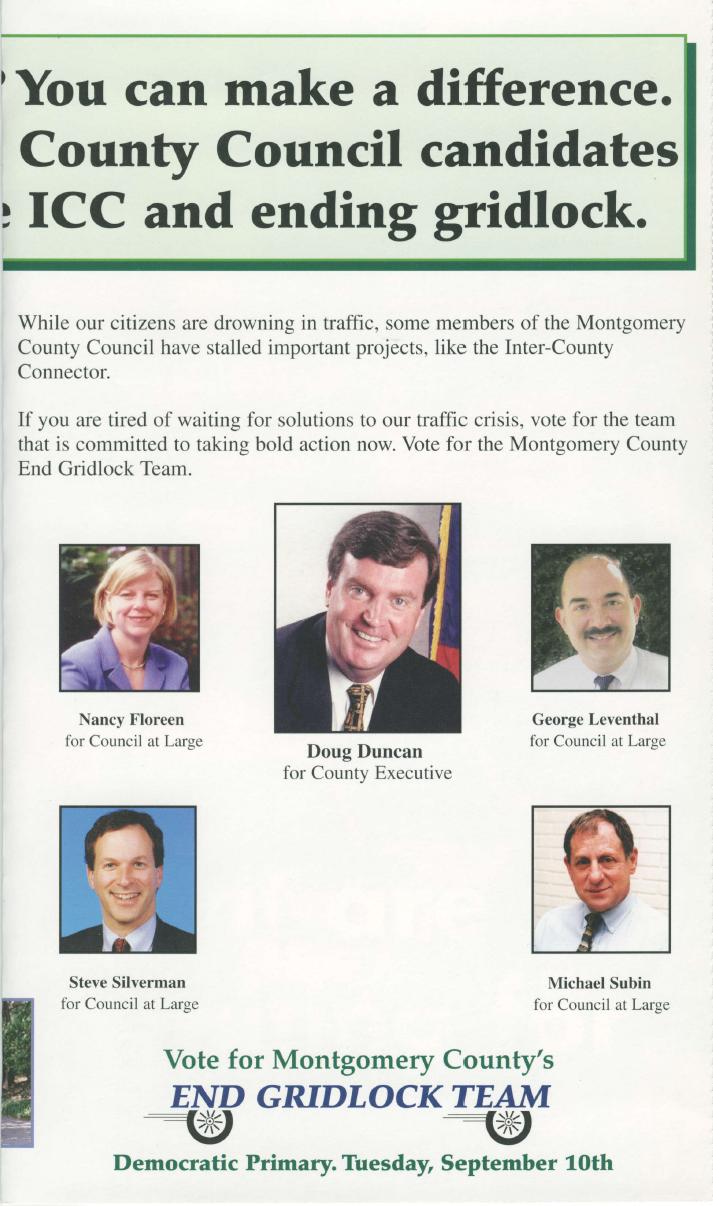
Please ignore that I was elected as part of the End Gridlock slate in 2002. (In 2002, End Gridlock flyers declared “our citizens are drowning in traffic” and promised “bold action now.”)

We do need to meet each of these challenges and I’ve worked on all of them for fifteen years as a councilmember and I think I have a good understanding of the leadership that’s necessary to take us into the next decade.

Please ignore what I just said. Our county needs experienced leadership.

Share

Playing Trump’s Game V: Denigrating American History

Notwithstanding Hillary Clinton’s ultimate loss, the Democratic Convention was very successful. One of its most heartening and effective aspects was its embrace of the country, the flag, and our progress as a people. As envious Republican commentators noted, President Obama’s speech and the audience reaction had the optimism previously associated with Reagan.

Since the election, too many active in progressive politics denigrate American history and America more broadly. This has always been a trope of the extreme Left but it is in danger of becoming far more widespread. When one reads these posts, it sounds like America has never done right, never can do right, and never will do right.

Like many countries, America has deeply unpleasant aspects of its history. Europeans arrived not just fleeing persecution but also as part of a colonial enterprise that exterminated almost all Native Americans. Slavery was the original sin at the country’s founding and the maintenance of Jim Crow after its end continued it. One could also mention the Chinese exclusion acts and the internment of Japanese Americans.

But fear of the future as “American carnage” is Trump’s market. Democrats won’t win by hectoring the country on its sins. Few will vote for someone who comes across as thinking that the only proper way to observe Thanksgiving is a vegan apology dinner. Yes, George Washington and Thomas Jefferson were slaveholders and (gasp) white men but they also played critical roles in crafting the country’s democratic institutions and the ideals that many have invoked so effectively to bend the arc of history.

No immigrant comes to America because they hate the country—they usually have reason to be grateful for the opportunities and freedom it offers—so the negative approach also has little appeal to the rising Latino and Asian American electorate.

We should acknowledge the past but the emphasis needs to be more squarely on our progress and celebrating the great wonder that is America. No need to celebrate historical figures whose essential contribution was primarily negative, like John Calhoun or George Wallace.  We want to move to the future to continue our amazing progress, which allows us to acknowledge darker moments in our past but as part of a tapestry in which we continue to move forward hopefully and confidently by holding on to our best ideals.

Share

Perennial Candidate Ficker Reprimanded for Ethics Violation Again

Ficker Reprimand by David Lublin on Scribd

Robin Ficker has been reprimanded yet again by the Maryland Court of Appeals for a legal ethics violation. Specifically, he failed to show up for court and left his client unrepresented, and also employed a disbarred lawyer without the appropriate required notice.

Ficker blamed a conflict and communication problems with the judge’s office for why the judge didn’t know that he wouldn’t appear. Did the client know that Ficker was leaving in the lurch? On the second violation, Ficker plead ignorance of the law as his excuse:

“I did not know about that rule. There was not a single Maryland case which had ever mentioned that rule or any ruling by the Maryland Court of Appeals,” Ficker said, adding that he stays up to date on developments in the state’s highest court.

Ficker is a frequent flier at the Court of Appeals for ethics violations and has been previously suspended from the practice of law. When Ficker was suspended in 2007, one judge wrote:

If disbarment is not warranted in this case for these types of issues, with a respondent with this history, it will never be warranted. If it is never going to be warranted in these types of cases, we should modify the rules to say so. I would disbar.

Taking into account his history, Ficker was lucky to once again get away with just a reprimand.

This will not affect his chances of being elected Montgomery County Executive, as those remain nil.

Share

Playing Trump’s Game IV: Denigrating People’s Jobs

Traditionally, Americans are big believers in the dignity of work. Being unemployed is felt to be shameful while anyone who works for a living, no matter how humble the job, can feel proud.

Republicans have corroded this view with an endless focus on the rich. People who work hard but don’t earn much are losers. Instead, we need to focus on the “job creators,” which seems to mean giving wealthy people ever more tax breaks and cutting basic services for average Americans in the manner of Kansas Gov. Sam Brownback.

Democrats have tried to take advantage of this with attacks on the rich but have often gone about it in ways that unthinkingly alienate the very people that they’re trying to attract. Many Democrats routinely describe all sorts of jobs as lousy for their low pay and status, or failure to allow much in the way of advancement.

Using McDonald’s employees or fast-food workers as bywords for jobs that stink unintentionally insults thousands and doesn’t acknowledge that these jobs actually require skills and ability to work under pressure. Calls for retraining workers and making it easier to obtain more education are laudable ideas. However, telling people that they need to do it so they can obtain “better” jobs comes across as patronizing at an incredibly stressful time, especially since many of the new jobs pay less than the lost jobs.

Parking attendants know that they work for low pay in a dark environment with too much pollution. For many in their situation, however, this may be as far as they end up going for a variety of reasons—not all related to lack of opportunity. They do these jobs year in and year out because it puts bread on the table and in the hope that their kids can do better. Even if they could use a helping hand, they want to retain their dignity and their respect.

There is a fine line between helping people improve their lives and denigrating the jobs they take to support their families. People who work in “lousy” jobs already know about the low pay and status. Just as they don’t need Republicans to tell them they’re chumps, they also don’t need Democrats saying their jobs are bad or somehow not good enough, which quickly gets read that they are not good enough.

A great part of Trump’s success was making whites who work these jobs feel respected in execrable identity terms that communicate that they are the “real” Americans and should come ahead of “those” people and snooty elites of both parties. Obviously, Democrats shouldn’t emulate this approach. A core Democratic belief is that we’re all real Americans.

But at the same time, Democrats have to find a way to communicate more respect for these jobs and the people who hold them. Democratic presidents from Clinton to Obama have heralded the many Americans who work two jobs to support their families, which is a good start though not a solution to this knotty problem.

It’s also not a quick fix for the bigger problem that many Americans feel that they are falling behind no matter how hard they work. The Republican approach now centers on gutting health care, tax cuts, and making Archie Bunker look tolerant, so Democrats have a real opening if they don’t unintentionally denigrate the voters.

Share

Playing Trump’s Game III: Old, White Men

About the worst epithet among Democrats as of late is “old, white men.” At best, this approach demonstrates a total lack of self-awareness in a party that adores Bernie Sanders. More to the point, it is oblivious engagement in exactly the sort of ageist, racist, and sexist behavior that Democrats claim to hate fervently.

It’s also a lousy way to attract voters. As it turns out, old, white men don’t like being stereotyped negatively any more than, say, young, black men. Needless to say, the right-wing media will be sure to highlight every single incident and even invent a few more. This thoughtless throwaway dig is a cheap and effective way to kiss goodbye to nice slices of the electorate by all but gift wrapping them for the Republicans.

White women, who often patiently work their way up the ladder to find themselves shunted aside once they reach a certain age, may also not appreciate the total celebration of youth over experience. This doesn’t mean ignoring the interests of younger voters on such issues as education affordability. It simply requires not denigrating older voters or experience.

It should be obvious but Democrats should stay out of the business of negatively stereotyping anyone for their identity characteristics. Advocacy on issues of particular interest to specific communities doesn’t require putting other people down based on their age, race, or gender.

In the last gubernatorial election, now-Rep. Anthony Brown hemorrhaged white support. If Maryland Democrats want to win back the Governor’s office, they shouldn’t insult big chunks of the largest group of voters in the state. Gov. Larry Hogan is not making this mistake with nonwhite constituencies.

Share

Rockville Councilmember Palakovich Carr Joins Delegate Race

Julie Palakovich Carr has won two terms on the Rockville City Council in 2013 and 2015. She came in second of the four winners in 2015 and first in 2013. Together, Rockville and Gaithersburg compose almost all of District 17, so Palakovich Carr should start out as a strong candidate. She will not need to give up her seat on the Council to run for delegate, as her term expires in 2019.

The announcement is interesting partly because it’s not clear that there will be a vacancy in the House. While it is well known that Del. Andrew Platt would like to run for Congress, Rep. John Delaney has not made his plans known yet. As far as I know, experienced Dels. Kumar Barve and Jim Gilchrist plan to seek new terms.

Here is Palakovich Carr’s announcement:

Rockville City Councilmember Julie Palakovich Carr Announces Candidacy for Maryland State Delegate

July 6, 2017

Rockville, Maryland—Today, Rockville City Councilmember Julie Palakovich Carr announced her candidacy for state delegate in District 17, which includes Gaithersburg and Rockville.  Palakovich Carr will run in the Democratic primary on June 26, 2018.

“Now more than ever, we need progressive leadership in Annapolis,” said Palakovich Carr.  “I’m going to fight for the values that people of Rockville and Gaithersburg hold dear: fairness, respect for diversity, and an open and honest government that helps people.”

“From safeguarding our children’s health from fracking and secondhand smoke to protecting law-abiding immigrants from deportation, I have a proven track record of working on behalf of the people in our communities to implement real progressive solutions.

Palakovich Carr was first elected to the Rockville City Council in 2013 and is currently serving her second term.  She is the author of the Fostering Community Trust Act, an ordinance enacted last month, which keeps local police focused on fighting crime rather than using city resources to enforce federal immigration laws.

Palakovich Carr also led successful initiatives to ensure smoke-free air in outdoor dining areas in Rockville, to protect local water quality, to improve pedestrian and bicyclist safety, and to honor and celebrate the community’s diversity.

In 2016, Councilmember Palakovich Carr was recognized as a Leading Woman by the Annapolis Daily Record for her community involvement and professional accomplishments.

A scientist by training, Palakovich Carr has a Master’s degree in Biology from the University of Minnesota and a Bachelor’s degree in Biology from Boston University.  She and her husband, Eric, have a son.

Prior to being elected to the City Council, Palakovich Carr served two terms on the city’s Environment Commission, chaired an advisory group on infrastructure and redevelopment, was vice chair of the City Services and Budget Working Group, and chaired the Watersheds Committee.

Share