All posts by David Lublin

63 Legislators Ask Hogan Not to Implement Trump Coal Pollution Standards

Trump’s effort to weaken clear water protections from coal are coming home to Maryland. At issue are three coal-fired power plants that would dump toxic waste into the Chesapeake Bay. Under President Obama’s proposed rules, the plants would have had to make improvements to better protect the environment to renew their permits. Trump has ended those protections. Will Hogan go with Trump or the Bay on this one?

Maryland Coal Letter by David Lublin on Scribd

Share

BREAKING: Dana Beyer Running for Senate

Looks like Jeff Waldstreicher isn’t going to waltz into the Democratic nomination for the open seat being vacated by Sen. Rich Madaleno, who is running for governor. Dana Beyer let it be known last night that she’s running.

A former eye surgeon and aide to one-term Councilmember Duchy Trachtenberg, Dana has sought election unsuccessfully before in District 18, twice for delegate and last time challenging Rich for Senate. She’s built name recognition, is independently wealthy and willing to spend it on a serious campaign. There is no love lost between Dana and Jeff, so expect this to be tough-fought contest at the very least.

Jeff will expect interest groups to go with him as the established incumbent legislator and work aggressively to persuade them that he will win so they should back him, Dana’s entry provides interesting opportunities for groups that feel Jeff has been insufficiently supportive or doesn’t have their back when push comes to shove and want to send a warning.

Dana has been working hard to organize a slate with candidates for delegate. It will be interesting to see if Jeff does the same and whether and how candidates for delegates choose to plump. I’m sure many will be watching Del. Al Carr, who has built a constituency the district’s municipalities–he was formerly a Kensington Councilman–as well as neighborhood associations and civil activists. There are dangers in joining either camp but also in remaining unaligned.

Fasten your seatbelts District 18, it’s going to be a wild ride!

Share

BREAKING: Prince George’s Teachers Walk Out on Rushern Baker at MSEA

At the Maryland State Education Association (MSEA) Convention, Rushern Baker’s camp teachers from Prince George’s County, Rushern Baker’s home county, walked out when he was called to the podium. According to its website, MSEA is the largest union in the state and represents over 75,000 public school employees.

That’s all the information I have for now.

Share

Correction: Raskin Did Not Endorse Waldstreicher

In an analysis earlier this week, I stated mistakenly that Rep. Jamie Raskin (MD 08) had endorsed Del. Jeff Waldstreicher in his effort to win the open District 18 Senate seat. Since then, I’ve learned that Rep. Raskin has told numerous candidates that he not endorsing, at least for now, in open seat races.

I contacted Jamie to confirm this. He explained that he had attended Del. Waldstreicher’s event, organized originally when Jeff was running for reelection to the House, and said some nice things about him but had not endorsed him or any other open-seat candidates at this time. I apologize to Rep. Raskin for the error.

The reason I thought Jeff had been endorsed was a multiplicity of Facebook posts and emails like this:

Del. Waldstricher did not contact me to correct the record after I posted that he had been endorsed by Rep. Raskin. Jeff is certainly not the first candidate to use quotations that make it easy for voters to infer stronger support than exists. But it does feed into criticisms of Jeff voiced by his General Assembly colleagues.

Share

They Just Don’t Get It

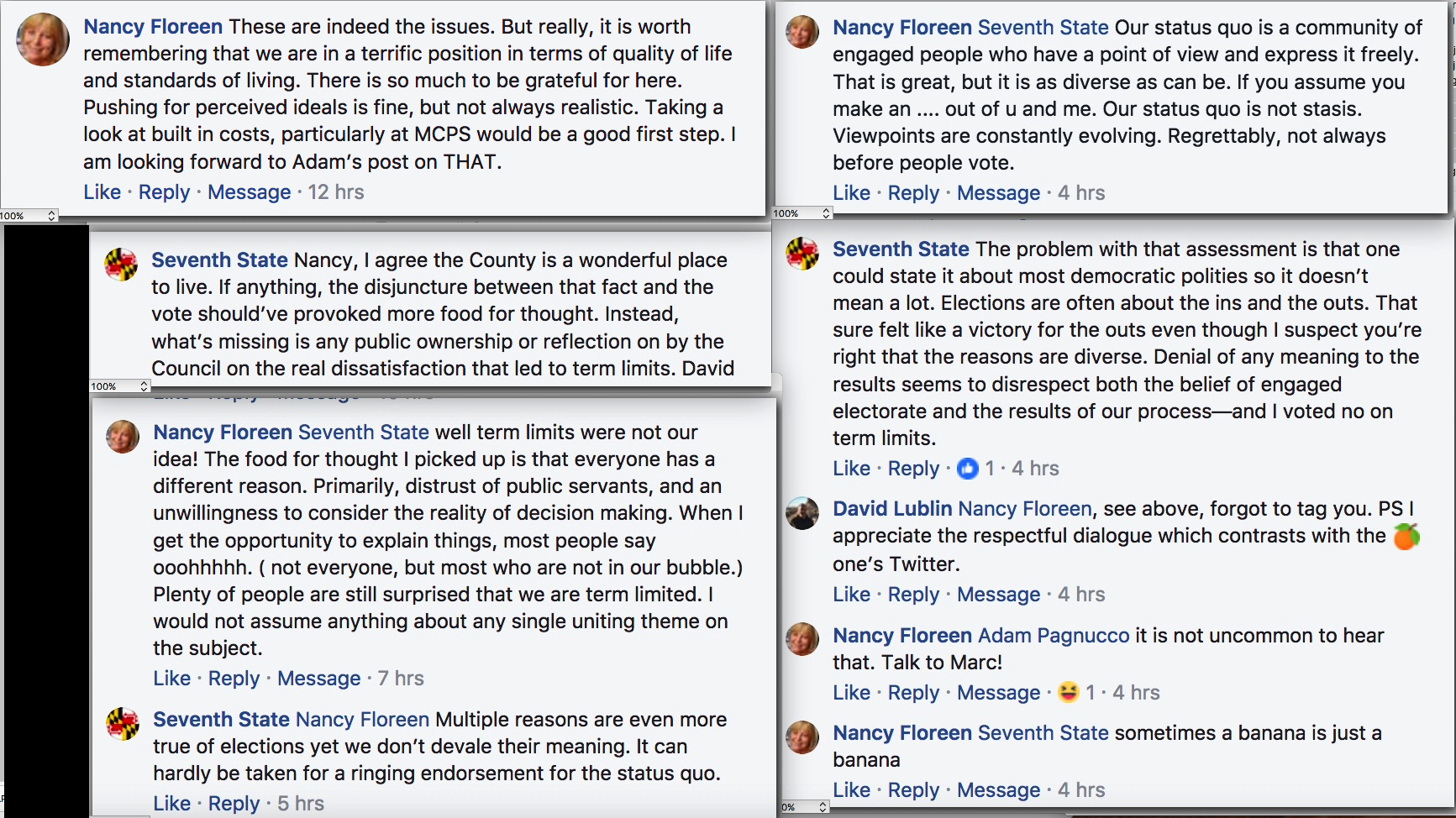
After Adam Pagnucco’s terrific and thought-provoking post from yesterday, I had an interesting conversation with Councilmember Nancy Floreen on Facebook. A very smart and knowledgeable former Council President who is happy to defend her record, the conversation was inadvertently helpful to me in understanding why term limits passed so overwhelmingly.

They Don’t Get It. At All.

Voters didn’t quite say “You have sat too long for any good you have been doing lately. . . Depart, I say; and let us have done with you. In the name of God, go!” in the manner of Oliver Cromwell to the Rump Parliament (repeated famously by a Conservative MP to Neville Chamberlain). But a 70% vote in favor of term limits is pretty darn close.

Yet, reflecting a common view on the Council, Nancy Floreen ascribes no meaning to the vote whatsoever, including viewing it as a vote against the status quo (see full Facebook exchange here). In short, there is now a yawning gap between how councilmembers see their work and the County government, and how voters see them.

This ostrich-like response on term limits–and even though I voted against them and really like and respect Nancy, I don’t know what else to call it–vividly demonstrates this distance and why voters supported them.

The Divorce

On reflection, I realized that something fundamental has changed about how voters see the County government. When I was a more of whippersnapper, people had a much more positive view of the County government. Yes, people paid a lot in taxes but the results were visible in terms of quality services from excellent schools to parks to libraries that made it a great place to raise kids.

People are now much more divorced from their County government–and not just because our population has doubled. Traffic, always bad, is now far worse. We’ve gone through a long period in which taxes have gone up but visible outputs in terms of those excellent services, such as libraries, are going down.

People even worry increasingly about the quality of our beloved school system and whether they’re getting value for money. Metro is no longer spanking new but decaying and dysfunctional. Other infrastructure from electric wires to gas lines to water mains needs replacement.

Why Did Voters Want to Throw the Bums Out?

Many of the problems that the County faces have little to do with its current membership. At least part of the term limits vote stems from having gone through a tough period when difficult, unpopular choices had to be made. And yet, the reasons that voters decided to make the psychological trial separation from the County a full-scale divorce via term limits go beyond that.

The Bubble

County Councilmembers are insulated from the public unless they make a strong effort. The highly symbolic locked door that prevents the plebeian masses from even entering their offices is just the start of it. Staff insulates councilmembers from the public, both by fielding calls and answering email.

Besides naturally supportive staff, councilmembers get a lot of positive feedback from visitors. After all, people lobbying for something tend not to want to alienate the Council. After 12 or 16 years, who wouldn’t be changed by that?

Two Electorates

Roughly 10% of eligible voters participate in the Democratic primaries that elect our local officials. Turnout in Montgomery has been stagnant, so politicians focus on the increasingly small share of people who participate in these contests.

The focus on the odd few of us who vote consistently in Democratic primaries leaves the rest feeling disengaged from politics, as politicians sensibly don’t reach out to them at election time because it won’t help them win.

It also leaves politicians with a pretty warped sense of what the average voter wants because the few who participate in primaries of either party tend to be more extreme than not just the average voter but also the average member of their party.

Term limits was one of the few ways that the other 90% could express dissatisfaction with local officials in a meaningful way other than casting a symbolic vote for a Republican, a brand tarnished by national Republicans that mostly fields weak or even nutty candidates here.

Confusing Congress and Local Government

Too many members of the Council seem to want to be national legislators and opine on the great national issues of the day. Increasingly, this creeps into legislation with more time spent on issues away from core functions.

I miss those wonderful ads with Doug Duncan taking out a voter’s trash. To voters, this said that he got it. One reason County Executive Ike Leggett was able to turn back challenges to his leadership despite being the man in charge at a difficult time was that (1) he showed an unusual capacity for listening at events around the county, and (2) he responded to voters with not just deep fluency on local issues but also a respect for voter concerns. At a town hall meeting with Ike, voters always felt heard.

Property Taxes

Most people’s salaries have been stagnant. Nonetheless, the County raised taxes by over 9%. At a time when many voters find it hard to live within their means, the County made it harder by increasing taxes. As it turns out, berating voters that they don’t care about schools or social justice if they feel this way doesn’t work.

In other words, it is time for the County to start to figure out how to live within its means. Maybe this means tax reform of some sort–no, not in the guise of a massive tax cut like federal Republicans–such as eliminating loopholes that help some but not most of us. Councilmember and County Executive Candidate Marc Elrich made a good start by highlighting an old post by Adam on a tax break for country clubs. But it may also mean taking on labor to rein in costs, actions Councilmember Roger Berliner or Del. Bill Frick, also running for executive, are more likely to do.

The tax argument for term limits was made especially effective by the 28.1% pay increase that the Council voted to award itself in 2013. The Citizens Commission report had recommended a 17.5% increase in one year plus COLAs. That would’ve given the Council a 17.8% increase through 2016 based on the CPI for the Washington-Baltimore region. Comparing annual wages per employee in Montgomery County from 2013 and 2016 reveals that private sector wages have risen just 7.6% in current dollars.

The People v. The Powerful

Monied interests are way better at working Rockville than the rest of us. While members of civic associations are part-time volunteers who are not always up on the latest in ZTAs (zoning text amendments), developers and other powerful interests have expensive lawyers who know how to work the process.

This critique is very different than rich v. poor because the problem affects neighborhoods across the County. Developers and other interests can afford lawyers who can navigate them through the process and leave neighborhoods feeling powerless.

Social Engineering

This intersects with the social engineering tendencies of both the Council and the Planning Board. Personally, I think smart growth is generally a great thing that builds urban nodes like Silver Spring, Rockville and Bethesda where many people want to live or to spend time.

At the same time, it needs to be done with sensitivity and awareness of existing neighborhoods. Most people moved out here for the suburban lifestyle of a house and a yard. They don’t appreciate being told that they’re outdated and even being demonized for caring about their neighborhoods and worrying about whether the infrastructure can handle the growth.

Moreover, those who have lived here a long time have a healthy suspicion of urban planners. In the 1970s and 1980s, these are the same people who told us that elevated urban plazas behind office buildings were the wave of the future. Total disaster.

I think they’ve got it more right this time with smart growth. But carrying it out in such an ideological manner that dismisses neighborhood concerns alienates the people who are supposed to be served. Downcounty residents are mighty tired of hearing patronizing talk of how much they’ll like that new 30-story building looming across the street from their home. Or that traffic is good because it will force us to ride the decaying Metro that doesn’t take us to the supermarket.

Upcounty residents really do want some of those promised roads built and are real tired of begging. If you don’t believe me, check out the hundreds of petition signatures submitted by upcounty citizens (see below) who are deeply unhappy that Councilmember Hans Riemer’s proposed resolution on traffic solutions for the area drops the M-83 extension of the Midcounty Highway.

Put another way, start treating smart growth like a very good idea to be pursued in concert with residents rather than a new religion desperate to burn some heretics. The Council made a good start with the Bethesda Master Plan. It wasn’t perfect but it was a good process so kudos, especially to Councilmembers Roger Berliner, Marc Elrich and Hans Riemer. But concerns have already arisen that development will go beyond what is in the plan, as developers and their lawyers are already working the process.

Ferment in the Land

So yes, it’s definitely “a time for a change” election. Yet, we may end up with a crowd that has much the same views as the previous one but voters will welcome the change of faces. And, who knows, new faces may bring some good new ideas and approaches.

Here’s hoping.

M-83 Petition Signatories 101717 by David Lublin on Scribd

Share

Can Waldstreicher Nail Down the D18 Open Senate Seat?

Del. Jeff Waldstreicher (D-18) has acted fast to lock down the open senate seat being vacated by Sen. Rich Madaleno (D-18), who is running for governor. Jeff is the favorite to win the Democratic nomination, and thus this very safe blue district, but openings nevertheless remain for the right candidate.

Advantages

Jeff has a solid advantage in name recognition. He has won three terms to the House. More voters begin to recognize state legislators, who often remain obscure to their constituents, after three campaigns and ballot appearances.

No one I know is more tenacious or focused when it comes to campaigns. Jeff won his first election in 2006 against a very tough field with just one open seat. Besides successful fundraising, Jeff won the endorsement of MCEA, in part by arguing convincingly that he was going to win and they should back him.

Jeff is also fortunate in having an extremely supportive family. In past races, they have had his back not only financially but also doing whatever they can to help out from cheering him on at debates to volunteering on the campaign.

Jeff possesses enviable fundraising skills. I have never met anyone more relentless in pursuing a campaign donation and the results show in his impressive bank account balance of $165,491 according to his last campaign finance report. This sort of war chest not only aids victory but deters potential opponents.

Jeff has already secured and vocally touted the valuable endorsement of Rep. Jamie Raskin (D-8), a local progressive icon. No doubt he is also pursuing the endorsement of Sen. Chris Van Hollen, which he has received in the past for the House.

Interest groups are likely to back Jeff, if only because he is an incumbent with a record they can assess. They also tend to want to back the winner to avoid alienating a future senator and will naturally perceive him as the heavy favorite. Jeff will not be afraid to pressure any groups that may hesitate.

Potential Openings for Challengers

For all of these advantages, Jeff has vulnerabilities that could tempt a well-funded candidate.

Jeff does not have an especially strong political base in the district. While he has easily gained reelection as part of the D18 team, I have yet to identify groups within the district who passionately support him and see him as their champion.

The perception that Jeff is unwilling to take firm stands on controversial issues hinders his ability to win avid supporters. Politicians naturally desire to avoid offending voters, but taking stands in tough fights is precisely how many politicians gain supporters who stand by them through thick and thin.

The same problem plagues Jeff’s relationships within the General Assembly. Even in a business known for back-stabbing, inhabitants of Annapolis-land are astonishingly willing to volunteer privately their lack of trust, and even dislike. They see Jeff as very transactional and attentive to his own ambitions but not especially hardworking or responsive to his colleague’s needs.

These weaknesses, however, give opponents less of an opening than may appear. Challenging a legislator on the basis of his effectiveness, rather than issues, is a proven way to lose a campaign. Moreover, regardless of their opinion, viewing him as the probable winner, his colleagues will likely line up to offer support and give a friendly quote for the press.

Like all politicians, Jeff is good at touting his support for popular positions and claiming credit on having voted for broadly supported bills passed by the General Assembly from marriage equality to additional funding for school construction. Occasionally, however, he takes it a bit far. Jeff routinely boasts that he is “fiscally responsible” because he “voted for a balanced budget.” Jeff never had the opportunity to do otherwise because the Maryland Constitution mandates balanced budgets. While this sort of false piety grates, opponents will only be able to use to their advantage if they can find a way to use it to feed into a larger portrait of Jeff as yet another inauthentic long-term politician.

Moreover, as a three-term legislator, Jeff has a couple of substantive achievements under his belt. His website mentions that he was the lead sponsor on legislation making possession of child porn a felony, and a ban on texting while driving. Both are easily understood, popular positions, and thus highly amenable to quick, effective campaign communication.

I asked Jeff last week via email how he got interested in these issues and to detail the leadership he showed in passing these bills, or on other issues not mentioned on the website, but did not receive any written answers for quotation.

Though I don’t think campaign websites matter a heck of a lot, his current website could nevertheless punch up his message, as it now highlights banal boilerplate that is about as convincing as ersatz coffee such as “As a father, husband, and life-long resident of Montgomery County, I am committed to the safety of our neighborhoods. I will continue to be a strong advocate for our families.” – Jeff on Safety.

Potential Opponents

Dana Beyer is the obvious candidate. She is seriously considering entering the race and rumor has it that she is trying to put together a slate.

A former eye surgeon and aide to one term Councilmember Duchy Trachtenberg, Dana has been hungry to win a seat in the General Assembly, seeking appointment twice and running three times. In 2014, Dana challenged Sen. Rich Madaleno and lost with 41.7% of the vote after spending in excess of $350,000 on her campaign.

Dana is one candidate who could easily bring to bear more money than Jeff. Like Jeff, she’s also smart, hardworking and extremely determined. While she has not won election, she has been on the ballot a number of times and built name recognition. She has gained valuable experience in running past campaigns.

On the other hand, though Dana has tried to build ties with left-wing progressives, she does not have a personal base of supporters in the district and has difficulty in recruiting or working with allies. She would also have a lot of fences to mend with Madaleno supporters. A decisive and opinionated person, she needs to articulate an authentic voice while at the same time remembering that voters want to be heard and not lectured—a skill that Jeff already possesses . In short, she’d have to figure out how to grow her support.

Of course, a candidate who is not currently on my radar could still emerge. The best bet for someone else to challenge Jeff is a candidate with very deep pockets who wants to run as a fresh, authentic face and argue that we need new ideas and new leadership in Annapolis. Even if it would likely remain an uphill battle to defeat Jeff, I could imagine such a candidate gaining traction and making him sweat to win the seat.

The bottom line is Jeff is well positioned to become District 18’s next senator. That doesn’t mean he won’t have to fight for it. However, if his luck continues, it may even occur with ease, as when Rich Madaleno won in 2006 without opposition.

Share

Elrich Slams Berliner on Minimum Wage

The following is by Councilmember Marc Elrich (D-At Large):

Earlier this week, the Council’s HHS committee voted 2-1 (Berliner and Rice vs Leventhal) to delay the full implementation of the minimum wage by two years for BOTH large and small businesses. (My bill cosponsored by 4 of my colleagues would raise the minimum wage 2020 for businesses with more than 25 employees and 2022 for those under 25.) While everyone acknowledges that there will be some impact on some small businesses, yet again no evidence was presented that demonstrated that it would be a significant impact.  While there are numerous studies, the meta-analysis of those studies show slight to no impacts on employment.[1] Statements should be supported by data or analysis.  The absence of data is part of what made the PFM study so bad, because their original massive job loss assertions, and even their second lower revised figure, did not reflect the data from anywhere (as this blog and others have documented[2]).  On the other side of the scale, studies clearly show the devastating impacts of poverty on children and families. I taught for 17 years at a high poverty school, and I saw up close the impact of poverty on students.

We have an opportunity to move toward a decent standard of living for these workers who have been working hard at low wages. Councilmember Berliner’s amendment to delay large businesses by two years to 2022 puts us two years behind Target’s stated nationwide plan. That is particularly inappropriate given that our county is one of the wealthiest in the entire country.

Councilmember Berliner argued for the delay using Minneapolis as the model and said that Montgomery County should use the same timing as they had. Using Minneapolis’ implementation schedule as a model would assume that it is a comparable jurisdiction. But it is not. Below I compare the living wage in the two jurisdictions. There are some big differences.

This table compares the living wage NEEDED TODAY in each jurisdiction.

Living Wage Minneapolis Montgomery County
Single adult $11.36 $15.80
1 adult 1 child $24.68 $29.82
1 adult 2 children $31.04 $34.87
2 adults 2 children $16.85* $18.72*

*This number is per adult in the two-adult family
(Source: Living Wage Calculator, MIT)

In every case, more than $15 an hour is needed TODAY in Montgomery County, but the cost difference between living here versus Minneapolis is the equivalent of $4 an hour, or $2 an hour if 2 adults are working.

However, the most important factor in cost of living differences is housing. Housing costs are what drives the cost of living and necessitate a particular wage. Here is a comparison of housing costs:

Jurisdiction 1br  yr/mo 2br  yr/mo 3br  yr/mo
Minneapolis $7824/ 652 $12635/1075 $17967/1497
Montgomery $15684/1307 $19476/1645 $25728/2144
Difference – or how much higher it is MoCo $7860/655 $6841/570 $7761/646

(Source: Living Wage Calculator, MIT)

A MoCo resident would need between $570-655/month more than a Minneapolis resident to pay the difference in housing costs. For all other expenses combined, Montgomery County is a few hundred dollars per year more costly to live in than Minneapolis, but annual housing costs are between $6841 and $7860 higher for Montgomery County. To suggest that a wage in Minneapolis, or a schedule for raising wages, should be replicated in Montgomery County ignores the enormous cost difference between the two jurisdictions which leaves our working poor deeply mired in poverty. We are simply prolonging an untenable situation for tens of thousands of families.

Finally, there is one last incorrect assumption in delaying the implementation date, and that is that Minneapolis is noticeably more gentle to small business. It’s been said that the proposed rate of increase is too fast. However, the facts show a different story.

Here is the pace of increase in the two jurisdictions:

Jurisdiction Small business increase # of years Cost/year Large business

increase

# of years Cost/year
Minneapolis $7.25 7 $1.03 $5.50 5 $1.10
Montgomery County $3.50 5 $.70 $3.50 3 $1.16

In other words, the impact in Minneapolis on small businesses is greater in terms of total increase than Montgomery County ($7.25 vs $3.50) and greater as a per-year expense ($1.03 vs .70) For large businesses, the difference in total increase in Minneapolis is also greater than MoCo ($5.50 vs $3.50) but is slightly less per year ($1.10 vs $1.16).

So for small businesses, if the issue is pace, then the Minneapolis schedule is worse for their small business than what I’ve proposed, and for large businesses our target is 2020, no different than what Target has committed to nationally for 2020.

In short, Minneapolis is so different regarding affordability for its citizens that the impact of raising the minimum wage, and the urgency for raising the minimum wage, is simply not the same. Our residents are far more rent burdened and have far less disposable income. And if you’re worried about small employers, our steps are smaller, only 2/3 of the average annual increases that Minneapolis is implementing.

For one last comparison, I looked at Flagstaff, Arizona, which is also raising its minimum wage to $15.  Their living costs are slightly higher than Minneapolis but still much lower than Montgomery County.  And housing costs in particular are slightly higher than in Minneapolis, but about $6,000 a year lower than those costs in Montgomery County.  Yet they are raising their minimum wage for all businesses from $8.05 in November 2016, to $11.00 in January 2018, and then up to $15 an hour in January 2021.  So they are increasing by $7 per hour over just 5 years – a rate of increase that exceeds anything proposed in Montgomery County.

The minimum wage needs to reflect the costs that people have to bear in order to sustain themselves.  Prolonging the implementation simply erodes the value of the wage.  Frankly, in a perfect world we’d be close to $15 today and then let it rise with inflation.  Even my bill, with 2020 and 2022 implementation dates will mean that when $15 is reached it will be worth less than $15 today, and I wish we could do better, but the proposed delay just makes things worse and is completely divorced from the reality that low-income families face.

[1] http://jaredbernsteinblog.com/the-minimum-wage-increase-and-the-cbos-job-loss-estimate/?utm_source=feedburner&utm_medium=feed&utm_campaign=Feed%3A+JaredBernstein+%28Jared+Bernstein%29 and https://www.hendrix.edu/news/news.aspx?id=64671

[2] http://www.epi.org/blog/the-montgomery-county-minimum-wage-impact-study-is-absurd-junk-science/

Share

Valerie Ervin for County Executive?

A reliable source tells me that former County Councilmember Valerie Ervin (D-5) is planning to jump into the race for Montgomery County Executive. I’ve reached out to her for comment but have not yet received a response.

Valerie Ervin won election to the School Board in 2004 prior to winning the District 5 Council seat in 2006–the seat now held by Tom Hucker. A past President and Vice President of the County Council, she stepped down in the year before her term ended in 2014 to take a job with the non-profit Center for Working Families.

Ervin briefly sought the nomination for the Eighth Congressional District in 2016 before pulling out of the race, which she explained was due to the challenge of raising the enormous sums of money required to be competitive.

The new public financing system would likely make it easier for to run a competitive campaign for county executive without raising the huge sums required for a congressional contest. Still, she would need to act fast to catch up with other candidates.

If she enters the contest, Ervin will be the only woman, African-American, or nonwhite candidate in the race. As Montgomery County is now 19.5%  black and only 44.7% non-Hispanic white according to Census estimates from 2016, this could prove an advantage. African Americans likely punch above their weight in the Democratic primary, as a disproportionate share are Democrats and vote compared to other racial and ethnic groups.

Democratic primaries are also disproportionately female, with women regularly comprising around 60% of the electorate, and sometimes even higher. Still, Montgomery voters have shown that they vote based on a variety of factors. Being from the same group as a voter may help get a candidate in the door but concrete issues and reasons are needed to gain a vote.

As I’ve mentioned previously, while in office, Councilmember Ervin had the knack for being well-liked by both labor and business, though the bloom was definitely off the rose in her relationship with labor by the time she left office. Her recent work for the Center for Working Families, however, has burnished her progressive credentials–helpful in a year when many are still energized by Bernie Sanders or angry about Donald Trump.

On other hand, many remain disquieted that Ervin left her Council seat early. In 2016, she endorsed Donna Edwards for Senate over Chris Van Hollen, who remains extremely popular in Montgomery and won handily here in the primary.

Interestingly, if she runs, Ervin would be running against her former boss, Councilmember George Leventhal. Both are officials who have eclectic sets of supporters in the past but would be trying to appeal to the progressive vote in this election.

Consequently, an Ervin candidacy would not help Leventhal’s prospects. It also could well provide an alternative to some Elrich voters, particularly those who would welcome a nonwhite candidate or our first woman as county executive.

At the same time, I imagine Marc Elrich would not be shy about pointing out occasions where he and Valerie diverged on business or social justice issues. Labor unions with long memories, especially MCGEO and the Police union, might enjoy exacting revenge. Ervin had good relations with SEIU but it might also join other unions in backing Elrich.

At any rate, Ervin’s entry would sure shake up an already interesting race. Will she take the plunge?

Share