All posts by David Lublin

CASA Endorses Elrich for Exec

From the press release issued jointly by CASA and the Elrich campaign:

SILVER SPRING, Md._ On December 21, CASA in Action announced its endorsement of Marc Elrich for Montgomery County Executive. CASA, a 96,000+ member immigrant advocacy organization, is the first civil rights group to weigh in on the county’s 2018 primary election.

“I am deeply honored to have the support of the CASA in Action community,” Marc Elrich said. “CASA in Action has been a leader on immigrant rights and economic justice issues and I have been humbled to have had the chance to work with them to move people to citizenship and achieve economic security for their families.”

In a crowded race, the CASA in Action board decided to endorse Elrich because of his outstanding commitment to immigrants and workers both during his time on the Takoma Park City Council and the Montgomery County Council. In the early 1990s, Elrich supported the establishment of the first day-laborer center in Takoma Park. He also strengthened Takoma Park’s rent stabilization law and directed city funding to community organizing efforts. Since Elrich has been on the County Council, he has taken leadership with CASA in Action members to pass legislation protecting domestic workers, improve legal protections for tenants, push back against master plans that eliminated existing affordable housing, and, most recently, raise Montgomery County’s minimum wage to $15 an hour.

“Time and again, Marc Elrich has stood shoulder to shoulder with our members to fight for a county where children can achieve, families can strive, and immigrants are woven into the fabric of every community,” said Gustavo Torres, President of CASA in Action.

During an election cycle that will bring vast change to leadership in the county, the CASA in Action board was able to consider many strong candidates, some whom – like Councilmember George Leventhal and Delegate Bill Frick – have long stood up for immigrant rights in their current roles.

“Elections require us to make choices about the communities we want to live in. This one comes at a time when the contrast between the lives of Montgomery County’s haves and have-nots could not be more stark,” said Mr. Torres. “Marc Elrich knows that a more equitable world is possible and is committed to make the necessary changes to achieve it.”

Share

Running Locally? Please Stop with the National Rhetoric

Based on their emails, many Democratic candidates for local office are none too interested in the bread and butter issues of local government. Why talk about snow plowing, property taxes, and sector plans when you can run against Donald Trump?

Roger Berliner is running for Montgomery County Executive to fight for net neutrality and against federal tax legislation:

At-Large Montgomery County Council Candidate Seth Grimes is running on a similar set of themes:

As it turns out, Montgomery County does not regulate the Internet.

Similarly, George Leventhal is running for County Executive to fight for gun control:

Of course, the reason George’s “action” on the issue consists of a resolution that wouldn’t stop a BB gun is that the county cannot do anything on guns any more than it can regulate the Internet.

These three candidates are good examples but they are far from alone in talking non-local issues, so don’t think they’re remotely outliers. Voters are quite naturally fixated on the latest horrendous news to come out of Trump’s cauldron.

Among Democrats, there is no greater motivator than running against Trump and his works. My guess is that it works a lot better at getting people to open up their wallets than talking about the county’s budget shortfall or zoning.

However, as someone who writes about local and state politics (and Trump too), it grates. Democratic candidates agree on all of these issues, so it doesn’t distinguish them. Despite trying to gain points for standing up for “the resistance,” opposing Trump is truly the path of least resistance in scoring Democratic dollars or votes.

It’s all the more problematic because there are many pressing local and state concerns. I just don’t seem to hear much about them from many candidates who are busily trumpeting their opposition to all things Trump.

If you’re running for the Democratic nomination for Montgomery County office, tell voters what you’re going to do here. If you focus on core county issues and concerns, that would be even better. I’m even willing to stipulate that you are a fervent Trump opponent.

Share

Busting Three Metro Myths

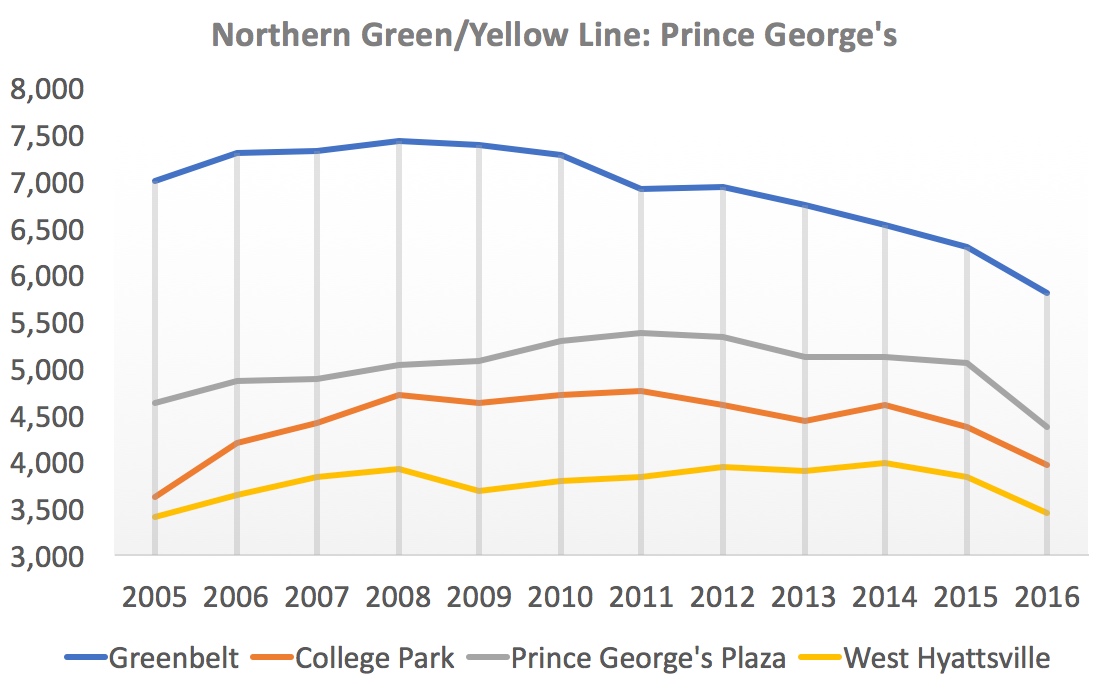
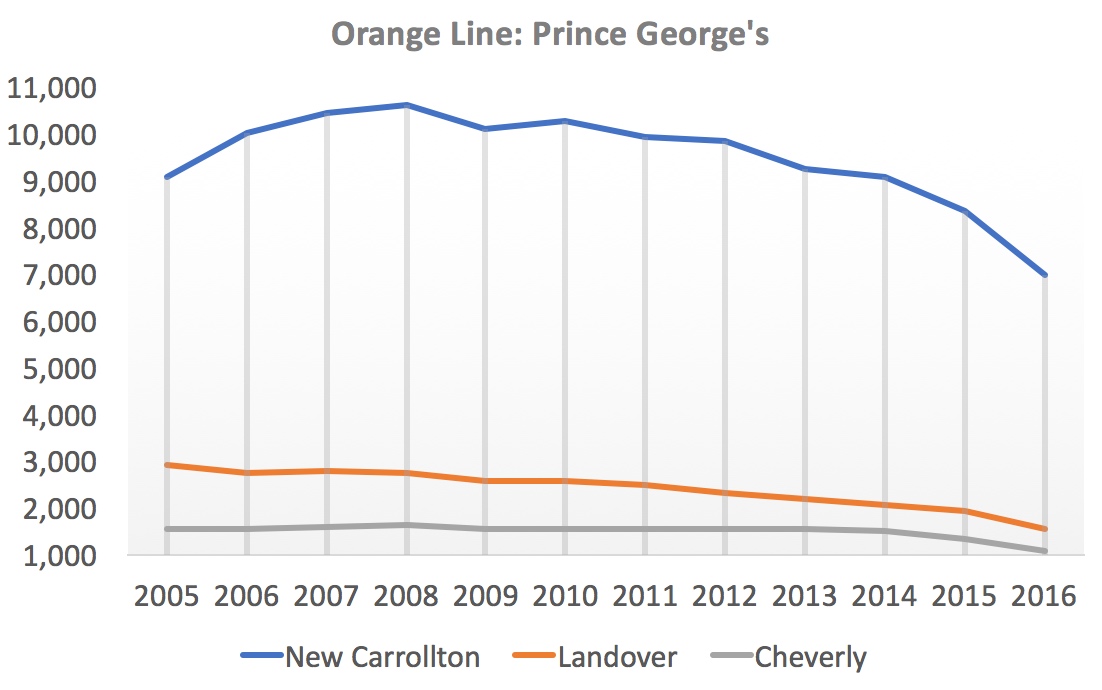
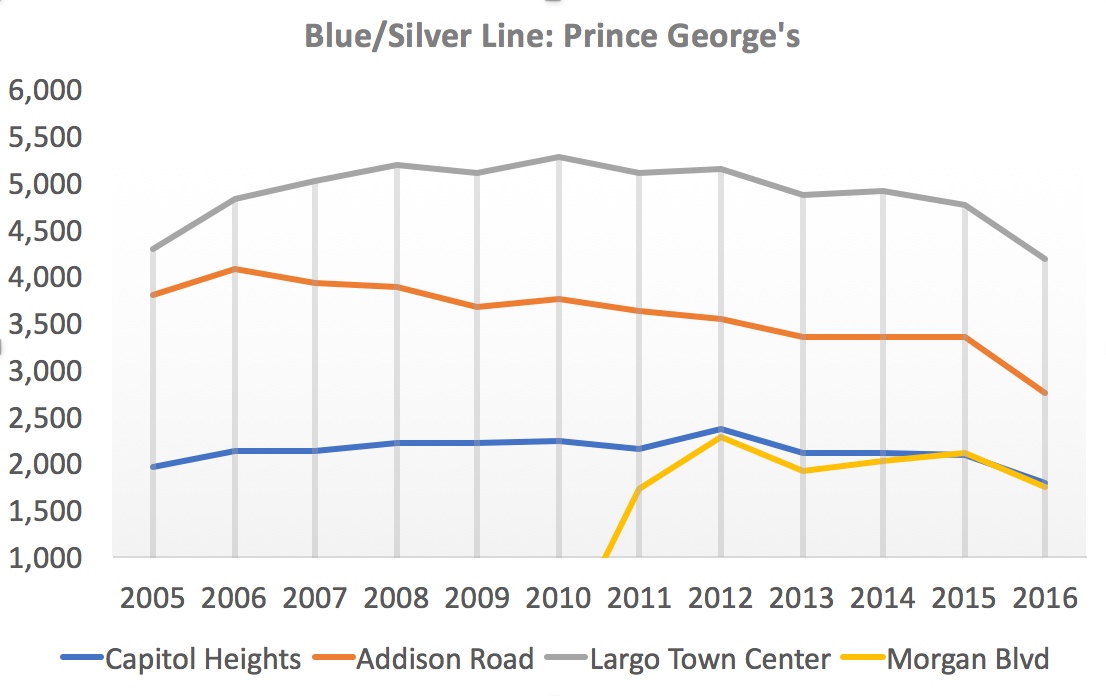
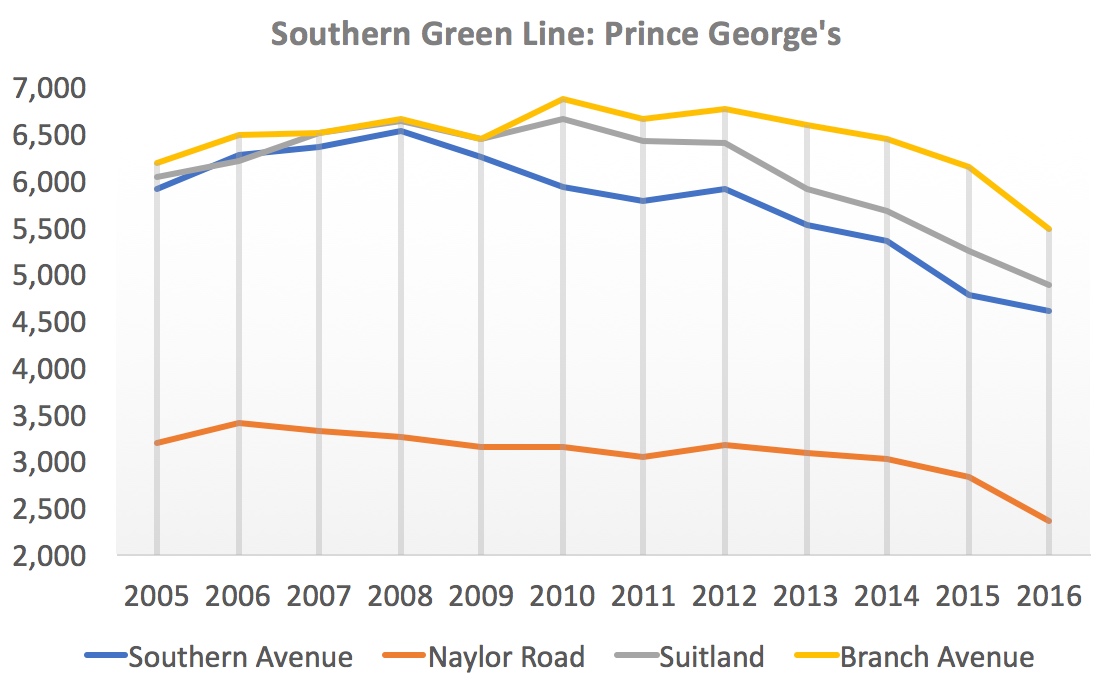
The six graphs – one for each Maryland branch of the Metro – in today’s post reveal the ridership figures for all Maryland Metro stops from 2005 through 2016. They’re not encouraging either for the health of the system or cherished myths around it.

Transit Always Heralds Urbanism

“If you build it, they will come.” Usually not. In Maryland, only three stops have become high traffic urban nodes: Bethesda, Silver Spring and Friendship Heights – the latter is shared with the District. The other 24 stops have not witnessed remotely this level of impressive urban development or Metro ridership. Outside the urban three, the highest ridership occurs mainly at end-of-the-line commuter stops, such as Shady Grove, Greenbelt and New Carrolton.

Transit advocates and developers are both very attached to this myth. The former because they believe fervently in transit. Developers like it because they are permitted to build far more when transit is built, which allows them to make a lot more money even if nobody ever rides it. Proximity to transit also raises the value of their property at somebody else’s expense.

The uncomfortable truth is that no nodes similar to Bethesda or Silver Spring – or Ballston or Rosslyn – have emerged in Prince George’s County. Leaving aside the terminus stops, ridership is not very high and certainly not growing. And the terminus stops have seen more precipitous declines than in Montgomery – 34% at New Carrollton, 21% at Greenbelt, and 20% at Branch Avenue.

Thriving Urbanism Heralds More Transit Riders

Not necessarily. Bethesda, Friendship Heights and Silver Spring have continued to grow yet ridership has declined. In 2016, all three served many fewer riders than at their peak – 15% in Bethesda, 17% in Silver Spring, and 20% in Friendship Heights.

Transit is a positive for these areas but it’s only one factor among many. It’s not that smart growth or new urbanism is totally off base. The focus on transit may lead to overestimation of its importance to successful development. Density and the mixture of residential and commercial looks more crucial to their continued success. It’s why places like the Kentlands thrive even though they’re nowhere near Metro.

There is little sign that less intense development around Metro stations other than the big three has increased ridership either. Throughout the Maryland portion of the system, ridership has tended to stay flat or decline. Remember that this has occurred despite population increases in both Prince George’s and Montgomery.

Declining Ridership is Temporary

Two major excuses are given for Metro’s declining ridership: the financial crisis and Metro’s “temporary” maintenance backlog. At this point, the former explains little as the recession is over and the population is now higher, so Metro should have more riders. The latter is belied by the similar decline in Metro’s bus ridership. Moreover, SafeTrack will not bring the system back to tip-top condition but simply prevent its complete collapse, as General Manager Paul Wiedefeld has been at pains to point out.

The wheel of technological change is driving changes in transportation patterns fast. Increasing numbers of jobs can be done via telecommuting. Competition from services like Uber and Lyft are remaking the taxi industry and attracting many new riders. Every price increase in Metro or its parking lots only makes them more competitive – and the price of both is likely to head up.

Share

Budget Cuts and Hunger in Montgomery County

Today, Seventh State is pleased to present a guest post by Manna Food Center CEO Jackie DeCarlo. Manna is a nonprofit dedicated to ending hunger in Montgomery County through food distribution, education and advocacy.

The holiday season is upon us, which means hunger relief organizations all over Maryland are welcoming an uptick in volunteerism and donations. While the individuals who organize food drives, pick up and deliver food, and volunteer at food pantries are critical to addressing hunger in our communities, their efforts will be undermined if threats to our social safety net currently working their way through Congress come to fruition.

Specifically, the federal tax plan headed for passage—and cuts to vital programs like the Supplemental Nutritional Assistance Programs (SNAP) that will likely accompany the price tag for that plan—will cause more Marylanders to tumble further into the kind of poverty that comes with inevitable hunger.

Even though Maryland is the wealthiest state in the nation, one in eight households struggles against hunger and programs like SNAP improve the lives of those neighbors on a daily basis. In Montgomery County, one of the richest counties in our state, one in three of our schoolchildren is food insecure, and there are large pockets where high unemployment and poverty rates prevail. Every day at Manna Food Center, we see the value of SNAP and other social safety net mainstays such as housing assistance programs and low-income tax credits.

A case in point is Sasha, a woman Manna has had the honor to serve. Sasha immigrated to the United States ten years ago, married and had a child, then was forced to leave an abusive husband. She didn’t have a job and found it hard to provide for her children, but the food she received from Manna helped her make it through an incredibly difficult time in her life, and eventually stand on her own.

There are countless stories like Sasha’s, which is why it so upsetting to see the budget Congress is debating on the heels of untested approaches to tax “reform.” Cuts being considered would likely cause millions of Americans to tumble further into the kind of poverty that comes with inevitable hunger. Regardless of political affiliation, there seems to be agreement that more responsibility is falling to local governments and local businesses.

Already in Montgomery County, our local government is trying to do its part to address hunger and poverty. This year, elected leaders worked with the food assistance community to develop a five-year strategy to reduce the number of food insecure neighbors by 22 percent. The plan aims to address the root causes of poverty and economic disparities through programs such as workforce training and youth skills building that ensure no one is left out of our county’s rapid development and growing prosperity.

The council also recently passed, and the County Executive signed, legislation securing a $15 minimum wage, a great step toward giving people financial autonomy – and one Governor Hogan should emulate so all of the state’s low-wage workers can enjoy a boost in earning. Even with those positive measures, however, the reality is that the minimum wage increase won’t be enough to raise people out of poverty, and none of our local government’s commendable plans amount to a silver bullet that will end hunger.

Therefore, the commitment of the local business community will also be required. Food businesses, in particular, can play an important role in alleviating hunger throughout Maryland. Through Manna’s Community Food Rescue network, Montgomery County farms, grocers, food service companies and restaurants donate unsold and surplus food that gets matched through an app and delivered by volunteers to food assistance organizations. In its first two years, the CFR network has recovered more than 2.3 million pounds of food—the equivalent of 1.9 million meals. As more businesses recognize the importance of getting food to people who need it, instead of to the landfill, the potential impact of food recovery programs here and across the state is tremendous.

Even with these positive local steps, ending hunger and poverty will be impossible without strong federal programs like SNAP, which helps ensure low-income families have enough to eat. SNAP benefits equal about $1.40 per person per meal, and if the budget passes with proposed SNAP reductions, food assistance organizations won’t be able to fill the gap.

While we have many reasons to be grateful this holiday season, I am concerned about what we stand to lose. The commitment of volunteers and donors who do their part to end hunger in communities nationwide must be matched by the commitment of businesses and, especially, policymakers at all levels of government. Rather than watching idly as a tax plan that does significant harm to those in greatest need gets passed, our local and state leaders should emphatically convey to Congress and the administration that their recklessness is unacceptable, and they will fight for the preservation of our social safety net.

Jackie DeCarlo is the CEO of Manna Food Center, a nonprofit dedicated to ending hunger in Montgomery County through food distribution, education and advocacy.

Share

Gabe Albornoz Qualifies for Matching Funds

The following is a press release from Gabe Albornoz’s campaign for an at-large seat on the Montgomery County Council:

Press Release:

FOR IMMEDIATE RELEASE: Wednesday, December 6, 2017

Gabe Albornoz Reaches Matching Funds Threshold for At-Large County Council Race

Kensington, MD – Gabe Albornoz, a Democratic candidate for an At-Large seat on the Montgomery County Council, announced that he had received over $20,000 and 250 contributions from Montgomery County residents. Albornoz’s campaign will be qualified to receive matching funds from the Montgomery County Public Campaign Financing Program upon certification by the Maryland State Board of Elections.

“I’m humbled and honored to receive this support. The Campaign Finance Program is working and has ensured that Montgomery County residents set the tone of our politics. I’m pleased that our campaign is playing a role in democratizing our county’s politics to give more power to people,” Albornoz said.

“I am very pleased to hear that Gabe has achieved this important milestone in his campaign. He has earned a reputation for strong leadership, collaboration and commitment to public service, which is why I’m happy to endorse his campaign,” said Councilmember Nancy Navarro.

At-Large candidates for County Council must receive at least 250 qualifying contributions, totaling at least $20,000, in order to qualify for a public financing, according to a law previously passed by the Council. Only contributions of up to $150 per election cycle from Montgomery County residents qualify for matching funds. Candidates in the program cannot accept any contributions from special interest groups, businesses, political action committees, unions, or political parties. Participating candidates are eligible to receive up to $250,000 in matching funds during the primary and general election campaigns.

“We are grateful to Gabe’s many supporters and their confidence in him to represent them as a member of the County Council. Gabe’s message of optimism for Montgomery County has been enthusiastically received,” said Campaign Chairman Chuck Short.

Albornoz is a lifelong Montgomery County resident and a past Chairman of the Montgomery County Democratic Central Committee. He is the current Director of the Montgomery County Recreation Department. He was appointed to that role by County Executive Ike Leggett in January 2007.

Share

Lost in Potomac: Stuart Rothenberg Eviscerates the Trone Campaign

National Political Pundit Stuart Rothenberg wrote a devastating account of his meeting David Trone:

Maryland Democrat David Trone, who is running for Congress in the 6th Congressional District, came to my Potomac community to talk about his candidacy – and he brought plenty of wine for residents to sample while they chatted with neighbors before turning their attention to the candidate. . . .

What made all the politicking odd is that my community is not in the 6th District but rather in the 8th, currently represented by Democrat Jamie Raskin, who beat Trone in the Democratic primary last year. In other words, Trone touted his credentials, talked about his views and supplied wine to a roomful of people who could not vote for him next year.

Oops.

But it gets even worse:

[My] second question involved my doubts that he is suited to being a lowly freshman who would have little influence. I noted his self-funding and his previous race, as well as the fact that he had flirted with running for county executive before deciding on a second race for Congress. I also noted that his earlier comments about leadership, about the county government and about his experiences in the private sector suggested he would be more effective in an executive position.

Trone seemed to dislike the question. He turned away from me and addressed others in the audience, insisting that his wealth was an asset not a liability, emphasizing that he would be politically independent, and promising that he could bring change. He was passionate, certainly, but he didn’t address my concerns about his temperament, district-shopping and suitability for a legislative office.

Trone took another question but suddenly had to run. He never stressed his Democratic label, instead embracing the “no labels” movement in response to a question and talking about his pro-business bent.

Running as the “no labels” candidate in a Democratic primary gives the impression that he thinks he has it sewn up. No voter likes being taken for granted or having his questions given the “talk to the hand” treatment–something you would think someone who runs a business with excellent customer service would know.

Rothenberg concluded his analysis with some sage advice for Trone:

His odds will improve if he campaigns among voters who actually live in the district where he is running.

I’d be glad I owned a liquor store after reading this piece.

Share

Frick Attacks Opponents for Budget Shortfall

Montgomery County is facing a budget shortfall and across-the-board operating budget cuts of 2%–and warning that’s just a start. Del. Bill Frick is highlighting the cuts to go after his three opponents in the Democratic primary for county executive who have served for many years on the County Council:

It is time for new leadership in Rockville.  Our councilmembers ignored warnings from County Executive Leggett to restrain spending.  Despite an increase in the recordation tax, and a nearly 9% increase in property taxes, we find ourselves without sufficient revenues to pay for these councilmembers  pet projects, and, as a result, public services are being cut.  Our county deserves better.

The full press release and supporting documents are posted below.

Frick Press Release on MoCo Budget Shortfall by David Lublin on Scribd

Share

Washington Challenges Conway, Part II


Today, we continue our look at the upcoming Democratic primary challenge by Del. Mary Washington to incumbent Sen. Joan Carter Conway (D-43).

Del. Mary Washington brings a record of serious work on issues and constituency service to her challenge to incumbent Sen. Joan Carter Conway. She has been keenly interested in expanding community schools that help link students and their families with services that can help in times of crisis or to overcome barriers to gaining an education.

Washington has also gained attention for her effort to prevent homes for being sold for unpaid water bills—a real problem in Baltimore City because of spiking rates and major glitches in the new water billing system that have led to over 1000 homes and churches facing the threat of sale. These are serious problems for people on fixed incomes.

Washington is poised to make a more serious bid to challenge Conway than Henry’s unsuccessful effort in 2014. First, Washington will have already represented the exact same constituents as Conway for eight years. Additionally, she ran a strong campaign for the House twelve years ago, so she’s well-known in the district and on the ballot.

Second, Washington is much more strongly positioned form a financial perspective. Her last report revealed that she had $81,572.45 in her campaign account. While less than Conway has, or will be able to bring to bear in a tough primary, Washington already has enough to afford key expenditures for a serious challenge.

On the other hand, the two sitting delegates, Maggie McIntosh and Curt Anderson, have made clear that they will stick with Conway. Like Sen. Mike Miller, who will also back Conway, Del. McIntosh is an experienced, skilled politician who can bring significant dollars to bear and plays for keeps. They’re key backers that Conway needs—and has—and not the sort of opponents anyone wants to face.

If Conway decides to retire, Anderson has indicated that he is inclined to enter the race, though the betting appears to be that Washington would defeat him. It will be interesting to seek how tight a joint effort the other incumbents run and if Washington aligns with other challengers.

Washington’s challenge appears to be having the effect of causing Sen. Conway to dig in her heels and want to run for a sixth term. While Conway is a seasoned incumbent who has won her spurs in tough races, it remains unclear how aggressively she could or would campaign. In contrast, Washington is clearly hungry for the seat.

This will be a great race to watch.

Share

Not Exactly the Ideal Rollout for Turnbull

Gubernatorial Candidate Ben Jealous Introduces Susan Turnbull as his Running Mate for Lieutenant Governor

Sometimes, it’s worth doing a third take.

Apparently, a car accident outside interrupted Ben Jealous’s effort to do his introduction of Susie Turnbull as his running mate for Lieutenant Governor. After investigating, they came back and did this second take.

It contains some real clunkers. Ben Jealous speaks of removing Gov. Larry Hogan “from the White House.” This Freudian slip only reinforces the perception that Jealous is a lot more knowledgeable and comfortable speaking about national issues and his real interests lie outside the State.

Incredibly, Turnbull then makes the same gaffe by referring to when she “moved to Washington” even though she quickly realizes her mistake and attempts to correct mid-course. She ends up saying:

For the last 40 years, I’ve been engaged in politics. Since I moved to Wash <pause> to Washington and Maryland, especially to Maryland, in the last . . . years ago, what I have done is build coalitions and work in my community.

Leading with her political chops without also highlighting any specific accomplishments doesn’t help sell the message. The takeaway for many may not be their message of “change” and “doing big things” but that Jealous has chosen yet another longtime well-off political insider, much of whose work in her community consists of serving in elite party positions.

Many in the DC area think of themselves as Washingtonians and identify heavily with the metro area. Saying you’re from more well-known Washington rather than Bethesda is natural for Turnbull. Yet Washington insider is not normally the image cultivated by a Sanders candidate. Describing herself as being from “Washington” will surely play poorly elsewhere in the State.

The jiggling camera puts a Maryland spin on it by reminding people of The Wire. I suppose the low production values can be sold as a form of authenticity but I would’ve thought a campaign intending to do a roll out would’ve been prepared to film it.

Jealous has gained a running mate who will reassure the political establishment and may help him raise money – two excellent reasons for Turnbull’s selection. Many people think highly of her and we’ll have future opportunities to hear from them. But this video utterly fails to sell why the broader public should think that she is a great choice for Lieutenant Governor.

Share