All posts by David Lublin

Jordan Cooper: Local Democratic Party Corrupts Democracy

Last night, the Montgomery County Democratic Central Committee considered several rules changes, including provisions involving conflicts of interest and the “Cooper amendment,” designed to prohibit candidates from running for office and MCDCC simultaneously. Today, I am pleased to present this response by Jordan Cooper.

On Tuesday February 13, 2018 the Montgomery County Democratic Central Committee (MCDCC) voted to prohibit candidates from seeking election to the MCDCC, a partisan political body, while seeking elected office in government. The practice of simultaneously holding a seat in the Maryland General Assembly while sitting as a member of a Democratic Party Central Committee is long established in Maryland and is currently the practice with numerous members of the state legislature from other jurisdictions outside of Montgomery County. The vote of the three dozen individuals who sit on the MCDCC drowned out the voices of the one million people who populate Montgomery County.

It is worthwhile noting that the MCDCC subsequently voted to prohibit its own members from seeking other elected offices but that this provision would not apply to the current election cycle, unlike the first decision that is effective immediately, thus annulling the candidacies of all persons running for both public and partisan office simultaneously. The MCDCC elected to inequitably apply the implementation of the new rules so as to benefit those among them who are currently seeking a seat in the Maryland General Assembly.

More than half of the MCDCC’s current membership has been appointed to the body including all of its officers. None of these individuals have been elected into their current office and yet they are responsible for having effectively appointed one in three members of the Montgomery Delegation to either the Maryland House of Delegates or the State Senate. That’s right; individuals who were appointed to the MCDCC in turn appoint themselves to the state legislature. The MCDCC has effectively become a de-facto channel for bypassing popular election into the Maryland General Assembly.

One would be excused from concluding that the MCDCC is a self-serving body of individuals that seeks to control our government by eluding the direct election of our representatives. Their aforementioned votes indicate their contempt for Democratic voters in Montgomery County who are now being denied the opportunity to determine who, among the willing candidates, will represent them in their local Democratic Party.

This perversion of democracy is indicative of a deeply corrupt Democratic Party that undermines popular participation in our elections. This is the same Democratic Party that created some of the most gerrymandered congressional districts in the nation based upon the presumption that having more Democrats elected to Congress is more important than providing Marylanders with free and fair elections.

One can only conclude that it has been in the interests of the MCDCC and of the incumbents in the Maryland General Assembly to depress voter turnout so as to ensure that those favored by the Democratic Establishment prevail on Election Day. Incumbents in Montgomery County are re-elected at a nearly absolute rate and they are elected in off-year gubernatorial Democratic Primary Elections in which only 1 out of every 6 registered Democrats participates, in which participation is closed to all voters who are not registered Democrats, and which are scheduled in the middle of the summer while families are away on vacation. During the last election cycle in 2014 less than ten percent of the population of District 16, where I ran and where I am once again a candidate, elected the Democratic Party nominees who inevitably went on to win the General Election.

Low voter participation favors incumbents who have name recognition among “super voters” and candidates tend to target these individuals on the campaign trail, effectively relegating the remainder of the population to electoral oblivion. As an Area Coordinator for the past few years I organized phone banks and canvasses with elected officials that specifically targeted Democrats who had not participated in every election for the past few cycles. The MCDCC had pledged support but that support never materialized.

I stood up at the MCDCC event to articulate my interest in reaching out to disengaged and disenchanted Democrats while also seeking to drive down healthcare premiums and to reduce the teacher to student ratio as a means of addressing overcrowding in our schools. I explained my steadfast support of the Democratic Party and its candidates in Maryland since I first worked for the Maryland House of Delegates in 2003. And the MCDCC voted to prevent my name from appearing on the ballot this June in a manner that has been permissible for decades.

The only rational conclusion that one can draw from the behavior of the Democratic Party in Maryland is that it is corrupt and that it is in need of a desperate overhaul of its leadership, its objectives, and its platform. The Democratic Party should be one of inclusion that facilitates participation in our democracy. It has shown itself to be decidedly against popular participation in our electoral process and has consistently demonstrated its interest in anti-democratic and collusive measures that undermine our democracy.

Jordan Cooper is a Democratic Candidate for Delegate in District 16 and up until this vote was a Democratic Candidate for the Montgomery County Democratic Central Committee in District 16

Share

MCDCC Chair Responds

Last week, I pointed out that MCDCC has an unusually high number of members running for other offices this year, which raises potential conflict of interest concerns. In particular, running for office seems to make it difficult for MCDCC members to carry out their function to promote Democratic turnout and run the precinct organization in a neutral manner.

The post resulted in a lively online discussion involving both MCDCC members and candidates. Current MCDCC Chair Dave Kunes was kind enough to reply and send me his thoughts on these issues.

Time

I think the maxim, “if you want something done ask a busy person,” applies here. Central committee members are unpaid volunteers with important responsibilities. While six members are seeking election to public office, many more of us are running for re-election. We all must balance our time between campaigning, official committee duties, work and family responsibilities. These demands are parallel to those of public officials who also campaign, work and raise families while continuing to hold public office. Committee members work all year doing planning, fundraising, recruiting and organizing. We currently have 348 assigned precinct volunteers and we do rely on them to provide poll coverage on Primary election day while most members are campaigning.

If there are concerns about Committee members not participating, I would advocate for more focused solutions. One proposal would be to alter the Committee’s current attendance policy that allows a member to miss up to a majority of meetings. Instead we could follow the lead of Montgomery County’s Boards and Commissions that have a much stricter attendance policy.

Neutrality

The MCDCC prohibits members and precinct officials from using party resources to materially benefit ANY partisan primary candidate, including themselves. However, we encourage all of our committee members, precinct officials and volunteers to participate in the primary process as individuals. We would take very seriously any complaint that a committee member has used Central Committee resources to benefit a primary candidate.

Seventh State has made a strong case for us to review and strengthen our policies on this not only for Central Committee members, but also for our club leaders, precinct officials, and staff. The Committee will discuss these issues at our membership meeting on Tuesday, February 13 starting at 7:30pm at the MCDCC office in Kensington. I’d encourage Seventh State and its readers to provide the committee feedback on any of these issues by using our contact form here: https://mcdcc.org/contact-us/.

Share

Ana Sol Gutiérrez for Senate?

In his analysis of the Montgomery County Council District 1 race, Adam Pagnucco pointed out correctly that Del. Ana Sol Gutiérrez (D-18) is completely outclassed on the fundraising front. She is unknown in much of D1, as the great majority of it is outside of District 18. Moreover, the portion of D18 that is Ana’s strongest base, though not her Chevy Chase home, lies outside D1.

Adam speculated that Ana might drop back to the delegate race. I suspect not. At this point, I imagine that she might prefer to retire or at least to go out in a long-shot race that gives her a better platform for her issues, especially on immigration and progressive policies designed to help poor and working Montgomeryites.

District 1 Race is a Bad Fit for Ana

Even taking this into account, the D1 Council race is a poor choice. This is a crowded contest with several highly qualified, well-funded candidates, so candidate debates may end up being more like those in a delegate contest. Additionally, even some of her usual supporters within D18 have decided to support other candidates rather than Ana’s surprising bid.

It’s also just a bad fit. Over the years, Ana has made little bones about her lack of interest in the local concerns of D1 residents. D1 residents are very pro-immigrant but there are a lot of local issues on which Ana has visibly little passion. The rationale for electing a councilmember who emphasizes immigration, as a glance as Ana’s twitter feed reveals, is not high because Nancy Navarro has occupied that niche and this is simply not a contested issue on the strongly pro-immigrant county council.

The barrier is not that Ana is Latina in a predominantly white district. African-American Craig Rice represents the whitest district in county and has no problem being simultaneously a proud African American and a strong local advocate. The idea that elected officials must match the predominant race or ethnicity in a district is grotesque.

Nevertheless, as in her quixotic congressional bid two years ago, Ana is destined to come towards the back of the pack in this group of candidates. She lacks the resources, the name recognition, or the strong rationale that would propel her candidacy forward.

District 18 Senate Race is Far More Intriguing

If Ana wants a platform, she’d be better off taking a flyer on the D18 Senate contest for a number of reasons.

Unlike on the Montgomery County Council, there is a real niche to fill in the Maryland Senate. Sen. Victor Ramirez is leaving the Senate to run for State’s Attorney in Prince George’s. The Senate will lose one of its strongest advocates on immigration and sole Latino voice. Though Maryland voted strongly for the Dream Act, immigration is contentious at the state level with Gov. Hogan more willing to make Trump-like noises on this issue than others.

Ana has already represented all of D18 for years and done well in delegate primaries. Though Jeff Waldstreicher spent far more money and campaigned far harder in 2014, he received only 122 votes more than Gutiérrez. In 2010, Ana beat Jeff by 483 votes to come in an easy first place.

Ana and Jeff ran on a slate together in these elections, so it is hard to gauge their individual support. Jeff campaigns much harder but Ana has a real following. She does well especially in the Wheaton and Silver Spring portions of the district but also gathers many votes near her Chevy Chase home.

If Ana ran, there would still only be three candidates in the race, which would prevent her voice from being crowded out. A conviction politician unafraid to stand up for what she believes, she will stand out. Moreover, her entry would completely scramble efforts by Jeff Waldstreicher and Dana Beyer fight to claim the progressive mantle.

Entering this race wouldn’t destroy any relationships. It is well known that Gutiérrez is no fan of her colleague, Del. Waldstreicher. I don’t know how she feels about Beyer but she supported Rich Madaleno steadfastly when Beyer challenged him four years ago.

Waldstreicher and Beyer will both run expensive, hungry campaigns. However, that leaves Gutiérrez able to position herself as more grassroots candidate who can’t dump thousands of her own money on a campaign like Beyer and is not beholden to the donors who Jeff has pursued with vigor. However, she’d need to cultivate local support, especially since Jeff positions himself as a good constituency service politician.

While most endorsers will overlook Gutiérrez for the D1 Council race, she would have to receive serious consideration in D18. Despite being way behind in the fundraising, she would have a shot based on name recognition alone. Endorsers would also have to explain why they are overlooking the more senior female delegate to endorse the younger Waldstreicher.

A Note on the Purple Line

Unlike in past D18 races, the Purple Line should not be an issue. In previous elections, there was no “right” position on the Purple Line in D18, as supporters and opponents both have prospered. (I was a strong opponent but now hope it goes well since we’re about to spend billions on it.)  Ana gained friends as a steadfast supporter.

Jeff and Dana’s positions are both more complex. Jeff positioned himself as an opponent but my conversations with people on both sides of the issue reveal that he bent over backward to curry their support without altering his public position. Pro-transit groups accused Dana of being opposed to the PL despite her statements of support. As a result, neither Jeff nor Dana gained allies from either supporters or opponents.

Regardless, to the extent it matters, it feeds the narrative of Ana as an authentic, conviction politician among both voters and, more importantly, among candidate validators and endorsers.

The Bottom Line

My guess is Ana sticks with the D1 race. I haven’t asked and she certainly doesn’t look to me for advice.

But if she switches horses, it would be far more interesting if she ran for Senate than sought another term in a crowded contest for the House with no incumbent slate. Though it would be a tough race and both Waldstreicher and Beyer possess real strengths in terms of money and drive, there is a path in D18 for Gutiérrez that just doesn’t exist in the D1 Council race.

Note: At various times, I have supported and given donations to Beyer, Gutiérrez and Waldstreicher. I have not donated or supported any of their campaigns this year.

Share

MCDCC Conflict of Interest Concerns

The Montgomery County Democratic Central Committee has a six members running for office this year:

  • Emily Shetty (Vice Chair), Delegate District 18.
  • Julian Haffner (Treasurer), Delegate District 17.
  • Loretta Jean Garcia, County Council At-Large.
  • Danielle Meitiv, County Council At-Large.
  • Marlin Jenkins, Delegate District 19.
  • Brenda Wolff, School Board.

Additionally, MCDCC Chair Dave Kunes is also the Chief of Staff for Councilmember Tom Hucker. Chris Bradbury sought the appointment to the District 14 vacancy. He quit the committee in a huff when he realized he wasn’t going to win but then managed to withdraw his repented resignation. MCDCC appointed Pam Queen, another one of its members, instead.

These candidacies present a problem because MCDCC is meant to promote turnout and run the precinct organization for both the primary and the general elections. How can candidates possibly have the time to carry out these functions or do so in a neutral manner?

MD VAN Access

Additionally, MCDCC members have access to the VAN vote database, which contains valuable information on voters that normally costs money to buy. I have asked the MCDCC members running for office if they have purchased access to the VAN. Marlin Jenkins, Emily Shetty and Danielle Meitiv purchased it in the Fall, assuring that there is no conflict between their use of it for MCDCC and their own campaign.

Loretta Garcia communicated via email that she has not purchased VAN access for her campaign. Brenda Wolff says she plans to purchase it this week “in preparation for February door knocking.” I have not heard from Julian Haffner, who recently jumped from running for the County Council to the delegate contest.

Proposed By-Laws Change

A change to MCDCC’s by-laws has been proposed that would require candidates to resign from the committee if they are  candidates for office in the Democratic primary.


MCDCC has yet to consider the change, which would go into effect for this year’s elections. All of the candidates, except Wolff who is running for a non-partisan office, would have to resign. It will be interesting how the candidates vote on it if MCDCC takes it up.

Ambition is healthy and politicians of all stripes often use their offices to their political benefit – often being responsive to the electorate as a result. However, in this case, MCDCC members shape the raw political process rather than public policy and it’s ripe for conflicts of interest. MCDCC also needs members focused on Democrats more broadly, rather than their own campaign, as turnout will be key to defeating Hogan.

Share

Part II: Democrats Most Likely to Lose 1-2 Senate Seats

Part I looked at the relationship between Trump’s share of the vote and Democratic success in Virginia’s state house elections. Today, I look and see what the Virginia results indicate for Maryland Senate races.

Using a statistical technique called logit, I estimated the probability of Democratic victories in all 47 districts based on the relationship between the share of the vote won by Trump and election outcomes in Virginia.

I also controlled for the presence of Republican incumbents. The statistical model indicated that the relationship is not statistically significant, but the inclusion of this factor results in slightly lower probabilities of success in districts with GOP incumbents. (All Democratic incumbents won and represented seats Clinton won by 15 points, so I cannot similarly control for any advantage held by Democratic incumbents.)

The statistical model suggests that Democrats are most likely to lose 1 or 2 seats in the Senate. A more conservative estimate would be that the Democrats lose 0 to 3 seats. Even a loss of 3 seats would leave Democrats with more than enough to override a Hogan veto should he overcome tough political winds and win reelection.

Which seats are most likely to shift?

Most Vulnerable Democratic Seat

Sen. Jim Mathias defies political gravity in holding Eastern Shore District 38, which gave Trump 61% of the vote – a full 28 points higher than the share received by Clinton. But this former Ocean City Mayor earns it by out hustling his opponents in every way and is a born politician. He beat a delegate in 2014 and will likely face one-term Del. Mary Beth Carozza this year.

District 38 has three subdistricts so Carozza has represented just one-third of the district, including Mathias’s home in Ocean City. She has $114K in the bank compared to $250K for Mathias. Senate President Miller spent big to aid Mathias in 2014 and is prepared to do it again. Hogan and the Republicans have also promised to invest large sums, but the big question is whether Hogan will decide he needs to money for himself.

Despite in theory being a lock for Republicans, this race is a conundrum. Statistically. Mathias should be a dead duck. But the same was true in 2014. Why should Mathias now lose in 2018, expected to be a good Democratic year? Additionally, my model cannot control for any positive impact of Democratic incumbency. I rate it a toss-up.

Vulnerable Democrats?

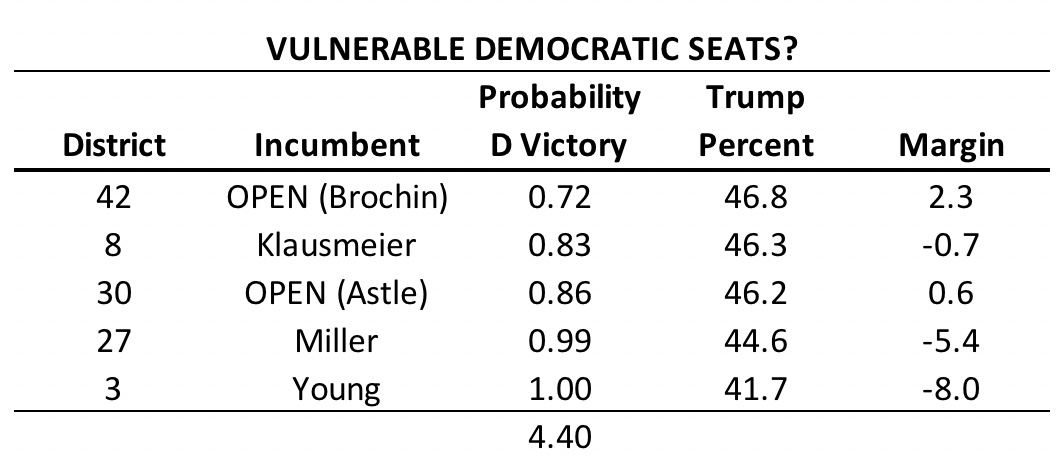
Recall from Part I that seats that had the potential to go either way in Virginia fell into the range of giving Trump between 40.5% and 48.0% of the vote. Only five Maryland Senate seats fall into this range, all held by Democrats:

Individually, Democrats are likely to win each of the seats. None are particularly encouraging for Republicans. Collectively, the model indicates a 60% chance of losing one of these seats.

District 3: Frederick
As usual, Republicans plan on going after Sen. Ron Young in Frederick. Good luck with that. The model suggests he is a lock, and this ignores that Frederick has been trending Democratic or that Democrats thumped Republicans in last year’s City of Frederick elections to win control of the mayoralty and city council. Trump lost to Clinton by 8 points in this district. Not going to happen.

District 27: Anne Arundel, Calvert and Prince George’s
Similarly, taking down Senate President Mike Miller would be quite a prize for Republicans. The model gives Republicans a 1 percent shot in this district Trump lost by over 5 points. However, it’s virtually impossible to see how the always well-prepared Miller, the longest serving legislative leader in American history, goes down in territory he has won easily for decades.

District 30: Anne Arundel
The next three seats have Republicans salivating but the model indicates that they are underdogs in each. Sen. John Astle’s retirement from his Annapolis-based district, after losing the primary for city’s mayoralty, leaves a vacancy. Even so, Republicans have only a 14% shot at picking up this district.

Democrats are very pleased with their dynamic and politically experienced candidate, Sarah Elfreth. As in Frederick, Democrats gave Republicans a hiding in the 2017 Annapolis municipal elections. Former Del. Ron George has a clear path to the Republican nomination, as Del. Herb McMillan has given the race a pass. George ran for governor in 2014, losing Anne Arundel to Hogan in the primary by a 2-1 margin. However, George has a bank balance of $169K to $50K for Elfreth.

District 8: Baltimore
Republicans seem to think that they have a shot at taking out Sen. Kathy Klausmeier. The model indicates they have a 1 in 6 chance of victory but that doesn’t take into account any incumbency benefit held by Klausmeier. Their candidate, Del. Christian Miele, doesn’t seem too excited about his prospects, sensing that voter anger with Trump will dominate:

“It definitely gives you some heartburn as a Republican when you see what just happened,” said Republican Delegate Christian J. Miele, of Baltimore County, who is challenging Democratic state Sen. Katherine Klausmeier. “We’re all wondering if 2018 is going to be a continued referendum on the president.”

As Trump’s life goal is to be in the headlines, the answer seems clear. Miele has $87K in the bank compared to $194 for Klausmeier, who is well liked in her district but taking nothing for granted. There are rumors that Miele might just run for reelection for delegate.

District 42: Baltimore
Sen. Jim Brochin is retiring to run for county executive. The most conservative Democrat in the Senate, Brochin had both a tough primary and general last time around. The improved political climate suggests that Democrats have a 72% probability of holding the seat. Del. Chris West (42B) is running for the Republicans. Democrats have two candidates, Robbie Leonard and Gretchen Manavel. Sources tell me Leonard, a former county party chair, has the advantage with local activists but that Manavel has money and the energy – and would be a stronger candidate.

Not Vulnerable

District 32: Anne Arundel
Republicans think they have a good chance of picking up retiring moderate Sen. Ed DeGrange’s seat. Wrong. Clinton carried the district by 12 and it’s not going to happen barring a massive sea change in the political environment. Del. Pam Beidle is a very strong candidate and will win. Republicans are spinning their wheels here.

Vulnerable Republicans?

There are four seats where Democrats hope to play but will likely fall short.

District 9: Howard
Sen. Gail Bates is the most vulnerable Republican but still holds a seat Trump won by nearly 8. The Carroll County portion of her district will likely save her from going down to defeat, as Howard includes less favorable territory even if it is by far the more Republican portion of the county. Democrats have nevertheless recruited a strong candidate in Katie Hester ready to take advantage of any wave.

District 6: Baltimore
For Democrats, this was a real heartbreaker race in 2014 as Del. John Olszewski, Jr., known to one and all as Johnny O, lost by less than 3% to now Sen. Johnny Ray Salling. Democrats think that Salling didn’t so much win as became the accidental senator due to the hellacious political climate. Though Salling is seen as a lightweight who doesn’t work hard in office or at fundraising – he has just $30K in his campaign account – this was territory Trump carried by 15 points that shifted GOP across the board in 2014 and 2016.

Democrats have recruited a local activist and electrician, Bud Staigerwald, who fits the district well and is strongly backed by Comptroller Peter Franchot. Staigerwald lost a primary for Council District 7 in 2014.

District 34: Harford
Sen. Bob Cassilly represents the more Democratic turf in Harford but it’s still Republican and went for Trump by 11 points. Del. Mary-Dulany James, a strong and well-funded candidate, lost by 14.5% to now Sen. Bob Cassilly. Democrats think that they can take Casilly this time around but it will remain tough. Their ability to take advantage of opportunity will improve substantially if the locally deep-rooted James runs again.

Share

What Do the Virginia Results Suggest for Maryland? Part I

All 100 seats in the Virginia House were up for election in 2017. Looking at the results can give an idea of what might happen in Maryland’s state legislative elections later this year. Using a statistical technique known as logit, I created models to estimate the impact of various factors on the probability of a Democratic victory.

Analysis of the election results indicates, unsurprisingly, that the 2016 results are an extremely powerful predictor of which party won Virginia House seats. Adding other demographic factors to statistical models had little impact.

Looking at the raw results reveals why. In 2016, Clinton beat Trump by 49.7% to 44.4% with 5.9% going to other candidates. Virginia was gerrymandered for the Republicans, so it has a disproportionate share of Trump-leaning seats even taking into account the concentration of Democrats in urban areas.

Republicans won all 47 seats in Virginia where Trump won more than 48.0% of the vote. Clinton won 46.0% or less in these districts.

Democrats won all of the 39 seats where Trump won less than 40.5% of the vote. Clinton received at least 54.0% in these districts. These 39 districts include four Democratic pickups.

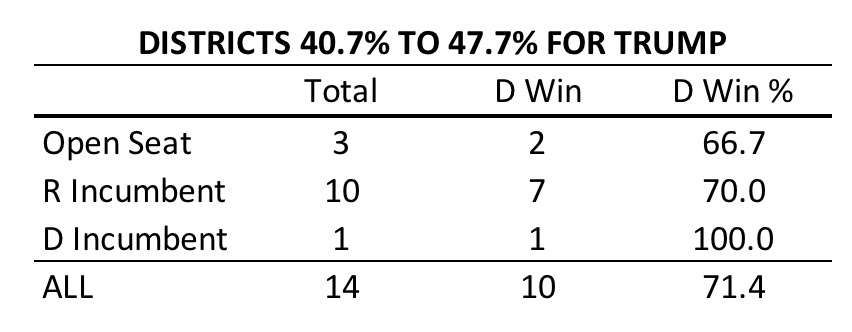
That leaves 14 districts where Trump won between 40.5% and 48.0% of the vote. Incumbency didn’t do a lot for Republicans according to either the statistical model or a look at the raw numbers. As the following table reveals, Democrats won roughly the same share of seats with Republicans seeking reelection as open seats.

The sole Democratic incumbent also won reelection. Indeed, no Democrat lost in 2017 but all represented districts that Clinton won with at least 56.0% and Trump received 41.0% or less. Overall, Democrats won 10 of the 14 seats in marginal range. It would have been eleven had the drawing in the tie race gone the other way.

Next up, what do the Virginia results indicate for Maryland Senate races?

Share

SEIU Janitorial Local Endorses Elrich

This may be the first in a wave of labor organizations to endorse Marc Elrich. While not shocking, it provides further evidence that Elrich continues to lock down labor support. Here is the Elrich campaign press release:

32BJ SEIU Endorses Marc Elrich for Montgomery County Executive

SILVER SPRING, Md._ On January 22, 32BJ of the Service Employees International Union (SEIU) announced their endorsement of Marc Elrich for Montgomery County Executive. 32BJ represents 18,000 members in the D.C. Metropolitan Area, including office cleaners who work throughout Montgomery County, and is a major force in area politics. They are the first union to announce an endorsement in the County Executive race.

Elrich has stood with unions in their efforts to secure fairer workplaces for decades. During his tenure on the Montgomery County Council, he has fought for paid sick and family leave, various safeguards against worker exploitation, and two minimum wage increases. He orchestrated the unanimous vote in favor of the recently passed bill that will gradually raise the county’s minimum wage to $15 an hour.

“I have been proud to champion issues of economic justice and would look forward to partnering with 32BJ and other unions as the next County Executive,” Elrich said. “I have enjoyed working with them already to strengthen worker rights and have great respect for the role they’ve played in advancing our shared vision of how to build a more just society. We face many challenges as a county, and it is only through collaboration with 32BJ members and other workers who see those challenges every day that we will figure out the best way to meet them.”

Marc Elrich has been an at-large Montgomery County Councilmember since 2006. He chairs the Public Safety Committee, serves on the Education Committee, and is the County Council’s representative to the Metropolitan Washington Council of Governments Transportation Planning Board. Prior to his election to the County Council, he served on the Takoma Park City Council for 19 years and taught at Rolling Terrace Elementary School for 17 years. For more information, see www.marcelrich.org.

Media Contact:
Ben Spielberg, Campaign Manager
Ben@marcelrich.org
609-828-3783

Share

Oprah Yes

By now, you’ve surely heard about Oprah Winfrey’s speech at the Golden Globes that has led to serious talk about Oprah making a bid for the White House. Take it seriously. A University of Maryland study concluded that Oprah’s 2008 endorsement of Barack Obama gained him more than 1 million votes in the Democratic primary.

I don’t know if Oprah should run for president. A true American success story, she has done so much in the private sector that it it would be a shame if she gave it up. Revealing incredible business acumen, she didn’t just become the most successful talk show host but the leader of a business empire.

As head of that empire, Oprah has been willing to use her power and influence for good in many ways. She has hired and promoted women, especially, minority women, to the top of her team. Smart business – why not grab talent others overlook – that helped create a new cohort of minority and female business leaders.

Oprah has also leveraged her wealth and power to present African-American women and stories in media from magazines to movies in a far more positive light. Most importantly, she does it in a way that is utterly normal and marketable, rather than forced tokenism. In other words, the way it should be.

At this point, there is a strong case to be made that the black community and America need more African-American business owners than more African-American politicians. Business brings money and influence – assets that make it far easier to exercise and to magnify political power.

The argument for Oprah for President is also clear. She is a great American communicator. Oprah has all the graciousness and dignity that Trump lacks. While Trump has empathy only for himself, Winfrey has deep compassion for others.

Trump slithers in the gutter appealing to dark impulses, but Oprah hearkens to the better angels of our nature. Trump excludes while Oprah includes. Even her strong advocacy for the “me too” movement and minority progress is inclusive and designed to raise people up rather than put others down.

Oprah grew up poor and created a business empire, while Trump inherited millions and prides himself on bilking people and treating others like garbage. Oprah has demonstrated an ability to delegate – she has to in such a large organization – even as she assimilates new information quickly.

Nevertheless, she lacks experience in politics and public policy. Obama had to pick up the economic and foreign policy wreckage of the Bush administration. The next president will face the arguably even greater challenge of restoring political norms and institutions as well as frayed foreign alliances.

We’ll see if Oprah chooses to take the plunge into politics. Her role as a powerful business leader, however, is not one to give up lightly and would be missed if she did.

Share

Chelsea No

Chelsea Manning has decided to run for the U.S. Senate. Hey, it’s a free country. We let Robin Ficker run for office, so why not Chelsea Manning? That doesn’t mean it’s not an easy lift for Democrats to  say hell no and renominate Sen. Ben Cardin.

Chelsea Manning is a traitor. While supporters view her actions of those of a whistleblower, she turned over hundreds of thousands of classified documents to Wikileaks. Since her release, Manning has taken responsibility for her actions:

In an interview broadcast on Friday morning on ABC’s Good Morning America, Manning said she had “accepted responsibility” for her actions.

“Anything I’ve done, it’s me,” she said. “There’s no one else. No one told me to do this. Nobody directed me to do this. This is me. It’s on me.”

Taking responsibility may not mean accepting that what she did was wrong. However, even if she views her actions as serving the larger good, accepting responsibility should mean that she accepts that she grossly violated her oath and the trust placed in her.

A major argument for Manning’s pardon was compassion over her mental state. While incarcerated at Leavenworth, she tried to commit suicide twice. Indeed, her deteriorated mental health was a key part of Manning’s defense at her trial. While lots of people have mental health issues and still serve valuable public roles, this seems a big step less than one year after her release from prison.

In her leaks, she chose to give the information to Julian Assange, someone who is not an American and with no affection, let alone loyalty, to this country. Or, as it turns out, to liberal democracy. While holed up in the Ecuadorian embassy in London resisting extradition on rape charges, Assange worked directly to undermine American democracy by working in service to Putin.

Manning’s campaign announcement seems especially ill-timed coming less than one week after Sen. Ben Cardin released a detailed report on Russia and Putin’s coordinated interference in our elections and actions that the U.S. needs to take to protect them from similar problems in 2018 and 2020.

While Manning has neither the experience nor the record to be a good senator, Ben Cardin has quietly worked hard for Maryland and the U.S. for decades. Cardin is not just knowledgeable but effective – a rare enough combination in public life. He has advocated for liberal causes since before Manning was born.

Manning refers to Maryland as her “home state” but she was born in Oklahoma and grew up there and Wales. She lived for 15 months with an aunt in Potomac. While military personnel often have short stays in a place for obvious reasons, even if she returned occasionally, one wonders how up she is on the state. Does she know, say, where Garrett and Somerset Counties are located?

Some make the case that Manning’s campaign will lead to debate over important questions. If anything, her record as a traitor will simply serve to undermine legitimate and important questions over Russian interference and American policy more generally.

Manning will undoubtedly attract lots of press coverage as a celebrity. Donald Trump did too. Perhaps it’s time we seek other qualities in our public officials than the ability to command media attention, especially when we have an outstanding public servant in Ben Cardin already in office.

Share

Madaleno-Hettleman to Sponsor $15 Minimum Wage Legislation

Here is the press release from the Madaleno campaign:

ECHOING THE WORDS OF MARTIN LUTHER KING, MADALENO TO INTRODUCE $15 MINIMUM WAGE LEGISLATION

To quote Dr. King, ‘Ultimately a great nation is a compassionate nation. No individual or nation can be great if it does not have a concern for ‘the least of these.’”

Annapolis, MD – Advocates, faith, labor and community leaders, social justice organizers, and elected officials gathered in Annapolis Monday in recognition of Dr. Martin Luther King Jr.’s birth and spirit of social and economic justice by calling for enactment of legislation to increase the minimum wage in Maryland to $15 an hour.  Senator Richard S. Madaleno, Jr. (D-18), who is also a Democratic candidate for governor, is the lead sponsor in the Maryland Senate.  Delegate Shelly Hettleman (D-11) is the lead sponsor in the Maryland House.

“Today we not only honor the spirit and legacy of Dr. King, but we heed his words by taking action to benefit those who perform the work that so few of us would choose to do, yet do the work that is indispensible to a functioning society,” said Senator Madaleno.  “Whether it be cleaning offices, serving food, or taking care of those who need assistance, there is dignity in all work, and we need to recognize and honor that dignity.”

The Madaleno-Hettleman legislation phases in a minimum wage to $15 per hour by July 1, 2023.  Once the minimum wage hits $15, the minimum wage may increase further since it is indexed to inflation.  Other important provisions in the bill include a phase-out of the “tipped credit”, an issue Sen. Madaleno has been working on for many years.  Eliminating the tipped credit is a significant step toward addressing the wage gap between men and women, particularly in the restaurant industry, an industry dominated by women.

Madaleno concluded, “In Dr. King’s acceptance speech upon being awarded the Nobel Peace Prize in 1964, he said, ‘Ultimately a great nation is a compassionate nation. No individual or nation can be great if it does not have a concern for ‘the least of these.’”  Today surrounded by so many whom are living the words of Dr. King through their deeds, we ask that the General Assembly and Governor Hogan join us in supporting, passing and enacting a $15 minimum wage.  Because, to quote another Dr. King phrase, ‘The time is always right to do what is right.’”

Rich Madaleno has served Montgomery County for 15 years in the Maryland General Assembly.  Rich has the distinction of being the first openly gay person elected to the Maryland House of Delegates and the first openly gay person elected to the Maryland State Senate. He is an expert on budget issues, serving as Vice-Chair of the Budget and Taxation Committee.  Additionally, Rich has been a leader in passing legislation on key progressive issues like marriage equality, ensuring funding for Planned Parenthood, investing in education, gender identity anti-discrimination, and protecting the environment.

###

BY AUTHORITY: Marylanders for Rich Madaleno. Linda Eisenstadt, Treasurer.

Share